Higher Education – an analysis of the Russell Group Universities in the UK
.
White Rose Research Online URL for this paper:
http://eprints.whiterose.ac.uk/167675/
Version: Published Version
Article:
Daley, Joshua and Baruah, Bidyut (2020) Leadership skills development among
engineering students in Higher Education – an analysis of the Russell Group Universities
in the UK. European Journal of Engineering Education.
[email protected] https://eprints.whiterose.ac.uk/ Reuse
Items deposited in White Rose Research Online are protected by copyright, with all rights reserved unless indicated otherwise. They may be downloaded and/or printed for private study, or other acts as permitted by national copyright laws. The publisher or other rights holders may allow further reproduction and re-use of the full text version. This is indicated by the licence information on the White Rose Research Online record for the item.
Takedown
If you consider content in White Rose Research Online to be in breach of UK law, please notify us by
Full Terms & Conditions of access and use can be found at
https://www.tandfonline.com/action/journalInformation?journalCode=ceee20
European Journal of Engineering Education
ISSN: (Print) (Online) Journal homepage: https://www.tandfonline.com/loi/ceee20
Leadership skills development among engineering
students in Higher Education – an analysis of the
Russell Group universities in the UK
Joshua Daley & Bidyut Baruah
To cite this article: Joshua Daley & Bidyut Baruah (2020): Leadership skills development among engineering students in Higher Education – an analysis of the Russell Group universities in the UK, European Journal of Engineering Education, DOI: 10.1080/03043797.2020.1832049
To link to this article: https://doi.org/10.1080/03043797.2020.1832049
Published online: 19 Oct 2020.
Submit your article to this journal
View related articles
Leadership skills development among engineering students in
Higher Education
–
an analysis of the Russell Group universities in
the UK
Joshua Daley and Bidyut Baruah University of York, York, UK
ABSTRACT
Today, the engineering landscape is continually changing, and Higher Education Institutions (HEIs) have a responsibility to design curricula that address the growing demands of various industry sectors. Likewise, the roles and responsibilities of an engineer are evolving; requiring a further broadening of the current engineering curriculum. As a profession, engineering draws upon broad interdisciplinary knowledge, and when training twenty-first-century engineers, universities should follow a more comprehensive teaching and learning approach, with a focus on both technical and soft skills including the integration of leadership into engineering curricula. However, the spectrum of engineering leadership is not well-defined. Leadership is one of the most widely sought-after skills in the Science, Technology, Engineering, and Mathematics (STEM) industries; it is, therefore, clear that more investigation needs to be carried out into this area of engineering pedagogy. One of the most distinct gaps in the literature is that there is little or no consensus on what approaches should be undertaken to integrate leadership in engineering courses by those in academia. This paper seeks to shed light on some of these gaps, with the primary objective of the evaluation of the current state of leadership education
using a nation-wide sample of BEng1 Electronic Engineering course
structures and contents at Russell Group2 universities in the UK. It highlights the case study of the University of York, where there is a strong emphasis on the integration of engineering leadership and management skills within the current BEng Electronic Engineering course structure. ARTICLE HISTORY Received 17 September 2019 Accepted 29 September 2020 KEYWORDS Leadership; Engineering Leadership; Higher Education; Curriculum Design Introduction
Effective leadership is widely regarded as one of the most critical assets of any organisation in today’s fast developing economic environment. An influential leader can play a pivotal role in ensuring the success of both the team and the enterprise as a whole. In STEM sectors, topfirms with effective lea-dership are approximately 40% more productive than the rest, with operating margins between 30% and 50% higher than industry peers (Mankins2017). The impact of effective leadership is widespread in thefields of engineering, and crucial for ensuring the competitive advantage of afirm. According to Shuman et al. (2002, 2),‘In a technological dominated world, the engineer becomes the switching point in modern industry and in society as a whole’. It is, therefore, important to understand the core skills and competences that organisations expect from modern engineers. However, the
modern global economy has rendered technical skills alone insufficient: communication, project
© 2020 SEFI
CONTACT Bidyut Baruah [email protected] https://doi.org/10.1080/03043797.2020.1832049
management, and other leadership skills are becoming more critical than ever before (Brown2005). The Institute of Engineering and Technology (IET), the world leading professional engineering organ-isation, notes how skills shortage in the engineering sector has been an ongoing problem in the UK. Their latest skills survey report
an estimated annual shortfall of 59,000 new engineering graduates and technicians, a deficit which only con-tinues to get worse….recruiting engineering and technical staffwith the right skills is the largest anticipated
obstacle that businesses face in achieving objectives over the next three years. (IET skills survey2019, 2)
Bayless and Robe (2010, 1) note‘Leadership skills are critical for accomplishing goals as an engineer and innovator’. The importance of leadership skills among twenty-first century engineers was simi-larly emphasised by the National Academy of Engineering’s report‘The Engineer of 2020’(National Academy of Engineering2004). An engineering workforce that possesses sufficient technical and lea-dership skills for the future will be critical to facilitate sustainable growth in the STEMfield and thus the economy as a whole. Today there is a need to transform engineering curricula within Higher Edu-cation (HE) with a particular emphasis on leadership skills. As the IET pointed out,‘We need courses that not only teach students technical skills but also develop their creativity and soft skills…’(IET2019, 10). Schell and Kauffmann (2016, 3) support‘Recognition of the importance of Engineering Leadership is part of an increasing movement toward incorporation of curricular materials that promote developing engineers who meet the broad needs of today’s industry’. Kotnour and Reilly (2014) noted how many universities are now attempting to integrate leadership into the engineering curriculum. However, literature on the integration of Engineering Leadership in UK curricula and universities is scarce, with recent studies such as Kotnour and Reilly (2014), Gonzalez, Schoephoerster, and Townsend (2015), Klassen et al. (2016), Schell and Kauffmann (2016) and Kendall et al. (2018) focusing mainly
on American and North American engineering curricula. Also, Kendall et al. (2018, 2) observed‘In
the engineering education literature to date, there has been relatively little attention paid to the increas-ing importance of leadership education as an element of engineerincreas-ing programs’.This paper, therefore, focuses on some of these gaps in literature.
The main objective of this paper is to evaluate the current state of Leadership Education by pre-senting a critical analysis of the current course content and pedagogical approaches employed by
UK universities. In order to complete a feasible study, the researchers focused on one specific
field of engineering–Electronics–which is one of the most popular engineering disciplines in
aca-demia and of great importance to the UK economy (RAE2016). The paper uses a nation-wide sample
of BEng Electronic Engineering course structures and contents at the Russell Group universities. The Russell Group is the equivalent of the American Ivy League of prestigious universities (The Guardian
2003) and are ‘committed to providing an outstanding education and experience for their students,
helping them to learn the skills they need to enter the workforce’(Russell Group2020). The term‘ inte-gration’in the context of this study also needs to be established. Klassen et al. (2016) identified three clusters of Engineering Leadership programmes: degrees where leadership is integrated with tech-nical engineering courses; degrees where leadership is treated as a stand-alone subject; and degrees which engage all engineering students in leadership education. Throughout this paper, all three clusters will be considered to reflect the overall integration of leadership education in electronic engineering courses at the Russell Group universities. The analysis will be further supported by using the case study of one of the Russell group universities–the University of York.
Complexity of the leadership concept
Leadership has naturally been a topic of interest for a long time, with literature on the subject being both broad and plentiful. Despite this, there is arguably little or no consensus on an agreed definition of leadership, with Rost (1993)finding 221 definitions in over 587 publications and Winston and Pat-terson (2006) uncovering over 90 variables that are encompassed within the concept of leadership. Some define leadership as the:‘ability to build and maintain a group that performs well relative to its
competition’(Hogan and Kaiser2005, 172);‘process of motivating people to work together collabora-tively to accomplish great things’(Vroom and Jago 2007, 18);‘process of interactive influence that occurs when, in a given context, some people accept someone as their leader to achieve common goals’(Silva 2016, 3);‘influence relationship among leaders and followers who intend real changes that reflect their mutual purposes’(Rosari2019, 17). Yukl (2010, 21) in this context observed‘leadership has so many different meanings to people, some theorists question whether it is even useful as a scien-tific construct’. Though that is not to suggest that we cannot accurately perceive or comprehend lea-dership, rather that we struggle to express it in its entirety within the narrow bounds of a‘definition’.
However, researchers have explored the components that can effectively illustrate the complex
concept of leadership. Northouse (2010) considers four components to conceptualise the phenom-enon of leadership; process, influence, group engagement, and common goals. For him, leadership is a process but not a linear one-way event. He calls it an interactive event in which influence is absol-utely vital, further adding,‘Without influence, leadership does not exist’(3). Yukl (2010) similarly puts strong emphasis on influence in his proposed concept of leadership. He defined it as‘the process of influencing others to understand and agree about what needs to be done and how to do it, and the process of facilitating individual and collective efforts to accomplish shared objectives’ (26). Yukl’s definition takes into account both direct and indirect forms of influence, with the view that leader-ship can be shared or distributed and that more than one individual can undertake a leaderleader-ship role with some form of role variations within a group. Rosari (2019, 23) agrees,‘The relationship that is leadership must be based on influence’.
Some researchers like Hartmann and Jahren (2015) have studied leadership in the context of engineering graduate roles. They have identifiedfive major themes that reflect engineering leader-ship and these include initiative/confidence, communication skills, interpersonal skills, teamwork skills, and engagement. However, there are some notable barriers to the recognition of leadership within the engineering profession. Although the roles of engineers have evolved over the years, researchers such as Kendall et al. (2018) and Rottmann et al. (2016) observed some form of resistance from engineering professionals when it comes to associating engineering roles with leadership. Rott-mann, Sacks, and Reeve (2014, 2) noted‘engineering leadership will not hold as a legitimatefield of study or practice until it is accepted and implemented by a critical mass of practicing engineers’. They emphasised the need for a widespread recognition of engineering as a leadership profession. A study conducted by Rottmann et al. (2016) on a group of engineers with distinct organisational
roles found that the response to the word‘leadership’varied heavily among the participants and
this was primarily influenced by their roles. They noted‘engineers in different roles experience and define leadership in distinct, organizationally contextualized ways…the domains over which engineers have some degree of influence shape their definitions of leadership’(164–165). For instance, an engin-eer working in a technical role used terms such as professional competence to define leadership as opposed to an entrepreneurial engineer who used terms like innovation drive and marketable
change. Despite the resistance to the word‘leadership’, Rottmann, Sacks, and Reeve2018(2014)
concluded that engineers across sectors do have the potential to lead. Their analysis identified
three orientations on engineering leadership–technical mastery (tendency to solve technical chal-lenges and problems), collaborative optimisation (tendency to build, facilitate and manage high per-forming teams) and organisational innovation (tendency to innovate and anchor ideas towards practical realisation). Engineers embodying one or more of these orientations would be able to demonstrate the integration of the technical, creative and humanistic components of this profession. These orientations represent distinct conceptions of leadership reflecting ‘engineers’professional experiences with interpersonal, team and organizational influence’(16).
Rottmann et al (2016) recommend exposing students to the full range of career options within an organisation setting to showcase the nature of Engineering Leadership and its orientations. They reflect‘As engineering educators, we need to help our students appreciate both formal and informal modes of leadership practised by engineers in a range of organizational roles and locations. To the extent that our students expand their definitions of leadership to include collaborative, informal
modes of influence, we will be helping them embrace the idea of engineering as a leadership profession’
(165). Therefore, in the education of leadership (outside of an organisational setting), an emphasis must be made to recognise the diverse nature of leadership and the dynamic nature of an effective leader. However, Adair (1984) maintained the stance that only skills which are teachable,
testable, or can be actively developed should be a worthwhile consideration – the contrary
encourages leader selection instead of leader development. According to Knight and Novoselich (2017, 45),‘leadership is important for advancing both the engineeringfield and for individual gradu-ates’careers. Despite such calls to expand engineering students’leadership abilities, however, we know fairly little about the potential influences on this learning outcome’. In this context, it is important to evaluate how leadership is viewed in the context of engineering education.
Engineering leadership in Higher Education
Modern-day engineering education has been the product of several decades of development, pro-viding graduates with a broad range of professional and technical skills in preparation for the work-place. HEIs design specific curricula to address the demands and needs of various industry sectors. In this context, Stevens et al (2009) noted that the world of technology and innovation is constantly witnessing new changes and these have a strong impact on the engineering practices including the education and training provided by HE. Universities have a responsibility to keep their pro-grammes and curricula up-to-date; keeping pace with the rapidly changing world of engineering.
Since the 1990s and the publication of official papers such as The Green Report (USA) (1994),
there has been a heightened demand for HEIs to broaden the skills taught in engineering degrees; encapsulating more elements of both leadership and management. But as Kumar and Hsiao (2007, 19) found‘Leadership is rarely discussed in traditional engineering courses’.For them, to become a true engineering leader, students must have both technical and soft skills.Supporting
Kumar and Hsiao, Bayless and Robe (2010, 1) add‘Engineering has often neglected leadership
edu-cation and/or training, being seen academically as a‘soft skill’not relevant to the discipline…Most engineering curricula focus on producing technical excellence. However, technical competence is‘ absol-utely necessary but not sufficient’for carrying out the professional responsibilities of today’s engineers’. Also, the literature on engineering leadership is limited. As Schell and Kauffmann (2016, 3) observe,
‘The concept of engineering leadership is a relatively new one in engineering education, with most pub-lications on the topic and formal programs to develop it appearing in the last ten years’. Rottman, Sacks and Reeve (2014, 3) point out that a lot of these publications are‘limited to authors’promotional descriptions of their own programs’.
Seat, Parsons and Poppen (2001) noted how engineers, as a group, are often known for their ability to solve problems and their inability to work well in teams. Knight and Novoselich (2017, 44) label engineers as‘the nation’s most well-equipped problem solvers’with the growing technol-ogy-driven environment requiring them to undertake leadership roles and develop sustainable and workable solutions. Kumar and Hsiao (2007) observed that engineers generally tend to focus on technical details and in the process, they often overlook the broader picture. They further explained ‘ …today’s engineers are asked to do a lot more than just apply the scientific knowledge to solve practical problems. Currently, engineers hone their leadership and management skills while at work (i.e. learning‘soft skills the hard way’)’(19). A shift towards a softer side of engineering is
now gradually emerging. As Stevens et al (2009, 1) explain‘ …the requirements of the engineering
profession have expanded beyond its domain, blurring the boundaries between disciplines, specifically with the management and leadershipfields’.Today’s engineers are expected to have a good under-standing of interdisciplinary knowledge such as intellectual property rights, data protection laws, ethics and compliance and the impact of engineering towards a sustainable environment and
economy. Kotnour et al (2014) reflected on the importance of engineering leaders to provide
sol-utions to some of the key challenges we face in the world. They stated‘We need engineering leaders
produce these engineers…the need to build worldly leadership and professional skills within the engin-eering profession…We need to produce the leaders who can deliver sustainable solutions to the world’s biggest challenges. Creating these engineers requires a unique educational experience and environment to learn these skills’(48). So, for training twenty-first century engineers, universities should follow a more comprehensive teaching and learning approach with a focus on both technical and soft skills. One of the approaches includes the integration of leadership in engineering curricula. A study conducted by Palmer et al (2016) on 30 North American, African and European universities
noted a lack of Engineering Leadership specific degrees. 70% of the sample they studied, didn’t
have any form of Engineering Leadership degree however, 73.3% had some form of Engineering
Lea-dership coursework. These authors summarise‘Within our sample, engineering leadership coursework
appears to be relatively commonplace. As leadership coursework continues to spread throughout the engineering curriculum, the number of degrees, minors, and certificates may continue to increase’
(11). Ahn et al (2014) highlighted three key difficulties associated with designing Engineering Leader-ship based courses and these are: defining Engineering Leadership; the absence of assessment tools that exclusively assess engineering students; and limitations with training engineering faculties who could design and teach leadership courses.
Many researchers note how the spectrum of Engineering Leadership in education is not
well-defined. Schuhmann (2010, 67) added‘While the study of leadership is considered to be a mature
field, engineering leadership education today remains effectively undefined…There is clearly a demand for leadership development in engineering students’. Ahn et al (2014, 117) stated‘It is impor-tant to define engineering leadership to identify the important competencies and traits that engineering leaders should possess…an operational definition of engineering leadership is needed to guide engin-eering faculty in their implementation of leadership activities. Also needed are tools that allow leadership program managers to assess the impact of their program or curriculum and tools that track the longi-tudinal development of students in engineering leadership programs’.Paul and Falls (2015) believe that a stronger understanding of this term will help in the development and improvement of engineering leadership programmes.
It is obvious that the roles and responsibilities of an engineer are evolving, and the curricula also
need to broaden in order to accommodate these developments (Bakos,1997). A recent study
con-ducted by Paul, Sen and Wyatt (2018) explored how leadership can be defined in an engineering
context. Using a content analysis on 163 definitions, they extracted four key themes which
include: leading and influencing others, personal effectiveness, engineering competency, and collab-oration. They defined Engineering Leadership as‘an approach that influences others to effectively col-laborate and solve problems. Engineering leadership requires technical expertise, authenticity, personal effectiveness, and the ability to synthesize diverse expertise and skillsets, Through engineering leadership, individuals and groups implement transformative change and innovation to positively influence technol-ogies, organizations, communities, society, and the world at large’(10).
While engineering education has evolved, the majority of the evidence of leadership integration in engineering curricula seems to be in the USA rather than Europe (Graham, Crawley and Mendel-sohn (2009), Kotnour and Reilly (2014), Gonzalez, Schoephoerster and Townsend (2015), Klassen et al (2016), Schell and Kauffmann (2016) and Kendall et al (2018)). For example, one of the most promi-nent programmes on Engineering Leadership is the Bernard M. Gordon- MIT Engineering Leadership Programme (GEL) which supports MIT engineering undergraduates to develop and shape their skills as‘effective and impactful leaders who will be charged with solving the world’s most challenging and complex problems’(GELP- MIT,2020). Thefirst year is tailored to provide an introduction to leadership frameworks and models such as ethical decision-making, project engineering and systems thinking; students practice such skills through simulations, coursework, and other experiential activities. The second year uses a more personalised leadership development approach. Students work closely
within, and lead, their own organisation – taking part in internship opportunities, courses on
project management, and challenges of people management. Reflection is key to the learning
identifying ways to improve their competencies such as decision-making. The University of Texas at
El Paso similarly offers an undergraduate programme in Engineering Leadership (E-Lead) which is
meant to be a paradigm shift in engineering education. Branded as‘thefirst degree of its kind in the nation’, this programme mainly focuses on student’s collaborative capabilities, mentoring skills
and personal growth to facilitate their personal and professional achievement (E-LEAD, 2020). In
order to infuse a leadership mind-set, this programme focuses on three pillars of Engineering Leader-ship: Character, Competence, and Capacity. It utilisesflipped classroom and project-based learning
which are multidisciplinary in nature. The programme advocates a‘culture where students actively
contribute to their own education and where individual contributions are valued and important. E-Lead students strive for excellence because they have a sense of ownership and power over their own education’(E-LEAD,2020). This emphasis on practice-based learning in Engineering Leadership pro-gramme was also reported by Klassen et al (2016) to be present in some of the leading North Amer-ican Universities. The success of these programmes shows the power of blending education with experiential learning and reflection, alongside opportunities to facilitate leadership capabilities and skills. In this context, Kendall et al (2018, 5) noted‘The calls for engineering education reform have led engineering educators to think more intentionally about creating learning experiences that incorporate reflective practice for students, in areas such as teamwork, communication, and lifelong learning. These areas collectively comprise not just a model of engineering leadership, but also a set of pedagogical approaches that can be used to develop an undergraduate experience that serves as a foundation for future engineering leadership development once students enter the workforce’. UK uni-versities such as Loughborough University and The University of Bristol, too have taken some initiat-ives with integrated programmes which explicitly develop leadership skills (Graham, Crawley and
Mendelsohn, 2009). Other institutions are similarly following this path by creating specific
pro-grammes which implicitly integrate leadership development into existing course content (Khattak,
Ku and Goh, 2012). Notwithstanding these developments, the IET and other professional bodies
have found skills such as leadership, management and communication skills are still deficient in
graduates and recruits (Hissey (2000), Mohan et al (2009), IET skills survey (2017,2019)). It is no sur-prise, therefore, that for senior management positions, individuals with MBAs or JDs are often
awarded such positions over engineers (Summers, Davis and Tomovic,2004). Generally, the
edu-cational demands of such degrees better prepare them in communication, leadership and manage-ment; precisely the skills that are deemed deficient in engineers. Considering these apparentflaws in engineering leadership and management education, this suggests there needs to be further review into what extent such skills are developed within course curricula. Stevens et al (2009, 1) summarised
‘It has become evident that there is a crucial need for change in the practice of engineering and the edu-cation of future engineers. Specifically, engineering disciplines need to be broadened and enriched to better prepare graduates for working in a constantly changing economy driven by the explosion of knowledge, globalization, and a myriad of other factors’.
Elements of Engineering Leadership
As established by Ahn et al (2014) and Rost (1993), the act of defining leadership is problematic, and can lead to many varied interpretations. Therefore, following the propositions of Adair (1984)–that leadership education should only consider skills which can be actively developed and are to some
degree testable or assessable–the authors propose the introduction of a framework in order to
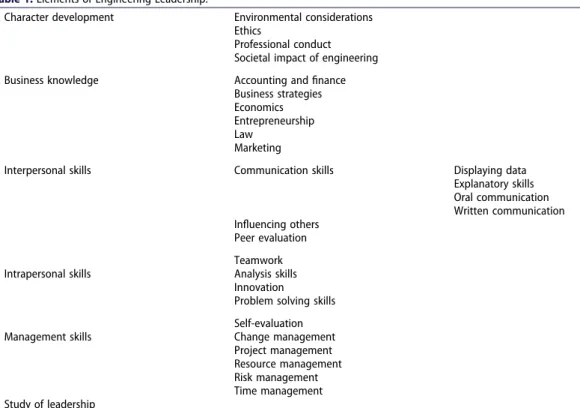
define the high-level concept of Engineering Leadership by its lower-level constituent and develop-able elements. Similar in approach to Farr, Walesh and Forsythe (1997) and their proposition of Engineering Leadership qualities. Such a proposal for defining Engineering Leadership is reductionist in its nature, with a pragmatic basis rather than solely theoretical. The framework shall henceforth be called the‘Elements of Engineering Leadership’, and is defined inTable 1.
In the development of the Elements of Engineering Leadership, a range of literature was sampled in order to establish the consensus on what overarching skills contribute to effective leadership and
Engineering Leadership, or are most pertinent. Following this, it was established there were six key knowledge bases, or skill areas, which the literature recognised:
. Character development . Business knowledge . Interpersonal skills . Intrapersonal skills . Management skills . Study of leadership
Character encompasses the moral, ethical and professional qualities which influence a leader’s
actions. There is no neutral ground concerning leadership ethics or values (Heifetz, 1994). And
whilst agreement on conceptions of ethics, integrity, and conduct is mixed in the broader domain
of leadership theory (Yukl, 2010), established expectations of engineering values, ethics, and
conduct exist (Engineering Council (2016), Royal Academy of Engineering (RAE) (2017)) and should thus be considered. Engineering leaders should know and exhibit these values, assuming a‘larger role in societal leadership’(Bonasso,2001, 1). Further, an engineering leader should‘ demon-strate a personal commitment to professional standards, recognising obligations to society, the pro-fession and the environment.’(Engineering Council,2016, 28). Thus, we propose Character shall be subdivided into 4 elements: Environmental Considerations, Ethics, Professional Conduct, and Societal Impact of Engineering. Considering the principles outlined by the RAE and Engineering Council, in this context, Environmental Considerations encompasses the obligations an engineering leader has on issues concerning sustainability and the environment. For instance, opting to utilise sustainable fuels and materials, ensuring the safe disposal of hazardous waste, or the minimisation of ecological impact. Further, one may question why ethics is distinct and separate. This shall be a
Table 1.Elements of Engineering Leadership.
1. Character development Environmental considerations Ethics
Professional conduct Societal impact of engineering 2. Business knowledge Accounting andfinance
Business strategies Economics Entrepreneurship Law
Marketing
3. Interpersonal skills Communication skills Displaying data Explanatory skills Oral communication Written communication Influencing others Peer evaluation Teamwork 4. Intrapersonal skills Analysis skills
Innovation
Problem solving skills Self-evaluation 5. Management skills Change management
Project management Resource management Risk management Time management 6. Study of leadership
catch-all for all ethical topics and principles not a subset of the other elements, for example, to
‘promote equality, diversity and inclusion’(RAE,2017, 2).
Business knowledge incorporates all of the appropriate knowledge bases required as a leader in
the field of business. Mumford, Campion and Morgeson (2007) outlined an understanding of
business skills to be vital for organisational leaders, the same is also said to be true for engineering leaders (Salmani and Bagheri (2010), Crumpton-Young et al (2010), Hissey (2000)). In order to sub-divide this category, we shall consider the commercial knowledge bases key for an engineering leader within an organisation. Hissey (2000) found that engineering industry leaders over various continents believed‘‘high-potential’engineers, who rapidly rise within their organisations to positions of great prominence and leadership’(1) should, but don’t, possess‘marketing-related knowledge, and a familiarity with business andfinancial matters’(2). Further, Carroll (1979)–in one of his most impactful papers–defined the Social Responsibility of any organisation and its executives to span (in order of importance); Economic responsibilities, Legal responsibilities, Ethical responsibilities, and Discretion-ary responsibilities. Whilst we feel that Ethical and DiscretionDiscretion-ary responsibilities to society are
sufficiently captured by Character, a sufficient understanding of Economic and Legal aspects of
business are crucial for organisational and business leaders. Further, the Engineering Council (2016) state that individuals with Incorporated Engineer status (and above) should have an appreci-ation for‘legal and statutory requirements’and take into account‘the need to progress…economic outcomes’(46). Considering these points, we would subdivide Business Knowledge into Accounting and Finance, Business Strategies, Economics, Law, Marketing. However, based on a persisting change in the landscape of the engineering industry, we propose the further inclusion of Entrepreneurship, as suggested by (Whetten and Cameron,2011). The post-industrial world has seen a decline in engin-eer employment from large industrials, with a rising number of graduates assuming positions in alternative, more entrepreneurial routes such as self-employment, Small and Medium-sized Enter-prises (SMEs), and start-ups (Wei (2005), Galloway et al (2005), Nabi, Holden and Walmsley (2006)). If this trend continues, the engineering leaders of tomorrow will likely require more and more entre-preneurial prowess. Naturally our leadership education should also reflect this change, and thus it will be a consideration.
Interpersonal skills are widely regarded as vital for any leader, irrespective of theirfield or
pro-fession. Many scholars go as far as defining leadership as an interpersonal phenomenon (Bass and
Bass,2009); there is little scholarly doubt of its importance and it should be included. We propose interpersonal skills required for leadership be subdivided into Communication skills (Koontz and
O’Donnell (1955), Bass and Bass (2009), Barge and Hirokawa (1989), Yukl (2010)), Influencing
others (Barnard (1956), Koontz and O’Donnell (1955), Yukl (2010)), Peer evaluation (Supporting
peer/subordinate Continual Professional Development (CPD) (Engineering Council, 2016)),
Team-work (Sosik and Dionne (1997), Boyatzis (2008), Yukl (2010)). We also propose the further sub-division of Communication skills into Oral Communication, Written Communication, Displaying Data (com-municating data effectively) and Explanatory Skills (the ability to articulate complex ideas to an audience).
Intrapersonal skills encompass the cognitive abilities within oneself utilised to analyse, rationalise, and process problems or stimuli along with the creation of new ideas. Whether acquired or inherited, Mumford et al (2017) found that the literature on the topic‘indicates that certain cognitive skills are a critical determinant of leader performance’(1). Thus, we propose the subdivision of such intrapersonal skills of an engineering leader to span Analysis Skills (Mumford et al (2017), Whetten and Cameron (2011)), Innovation (Mumford et al (2017), Yukl (2010), Whetten and Cameron (2011)), Problem-Solving Skills (Mumford et al (2002), Mumford et al (2017), Whetten and Cameron (2011)), Self-Evalu-ation (Boyatzis (2008), Engineering Council, (2016)).
Whilst many scholars define management and leadership to be distinct and separate (Bass and
Bass, 2009), some claim we are observing an intertwining of the roles – with ‘such distinctions
between leadership and management…neither accurate nor useful’(Whetten and Cameron, 2011, 34). From a practical sense however, the importance of such skills and knowledge bases increases
for engineers assuming leadership roles (Farr, Walesh and Forsythe, 1997). Therefore, in order to maintain the stance of pragmatism, it should be considered. We propose management pertinent
to Engineering Leadership to span 5 bases – Change management (Yukl and Lepsinger, 2004),
Project Management (Engineering Council, 2016), Resource Management (Yukl and Lepsinger
(2004), Engineering Council (2016)), Time Management (Adair (1984), Whetten and Cameron (2011), Engineering Council (2016)), Risk Management (Burke and Barron (2014), Engineering Council (2016)). It must be noted, in this context, management is not necessarily synonymous
with aversion or minimisation, rather the overarching mastering of the area (e.g Risk, Change) –
be that minimisation or utilisation.
Research gaps
Some scholars have adopted the stance that leadership education should be a solely intrapersonal pursuit (Barling, Weber and Kelloway (1996), Neck and Manz (1996)). Others believe it to be an iso-lated phenomenon and should thus be developed independently of other skills. However, such a
stance would disregard the suggestions by opposing scholars and many in industries–that
leader-ship is naturally intertwined with skills such as management, business acumen, entrepreneurleader-ship, innovation, and ethics. Some approaches in HE do tend to blend leadership along with other skills that allow for its application into various project settings. This aims to develop a more compre-hensive training environment, whereby students learn the theory and have the ability to apply it within a structured programme. It must be noted that integrating specialised independent modules for the development of leadership might be a challenge for some programmes due to their already stretched syllabus. Further, how can we expect undergraduates to study specialised and intensive leadership modules without the ability to apply it to a real-world situation? In this
context, some researchers have even questioned whether leadership can be effectively taught in
an academic environment at all (Elmuti, Minnis and Abebe,2005). From the literature review, it is
abundantly clear that there is still a lack of consensus over how we define and develop leadership within individuals. The theories behind leadership development are debated almost as much as lea-dership itself. For this study, we have derived the key elements for defining Engineering Leadership in HE. Employing this leadership framework removes a degree of researcher bias by explicitly pre-defining the hierarchy of themes which will be later referenced in the analysis.
It is clear that leadership is one of the most widely demanded skills in the STEM industry; hence, more investigation needs to be carried out into this area of engineering pedagogy. Although there is little to no consensus on what approach should be taken by those in academia, completely removing leadership and management education from the curriculum will not contribute to bridging the skills gap. It is clear that the idea of integrating leadership development seamlessly with existing course content needs to be examined more deeply, and the outcome of such integration needs to be assessed. The prime objective of this paper is to contribute to such a discussion. By utilising content analysis, it will critically evaluate the current state of BEng leadership education in the dis-ciplines of electronic engineering within the Russell Group UK universities and will compare and con-trast with the current needs of the STEM industry. This will be followed by a case study of approaches used by the Department of Electronics at the University of York and interviews with academics.
Research methodology
This research carried out thematic content analysis of module specifications and publicly available descriptors of engineering courses published by UK Russell Group universities. In order to present a reliable and coherent analysis, the researchers focused on one specificfield of engineering– Elec-tronic Engineering. The goal of this study was not to fully capture and categorise everyfield of engin-eering; such an approach would be an extremely monumental and ambitious objective for two researchers. Rather, this study sought to build a deeper understanding on how leadership is
integrated in engineering curricula by exploring one specificfield as an example. Also, the associ-ation and expertise of the two researchers with Electronic Engineering added a level of familiarity to the subject content. The population selected for this phase of research, as outlined in the project aims, were Russell Group universities offering BEng Electronic Engineering courses. The jus-tification for selecting these universities was that it was both possible and feasible to gather data for all Russell Group institutions offering these courses, resulting in the group being represented in its entirety.
By limiting the sample set to Russell Group universities, the assumption was that their BEng Elec-tronic Engineering courses would be some of the best within the UK in terms of quality and consist-ency of teaching and research. Such an approach also meant researcher bias in the selection of institutions was removed and thus the possibility of a random sample not being representative of
the whole population removed too. Many departments offer multiple variations of the Electronic
Engineering stream, but only the core BEng Electronic Engineering stream was selected for each uni-versity, along with any compulsory or optional modules taken along that particular stream. The jus-tification for selecting this stream alone is that it is a suitable basis point for analysis. The majority of students will roughly follow this core pathway and it is the most representative of the course content at a given institution. Apart from that, many universities offer alternative streams which vary signifi -cantly between institutions. This would, therefore, lead to aflawed study if such varied courses were compared directly.
Content analysis is well founded and has been utilised in various areas within the social sciences for decades. However, its use in analysing academic courses has been limited. There has been util-isation of the method for analysing entrepreneurial content (Malekipour et al,2017), environmental
content (Chakraborty, Singh and Roy,2018), development of teamwork competencies (Zydziunaite,
2004), and rating the effectiveness of online courses (Sonwalkar,2002). It has yet to be utilised for
analysing the integration of leadership competencies within HE. The rationale behind utilising this method was that it had potential to provide a new approach to more objectively evaluate the extent of leadership integration in BEng Electronic Engineering courses. Carrying out such analysis contributes tofilling a gap in the literature surrounding leadership education in disciplines of engin-eering, whilst simultaneously investigating the effectiveness of content analysis methods for evalu-ating both explicit and implicit course content. In order to carry out the content analysis, each Russell Group university was accessed, and all module specifications for BEng Electronic Engineering courses downloaded for offline access. NVivo 12–a qualitative data analysis software–was used for content analysis. NVivo allows the user to highlight and mark references to specific nodes (or themes) present in the text; facilitating fast content analysis of the data compared to a manual approach. It also pro-vides features for effective categorisation and cross comparison of processed data, along with the ability to export data to suitable data analysis software suites such as Excel or MATLAB. The hierarchy of nodes and sub-nodes utilised in NVivo were the same as the elements of leadership outlined
earlier (Table 1). Each module specification was examined and any direct – or sufficiently close,
but indirect– reference to one of these elements linked to its corresponding node in NVivo. As
written language is an interpretive medium, if one were to solely consider direct word-for-word references to the elements of leadership outlined, then this would likely lead to a weaker and less representative set of results which poorly detect the intended meaning of the text. Therefore, indir-ect and implied references to the elements of leadership were also considered; only where it was
clear and obvious that the implied meaning was sufficiently synonymous to one of the nodes
out-lined in the elements of leadership. In the interest of consistency, this interpretation was conducted by an individual researcher.
Once completed, the themes present in each module were investigated and analysed using quan-titative methods and supplementary logical analysis. Therefore, whilst the data is qualitative in its origin, the analysis is quantitative in its approach. The use of content analysis in this context is
dependent on some assumptions. These assumptions, whilst not necessarily affecting the accuracy
misinterpretation of the results. The core assumption is that if universities intend to include elements of leadership and/or management into their modules, then it will be discussed or mentioned within their module specifications. Before proposing to carry out the research in this manner, a number of
BEng Electronic Engineering module specifications were sampled for the quality of descriptive
content contained within. Following the pilot, other modules were included in the sample and
the set was deemed to contain sufficient qualitative data in order to conduct meaningful content
analysis. It was also assumed that the content of the selected module specifications for the univer-sities at the time of data collection were up-to-date, factually correct, and not substantially embel-lished. Furthermore, as previously discussed, due to the course specifications being descriptive, there is a strong element of human influence in how the specifications are written and interpreted. By uti-lising only one individual for the interpretation and processing of results, this minimises discrepan-cies in the interpretation process. However, there will still be differences in the language utilised in the module specifications. That will naturally introduce unavoidable discrepancies between
equival-ent modules; even though this is expected with contequival-ent analysis, its influence needs to be
con-sidered when interpreting results.
For the case study of the University of York, interviews were conducted with three academics within the department of Electronic Engineering who are actively involved with engineering leadership and
management courses. One of the academics–Participant 1 has been leading the business
manage-ment stream for over 25 years. Prior to this teaching role, he had 18 years of industry experience working in roles such as design engineer, technical manager and programme manager. For the second academic Participant 2, following a successful 30 years of extensive experience in one of the top telecommunication companies in the UK, the teaching role at York utilises his expertise in areas like strategic leadership and project management. Thefinal academic Participant 3 in this study has over 30 years of teaching and research experience within the department leading several large-scale research projects over the years. The three academics interviewed in this study are White British. The interviews conducted were semi-structured and audio-recorded. The semi-structured approach allowed the interviewer someflexibility to explore deeply any areas that emerged during the interviews which were deemed highly relevant or appropriate to the line of research. The interview explored
themes such as the academics’knowledge and understanding of leadership and its importance in
industry, their opinions on the importance of leadership in education. Some of the questions include:
. How would you best describe leadership?
. To what extent do you think graduate leadership qualities are desired by industry?
. What do you think is the best way to encourage leadership development among undergraduates?
. Can you think of any specific module(s) here at York that you feel develop leadership
competen-cies the most among undergraduates?
Each interview lasted approximately 30–45 min. Following the interviews, textual transcripts were
drafted and then uploaded into NVivo. Using thematic coding approach, different themes were
identified from the transcripts and then coded in NVivo. This process led to a series of prominent categories which are used as a basis for discussion in this paper.
Analysis
Of the 24 Russel Group universities, there were four universities which did not offer a BEng Electronic Engineering course (or equivalent). These were the University of Oxford, London School of Econ-omics, University of Cambridge, and Durham University. Further to this, The University of
Birming-ham did not have publicly available module specifications and did not supply any. Therefore 19
of the 24 institutions were included in the study, with a total of 635 module specifications analysed. The total population of Russell Group institutions offering a BEng Electronic Engineering course was therefore, represented in its entirety (less one institution that could not be included), this, therefore,
makes statistical analysis to evaluate the significance or certainty of data redundant. Because the data was qualitative in its origin, such evaluation of the significance could be made through critical analysis.
Since this study only concerned BEng streams, modules exclusive to MEng3 streams were not
within the bounds of this research. Further, University of Glasgow and the University of Edinburgh follow a standard Scottish four-year course structure, significantly different to the standard BEng structure in the rest of the UK (England, Wales and Northern Ireland). The extra year at these insti-tutions amounts to 120 extra credits, and comparing a 360-credit course to a 480-credit course would be inappropriate. It is the completion of the fourth year of an engineering degree in Scotland that satisfies the education for an Incorporated Engineer, resulting in a BEng Honours award; equiv-alent to that of England, Wales and Northern Ireland. The Scottish education system permits students to enter university with Scottish Highers, which is equivalent to AS levels. Further, it allows high per-forming students taking Scottish Advanced Highers or A-Levels to take a 360 credit BEng degree by skipping thefirst year. It is this route which shall be considered. Therefore, it was decided to omit from consideration the Scottishfirst year, as it is of similar content level to a Foundation Year in England, Wales and Northern Ireland.
Most referenced elements
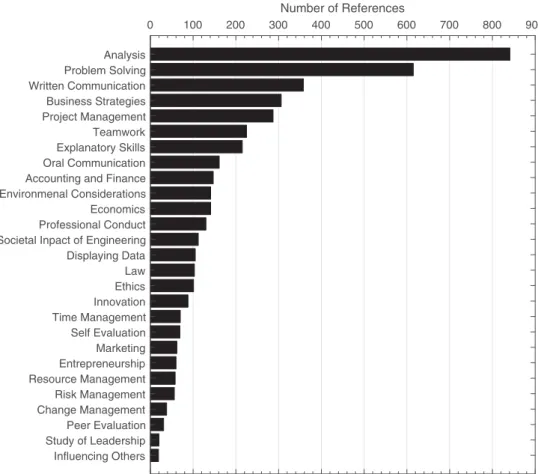
When summing all the references to each individual skill or element outlined inTable 1, the results in
Figure 1were obtained. The problem withFigure 1however, is that it does not consider the fact that
Analysis Problem Solving Written Communication Business Strategies Project Management Teamwork Explanatory Skills Oral Communication Accounting and Finance Environmenal Considerations Economics Professional Conduct Societal Inpact of Engineering Displaying Data Law Ethics Innovation Time Management Self Evaluation Marketing Entrepreneurship Resource Management Risk Management Change Management Peer Evaluation Study of Leadership Influencing Others 0 100 200 300 400 500 600 700 800 900 Number of References
an individual skill may be referenced multiple times per module; this can slightly inflate the reference
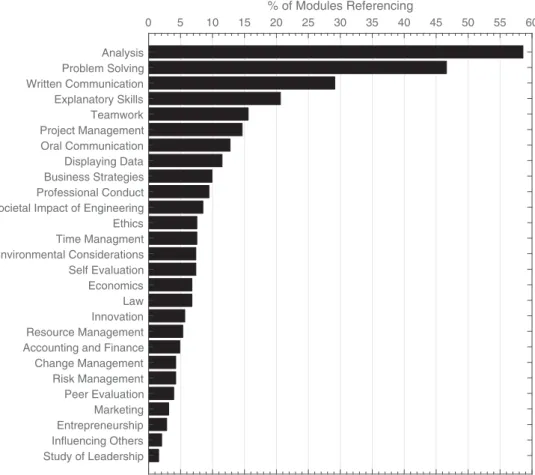
count of some elements.Figure 2was created in order to remove this problem by displaying the
percentage of modules which reference each individual element at least once.
Observing the two graphs, there are six elements which are present in the upper quartile of both
Figures 1and2, these are:
. Analysis skills
. Problem solving skills
. Written communication skills
. Explanatory skills
. Teamwork
. Project management
This indicates that these skills associated with leadership are utilised the most in BEng Electronic Engineering courses. Analysis skills and problem-solving skills are referenced the most; 757 and 562 times respectively. When considering the nature of an engineering degree, this is expected. Engin-eering draws heavily on these skills, and therefore it is of no surprise that the reference count reflects this. Such a result implies that graduates will have had the most exposure to these elements, or at least required to use them the most. If a leadership role demands the use of these skills, they should have had more exposure to utilising such skills relative to the other elements sampled for.
Analysis Problem Solving Written Communication Explanatory Skills Teamwork Project Management Oral Communication Displaying Data Business Strategies Professional Conduct Societal Impact of Engineering Ethics Time Managment Environmental Considerations Self Evaluation Economics Law Innovation Resource Management Accounting and Finance Change Management Risk Management Peer Evaluation Marketing Entrepreneurship Influencing Others Study of Leadership 0 5 10 15 20 25 30 35 40 45 50 55 60 % of Modules Referencing
Written communication skills and explanatory skills are also present in both graphs. The reason these skills have such a high reference count is likely due to them being critical methods of assess-ment within university modules. Undergraduates are required to attend a written exam or submit a written report for the majority of their modules, and this will require an element of explanatory skills. Therefore, the number of references for each of these are naturally linked, as the two skills are com-monly utilised in unison. The presence of teamwork and project management is noteworthy. As established in the literature review, these two skills are widely regarded as crucial for an engineering leader. However, they are not necessarily the skills which those in industry have outlined that gradu-ates are deficient in. Project management skills are crucial for technicians, engineers and engineering leaders alike. Therefore, the inclusion of them into an engineering degree is critical (included in Engineering Council’s UK-SPEC (Engineering Council,2016)), with or without consideration for the development of leadership competencies. Likewise, teamwork is critical for the modern STEM work-place. It can thus be inferred from such results that graduates of Electronic Engineering degrees will, on average, have been required to utilise such skills throughout their degree and could be better equipped in these areas relative to others. This indicates a good level of integration of these skills into the courses sampled.
Least referenced elements
When observing the two sets of data, it is apparent that there are elements in the lower quartile of
bothFigures 1and2are the same, albeit ordered slightly differently. These are:
. Study of leadership . Influencing others . Entrepreneurship . Marketing . Risk management . Change management . Peer evaluation
Therefore, since these elements are the least referenced, and also referenced in the fewest number of modules, it would suggest they are integrated the least into the BEng Electronic
Engin-eering degrees sampled. Now, four of these–Entrepreneurship, Marketing, Risk Management, and
Change Management–were previously discussed as either being essential leadership elements for
engineering managers, or found to be deficient in industry by bodies such as the IEEE. Further, these four elements may indeed be easier to integrate alongside existing imperatives for many of the
courses sampled– especially when compared to somewhat more sizable and detached subjects
such as Law, Study of Leadership, or Accounting and Finance. They are hard-skills and can thus
be taught in an academic environment. However, they also have sufficient crossover and relevance
to engineering projects, so as not to impede the education of engineering itself if integrated. Peer-evaluation is also a skill appears to be least referenced, yet it was previously established as a key skill for both effective leadership and CPD. Around 5% of BEng modules of Russell Group univer-sities incorporate elements of peer evaluation, clearly showing a lack of roll-out of this element to BEng courses. Despite this, peer evaluation has been outlined by the RAE and Engineering Council as a critical skill for engineers (Engineering Council,2016); understanding the development needs of colleagues and supporting their CPD as well as your own. The fact that only 5% of modules reference peer evaluation is somewhat surprising when over 15% of modules reference teamwork. Further, only 3.5% of modules analysed reference both teamwork and peer evaluation. Hence, there
appears to be a disconnect between the utilisation of peer evaluation and teamwork–only 20% of
all modules referencing teamwork simultaneously reference peer evaluation. The origin of such a dis-crepancy probably arises from several causes: the level of teamwork integrated into many modules
may not be substantial or prolonged enough to justify peer evaluation; teamwork may be regular but with different peer groups; or module designers may fail explicitly to outline the integration of peer evaluation alongside teamwork. Modules may also contain elements of peer evaluation without teamwork, a common occurrence in individual projects which are presented before, and scrutinised by, others–and vice-versa.
As somewhat expected, the study of leadership occurs the least. This is likely due to lack engage-ment by course designers with the need to bridge the leadership skills gap, an inability to integrate leadership with existing modules, or an inability to offer leadership as a standalone module due to an already stretched syllabus.
The list of least referenced elements, whilst not being definitive, does give a useful indication of
which leadership elements are deficient within BEng Electronic Engineering Degrees at the Russell
Group universities sampled, and thus, which should be considered for further integration into BEng Electronic Engineering courses in the future. It agrees with the sentiment of many in industry, and this gives a strong indication that these are areas that can be improved.
At this point, one may put forth the argument that, if leadership is the least referenced element,
encouraging universities to offer a standalone compulsory module for leadership development
would be an appropriate solution. Advocating such an approach would significantly simplify the
complexity of the solution to bridging the leadership gap. Whilst the authors do not in principle dis-agree with this stance, practical limitations mean such a recommendation is optimistic. In order to meet accreditation standards set by bodies such as the IET, engineering course designers in the UK
are required to prove they cover a sufficiently broad and deep set of technical and non-technical
skills. Though the extent to which each area is developed needs to be rigidised, one cannot have discrepancies between accredited institutions with respect to the weighting of technical and non-technical teaching hours. With this in mind, the IET state that, at most, 30% of all course credits
should be non-technical (IET, 2020). This prioritises exposure to technical components, and
ensures non-technical work is still encouraged, but limited. Hence, there is an upper bound upon the extent to which standalone supplementary modules can be integrated. Course designers
must, therefore, select some non-technical modules over others – and many have existing
modules in place. Whilst leadership development is important, and a dedicated module would likely aid development in this area, one may put forward an equivalently strong argument for the integration of a range of other non-technical domains. This, therefore, emphasises the importance of a thorough consideration of implicit integration of the Elements of Engineering Leadership, rather than leadership itself.
Compulsory/Optional dominance
The content analysis also allowed for a new method of establishing the extent to which leadership skills are integrated in either compulsory or optional modules, giving an indication of the delivery method utilised by universities. Further, if the Elements of Engineering Leadership were referenced
significantly more in optional modules, this would suggest an increased likelihood that an
under-graduate can fail to have sufficient exposure to such elements, because they can opt-out.
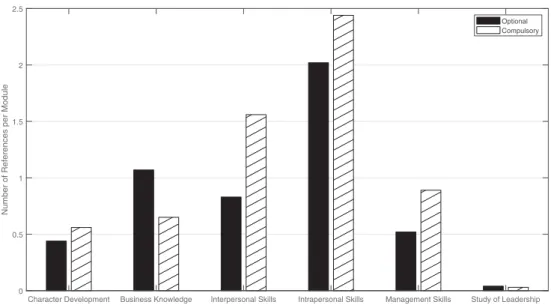
Upon studyingFigures 3and4, it would appear that branches of leadership associated with char-acter development are taught almost equally as much in the average optional module and average
compulsory module – indicating a somewhat equal utilisation in both optional and compulsory
modules. To a similar degree, the same can be said of the study of leadership itself.
However, it would appear that for Interpersonal Skills, Intrapersonal Skills and Management Skills, compulsory modules have a higher average reference count, and also a higher number of modules referencing them at least once. A result which indicates good integration of these skill areas into the average compulsory module compared to the average optional module, and likely a blending of these skills with the core engineering curriculum.
On the other hand, the average number of references to the development of Business Knowledge is greater in optional modules than compulsory modules, despite having almost the same number of modules referencing it at least once. This indicates the common delivery approach for business related skills is likely through specialised optional modules, each with a high reference count to business related skills. Whilst a discussion on the effectiveness of such an approach is outside of the bounds of this paper, the delivery of this skill type is likely different to the other leadership skill types. Results indicate the business skills have been integrated well into the optional module structure, however, relative to this, a marginally lower level of integration into the compulsory module structure.
Character Development Business Knowledge Interpersonal Skills Intrapersonal Skills Management Skills Study of Leadership 0 10 20 30 40 50 60 70 80 % of Modules Referencing Optional Compulsory
Figure 3.Percentage of modules referencing each skill type.
Character Development Business Knowledge Interpersonal Skills Intrapersonal Skills Management Skills Study of Leadership 0 0.5 1 1.5 2 2.5
Number of References per Module
Optional Compulsory
Development across academic years
Content analysis provided means of analysing the change in leadership skill usage throughout the undergraduate programmes sampled. By grouping leadership into the six core areas, as
out-lined in Table 1, and measuring the average reference count per module across the academic
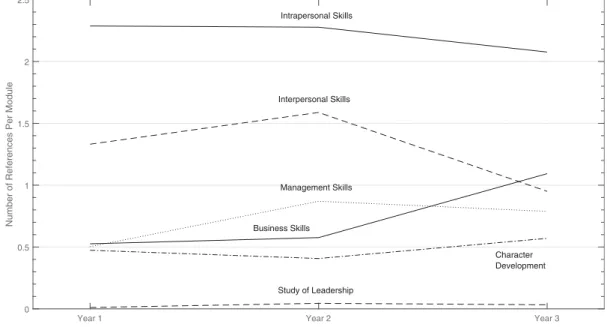
years, this showed some interesting trends (Figures 5 and 6). As the academic years progress,
it would appear that interpersonal skills and intrapersonal skills exhibit a decrease in average reference count and percentage of modules referencing them. Whilst business skills and manage-ment skills experience a slightly upward trend over the years. This trend indicates that at the beginning of the courses sampled, there is a greater importance attributed to the development of soft leadership skills such as intrapersonal skills and interpersonal skills, whilst as the courses progress, there is a rise in the education of hard leadership skills such as business and management.
Upon studying the course structures, the explanation behind this seems to be that course designers consciously integrate soft skills into the compulsoryfirst year modules, affording students
little opportunity to opt-out. Whereas in final years, undergraduates are commonly afforded the
choice of modules in varied academic disciplines; diversifying their academic base beyond
engineer-ing alone. Thesefields of choice are commonly business and management orientated, however there
are a broad range, most with application in the STEM sector.
Module comprehensiveness
One constructive usage of the content analysis was in the development of a comprehensiveness
ranking, or index. By utilising the Elements of Engineering Leadership introduced inTable 1, this
allowed the ranking of engineering leadership content based on a reductionist approach. Evaluating leadership content present in modules from its core elements, rather than the overarching definition of leadership itself. This form of analysis facilitates a more objective approach in comparing the breadth and depth of leadership integration between modules, allowing for a quantitative approach to be utilised in the comparison rather than a solely qualitative. Such an approach should provide a suitable data-point for further discussion on what module types are the most comprehensive in their
leadership integration, based on the framework outlined inTable 1.
Year 1 Year 2 Year 3
10 20 30 40 50 60 70 80
% of References per Module
Intrapersonal Skills Interpersonal Skills Management Skills Business Skills Study of Leadership Character Development
Year 1 Year 2 Year 3 0 0.5 1 1.5 2 2.5
Number of References Per Module
Intrapersonal Skills Interpersonal Skills Management Skills Business Skills Study of Leadership Character Development
Figure 6.Development of average reference count per module to each skill type.
J. DALEY A ND B. BARUAH
In order to fairly compare modules, they werefirst sorted according to their coverage of all 27 Elements of Engineering Leadership, then they were further ranked according to a normalized measure of dispersion across all the elements. In other words, the coefficient of variation (Cv).
Given an array of reference count datac:=[x0,x1, . . .,xn], wheren[Ndenotes the number of
sep-arate leadership elements or categories sampled for. Further, let us define the corresponding
arith-metic mean as mc, and population standard deviation as sc. The coefficient of variation can be
defined as such
Cv(c):=sc
mc
. (1)
For example, let us consider a module with the following reference count data across six
leader-ship categories, c=[10, 12, 7, 15, 3, 4], clearly mc=8.5, sc4.27. Therefore, applying
Equation (1),
Cv(c)0.5
The rationale behind utilising this metric being that the lower the module’s coefficient of variation, the lower the degree of dispersion with respect to its mean, therefore implying a greater likelihood that all elements are of equal importance to the nature of the module.
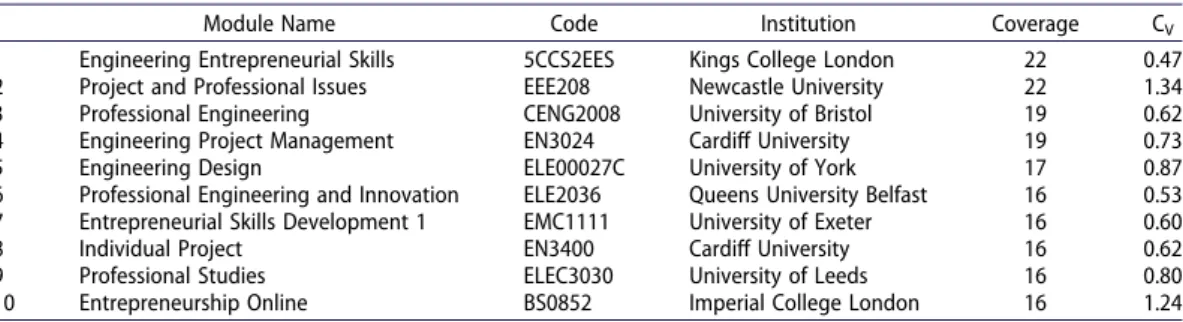
Table 2outlines the top ten modules according to the comprehensiveness analysis. The results
show a clear trend in the nature of the most comprehensive modules based on the framework in
Table 1. That is, that they generally utilise engineering skills with a supplementaryfield (e.g Business,
Management) within a team-project based environment. Of course, these results are indicative only and not to suggest that such modules are the most effective in leadership development, rather that they appear to reference–and likely utilise–the broadest range of leadership skills.
The data also identifies a crucial flaw with the utilisation of content analysis. The ‘Individual Project’offered by Cardiff University appeared to perform well in this ranking, however since the
majority of final year projects are wholly the same across institutions, it would be logical to
expect to see other equivalent modules performing equally as well. Alas, this is where the practical
bounds of content analysis become apparent. The creative freedom afforded to those who write
module descriptors can artificially inflate or deflate its apparent qualities when compared to
almost identical modules.
Case study: University of York
The Department of Electronic Engineering in the University of Yorkfirst established in 1978 offers a
range of IET accredited BEng and MEng Electronic Engineering courses. Due to subject specific
research specialisations, this department offers a range of routes for undergraduate studies includ-ing Communication Engineerinclud-ing, Computer Engineerinclud-ing, Nanotechnology, and Business Manage-ment. As one of the Russell Group universities, York has maintained a good reputation in
Table 2.Most Comprehensive Modules.
Module Name Code Institution Coverage CV
1 Engineering Entrepreneurial Skills 5CCS2EES Kings College London 22 0.47 2 Project and Professional Issues EEE208 Newcastle University 22 1.34 3 Professional Engineering CENG2008 University of Bristol 19 0.62 4 Engineering Project Management EN3024 CardiffUniversity 19 0.73 5 Engineering Design ELE00027C University of York 17 0.87 6 Professional Engineering and Innovation ELE2036 Queens University Belfast 16 0.53 7 Entrepreneurial Skills Development 1 EMC1111 University of Exeter 16 0.60 8 Individual Project EN3400 CardiffUniversity 16 0.62 9 Professional Studies ELEC3030 University of Leeds 16 0.80 10 Entrepreneurship Online BS0852 Imperial College London 16 1.24
teaching and research. The Department of Electronic Engineering was rankedfirst for teaching and second for overall student satisfaction in the Russell Group according to the 2018 National Student Survey (NSS)4(NSS,2018).
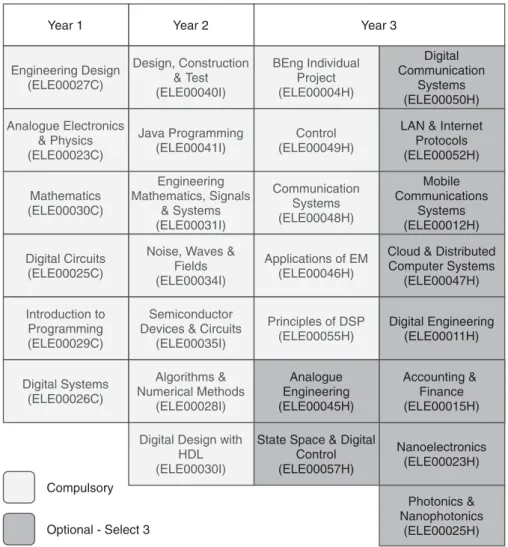
Since 2016, the University of York BEng Electronic Engineering course has operated on afixed
module structure up until the third academic year; students are then offered three optional
modules in order to gain further knowledge in more specialisedfields. The new course structure
is outlined inFigure 7and this framework was primarily used for this study’s analysis. Undergradu-ates are required to complete compulsory modules until year three, in which they can specialise in the optional module areas. As established in the literature review, the STEM landscape is demanding a greater importance be attributed to leadership skills throughout the HE system. The Department of Electronic Engineering at York has therefore adopted an integrated approach, along with a Pro-fessional Development Framework to facilitate leadership skills in their module structure and
pro-grammes. As part of this study, three academics having significant involvement in the education
of engineering management within the department were interviewed; an intentional selection as they have a wealth of experience and knowledge in the areas of engineering leadership.
Year 1 Year 2 Engineering Design (ELE00027C) Analogue Electronics & Physics (ELE00023C) Mathematics (ELE00030C) Digital Circuits (ELE00025C) Introduction to Programming (ELE00029C) Digital Systems (ELE00026C) Design, Construction & Test (ELE00040I) Java Programming (ELE00041I) Engineering Mathematics, Signals & Systems (ELE00031I) Noise, Waves &
Fields (ELE00034I) Semiconductor Devices & Circuits
(ELE00035I) Algorithms & Numerical Methods (ELE00028I) BEng Individual Project (ELE00004H) Control (ELE00049H) Communication Systems (ELE00048H) Applications of EM (ELE00046H) Principles of DSP (ELE00055H) Digital Communication Systems (ELE00050H) LAN & Internet
Protocols (ELE00052H)
Cloud & Distributed Computer Systems (ELE00047H) Mobile Communications Systems (ELE00012H) Digital Engineering (ELE00011H) Accounting & Finance (ELE00015H) Analogue Engineering (ELE00045H) Nanoelectronics (ELE00023H) Photonics & Nanophotonics (ELE00025H) Compulsory Optional - Select 3 Year 3
Digital Design with HDL (ELE00030I)
State Space & Digital Control (ELE00057H)
Accounting & Finance (ELE00015H)