AMCIS 2012 Proceedings
Proceedings
A Methodology for the Development of
Web-based Information Systems: Web Development
Team Perspective
Azlianor Abdul-Aziz
School of Computer and Information Science, University of South Australia, Adelaide, SA, Australia., [email protected]
Andy Koronios
School of Computer and Information Science, University of South Australia, Adelaide, SA, Australia., [email protected]
Jing Gao
School of Computer and Information Science, University of South Australia, Adelaide, SA, Australia., [email protected]
Muhammad Suhaizan Sulong
Software Engineering, Universiti Teknikal Malaysia Melaka, Melaka, Melaka, Malaysia., [email protected]
Follow this and additional works at:
http://aisel.aisnet.org/amcis2012
This material is brought to you by the Americas Conference on Information Systems (AMCIS) at AIS Electronic Library (AISeL). It has been accepted for inclusion in AMCIS 2012 Proceedings by an authorized administrator of AIS Electronic Library (AISeL). For more information, please contact [email protected].
Recommended Citation
Azlianor Abdul-Aziz, Andy Koronios, Jing Gao, and Muhammad Suhaizan Sulong, "A Methodology for the Development of Web-based Information Systems: Web Development Team Perspective" ( July 29, 2012).AMCIS 2012 Proceedings.Paper 11.
A Methodology for the Development of Web-based
Information Systems: Web Development Team Perspective
Azlianor Abdul-Aziz
Department of Software Engineering,
Faculty of Information and Communication
Technology, Universiti Teknikal Malaysia Melaka
[email protected]
Andy Koronios
Strategic Information Management Lab Group,
School of Computer and Information Science,
University of South Australia
[email protected]
Jing Gao
Strategic Information Management Lab Group,
School of Computer and Information Science,
University of South Australia
[email protected]
Muhammad Suhaizan Sulong
Department of Software Engineering,
Faculty of Information and Communication
Technology, Universiti Teknikal Malaysia Melaka
[email protected]
ABSTRACT
Web engineering has evolved through software engineering due to the technological changes from traditional information systems to web-based services. It has powered the Internet and World Wide Web technologies in which it has reflected the use of web-based information systems to reach broader audiences, new markets, access more information and interact in real time across barriers. The need for a methodology to develop such web-based information systems is inevitable, to enable adaptation of the traditional approach of systems analysis and design that is the software development life cycle (SDLC) to shift into a new paradigm namely the web-based development life cycle (WDLC). In this paper, the literature review has discovered a general methodology for WDLC that differs in terms of the number of stages and the nature of the development environment compared to the SDLC approach. However, from the insights of web development team through case studies, it is found that there is a collective agreement that having comprehensive development stages can satisfy their clients. The reason is their clients seem to believe that, if a smaller number of development stages exist to build web-based information systems, this can really reduce the development costs and time leading to faster delivery to the market.
Keywords
Web Application Development, Information Systems, Web Engineering, WDLC
INTRODUCTION
The past decade has seen a rapid growth and the advancement of the World Wide Web and Internet which have drastically changed the way in which information technology and information systems are applied to solve problems and to create more opportunities for organisations to improve and enhance their operations on a global scale (Leiner, Cerf, Clark, Kahn, Kleinrock, Lynch, Postel, Roberts and Wolff, 2009). In addition, the average world growth of Internet users has tremendously increased, by about 480.4% , between 2000 and 2009 (Internet World Stats 2011). This means that more and more applications are deployed on the web and generally in this research such applications are denoted as web-based information systems. It also must be noted that there are numerous synonyms that refer to web-based information systems such as web applications, web-based applications, web-based systems, internet web applications and rich internet applications (Yang and Tang, 2003; Mendes, Mosley and Counsell, 2006; Eldai, Ali and Raviraja, 2008; Murugesan, 2008; Fraternali, Rossi and Sánchez-Figueroa, 2010).
Most organisations have deployed major web-based information systems such as web-based customer relationship management systems, supply chain management systems, social networking, educational and entertainment systems, to provide information and services to web users and also to their clients. These include intranet applications ranging from simple applications to complex applications (Kappel, Proell, Reich and Retschitzegger, 2006). Therefore, with today’s Internet and web technologies revolution, the web-based information systems – compared to traditional information systems
these web-based information systems, this has with time introduced a new paradigm referred to as the Web-based Development Life Cycle (WDLC). Many a critic has argued that the current software development methodologies do not have all the necessary features required in systematic development of web-based information systems. Therefore, there is an urgent need to adapt or modify conventional software engineering methodologies (i.e. software development life cycle (SDLC)) to render them compatible for the development and maintenance of web-based information systems. A new approach to software development, WDLC, is thus receiving a lot of attention (Kumar and Sangwan, 2011).
This paper aims to determine whether the general WDLC stages found in the literature are currently applied by web-based development consultancy organisations. Case studies were conducted with seven of these organisations, with 32 members of web development teams being interviewed in order to obtain insights and understanding about the usage of the general WDLC among the team and with their clients. It attempts to identify any related issues in the development process through each stage of WDLC. The results may guide the web development team and assist them to engage with their clients by offering a comprehensive methodology that can reduce development costs and provide faster delivery of the web-based information systems.
This paper presents information on, how web-based information systems are developed by adapting the traditional methodology of software development to introduce a general approach for developing web-based information system. Next, the findings from the case studies discuss ways in which the WDLC methodology for web-based information systems is improved. Then, the conclusion is drawn that explains the importance of WDLC for the web development team to employ in developing web-based information systems.
ADAPTING TRADITIONAL SOFTWARE DEVELOPMENT METHODOLOGY
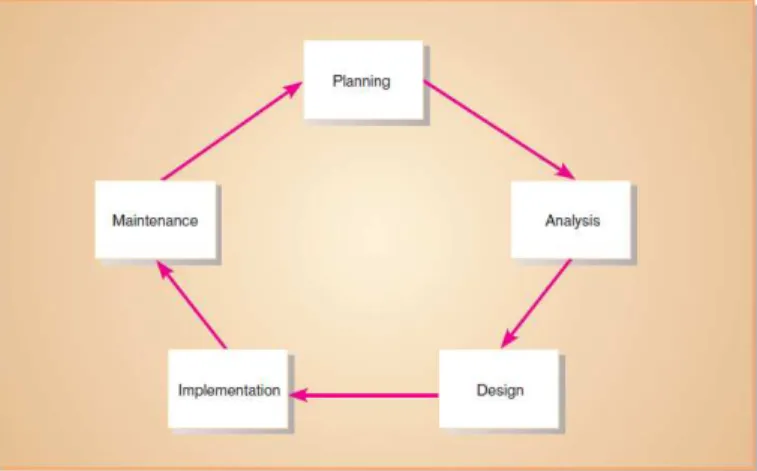
The software or system development life cycle had been in practice in software engineering (Lee, Sheridan-Smith, O'Neill, Leaney, Sandrasegaran and Markovits, 2003) for many years. Some studies define SDLC primarily as a complete step-by-step process of developing an application system that supports business needs or the requirements of an organisation (McManus, 2003; Rob, 2004). Interestingly, other studies implicitly state that SDLC is not only a process model, but also “a conceptual model” particularly for the management team to plan and develop information systems (Satzinger, Jackson and Burd, 2009) such as transaction information systems, management information system and decision support system (Hoffer, George and Valacich, 2011). This is because information systems are required to assist an organisation in carrying out its business functions and activities. An acceptable definition of SDLC is given as“the traditional methodology used to develop, maintain, and replace information systems” (Hoffer et al. 2011) by following a standard process which consists of a number of sequential stages namely, Planning, Design, Analysis, Implementation and Maintenance as illustrated in Figure 1.
Figure 1: System Development Life Cycle (Hoffer, George & Valacich 2011)
Basically, first in the Planning stage, the proposed system needs to be identified, prioritised and arranged according to the user requirements. Next, in the Analysis stage, those requirements will be comprehensively analysed and structured to produce solutions. Then, at the Design stage, the requirements will be transformed into the solutions – into logical and physical system specifications which contain detailed descriptions of independent functions and features associated with the technology to be employed. After that, in the Implementation stage, the system will be fully implemented and tested to ensure the requirements are met. And lastly, the Maintenance stage will soon to improve and enhance the system.
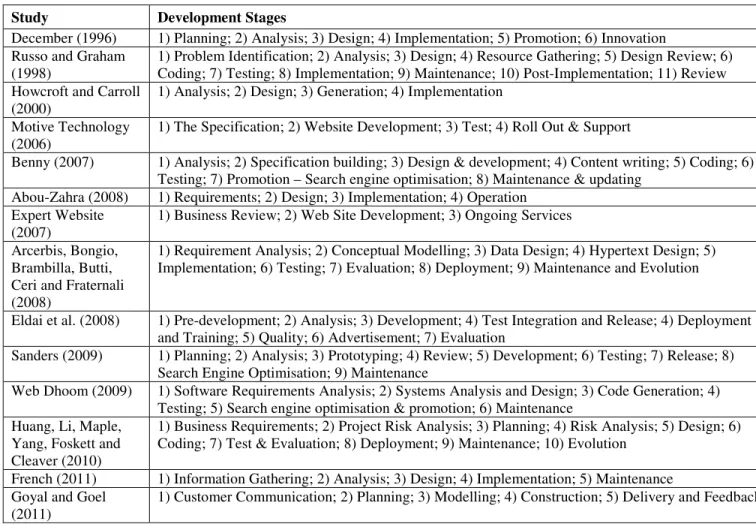
This SDLC methodology is taken as a basis to create a new development methodology for building web-based information systems. This new development methodology needs to cater to the multi-disciplinary nature of web-based development including aspects such as analysis and design, user interface development, human-computer interaction, project management, graphic design and presentation (Kumar and Sangwan, 2011). That is why the best practices employed in SDLC can be adapted to developing web-based information systems. In Table 1, a number of development methodologies in regards to developing web-based information systems are presented. These methodologies have been employed to develop and deploy web-based information systems that suit special characteristics such as multilingual, multiple Internet browsers, navigational structure and frequent maintenance (Abdul-Aziz, Koronios, Gao and Sulong, 2011).
Study Development Stages
December (1996) 1) Planning; 2) Analysis; 3) Design; 4) Implementation; 5) Promotion; 6) Innovation Russo and Graham
(1998)
1) Problem Identification; 2) Analysis; 3) Design; 4) Resource Gathering; 5) Design Review; 6) Coding; 7) Testing; 8) Implementation; 9) Maintenance; 10) Post-Implementation; 11) Review Howcroft and Carroll
(2000)
1) Analysis; 2) Design; 3) Generation; 4) Implementation Motive Technology
(2006)
1) The Specification; 2) Website Development; 3) Test; 4) Roll Out & Support
Benny (2007) 1) Analysis; 2) Specification building; 3) Design & development; 4) Content writing; 5) Coding; 6) Testing; 7) Promotion – Search engine optimisation; 8) Maintenance & updating
Abou-Zahra (2008) 1) Requirements; 2) Design; 3) Implementation; 4) Operation Expert Website
(2007)
1) Business Review; 2) Web Site Development; 3) Ongoing Services Arcerbis, Bongio,
Brambilla, Butti, Ceri and Fraternali (2008)
1) Requirement Analysis; 2) Conceptual Modelling; 3) Data Design; 4) Hypertext Design; 5) Implementation; 6) Testing; 7) Evaluation; 8) Deployment; 9) Maintenance and Evolution
Eldai et al. (2008) 1) Pre-development; 2) Analysis; 3) Development; 4) Test Integration and Release; 4) Deployment and Training; 5) Quality; 6) Advertisement; 7) Evaluation
Sanders (2009) 1) Planning; 2) Analysis; 3) Prototyping; 4) Review; 5) Development; 6) Testing; 7) Release; 8) Search Engine Optimisation; 9) Maintenance
Web Dhoom (2009) 1) Software Requirements Analysis; 2) Systems Analysis and Design; 3) Code Generation; 4) Testing; 5) Search engine optimisation & promotion; 6) Maintenance
Huang, Li, Maple, Yang, Foskett and Cleaver (2010)
1) Business Requirements; 2) Project Risk Analysis; 3) Planning; 4) Risk Analysis; 5) Design; 6) Coding; 7) Test & Evaluation; 8) Deployment; 9) Maintenance; 10) Evolution
French (2011) 1) Information Gathering; 2) Analysis; 3) Design; 4) Implementation; 5) Maintenance Goyal and Goel
(2011)
1) Customer Communication; 2) Planning; 3) Modelling; 4) Construction; 5) Delivery and Feedback Table 1: Various Web Development Methodologies
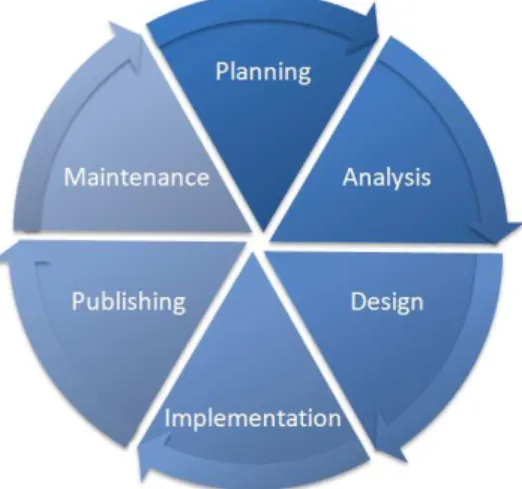
After comprehensively reviewing these various methodologies, a general methodology can be derived which comprises six stages; planning, analysis, design, implementation, publishing and maintenance. In addition, the definition of web-based information systems development can be defined as “a systematic methodology involving a streamlined multi-step process of developing web-based applications according to specifications and web standards as efficiently as possible”. This general methodology is discussed further in the next section.
GENERAL METHODOLOGY FOR WEB-BASED INFORMATION SYSTEMS DEVELOPMENT
A new general methodology named the Web-based Development Life Cycle has been derived from diverse reviewed methodologies from web development organisations and researchers as shown in Table 1. Although all methodologies use different terms and propose slightly different development processes, they are still based on common processes and activities for the web-based application domain. It also adapts one of the ISO methodologies which is a widespread acceptance by the web development community for developing web-based information systems. The ISO methodology is ISO 12207 Software Life Cycle Processes (2008). The summary of each stage which has been derived from reviewed literature is presented as follows. Next, Figure 2 illustrates the proposed WDLC methodology.
• The planning stage involves eliciting responses and gathering requirements from the clients either through direct communication, collecting relevant artefacts or any related documents (Valacich, George and Hoffer, 2009) and then a development schedule is created to manage the entire development of web-based information systems and to ensure success by delivering it on time (Kok, 2010).
• The analysis stage is the most critical stage, and concerns the content of information and the attractiveness of web application design. It analyses and examines the requirements to produce a complete specification and to construct an information systems model for reference throughout the development life cycle (Al-Salem and Abu Samaha, 2007). This is to ensure that the web-based information systems are feasible to be developed.
• The design stage provides a ‘skeleton’ to the web-based information systems (Acerbis et al. 2008) where it describes how such systems are to be designed based on the requirement document. All necessary design specifications are developed including interface design, system architecture and database structure. A mock-up design is produced to demonstrate the feasibility and to crystallise the design concept leading to the client’s approval (Abou-Zahra 2008).
• The implementation stage involves creating the database, constructing interfaces and implementing codes according to design specifications. The actual program codes that are written may conform to the web standards such as Web Content Accessibility Guidelines (WCAG Working Group 2008). Testing the web-based information systems for quality assurance is also required and must take into consideration the nature of the web (Alshahwan and Harman 2011).
• The publishing stage promotes and advertises completed web-based information systems to potential web users (Russo 2000). The systems can be made accessible through a web hosting service either in-house or at a web hosting provider. Prior to that, search engine optimisation (SEO), a unique feature of WDLC, is applied to promote web-based information systems to the public (Rogowski, 2007).
• The maintenance stage ensures the content of the web-based information systems is dynamically updated and made continuously reliable by reviewing and maintaining the systems (Russo 2000). The reviewing process is conducted frequently, due to the nature of web-based information systems that are fast changing in terms of their environment, technology and web users (Wei, Ru, Maple, Hongji, Foskett and Cleaver 2008). The maintaining process is a continuous task where the system is continuously updated and conformed to changes (Huang et al. 2010).
Figure 2: General Web-based Development Life Cycle
It is clear that the only major difference between SDLC and WDLC is the publishing stage, which makes a total of six stages in the WDLC for developing web-based information systems. The names of all the stages except the publishing stage still remain similar as to the SDLC stages but the roles reflect the nature of the web environment. This WDLC is taken as a basis to conduct further research through case studies in order to seek whether its stages are being employed by web practitioners (i.e. web development team that consists of project managers, analysts, developers and designers), to develop web-based information systems.
RESEARCH METHODOLOGY
This paper aims to look at how web development team perceived the WDLC methodology found in the literature in building web-based information systems. A comprehensive examination is required for understanding the insights of a web development team and, therefore, interpretive research is adopted where interviewing is used as a qualitative method. In order
to obtain a diverse perspective on this research area, different organisations that provide consultancy services and web-based information systems development for other organisations were selected as case studies, employing social interaction with participants in regards to the context of the research (Myers and Avison, 2002; Yin, 2009).
A number of these organisations, which have a wide knowledge and experience of web development teams, were invited to participate in this research – a total of 32 interviews in seven organisations were conducted and all results of the interviews were taken into account. The web development team in each organisation may comprise up to 15 members in various roles and responsibilities where each member should have at least a minimum of three years’ experience, with at least five completed projects related to web-based information systems. Thus, it is most likely that these web development teams have adequate level of experiences and knowledge in providing input for this research.
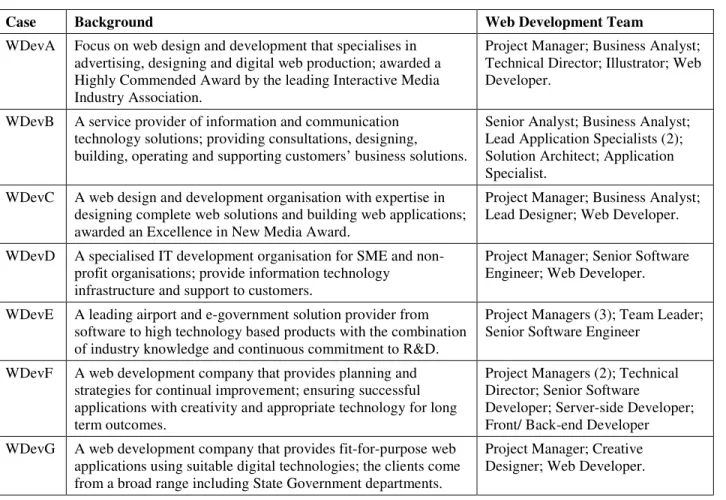
The interviews were semi-structured and lasted about 1.5 hours for each participant to acquire useful insights and information regarding the usage of WDLC methodology in developing web-based information systems. Their names were kept confidential and only their roles were identified. A brief overview over each case and their web development team is presented in Table 2.
Case Background Web Development Team
WDevA Focus on web design and development that specialises in advertising, designing and digital web production; awarded a Highly Commended Award by the leading Interactive Media Industry Association.
Project Manager; Business Analyst; Technical Director; Illustrator; Web Developer.
WDevB A service provider of information and communication technology solutions; providing consultations, designing, building, operating and supporting customers’ business solutions.
Senior Analyst; Business Analyst; Lead Application Specialists (2); Solution Architect; Application Specialist.
WDevC A web design and development organisation with expertise in designing complete web solutions and building web applications; awarded an Excellence in New Media Award.
Project Manager; Business Analyst; Lead Designer; Web Developer. WDevD A specialised IT development organisation for SME and
non-profit organisations; provide information technology infrastructure and support to customers.
Project Manager; Senior Software Engineer; Web Developer. WDevE A leading airport and e-government solution provider from
software to high technology based products with the combination of industry knowledge and continuous commitment to R&D.
Project Managers (3); Team Leader; Senior Software Engineer
WDevF A web development company that provides planning and strategies for continual improvement; ensuring successful applications with creativity and appropriate technology for long term outcomes.
Project Managers (2); Technical Director; Senior Software
Developer; Server-side Developer; Front/ Back-end Developer WDevG A web development company that provides fit-for-purpose web
applications using suitable digital technologies; the clients come from a broad range including State Government departments.
Project Manager; Creative Designer; Web Developer.
Table 2. Participating Organisations with Their Respective Web Development Team;
( ) – denotes number of interviewees. DISCUSSION AND FINDINGS
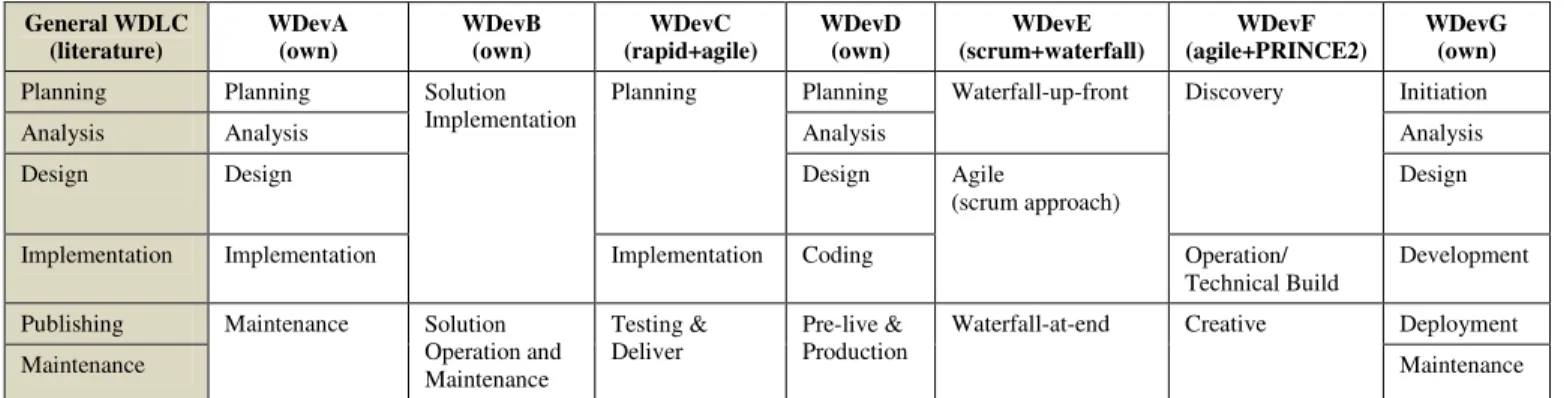
All participating organisations have a common business objective, of providing consultancy services in web-based information systems development to various clients, national and international, which include corporate business, banks, government agencies, etc. They have employed various types of methodology in developing these web-based information systems. Their development methodologies are generally specified by most participants as applied in their organisations but some have described them in detail. However, there are similarities in describing each stage of WDLC employed by these organisations. Referring to Table 3, three organisations use methodologies that are developed from existing methodologies
application development methodology with agile methodology (WDevC), scrum approach (agile) with waterfall methodology (WDevE) and agile methodology with the PRojects IN Controlled Environments (PRINCE2) methodology (WDevF). The rest develop their owned methodologies but base them on the general WDLC methodology. The following provides is a brief description for each methodology, adapted from Mohtashim (2009) and Siemaszkiewicz (2012).
• Rapid Application Development (RAD) – The RAD methodology aims to develop web-based information systems faster with high quality. It uses a workshop approach in getting necessary requirements and produces a number of prototypes to ensure that the requirements are identified and addressed within the prototype. The prototype is developed by re-using existing application components for faster delivery of web-based information systems.
• Agile – The agile methodology focuses on formulating requirements to become more able to suit an agile development. The key features of agile are its short-termed delivery cycles (sprints), agile requirements, dynamic team culture, less restrictive project control, and emphasis on real-time communication.
• Scrum – The scrum methodology is an agile framework using an iterative, incremental methodology for project management and software development. It is used to coordinate complex software projects by encouraging teamwork and self-organisation.
• Waterfall – The waterfall methodology is the famous legacy development methodology which SDLC is based on. It follows a step-by-step process in which a process needs to be completed prior moving on to the next.
• PRINCE2 – The PRINCE2 methodology is internationally recognized and is referred to as process based project management. It provides a generic method within a defined framework which is designed for any type of project. It involves coordinating people and activities in a project, designing and supervising the project and handling the project if it does not develop as planned.
General WDLC (literature) WDevA (own) WDevB (own) WDevC (rapid+agile) WDevD (own) WDevE (scrum+waterfall) WDevF (agile+PRINCE2) WDevG (own)
Planning Planning Solution
Implementation
Planning Planning Waterfall-up-front Discovery Initiation
Analysis Analysis Analysis Analysis
Design Design Design Agile
(scrum approach)
Design
Implementation Implementation Implementation Coding Operation/
Technical Build
Development
Publishing Maintenance Solution
Operation and Maintenance Testing & Deliver Pre-live & Production
Waterfall-at-end Creative Deployment
Maintenance Maintenance
Table 3. Comparing the General WDLC with Development Methodologies Employed in Each Participating Organisations
The case study results indicate that the general WDLC, derived from the literature, is still being employed for developing web-based information systems but the study found that all participating organisations (except WDevG) have customised the general WDLC to suit their development environment. By comparing organisations’ web development methodologies with the general WDLC, some of the stages employed in those organisations have similar functions. For example, all of the organisations have a planning stage in their development methodology. Without planning, the entire development may collapse.
It is noteworthy to point out that even though many stages can be useful, a smaller number of stages may be beneficial. For example, regarding the last two stages (publishing and maintenance), most organisations combine these stages into one so that, once a web-based information system is deployed i.e. published to the web, the maintenance process starts immediately. Having a small number of stages in their web development methodologies may indicate that there are few processes in developing web-based information systems. For instance, four organisations have just two or three stages (WDevB, WDevC, WDevE and WDevF).
Therefore, the general WDLC is refined so that a comprehensive WDLC with five stages is derived, as illustrated in Figure 3. Most participants suggest that in order to make it distinct from the traditional SDLC, the names of the stages should be changed. The reason is to have a fresh look and better reflect the nature of web-based development.
Figure 3: Refined Web Development Methodology Derived from Case Studies (developed for this research)
• Web Development Planning (WDP) – Clients and the project manager start discussing possible web-based information systems that will help the client’s business. A web project strategy is defined including a project schedule and plan and high-level requirements (after consulting web developers and designers).
• Web Requirements Engineering (WRE) – There are two main activities which are relevant at this stage. Firstly, requirement elicitation that involve gathering and articulating the needs of the clients. Secondly, requirement analysis which at the end will produce requirement specifications and the model. This requirements document needs validation to ensure specified requirements are correct.
• Web Application Design (WAD) – This stage describes how the web-based information systems are designed based on the requirements document. Designers work closely with clients and a small group of developers that have the technical background to prepare and develop all necessary design specifications. A prototype is created to demonstrate the feasibility of a design, leading to client’s approval. This design activity is frequently taken to produce a complete set of design requirements prior to actual development of web-based information systems.
• Web Technical Implementation (WTI) – Building web-based information systems, including creating the database, constructing interfaces and implementing codes; on various web browsers (because of the dependent nature of web-based information systems). Testing is required to avoid errors and to ensure the web-based information systems are useful and meet specifications.
• Web System Operations (WSO) – Web-based information systems are published either at a web hosting organisation or at the client’s own site. Accordingly, search engine optimisation is applied; maintenance involves evaluating and reviewing web-based information systems in a consistent way for security vulnerabilities and providing recommendation for improvement.
CONCLUSION
Web-based information systems have been well developed that offer huge potential to the market in business-to-consumer e-transactions, and gains of efficiency in business-to-business e-commerce. Information systems using web technology, delivered by the Internet, are now prevalent throughout the world. To design and develop such systems, we need to consider the aspect of development time and costs for the entire development process which covers stages from requirements analysis up to implementation. This is important to the clients of web-based development consultancy organisations where they need to rapidly deliver their web-based information systems online to the market. That is why this research seeks, through case study, to determine whether or not the general WDLC derived from the literature is currently applied by the web development teams to develop web-based information systems.
The research identifies that, although the general WDLC can be used to develop web-based information systems, the comprehensive WDLC appears more beneficial. As a whole, all web development teams in seven participating organisations agree with having a comprehensive WDLC methodology, especially as it can increase the level of confidence of their clients. This may mean that the clients are comfortable with the methods, as it could reduce the development time and costs and ensure faster delivery of web-based information systems. Thus, the proposed comprehensive WDLC methodology can be taken into consideration to use in developing web-based information systems by web-based development consultancy organisations in order to better satisfy their clients.
ACKNOWLEDGMENTS
This research is funded by the Ministry of Higher Education Malaysia (MOHE), Universiti Teknikal Malaysia Melaka (UTeM) and University of South Australia (UniSA). We gratefully acknowledge their generous financial support.
REFERENCES
1. Abdul-Aziz, A., Koronios, A., Gao, J. and Sulong M. S. (2011) Methodology and factors consideration for effective building web-based business applications, Proceedings of the 17th International Business Information Management Conference, November 14-15, Milan, Italy.
2. Abou-Zahra, S. (2008) Web accessibility evaluation, in Web Accessibility, Springer, London, 79-106.
3. Acerbis, R., Bongio, A., Brambilla, M., Butti, S., Ceri, S. and Fraternali, P. (2008) Web applications design and development with WebML and WebRatio 5.0, Objects, Components, Models and Patterns, 11, Springer Berlin Heidelberg, 392-411.
4. Al-Salem, L. S. and Abu Samaha, A. (2007) Eliciting web application requirements - an industrial case study, Journal of Systems and Software, 80, 3, 294-313.
5. Alshahwan, N. and Harman, M. (2011) Automated web application testing using search based software engineering, 26th
IEEE/ACM International Conference on Automated Software Engineering (ASE), November 6-10, USA.
6. Benny, A. (2007) Web site development process – The life cycle steps. Macronimous Web Solutions, viewed 2 August, 2011, <http://www.macronimous.com/resources/web_development _life_cycle.asp>.
7. December, J. (1996) An information development methodology for the world wide web, Technical Communication, 43, 4, 369-375.
8. Eldai, O. I., Ali, A. H. M. H. and Raviraja, S. (2008) Towards a new methodology for developing web-based systems,
World Academy of Science, Engineering and Technology, 46, pp. 190-195.
9. Expert Website (2007), Web development lifecycle, viewed 4 May 2009, <http://www.expertwebsiteservices.com/web_development_lifecycle.php>.
10. Fraternali, P., Rossi, G. and Sánchez-Figueroa, F. (2010) Rich internet applications, IEEE Internet Computing, 14, 3, 9-12.
11. French, A. M. (2011) Web development life cycle: A new methodology for developing web applications, Journal of Internet Banking and Commerce, 16, 2.
12. Goyal, K. and Goel, S. (2011) Challenges for reuse in web engineering, International Journal of Computer Science and Information Technology & Security, 1, 2, 133-135.
13. Hoffer, J. A., George, J. F. and Valacich, J. S. (2011) Modern systems analysis and design, 6th ed. edn, Pearson/Prentice Hall, Upper Saddle River, N.J.
14. Howcroft, D. and Carroll, J. (2000) A proposed methodology for web development, Proceeding of the European Conference on Information Systems, July 3-5, Vienna, Austria, 290-297.
15. Huang, W., Li, R., Maple, C., Yang, H-J., Foskett, D. and Cleaver, V. (2010) A novel lifecycle model for Web-based application development in small and medium enterprises, International Journal of Automation and Computing, 7, 3, 389-398.
16. Internet World Stats 2011, World Internet usage statistics news and world population stats, Miniwatts Marketing Group, viewed 16 December 2011, <http://www.internetworldstats.com/stats.htm>.
17. ISO/IEC 12207 (2008) Systems and software engineering – Software life cycle processes, ISO/IEC, Switzerland. 18. Kappel, G., Proell, B., Reich, S. and Retschitzegger, W. (2006) Web engineering: the discipline of systematic
development of web applications, John Wiley & Sons, Hoboken, New Jersey.
19. Kok, M. (2010) The five phases of effective web development, Bachelor Thesis, Middlesex University.
20. Kumar, S. and Sangwan, S. (2011) Adapting the software engineering process to web engineering process, International Journal of Computing and Business Research, 2, 1.
21. Lee, S., Sheridan-Smith, N., O'Neill, T., Leaney, J., Sandrasegaran, K. and Markovits, S. (2003) Managing the enriched experience network--learning-outcome approach to the experimental design life-cycle, Australian Telecommunication
Networks and Applications Conference, December 8-10, Melbourne, Australia.
22. Leiner, B. M., Cerf, V. G., Clark, D. D., Kahn, R. E., Kleinrock, L., Lynch, D. C., Postel, J., Roberts, L. G. and Wolff, S. (2009) A brief history of the Internet, SIGCOMM Comput. Commun. Rev., 39, 5, 22-31.
23. McManus, D. J. (2003) A model of organizational innovation: Build versus buy in the decision stage, The International
24. Mendes, E, Mosley, N. and Counsell, S. (2006) The need for web engineering: An introduction, in web engineering, Springer Berlin Heidelberg, 1-27.
25. Mohtashim, M. (2009) Project Management Methodologies. TutorialsPoint.com, viewed 15 April, 2012, <http://www.tutorialspoint.com/management_concepts/project_management_methodologies.htm>.
26. Motive Technology (2008), Our work, Motive Technology, viewed 12 February 2012, <http://www.motivetechnology.com/Our-Work/>.
27. Murugesan, S. (2008) Web application development: Challenges and the role of web engineering, in Web Engineering: Modelling and Implementing Web Applications, 7-32.
28. Myers, M. D. and Avison D. E. (2002) Qualitative research in information systems: A reader, Sage Publications, London.
29. Pearrow, M. (2007) Web usability handbook, 2nd edn, Charles River Media, USA.
30. Rob, M. (2004) Issues of structured vs. object-oriented methodology of systems analysis and design, Issues in Information Systems, 10, 1.
31. Rogowski, R. (2007), The business case for rich internet applications, Best Practices, Forrester Research, Inc.
32. Russo, N. L. (2000) Developing applications for the web: exploring differences between traditional and world wide web application development, in Managing Web-Enabled technologies in Organizations: A Global Perspective, ed. M Khosrowpour, Idea Group Publishing, Hershey, USA, 23-35.
33. Russo, N. and Graham, B. (1998) A first step in developing a Web application design methodology: understanding the environment, 6th International Conference on Information Systems Methodology, August 25-27, Salford University, Manchester, UK, 24-33.
34. Sanders (2009), Web site development life cycle, Sanders Software COnsulting Inc., viewed 4 January 2012, <http://www.sanderssoftware.com/services-web_development.htm>.
35. Satzinger, J. W., Jackson, R. B. and Burd, S. D. (2009) Systems analysis and design in a changing world, 5th ed. edn, Course Technology, Cambridge Mass.
36. Siemaszkiewicz, M. (2012) Project Management. Siems Production, viewed 15 April, 2012, <http://www.successfulprojectmanager.com/project-management/>.
37. Valacich, J., George, J. and Hoffer, J. (2009), Essentials of system analysis and design, 4th edn, Prentice Hall Press. 38. WCAG Working Group (2008), Web Content Accessibility Guidelines (WCAG) 2.0, World Wide Web Consortium,
viewed 17 April 2012, <http://www.w3.org/TR/WCAG20/>..
39. Web Dhoom (2009), Web application development India, Web Dhoom, viewed 4 January 2012, <http://www.webdhoom.com/web-development/Software-Development-Life-Cycle-(SDLC).html>.
40. Wei, H., Ru, L., Maple, C., Hongji, Y., Foskett, D. and Cleaver, V. (2008) Web Application Development Lifecycle for Small Medium-Sized Enterprises (SMEs), Eighth International Conference on Quality Software, August 12-13, Oxford, UK, 247-252.
41. Yang, H. L. and Tang, J. H. (2003) A three-stage model of requirements elicitation for web-based information systems,
Industrial Management & Data Systems, 103, 6, 398-409.