Multi-Cloud Oblivious Storage
Emil Stefanov
UC Berkeley[email protected]
Elaine Shi
University of Maryland[email protected]
ABSTRACT
We present a 2-cloud oblivious storage (ORAM) system that achieves 2.6X bandwidth cost between the client and the cloud. Splitting an ORAM across 2 or more non-colluding clouds allows us to reduce the client-cloud bandwidth cost by at least one order of magnitude, shifting the higher-bandwidth communication to in-between the clouds where bandwidth provisioning is abundant. Our approach makes ORAM practical for bandwidth-constrained clients such as home or mobile Internet connections. We provide a full-fledged implementation of our 2-cloud ORAM system, and report results from a real-world deployment over Amazon EC2 and Microsoft Azure.
Categories and Subject Descriptors
K.6.5 [Management of Computing and Information Systems]: Security and Protection
General Terms
Algorithms; SecurityKeywords
Oblivious RAM; outsourced storage; multi-cloud; privacy
1.
INTRODUCTION
Storage outsourcing is a growing industry that shields storage users from the burden of in-house infrastructure maintenance, and offers economies of scale. However, due to concerns over data privacy, “many potential cloud users have yet to join the cloud, and many are for the most part putting only their less sensitive data in the cloud” [8]. Encryption alone is insufficient for ensuring data privacy, since access patterns can also leak a considerable amount of sensitive information. For example, Islamet al. demonstrate statisti-cal attacks that leverage access patterns to successfully infer about 80% of the search queries made to an encrypted email repository [18].
Permission to make digital or hard copies of all or part of this work for personal or classroom use is granted without fee provided that copies are not made or distributed for profit or commercial advantage and that copies bear this notice and the full citation on the first page. Copyrights for components of this work owned by others than the author(s) must be honored. Abstracting with credit is permitted. To copy otherwise, or republish, to post on servers or to redistribute to lists, requires prior specific permission and/or a fee. Request permissions from [email protected].
CCS’13,November 4–8, 2013, Berlin, Germany.
Copyright is held by the owner/author(s). Publication rights licensed to ACM. ACM 978-1-4503-2477-9/13/11 ...$15.00.
http://dx.doi.org/10.1145/2508859.2516673.
Oblivious RAM (ORAM) [7, 9–11, 13, 14, 16, 19, 22, 23, 25, 30–32,34,35], first proposed by Goldreich and Ostrovsky [11], is a cryptographic construct that allows a client to access encrypted data residing on an untrusted storage provider, while completely hiding data access patterns. ORAM guarantees that the sequence of physical addresses accessed is independent of the actual data requested – in other words, the physicalaccess patterns do not reveal in-formation about thelogicalaccess patterns. To achieve this, the client continuously re-encrypts and reshuffles data blocks on the storage server, to cryptographically conceal the logi-calaccess pattern.
Due to the attractive security guarantees ORAM provides, several recent works have investigated how to make ORAM practical in an outsourced storage setting [20, 30, 31, 34, 35]. These works suggest that a primary hurdle for real-world ORAM deployment stems from its high bandwidth cost. Un-der realistic parameterizations (e.g., gigabytes to terabytes of outsourced storage), the best known ORAM schemes in-cur about 20X – 35X bandwidth cost, i.e., for every data block accessed, on average 20 to 35 blocks need to be trans-ferred. This makes ORAM unsuitable especially for band-width constrained clients, e.g., home Internet connections or mobile devices.
In some cases, shipping computation to the cloud can al-leviate the client-cloud bandwidth consumption. When the client does not trust the cloud provider, however, one im-mediate challenge is how to securely compute in the cloud without leaking data to the cloud provider. To this end, re-searchers have suggested combining trusted hardware and ORAM to securely delegate both computation and stor-age to the cloud [2, 3, 6, 17, 20, 26]. While this approach is promising, trusted hardware is not widely deployed on to-day’s cloud platforms. Instead, we seek a solution that is readily deployableon today’s cloud service providers.
1.1
Two-Cloud ORAM
We observe the following asymmetry in bandwidth re-source provisioning: while client-cloud bandwidth is scarce in many settings such as cellular networks or slower home Internet connections; network bandwidth in between major cloud providers (e.g., Amazon Web Services and Microsoft Azure) is ample.
We show that by spreading data across multiple non-colludingcloud providers, we can shift the 20X – 35X band-width cost to inter-cloud communication, while keeping the client-cloud bandwidth cost minimal — about 2.6Xunder typical parametrization, and out of which 2X is necessary to hide whether each access is a read or write. While a
general k-cloud scheme exists as described in the full on-line version [29], we focus on designing a highly optimized two-cloud solution which we believe to be the more likely deployment scenario. We provide a full-fledged two-cloud ORAM implementation, and have successfully deployed it on two major cloud providers, Amazon Web Services (AWS) and Microsoft Azure.
While the idea of using multiple non-colluding clouds is natural, how to design a provably secure and practically ef-ficient scheme is challenging. The main challenge is how to avoid passing data through the client during data shuffling, and still ensuring security against a potentially malicious cloud that can arbitrarily deviate from the prescribed behav-ior. Multi-server ORAM has been considered in a theoretic setting by Lu and Ostrovsky [21]. Their construction, how-ever, focuses on asymptotic performance, and still requires passing data through the client during shuffling. Conse-quently, their construction would result in at least 20X-35X client-cloud bandwidth cost under typical parametrization.
Technical highlights.Our main technique is to let the two clouds shuffle the data amongst themselves. Particularly, one cloud shuffles the data blocks, adds an “onion” layer of encryption, and send them to the other cloud. In this way, one cloud observes the permutation while the other observes the accesses to these blocks — and neither cloud observes both. In the next round, the two clouds switch roles.
To enforce honest behavior when one of the clouds may be malicious, we design a novelcommutative checksum-encryption construction. At a very high level, the client shares a secret checksum function with each cloud, such that the clouds can monitor each other’s actions. After every shuffle, about 4λ checksum bits per block are transferred between the client and the clouds such that the client can verify the correctness of the shuffle. In the above,λ= 128 is the security parame-ter. The typical block size is much larger thanλ, e.g., 4KB (size of a memory page) or higher. While transferring entire blocks to the client during shuffling would have incurred 20X-35X cost, by transferring 4λ bits per block we bring this part of the cost down to 0.1X to 0.2X (out of a total of 2.6X) as shown in Section 5. We also show that a similar technique may be employed to avoid reading a logarithmic number of blocks for each data access, which is necessary in most existing ORAM schemes.
Similar to the SSS construction [31], our 2-cloud ORAM scheme requires the client to store less than 1.5GB of data for an ORAM of 1TB in capacity (i.e., less than 0.15% of the ORAM capacity). Particularly, in addition to caching aboutO(√N) data blocks whereN is the total number of blocks, the client also stores about 4 bytes of metadata per block. While the metadata size is linear in theory; its size in practice is typically comparable to or smaller than the O(√N) data blocks cached. Out of theoretic interest, with suitable modifications to our scheme, it is possible to achieve sublinear client storage by applying the recursion technique described in earlier works [27,31], such that we could (recur-sively) outsource the linear metadata to the cloud as well. In practice, however, this is rarely necessary – and even if one does apply the recursion, the recursion depth rarely exceeds 2 to 3 in practical settings [20, 27].
In addition to minimizing the client-cloud bandwidth con-sumption, our 2-cloud ORAM scheme also roughly halves the total bandwidth consumption (including inter-cloud and
client-cloud communication) in comparison with single-cloud counterparts [31].
Threat model. We assume that at least 1 cloud provider is honest, i.e., faithfully executes the prescribed protocol. The other cloud may be malicious and arbitrarily deviate from the protocol. We do not know ahead of time which cloud is malicious. It is not within our goal to prevent the malicious cloud from launching Denial-of-Service (DoS) style attacks — DoS defense is orthogonal to and outside the scope of this work. We also cannot prevent a malicious cloud from voluntarily divulging its local states and views to the hon-est cloud, which can potentially allow the honhon-est cloud to learn additional information. For example, a malicious cloud can simply publish its states and protocol views on a public website.
However, we do guarantee that as long as there exists at least one honest cloud, a malicious cloud cannot learn any information about the client’s logical access patterns. In fact, any deviation from the prescribed protocol is immediately de-tectable by the client. In other words, by deviating from the prescribed protocol, a malicious cloud can only help an hon-est cloud gain information, but cannot learn anything itself. Moreover, it will be caught immediately if it ever deviates.
The above intuitive security model is generalized to the k-cloud setting (when only 1 out of k clouds needs to be honest), and defined formally using a simulation-based def-inition in the full online version [29]. We prove that our constructions are secure under this simulation-based defini-tion in the full online version [29].
2.
PRELIMINARIES
Our algorithm depends on the partitioning framework and the partition ORAM construction proposed by Stefanov, Shi, and Song [31], referred to as the SSS construction. We give a brief background of the SSS construction.
It is important to note that partitions do not represent clouds. In fact, as will be later explained in our construction, each partition is split across multiple clouds.
2.1
Partitioning Framework
The SSS partitioning framework [31] allows us to securely break-up ORAM read/write operations into read/write op-erations over smaller partitions, where each partition is an ORAM itself.
The framework consists of two main techniques, partition-ing andeviction. Through partitioning, a bigger ORAM in-stance of capacityNis divided intoO(√N) smaller ORAM instances (called partitions), each with capacity O(√N). While naive partitioning can break security, Stefanovet al.[31] propose a novel approach to allow partitioning without com-promising security, as outlined below.
Figure 1 illustrates the partitioning framework. At any point of time, a block resides in a random partition. The client stores a position map to keep track of which parti-tion each block resides in. To access a block whose identifier is u, the client first looks up the position map and deter-mine blocku’s current partitionp. Then the client issues an ORAM read operation to partitionpand looks up blocku. On fetching the block from the server, the client logically as-signs it to a freshly chosen random partition – without writ-ing the block to the server immediately. Instead, this block is temporarily cached in the client’s localeviction cache.
The partitioning framework [31]
// Divide the ORAM into√N partitions of sizeO(√N). Read(u):
• Look up position map and determine that uis assigned to partitionp.
• Ifuis not found in eviction caches: – ReadPartition(p,u)
Else ifuis found in local eviction caches: – ReadPartition(p,⊥) //read dummy
• Pick a random partitionp0, add the block identified byuto the eviction caches, and logically assignuto partitionp0. • CallEvictνtimes whereν >1 is the eviction rate. Write(u, B):
Same asRead(u), except that the block written to the eviction cache is replaced with the new block.
Evict:
• Pick a random partitionp.
• If a blockBexists in the eviction cache assigned to partition
p, callWritePartition(p, B).
• Else, call WritePartition(p,⊥), where ⊥ represents a dummy block.
Figure 1: The SSS partitioning framework [31]. Our construction uses this framework to express ORAM Read
andWriteoperations in terms of theReadPartitionand
WritePartition operations of our multi-clouds construc-tion.
A background eviction process evicts blocks from the evic-tion cache back to the server in an oblivious manner. With every data access, randomly select 2 partitions for eviction. If a block exists in the eviction cache assigned to the chosen partition, evict a real block; otherwise, evict a dummy block to prevent leakage.
2.2
Partition ORAM
Each partition is a fully functional ORAM in itself. Our partition ORAM construction is based on the partition ORAM of the SSS construction [31], which is a variant of the origi-nal hierarchical construction [11], but with various optimiza-tions geared towards maximal practical performance.
Each partition consists ofL:= 12logN+ 1 levels, where leveli∈ {0,1, . . . , L−1} can store at more 2i real blocks,
and 2ior more dummy blocks. We refer to the largest level, i.e., levelL−1, as thetop level.
We extend the client’s position map to store the position tuple (p, `,offset) for each block, wherepis the partition,` is the level, andoffsetdenotes the offset within the level.
Read. To read a block, the client first reads its position map and find out the position (p∗, `∗,offset∗) of the block. Then, the client reads one block from each level of partition p. For level ` = `∗, the client reads the block at offset∗. For other levels, the client reads a random unread dummy block. If the block is found in the client’s eviction cache, one dummy block is read from each level.
Write. Writing back a block to a partition causes a reshuf-fling operation. Specifically, let 0,1, . . . , ` denote consecu-tively filled levels such that level`+1 is empty. Writing back a blockB causes levels 0,1, . . . , `to be reshuffled into level `+ 1. In the single-cloud SSS construction, the reshuffling is done by having the client download all blocks, permute
them, re-encrypt them, and then write them back to the server.
3.
BASIC TWO-CLOUD CONSTRUCTION
IN THE SEMI-HONEST MODEL
We first explain a scheme that is secure when both clouds are semi-honest. Then, in Section 4, we explain how to use our commutative checksum-encryption construction to achieve security against one malicious cloud (without know-ing which one might be malicious).
3.1
Intuition
Reducing ORAM shuffling overhead. In existing single-cloud ORAM schemes [30–32, 35], a major source of the client bandwidth overhead stems from shuffling. Periodi-cally, the client has to download a subset of data blocks from the cloud, permute them, re-encrypt them locally, and write them back.
In our multi-cloud ORAM construction, we delegate the shuffling work to the two clouds to minimize client-cloud bandwidth usage. For example, cloud S1 shuffles a subset of blocks, adds a layer of encryption (i.e., an “onion layer”), and sends them toS2. Later when the client needs to read from that subset of blocks, it fetches them fromS2. In this way, while cloudS1knows the permutation used in the shuf-fling, it does not see which blocks the client requests from S2later. In contrast, whileS2sees which shuffled blocks the client requests later, it has no knowledge of the permutation applied byS1. As a result, neither cloud learns any infor-mation about the client’s logical (i.e., “unshuffled”) access pattern. The details of inter-cloud shuffling are described in Section 3.5.2.
Note that it is necessary for security to add onion encryp-tion layers after every shuffle: if a blockBgets shuffled from S1toS2 and then back toS1, we do not wantS1to be able to link the two occurrences of the same block B based on the block’s data. In the full online version [29], we intro-duce a background onion removal process to avoid adding an unbounded number of onion layers to a block.
Reducing ORAM read overhead. Existing single-cloud ORAM schemes can also incur significant bandwidth over-head for reading a data block in-between shufflings [30–32, 35]. For example, the client may need to read one or more blocks fromO(logN) levels in a hierarchy.
In our multi-cloud construction, we are able to signifi-cantly reduce the bandwidth overhead for reading a block by doing the following. The client requests a set of (already shuffled) blocks fromS1. S1 then randomly permutes them with a permutation known only byS1 and the client, and thenS1 sends them toS2. Finally, the client requests and downloads only a single block fromS2by providingS2with the permuted index of the requested block. The details of reading a block from multiple clouds are described in Sec-tion 3.5.1.
3.2
Data Layout on Clouds
Our scheme leverages the partitioning framework as de-scribed in Section 2.1. We divide our ORAM intoO(√N) partitions each of capacity O(√N). Each partition is di-vided into L = O(logN) levels, and each level resides on one of the two clouds. Which level resides on which cloud
changes as partitions are shuffled. Each level can be filled (i.e., it contains blocks) or empty.
In practice, each cloud can distribute the data across mul-tiple servers. For simplicity, we will first regard each cloud as a single logical entity; then in the full online version [29], we explain how to distribute the data and workload across multiple servers within each cloud.
New use of partitioning framework.We use partition-ing for a somewhat different motivation than described in the SSS paper [31]. Particularly, the SSS construction relies on partitioning mainly to get rid of oblivious sorting [11,12], thus achieving a constant factor saving in bandwidth.
Like in ObliviStore [30], we use partitioning to achieve parallelism, and to greatly improve response time. We shuf-fle and read from multiple partitions in parallel as described in the full online version [29], and such parallelism is espe-cially useful if each cloud has multiple servers each serving a subset of the partitions. If a read request happens on a partition not currently being shuffled, the read does not block on shuffling. In our system, the contention (proba-bility of a read occurring on a partition involved in a large shuffle) is very small — since (1) each read happens to a uni-formly random partition (regardless of the access pattern), (2) there are thousands of partitions, and (3) large shuffles happen very infrequently, i.e., with exponentially decreasing frequency. It’s also important to note that as the amount of parallelism increases, the contention increases. However, in practice, for large enough ORAMs with many partitions, the amount of parallelism necessary to saturate the server bandwidth does not cause significant contention.
In our multi-cloud ORAM, we can still achieve about 2X-3X client-cloud bandwidth cost even with a single partition. However, with a single partition, reads would have to block waiting for reshuffling operations of up toNblocks to finish (e.g., gigabytes or terabytes of data transfered between the two clouds), resulting in prolonged response times. Williams and Sion [35] describe an algorithm for simultaneously read-ing and shufflread-ing a sread-ingle-partition ORAM, but we observe that this technique about doubles the cloud-to-cloud band-width used because the single partition has twice as many levels than ourO(√N) sized partitions.
As studied in [31], a larger number of partitions requires a larger amount of client-side cache. Therefore, the number of partitions can be used as a knob to tune the tradeoff between the client-side storage and the response time.
3.3
Client Metadata
The client stores the following metadata. Note that even though the client storage is asymptotically linear, it has a very small constant and is quite small in practice. For ex-ample, all of the client storage combined is less than 1.5 GB for a 1 TB ORAM with 4KB blocks (i.e., less than 0.15% of the ORAM capacity). The amount of client stor-age used is similar to several existing single-cloud ORAM systems [30, 31, 35].
• The position tuple (p, `,offset) denoting the block’s cur-rent partition, level, and offset within the level.
• A bit vector for every partition and every filled level, indi-cating which blocks in the level have been read and (logi-cally) removed.
• A time value for every partition, i.e., the total number of operations that have occurred so far for each partition.
• A next dummy block counter for each partition and each level. The counter is set to 0 when a level is being rebuilt; and incremented when a next dummy element is read. This counter is sufficient to implement theGetNextDummy function mentioned in Figure 4.
It is possible to even further reduce the client storage to O(√N) by recursing on the position map as was proposed in [31].
3.4
Initializing
Each partition is initially placed in a random cloud (S1 orS2). Each block is assigned to a random partition, and a random offset in the top level (the largest level) of the par-tition. The client’s position map is initialized accordingly.
We assume initially, all blocks have the value zero. This can be done by initializing all blocks on the server to be encryptions of the zero block with appropriate metadata at-tached. Initialization can be optimized to consume much less bandwidth using a similar technique described in [31].
3.5
ORAM Read and Write Operations
A standard ORAM includes two operations: Read and
Write. As previously mentioned in Section 2 and Sec-tion 3.2, our construcSec-tion uses the SSS partiSec-tioning frame-work [31]. The SSS framework specifies how Read and
Writeoperations can be securely expressed in terms of par-tition ORAM read/write operations calledReadPartition
and WritePartition. Section 2 explains how this can be achieved. Since we rely on this framework we only need to describe how to implement ReadPartition and
WritePartition.
ReadPartitionandWritePartitionoperations are per-formed in parallel across all partitions but in serial for each individual partition to ensure consistency.
3.5.1
Reading from a Partition
In a typical single-cloud ORAM scheme [31], the client needs to download one block for each of theO(logN) levels in a partition to hide which level it wants to read from. In our construction, we rely on the inter-cloud shuffling tech-nique such that the client only needs to download a single block.
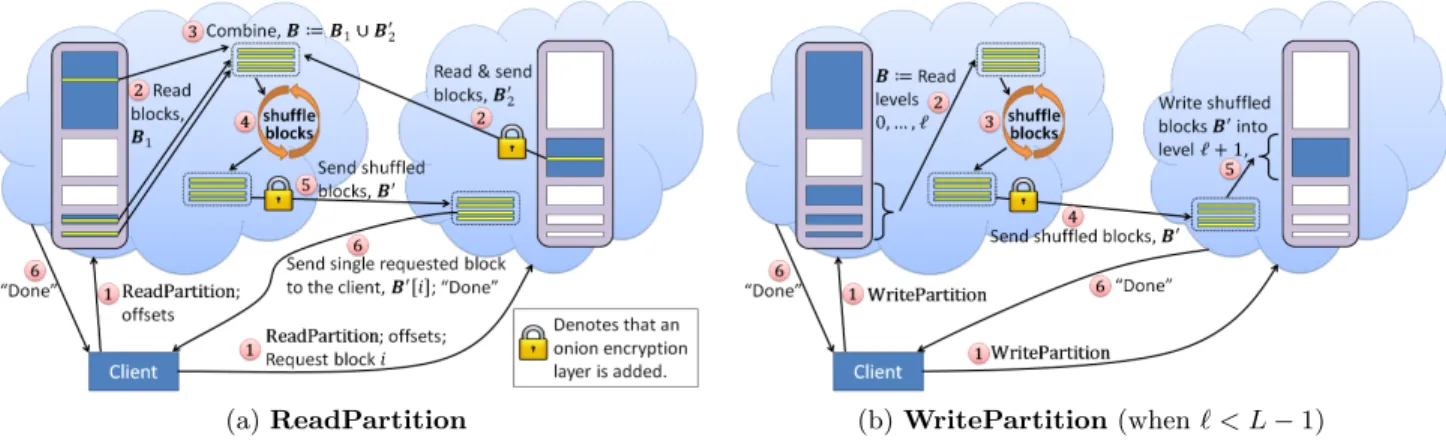
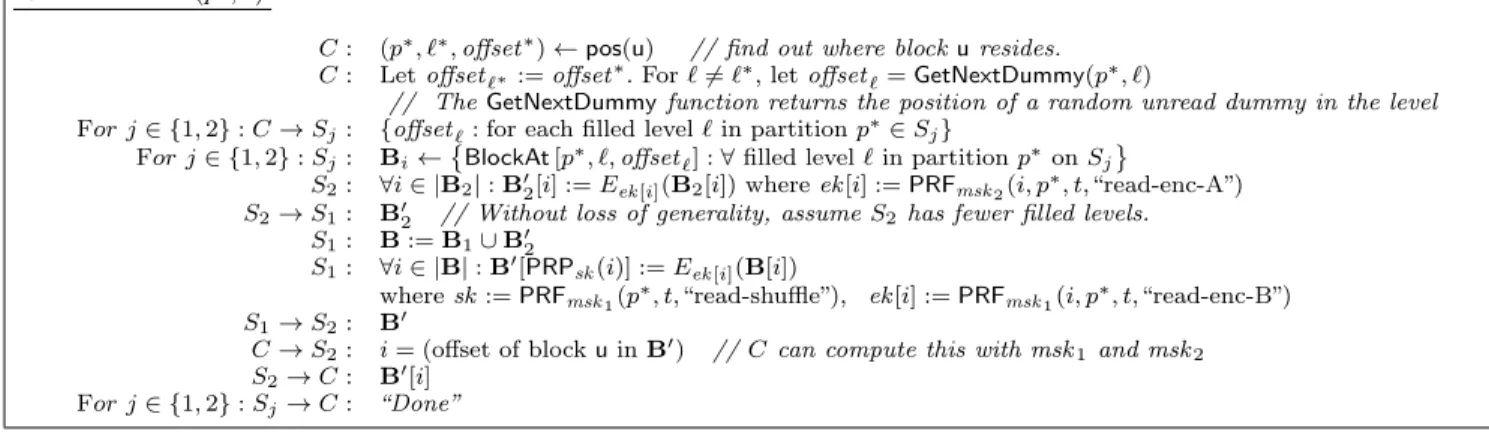
OurReadPartitionprotocol is illustrated in Figure 2(a) and described in detail in Figure 4. To read a block u, the client first looks up its position map to get the tuple (p∗, `∗,offset∗) indicating the position (partition p∗, level `∗, offset offset∗) for block u. The client then generates one offset for each filled level ` in partition p. For level `=`∗, the offsetoffset`=offset∗. For all other levels, its offset` corresponds to a random unread dummy (obtained
viaGetNextDummy) determined by computing the permuted offset of the nextDummy[p∗, `] counter of each level. The client now divides these offsets based on which cloud con-tains each level, and sends the corresponding offsets to each cloud. It is important for security that the client sends to each cloud only the offsets of the levels contained within the cloud.
Now, each cloud reads one block from each of its filled level, at the offsets indicated by the client. The cloud with fewer filled levels onion-encrypts the fetched blocks, and
(a)ReadPartition (b)WritePartition(when` < L−1)
Figure 2: Two-cloud ORAM protocol. Actions are performed in nondecreasing order specified by the circled numbers. If two actions have the same number within a diagram, it means that they can happen in parallel.
Figure 3: Layout of an ORAM partition across two clouds over time. This figure shows for a specific partition which levels are filled in each cloud (S1 and S2) over time (ti∈ {t1, . . . , t16}). When the bottom-most level is
empty, our algorithm automatically decides to which cloud to write the next block to preserve the invariant that all consequentially filled levels (from the bottom upwards) are always located on the same cloud.
sends them to the other cloud. Without loss of general-ity, assumeS2 sends its onion-encrypted blocks to S1. S1 now merges the blocks from S2 with its own fetched set, onion-encrypts them, and reshuffles them using a PRP key shared with the client. The reshuffled set is sent toS2.
The client now reveals the desired index within the reshuf-fled array to S2, and S2 returns the block at that index. In the full online version [29], we explain how the client decrypts the fetched block. Decrypting involves removing multiple onion layers of encryption as described in the full online version [29].
3.5.2
Writing to a Partition
OurWritePartitionprotocol is illustrated in Figure 2(b) and described in detail in Figure 4. Whenever a block is written to a partitionp, it is shuffled with all consecutively filled levels 0,1,2, . . . , ` of the partition into level`+ 1. If `=L−1 is the top level, all levels will be shuffled into the top level.
Note that there are 2Lpossible ways to divideLlevels be-tween two clouds. Our assignment algorithm is designed to best facilitate inter-cloud shuffling by enforcing the following invariant.
Invariant. Any time when consecutive levels 0..i are filled and need to be shuffled into leveli+ 1, levels 0..i all reside within the same cloud.
This minimizes the cloud-cloud bandwidth because shuf-fles always involve consequentially filled levels (i.e., 0..i). Suppose that, without loss of generality, cloudS1 holds lev-els 0..ito be shuffled into leveli+ 1 of cloudS2. By ensuring that the above invariant holds, at the start of shuffling,S1
already has all of levels being shuffled (0..i) and does not have to fetch additional levels from S2 before starting the shuffle. Figure 3 demonstrates how the levels of a partition are divided amongst the two clouds over time.
These shuffled blocks now form level `+ 1 of the same partition, and reside onS2. Levels 0, . . . , `onS1of partition
p are deleted and future requests for level` of partitionp are directed toS2.
Shuffling the top level. The only exception is when all levels 0..L−1 are shuffled, i.e., when the top level is involved in the shuffle. In this case, some dummy or obsolete blocks need to be discarded during the shuffle. Therefore, a top-level shuffle needs to be treated slightly differently, where the client tells S1 (i.e., source of the shuffle) a subset of blocks to keep for each level — without leaking any information. The detailed protocol is described in Figure 4.
Note that almost all of the bandwidth consumed happens when the two clouds exchange blocks, and the client’s band-width is conserved.
3.6
Onion Encryption Layers
Key generation. The client shares a master secret key msk1 with cloudS1; andmsk2 with cloudS2.
Onion encryption. Whenever a cloud, say S1, needs to onion encrypt a block, it generates a pseudo-random one-time encryption key based on msk1, the time value for the partition under consideration, and the block’s position tuple pos0 after the shuffle1.
1For read-phase shuffles, we use the block’s position prior to shuffle.
ReadPartition(p∗,u):
C: (p∗, `∗,offset∗)←pos(u) // find out where blockuresides.
C: Letoffset`∗ :=offset∗.For`=6 `∗, letoffset`=GetNextDummy(p∗, `)
// TheGetNextDummyfunction returns the position of a random unread dummy in the level
For j∈ {1,2}:C→Sj: {offset`: for each filled level`in partitionp∗∈Sj}
For j∈ {1,2}:Sj: Bi←
BlockAt[p∗, `,offset`] :∀filled level`in partitionp∗onSj
S2: ∀i∈ |B2|:B02[i] :=Eek[i](B2[i]) whereek[i] :=PRFmsk2(i, p
∗, t,“read-enc-A”) S2→S1: B02 // Without loss of generality, assumeS2has fewer filled levels.
S1: B:=B1∪B02 S1: ∀i∈ |B|:B0[PRPsk(i)] :=Eek[i](B[i]) wheresk:=PRFmsk1(p ∗, t,“read-shuffle”), ek[i] :=PRF msk1(i, p ∗, t,“read-enc-B”) S1→S2: B0
C→S2: i= (offset of blockuinB0) //Ccan compute this with msk1 and msk2
S2→C: B0[i] For j∈ {1,2}:Sj→C: “Done”
WritePartition(p∗, B):
/* Without loss of generality, assume that cloud 1 needs to shuffle`consecutive levels and send to cloud 2. Assume that the block to be writtenBhas been encrypted by the client using a secret key known only to itself.*/
Case 1: ` < L−1 C→S1: “Write partition”, p∗, B S1: B←BlocksAt[p∗,0..`]∪ {B} S1: ∀i∈ |B|: do Leti0=PRPsk(i), B0[i0] :=Eek[i](B[i]) where sk:=PRFmsk1(p ∗, t,“write-shuffle”), ek[i] :=PRFmsk1(pos 0, t,“write-enc”) //pos0 isB[i]’s position after the shuffle //pos0 can be computed giveni0
done
S1→S2: B0
S2: BlocksAt[p∗, `+ 1]←B0
S1→C: “Done.”
S2→C: “Done.”
C: Update local metadata appropriately.
Case 2: `=L−1
C→S1: “Write partition”, p∗, B
C: I← ∅
For each leveli= 0 toL−1:
letIr:={positions of all unread real blocks},
let Id:={positions of 2i− |Ir|randomly
chosen unread dummy blocks}, I←I∪(Ir∪Id) C→S1: sorted(I) S1: B←BlocksAt[I]∪ {B} S1: ∀i∈ |B|: do Leti0=PRP sk(i), B0[i0] :=Eek[i](B[i]) where sk:=PRFmsk1(p ∗, t,“write-shuffle”), ek[i] :=PRFmsk1(pos 0, t,“write-enc”) //pos0 isB[i]’s position after the shuffle
//pos0 can be computed giveni0
done
S1→S2: B0
S2: BlocksAt[p∗, L−1]←B0
S1→C: “Done.”
S2→C: “Done.”
C: Update local metadata appropriately.
Figure 4: Partition read and write algorithms for the honest-but-curious model.
Whenever a cloud, sayS1, needs to shuffle a set of blocks, it generates a pseudo-random one-time shuffling key based onmsk1, the current partition, and its the time value.
Onion decryption and background onion removal.
The client can recover all encryption keys and decrypt any onion-encrypted block. The details of this is deferred to the full online version [29] for our full construction — which is based on the basic construction described in this section, but augmented to provide security when one of the two clouds is malicious.
4.
SECURITY AGAINST ONE MALICIOUS
CLOUD
Informally, a malicious server can 1) corrupt data in stor-age; and 2) deviate from the prescribed protocol, particu-larly, not performing shuffling correctly.
Corrupted data blocks can be detected through standard techniques such as message authentication codes (MAC), as described in several earlier works [11, 31]. Therefore, we focus our attention on how to detect deviations from the prescribed protocol behavior.
High-level idea. The high-level idea is as follows. The client has two secret checksum functions σ1 and σ2. σ1 is shared with cloudS1, andσ2 is shared with cloudS2. The client attaches encrypted and authenticated version of the two checksums, denoted σ˜1(B) and σ˜2(B) to each block B and stored on the servers along with the block. The check-sums are encrypted and authenticated with a private key that only the client knows.
The client treats the checksums the analogously to the way the clouds treats the blocks. For example, whenever a cloud permutes a set of blocks, the client will permute the corresponding checksums. Whenever a cloud adds an onion layer of encryption to a block, the client will compute the
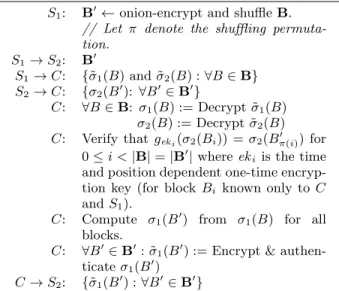
S1: B0←onion-encrypt and shuffleB. // Let π denote the shuffling permuta-tion. S1→S2: B0 S1→C: {σ˜1(B) and ˜σ2(B) :∀B∈B} S2→C: {σ2(B0): ∀B0∈B0} C: ∀B∈B: σ1(B) := Decrypt ˜σ1(B) σ2(B) := Decrypt ˜σ2(B) C: Verify that geki(σ2(Bi)) =σ2(B 0 π(i)) for 0≤i <|B|=|B0|whereeki is the time
and position dependent one-time encryp-tion key (for block Bi known only toC
andS1).
C: Compute σ1(B0) from σ1(B) for all blocks.
C: ∀B0∈B0: ˜σ1(B0) := Encrypt & authen-ticateσ1(B0)
C→S2: {σ˜1(B0) :∀B0∈B0}
Figure 5: Verifying shuffling and onion-encryption performed by cloud S1. The protocol is symmetric and the same verification can be done with forS2 by swapping the roles ofS1andS2. The verification is bandwidth efficient in that the client only needs to transfer checksums and not the blocks themselves. Encryption and authentication of the checksums is performed using a secret key known only to the client.
checksum for the onion-encrypted block from its old check-sum. After updating a checksum and before uploading it back to the clouds, the client always encrypts it and re-authenticates it using authenticated encryption.
Suppose Cloud S1 onion encrypts and shuffles a set of blocks and sends them to S2. The client can verify that
S1 did this correctly by askingS2 to compute and send the checksums of the shuffled and onion-encrypted blocks it re-ceived fromS1. The client can then verify the checksums it received fromS2against the ones it computed directly from the checksums of the old blocks (before shuffling and onion encryption).
Detailed algorithm. Figure 5 describes in more detail how the client can verify that a set of blocks have been correctly shuffled and onion-encrypted by cloud S1. The same protocol can be run withS1 andS2 interchanged to verify shuffling and onion encryption performed byS2. We prove the security of this verification algorithm in the full online version [29].
In order make the verification in Figure 5 possible, our checksum construction is designed to have the following prop-erties.
Commutative checksum/encryption construction. The client can compute the new checksum of a block (after onion encryption byS1) from an old checksum (before onion en-cryption byS1),without having to download the block itself. In other words, for j ∈ {1,2}, there is an efficiently com-putable function gek taking the encryption key ek as the
key, such that
gek(σj(B)) =σj(Eek(B)) (1)
Unforgeability of checksum function. For the above construction to be secure, the checksum function σ needs
to satisfy the following unforgeability property: when the checksum functionσ is kept secret from an adversary (i.e., one of the clouds), and the adversary hasnotobserved any input-output pairs, then, the adversary cannot find a pair B 6= B0 such that σ(B) = σ(B0) except with negligible probability. Note that our checksum function isnota hash function in the traditional sense, since for a traditional hash function, the description of the function is public.
Intuitively, this property ensures thatS1 cannot deviate from the shuffling protocol: suppose that after a shuffle from S1 toS2, the correct block at permuted index i0 should be
B0. If S1 sent toS2 some other B∗6=B0 for indexi0, then
σ2(B0)6=σ2(B∗) except with negligible probability. Hence, the client can immediately detect such deviation.
This property can be formalized as below, and is used as a building block in our full proof in the full online version [29].
Definition 1 (Unforgeability). We say that a check-sum function family Σ has our special collision resistance property if for all adversariesA(even when Ais computa-tionally unbounded),
Pr
Pick randomσfromΣ; (B0, B1)← A(1λ) :
σ(B0) =σ(B1) ∧B06=B1
=negl(λ)
4.1
Commutative Checksum-Encryption
Con-struction
Counter mode of AES encryption. We use counter mode of AES encryption. To encrypt a block B ∈ {0,1}β
, with aone-timekeyek∈ {0,1}κwhereκis 128 bits or 256
bits, compute the ciphertextR⊕B whereR is defined as
R:=prefix(AESek(0)||AESek(1)||AESek(2). . .) (2)
In the above prefix denotes the function that takes the first β bits of the string input. This is a secure one-time encryption scheme, since each ek is used to encrypt only one message.
Checksum construction. Let σ :{0,1}β → {
0,1}λ
de-note our specially constructed checksum function, whereβ is the block size, andλis the security parameter with a typ-ical choice of 128. Our checksum functionσis defined by a λ×βmatrixM ∈ {0,1}λβ
, whereλis the number of rows, andβ is the number of columns. Each entry in the matrix is a bit picked at random from{0,1}. Checksuming a block is simply a matrix multiplication operation:
σ(B) :=M·B (mod 2)
Commutative property of checksum-encryption com-bination. Given an encryption key ek, and a previous checksum σ, we define a verification function g taking ek andσas inputs:
gek(σ) :=σ⊕(M·R) (3)
where the vectorR is defined as in Equation (2) — taking ek as input.
Lemma 1. The above encryption and checksum combina-tion satisfy Equacombina-tion (1) for any ek ∈ {0,1}κ
, and any block B∈ {0,1}β,
Proof. Note that XOR denoted ⊕ is simply addition mod 2. Let R ∈ {0,1}β
by Equation (2). Therefore, gek(σ(B)) =σ(B)⊕(M·R)
=(M·B)⊕(M·R) =M·(B⊕R) =σ(Eek(B))
Lemma 2 (Security of checksum function). Our
checksum function is secure by Definition 1.
The proof of this lemma is deferred to the full online ver-sion [29].
Authenticated encryption of checksums.As mentioned earlier, our checksum function is secure only when an adver-sary has not seen any checksum value. Furthermore, we also need to ensure that a malicious cloud cannot modify the checksum and claim a different checksum. We therefore need to ensure the confidentiality and authenticity (implies freshness) of the checksums. To do this, the client will rely on authenticated encryption to encrypt these checksums be-fore attaching them to the blocks and uploading them to a cloud. To ensure freshness, the authenticated encryption incorporate thetimeof write and thepositionas well. One way to do this is the following: for each block shuffled at timetand shuffled to positionposon cloudSj, generate a
one-time authenticated encryption keyakbased off a master secret keyck known only to the client:
ak :=PRFck(pos, t, j,“AE-Write-Shuffle”)
˜
σ:=AEak(σ)
whereAEis an authenticated encryption scheme. For shuf-fles that occur in the ReadPartitionalgorithm (see Fig-ure 4), a different tag “AE-Read-Shuffle” may be used.
Optimization. In description so far,S2 sends the client a new checksumσ2(B0) for each blockB0 after shuffling, and the client verifies them one-by-one. A simple optimization is forS2 to use a collision-resistant hash function (e.g., SHA-256), and hash all of theσ2(B)’s, and send a single hash to the clientC— who can then verify the hash by reconstruct-ing all theσ2(B)’s.
4.2
Verifying Fetched Blocks
Whenever the client reads any data block using the
ReadPartition algorithm, it needs to verify the authen-ticity and freshness of the fetched block. Our encrypted and authenticated checksums ˜σ1(B) and ˜σ2(B) allow the client to verify the authenticity and freshness for the block B. Particularly, the freshness property is due to the fact the authenticated encryption uses a time and position de-pendent key.
In theReadPartitionalgorithm, we simply use the afore-mentioned algorithm to verify the shuffles associated with read operations. Finally, after fetching a blockB, the client verifies its authenticity and freshness using ˜σ1(B) or ˜σ2(B).
5.
EXPERIMENTAL RESULTS
5.1
Overview and Experimental Setup
We have implemented a full-fledged multi-cloud ORAM implementation, consisting of 12,000 lines of code. Our im-plementation uses hardware-accelerated AES-NI whenever available (it is available on most modern Intel processors).
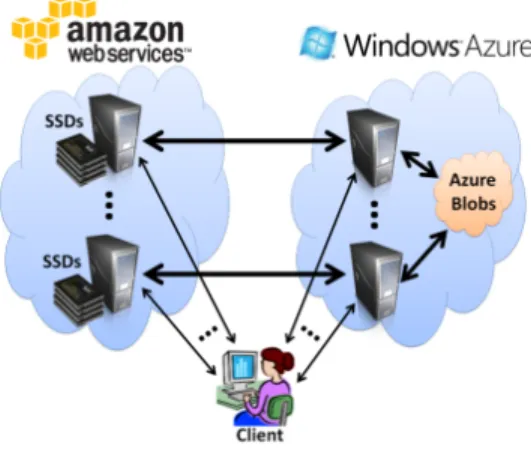
Figure 6: Our deployment. The workload is distributed across multiple servers per cloud communicating in pairs. We use this deployment for the experiments.
Our ORAM implementation uses asynchronous I/O oper-ations to increase throughput. As Stefanov and Shi point out in their recent work [30], in an asynchronous ORAM, to avoid information leakage through timing of I/O events, we need to make sure that the scheduling module does not use any information related to the logical access pattern. We therefore follow this guideline in our multi-cloud ORAM de-sign, to ensure security in the asynchronous ORAM model.
Deployment. We deployed our multi-cloud ORAM im-plementation running on top of two real-world major cloud providers: Amazon Web Services (AWS) [1] and Microsoft Azure [4]. We rented up to 5 servers per cloud. The AWS servers were High I/O Quadruple Extra Large Instances, each with 2 SSD-based volumes (1 TB each). The Azure servers were Extra Large instances, with the Azure blob storage as the storage backend (SSDs were not available on Azure). Figure 6 illustrates our deployment.
Although these VM instances have large memory and fast CPUs, we chose them only because they are provisioned by the cloud providers with higher disk I/O and network I/O than other instances. As explained in Section 5.4 and Section 5.5, CPU and memory were never the bottlenecks in our experiments.
Latency. Unless otherwise specified, we simulate a 50ms (round-trip) latency between the client and the closest cloud by asynchronously delaying the client’s requests and responses. Since our two clouds are in fact two different clouds (Amazon and Azure), we do not simulate additional latency between the clouds.
Scaling. We scale our experiments up to 5 servers per cloud, because our experiments suggest that by this time, the client-cloud bandwidth would already have been satu-rated in most typical settings – hence, further scaling up in-side the clouds would not have increased the overall ORAM throughput. We consider a single client as in most existing ORAM work.
Warming up. All of our experimental results represent the performance of a warmed-up ORAM with N blocks. We use the same technique for warming-up the ORAM as in previous work [30, 31]. As explained in the full online ver-sion [29], the client initializes the internal data structures
of our construction so that the ORAM immediately starts-off in a warmed-up state (i.e., with multiple filled levels in each partition) without having to pre-initialize or zero-out the server-side storage. This ensures that our performance measurements are steady-state measurements, not burst or best-case performance.
Access pattern.Because our ORAM construction protects the privacy of the access pattern, the access pattern will have no distinguishable effect on the performance of the clouds. However, the access pattern can affect the size of the client’s internal data structures (up to a certain point). In order to fairly evaluate our construction, we used a round-robin access pattern as in previous work [30, 31], which turns out to maximize the client storage by reducing the possibility of reusing data already stored by the client.
For ORAM, reads and writes are also indistinguishable. In our construction, they each involve invokingReadPartition
and thenWritePartition, except that during write opera-tion, the client locally updates the block’s value in between theReadPartitionandWritePartitionoperations. Our access pattern hence consisted of writes.
System load. All of our experiments represent the perfor-mance of our system under full load. In other words, data is continuously being written to the ORAM as fast as the ORAM can handle it. For each trial of each data point, we started measuring the performance after 200 MB of data had been written to the ORAM and we stopped measuring after 400 MB of data had been written (committed to disk by the cloud). Although the client memory is up to 1.5 GB for a 1 TB ORAM, most of it is used for the position map, and semaphores in our implementation ensure that only at most 70 MB of it is used to temporarily store data blocks before they are evicted to the clouds. Therefore by starting our measurements after 200 MB of data is written, we eliminate the effect of data buffering by the client.
Number of trails. Except for Figure 15, which provides exact values calculated for our construction, each data point in each figure represents the average over 20 trials. The error bars represent one standard deviation.
5.2
Results: Single Server Per Cloud
We first experimented with a single server per cloud, and report our experimental results below.
Throughput to a large extent depends on the bandwidth of the bottleneck resource. If the client-cloud link is the bottleneck, then our throughput would be roughlyBW/2.6 where BW denotes the available bandwidth on the client-cloud link. We refer to the number 2.6 as the client-cloud bandwidth cost, i.e., to access a block, roughly 2.6 blocks need to be transferred across the client-cloud link. A break-down of the client-cloud bandwidth cost is shown in Fig-ure 12.
In Figures 7, we measure maximum ORAM throughput that our multi-cloud system can handle with with 1 server per cloud when the client-to-cloud bandwidth is ample. A 300 GB ORAM of 4 KB blocks with a client over a 50ms latency connection to the clouds can handle up to about 0.8 to 1.0 MB/s throughput. If the block size is increased to 8 KB or 16 KB, the ORAM can sustain 1.2 to 1.6 MB/s of throughput. The graph shows that for ORAMs of sizes between 50 and 300 GB, the throughput is about the same. Theoretically it should decrease by about 15% because an
ORAM of size 300 GB has about 14 levels per partition whereas an ORAM with size 50 GB has about 12 levels per partition and the cost I/O cost of the ORAM is pro-portional to the number of levels in the partitions. This slight decrease in performance is somewhat noticeable but it’s mostly masked by variance due to external factors such as fluctuation in cloud network performance.
Figures 8,9, and 10 show the response time of our sys-tem under different parameterizations and the effect that the client-to-cloud latency has on the system throughput and response time. In Figure 10 the dotted line is the ideal y=xcurve, and represents the case when the request can be handled in exactly the client-to-cloud latency. The response-time of our system is about 200ms to 300ms higher than the client-to-cloud latency due to the cloud-to-cloud latency and the network congestion created by the fact that our system is under full load.
In these figures, the actual client-cloud bandwidth con-sumption is about 2.6 times the ORAM throughput.
5.3
Scaling to Multiple Servers per Cloud
Figure 11 shows the scaling effect when we use multiple servers per cloud as described in the full online version [29]. Each server handles roughly 300GB of ORAM capacity, and the load distribution scheme is described in the full online version [29]. The total ORAM capacity is therefore 300GB times the number of servers per cloud. We can see that the throughput roughly scales linearly as the number of servers grow (when the client-cloud link is not the bottleneck). The variations are due mostly to varying network performance between specific servers in the clouds. Our experiments also suggest that the response time grows very slightly as the number of servers per cloud grows (Figure 15).
We did not further scale up our experiments beyond 5 servers per cloud, since in the real-world settings we con-sider, the client-cloud bandwidth would already have been saturated at this scale.
5.4
Bottleneck Analysis
Client-cloud link is the bottleneck. As mentioned ear-lier, if the client-cloud link is the bottleneck, the ORAM throughput would just beBW/2.6, whereBW is the client-cloud bandwidth.
Storage performance is the bottleneck. When the client-cloud link has ample bandwidth, the next immedi-ate bottleneck is storage performance. In our deployment, since Azure did not offer SSD-capable instances, Azure’s blob storage becomes the bottleneck. Figures 7, 8, 9, 10, and 11, reported above focus on this case.
Inter-cloud networking is the bottleneck. Figures 14 and 15 report the throughput and response time we could potentially obtain had the storage performance not been the bottleneck – e.g., if Azure could provide SSD as their stor-age; or if in the future, RAM-based persistent storage be-comes available (e.g., RAMClouds [24]). In our deployment scenario, the cloud-cloud network bandwidth varied from 30–60MB/s between a pair of servers, which is slower than typical SSD performance (about 150MB/s). Therefore, to extrapolate the performance we could obtain had Azure pro-vided SSD-based storage, in Figures 14 and 15 we emulate the storage back-end using /dev/zero(or its equivalent on Windows) – such that the cloud-cloud network is the bot-tleneck.
Figure 7: ORAM throughput vs. ca-pacity. With 1 server per cloud, and a simulated 50ms latency client-cloud network link.
Figure 8: ORAM response time vs. capacity. With 1 server per cloud, and a simulated 50ms latency client-cloud network link.
Figure 9: Effect of client-cloud net-work latency on throughput. With 1 server per cloud, and an ORAM of 300GB capacity.
Figure 10: Effect of client-cloud net-work latency on response time. With 1 server per cloud, and an ORAM of 300GB capacity. The dotted line represents the net-work roundtrip latency – this is the lower bound on response time.
Figure 11: Scaling to multiple servers per cloud: Throughput. With a sim-ulated 50ms latency client-cloud network link. The total ORAM capacity is 300GB times the number of servers. The work-load distribution scheme across servers is ex-plained in the full online version [29].
Figure 12: Breakdown of client-cloud bandwidth cost. Measured between the client and all clouds combined for a single ORAM read/write. The number of servers per cloud does not affect the client-cloud bandwidth cost.
Figure 13: Microbenchmarks for checksum computation. Rate at which each VM in our experiments is able to per-form the commutative checksum computa-tion (parallelizing across all cores). Check-sum performance slightly decreases with the block size due to a decrease in memory lo-cality as the checksum matrix increases pro-portionally to the block size.
Figure 14: Potential improvement in throughput if storage were fast enough (for 4 KB blocks). The “Stor-age” curve represents the real-world case where the storage performance is the bot-tleneck. The “Cloud-cloud network” curve emulates the storage with/dev/zero such that the cloud-cloud network link is the bot-tleneck.
Figure 15: Potential improvement in response time if storage were fast enough (for 4 KB blocks). The “Stor-age” curve represents the real-world case where the storage performance is the bot-tleneck. The “Cloud-cloud network” curve emulates the storage with /dev/zero such that the cloud-cloud network link is the bot-tleneck.
5.5
Breakdown of Costs
Bandwidth baseline. Our baseline for bandwidth is a simple cloud storage system that just reads and writes
un-encrypted blocks to storage. For example, reading or writing a 4 KB block from the baseline system will incur 4 KB of
bandwidth. When we say that there is kX ORAM band-width cost, we mean that it takesk times as much band-width to perform an ORAM read or a write operation.
Client-to-cloud bandwidth. Our construction achieves about 2.6X bandwidth cost which means it takes about 10,647 bytes to read or write 4096 bytes from our multi-cloud ORAM. Figure 12 shows the breakdown of the client-cloud band-width cost. Particularly, about 2X (out of a total of∼2.6X) of the bandwidth cost is due to hiding whether the block is being read or written (i.e., fetching one block of data with 1X cost and writing one block of data with 1X cost).
For the SSS partitioning framework (Section 2), we use a background eviction rate at 0.3 times rate of data access (in addition to the piggybacked write-back with each oper-ation). Therefore, background evictions account for 0.3X client-cloud bandwidth cost. Due to space limitations, the reader is encouraged to refer to [31] for details about the background eviction process.
The remaining 0.3X or so bandwidth cost is due to the background onion removal process and the transfer of (en-crypted and authenticated) checksums between the client and cloud – as mentioned in Section 4, these checksums are necessary to ensure security against one malicious cloud. The checksum size is independent of the block size therefore when the block size increases, the checksum fraction of the bandwidth cost decreases.
Cloud-to-cloud bandwidth. The bandwidth cost of the entire system, which mostly consists of the cloud-to-cloud bandwidth is a constant factor smaller than that for the best known single-cloud construction [30] using the same amount of client memory. The intuition behind why that is the case is as follows. In the single-cloud ORAM by Stefanov et al. [30], when blocks need to be shuffled, the client downloads the blocks, shuffles them locally, and up-loads them back to the cloud in order to avoid increasing the the client’s storage. However, in our multi-cloud construc-tion, one of the clouds just shuffles the blocks and sends them to the other cloud and the other cloud simply stores them and does not need to send the blocks back to the first cloud.
Cryptographic microbenchmarks. We report micro-benchmarks for our new checksum function described in Sec-tion 4.1. Figure 13 shows that our checksum funcSec-tion can be computed at roughly 250-350 MB/s on our Amazon VM, and at 150 MB/s on our Azure VM. Using hardware-accelerated AES-NI in modern processors, decryption can be performed at 2.5 GB/s per onion layer.
Client computation. The client computation for a 1 TB ORAM mainly consists of: (1) encrypting and computing the initial checksum of a block when it is written to the ORAM, (2) encrypting about 15 checksums (16 bytes each) per block written using the commutative checksum-encryption technique described in Section 4.1, and (3) decrypting using AES about 5-15 onion layers of a fetched block that were added by the clouds during shuffling.
Even without hardware AES available on the client, a modern laptop or desktop computer can easily perform these cryptographic operations to sustain several megabytes per second of ORAM throughput, and most likely saturate its Internet connection (depending on the connection available to the client).
Server computation. In order for a server to sustain about 1 MB/s per sever of bandwidth for a 1 TB ORAM, the the server needs to be able to sustain about 30 MB/s of AES computation and 30 MB/s checksum computation over 4 KB blocks. As we just mentioned, our cryptographic microbenchmarks show that the Amazon and Azure servers we rented can sustain at least 5 to 10 times that rate for checksums and over 80 times that rate for AES.
Client memory and storage. Our client-side storage (memory) is less than 1.5 GB for an ORAM of up to 1 TB capacity (i.e., less than 0.15% of the entire ORAM capacity).
Monetary cost. The monetary cost of our system depends on several factors such as (1) the desired throughput and re-sponse time, (2) the size of the ORAM, (3) idle time, and (4) other factors such as geographic location. At the time the experiment was run, under full load, it’s cost was about $3.10/hour + $2.50/GB data transfer for 1-server per cloud. By using Amazon S3 and cheaper VMs instead of high I/O VM instances, the hourly cost can likely be reduced signifi-cantly.
6.
RELATED WORK
Oblivious RAM was first proposed by Goldreich and Os-trovsky [11] in the context of protecting software from piracy. They propose a seminal hierarchical construction with O((logN)3) amortized bandwidth cost, where N denotes the storage capacity of the ORAM. Since then, a line of research in the theory community has been dedicated to ORAM [7, 9–11, 13–16, 19, 22, 23, 25, 32–34].
Several works have suggested the use of ORAM in cloud computing applications [13, 15, 16, 30, 32, 34, 35]. Williams, Sionet al. have significantly bridged the theory and prac-tice of ORAM [32, 34, 35]. Goodrich, Mitzenmacher, Ohri-menko, Tamassia et al. [15, 16] have also made significant contributions in this space. Backeset al.[6] use a combina-tion of the binary-tree ORAM [27] and trusted hardware to build privacy-preserving behavioral advertising applications. Several recent efforts have made further progress towards making ORAM practical, including PrivateFS [35], Shroud [20], and ObliviStore [30]. PrivateFS and Oblivi-Store show how to build parallel or asynchronous ORAM schemes that achieve throughput in the range of hundreds of kilobytes per second on a single disk-bound server — assum-ing the client-cloud bandwidth is not the bottleneck. Unless trusted hardware is deployed in the cloud, these schemes result in 20X-35X client-cloud bandwidth cost, and is un-suitable for bandwidth constrained clients. Our multi-cloud ORAM is able to achieve a lower overall bandwidth cost than both ObliviStore [30] and PrivateFS [35], and an even lower client-cloud bandwidth cost. Shroud shows how to implement ORAM with trusted co-processors such as IBM 4764 [2], and scale it up in a distributed data center setting, but its performance is severely limited by the trusted co-processors. In comparison, our goal is to provide an imple-mentation that is readily deployable today (i.e., not relying on trusted hardware), and that addresses the client-cloud bandwidth bottleneck.
As mentioned earlier, Lu and Ostrovsky study multi-server oblivious RAM from a theoretic perspective [21]. They show that if there exists two non-colluding servers, the total band-width cost of oblivious RAM (including messages sent be-tween the client and the servers, as well as amongst the
servers themselves) may be reduced toO(logN) under the constant client local storage setting. Their work is mostly theory-minded, and results in a high client-server bandwidth in practice. Lu and Ostrovsky’s non-collusion model is stronger than ours, since their two non-colluding servers do not com-municate with each other.
7.
CONCLUSION
In this paper, we described a practical two-cloud Oblivi-ous RAM protocol thatreduces the client-server bandwidth cost to about2.6times that of simply reading or writing the block from non-oblivious cloud storage. In comparison, for the same amount of client memory available to the client, the best-known existing (single-cloud) ORAM constructions have a bandwidth cost of about 20X–35X.
We proposed a novel commutative checksum-encryption construction that allows our multi-cloud ORAM protocol to to efficiently protect the privacy of the access pattern against one malicious cloud (without necessarily knowing which one).
We implemented a complete end-to-end systemdeployed on multiple servers across two clouds (Amazon EC2 and Windows Azure) and demonstrated that it can scale and achieve several megabytes of throughput, saturating the avail-able bandwidth of most typical client Internet connections.
Acknowledgments
This work is partially supported2 by an NSF Graduate Re-search Fellowship under Grant No. DGE-0946797, by a DoD National Defense Science and Engineering Graduate Fellow-ship, NSF grant CNS-1314857, a Google Research Award, and a grant from Amazon Web Services. We would like to thank Matthew Green for helpful discussions and the anony-mous reviewers for their insightful feedback.
8.
REFERENCES
[1] Amazon web services.http://aws.amazon.com/. [2] IBM 4764 PCI-X cryptographic coprocessor (PCIXCC).
http://www-03.ibm.com/security/cryptocards/pcixcc/ overview.shtml.
[3] Trusted computing group.
http://www.trustedcomputinggroup.org/. [4] Windows azure.http://www.windowsazure.com/. [5] D. Asonov and J.-C. Freytag. Almost optimal private
information retrieval. InPET, 2003.
[6] M. Backes, A. Kate, M. Maffe, and K. Pecina. Obliviad: Provably secure and practical online behavioral advertising. InS & P, 2012.
[7] D. Boneh, D. Mazieres, and R. A. Popa. Remote oblivious storage: Making oblivious RAM practical. Manuscript, 2011.
[8] R. Chow, P. Golle, M. Jakobsson, E. Shi, J. Staddon, R. Masuoka, and J. Molina. Controlling data in the cloud: outsourcing computation without outsourcing control. In
CCSW, 2009.
[9] I. Damg˚ard, S. Meldgaard, and J. B. Nielsen. Perfectly secure oblivious RAM without random oracles. InTCC, 2011.
[10] O. Goldreich. Towards a theory of software protection and simulation by oblivious RAMs. InSTOC, 1987.
2Any opinions, findings, and conclusions or recommenda-tions expressed in this material are those of the author(s) and do not necessarily reflect the views of the funding agen-cies.
[11] O. Goldreich and R. Ostrovsky. Software protection and simulation on oblivious RAMs.J. ACM, 1996.
[12] M. T. Goodrich. Randomized shellsort: A simple
data-oblivious sorting algorithm.J. ACM, 58(6):27:1–27:26, Dec. 2011.
[13] M. T. Goodrich and M. Mitzenmacher. Privacy-preserving access of outsourced data via oblivious RAM simulation. In
ICALP, 2011.
[14] M. T. Goodrich, M. Mitzenmacher, O. Ohrimenko, and R. Tamassia. Oblivious RAM simulation with efficient worst-case access overhead. InACM Cloud Computing Security Workshop (CCSW), 2011.
[15] M. T. Goodrich, M. Mitzenmacher, O. Ohrimenko, and R. Tamassia. Practical oblivious storage. InCODASPY, 2012.
[16] M. T. Goodrich, M. Mitzenmacher, O. Ohrimenko, and R. Tamassia. Privacy-preserving group data access via stateless oblivious RAM simulation. InSODA, 2012. [17] A. Iliev and S. W. Smith. Protecting client privacy with
trusted computing at the server.IEEE Security and Privacy, 3(2):20–28, Mar. 2005.
[18] M. Islam, M. Kuzu, and M. Kantarcioglu. Access pattern disclosure on searchable encryption: Ramification, attack and mitigation. InNetwork and Distributed System Security Symposium (NDSS), 2012.
[19] E. Kushilevitz, S. Lu, and R. Ostrovsky. On the (in)security of hash-based oblivious RAM and a new balancing scheme. InSODA, 2012.
[20] J. R. Lorch, J. W. Mickens, B. Parno, M. Raykova, and J. Schiffman. Shroud: Enabling private access to large-scale data in the data center. InFAST, 2013.
[21] S. Lu and R. Ostrovsky. Distributed oblivious ram for secure two-party computation. Cryptology ePrint Archive, Report 2011/384, 2011.http://eprint.iacr.org/. [22] R. Ostrovsky. Efficient computation on oblivious RAMs. In
ACM Symposium on Theory of Computing (STOC), 1990. [23] R. Ostrovsky and V. Shoup. Private information storage
(extended abstract). InSTOC, pages 294–303, 1997. [24] J. Ousterhout, P. Agrawal, D. Erickson, C. Kozyrakis,
J. Leverich, D. Mazi`eres, S. Mitra, A. Narayanan, G. Parulkar, M. Rosenblum, S. M. Rumble, E. Stratmann, and R. Stutsman. The case for ramclouds: scalable high-performance storage entirely in dram.SIGOPS Oper. Syst. Rev., 43(4):92–105, Jan. 2010.
[25] B. Pinkas and T. Reinman. Oblivious RAM revisited. In
CRYPTO, 2010.
[26] J. Schiffman, T. Moyer, H. Vijayakumar, T. Jaeger, and P. McDaniel. Seeding clouds with trust anchors. InCCSW, pages 43–46, 2010.
[27] E. Shi, T.-H. H. Chan, E. Stefanov, and M. Li. Oblivious RAM withO((logN)3) worst-case cost. InASIACRYPT, pages 197–214, 2011.
[28] S. W. Smith and D. Safford. Practical server privacy with secure coprocessors.IBM Syst. J., 40(3):683–695, Mar. 2001.
[29] E. Stefanov and E. Shi. Multi-cloud oblivious storage. Technical report.
[30] E. Stefanov and E. Shi. ObliviStore: High performance oblivious cloud storage. InIEEE Symposium on Security and Privacy, 2013.
[31] E. Stefanov, E. Shi, and D. Song. Towards practical oblivious RAM. InNDSS, 2012.
[32] P. Williams and R. Sion. Usable PIR. InNDSS, 2008. [33] P. Williams and R. Sion. Round-optimal access privacy on
outsourced storage. InCCS, 2012.
[34] P. Williams, R. Sion, and B. Carbunar. Building castles out of mud: practical access pattern privacy and correctness on untrusted storage. InCCS, 2008.
[35] P. Williams, R. Sion, and A. Tomescu. Privatefs: A parallel oblivious file system. InCCS, 2012.