Thesis for the degree of Doctor of Philosophy
Formal Development of Safe and Secure
J
AVA
C
ARD
Applets
Wojciech Mostowski
Department of Computer Science and Engineering
Chalmers University of Technology and G¨
oteborg University
SE-412 96 G¨
oteborg, Sweden
G¨
oteborg, February 2005
Copyright cWojciech Mostowski, 2005
Doktorsavhandlingar vid Chalmers Tekniska H¨ogskola Ny serie nr 2257
ISSN 0346-718X Technical Report 2D
Department of Computer Science and Engineering Formal Methods Research Group
Department of Computer Science and Engineering
Chalmers University of Technology and G¨oteborg University SE-412 96 G¨oteborg, Sweden
Telephone +46 (0)31-772 1000
Cover: A schematic, SIM shaped JAVACARDdevice Chalmers Reproservice
Formal Development of Safe and Secure JAVACARDApplets Wojciech Mostowski
Department of Computer Science and Engineering
Chalmers University of Technology and G¨oteborg University
Abstract
This thesis is concerned with formal development of JAVA CARD applets. JAVA CARDis a technology that provides a means to program smart cards with (a sub-set of) the JAVAlanguage. In recent years JAVACARD technology gained great interest in the formal verification community. There are two reasons for this. Due to the sensitive nature (e.g., security, maintenance costs) of JAVA CARD applets, formal verification for JAVACARDis highlydesired. Moreover, because of the relative simplicity of the programming language, JAVA CARD is also a
feasibletarget for formal verification. The formal verification platform that we used in our research is the KeY system developed in the KeY Project. One of the main objectives of our research is to find out how far formal verification for industrial size JAVACARD applets goes, in terms of usability, automation, and power (expressivity of constraints). Furthermore, we investigated practical and theoretical shortcomings of the verification techniques and development meth-ods for JAVA CARD applets. As a result, we adapted a program logic for JAVA CARD to be able to express interesting, meaningful safety and security prop-erties (strong invariants) and proposed design guidelines to support and ease formal verification (design for verification). We performed extensive practical experiments with the KeY system to justify and evaluate our work.
Formal aspects of our research concentrate on source code level verification of JAVACARD programs with interactive and automated theorem proving. Our work has been driven by certain assumptions, motivated by the KeY Project’s philosophy: (1) formal verification should be accessible to software engineers without years of training in formal methods, (2) we should be able to perform full verification whenever needed, i.e., we want to handle complex JAVACARD applets that involve JAVA CARD specific features, like atomic transactions and object persistency, (3) the verified code should not be subjected to translations, simplifications, intermediate representations, etc., and finally, (4) the properties that we prove should relate to important safety and security issues in JAVACARD development. We relate to these goals in our work.
Keywords: JAVA CARD, object-oriented design, formal specification, formal verification, Dynamic Logic
List of Included Papers and Reports
This thesis is based on the publications listed below. My involvement in the work presented in these papers is described in detail in the thesis’ introduction. [Mos02] Wojciech Mostowski. Rigorous Development of JAVA CARD Appli-cations. In T. Clarke, A. Evans, and K. Lano, editors, Proceedings, Fourth Workshop on Rigorous Object-Oriented Methods, London, U.K., March 2002.
[BM03] Bernhard Beckert and Wojciech Mostowski. A Program Logic for Han-dling JAVA CARD’s Transaction Mechanism. In Mauro Pezz`e, editor,
Proceedings, Fundamental Approaches to Software Engineering (FASE) Conference, Warsaw, Poland, volume 2621 of LNCS, pages 246–260. Springer, April 2003.
[LM04] Daniel Larsson and Wojciech Mostowski. Specifying JAVACARDAPI in OCL. In Peter H. Schmitt, editor,OCL 2.0 Workshop at UML 2003, volume 102C ofENTCS, pages 3–19. Elsevier, November 2004. [HM05] Reiner H¨ahnle and Wojciech Mostowski. Verification of Safety
Prop-erties in the Presence of Transactions. In Gilles Barthe and Marieke Huisman, editors,Proceedings, Construction and Analysis of Safe, Se-cure and Interoperable Smart devices (CASSIS’04) Workshop, volume 3362 ofLNCS, pages 151–171. Springer, 2005.
[Mos05] Wojciech Mostowski. Formalisation and Verification of JAVACARD Se-curity Properties in Dynamic Logic. In Maura Cerioli, editor, Proceed-ings, Fundamental Approaches to Software Engineering (FASE) Con-ference 2005, Edinburgh, Scotland, LNCS. Springer, April 2005. To appear.
Table of Contents
Acknowledgements ix
Introduction 1
1 Overview . . . 1
2 JAVACARD . . . 2
3 The KeY System . . . 5
3.1 Architecture of the KeY Tool . . . 6
3.2 Dynamic Logic . . . 8
3.3 Syntax of JAVACARD DL . . . 9
3.4 Proof Obligations . . . 10
3.5 Deductive Calculus for Proving Obligations . . . 10
3.6 Taclets . . . 13
3.7 Implementation . . . 14
4 Description of the Papers . . . 14
5 Contributions . . . 18
6 Related Work . . . 20
7 Future Work . . . 23
Paper I: Rigorous Development of JAVA CARD Applications 35 1 Introduction . . . 35
1.1 JAVACARD . . . 35
1.2 Analysis of the Current Situation . . . 36
1.3 Related Work . . . 37
1.4 Our Approach . . . 38
2 Case Study: pam iButton . . . 39
3 Design Issues for JAVACARD Applications . . . 41
4 Developing JAVACARD Applications . . . 43
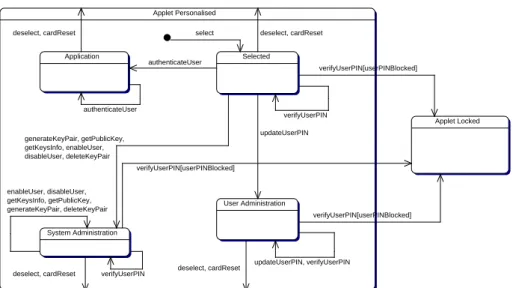
4.1 Applet Life States . . . 43
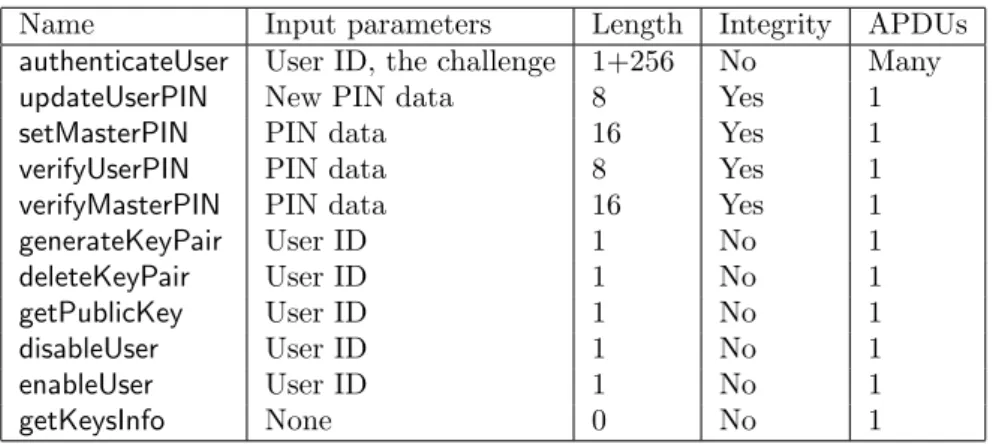
4.2 Applet Commands . . . 44
4.3 Command Invocation Protocol . . . 46
4.4 Command Processing . . . 48
5 The Framework . . . 53
5.1 Support from the CASE Tool . . . 54
5.2 Formal Specification and Verification . . . 54
5.3 Employing the KeY System . . . 57
6 Conclusions . . . 58
2 Background . . . 64
3 JAVACARD Dynamic Logic . . . 67
3.1 Syntax of JAVACARD DL . . . 67
3.2 Semantics of JAVACARD DL . . . 68
3.3 State Updates . . . 69
3.4 Rules of the Sequent Calculus . . . 69
4 Extension for Handling “Throughout” and Transactions . . . 70
4.1 Additional Sequent Calculus Rules for the [[·]] Modality . 71 4.2 Additional Sequent Calculus Rules for Transactions . . . 72
5 Examples . . . 76
6 Conclusions and Future Work . . . 80
Paper III: Specifying JAVA CARD API in OCL 85 1 Introduction . . . 85
2 Background . . . 86
2.1 The KeY Project . . . 86
2.2 JAVACARD and JAVACARDAPI . . . 87
2.3 Use Cases for OCL Specification of the JAVACARDAPI . 88 2.4 Related Work . . . 89
3 The Development of OCL Specification . . . 89
3.1 JML vs. OCL . . . 90
3.2 Exceptions . . . 91
3.3 Thenullvalue . . . 92
3.4 Integer Arithmetics . . . 92
3.5 JML@assignableclause . . . 93
4 The Specification . . . 93
4.1 Formal Verification . . . 97
5 Short Evaluation of OCL . . . 98
6 Conclusions . . . 98
Paper IV: Verification of Safety Properties in the Presence of Transactions 103 1 Introduction . . . 103
2 Background . . . 104
2.1 The KeY Project . . . 104
2.2 JAVACARD Dynamic Logic . . . 105
2.3 Strong Invariants . . . 106
2.4 JAVACARD Atomic Transactions . . . 107
3 Case Study: JAVACARDElectronic Purse . . . 108
3.1 TheLogRecordClass . . . 109
3.2 Specification and Verification of setRecord . . . 110
3.3 ThePurseClass . . . 111
3.4 Specification and Verification of processSale. . . 111
3.5 Post Hoc Verification of Unaltered Code . . . 111
3.6 Performance . . . 113
4 Results . . . 115
4.1 Verification Technology . . . 115
4.2 Design for Specification and Verification . . . 116
5 Related Work . . . 119
6 Conclusions . . . 121
Paper V: Formalisation and Verification of JAVA CARD Security Properties in Dynamic Logic 129 1 Introduction . . . 129
2 Background . . . 130
2.1 The KeY Project . . . 130
2.2 JAVACARD . . . 131
2.3 JAVACARD Dynamic Logic . . . 132
2.4 Related Work . . . 133
3 Case Studies . . . 134
4 Security Properties . . . 134
4.1 OnlyISOExceptionsat Top Level . . . 135
4.2 NoX Exceptions at Top Level . . . 139
4.3 Well Formed Transactions . . . 140
4.4 Atomic Updates . . . 141
4.5 No Unwanted Overflow . . . 144
4.6 Other Properties . . . 145
5 Discussion . . . 146
5.1 Lessons Learned . . . 146
5.2 Static Analysis vs. Interactive Theorem Proving . . . 148
6 Summary and Future Work . . . 148
Acknowledgements
Believe it or not, but for me this the most difficult part of the thesis to write. The reason is that I will never know if I missed someone in the list below. But I will try to do my best to include everyone that deserves my gratitude.
Most of all, I would like to thank my Ph.D. supervisor, prof. Reiner H¨ahnle, for putting up with me and providing me with excellent guidance during my graduate studies at Chalmers. Without him, doing my research and writing this thesis would not be possible. I would also like to thank my opponent, prof. Arnd Poetzsch-Heffter, and the members of my grading committee, prof. Peter Dyb-jer, Mads Dam, and Erik Poll, for agreeing to participate in my Ph.D. defense. The members of my Ph.D. advising committee, prof. Mary Sheeran and Bj¨orn von Sydow, provided me with great support over the last four years.
Many people contributed to the quality of this thesis by commenting on the papers I (co-)wrote and giving me feedback on the thesis as such: prof. Reiner H¨ahnle, prof. Mary Sheeran, prof. Arnd Poetzsch-Heffter, Erik Poll, Steffen Schlager, Philipp R¨ummer, and Martin Giese. At this point I would also like to thank my co-authors for excellent cooperation in writing papers: Bernhard Beckert, Daniel Larsson, and prof. Reiner H¨ahnle. Special thanks to Vladimir Klebanov for helping me give the thesis the “final touch”.
Most of my work has been done in close cooperation with the KeY Project group. I would like to thank the following people, for always interesting dis-cussions and for their friendship: prof. Peter H. Schmitt, Bernhard Beckert, Martin Giese, Wolfgang Ahrendt, Thomas Baar, Angela Wallenburg, Tobias Gedell, Daniel Larsson, Philipp R¨ummer, Vladimir Klebanov, Andreas Roth, Steffen Schalger, and Richard Bubel. Special thanks to Andreas, Steffen, and Richard for exhibiting extreme patience in fulfilling my constant requests about missing features in the KeY system and fixing bugs.
Working in our department would not be possible without our great ad-ministrative staff. I would like to thank Jeanette Tr¨aff, Catharina Jerkbrant, Birgitta Magnusson, and Eva L¨othman for all the help they have provided.
Life does not consist only of work. The list of people that made my social life in Sweden more enjoyable is very long. In particular my gratitude goes to my very good friend and former office mate, Angela Wallenburg, the current fifth floor corridor gang, Andrei Sabelfeld, Wolfgang Ahrendt, Rogardt Heldal, Reiner H¨ahnle, Philipp R¨ummer, Martin Giese, and Jan-Willem Roorda, who sits just around the corner. Other people that specifically contributed to my life outside of work are ´Ad´am Darvas, Erik Kilborn, Tuomo Takkula, Birgit Grohe, Boris Koldehofe, and H˚akan Sundell. Tuomo, Birgit, Boris, and H˚akan were
vsk´y, and Rogardt Heldal. Last in this list, but not least, I would like to thank all of my other office friends for making our department such a great place to work.
I would not have even thought of starting the Ph.D. studies in the first place, if I wasn’t injected with the interest in research and formal methods by Tomasz Janowski during the pre-Chalmers era – many thanks for nursing me through the early stages of my research life.
Finally, I would be nowhere in my life without the love and support of my closest family. Most sincere thanks to Mama (also for proof reading large parts of this thesis!), Tata, and my dear brother Misio. Dziękuję Kochani!
Wojciech Mostowski G¨oteborg
January 2005
Introduction
1
Overview
This thesis is concerned with formal development of JAVA CARD applets. JAVA CARD is a technology that provides a means to program smart cards with (a subset of) the JAVA language. In recent years JAVA CARD technology gained great interest in the formal verification community. There are two main reasons for this. First of all, certain issues are critical in JAVACARD. Application areas like authentication or electronic cash require applets to besafeandsecure. Also, because applets are usually distributed in large amounts, they are difficult and costly tomaintain. Finally,legal mattersmay be critical in certain situations, for example, when the digital signature law is considered. Thus, formal verification of JAVA CARD applets is highlydesired. Secondly, due to the relative language simplicity, JAVACARDis also afeasibletarget for formal verification. The formal verification platform that we used in our research is the KeY system developed in the KeY Project1 [ABB+04]. One of the main objectives of our research is to find out how far formal verification, in particular using the KeY system, for industrial size JAVACARD applets goes, in terms of usability, automation, and power (expressivity of constraints). Furthermore, we investigated practical and theoretical shortcomings of the verification techniques and development methods for JAVA CARD applets. As a result, we adapted the KeY system’s Dynamic Logic to be able to express interesting, meaningful safety and security properties (strong invariants among others) and proposed design guidelines to support and ease formal verification (design for verification). We performed extensive practical experiments with the KeY system to justify and evaluate our work.
Formal aspects of our research concentrate on source code level verification of sequential JAVAprograms, in particular JAVACARD, with interactive and au-tomated theorem proving. Our work has been driven by certain assumptions, motivated by the KeY Project’s philosophy. The basic one is that formal veri-fication should be accessible to software engineers without years of training in formal methods. This turns out to be possible to achieve, however, in certain situations expertise in formal verification is required, in particular when verifica-tion of an already existing JAVACARDcode is considered (post hocverification). Another assumption is that we should be able to perform full verification when-ever needed, i.e., we want to handle complex JAVACARD applets that involve
1 http://www.key-project.org
JAVA CARD specific features, like atomic transactions and object persistency. Moreover, the verified code should not be subjected to translations, simplifica-tions, intermediate representasimplifica-tions, etc. Finally, the properties that we prove should relate to important safety and security issues in JAVACARDdevelopment. We relate to and comment on these goals throughout this work.
This work is a collection of papers that were published during the course of our research. The papers explore the subjects that we have just outlined. We explain the contents of these papers in detail later on in this chapter. First we start with some introductory material about JAVACARDtechnology and the KeY system (Sections 2 and 3). We describe the papers included in this thesis in Section 4 and we discuss the contributions of this work in Section 5. Section 6 gives an overview of related work, and finally, Section 7 discusses possible future work.
2
J
AVAC
ARDHere we give a short, but for the purpose of this thesis complete, introduction to JAVACARDtechnology and language [Che00, Sun03].
Smart Cards. Smart cards (chip cards) are small computers, providing 8, 16 or 32 bit CPU with clock speeds ranging from 5 up to 40 MHz, ROM memory between 32 and 64 KB, EEPROM memory (writable, persistent) between 16 and 32 KB and RAM memory (writable, non-persistent) between 1 and 4 KB. The ROM usually holds the card’s operating system, the EEPROM is used to store persistent data of the applications residing on a smart card (for exam-ple, electronic cash) and the RAM is used for local computations. Smart cards communicate with the rest of the world through application protocol data units (APDUs, ISO 7816–4 standard). The communication is done in master-slave mode – it is always the master/terminal application that initialises the commu-nication by sending a command APDU to the card and then the card replies by sending a response APDU (possibly with empty contents). There is no way for a smart card to initialise the communication (even though its CPU is active when the power is up), it can only reply to requests sent by the host system. APDUs are the only means to communicate with smart cards, which in practice means that the user of a smart card does not have any direct access to a smart card’s “internals” (for example, there is no direct memory access).
JAVA Smart Cards. A smart card can be provided with functionality to run JAVAprograms on it directly. Such cards are usually called JAVApowered cards (or simply JAVAcards) and the whole technology that provides JAVA functional-ity to smart cards (including a restricted subset of a JAVAlanguage to program applets residing on a card) is called JAVACARD. JAVACARD’s ROM, beside the operating system, includes a JAVACARD virtual machine which implements the JAVACARDlanguage and allows applets to be run on the card.
2. JAVACARD 3
JAVA CARD Language Restrictions. Most of the JAVACARDlanguage re-strictions are related to the limited computing resources of smart cards. To start with, large primitive data types, likeint,long,doubleorfloatare not avail-able (althoughintis available on some JAVACARDplatforms). Also characters, and thus strings, are excluded from the JAVACARDlanguage. Furthermore mul-tidimensional arrays, dynamic class loading, threads (concurrency) and garbage collection are not available in JAVA CARD (again, garbage collection might be available on some platforms, but it is not required by the JAVACARDstandard). Otherwise JAVACARDis a fully functional JAVAwith all object oriented fea-tures like interfaces, inheritance, virtual methods, overloading, dynamic object creation and scoping.
JAVA CARD API and Applets. One other aspect where JAVACARD differs from JAVAis JAVACARD’s API. The API is specific to the smart card environ-ment and, thus, it provides support for handling APDUs, smart card Application IDentifiers (AIDs), PIN codes and JAVA CARD specific system routines. Most of the “big” classes of the JAVA API, like System, String or Vector, are not available in JAVACARD.
The applications running in a JAVACARDenvironment are called JAVACARD applets. A proper applet should implement the install method responsible for the initialisation of the applet (one can see it as applet construction) and
a process method for handling incoming command APDUs and sending the
response APDUs back to the host. APDUs are the only means of communication with JAVAsmart cards at the moment, but the upcoming versions of JAVACARD will also include support for Remote Method Invocation protocol. This will further decouple the hardware from the application level.
There can be more than one applet existing on a single JAVA CARD, but there can be only one active at a time (the active one is the one most recently selected by the JAVACARDrun-time environment).
Finally, we present a small example of a JAVA CARD applet to show how applets work in practice. CounterAppletis an applet that simply returns the value of an internal counter when requested by the host. The counter is in-creased each time the applet is selected (activated) by the JAVACARDruntime environment. Here is the code:
import javacard.framework.*;
public class CounterApplet extends Applet { // CounterApplet APDU command codes
final static byte CounterApplet_CLA = (byte)0xB2; final static byte GET_SELECT_COUNT = (byte)0x10; // (persistent) counter variable
private byte counter; protected CounterApplet() {
// applet initialisation counter = (byte)0;
register(); }
public static void install(byte[] bArray, short bOffset, byte bLength) {
new CounterApplet(); }
public void process(APDU apdu) { byte buffer[] = apdu.getBuffer();
if ((buffer[ISO7816.OFFSET_CLA] == ISO7816.CLA_ISO7816) && (buffer[ISO7816.OFFSET_INS] == ISO7816.INS_SELECT)) { // That was the SELECT APDU
counter++; }else{ if (buffer[ISO7816.OFFSET_CLA] != CounterApplet_CLA) ISOException.throwIt(ISO7816.SW_CLA_NOT_SUPPORTED); if (buffer[ISO7816.OFFSET_INS] != GET_SELECT_COUNT) ISOException.throwIt(ISO7816.SW_INS_NOT_SUPPORTED); // That was the command to return the current value of // the counter.
// Switch to ’send response’ mode apdu.setOutgoing();
apdu.setOutgoingLength((short)1); // Prepare the output buffer buffer[0] = counter;
// Send the response
apdu.sendBytes((short)0, (short)1); }
} }
During the initialisation of the applet (installmethod) a new instance of the applet is created, the counter is set to 0 and the applet is registered with the JAVA CARD run-time environment. Then the process method takes care of processing the incoming APDUs. In case it is the select command APDU (the first ifstatement) the counter is increased. Otherwise the APDU is checked again whether it issues a command to return the current value of the counter. If that is the case the response is prepared and sent back to the host, otherwise an exception is thrown, which causes an APDU with a proper status word to be sent to the host informing that the request could not be handled.
JAVA CARD Object Persistency, Atomicity and Transactions. Note that the value of the counter variable is not lost after the card’s session is finished – all the instance variables of the applet are kept in the persistent (usually EEPROM) memory and, thus, their values are preserved when a power loss occurs. This is a specific feature of JAVACARDnot present in JAVA.
3. The KeY System 5
When the execution of a JAVA CARD applet is interrupted unexpectedly then all the updates to persistent objects performed so far are maintained. The atomicity level of the JAVA CARD platform is quite “high” – all the updates to single variables and object fields are atomic. The user can perform atomic updates of a larger size using the transaction mechanism of JAVACARD. Inside a transaction the updates to persistent objects (only) are executed conditionally. When the transaction is committed, all the conditional updates are executed in one atomic step. In case the transaction is aborted (either by an abrupt termination of a program or by a system call) all the conditionally updated objects are rolled back to the state before the transaction started. Take a look at the following fragment of JAVACARDcode:
counter = 100; JCSystem.beginTransaction(); counter = i; counter++; if(counter > 100) JCSystem.abortTransaction(); else JCSystem.commitTransaction();
When the value of the counter inside the transaction rises above 100 the trans-action will be aborted – the value of counter will be rolled back to its state before the transaction started, i.e., it will be 100 again. Otherwise the trans-action will commit successfully and the value of counterwill be equal to i+1
after this piece of the program is executed.
3
The KeY System
The contents of this section is based on selected fragments of [ABB+04]. Here we explain the basic goals of the KeY Project and some technical details about the architecture of the KeY system, the Dynamic Logic used in interactive theorem proving, as well as some notes about the implementation and the current state of the system.
KeY is a tool for the development of high quality object-oriented software. The “KeY” idea behind this tool is to provide facilities for formal specification and verification of programswithina software development platform supporting contemporary design and implementation methodologies. The KeY tool empow-ers its usempow-ers to perform formal specification and verification as part of software development based on the Unified Modelling Language (UML) [Obj03]. To achieve this, the system is realised as the extension of a commercial UML-based
Computer Aided Software Engineering Tool (CASE tool). As a consequence, specification and verification can be performed within the extended CASE tool itself. Such a deep integration of formal specification and verification into mod-ern software engineering concepts serves two purposes. First, formal methods and object-oriented development techniques becomeapplicable in a meaningful
combination. Second, formal specification and verification become more acces-sible to developers who are already using object-oriented design methodology. Moreover, KeY allows alightweight usage of the provided formal techniques, as both, specification and verification, can be performed at any time, and to any desired degree.
UML based software development puts an emphasis on the activity of de-signing the targeted system. It is increasingly accepted that the design stage is very much where one actually has the power to prevent a system from fail-ing. This suggests that formal specification and verification should (in different ways) be closely tied to the design phase, to design documents, and to design tools. One way of combining object-oriented design and formal specification is to attach constraints to class diagrams. An appropriate notation for such a purpose is already offered by the UML: the standard [Obj03] includes theObject Constraint Language (OCL)[WK03]. We briefly point out the three major roles of OCL constraints within KeY:
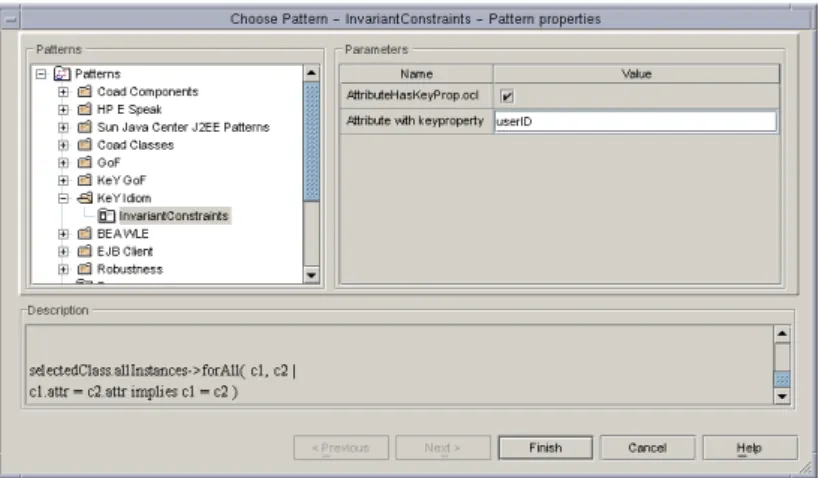
• The KeY tool supports the creation of constraints. While a user is free in general to formulate any desired constraint, he or she can also take advantage of the automatic generation of constraints, a feature which is realised in the KeY tool by extending the CASE tool’s design pattern instantiation mechanism.
• The KeY tool supports the formal analysis of constraints. The relations between classes in the design imply relations between corresponding con-straints, which can be analysed regardless of any implementation.
• The KeY tool supports theverification of implementations with respect to the constraints. A theorem prover with interactive and automatic opera-tion modes can check consistency of JAVAimplementations with the given constraints.
The target language of KeY-driven software development is JAVA. In partic-ular, the verification facilities of KeY are focused on the JAVACARD language [Che00, Sun03]. We have already given the description of JAVACARDtechnology in the previous section. We have also pointed out why JAVA CARD is an
im-portant target for verification, and that the technical restrictions of JAVACARD make verification of the full language feasible. However, KeY is not restricted to being used for the development of smart card applications – many features of JAVAthat are not present in JAVACARDare nevertheless supported by KeY, for example,intandlongdata types or characters and strings. In general, the KeY tool is applicable to most sequential JAVAprograms.
3.1
Architecture of the KeY Tool
The KeY system is built on top of a commercial CASE tool. Integrating our system into an already existing tool has obvious advantages:
3. The KeY System 7
Verification Middleware
automated interactive Deduction Component CASE Tool Together CC
extension for formal specification
UML OCL Java
Dynamic Logic
Figure 1. The architecture of the KeY system
1. All features of the existing tool can be used and do not need to be reim-plemented.
2. The software developer does not have to become familiar with a new de-sign and development tool. Furthermore, the developer is not required to change tools during development, everything that is needed is integrated into one tool.
A CASE tool that is well suited for our purposes has to be easily extensible and the extensions have to fit nicely into the tool providing a uniform user interface. At the moment we useTogether Control Center from Borland.2 Among all the tools on the market this one seems to be the most suitable for our purposes. It has state-of-the-art development and UML support (including some very basic support for textual specifications) and can be extended in almost any possible way by JAVA modules – TogetherCC offers access to most of its “internals” by means of a JAVAopen API. There is, however, no fundamental obstacle to adding the KeY extensions to other, similar CASE tools, for example, work on integrating KeY into Eclipse3 is underway.
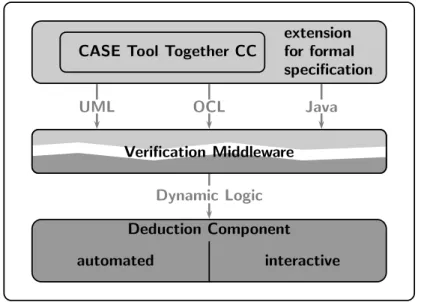
The architecture of the KeY system is shown in Figure 1. In the following, we briefly describe the components and the interactions between them:
1. Themodelling component (upper part in Figure 1) consists of the CASE tool with extensions for formal specification. While the CASE tool already
2
http://www.borland.com/together/
allows the software model to contain OCL specifications, it does not have any support to create or process them in a formal way – OCL specifica-tions are just textual annotaspecifica-tions and are handled in the same way as comments. This is where the extension comes into play. It allows the user to create, process and prepare the OCL specifications (together with the model and its implementation) which can be later processed and passed to the deduction component. Manipulating OCL specifications is done by employing external programs and libraries as well as using TogetherCC’s pattern mechanism to instantiate specifications from OCL specification templates [BHSS00, GHL04]. The CASE tool itself provides all the func-tionality for UML modelling and project development and is responsible for most of the user interactions with the project.
2. The verification middleware is the link between the modelling and the deduction component. It translates the model (UML), the implementation (JAVA) and the specification (OCL) into JAVACARDDynamic Logic proof obligations which are passed to the deduction component. JAVA CARD Dynamic Logic is a program logic used by the KeY prover (deduction component). The verification component is also responsible for storing and managing proofs during the development process.
3. Thededuction component is used to construct proofs for JAVACARD Dy-namic Logic proof obligations generated by the verification component. It is an interactive verification system combined with powerful automated deduction techniques. All those components are fully integrated and work on the same data structures.
3.2
Dynamic Logic
We use an instance of Dynamic Logic (DL) [KT90, HKT00] – which can be seen as an extension of Hoare logic – as the logical basis of the KeY system’s software verification component. Deduction in DL is based on symbolic pro-gram execution and simple propro-gram transformations and is, thus, close to a programmer’s understanding of JAVA. DL is used in the software verification systems KIV [BRS+00] and VSE [HLS+96] for (artificial) imperative program-ming languages. More recently, the KIV system supports also a fragment of the JAVAlanguage [Ste01]. In both systems, DL was successfully applied to verify software systems of considerable size [BRS+00, Ste01].
DL can be seen as a modal logic with a modality hpi for every program p (we allowpto be any sequence of legal JAVACARDstatements);hpirefers to the successor worlds (called states in the DL framework) that are reachable by run-ning the programp. In standard DL there can be several such states (worlds) because the programs can be non-deterministic; but here, since JAVACARD pro-grams are deterministic, there is exactly one such world (if p terminates) or there is no such world (ifpdoes not terminate). In JAVACARDDL termination forbids exceptions to be thrown, i.e., a program that throws an uncaught ex-ception is considered to be non terminating (or, terminating abruptly) [BS01].
3. The KeY System 9
The formulahpiφexpresses that the programpterminates in a state in whichφ holds. A formulaφ→ hpiψis valid if for every statessatisfying pre-conditionφ a run of the programp starting in sterminates, and in the terminating state the post-conditionψholds.
Thus, the formulaφ→ hpiψis similar to the Hoare triple{φ}p{ψ}. But in contrast to Hoare logic, the set of formulas of DL is closed under the usual logical operators. In Hoare logic, the formulasφ and ψ are pure first-order formulas, whereas in DL they can contain programs. DL allows to involve programs in the descriptions φresp. ψ of states. For example, using a program, it is easy to specify that a data structure is not cyclic, which is impossible in pure first-order logic. Also, all JAVAconstructs are available in our DL for the description of states (including whileloops and recursion). It is, therefore, not necessary to define an abstract data type state and to represent states as terms of that type; instead DL formulas can be used to give a (partial) description of states, which is a more flexible technique and allows one to concentrate on the relevant properties of a state.
3.3
Syntax of J
AVAC
ARDDL
As mentioned above, a dynamic logic is constructed by extending some non-dynamic logic with a modal operator h·i. In addition, we use the dual oper-ator [·], for which [p]φ ≡ ¬hpi¬φ. The non-dynamic base logic of our DL is typed first-order predicate logic. We do not describe in detail what the types of our logic are (basically they are identical to the JAVAtypes) nor how exactly terms and formulas are built. The definitions can be found in [Bec01]. Note that terms (which we often call “logical terms” in the following) are different from JAVAexpressions; the former never have side effects.
In order to reduce the complexity of the programs occurring in formulas, we introduce the notion of aprogram context. The context can consist of any JAVA CARD program, i.e., it is a sequence of class and interface definitions. Syntax and semantics of JAVA CARD DL formulas are then defined with respect to a given context; and the programs in JAVACARD DL formulas are assumed not to contain class definitions.
The programs in JAVACARDDL formulas are basically executable statements of JAVA CARD code. The verification of a given program can be thought of as symbolic code execution [HK76]. As will be detailed below, each rule of the calculus for JAVA CARD DL specifies how to execute one particular JAVA statement, possibly with additional restrictions. When a loop or a recursive method call is encountered, it is necessary to perform induction over a suitable data structure.
Given that we follow the symbolic execution paradigm for verification, it is evident that a certain amount of runtime infrastructure must be represented in JAVACARDDL. It would be possible, but clumsy and inefficient, to achieve this by purely logical means. Therefore, we introduced an additional construct for handling of method calls that is not available in plain JAVACARD. Methods are invoked by syntactically replacing the call by the method’s implementation. To
handle thereturnstatement in the right way, possible exceptions, and dynamic binding it is necessary (a) to record the object field or variablexthat the result is to be assigned to, (b) to record the objectoand its typeC that the method is applied to, and (c) to mark the boundaries of the implementationbodywhen it is substituted for the method call. For that purpose, we allow statements of the formmethod-frame(x,C(o)){body}to occur in JAVACARD DL programs. In practice, before themethod-frame construct is introduced in a proof, rules that establish the run-time type of o and factor out method calls appearing inside expressions are applied first. Note, that themethod-frame construct is a “harmless” extension because this construct is only used for proof purposes and never occurs in the verified JAVACARD programs.
3.4
Proof Obligations
Let us now turn to the translation of OCL constraints into JAVACARDDL proof obligations. To prove that a method m(arg1,...,argn) of class C satisfies a
pre-/post-condition pair, the OCL conditions are first translated into first-order formulaspre(self,arg1, . . . ,argn) andpost(self,arg1, . . . ,argn), respectively. From these formulas, KeY constructs the JAVACARD DL proof obligation:
pre(self,arg1, . . . ,argn)→
hself.m(arg1,...,argn);ipost(self,arg1, . . . ,argn)
where nowselfandarg1, . . . ,argn are program variables, which are implicitly universally quantified with respect to their initial value.
Similarly, to prove that a methodm(arg1,...,argn)preserves an invariant,
the proof obligation
(inv(self) ∧ pre(self,arg1, . . . ,argn))→
hself.m(arg1,...,argn);iinv(self)
is constructed, whereinv(self) is the first-order translation of the invariant.
3.5
Deductive Calculus for Proving Obligations
As usual for deductive program verification, we use a sequent-style calculus. A
sequent is of the form Γ ` ∆, where Γ,∆ are duplicate-free lists of formulas. Intuitively, its semantics is the same as that of the formulaVΓ
→W∆.
Rules of a sequent calculus are often represented by rule schemata, such as the example rules that will follow. In the KeY system, rules are implemented using the taclet mechanism (see the next section).
A proof for a goal (a sequent) S is an upside-down tree with root S. In practice, rules are applied from bottom to top. That is, proof construction starts with the initial proof obligation at the bottom and ends with axioms (rules with an empty premise tuple). In the following we describe some exemplary rules of the calculus. The whole JAVACARDDL calculus contains (at least) one rule for each JAVACARD programming construct, in total there are about 250 rules for handling the JAVApart of the logic.
3. The KeY System 11
The Active Statement in a Program
The rules of our calculus operate on the first active command p of a pro-gramπpω. The non-active prefixπconsists of an arbitrary sequence of opening braces “{”, labels, beginnings “try{” of try-catch-finallyblocks, and begin-nings “method-frame(. . .){” of method invocation blocks. The prefix is needed to keep track of the blocks that the (first) active command is part of, such that the abruptly terminating statementsthrow,return,break, andcontinuecan be handled appropriately.4 The postfix ω denotes the “rest” of the program, i.e., everything except the non-active prefix and the part of the program the rule operates on. For example, if a rule is applied to the following JAVA block operating on its first active command “i=0;”, then the non-active prefixπand the “rest”ωare the indicated parts of the block:
l:{try{ | {z } π i=0; j=0; } finally{ k=0; }} | {z } ω
The Assignment Rule and Handling State Updates
In JAVA(like in other object-oriented programming languages), different object variables can refer to the same object. This phenomenon, called aliasing, causes serious difficulties for handling of assignments in a calculus for JAVACARDDL. For example, whether or not a formula “o1.a= 1” still holds after the (sym-bolic) execution of the assignment “o2.a = 2;”, depends on whether or noto1
ando2refer to the same object.
Therefore, JAVA assignments cannot be symbolically executed by syntactic substitution. Solving this problem naively – by doing a case split if the effect of an assignment is unclear – is inefficient and leads to heavy branching of the proof tree.
In our JAVACARDDL calculus we use a different solution. It is based on the notion ofupdates. These (state) updates are of the form {loc :=val} and can be put in front of any formula. The semantics of{loc :=val}φis the same as that ofhloc = val;iφ. The difference between an update and an assignment is syntactical. The expressionsloc andval must be simple in the following sense:
locis (a) a program variablevar, or (b) a field accessobj.attr, or (c) an array access arr[i]; and val is a logical term (that is free of side effects). More complex expressions are not allowed in updates.
The syntactical simplicity of loc and val has semantical consequences. In particular, computing the value ofval has no side effects. The KeY system uses special simplification rules to compute the result of applying an update to logical terms and formulas not containing programs. Computing the effect of an update to a program p(and a formula hpiφ) is delayed until p has been symbolically
4 In DL versions for simple artificial programming languages, where no prefixes are needed,
any formula of the formhpqiφcan be replaced by hpihqiφ. In our calculus, splitting of
hπpqωiφintohπpihqωiφis not possible (unless the prefixπis empty) becauseπpis not a valid program; and the formulahπpωihπqωiφcannot be used either because its semantics is in general different from that ofhπpqωiφ.
executed using other rules of the calculus. Thus, case distinctions are not only delayed but they can often be avoided completely, because (a) updates can be simplified before their effect is computed and (b) their effect is computed when a maximal amount of information is available (namely after the symbolic execution of the program).
The assignment rule now takes the following form (U stands for an arbitrary sequence of updates):
Γ ` U {loc:=val}hπ ωiφ
Γ ` U hπloc = val;ωiφ (R1)
That is, it just adds the assignment to the list of updatesU. Of course, this does not solve the problem of computing the effect of the assignment. This problem is postponed and solved by rules for simplifying updates.
This assignment rule can, of course, only be used if the expression val is a logical term. Otherwise, other rules have to be applied first to evaluate val (as that evaluation may have side effects). For example, these rules replace the formula hx = ++i;iφ with hi = i+1; x = i;iφ. One can view these rules as on-the-fly program transformations. Their effect is always local and fairly obvious, so that the user’s understanding of the proof is not obfuscated.
The Rule for if-else
One more example that shows how the calculus corresponds to symbolic program execution, is the rule for theifstatement:
Γ, U(b=. true) ` U hπ p ωiφ Γ, U(b=. false) ` U hπ q ωiφ
Γ ` U hπif(b) p else q ωiφ (R2)
The two premises of this rule correspond to the two cases of theifstatement. The semantics of rules is that, if all the premises are true in a state, then the conclusion is true in that state. In particular, if the premises are valid, then the conclusion is valid. As the rule demonstrates, applying it (from bottom to top) corresponds to a symbolic execution of the program to be verified.
The Rules for try/throw
Finally, the following rules allow to handletry-catch-finallyblocks and the
throwstatement. These are simplified versions of the actual rules that apply to
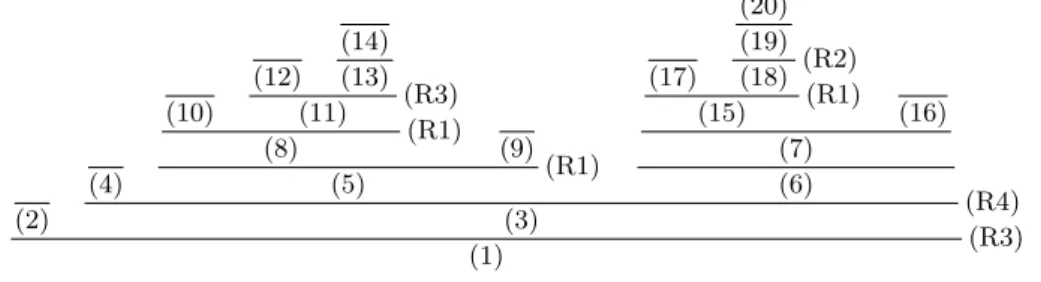
the case where there is exactly onecatch clause and onefinallyclause. Γ ` instanceof(exc, T) Γ ` hπtry{e=exc;q}finally{r}ωiφ
Γ ` hπtry{throw exc;p}catch(T e){q}finally{r}ωiφ (R3)
Γ ` ¬instanceof(exc, T) Γ ` hπ r; throw exc;ωiφ
Γ ` hπtry{throw exc;p}catch(T e){q}finally{r}ωiφ (R4)
The predicate instanceof(exc, T) has the same semantics as the instanceof
operator in JAVA. It evaluates to true if the value of exc is assignable to a program variable of typeT, i.e., if its dynamic type is a sub-type ofT.
3. The KeY System 13
Rule (R3) applies if an exception exc is thrown that is an instance of ex-ception classT, i.e., the exception is caught; otherwise, if the exception is not caught, rule (R4) applies.
3.6
Taclets
Most existing interactive theorem provers are “tactical theorem provers”. The tactics for which these systems are named are programs which act on the proof tree, mostly by many applications of primitive rules, of which there is a small, fixed set. The user constructs the proof by selecting the tactics to run. Writing a new tactic for a certain purpose, for example, to support a new data type theory requires expert knowledge of the theorem prover.
In the KeY prover, both tactics and primitive rules are replaced by thetaclet
concept [BGH+04, Hab00]. A taclet combines the logical content of a sequent calculus rule with pragmatic information that indicates when and for what it should be used. In contrast to the usual fixed set of primitive rules, taclets can easily be added to the system. All the JAVA CARD DL calculus rules are implemented in the form of taclets. Moreover, since rules can be dynamically added to the prover, it is possible to have alternative sets of rules for certain purposes. For example, when dealing with integer arithmetics, different integer semantics can be chosen to handle all possible overflow scenarios: ideal integer arithmetics (no overflow), finite integer types (overflow prohibited), or JAVA integer semantics (types are finite, overflow is allowed and modelled accurately as it happens in JVM) [BS04].
Taclets are formulated as simple pattern matching and replacement schemas. For instance, a typical taclet might read as follows:
find (b -> c ==>)
if (b ==>) replacewith (c ==>) heuristics(simplify)
This means that an implication b -> c on the left side of a sequent may be replaced by c, if the formula b also appears on the left side of that sequent. The clause heuristics(simplify) indicates that this rule should be part of the heuristic namedsimplify, meaning that it should be applied automatically whenever possible if that heuristic is activated.
While taclets can be more complex than the typically minimalistic primitive rules of tactical theorem provers, they do not constitute a tactical programming language. There are no conditional statements, no procedure calls and no loop constructs. This makes taclets easier to understand and easier to formulate than tactics. In conjunction with an appropriate mechanism for application of heuristics, they are nevertheless powerful enough to permit interactive theorem proving in a convenient and efficient way.
In principle, nothing prevents one from formulating a taclet that represents an unsound proof step. It is possible, however, to generate a first-order proof obligation from a taclet, at least for taclets not involving programs. If that formula can be proven using a restricted set of “primitive” taclets, then the
new taclet is guaranteed to be a correct derived rule. As for the primitive taclets for handling JAVA programs in JAVA CARD DL, it is possible to show their correctness using the Isabelle formalisation of JAVAby Oheimb [vO01].
3.7
Implementation
The KeY tool is an extension of the commercial case tool TogetherCC. The open API of TogetherCC allows the KeY tool to add items to the CASE tool’s contextual menus for classes, methods, etc. The API also makes it possible to modify the currently open UML model. All KeY system extensions can optionally be switched on and off in TogetherCC and thus it is the developer’s decision to use them or not.
The KeY tool is implemented in the JAVA programming language. This choice has several advantages, besides the obvious one of portability. Using the JAVAlanguage makes it easy to link the KeY tool to TogetherCC, which is also written in JAVA. More generally, JAVA is well suited for interaction with other tools, whether they are written in JAVA or not. In particular, the imperative nature of the language leads to a comparatively natural native code interface, in contrast to the logic or functional programming languages often preferred for deduction purposes.
JAVA was also a good choice for the construction of the graphical user in-terface, which is an important aspect of the KeY tool. Finally, previous exper-iments with both interactive [Hab00] and automated [Gie01] theorem proving have shown that the advantages of JAVAoutweigh the additional effort for the implementation of term data structures, unification, etc.
Some components of the KeY tool can be used stand alone. In particular, it is possible to use the KeY prover to prove properties about JAVAprograms without the presence or availability of the CASE tool. The KeY system is still being developed; however it can already handle all of JAVACARD features, including JAVACARDtransactions and object persistency. The current publicly available version of KeY can be downloaded from the KeY Project web page.5 Development versions are available on request.
4
Description of the Papers
In the following we give a description of the papers included in this thesis. All the papers have been revised and are self contained. Thus, some introduc-tory material in the papers is repeated and overlaps with the material already presented in this introduction. For each of the papers we shortly present its contents, describe its relation to this thesis and the author’s involvement in the presented work.
4. Description of the Papers 15
Paper I: Rigorous Development of JAVA CARD Applications
This paper is the starting point to develop a rigorous, well defined development process for JAVA CARD applications with formal methods support. It is based on a real-life case study – a system for authenticating users in the Linux sys-tem with JAVA Powered iButtons6 instead of the password mechanism. The first step was to identify all the problems and deficiencies of the JAVA CARD applet caused by an unorganised development process and “too relaxed” use of the JAVACARDlanguage. Then a development process is proposed, which aims at overcoming the problems discovered. Among other things, it ensures a well defined and self-controlled (by the applet itself) message exchange protocol dis-allowing tampering with the applet, it enforces integrity checks on the incoming APDU data (wherever necessary) and constrained usage of memory making the applet “memory safe”. The development process is based on UML and OCL giving the basis for formal verification. The new development process applied to the case study (i.e., the case study was reengineered) produced a robust, self-controlled, memory safe JAVACARD applet. Moreover, most of the actual applet code was derived from UML/OCL specifications.
The paper also describes the problem of a card “rip-out” in some detail. The problem occurs when the execution of the applet is abruptly terminated by ripping out the card from the reader (terminal) or simply by power loss. In such a case the applet’s memory may be left in an undefined state, disabling the proper functioning of the applet in some cases. To handle this problem one needs to be able to specify and prove a property that should hold throughout the whole execution of a JAVA CARD program, so that in case of a “rip-out” at any point the property is maintained. The theoretical aspects of handling “rip-out” properties is the subject of the next paper.
The work described in this paper was carried out solely by the author. Origi-nally, this paper was presented at the Rigorous Object Oriented Methods Work-shop in London, March 2002 [Mos02]. Later it was submitted to the Software and Systems Modelling Journal and it is currently undergoing the review pro-cess.
Paper II: A Program Logic for Handling JAVA CARD’s
Transaction Mechanism
This paper extends the JAVACARD Dynamic Logic used in the KeY system’s interactive prover to handle the mentioned “rip-out” properties. The new modal operator “throughout” is introduced to the logic, which can be used to prove that a property holds throughout the whole execution of a JAVA CARD pro-gram (in all the intermediate states). We call the “rip-out” properties strong invariants. Such an invariant on the objects’ data is maintained at any time during applet execution and, in particular, in case of abrupt termination. The main challenge in this work was to handle JAVACARD’s transaction mechanism
6 “iButtons” are particular J
AVA CARD devices embedded in a button shaped case, see
in connection with object persistency (which is specific to JAVACARD) in the sequent calculus rules. It should be noted here that transactions and object persistency affect the semantics of theh·i and [·] modal operators (specifically programmatic abortion of a transaction) – the necessary rules to handle transac-tions for diamond and box operators are also presented in the paper. The paper also contains examples of simple proofs using the new rules. To the best of our knowledge, currently there is only one other research effort to deal with JAVA CARDtransactions and “rip-out” properties in JAVACARDprogram verification, see Section 6.
This paper was presented (and published in the proceedings) at the Funda-mental Approaches to Software Engineering Conference (part of ETAPS) held in Warsaw, April 2003 [BM03]. The theoretical aspects of introducing the ex-tensions to the JAVA CARD DL calculus were carried out in close cooperation with Bernhard Beckert from the University of Karlsruhe, Germany7during the author’s six months research visit to Karlsruhe. Later on, the author imple-mented all the extensions in the KeY prover by himself. The version of the paper included in this thesis is a slightly extended version of the one published in the conference proceedings.
Paper III: Specifying JAVA CARD API in OCL
After implementing the “throughout” and transactions extensions the author engaged in practical experiments. At that point it was already known that to properly verify real JAVA CARD applications one needs a full JAVA CARD API specification. Such a specification is used in proofs to handle method calls to the JAVA CARD library. In particular, when the implementation of a given method in the JAVA CARD API is not known, the prover should “re-place” the method call with the specification of that method. Since OCL is the main design and specification language in KeY, it was a natural deci-sion to develop the specification of the JAVACARD API in OCL. The starting point for this work was the already existing specification of the API written in JML (JAVA Modelling Language) [LBR99] developed for the LOOP tool (see Section 6). The paper reports on the problems that were encountered when writing the specification and their solutions. This work was also treated as a JAVA CARD verification case study for the KeY system, successful veri-fication attempts of some small parts of the reference implementation of the API library are reported. Finally, the paper evaluates OCL and compares it to JML in the context of JAVA CARD program specification and verifica-tion.
Later on, when the KeY prover was equipped with the ability to use OCL method specifications (or method contracts, as they are referred to in KeY) in proofs, certain practical deficiencies of OCL have been discovered. In short, proper verification of JAVACARD programs using method contracts requires at-tribute modification information to be given in the specification [M¨ul01, BS03].
7 Currently at the Department of Computer Science, University of Koblenz-Landau,
4. Description of the Papers 17
Pure OCL does not support this, KeY introduces its own OCL extensions to handle such information (“modifies” clauses). Yet another problem is OCL’s limited capability to deal with primitive arrays, which are the basis of the JAVA CARDcommunication and API. Finally, the OCL parser (external) implementa-tion that KeY uses, does not handle JAVApackage information. Given all this, it turned out that OCL in its pure form is too high level for low level applications like JAVACARD. Currently, the experience gathered during this work serves as a case study to develop a more flexible OCL parser and type checker8 [Joh04]. Such a general purpose parser could be used to interface OCL to a formal ver-ification tool like KeY. The last paper of this thesis gives some brief insights on how we have overcome the deficiencies of OCL by defining method contracts directly in JAVACARD DL.
The work described in this paper has been carried out mostly by Daniel Larsson9as his Master’s Thesis project [Lar03]. He has been supervised by the author of this thesis. Together, we wrote a paper based on Daniel’s work, which was presented at the OCL 2.0 Satellite Workshop of the UML Con-ference, held in San Francisco, October 2003 [LM04]. Although the author’s involvement in the actual development of the JAVA CARD API specification was limited, we still consider this work an important element of further re-search that took place. Therefore, we decided to include this paper in the thesis.
Paper IV: Verification of Safety Properties in the Presence of Transactions
This paper presents the first practical case study, based on a real JAVA CARD application, that involve strong invariants and JAVA CARD transactions. Some difficulties has been discovered when trying to prove safety properties related to transactions. It is argued that, to overcome such difficulties, formal verification has to be taken into account during the design and coding phase of the JAVA CARD applet development. This gives raise to practical JAVA CARD design for
verificationguidelines. As a result of applying such guidelines, safety properties for JAVACARD applets can be proven easily – automatically and in a relatively short time. To support this claim, benchmarks of the KeY system are given in the paper.
All the practical work described in this paper was done by the author of this thesis. The author’s supervisor, prof. Reiner H¨ahnle,10 was invited to the CASSIS (Construction and Analysis of Safe, Secure and Interoperable Smart devices) Workshop (Marseille, March 2004), where he presented this work. The paper that we have written together, was accepted to be published in the post-workshop LNCS proceedings [HM05].
8 http://www.cs.chalmers.se/~krijo/ocltc/
9 Department of Computer Science and Engineering, Chalmers University of Technology,
SE-412 96 G¨oteborg, Sweden, e-mail: [email protected]
10Department of Computer Science and Engineering, Chalmers University of Technology,
Paper V: Formalisation and Verification of JAVA CARD
Security Properties in Dynamic Logic
This paper presents how common JAVA CARD security properties can be for-malised in Dynamic Logic and verified with the KeY system. The properties under consideration originate from [MM01], a document listing JAVACARD se-curity properties to be studied in the SecSafe Project.11 It consists of ten security properties that are of importance to the smart card industry. In the paper we show how we formalised and verified a large part of those proper-ties. For the remaining properties we give concrete suggestions on how they can be treated in interactive theorem proving. The formalisation of the properties is accompanied by concrete examples based on real-life, industrial size, JAVA CARD applications. The first one is the authentication applet described in the first paper of this thesis. The second is an electronic purse applet Demoney, provided to us by Trusted Logic.12 TheDemoney applet is also the motivat-ing example for the previous paper. The SecSafe Project focuses on applymotivat-ing static analysis techniques to establish the JAVA CARD security properties. We managed to formalise the properties in JAVACARDDL and verify them with the KeY prover. Therefore, we give an assessment of interactive theorem proving as an alternative to static analysis. Finally, all the verification described in the paper, was performed on anunaltered JAVACARDcode, which was not designed to support verification (i.e., we used JAVACARDcode “as is”). Thus, we discuss the practical experience that we gathered during the course of this work. The main conclusion is that, for the scenario of JAVACARDapplet verification, while automation is still achievable and the time requirements stay within reasonable limits, certain user expertise is required.
The work described in this paper was carried out solely by the author. The paper was accepted to be published in the proceedings of the Fundamental Approaches to Software Engineering Conference, to be held in Edinburgh, Scot-land, April 2005 [Mos05]. The version of the paper included in this thesis is an extended version of the conference paper, published as a technical re-port [Mos04].
5
Contributions
The work presented in this thesis brings a number of benefits to the area of formal JAVACARDdevelopment and, in particular, to the KeY Project. To start with, the development process for JAVACARD has been investigated. Together with the design for verification guidelines presented in the fourth paper and other case study work (for example, see [BH04]) it gives a solid basis for defining a general formal verification oriented development process that would bring formal methods to contemporary software engineering.
11http://www.doc.ic.ac.uk/~siveroni/secsafe/ 12
http://www.trusted-logic.com. We thank Renaud Marlet for providing the Demoney
5. Contributions 19
Secondly, a lot of practical experiments and formal verification have been performed during the course of this work. In particular, this gives the KeY system a real usability test in the context of industrial size JAVACARD applets. Moreover, we believe that the practical experience that we gathered could be useful for JAVACARDverification attempts using other tools as well. Our exper-iments have been driven by the following aspects: expressiveness, automation, and performance. To enhance expressiveness the JAVA CARD DL has been ex-tended with the throughout modality, which enables us to express and verify JAVA CARD specific properties (strong invariants for rip-out situations). The ideas behind our extensions to handle the throughout modality and transactions could be used in other Hoare-like logics for JAVACARD programs. The last two papers of this thesis show that a tool equipped with such extensions can be used to verify many of the interesting JAVACARD safety and security properties.
The main obstacle to reach full automation in the verification process are loops and recursion. In principle, handling loops and recursive method calls requires using the induction rule in the proof. Although work on supporting inductive proofs is underway [HW03, Wal04], induction still requires user inter-action with the prover. However, in practice, recursion is non existent in JAVA CARD programs, so this is not considered to be a problem. As for loops, the situation is also manageable. In JAVA CARD, most of the loops have constant bounds and can be symbolically executed step by step without user interaction (although the proofs tend to grow large). Moreover, the loops that are not bounded by a constant, are usually in a special form, i.e., each execution of loop body is independent of the other loop body executions (for example, simple array traversal or initialisation). In such situations, loops can be handled by a dedicated loop rule. Our practical experience regarding the loops currently serves as a basis for research on such JAVACARD specific loop handling. What also helps with loops, is the proper design and coding of the routines involv-ing loops. Such design and codinvolv-ing guidelines should be incorporated into the general JAVACARD development process described above.
Our research has identified performance bottlenecks of the KeY prover. One of the bottlenecks is the handling of loops described above. The other one is the efficient use of JAVA CARD API method contracts in proofs. The current contract mechanism implemented in KeY turns out not to be flexible enough in some situations. Our research has identified the deficiencies in this respect and issues that need to be addressed in the implementation of the contract mech-anism to reach full support for JAVA CARD specific method contracts. Such improvements are currently underway. Despite the discovered performance de-ficiencies, we found the KeY prover flexible enough to handle complex JAVA CARD applets, mostly automatically, in reasonable time. Given that, according to the literature [PvdBJ00, JMR04], other JAVA CARD verification tools sup-port method contracts quite well, we consider regular use of formal methods in software engineering, and, in particular, JAVACARD development, absolutely feasible in the near future.
Finally, we introduced the throughout modality for the sole purpose of han-dling the rip-out properties. However, there is no obstacle to introduce other
temporal modal operators to the JAVACARD DL. The theoretical research re-garding the transaction mechanism, and the schematic modal operators frame-work implemented by us in the KeY prover, make implementing a new modality in the prover literally a one day process, given that the set of the rules for the new modality is known. Additional temporal operators could be used to specify and prove correctness of non-terminating programs, for example, control soft-ware in JAVA2 Micro Edition devices. Given the close relation of the Dynamic Logic to Hoare calculus and relative genericity of our solution, we believe that extensions to handle temporal properties could also be added to other JAVA CARD verification tools in a similar fashion.
6
Related Work
In recent years formal approaches to JAVACARD development gained consider-able interest, both in academia and industry. Work in JAVACARD verification can be classified according to several criteria. Working on byte code avoids the problems of source code availability and compiler trustworthiness, but makes full verification more difficult due to information loss during compilation. An overview of work done on the byte code level is provided in [Boy03]. For us the most interesting projects and approaches are those that aim at source code verification of JAVAand JAVACARD programs. To start with, [HM01] contains an overview of the existing literature (until end of year 2001) on JAVAand JAVA CARD safety with emphasis on formal approaches (including the ones targeted at byte code level). Here we list the most relevant (in our opinion) tools and approaches to formal verification of JAVAand JAVACARD programs.
The iContract tool [Kra98, Ens01], based on the idea of Design-By-Contract [Mey92], represents the most lightweight category of tools to enforce reliability of JAVAprograms. In this approach, a JAVAprogram is decorated with annotations from a restricted language (based on OCL). Such specifications are checked during runtime, giving raise to exceptions when the specification is violated. Some other tools for JAVA based on the idea of run-time assertion checking are Jass13(uses a language resembling JML), the JML compiler –jmlc[CL02a] (assertions are written in a subset of JML), orjmlunit[CL02b], which combines JML assertion checking with unit testing [BG98].
The ESC/JAVA tool [FLL+02] also relies on annotations from a restricted specification language, based on JML. The tool employs extended static check-ing techniques to validate JAVA programs. Annotated programs (via an inter-mediate representation) undergo a dynamic analysis that produces first-order verification conditions for a theorem prover (Simplify). The analysis does not attempt to be sound or complete, but it is fully automatic and produces warn-ings, when annotations are potentially violated. With ESC/JAVAit is possible to express and check properties similar to our strong invariants – an arbitrary code location can be annotated with an object invariant [LS97]. Annotating every program statement with an object invariant is an equivalent of expressing
6. Related Work 21
a strong invariant. The development of ESC/JAVA2, the successor of ESC/JAVA, started at the University of Nijmegen, Netherlands, as part of the VerifiCard Project14[JMP01]. The following tools that we discuss are also related to this project.
The Jive system [MPH00, MMPH00] uses an extended Hoare-style calcu-lus [PHM99] to prove properties about programs written in subdialect of JAVA CARD (Diet JAVA CARD). Jive is an interactive theorem prover with a ded-icated user interface that uses an associated general purpose theorem prover (Isabelle [Pau94] or PVS [ORSvH95]).
The LOOP tool [JP03] employs a Hoare-like logic formalised in Type The-ory [JP01, vdBHJP00, HJ00] to verify sequential JAVA programs. The back-end theorem prover of the LOOP tool is PVS and the input specification language is JML. The LOOP tool is capable of verifying advanced JAVA pro-grams [vdBJP01, JMR04, BCHJ04]. As a part of the work on the LOOP tool, a JAVACARDAPI specification in JML has been developed [MP01, PvdBJ00].
Yet another system associated with the VerifiCard Project is the
Kraka-toa tool [MPMU04]. Here, JAVA programs and their JML specifications are translated into an intermediate, mostly functional, language, then proof obli-gations are generated, which in turn are proved with the Coq proof assis-tant [CDT04].
The VerifiCard Project tools that we mention, have been used to perform serious verification of a commercial JAVACARDapplet [JMR04]. The considered property is one of the properties listed in [MM01]. The main result of the paper is that subtle bugs were found in the verified applet. In the last two papers of this thesis we give a more thorough comparison to the tools and results described in [JMR04]. We should also mention here that recently some preliminary work to reason about rip-out properties and JAVACARDtransactions has been initiated in the context of the VerifiCard Project [HP04] (there, rip-outs are called card tears). This is the only work that we are aware of that considers JAVACARD’s transaction mechanism. The approach taken in [HP04] differs from ours in certain respects, we describe that in the fourth paper of this thesis.
The JACK (JAVA Applet Correctness Kit) tool [BRL03] is also associated with the VerifiCard project, but initially it has been developed outside of the project by Gemplus Research Labs. Currently, it is maintained as part of the Everest project at INRIA, Sophia-Antipolis, France.15 The motivation and goals of JACK are closely related to those of the KeY system – JACK is designed for JAVAprogrammers that do not have background in formal methods. It provides intuitive, integrated user interface to developers (like KeY, JACK is integrated into a commercial IDE tool). Specifications for JACK are written in JML. The tool implements fully automated weakest precondition calculus. It can generate proof obligations for the B [Abr96] method’s prover, Simplify theorem prover (the prover used by the ESC/JAVA), orCoqproof assistant.
14
http://www.verificard.org