FAKULT ¨
AT F ¨
UR INFORMATIK
DER TECHNISCHEN UNIVERSIT ¨AT M ¨UNCHENMaster’s thesis in computer science
Privileged User Password Management in
Shared Environments
FAKULT ¨
AT F ¨
UR INFORMATIK
DER TECHNISCHEN UNIVERSIT ¨AT M ¨UNCHENMaster’s thesis in computer science
Privileged User Password Management in Shared
Environments
Privileged User Password Management in verteilten
Umgebungen
Author:
Manuel S ¨ohner
Supervisor:
Prof. Dr.-Ing. Georg Carle
Advisors:
Benjamin Hof, M.Sc
Daniela P ¨ohn, Felix von Eye (LRZ)
Dr.-Ing. Ingo Pansa (iC Consult GmbH)
Submission date: April 15, 2014
I assure the single handed composition of this master’s thesis only supported by declared resources.
Acknowledgments
I would like to thank the advisors Benjamin Hof from the Chair for Network Architectures and Services, Daniela P ¨ohn and Felix von Eye from the Leibniz Supercomputing Centre, and Ingo Pansa from iC Consult for their good advice, support, and feedback during the writing of this thesis.
I would also like to thank Prof. Dr.-Ing. Georg Carle for supervising this thesis and for the advice after the first presentation.
Abstract
Administrators often require access to privileged and shared accounts to manage systems, services, and applications. Subsequently, the unlimited power gives them unrestricted access to sensitive data and to important components of the network infrastructure. In order to prevent from insider and outsider threats, the privileged user accounts need to be securely shared between authorized administrators and the access to these accounts needs to be monitored and audited.
This thesis analysis the threats that arise from privileged user accounts in shared environ-ments and brings up countermeasures that need to be taken into account in a privileged user password management solution.
Besides the security aspects, generic as well as specific requirements of two organizations are presented. For that purpose, the status quo of the current password management as well as use cases at the Leibniz Supercomputing Centre (LRZ) and iC Consult GmbH, which is a system integrator specialized in identity and access management, were ana-lyzed.
Based on that requirements catalog, three software products are evaluated and compared to each other. Moreover, the suitability of these products for the purpose of the LRZ and iC Consult is examined.
The thesis then proposes a generic architecture that addresses the management of privi-leged user passwords as well as the fine-grained control of access rights that administra-tors require to perform actions as privileged user. After that, a demonstrator illustrates some of the use cases that have been brought up during the requirements research by im-plementing the essential parts of the proposed architecture.
In conclusion, the thesis shows that the management of privileged user passwords not only requires a centralized component that securely controls which administrator is authorized to access what privileged user passwords. Moreover, it is necessary to consider special use cases that normal password managers do not have to consider, for example, an emergency access that allows administrators to use a privileged account which they usually are not authorized to use. Additionally, the auditing of shared privileged accounts needs to be addressed and the unrestricted access rights need to be taken into account.
Contents
1 Introduction 1
1.1 Problem Statement . . . 1
1.2 Identity and Access Management . . . 2
1.3 Definitions and Notation . . . 3
1.3.1 Terms and Definitions . . . 3
1.3.2 Notation for XML Namespaces . . . 5
1.4 Approach and Structure of This Thesis . . . 6
2 Related Work 9 2.1 eXtensible Access Control Markup Language . . . 9
2.2 Distributed Enforcement of XACML Policies With pam xacml . . . 15
2.3 Security Assertion Markup Language . . . 16
2.4 OpenID . . . 17
2.5 OAuth . . . 18
2.6 Shibboleth . . . 19
3 Threat Model 21 3.1 Basic Terms . . . 21
3.2 Scenarios Concerning Privileged User Password Management . . . 23
3.3 Threat Targets, Threats and Attacks . . . 25
3.3.1 Hardware . . . 26
3.3.2 Network . . . 27
3.3.3 Account . . . 28
4 Requirements 33 4.1 Operational and Business Requirements . . . 33
4.1.1 Security Regulations . . . 34
4.1.2 Information Distribution . . . 35
4.1.3 Separation of Duties . . . 36
4.1.4 Auditing and Reporting . . . 36
4.2 Practicability Requirements . . . 36
4.3 Non-Functional Requirements . . . 37
4.3.1 Availability . . . 37
4.3.2 Systems Integration . . . 38
4.3.3 Security . . . 38
4.4 Use Cases and Requirements at the Leibniz Supercomputing Centre . . . . 39
4.4.1 Infrastructure of the LRZ . . . 39
4.5 Use Cases and Requirements of iC Consult . . . 42
4.5.1 Infrastructure of iC Consult . . . 42
4.5.2 Status Quo and Requirements . . . 42
4.6 Requirements Catalog . . . 43
5 Analysis of Established Solutions 47 5.1 CA ControlMinder . . . 47
5.1.1 System Architecture . . . 48
5.1.2 Test Environment . . . 50
5.1.3 Analysis Based on the Requirements Catalog . . . 52
5.2 Netwrix Privileged Account Manager . . . 55
5.2.1 System Architecture . . . 55
5.2.2 Test Environment . . . 57
5.2.3 Analysis Based on the Requirements Catalog . . . 58
5.3 Soffid Identity and Access Management . . . 61
5.3.1 System Architecture . . . 62
5.3.2 Test Environment . . . 63
5.3.3 Analysis Based on the Requirements Catalog . . . 63
5.4 Summary of Software Analysis . . . 67
6 Architecture 69 6.1 Components . . . 70
6.1.1 Policy Administration Point . . . 71
6.1.2 Policy Decision Point . . . 71
6.1.3 Policy Enforcement Point . . . 72
6.1.4 Password Manager . . . 76
6.1.5 Audit Logging System . . . 77
6.2 Security Considerations . . . 78
6.2.1 Encryption of Credentials . . . 78
6.2.2 Secure Audit Logs . . . 79
6.3 Analysis Based on the Requirements Catalog . . . 81
6.4 Summary . . . 84
7 Specification and Implementation of a Demonstrator 89 7.1 Authorization for PAM-Enabled Applications . . . 91
7.2 Policy Decision Point . . . 92
7.3 Jump Server . . . 93
7.4 Web Interface and Password Database . . . 94
8 Evaluation 95 8.1 iC Consult Compared to the Leibniz Supercomputing Centre . . . 95
8.2 Applicability Analysis for the Leibniz Supercomputing Centre . . . 97
8.2.1 Applicability of the Architecture . . . 97
8.2.2 Applicability of the Analyzed Software . . . 97
8.3 Applicability Analysis for iC Consult . . . 98
Contents
8.3.2 Applicability of the Analyzed Software . . . 98
9 Conclusion and Future Work 101 9.1 Summary . . . 101
9.2 Future Work . . . 102
9.2.1 Attribute-Based Encryption For Sensitive Data . . . 103
9.2.2 Transformation of High-Level Policies to Low-Level Policies . . . 104
9.2.3 Expansion to Other Operating Systems . . . 104
9.2.4 Virtual Environments . . . 105
List of Figures
3.1 The Source of Greatest Risk to Sensitive Data . . . 22
4.1 Organization Structure of the LRZ . . . 40
5.1 Screenshot of PuTTY Demonstrating Non-Repudiation in CA ControlMinder 49 5.2 Screenshot of PuTTY Demonstrating Fine-Grained Access Control in CA ControlMinder . . . 50
5.3 Netwrix Privileged Account Manager . . . 56
5.4 Architecture of Soffid Identity and Access Management . . . 62
5.5 Revealing a Password in the Soffid Self-Service Portal . . . 63
6.1 IETF Policy Framework Architecture . . . 70
6.2 Jump Server . . . 75
6.3 Full Architecture . . . 86
List of Tables
2.1 Attributes in the XACML Request Message . . . 10
2.2 Attributes in the XACML Response Message . . . 11
4.1 Use Cases at iC Consult . . . 43
5.1 Environment Specification for CA ControlMinder (Windows Server) . . . . 51
5.2 Environment Specification for CA ControlMinder (Linux Server) . . . 51
5.3 Environment Specification for Windows Domain Controller . . . 58
5.4 Environment Specification for Netwrix Privileged Account Manager . . . . 58
5.5 Environment Specification for Soffid Identity and Access Management . . . 64
5.6 Summary of the Software Analysis Based on the Requirements Catalog . . . 68
6.1 Summary of the Architecture Based on the Requirements Catalog . . . 87
7.1 Environment Specification for the Policy Decision Point . . . 90
7.2 Environment Specification for the Jump Server . . . 90
7.3 Environment Specification for the Web Server . . . 91 8.1 Requirements of the Leibniz Supercomputing Centre Compared to iC Consult 96
Listings
2.1 Example for a Separation of Duties in XACML . . . 12
2.2 Excerpt of a Break-Glass Policy in XACML . . . 13
2.3 Example for a Policy that Allows the Delegation of Rights . . . 14
7.1 PAM Configuration for sudo . . . 91
7.2 Example Request Message for sudo . . . 92
7.3 Example Response Message That Permits the use of sudo . . . 93
7.4 ProxyCommand in authorized keys File . . . 93
1 Introduction
The recent disclosure of global surveillance, which was uncovered by Edward Snowden, a former contractor of the U.S. National Security Agency (NSA), showed that the unre-stricted access of administrators to sensitive data is a crucial aspect in computer networks. Often, privileged user accounts are shared between different administrators and thereby the abuse by an insider is hard to impute to a specific person. In order to reduce the secu-rity risk for an organization, the access to privileged user passwords needs to be controlled and the privileged access rights need to be managed.
This chapter gives an overview on the problem that is addressed by this thesis and clas-sifies the privileged user password management into the context of identity and access management.
1.1 Problem Statement
Many organizations employ at least one administrator that manages the IT infrastructure with its corresponding business-critical resources. In order to do their job, the adminis-trators are equipped with rights that give them access to operating systems, applications, databases and other data storage. Because of that, they areprivileged userswhich have ex-tensive authority on each system they administrate – and often beyond that. In some cases, those privileged users do not operate with personal accounts but share dedicated supe-ruser accounts. This raises a problem in the area of accountability, since actions cannot be attributed to a specific person once a granted permission got abused [9]. Furthermore, the user accounts with elevated access rights present a target for external as well as internal attackers and therefore provoke a high security risk.
Moreover, privileged user accounts are also included in many network devices and soft-ware products that are shipped with a default username and password combination. Some-times, the credentials are not changed by the IT administrators, which makes it easier for attackers to break into a system and manipulate or steal sensitive data [73].
Besides the employees that use privileged identities, there are also applications and ser-vices that run under privileged user accounts, which therefore represent a security risk as well [15]. Once a central component (e.g., a directory service or database) is compromised, it is easy to sabotage other network components or steal identities and data.
The problem becomes more complicated in distributed environments, like it is the case with outsourced departments. Here, different stakeholders are connected in a
heteroge-neous environment and need to have access to the systems and data. Another example is the growing sector of cloud computing, where administrators of a service provider have access to the hardware they are managing in order to provide the infrastructure. Those could also gain access to the sensitive data or manipulate the system.
For that reason, the system administrators need to establish a solution that protects the data and restricts the access of privileged user accounts, based on the identity’s authoriza-tion level. In addiauthoriza-tion, an organizaauthoriza-tion might also have an interest in reducing the access of their administrators to a minimum in order to lower the possibility of getting attacked from inside the company.
In order to solve the above mentioned problems, the organization needs to introduce a dedicated security architecture that takes care of the authentication and authorization of users and applications. For that purpose, the organization has to manage all stakeholders as identities and define the access permissions and policies that guard the data. Basis for that are the business processes inside the institution, as they define the resources a stakeholder requires to accomplish a task. That is where another problem could arise since the processes have to be analyzed and sometimes changed in order to extend the existing infrastructure.
1.2 Identity and Access Management
In most organizations people work with different kinds of sensitive data while fulfilling their tasks. In order to control which person has access to which data, the IT administrators need to provide a system that enforces access control policies. In most of the cases these policies are derived from the business processes inside the organization. The essential goal is to give each person the minimum amount of access in order to secure the data and protect from faults and malicious actions. In computer science, this idea is generally referred to as theprinciple of least privilege[64]. The simplest approach of achieving that goal is to give each person an individual and thus unique identity (e.g., a personal account) that represents it on every system in the infrastructure.
In order to authenticate a user and authorize the resource access, the systems utilize the predefined information that is part of the individual identity. Controlling all that infor-mation is the purpose of theIdentity Management (IdM). Besides creating, deleting, and modifying the identities throughout their existence as part of the identity lifecycle man-agement, the identities need to be monitored. For that purpose, the IdM software often provides a logging component that fulfills the auditing requirements of the organization. Controlling the identities becomes even more important when external users can access internal systems or when users have access to external systems. For that purpose, the ap-proach of aFederated Identity Management(FIdM) has been established, where autonomous security domains are interconnected and share identities with uniform standards [6]. On the other hand, there is the data that needs to be protected. This can be done by defin-ing roles, access permissions, and policies that determine the necessary rights an identity
1.3 Definitions and Notation
has to have in order to get access to a resource or object. This task is part of the access management and complements the identity management. The most important aspect of the access management is to apply the principle of least privilege to reduce the risk of peo-ple accessing sensitive data they should not have access to. Hence, these tasks are often combined to the termIdentity and Access Management(IAM).
A subarea of IAM is the Privileged Identity Management (PIM), which mostly deals with non-personal accounts that are used by humans and software. As mentioned in chapter 1.1, users with privileged accounts are a security risk and can cause a huge damage to the organization. This is because privileged accounts have access to sensitive data and are able to change the configuration of hardware and software, most of the time without being tracked. Thus, these identities have to be managed and monitored accurately. For that purpose, the organization firstly defines who is allowed to perform specific actions. Then, the PIM has to monitor each identity and log the actions that have been performed in a session. Furthermore, a partial aspect of that is thePrivileged User Password Management
(PUPM) and theShared Account Password Management(SAPM) [40].
1.3 Definitions and Notation
This section introduces basic definitions and XML notations that are used throughout the remainder of this thesis.
1.3.1 Terms and Definitions
The following terms are defined for the context of this thesis and are based on the sugges-tions of RFC 4949 [28].
Attributesprovide information that identify a person or system entity. Before the system
can utilize them, for example, for the authorization process, an authority needs to prede-fine and assign the attributes to the identities.
Anidentityrepresents and describes a person or other entity (e.g., a service or application)
inside a system with various attributes. These attributes mainly focus on the personal data that make an identity unique.
A(system) useris defined as a person that uses and accesses resources that are provided
by the system. In addition, also services and applications are referred to as “user”, since application-to-application scenarios are almost equal to the human-computer interaction.
Policiesare the basis of access control since they render the decision which user-assigned
attributes grant access.
Arolerepresents a job function inside the organization to which users get assigned. Policies may define that a role is allowed to perform a specific action in the system.
Anobjectorresourceis a system component that contains or receives information. Because of that, objects are sensitive resources which need to be protected by an access control. Subjects can perform actions on them and modify their state if the permissions are valid.
Subjectsare system entities that perform actions on objects, for example, change system
states or the content of objects. For such actions, they require access rights which need to be assigned to each subject. Subjects might be human beings as well as applications (e.g., services or scripts). A subject itself can also be an object, depending on the situation and interaction. Users are a concrete example of a subject.
Assetsare system resources that need to be protected since they contain critical or sensitive
information of an organization. They are used and managed by the subjects of a system.
Accountsare system entities that are mostly assigned uniquely to an identity and used to
authenticate and authorize a user. There are different types of accounts that need to be differentiated:
• Accounts of applications or services
• Shared, non-personal accounts (e.g.,adminandroot)
• Personal accounts with permanently enhanced permissions
• Break-glass accounts (users can elevate their permissions (e.g., in emergency cases) although they do not have these rights assigned permanently for their day-to-day tasks)
In the process of authentication, the identity of a user is confirmed, based on the given information (e.g., credentials such as a username/password combination or certificates).
Authorizationpresupposes authentication and ensures that a user is granted or denied
ac-cess to a protected resource. Moreover, it is the proac-cess of specifying acac-cess rights and the assignment to the resources that should be protected. The permissions or rights of a user depend on the assigned attributes, which are evaluated as part of the policy enforcement process. The enforcement is fulfilled by anaccess control.
Accountingis the process of logging and tracking the activity of a user. The collected
in-formation (e.g., a session with every command that has been executed) can be used for auditing purpose.
Privileged User and Shared Account
First and foremost the role of a privileged user is associated with employees that have enhanced rights allocated to their identity, including system administrators, operators, and users with high-risk access to resources. Besides the personal accounts, a system also consists of pre-existing non-personal accounts that are shared by different people, such as the superuser on Windows computers (“administrator”), UNIX systems (“root”), routers, and switches. Moreover, there are privileged accounts in applications, such as a database
1.3 Definitions and Notation
administration account [18]. Additionally, external partners can also have accounts in the system that are privileged and thus are a potential security risk. Furthermore, applications and services might use or run as privileged processes that can perform security-relevant functions in contrast to other processes that are not authorized to execute such actions [28]. On the other hand, there are persons that might have access to privileged accounts even though they are not authorized to use the elevated access rights that are connected with these accounts. One example are employees that still have privileges assigned to their identity, even though these should have been revoked, for example, because they have finished a project for which they required enhanced rights. In addition, a user might still have valid credentials of shared accounts which cannot be easily revoked [14]. Another example are alumni that have left the company but can still use their account because it has not been deleted yet.
The most dangerous owners of a privileged account are malicious users. They can be separated into two groups: On the one hand, the external attackers that do not know anything or very little about the system architecture and try to get access to some sensitive data and privileged accounts. On the other hand, there are the insiders, that were former employees or still work for a company and thus know things about the systems they can use to exploit loopholes in order to get access to the desired information or sabotage the infrastructure [69].
1.3.2 Notation for XML Namespaces
In order to improve readability, the XML examples in this thesis assume use of the follow-ing XML Internal Entity Declarations:
<!ENTITY xacml ” urn : o a s i s : names : t c : xacml : 1 . 0 : ”> <!ENTITY xml ” h t t p ://www. w3 . org /2001/XMLSchema#”> <!ENTITY r u l e−combine
” urn : o a s i s : names : t c : xacml : 1 . 0 : r u l e−combining−a l g o r i t h m :”> <!ENTITY p o l i c y−combine
” urn : o a s i s : names : t c : xacml : 1 . 0 : p o l i c y−combining−a l g o r i t h m :”> <!ENTITY a t t r i b u t e−c a t e g o r y
” urn : o a s i s : names : t c : xacml : 3 . 0 : a t t r i b u t e−c a t e g o r y :”> <!ENTITY s u b j e c t−c a t e g o r y
” urn : o a s i s : names : t c : xacml : 3 . 0 : s u b j e c t−c a t e g o r y :”> <!ENTITY f u n c t i o n ” urn : o a s i s : names : t c : xacml : 1 . 0 : f u n c t i o n :”> <!ENTITY s u b j e c t ” urn : o a s i s : names : t c : xacml : 1 . 0 : s u b j e c t :”> <!ENTITY r e s o u r c e ” urn : o a s i s : names : t c : xacml : 1 . 0 : r e s o u r c e :”> <!ENTITY a c t i o n ” urn : o a s i s : names : t c : xacml : 1 . 0 : a c t i o n :”> <!ENTITY s t a t u s ” urn : o a s i s : names : t c : xacml : 1 . 0 : s t a t u s :”>
For example,&xml;#stringis the same as
1.4 Approach and Structure of This Thesis
Managing (privileged) user passwords with software is a common approach. Besides maintaining password lists with Excel spreadsheets that are shared via email or saved on a network storage, there are password manager tools which can provide several advantages over the lists approach.
However, these software solutions have some limitations when it comes to security goals like authorization and accounting. Once a user has access to credentials in the password manager, he can log in to the system and perform all actions that are possible with the assigned permissions. This critical problem is especially related to shared accounts (e.g., “root” on UNIX-like operating systems) since usually there is no information about the person that used the account. The password manager might provide some kind of log with information about who accessed a password at a given time but that is not enough to ensure accountability. Moreover, the management of privileged user passwords only controls who has access to the credentials but it does not offer any control about what a malicious user can do once he has gained access to a privileged account [49].
That problem could be solved by reducing the need for shared accounts and only keeping them for emergency cases. Instead, the permissions a user requires to fulfill the day-to-day tasks could be assigned to the personal account. This provides accountability and traceability because every user performs the actions with his unique identity [21].
This thesis develops a centralized authorization architecture that provides a fine-grained access control to operating-system components like the file system and to applications. However, there are situations where devices (e.g., routers and switches) cannot be inte-grated into the architecture because they do not provide the necessary interfaces or cannot be adjusted. For these, another solution is outlined, as well as for situations where only a password manager is capable.
The structure is as follows: Chapter 2 outlines established solutions that (partly) solve a similar problem in other environments or serve as a basis for the architecture that is developed in this thesis.
Following up on this, Chapter 3 explains which threats and challenges need to be taken into account in order to design a secure architecture for the management of privileged user passwords. Moreover, the chapter outlines typical scenarios that occur inside organi-zations.
After that, Chapter 4 describes the generic requirements for a privileged user password management as well as specific requirements that exist at the Leibniz Supercomputing Centre and iC Consult GmbH, which is a system integrator specialized in identity and access management.
Then, Chapter 5 analyzes established products of companies that aim to provide a solution for the management of privileged user passwords. The products are then compared to the challenges and requirements that have been outlined in the preceding chapters.
1.4 Approach and Structure of This Thesis
Following, Chapter 6 illustrates the components and security aspects of an architecture that provides authorization decisions, auditing, and the management of passwords. For that purpose, open standards are used, so that the generic architecture can be adapted and extended.
After that, Chapter 7 specifies a demonstrator that implements the essential parts of the architecture to show some of the scenarios of a privileged user password management. In Chapter 8, the requirements of the Leibniz Supercomputing Centre and iC Consult are compared and the evaluated software products are analyzed regarding the suitability for these organizations.
At the end, Chapter 9 summarizes the findings and proposes topics and approaches for future work.
2 Related Work
In order to implement the idea of reducing the need for shared privileged accounts, it requires a way to model access rights and enforce them when a subject accesses an object. This chapter outlines established standards and solutions that serve as an example for or will be the basis of the architecture that is developed in Chapter 6.
There are different solutions available for web environments that solve the problem of au-thorization in distributed environments. The established standards are OpenID, OAuth, the Security Assertion Markup Language (SAML), and the eXtensible Access Control Mark-up Language (XACML). Besides that, Shibboleth is an open-source architecture that pro-vides authentication and authorization to web applications and web services.
2.1 eXtensible Access Control Markup Language
The eXtensible Access Control Markup Language (XACML) is an XML-based open stan-dard that specifies a format for access control policies as well as a processing model which describes the evaluation process of access requests. The response to these requests then describes who has access to what resources on which conditions. That decision is then enforced by the system that protects the access to the resource.
XACML is anAttribute Based Access Control(ABAC) and will be used in Chapter 6 to realize the authorization process that determines which subject is allowed to perform what action on which resource. In contrast to aRole Based Access Control(RBAC), XACML provides a more fine-grained way to model access rights since the flexible attributes are attached to the identity and evaluated by the rules of a policy. Instead, the RBAC approach requires to combine permissions in a role and assign it to the users. This implies that unique roles are engineered for each scenario that a user might perform and that requires different permissions. This results in more roles and a complex management of access rights [81]. The main components of the authorization decision process are
• thesubject(user) that requests access to a protected resource,
• theresource, which can be data in a file, a command, an application or service as well as a system component,
• thePolicy Enforcement Point(PEP), which performs the access control by enforcing an authorization decision on the protected resource,
• thePolicy Decision Point(PDP), which evaluates a request and then renders an autho-rization decision after determining the appropriate authoautho-rization to grant,
• thePolicy Information Point(PIP), which is a source of attribute values that retrieves attributes for the PDP if they are missing in the request message of the PEP,
• and thePolicy Administration Point(PAP), where policies are created, managed, and deployed so that the PDP can use them [54].
The communication between the PEP and the PDP is based on a standardized request-response protocol. When the PEP recognizes the access attempt of a subject to a resource, it sends a description of the attempted resource access to a PDP in the form of an autho-rization decision request [56]. The request message contains attributes from a set of four different attribute types, which are listed in Table 2.1.
Table 2.1: Attributes in the XACML Request Message
Attribute Description
Subject Represents the entity that initiated the request and requires access to a resource.
Action Gives information about the action that the subject wants to per-form on the object/resource (e.g., read or write).
Resource Specifies the object that a subject wants to access (e.g., the data or system component).
Environment Contains additional information that is not related to the subject, action, or resource but is required by the PDP to evaluate the de-cision (e.g., the time of day or the IP address of the client from which the access request came from).
On the other hand, the response message contains information about the decision and status which represent the result of the evaluation process of the PDP. The attributes of the response message are listed in Table 2.2.
The PDP uses the request message as input in order to evaluate the appropriate Policy. Such policies are created by the PAP and are made up of information about the target to which the policy applies and aRule-Combining Algorithm which specifies how the rules should be combined when more than one rule applies (e.g., “deny-overrides” or “allow-overrides”).
A policy contains at least oneRulethat specifies a target to which it applies, an optional
Condition that satisfies the rule, and the Effect of the rule (e.g., Permit or Deny). In the
evaluation process the PDP matches the target of the policy and rule against the target that was submitted with the request message, in order to check if they are applicable.
With conditions it is possible to formulate rules that can check environment and system variables, such as the current time or the location of the device that sent the request [29].
2.1 eXtensible Access Control Markup Language
Table 2.2: Attributes in the XACML Response Message
Attribute Description
Decision ContainsPermit,Deny,IndeterminateorNotApplicable. Status Returns a status code to the PEP to inform it whether the
request was correct, if attributes were missing or if the re-quest contained a syntax error. Besides the status code, it can also contain a status message that gives more informa-tion.
Obligations or Advice Informs the PEP that it must (obligation) or should (advice) perform an operation before or after the authorization de-cision is enforced.
This makes it possible to bind authorization decisions to additional requirements that have to be satisfied for a valid access but are non-static (like a permission that is assigned to the account).
Another optional part of a policy are Obligations, which can be used to communicate to a PEP which actions it must perform before and after the authorization decision is made. Thereby, it is possible to attach additional constraints to a decision, like triggering an event that sends a notification or writes a log entry which includes all necessary information about the request (e.g., which user wanted to access what resource and if the access was granted or denied) [29]. This feature allows the organization to ensure non-repudiation on the requests a user generates while accessing a resource.
Advanced Use Cases
With XACML it is possible to model business processes on a fine-grained level by combin-ing attributes in an appropriate way. The followcombin-ing paragraphs will outline some example processes that might be required in an architecture that aims to reduce the power of privi-leged users.
Separation of Duties (SoD).This is an important security control feature when it comes to
critical actions that should not be performed by one person only. Thefour-eye-principleor
two-man ruleis a common form of such control which aims to prevent fraud and errors. It
requires that tasks and privileges are split into activities which are performed by individ-uals if the fulfillment by one person rises potential conflicts of interest. This ensures that privileged users cannot perform actions without being detected because another person is able to monitor all actions. Usually, these regulations are also part of the business process and formulated as business rules [5].
With XACML, such SoD rules can be formulated as policies in order to ensures data con-fidentiality and integrity. The basic idea is to build policies for the same target and define
critical actions that need to be performed by different subjects. An example scenario is depicted in Listing 2.1, which shows a policy that denies the access to the database audit log to any user that holds both the administrator and auditor roles [53].
Listing 2.1: Example for a Separation of Duties in XACML
<P o l i c y P o l i c y I d=” a d m i n i s t r a t o r :AND: a u d i t o r : d i s a l l o w e d ”
RuleCombiningAlgId=”&r u l e−combine ; deny−o v e r r i d e s ”>
<Target> <S u b j e c t s>
<Subject>
<SubjectMatch MatchId=”&f u n c t i o n ; s t r i n g−equal ”>
<Attri buteVal ue
DataType=”&xml ; s t r i n g ”>a d m i n i s t r a t o r</Attr ibuteVa lue>
<S u b j e c t A t t r i b u t e D e s i g n a t o r
A t t r i b u t e I d=” urn : mynamespace : a t t r i b u t e s : r o l e ”
DataType=”&xml ; s t r i n g ”/>
</SubjectMatch>
<SubjectMatch MatchId=”&f u n c t i o n ; s t r i n g−equal ”>
<Attri buteVal ue
DataType=”&xml ; s t r i n g ”>a u d i t o r</Attr ibuteVa lue>
<S u b j e c t A t t r i b u t e D e s i g n a t o r A t t r i b u t e I d=” urn : mynamespace : a t t r i b u t e s : r o l e ” DataType=”&xml ; s t r i n g ”/> </SubjectMatch> </Subject> </S u b j e c t s> <Resources> <Resource>
<ResourceMatch MatchId=”&f u n c t i o n ; s t r i n g−equal ”>
<Attr ibuteVa lue>database−audit−l o g</Attr ibuteVa lue>
<R e s o u r c e A t t r i b u t e D e s i g n a t o r
A t t r i b u t e I d=”&r e s o u r c e ; r e s o u r c e−id ”/>
</ResourceMatch>
</Resource>
</Resources>
<Actions><AnyAction/></Actions>
</Target>
<Rule RuleId=”Deny : t a r g e t : r o l e : combination ” E f f e c t=”Deny”/>
</P o l i c y>
The listing starts with aPolicyelement that consists of two attributes: a unique policy identifier and the declaration of the rule-combining algorithm, which ensures that in a case where more than one policy matches, the deny decision has priority. This is important because the separation of duties must ensure that even though the user has the permissions to perform the actions independently, the policy that denies the subsequent completion takes precedence. The resulting effect (“Deny”) can be seen in theRule element at the
2.1 eXtensible Access Control Markup Language
bottom of the policy. TheTargetelement comprises two subjects, which need to be given for a match. If the subject has theadministratorandauditorattributes assigned and if the subject performs an arbitrary action on thedatabase-audit-logresource, the policy matches and the access will be denied.
Break-Glass Situations.In a break-glass scenario a user who usually does not have access
to a resource but has the right to “break the glass” in an emergency situation, will be granted access to the requested resource immediately but temporarily.
In [11] Chadwick and Lievens suggest a break-glass approach for XACML which works as follows:
1. Based on a subject’s access to a resource, the PEP sends a request to the PDP which evaluates the request and might return the decision that the access is denied. How-ever, if the policy contains the information that the subject is allowed to break the glass, the response additionally contains an obligation that informs the PEP about that.
2. The PEP can then either prompt the user for the decision or decide on its own if the break-glass action should be performed. If yes, the PEP sends another request message to the PDP which contains the action that the subject wants to perform and that it is a break-glass request.
3. The PDP then searches for a policy that contains the original action as well as the break-glass action and returns the authorization decision to the PEP. The relevant excerpt of the policy that is evaluated in this step is shown in Listing 2.2.
4. If the second response message included obligations, the PEP must take care that all are fulfilled, otherwise the break-glass has to be denied. At this point, an audit log might be created or a supervisor might be informed about the success or failure of the break-glass request.
Listing 2.2: Excerpt of a Break-Glass Policy in XACML
<Action>
<A t t r i b u t e A t t r i b u t e I d=”&a c t i o n ; a c t i o n−id ”
DataType=”&xml ; # s t r i n g ”>
<Attr ibuteVal ue>BreakTheGlass</Attr ibuteVa lue>
</A t t r i b u t e>
<A t t r i b u t e A t t r i b u t e I d=”&a c t i o n ; o r i g i n a l U s e r A c t i o n−id ”
DataType=”&xml ; # s t r i n g ”>
<Attr ibuteVa lue>o r i g i n a l A c t i o n</Attr ibuteVa lue>
</A t t r i b u t e> </Action>
Delegation of Permissions. Since XACML v3.0 the delegation of permissions is
sup-ported, which allows an authorized person (the delegator) to delegate the whole policy or parts of it to another user (the delegate). Thereby, it is possible to create temporary rules that allow a user to do something on behalf of another user [57]. The example in Listing
2.3 allows Alice to delegate the permission of performing the backup action on a database resource to any user of the network-admin group. This might be necessary because Alice is on vacation and Bob, who is a member of the network administrators group, should perform the backup tasks until Alice is back.
Listing 2.3: Example for a Policy that Allows the Delegation of Rights
<P o l i c y P o l i c y I d=” A l i c e : D e l e g a t i o n : allowed ” Version=” 1 . 0 ”
RuleCombiningAlgId=”&r u l e−combining ; permit−o v e r r i d e s ”>
<Target> <AnyOf>
<AllOf>
<Match MatchId=”&f u n c t i o n ; s t r i n g−equal ”>
<Attr ibuteVal ue DataType=”&xml ; # s t r i n g ”>
network−admin
</Attr ibuteVa lue>
<A t t r i b u t e D e s i g n a t o r
Category=”&a t t r i b u t e−c a t e g o r y ; d e l e g a t e d :
&s u b j e c t−c a t e g o r y ; a c c e s s−s u b j e c t ” A t t r i b u t e I d=” group ”
MustBePresent=” f a l s e ” DataType=”&xml ; # s t r i n g ”/>
</Match> </AllOf> </AnyOf> <AnyOf>
<AllOf>
<Match MatchId=”&f u n c t i o n ; s t r i n g−equal ”>
<Attri buteVal ue
DataType=”&xml ; # s t r i n g ”>d a t a b a s e</Attr ibuteVa lue>
<A t t r i b u t e D e s i g n a t o r
Category=”&a t t r i b u t e−c a t e g o r y ; d e l e g a t e d :
&a t t r i b u t e−c a t e g o r y ; r e s o u r c e ”
A t t r i b u t e I d=”&r e s o u r c e ; r e s o u r c e−id ”
MustBePresent=” f a l s e ” DataType=”&xml ; # s t r i n g ”/>
</Match> </AllOf> </AnyOf> <AnyOf>
<AllOf>
<Match MatchId=”&f u n c t i o n ; s t r i n g−equal ”>
<Attr ibuteVa lue
DataType=”&xml ; # s t r i n g ”>backup</Attr ibuteVa lue>
<A t t r i b u t e D e s i g n a t o r Category=”&a t t r i b u t e−c a t e g o r y ; d e l e g a t e d : &a t t r i b u t e−c a t e g o r y ; a c t i o n ” A t t r i b u t e I d=”&a c t i o n ; a c t i o n−id ” MustBePresent=” f a l s e ” DataType=”&xml ; # s t r i n g ”/> </Match>
2.2 Distributed Enforcement of XACML Policies With pam xacml
</AllOf> </AnyOf> <AnyOf>
<AllOf>
<Match MatchId=”&f u n c t i o n ; s t r i n g−equal ”>
<Attr ibuteVa lue
DataType=”&xml ; # s t r i n g ”>A l i c e</Attr ibuteVa lue>
<A t t r i b u t e D e s i g n a t o r
Category=”&a t t r i b u t e−c a t e g o r y ; d e l e g a t e ”
A t t r i b u t e I d=”&s u b j e c t ; s u b j e c t−id ”
MustBePresent=” f a l s e ” DataType=”&xml ; # s t r i n g ”/>
</Match> </AllOf> </AnyOf> </Target>
<Rule RuleId=” Permit : D e l e g a t i o n ” E f f e c t=” Permit ”/>
</P o l i c y>
The firstAllOfdefines the attribute a subject (the delegate) must have (in that case
network-admin) so that Alice can delegate the permission. The secondAllOfdefines the resource
and the thirdAllOf defines the action that Alice is allowed to delegate to a user of the network-admin group. The lastAllOfspecifies the subject that is allowed to delegate the permission, which is Alice.
In order to allow users to delegate permissions, the policy administration point or a similar component needs to provide some kind of self-service interface for administrators so that they can establish such temporary policies without being able to manipulate other rules that have been created by an authority.
2.2 Distributed Enforcement of XACML Policies With pam xacml
The benefits of using a policy language like XACML can only be used if the applications support the standard. Since most of the applications do not have an integration for such policy languages, there is no way to provide centralized security policies for them directly. However, in UNIX-like operating systems there is a level of abstraction which can be used by applications to integrate an independent authentication mechanism. This can be achieved with thePluggable Authentication Module(PAM), which provides support for
authentication,account management,session managementandpassword management[22].
Research has shown that PAM can also be used for authorization schemes. One paper in-troducedpam xacml, a PAM module that enables every application that implements PAM to support XACML authorization. It was developed as a prototype in the paperPluggable
ap-proach allows developers to connect every PAM-enabled application to a PDP and thereby unify the authorization policies.
The PAM module can operate in a legacy mode that does not require changes to the ap-plications and another mode that provides a more powerful authorization but therefore requires changes to the application. The module is activated like any other PAM module and can be configured with settings regarding the connection to the PDP and the path to a template that is used for authorization requests [32].
2.3 Security Assertion Markup Language
The Security Assertion Markup Language (SAML) is an XML-based open standard that specifies a format for exchanging authentication and authorization messages between an
Identity Provider(IP) and aService Provider(SP). The messages that are exchanged between
the providers are calledAssertions, which are separated into authentication, authorization, and attribute assertions. The exchange of an assertion is realized by a request-response protocol and triggered by the service provider [45].
The identity provider acts as an Asserting Party (AP) and is the central component that hosts, authenticates, and authorizes an identity. The service provider instead is theRelying
Party(RP) that requests all required information from the identity provider [55].
In the area of federated identity management in web environments, SAML is often used to implement single sign-on between different organizations and websites. It enables admin-istrators to centrally manage the identities and privileges [8]. Since the authentication is performed on a dedicated system (the identity provider), the threats, auditing, and control are located in one place. Hence, a service provider is never passed sensitive data like user credentials.
With SAML, one entity (e.g., a website) can pass information about a subject in the form of attributes to another party that utilizes them for an attribute-based access control [77]. However, one downside in contrast to XACML is that SAML does not define a processing model that describes how to express and interpret policies.
Certainly, SAML supports extensions which provides a mechanism to extend it with a fine-grained access control by combining it with XACML [45]. On the other hand, by adding SAML to XACML, it is possible to protect integrity and authenticity by signing access request and response messages [56]. If this is applied to the communication between the PDP and PEP, which were introduced in Section 2.1, the correctness of the messages can be verified and manipulations can be detected, which is a gain in security because attackers cannot tamper with the authorization messages and thereby exploit the access control.
2.4 OpenID
2.4 OpenID
OpenID is an open standard that implements a federated authentication mechanism in order to build a decentralized security architecture for web-based services.
The architecture of OpenID consists of three components:
• theend user that wants to use a specific service and for this purpose has a unique OpenID identity,
• theOpenID Provider(OP) that hosts the OpenID identities and authenticates users, • theRelying Party(RP), for example, an application or website that wants to use the
OpenID information and thereto delegates the authentication to an OpenID provider. The authentication process works as follows:
1. The end user authenticates on a website (the relying party) that provides a login with an OpenID identity by entering the previously registered identity, for example,
alice.example.com.
2. The RP normalizes the supplied identifier and requests a document from the discov-ered OpenID provider.
3. The RP interprets the document and extracts necessary information to construct a new URL to which the user agent is redirected. The URL includes a URL to which the user agent should return to in case the authentication was successful and another URL to which the user is redirected in the case of a failure.
4. After the end user has been redirected to the OpenID provider that hosts the identity, the user is presented a login form. There, he enters the login identity and a password, which are evaluated by the OP after the user submitted the form.
5. The OP performs an authentication and redirects the user agent to the appropriate URL (see step 3).
6. The RP might now verify the information that has been passed by the OP and the user can use the services provided by OP since he is now authenticated [41].
Like SAML, the OpenID framework provides a single sign-on mechanism but it does not have a single sign-out mechanism. In order to authenticate a user, the OP can consult a database or directory (e.g., MySQL or LDAP) [39].
In contrast to SAML, which usually enforces that the identity provider and service provider trust each other, OpenID is used between websites that are unknown to each other. This allows a developer or administrator to establish an authorization for external parties that are not known in advance. With SAML, it is necessary to establish a trusted link between the parties first [50].
the OpenID identity, which is represented by a unique Uniform Resource Locator (URL). All the other information, for example, an email address or the person’s name cannot be trusted because there is no guarantee that the OP validated the information.
2.5 OAuth
OAuth is an open standard for authorization that enables third-party clients to access pro-tected resources on behalf of a user. In contrast to SAML and OpenID it does not provide an authentication mechanism.
The advantage of OAuth is that the access to resources can be protected by the end user in a fine-grained way. It allows the user to define which application is authorized to access which data. Moreover, the user can revoke granted permissions so that an application cannot access the data beyond that revocation. In other solutions, a user would have to change the password to lock out the application.
With OAuth, the application does not require the credentials of the user to access the pro-tected resource, which makes the credentials more secure [41]. In order to access the data on behalf of the user, the application needs to request a token, which is only issued if the user granted the necessary access rights to the application.
The three main components of OAuth are:
• theResource Owner(mainly represented by a user agent (e.g., a web browser)) that wants to use a specific service,
• theResource Serverthat hosts the user’s resources which can be accessed by a Client, • theAuthorization Serverthat issues access tokens after authenticating the end user, • theClientthat requires access to protected resources (which are stored on the service
provider) in order to fulfill the Resource Owner’s request. This could be, for example, a website, desktop application, or mobile application.
The authorization process works as follows:
1. The Resource Owner wants the Consumer to access a resource that is hosted on the Service Provider.
2. The Client requests authorization either directly from the Resource Owner or trans-parently via the Authorization Server.
3. The Client receives a credential that represents the authorization grant from the Re-source Owner.
4. The Client requests an access token from the Authorization Server, which requires an authentication first.
2.6 Shibboleth
which is validated by the Authorization Server.
6. In the case the authorization grant was valid, the Client receives the access token and connects to the Resource Server.
7. The Client authenticates at the Resource Server and presents the access token, which is validated before the access to the requested resource is granted [30].
With OAuth, it is not possible to implement complex policies based on subjects, resources, and actions. For web-based scenarios the approach of OAuth usually suffices but in net-work infrastructures with privileged user accounts the XACML standard offers more flex-ibility and functionality.
2.6 Shibboleth
Shibboleth is an implementation for a federated identity-based authentication and autho-rization infrastructure. It uses the Security Assertion Markup Language (SAML) standard for the exchange of messages between the Service Provider (SP) and the Identity Provider (IP). In contrast to OpenID, in a Shibboleth architecture the service provider can trust the information that it receives from the identity provider because it asserts that the user is who he pretends to be.
The main components of the Shibboleth architecture are: • theuserthat wants to access a resource,
• theresourcethat is protected,
• theIdentity Provider(IP) which authenticates the user,
• theService Provider(SP) which performs the single sign-on process [13].
Although Shibboleth supportsAttribute Release Policies(ARPs), the format has some down-sides. For example, it does not allow to group attributes and it only supports simple con-ditions. Moreover, there are no obligations which is an important functionality in the area of access rights of privileged user accounts. Thus, replacing the ARPs of Shibboleth with a more flexible access control policy language like XACML is suitable for some organiza-tions [33].
3 Threat Model
In the last couple of years the infrastructures of many organizations changed significantly. Not only the trend towards heterogeneous networks with different systems and the in-creasing amount of users with different access rights create a challenge. Also the dis-tributed and dynamic environments that are comprised of systems that come and go need to be taken into account. Furthermore, the accompanying connection of systems over the Internet increases the security risks and attack vectors. Subsequently, the growing market of cloud computing and the outsourcing of departments as well as the remote administra-tion brings up more challenging aspects.
For that reason, it is important to isolate the most critical data of the system and protected it from insiders and external attackers with contemporary security mechanisms [51]. Most notably, this applies to systems that are managed by a lot of people which have privileged access rights and use shared accounts to maintain the infrastructure. This is because the abuse of privileged user accounts is a growing threat.
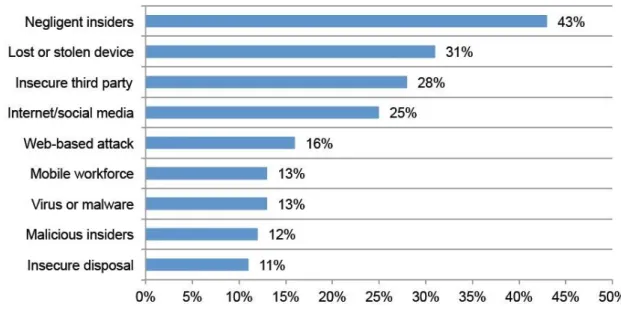
In a recent study, Ponemon Institute and IBM surveyed 265 C-level executives. One result of the survey was that “ninety percent of senior executives surveyed say their company has had a data breach and almost half (forty-eight percent) expect more data breaches to occur” [36]. The chart in Figure 3.1 shows that they identify negligent insiders as the greatest threat to sensitive data, followed by lost or stolen devices. Twelve percent identified malicious insider attacks as a risk to sensitive data.
3.1 Basic Terms
In information security, there are three core goals: theconfidentiality,integrityand availabil-ity of information and information systems. These terms are also referred to as theCIA
triadorinformation security triad[12].
Confidentiality“[...] means preserving authorized restrictions on access and disclosure,
including means for protecting personal privacy and proprietary information” [44 U.S.C., Sec. 3542].
In the area of privileged user password management a breach of confidentiality is, for ex-ample, that an unauthorized person gains access to a password (e.g., by stealing a device that contains a list of passwords or by handing a password to someone that is not autho-rized to know it). The consideration of confidentiality of privileged user passwords can be extended to the data that are only accessible with elevated access rights. If the confiden-tiality of privileged user credentials is not given, the confidenconfiden-tiality of the data cannot be
Figure 3.1: The Source of Greatest Risk to Sensitive Data
Source: Ponemon Institute and IBM survey of 265 c-level executives, February
2012
guaranteed as well.
Integrity “[...] means guarding against improper information modification or
destruc-tion, and includes ensuring information nonrepudiation and authenticity” [44 U.S.C., Sec. 3542].
If the integrity is not guaranteed, unauthorized modifications and destruction can happen without noticing, which leads to untrustworthy information and systems. This especially applies to privileged accounts since administrators can perform malicious or accidental actions that cause a breach of integrity. Moreover, if the access control cannot guarantee a separation of duties, the violation of integrity cannot be detected if the privileged user covers the tracks by manipulating audit logs.
Availability“[...] means ensuring timely and reliable access to and use of information” [44
U.S.C., Sec. 3542].
If the availability goal is not met, it will lead to a disruption of service or information will be unaccessible. Thus, the security mechanisms that protect and monitor the availability of systems need to be made accessible only to authorized administrators. If a privileged user can lock down important network components, it can cause a huge damage to the business of an organization.
Beyond that, there are other principles of information security that are used in this thesis:
Threat.“A potential for violation of security, which exists when there is an entity,
3.2 Scenarios Concerning Privileged User Password Management
Attack. “An intentional act by which an entity attempts to evade security services and
violate the security policy of a system. That is, an actual assault on system security that derives from an intelligent threat” [28].
Non-repudiation. “Assurance the sender of data is provided with proof of delivery and
the recipient is provided with proof of the senderˆas identity, so neither can later deny hav-ing processed the data” [2].
In the area of shared privileged user passwords it is important that a person cannot dis-claim actions that have been performed with a shared account.
3.2 Scenarios Concerning Privileged User Password Management
Example Corporation is a fictitious organization that is representative in having an hetero-geneous IT infrastructure like many other companies in the world.
The network consists of different types of servers which host or serve different types of services. There are database servers that run the Solaris operating system and serve Or-acle databases that are used by various applications. Furthermore, there is a Linux web server that hosts the company’s website besides several web-based applications that allow employees, partners, and customers access to Internet and Intranet services. In order to manage the authentication and authorization of users and computers they are using a di-rectory service that runs on a Microsoft Windows server. Last but not least there are file servers and backup servers that also host sensitive data.
The employees use desktop computers as well as mobile devices like notebooks and smart-phones, which run different operating systems.
Alice, Bob, and Charlie are employees at Example Corporation but they are working in different areas. Alice is a database administrator while Bob is responsible for managing all the UNIX servers in the network. Charlie is also a server administrator but he mainly takes care of the Windows machines. Both, Bob and Charlie also administrate the routers and switches in the infrastructure. Peter is the boss of the server department while Paul is head of database department.
Scenario 1: Shared Accounts
Bob and Charlie both have access to the Windows as well as the Linux servers. For that purpose they share the privileged accounts (“root” on Linux and “Administrator” on Win-dows). However, they also have personal accounts which they mainly use to perform their day-to-day tasks and only in situations where a privilege elevation (e.g., with “sudo” on UNIX-like systems or the User Account Control (UAC) on Windows) cannot be applied, they use the privileged account.
Scenario 2: Password Changes
Because of the password policies, the administrators have to change the passwords on a regular basis. This requires a lot of time and effort, because of the high amount of systems they have. Since they cannot remember all the passwords, they are writing them down every time they have changed them on the target system.
Scenario 3: Simple Access Control
Moreover, Bob and Charlie are authorized to access the routers and switches and to per-form the actions that are required to keep the infrastructure running. However, because of the simple access control the network components only support one privileged account that needs to be shared by Bob and Charlie. Here, they cannot use their personal account and require access to the privileged user password.
Scenario 4: Emergency Access
Bob is on vacation and one system that usually is taken care of him has an urgent problem. Since it is a critical component the problem needs to get fixed promptly. Charlie is skilled enough to find and solve the problem, but he has no credentials nor is authorized to log in on the system.
Scenario 5: Hard-Coded Credentials
Bob needs to set up a backup task on the database server that exports and transfers all the databases to the backup server. For that, he needs to insert the credentials (username and password) of a privileged database user into the backup script.
Scenario 6: Separation of Duties
Because of her day-to-day tasks, Alice is only interested in the configuration on the servers that is related to the database infrastructure. Everything else is not her business and thus she does not know how to manage the other services (e.g., the directory service) in the network. Since Bob is the server administrator, he knows about every configuration on the server-side but he is not informed about the things that are going on inside the services. So his job is to provide a working infrastructure for the services (e.g., manage the firewall and update the systems) but it is up to Alice to manage the databases. Once Alice needs some server-related changes, she has to ask Bob to take care of them.
In order to fulfill all the database-related tasks, she uses the privileged superuser account (e.g., “root” or “sysdba”).
3.3 Threat Targets, Threats and Attacks
Scenario 7: External Accounts
Since Bob and Charlie also administrate systems from customer projects, they need to manage the credentials of those systems as well. For that purpose, they use a password list that is saved on a network storage.
Scenario 8: Auditing and Reporting
Peter and Paul have an interest that each of their employees have access to all resources they require to fulfill their tasks. On the other hand, they want to make sure that the system is as secure as possible and that no one interferes with someone else’s work. To prevent from attacks, no administrator should have the privileges to access all systems and data in the infrastructure. Furthermore, they want to be notified at every suspicious action and to be able to see which changes have been made by which person. Additionally, Peter and Paul want to assure that unauthorized persons do not have access to systems, including former employees and partners.
Scenario 9: Fine-Grained Access Assignment
As part of a new project Alice joins the webmaster group to help them with the database layout. During that time she needs the same permissions as the webmaster group.
Scenario 10: Platform-Independent Access
In emergency cases, the administrators sometimes use their smartphone or a private com-puter to access the list of privileged user passwords.
Scenario 11: Access of External Administrators
The financial application is hosted on the Solaris system. Because of the application’s complexity, the software is administrated by the software producer and not by the orga-nization’s administrators. For that purpose, external persons require access to the server and sufficient access rights.
3.3 Threat Targets, Threats and Attacks
An attacker might try to find vulnerabilities at the network, host, or application level [47]. Many networks use the distributed client-server architecture with separate machines for clients and servers. Here, a client communicates with services that run on one or many
servers (e.g., web or database servers). In order to represent the different components of the network in a logical way, the threat targets are grouped into three areas: hardware,
network, andaccount.
3.3.1 Hardware
An attacker could try to get access to the hardware by breaking into the computing center, but it is more likely that he steals a client (e.g., a laptop or smartphone) that belongs to the organization and is authorized to connect to the infrastructure [37].
Thus, the consideration of threats to the hardware is divided into theserver andclientas threat targets.
Threats to the Server
An insider might be authorized to enter the server room and could steal disks with sensi-tive data directly without using an end device or the credentials of privileged users to gain access.
The same applies to backup devices (e.g., tapes, CDs, and hard disks) which contain sen-sitive data that usually is only accessible by authorized users but the backups often are less secure. In such cases, for an attacker (usually an insider) it is not necessary to possess a privileged user password since the data is not protected by an authentication and au-thorization mechanism. A countermeasure is to encrypt the backups and keep them in a secure place (e.g., a safe to which only managers have access to).
After stealing the hardware or copying sensitive data, an attacker could crack passwords or search for configuration files and scripts that contain hard-coded passwords in cleartext.
Threats to the Client
A common attack to spy on passwords is to compromise an end device with viruses and keyloggers, to get access to credentials.
As already mentioned, an attacker could steal an end device (e.g., a laptop or smartphone) that contains credentials. This could be cleartext password lists or application-specific password vaults that save the credentials for a user-friendly authentication.
Once the attacker has access to the privileged user passwords, he can break into the sys-tems to which the credentials belong to. A countermeasure against that attack is to encrypt the password lists or avoid saving them on end devices. Instead, the privileged user pass-words should be kept on a dedicated system so that they can be secured and centrally managed.
3.3 Threat Targets, Threats and Attacks
3.3.2 Network
Besides attacking the clients and servers, an attacker can cause security breaches to net-work components like routers, switches, bridges, gateways, and firewalls.
Sniffing
Instead of stealing the data from the server or capturing the traffic that is sent and retrieved directly on the host, an attacker might aim to get access to network components or directly capture the network traffic [37]. This allows the attacker to read and manipulate the data that is transmitted between the components.
Hereby, the attacker could collect more credentials of privileged accounts that allow him to access other systems. Moreover, the attacker could tamper with data, for example, manip-ulate an authorization decision that would deny the access but because it was tampered now grants it to the attacker.
Thus, a countermeasure is to encrypt and sign sensitive messages before they are trans-mitted, so that the confidentiality and integrity of the data can be guaranteed [37].
Denial of Service
Since routers and switches are important for the functionality of a network, the availabil-ity goal needs to be considered. In order to manage the network devices, administrators mostly use privileged accounts because these devices often have no or only a simple access control. This implies that they have to share the password for the privileged account and it is often not possible to log the actions an administrator performed on the device.
The knowledge of privileged user passwords allows a malicious insider to sabotage the network by misconfiguring the core network components, which results in a denial of service.
A countermeasure is to block the direct access to the target system and use a gateway that authenticates and authorizes an administrator. If the access is allowed, the gateway will establish a connection to the target system without requiring that the administrator knows the password. In addition, the gateway can log the actions that have been performed and account them to a specific person. An example for such gateway is theShell Control Box
sold by the company BalaBit1.
In order to diminish the vulnerability of external attacks, the administrators could estab-lish a firewall that blocks the direct access to servers from the Internet and only allows connections from trustworthy clients [59]. Moreover, external attacks can be reduced by limiting the authorized connections (e.g., by only allowing the access from trusted clients or over a Virtual Private Network (VPN)) [37].