DIMETHOMORPH (225)
The 1
stdraft was prepared by Mr. David Lunn New Zealand Food Safety Authority, Wellington, New
Zealand
EXPLANATION
Dimethomorph, a cinnamic acid derivative, is a member of the morpholine group of fungicides and
consists of a mixture of the E and Z isomers in approximately equal proportions. Its mode of action is
through the disruption of fungal cell wall formation. When applied as a foliar spray, dimethomorph
penetrates the leaf surface and is translocated within the leaf to provide protectant action against plant
pathogenic Phytophthora species and a number of downy mildew diseases of fruit, vegetables and
potatoes.
Residue and analytical aspects of dimethomorph were considered for the first time by the
present meeting. The manufacturer submitted studies on metabolism, analytical methods, supervised
field trials, processing, freezer storage stability, environmental fate in soil and rotational crop
residues. Information on GAP was also provided by Australia.
IDENTITY
ISO common name: Dimethomorph
Synonyms or code
numbers
AC
336379
CL
336379
CME
151
AG
151
L
127294
BAS 550 F
IUPAC name:
(E,Z) 4-[3-(4-chlorophenyl)-3-(3,4-dimethoxyphenyl)acryloyl]morpholine
CA name:
(E,Z)
4-[3-(4-chlorophenyl)-3-(3,4-dimethoxy-phenyl)-1-oxo-2-propenyl]-morpholine
CAS number
110488-70-5
E isomer
113210-97-2
Z isomer
113210-98-3
CIPAC number
483
ISO common name: Dimethomorph
Molecular formula
C21H22ClNO4
Structural formula:
E isomer
Z isomer
PHYSICAL AND CHEMICAL PROPERTIES
Pure active ingredient (%purity)
Characteristic
Value
Reference
Colour, odour and
physical state
49/51 E/Z mixture (98.8%), White crystalline
odourless solid at room temperature
Cevasco,
1999
[Ref: DK-301-007]
Melting point
48/52 E/Z mixture (99.1%)
125.2 - 149.2 °C
E isomer (98.9-99.6%) 136.8 - 139.4
°
C
Z isomer (96.3-98.7%) 166.3 - 171.1
°
C
Allman & Henke, 1989
[Ref:
DK-303-001]
Daum
A.,
2002
[Ref:
2002/1008775]
[Ref: 2002/1008776]
Boiling point
Not applicable
Temperature
of
decomposition
Start
of
decomposition
(colour
change):
E-isomer (98.9%)
about
270°C
Z-isomer (96.3%)
about 280°C
Daum,
2002
[Ref:
2002/1008775]
[Ref: 2002/1008776]
Characteristic
Value
Reference
Relative density
48/52 E/Z mixture (99.1%)
1.318 g/cm
3at 20
°C
Allman & Henke, 1989
[Ref: DK-308-001]
Vapour pressure
48/52 E/Z
mixture (99.1%) at
20
°C
E-isomer
9.7 x 10
-7Pa
Z isomer
1.0 x 10
-6Pa
Rech & Henke, 1989
[Ref: DK-306-004]
Solubility in water
44/56 E/Z
mixture (97.6%) at
20
°C
Deionized water 0.06
g/litre
pH 4
0.08
g/litre
pH 7
0.05
g/litre
pH 9
0.04
g/litre
E isomer (98.9%)
Deionised water 0.05 g/litre
Z isomer (96.3%)
Deionised water 0.01 g/litre
Akkari,
2002
[Ref:
DK-311-007]
Akkari,
2002
[Ref: DK-311-006]
Solubility in organic
solvents
48/52 E/Z mixture (99.1%) at 20 °C:
Solvent E isomer
Z isomer
Total
n-Hexane
0.076 0.036 0.112
g/litre
Methanol:
31.5
7.5
39
g/litre
Toluene:
39.0
10.5
49.5
g/litre
Ethyl acetate: 39.9
8.4
48.3 g/litre
Acetone :
84.1
16.3
100.4
g/litre
Dichloromethane:
296
165
461 g/litre
44/56 E/Z mixture (97.6%) at 20 °C:
Solvent E isomer
Z isomer
Total
n-Heptane:
0.12
0.053 0.173
g/litre
Xylene: 22.2
6.4
28.6
g/litre
Methanol
33.7
7.4
41.1
g/litre
Ethyl acetate: 46.6
9.5
56.1g/litre
Acetone:
105.6 18
123.7
g/litre
1,2-dichloroethane
182.5 92.5
275.1
g/litre
Grimm & Henke, 1989
[Ref:
DK-312-001]
Werle,
1999
[Ref: DK-312-003]
Dissociation constant
Calculated pKa -1.305
Martin,
2002
[Ref: DK-390-059]
Henry’s law constant
Approx 50/50 E/Z mixture at 20 °C:
E isomer
5.4 x 10
-6Pa
m
3/mol
Z isomer
2.5 x 10
-5Pa
m
3/mol
Martin,
2002
[Ref: DK-390-060]
Partition coefficient
(n-octanol/water)
E/Z mixture (99.1%) at 20 ± 1 °C:
E isomer
log
Pow
2.63
Z isomer
log Pow 2.73
Rech & Henke, 1989
[Ref: DK-315-001]
Characteristic
Value
Reference
Hydrolysis rate
50/50
E/Z
mixture
(99.2%)
After 10 weeks incubation at 70 °C and pH 4, pH 7
and pH 9, max 6.1% degradation to polar
(unidentified) residues. Gradual shift in E:Z isomer
ratio from 60:40 to 52:48 after 10 weeks.
After 10 weeks incubation at 90°C and pH 4, no
degradation or polar residues observed
Ochsenbein,
1989
[Ref: DK-322-003]
Photochemical
degradation
50/50
14C labeled E/Z mixture (99.2%):
Estimated DT
50of 25 – 28 days under continuous
illumination at pH 5 and 20
°
C. Five minor
(uncharacterised) photolytic degradation products
measured, all < 7% applied radioactivity. The E:Z
isomer ratio shifted from 47:53 to 24:76 within 1 day
with
little
further
movement.
14
C labeled 45/55 E/Z mixture (> 98%):
Extrapolated DT
50values of 107 days (chlorophenyl
label) and 86 days (morpholine label) under
continuous irradiation at pH 5 and 20-23 ºC. Minor
(uncharacterised) photolytic degradation products
measured, all < 6% applied radioactivity. The E:Z
isomer ratio shifted from 45:55 to about 20:80 within
4
days
with
little
further
movement.
44/56
E/Z
mixture
(97.6%):
Calculated mean DT
50of 12.6 days under continuous
irradiation at pH 7 and 20 ± 2 °C and a mean
quantum yield ,
Φ
, of 6.71 x 10
-6.
Van
Dijk,
1990
[Ref:
DK-630-001]
Panek et al., 2001
[Ref:
DK-324-006]
Knoch & Holman, 1998
[Ref: DK-324-004]
FORMULATIONS
Dimethomorph formulations available include wettable powders, water soluble granules, suspension
concentrates and a dispersible concentrate. In many cases, dimethomorph is co-formulated with other
fungicides such as mancozeb, folpet, dithianon, copper or chlorothalonil to facilitate disease resistance
management.
Formulation type Active ingredient Trade Name
500 g/litre dimethomorph Forum SC Suspension concentrates (SC)
100 g/litre dimethomorph +
500 g/litre chlorothalonil Forum Plus, Acrobat CT 60 SC 500 g/kg dimethomorph Forum, Forum 500 WP, Acrobat DF 90 g/kg dimethomorph +
600 g/kg mancozeb
Acrobat, Acrobat MZ, Acrobat MZ 69 WP 75 g/kg dimethomorph + 667 g/kg mancozeb Acrobat MZ Wettable powders (WP) 60 g/kg dimethomorph + 400 g/kg dithianon Forum 6/40 WP 90 g/kg dimethomorph +
600 g/kg mancozeb Acrobat Plus WG, Acrobat MDG, Forum MZ 75 g/kg dimethomorph +
667 g/kg mancozeb
Acrobat, Acrobat Extra, Invader Water dispersible granule
(WG)
113 g/kg dimethomorph + 600 g/kg folpet
Formulation type Active ingredient Trade Name 150 g/kg dimethomorph +
350 g/kg dithianon Forum DTI, Forum Gold 60 g/kg dimethomorph +
400 g/kg dithianon Acrobat R, Acrobat Co, Forum R, Forum R Blu, Forum 6/40 WP Dispersible concentrate (DC) 150 g/litre dimethomorph Forum, Forum 15 DC
METABOLISM
Radiolabelled dimethomorph was used in plant and animal metabolism studies and in two rotational
crop studies. In the animal metabolism studies, rotational crop studies and in four of the five plant
metabolism studies, the phenyl ring was uniformly labelled with
14C. In one potato metabolism study,
the morpholine ring was labelled with
14C.
OCH3 Cl C H CO N O CH3O
*
OCH3 Cl C H CO N O CH3O # # # #* denotes uniformly labelled
14C-chlorophenyl ring
# denotes
14C-morpholine ring label
Figure 1. Positions of
14C in metabolism studies
In most studies, radioactivity was determined by liquid scintillation and combustion analysis
with identification by thin layer chromatography and HPLC-UV and confirmed by HPLC-MS or
GC-MS.
Structures, names and codes for metabolites reported in the plant and animal metabolism studies are
summarised below.
CL 199322 (beta-D-glucopyranoside) 5-[(1Z)-1-(4-chlorophenyl)-3-(4-morpholinyl)-3-oxo-1-propenyl]-2-methoxyphenyl O H OH OH O OH O Cl CH CO N O CH3O CL411266 (beta-D-glucopyranoside) 4-[(1Z)-1-(4-chlorophenyl)-3-(4-morpholinyl)-3-oxo-1-propenyl]-2-methoxyphenyl OH O H O H O O H O OCH3 Cl C H CO N OZ7 (CL 1336305) 4-Chloro-3',4'-dimethoxy-benzophenone Cl O CH3O CH3O
Z37 (CL 153868) 4-[3-(4-chlorophenyl)-3-3,4-dimethoxy-phenyl)-1-oxo-2-propenyl]-2-oxo-morpholine CH3O CH3O Cl C H CO N O O Z43 3-(4-chlorophenyl)-3-(3,4-dimethoxyphenyl)-propenoic acid OH Cl CHCOOH CH3O Z67 (CL 900987)
4-[(E) -and (Z)-beta-(p-Chlorophenyl)-3-hydroxy-4-methoxycinnamoyl]morpholine or (E/Z)-4-(3-(4-Chlorophenyl)-3-(3’-methoxy-4’-hydroxyphenyl)-1-oxo-2-prophenyl)-morpholine OH Cl C H CO N O CH3O Z69 (CL 900986)
4-[(E) -and (Z)-beta-(p-Chlorophenyl)-4-hydroxy-3-methoxycinnamoyl]morpholine or (E/Z)-4-(3-(4-Chlorophenyl)-3-(3’-hydroxy-4’-methoxyphenyl)1-oxo-2-prophenyl)-morpholine OCH3 Cl C H CO N O OH Z89 (CUR 7117) N-[3-(4-chlorophenyl)-3-3,4-dimethoxyphenyl)-1-oxo-2-propenyl-glycine OCH3 Cl C H CO NHCH2COOH CH3O Z93 (CL 901423, WL 376084) 3-(4-chlorophenyl)-3-(3,4-dimethoxy-phenyl)-N,N-bis-(2-hydroxyethyl) acrylamide OCH3 Cl C H CO N (CH2)2OH (CH2)2OH CH3O Z94 (CUR 7586) 4-[3-(4-chlorophenyl)-3-3,4-dimethoxyphenyl)-1-oxo-2-propenyl]-3-oxo-morpholine CH3O Cl C H CO N O O CH3O Z95 (CL 153827, CUR 7216) N-[3-(4-chlorophenyl)-3-3,4-dimethoxyphenyl)-1-oxo-2-propenyl-ethanolamine CH3O Cl C H CO NHCH2CH2OH CH3O
Z98 (CL 153815) 3-(4-chlorophenyl)-3-(3,4-dimethoxy-phenyl)-acrylamide CH3O Cl C H CONH2 CH3O
Animal metabolism
The Meeting received animal metabolism studies on rats, lactating goats and laying hens, following
oral dosing with [p-chlorophenyl-U-
14C]-dimethomorph.
Rats
The metabolism of dimethomorph in rats was evaluated by the WHO Core Assessment Group of the
2007 JMPR, where it was concluded that after oral gavage with single doses of 10 or 500 mg/kg bw
per day to male and female rats, the low dose was quantitatively absorbed and excreted to more than
90% via bile and to 7% via urine in both sexes. At 500 mg/kg bw per day, absorption was decreased
to 65% in males and to 40% in females. Pre-treatment of the animals with non-labeled dimethomorph
at the low dose did not influence the excretion pattern. At 10 mg/kg bw per day, the radioactivity
reached a maximum within 1.4 – 2.8 h and excretion was virtually complete after 48 h. Less than 1%
of dose was found in carcass and in liver and less or equal to 0.2% of dose in kidneys and plasma. In
all other organs, radioactivity was no longer quantifiable. At 500 mg/kg bw per day, some delay in
depletion from organs was observed since radioactivity as percentage of dose was approximately 3
fold greater when compared to the 10 mg/kg bw group. After 168 h the pattern of distribution was the
same as at the low dose at 24 h with the exception of very low radioactivity in the gastrointestinal
tract. Dimethomorph is extensively metabolized by demethylation of one of the methoxy groups and
formation of O-conjugate and degradation products of morpholine ring opening were found.
Lactating goats
A metabolism study was conducted on two lactating goats, with each goat receiving oral doses of
0.55 mg
14C-dimethomorph/kg body weight (target dose of 1.1 mg/kg bw per day, equivalent to about
25 ppm in the diet) after each morning and afternoon milking for 7 days and after the morning
milking on day-8 (4 h before sacrifice). The results of this study have been reported by Van Dijk,
1990 [Ref: DK-440-005] and Van Dijk, 1991 [Ref: DK-440-008].
The majority of the administered radioactivity (TRR) was present in the excreta, with 70 –
74% found in the faeces and 14 – 16% present in the urine. The radioactivity level in milk reached a
level of about 0.05 mg/kg after the 3rd administration (day 2) (Table 1), with residues increasing
slowly to about 0.1 mg/kg at the time of sacrifice. After fractionation of the milk, about 80% of the
TRR was found in the whey (0.08 – 0.09 mg/kg) with lower levels being measured in milk fat (0.014
– 0.015 mg/kg) and in the protein pellet (0.004 – 0.005 mg/kg). Together with residual radioactivity in
cage wash, organs, tissues and blood, the total recovery at sacrifice amounted to 88 – 92% of the
TRR.
At sacrifice, 0.1 – 0.2% of the TRR was detected in the muscle, fat and kidney with higher
levels being found in liver (1.5% and 1.9% TRR in the two goats).
Table 1. Distribution of
14C residue in lactating goats dosed orally for 8 days with 1.0 mg/kg bw/day
14C-[chlorophenyl]-dimethomorph (25 ppm equivalent in feed)
Matrix Goat 1 Goat 2
mg/kg equivalent %TRR mg/kg equivalent %TRR Milk – day 1 am 0.002 0.002 Milk – day 1 pm 0.02 0.012 Milk – day 2 am 0.043 0.045 Milk – day 2 pm 0.045 0.078 Milk – day 3 am 0.038 0.045 Milk – day 3 pm 0.045 0.077 Milk – day 4 am 0.039 0.054 Milk – day 4 pm 0.069 0.032 Milk – day 5 am 0.065 0.045 Milk – day 5 pm 0.083 0.033 Milk – day 6 am 0.067 0.051 Milk – day 6 pm 0.104 0.08 Milk – day 7 am 0.069 0.028 Milk – day 7 pm 0.046 0.09 Milk – day 8 am 0.05 0.052 Milk – day 8 pm 0.10 0.11 Kidney 0.289 < 0.1 0.270 < 0.1 Liver 7.718 1.9 6.550 1.5 Heart 0.073 < 0.1 0.050 < 0.1 Muscle 0.032 0.2 a 0.022 0.1 a/ Fat 0.088 0.1 a 0.057 0.1 a/ Blood 0.066 0.1 a 0.066 0.1 a/ Bile 16.289 < 0.1 9.204 0.2
Milk: Combined results from the morning and evening milking just before dosing, except for day 1 (evening milk only) and day 8 (just before the morning dose and at sacrifice). Background level was 0.002 mg/kg equivalents a - Calculated on the assumption of 40% bodyweight being muscle, 12% being fat and 8% being blood
In milk, the major identified residue was the polar Z89 metabolite, measured at 0.047 –
0.052 mg/kg (about 48% TRR) with a further five unidentified metabolite fractions being present at
concentrations below 0.015 mg/kg.
In kidney, besides the parent compound (0.019-0.034 mg/kg or 6.8 – 12% TRR), residues of
the Z67 and Z93 metabolites were found at levels averaging 0.033 mg/kg and 0.019 mg/kg
respectively, with six unidentified metabolites also present at levels ranging from 0.012 – 0.045
mg/kg. In liver, the main component was the unchanged parent, present at 4.5 – 5.8 mg/kg (63 – 81%
TRR) with other identified metabolites being Z67 (0.14 – 0.42 mg/kg, 1.9 – 5.9%TRR) and Z69 (0.12
– 0.33 mg/kg, 1.6 – 4.6% TRR). Four unidentified minor metabolites were detected at about 0.05 –
0.3 mg/kg.
In muscle, low levels of the parent compound (0.002 – 0.015 mg/kg, about 7.5% TRR) were
detected, with five unidentified metabolite fractions also being measured at < 0.015 mg/kg. In fat,
besides two unknown metabolite fractions (0.003 – 0.006 mg/kg), the parent compound was the main
component, accounting for 0.045 – 0.065 mg/kg (62 – 89% TRR). The results are summarised in
Table 2.
Table 2. Identification of
14C residues in tissues and milk of two lactating goats dosed orally for 8
days with 1.0 mg/kg bw/day [
14C-chlorophenyl]-dimethomorph (25 ppm equivalent in feed)
Concentration, mg/kg, expressed as parent equivalents Component
Milk Muscle Fat Liver Kidney
Dimethomorph nd 0.002 0.055 5.14 0.027 Z67 nd nd nd 0.28 0.033 Z69 nd nd nd 0.22 nd Z93 nd nd nd nd 0.019 Z89 0.05 nd nd nd nd Unidentified metabolites (number) 0.03 (5) 0.018 (5) 0.009 (2) 0.47 (4) 0.15 (6) Not extracted 0.02 0.003 0.004 0.8 0.02 Total 14C residues (TRR) 0.1 0.027 0.073 7.13 0.28
Residues are mean values from two goats nd = Not Detected
In general, about 90% of the administered dose was excreted in faeces and urine and
radioactivity in the edible organs and tissues was readily and almost completely extracted, indicating
that dimethomorph or its metabolites were not bound in the organs and tissues. The major component
of the extractable residue in liver, muscle and fat was the unchanged parent, with dimethomorph and
the Z67 metabolite being the predominant residues identified in kidney. The Z67 metabolite was also
found in liver, as was the Z69 metabolite, both at relatively low levels. Low levels of the Z93
metabolite were found in kidney and the only residue identified in milk was the Z89 metabolite.
The proposed metabolic pathway for dimethomorph in the lactating goat is similar to that
proposed for rats, and involves the demethylation of one of the phenolic methoxy-groups, with an
alternative pathway being the cleavage of the morpholine-ring.
Laying hens
In a study reported by Van Dijk[1990, DK-440-003 and 1991, DK-440-007] three groups of 6 - 9 hens
received two oral doses per day (each being 1.0 mg/kg bw), equivalent to 40 ppm in the feed) for
seven consecutive days, with a final dose on the morning of day 8 (a total of 15 doses). Hens in the
three groups were sacrificed 8 hours (Group 1), 7 days (Group 2) and 12 days (Group 3) after the last
administration.
Most of the administered radioactivity was recovered in the excreta (84.8%) and the cage
wash (2.9%). About 0.4% of the
14C remained in organs and tissues of hens sacrificed 8 hours after
the last of 15 doses and < 0.1% of the dose remained in eggs. The material balance after dosing with
14C-dimethomorph with the chlorophenyl radiolabel accounted for 88.2% of the administered dose.
In whites of eggs,
14C residues were low, reaching a maximum of 0.056 mg/kg after 4 days,
while in yolks, highest residues (0.49 mg/kg) were found one day after the last administration
(Table 3). At the end of the depuration period (12 days) the radioactivity levels had decreased to about
the background levels of 0.011 mg/kg (egg whites) and 0.017 mg/kg (yolks).
In the edible organs and tissues (Table 4.), namely heart, gizzard, fat and skin, low
concentrations of residual radioactivity levels (0.054 – 0.075 mg/kg) were found. The highest
14C
residue was observed in liver (1.06 mg/kg) with lower levels in kidney (0.31 mg/kg) and muscle
(0.016 mg/kg).
Table 3. Mean residues of
14C residue in pooled whites and yolks of eggs from laying hens dosed
orally for 8 days with 1.96 mg/kg bw/day of
14C-[chlorophenyl]-dimethomorph (40 ppm equivalent in
feed).
Component TRR (mg/kg)
Egg Yolks Egg Whites
am pm am pm Day 1 0.018 - 0.011 - Day 2 0.025 0.027 0.025 0.033 Day 3 0.076 0.13 0.022 0.034 Day 4 0.16 0.3 0.021 0.056 Day 5 0.23 - 0.028 - Day 6 0.33 - 0.027 - Day 7 0.4 0.51 0.032 0.029 Day 8 0.47 0.38 0.024 0.02 Day 8+0 0.43 0.024 Day 8+1 0.49 0.022 Day 8+2 0.47 0.014 Day 8+3 0.41 0.013 Day 8+4 0.34 0.011 Day 8+5 0.27 0.013 Day 8+6 0.19 0.012 Day 8+7 0.12 0.012 Day 8+8 0.069 0.013 Day 8+9 0.045 0.013 Day 8+10 0.03 0.012 Day 8+11 0.024 0.01 Day 8+12 0.023 0.011
TRR values for eggs are average residues in pooled eggs from each day, not corrected for background radioactivity (0.011 mg/kg – egg whites, 0.017 mg/kg – egg yolks)
Table 4. Distribution of
14C residue in laying hens dosed orally for 8 days with 1.96 mg/kg bw/day of
14C-[chlorophenyl]-dimethomorph (40 ppm equivalent in feed).
TRR Extractable residue Non-extractable residue %Recovery Component mg/kg mg/kg %TRR mg/kg %TRR Egg Yolks 0.38 0.177a 46.5 0.204 53.5 96.9 Egg Whites 0.011 0.009 81.7 0.002 18.3 Plasma 0.158 0.117 73.9 0.041 26.1 100.0 Liver 1.051 0.717 78.0 0.334 36.3 78.0 Kidney 0.301 0.235 88.4 0.066 24.6 88.4 Muscle 0.016 0.014 105.4 0.002 15.6 90.3 Heart 0.049 0.036 79.9 0.013 29.8 78.3 Gizzard 0.038 0.034 96.0 0.004 12.7 85.7 Skin 0.037 0.032 91.6 0.005 14.3 87.4 Fat 0.037 0.035 97.8 0.002 7.0 97.8
Results corrected for background radioactivity (0.009 mg/kg – kidney & muscle, 0.013 mg/kg – liver, 0.016 mg/kg – gizzard & plasma, 0.022 mg/kg – fat, 0.023 mg/kg – fat and 0.026 mg/kg – heart, 0.011 mg/kg – egg whites, 0.017 mg/kg – egg yolks)
a - Extractability of protein-free fraction
Dimethomorph, the parent compound (Table 5), was not found in any edible tissues except fat
and skin, where residues were 0.017 mg/kg and 0.01 mg/kg respectively.
In muscle, low levels (0.002-0.003 mg/kg) of the Z69/Z67 and Z93 metabolites were
measured, while in liver the Z69/Z67 metabolites were the only identified metabolites found
(0.132 mg/kg). In kidney, the major metabolite fraction was Z67/Z69 and accounted for 0.032 mg/kg
with minor levels of Z43 (0.015 mg/kg) also being detected. In both liver and kidney, 10 – 11
unidentified metabolites were also measured, but at low levels, not exceeding 8 – 9% TRR (max
0.07 mg/kg in liver and max 0.02 mg/kg in kidney).
In egg yolks, the major metabolite fraction Z67/Z69 accounted for 0.07 mg/kg. Metabolite
fractions Z43 (0.045 mg/kg), Z95 (0.038 mg/kg) and Z93 (0.018 mg/kg) were also detected, with a
further three minor or unidentified metabolites being measured at 0.009 – 0.016 mg/kg.
Table 5. Identification of
14C residues in tissues and eggs of laying hens dosed orally for 8 days with
1.96 mg/kg bw/day [
14C-chlorophenyl]-dimethomorph (40 ppm equivalent in feed)
Concentration, mg/kg, expressed as parent equivalents Component
Egg yolks Liver Kidney Muscle Fat Skin
Dimethomorph nd nd nd nd 0.017 0.01 Z67 Z69 0.07 0.13 0.032 0.003 nd nd Z93 0.018 nd nd 0.002 nd nd Z95 0.038 nd nd nd nd nd Z43 0.045 nd 0.018 nd nd nd Unidentified metabolites (number) 0.037 (3) 0.41 (11) 0.1 (10) 0.004 (2) 0.014 (3) 0.021 (3) Total 14C residues (TRR) 0.21 0.55 0.15 0.009 0.031 0.031 nd = Not Detected
In general, dimethomorph is rapidly eliminated in hens, with about 0.4% of the applied
radio-label remaining in tissues eight hours after the end of the dosing period. Highest
14C residues were
found in liver (approx 1.0 mg/kg) and in kidney (0.3 mg/kg). In eggs,
14C residues did not exceed 0.05
mg/kg in egg whites and while residues in yolks increased during the 8 day dosing period (up to 0.5
mg/kg), radioactive residues at the end of the 12-day depuration period were close to the background
level.
Residues of the parent compound were only found in fat and skin (0.01 – 0.017 mg/kg), with
the most common metabolites being Z67/Z69 (up to 0.13 mg/kg in liver), indicating that the primary
metabolic pathway is by demethylation of one of the phenolic methoxy groups. The occurrence of
metabolites Z93 (yolks, muscle), Z95 (yolks) and Z43 (yolks, kidney) at relatively low levels suggests
that dimethomorph can also be metabolized via morpholine-ring cleavage. These pathways, shown in
Figure 2, are similar to those proposed for rats and lactating goats.
+ (Z43) O OCH3 Cl CH CO N O OCH3 Cl CHCOOH CH3O O Cl CH CO N O CH3O Glucuronide Glucuronide OCH3 Cl CHCONHCH2COOH CH3O CUR 7117 G,R,H
Figure 2. Metabolic pathway of
14C-dimethomorph in rats, goats and laying hens
Plant metabolism
The Meeting received plant metabolism studies on grapes, potato, lettuce and tomato, following
treatment with either an EC or a DC formulation of [p-chlorophenyl-U-
14C]-dimethomorph and on
potato following treatment with an EC formulation of [morpholine-U-
14C] dimethomorph.
Grapes
In a study reported by Schlüter, 1990 [DK 640-005 and DK 640-010],
14C-dimethomorph formulated
as a 10% EC was applied by syringe to selected grapes and grape leaves (both surfaces) at a
concentration of 0.09 kg ai/hL (equivalent to 0.9 kg ai/ha) with four applications being made at 9 – 10
day intervals up to 35 days before harvest. Grapes and leaves were sampled after each individual
treatment and stored at < -18
oC for up to 5 weeks before extraction and analysis. Surface residues
were removed in acetone, after which the samples were homogenised and the remaining residues
extracted first in acetone and then in methanol.
In treated grapes, 100% of the applied radioactivity was recovered (Table 6), 72.5% of which
was found in the surface wash, while in treated leaves 70 – 76% of the applied radioactivity was
+ OCH3 Cl CH CO N O CH3O CUR 7586 CL 336379 CL 900986 (Z69) OCH3 Cl CH CO N O O CH3O OH Cl CH CO N O CH3O OCH3 Cl CH CO N CH2CH2OH CH2CH2OH CH3O OCH3 Cl CH CO N O HO OCH 3 Cl CHCONHCH2CH2OH CH3O CUR 7216 Glucuronidase Acid Glucuronidase Acid WL 376084 G,R R,H G,R,H G G G,R
recovered, 95% of which was present in the surface wash. Untreated grapes and leaves close to the
treated leaves contained only low levels of radioactivity (< 0.03 mg/kg dimethomorph equivalents)
mostly as surface residues, indicating negligible systemic movement from treated leaves. Total
recovery rates were 100 – 102% and only 2 – 3% of the applied
14C was not extractable with acetone
or methanol.
Table 6. Distribution of
14C residues in grapes and grape leaves 35 days after 4 applications of
14C-[chlorophenyl]-dimethomorph at a concentration equivalent to 0.09 kg ai/hL
Component Treated Grapes Untreated Grapes Treated Leaves
TRR (mg/kg) 14.6 0.026 90.1
%TRR in surface wash 72.5 95.2 95
%TRR in homogenate 25.7 - 2
%TRR extracted 98.2 95.2 97
%TRR non extractable 1.8 4.2 3.1
Surface residues extracted in acetone, homogenate residues extracted in acetone then methanol
The majority of the extractable residue was identified (Table 7) as unchanged parent,
dimethomorph, which accounted for 86.3% (equivalent to12.6 mg/kg) and 82.9% (equivalent to
74.8 mg/kg) of the TRR in grapes and leaves, respectively. In treated leaves, a trace amount of the
metabolite Z7 was found (1.6% TRR or 1.44 mg/kg). The remaining fractions (grapes: 11.9%,
1.74 mg/kg; leaves: 14%, 12.6 mg/kg) were not characterized.
Table 7. Identification of
14C residues in grapes and grape leaves 35 days after 4 applications of
14C-[chlorophenyl]-dimethomorph at a concentration equivalent to 0.09 kg ai/hL
Concentration & %TRR
Treated Grapes Untreated Grapes Treated Leaves
Component mg/kg %TRR mg/kg %TRR mg/kg (% TRR) Dimethomorph 12.6 86.3 0.013 48.8 74.7 82.9 Metabolite Z7 nd - nd - 1.44 1.6 Metabolite Fraction 1 a 0.84 5.8 0.004 16.7 7.75 8.6 Metabolite Fraction 2 a 0.70 4.7 0.005 20.8 1.08 1.2
Acetone extract (leaves) - - - - 1.8 2.0
Others 0.2 1.4 0.002 9.5 0.54 0.6
Total 14.6 98.2 0.026 95.8 90.1 96.9
a - One dimensional TLC using pre-coated silica gel plates and acetonitrile, ethyl acetate and chloroform/acetone 9:1 solvent systems.
Potato
In a study reported by Thiele, 1990 [DK 640-004 and DK 640-009],
14C-dimethomorph formulated as
a 10% EC was applied to greenhouse potato plants at a concentration of 0.06 kg ai/hL (equivalent to
0.6 kg ai/ha) with four applications (40 ml/plant) being made at 10 day intervals up to 7 days before
harvest. Stems, leaves and tubers were sampled at harvest time and stored at < -18
oC for up to 5
weeks before extraction and analysis. Surface residues were removed in acetone, after which the
samples were homogenised and the remaining residues extracted in methanol.
At harvest, 41.7% (23.5 mg/kg dimethomorph equivalents) of the applied
14C was recovered
from the treated foliage. Small amounts of radioactivity were measured in tubers from treated plants
(0.04 – 0.08% of the TRR), predominantly in peel where radioactive residues of < 0.02 mg/kg were
found (except in two samples with higher values of 0.09 – 0.18 mg/kg, attributed to spray
contamination). In treated foliage (stems and leaves), the acetone surface wash contained 61% of the
TRR with a further 36.5% TRR being measured in the methanol-extracted homogenate.
The majority of the extractable residue in foliage was identified as unchanged parent
(Table 8), dimethomorph, which accounted for 68% of the TRR. Most of the remaining extractable
residue (14% TRR in the acetone wash and 15.8% in the methanol homogenate consisted of several
unknown (mainly polar) metabolites, with only trace amounts of the metabolite Z7 being identified
(< 0.5% TRR).
Table 8. Distribution and characterisation of
14C residues in potato tubers and foliage 7 days after 4
applications of
14C-[chlorophenyl]-dimethomorph at a concentration equivalent to 0.06 kg ai/hL
Component Foliage
mg/kg Tubers mg/kg (peel) Tubers mg/kg (peeled)
TRR (mg/kg) 23.5 0.024 a 0.01a TRR in surface wash (%TRR) Dimethomorph Metabolite Z7 Not identified Total (47.3%) (< 0.5%) (14%) 14.1 (61.3%) TRR in homogenate (%TRR) Dimethomorph Metabolite Z7 Not identified Total (20.7%) (< 0.5%) (15.8%) 8.4 (36.5%) TRR extracted mg/kg 23 (87.8) TRR non extractable (%TRR) 0.53 (2.2%)
Surface residues extracted in acetone, homogenate residues extracted in methanol
a - Mean of 7 tubers. Excludes results from one upper layer tuber (0.18 mg/kg in peel, 0.04 mg/kg peeled) assumed to be contaminated during application
In a further study reported by Edwards, 1992 [DK 640-014], potato plants growing in a
lysimeter were treated with a 150 g ai/L DC formulation of
14C-[chlorophenyl]-dimethomorph at a
rate equivalent to 0.3 kg ai/745 L/ha three times during the growing period. Treatment intervals were
10 days. Foliage and tubers (washed) were sampled at harvest about 28 days after the last treatment.
Samples were stored at <-18
oC for 4 – 6 months before extraction and analysis.
Most of the radioactivity was found in the leaves, accounting for about 98%. Only 0.8%
(equivalent to 0.12 mg/kg dimethomorph was found in the peel and 0.7% (equivalent to 0.025 mg/kg)
in the peeled potato. The calculated total residue in whole potato residue was 0.146 mg/kg (1.5%
TRR).
Residues in both tuber peel and peeled tuber were extracted with methanol/water and water,
with 63.3% of the radioactivity in peel and 47.7% of the radioactivity in peeled tubers being extracted
(Table 9). These extracts were partitioned with dichloromethane to measure and characterise the
organo-soluble and water-soluble components.
In the organo-soluble fraction dimethomorph residues were 0.056 mg/kg (46.3% TRR) in peel
and 0.003 mg/kg (12.0%) in the peeled tubers. Low levels of the desmethyl metabolites Z67 (11.6%
TRR, 0.014 mg/kg) and Z69 (5% TRR, 0.006 mg/kg) were also found in peel but not in the peeled
tubers.
In both the peel and the peeled tubers, the water-soluble fraction contained several minor
polar components accounting for 8.3% (0.01 mg/kg) and 24.0% (0.006 mg/kg) of the TRR,
respectively, and were not further characterized.
Table 9. Distribution and characterisation of
14C residues in potato tubers 28 days after 3 applications
of
14C-[chlorophenyl]-dimethomorph at a rate equivalent to 0.3 kg ai/ha (lysimeter study)
Organosoluble Water soluble
Tuber Peel Peeled Tuber Tuber Peel Peeled Tuber
Component
mg/kg (% TRR) mg/kg (% TRR) mg/kg (% TRR) mg/kg (% TRR)
Dimethomorph 0.056 (46.3) 0.003 (12.0) 0.002 (21.0) 0.012 (29.4)
Metabolite Z67 0.014 (11.6) nd nd nd
Metabolite Z69 0.006 (4.96) nd nd nd
nd not detected; the water soluble fractions was composed of several minor polar components which precluded further characterization
A potato metabolism study using dimethomorph labelled with
14C in the morpholine ring was
also provided to the Meeting (Thiele, 1990 [DK 640-006and Thiele, 1991 DK 640-011]. In this study,
14C-dimethomorph formulated as a 10% EC was applied to greenhouse potato plants at a
concentration of 0.06 kg ai/hL (equivalent to 0.6 kg ai/ha) with four applications (40 ml/plant) being
made at 10 day intervals up to 7 days before harvest. Stems, leaves and tubers were sampled at
harvest time and stored at < -18
oC for up to 5 weeks before extraction and analysis. Surface residues
were removed in acetone, after which the samples were homogenised and the remaining residues
extracted in methanol.
At harvest, 48.6% (18.2 mg/kg dimethomorph equivalents) of the applied
14C was recovered
from the treated foliage (Table 10). Small amounts of radioactivity were measured in tubers from
treated plants predominantly in peel where radioactive residues of < 0.03 mg/kg were found. In
treated foliage (stems and leaves), the acetone surface wash contained 72.3% of the TRR with a
further 25.7% TRR being measured in the methanol-extracted homogenate.
The majority of the extractable residue in foliage was identified as unchanged parent,
dimethomorph, which accounted for 76% of the TRR (13.8 mg/kg). The remaining extractable residue
(11% TRR in the acetone wash and 11% in the methanol homogenate consisted of several unknown
(mainly polar) metabolites, but at levels too low to identify.
Table 10. Distribution and characterisation of
14C residues in potato tubers and foliage 7 days after 4
applications of
14C-[morpholine]-dimethomorph at a concentration equivalent to 0.06 kg ai/hL
Component Foliage mg/kg (%TRR) Tubers (peel) mg/kg (%TRR) Tubers (peeled) mg/kg (%TRR) TRR (mg/kg) 18.2 0.015 0.014 TRR in surface wash (%TRR) Dimethomorph Not identified Total (61.2%) (11.1%) 13.1 (72.3%) TRR in homogenate (%TRR) Dimethomorph Not identified Total (14.7%) (11%) 4.7 (25.7%) TRR extracted mg/kg 17.8 (97.9) TRR non extractable (%TRR) 0.38 (2.1%)
Surface residues extracted in acetone, homogenate residues extracted in methanol
Lettuce
In a study with field grown lettuce reported by Goodyear, 1995 [DK 640-021], chlorophenyl ring
labelled
14C-dimethomorph formulated as a 0.15 kg ai/litre DC was applied in four successive foliar
applications at a rate equivalent to a mean treatment rate of 1.14 kg ai/ha. Applications were made 30
days after sowing of lettuce seed (8 days after transplanting) and again at intervals of 9, 10 and 11
days. Plants (without roots) were sampled four days after the final application and processed
immediately.
The total radioactivity in lettuce was 102 mg/kg (Table 11), 95% of which was found in
macerated acetone extracts with a further 3.6% being extracted in acetone:water (1:1) and 1.6% being
unextracted.
Most of the extractable residue (93% TRR) was identified as unchanged dimethomorph
(94.9 mg/kg) of the TRR in lettuce. Trace levels of the metabolites Z7 and Z67 were also reported,
each accounting for 0.5% TRR (0.5 mg/kg). The remaining extractable residue (4.5%, 4.6 mg/kg)
consisted of several minor unknown polar components, which were not further characterized.
Table 11. Distribution and characterisation of
14C residues in lettuce 4 days after 4 applications of
14C-[chlorophenyl]-dimethomorph at a mean rate equivalent to 1.14 kg ai/ha
Component Residues (mg/kg) %TRR TRR 102 Acetone extract 96.7 94.8 Acetone:water extract 3.7 3.6 Total extracted 100 98.4 Unextracted 1.6 1.5 Dimethomorph 94.9 93 Metabolite Z7 0.5 0.5 Metabolite Z67 0.5 0.5 Unidentified 4.6 4.5
Tomato
A study investigating the metabolism of
14C-[chlorophenyl]-dimethomorph in tomato plants following
root uptake was reported by Schüter and Varga, 1995 [DK-640-020]. In this study,
14C dimethomorph
was added to the nutrient hydroponic solution (8 mg ai/L) for uptake through the roots of young
tomato plants for a 7-day application period. Samples were taken 0, 14 and 28 days after termination
of the application. Samples of plants (without roots) were weighed and kept frozen until preparation
for analysis.
Radioactive residues in the freeze-dried samples were extracted with acetone, methanol and
methanol: water (4:1) for subsequent quantification with and without partitioning into
dichloromethane and HCl hydrolysis.
Total radioactive residues at the end of the 7 day exposure period were 24.5 mg/kg dimethomorph
equivalents, reducing to 12.5 mg/kg 14 days later and to 7 mg/kg at the end of the experiment (28
days after the end of the application period (Table 12).
Table 12. Distribution of
14C residues in young tomato plants at intervals following a 7-day exposure
to
14C-[chlorophenyl]-dimethomorph (8 mg ai/litre) in a hydroponic nutrient solution
Concentration, mg/kg and (%TRR)
0 days 14 days 28 days
TRR 24.5 (mean) 12.5 (mean) [13.4] (*) 7 (mean) [6.6]a/
Acetone extract 13.1 (53.5%) 4.2 (31.7%) 1.3 (18.8%)
Methanol extract 10.3 (41.9%) 7.7 (57.9%) 2.9 (43.2%)
Methanol:water extract 0.45 (1.9%) 0.25 (1.9%) 1.2 (18.3%)
Total extracted 23.8 (97.3%) 11.4 (90.7%) 5.84 (83.3%)
Unextracted 0.67 (2.7%) 1.16 (9.3%) 1.17 (16.7%)
a - [TRR] in the sample used for further investigations
Dimethomorph was the predominant residue, initially comprising 66% of the TRR and
reducing to 28% after 14 days and to 16% after 28 days. The calculated half-life of the parent
compound was about 13 days. The demethylated metabolite Z69 (including conjugates) was the major
metabolite found, with Z93, Z95 and Z98 also identified, mostly at levels < 10% TRR (Table 13).
Table 13. Identification of
14C residues in young tomato plants at intervals following a 7-day exposure
to
14C-[chlorophenyl]-dimethomorph (8 mg ai/litre) in a hydroponic nutrient solution
Concentration, mg/kg and (%TRR)
0 days 14 days 28 days
Dimethomorph 15.75 (66%) 3.18 (28%) 0.93 (16%)
Metabolite Z69 ≤ 3.1 (≤ 13%) 2.05-3.75 (18-33%) 0.76-1.98 (13-34%)
Metabolite Z93 1.91 (8%) 1.93 (17%) 0.52 (9%)
Metabolite Z95 ≤ 1.43 (≤ 6%) 0.45-0.91 (4-8%) ≤ 0.41 (≤ 7%) Metabolite Z98 ≤ 1.43 (≤ 6%) 0.11-0.57 (1-5%) ≤ 0.41 (≤ 7%)
In summary, the metabolic pathways of dimethomorph in plants show a common pattern, with
the unchanged parent being the only significant component of the total residue in grapes, potatoes and
lettuce. The primary metabolic pathway involves either the demethylation of the dimethoxyphenyl
ring to produce 4-[(E) -and (Z)-beta-(p-chlorophenyl)-3-hydroxy-4-methoxycinnamoyl]morpholine
(Z67) and 4-[(E) -and (Z)-beta-(p-chlorophenyl)-4-hydroxy-3-methoxycinnamoyl]morpholine (Z69)
with the probable formation of the associated glucose conjugates. A secondary pathway involves the
hydrolysis of dimethomorph to form 4-chloro-3',4'-dimethoxy-benzophenone (Z7)
In summary (Table 14), the predominant residue (dimethomorph) was mostly found as a
surface residue in grape, with negligible systemic translocation, while in potato only low residues
were found in tubers (almost all in the peel), suggesting that translocation from treated aerial parts to
the tuber is negligible. In lettuce the predominant residue was dimethomorph with all other
metabolites being < 5% TRR. In tomato plants exposed to dimethomorph in a hydroponic nutrient
solution, residues were taken up by the roots and two metabolic pathways were proposed, one
involving demethylation of the 4-methoxy group of the dimethoxyphenyl ring followed by conjugate
formation, the other being the stepwise degradation of the morpholine ring.
Table 14. Summary of dimethomorph metabolites in grapes, potato and lettuce
Crop Rate (PHI) Matrix Parent %TRR Metabolite Metabolite % TRR
Leaf 83.0 Z7 1.5 Grapes 4× 0.9 kg ai/ha (35 days) Grape 86.5 nd - Foliage 66.5 Z7 < 0.5 Peel - - - Potato 4× 0.6 kg ai/ha (7 days) Peeled tuber - - - Foliage 74.5 nd nd Peel - - - Potato 4× 0.6 kg ai/ha (7 days) Peeled tuber - - - Foliage - - - Peel 46.3 Z67 Z69 11.6 4.96 Potato 3× 0.3 kg ai/ha (28 days) Peeled tuber 12.0 Z67 Z69 nd nd Lettuce 4× 1.1kg ai/ha (4 days) Foliage 93.0 Z7 Z67 or Z37 Z69 < 0.5 < 0.5 < 0.5 Tomato
(hydroponic) 8 mg ai/litre Foliage Day 0 Day 14 Day 28 66 28 16 Z69/Z93 a Z69/Z93 a Z69/Z93 a 13/8 18–33/17 13–34/9 nd not detected
+ OCH3 Cl O CH3O OCH3 Cl CH CO N O CH3O + CL 153868 (Z37) (L) (G. L. P) (P, L) (T) CL 336379 CL 336305 CL 901423 (Z93) CL 900986 (Z69) CL 900987 (Z67) (T) (L, T) Acid CL 153827 (Z95) CL 153815 (Z98) (T) (L) Acid OCH3 Cl CH CO N O CH3O O OH Cl CH CO N O CH3O (T) OCH3 Cl CH CO N CH2CH2OH CH2CH2OH CH3O OCH3 Cl CH CO N O HO OH O H O H O O H O OCH3 Cl CH CO N O OCH3 C=CH-CO-NH-CH2-CH2OH Cl CH3O OCH3 Cl C=CH-CONH2 CH3O G = Grape L = Lettuce P = Potato
T = Tomato (Hydroponic System) [ ] = Proposed Intermediate O H OH OH O OH O Cl CH CO N O CH3O
Figure 3. Metabolic pathway of
14C-dimethomorph in grape, lettuce, potato and tomato
Environmental fate
The Meeting received information on the environmental fate of dimethomorph in soil, including
studies on aerobic and anaerobic soil metabolism, photodegradation, soil adsorbtion and desorbtion,
field dissipation and mobility. Because dimethomorph is used on some root crops (onions, potatoes,
taro and radish), studies on aerobic soil metabolism and soil dissipation have been evaluated.
Environmental fate studies in aquatic and water-sediment systems were also provided, but
because these studies do not assist significantly in defining the residue of concern or in estimating
residue levels, these studies were not evaluated (as indicated in Revised Data Requirements for
Studies of Environmental Fate (JMPR 2003, section 2.11, p. 12).
Dimethomorph uniformly labelled with
14C in the phenyl ring or in the morpholine ring was
used in the aerobic soil degradation studies.
OCH3 Cl C H CO N O CH3O * OCH3 Cl C H CO N O CH3O # # # #
* denotes uniformly labelled
14C-chlorophenyl ring
# denotes
14C-morpholine ring label
Aerobic soil metabolism
A study in a sandy loam soil by Schlüter, 1990 [DK-620-010] showed that dimethomorph residues in
soil incubated in the dark at 22
°
C decreased to 42.0% TRR after 60 days and to 2.9% TRR after 362
days and the amount of unextracted radiolabel increased to about 57% TRR after one year. The
amount of
14CO
2collected in the potassium hydroxide traps increased throughout the study and
accounted for 17% of the applied radioactivity after one year of incubation, indicating extensive
mineralization of the chlorophenyl ring. Small amounts of unidentified polar metabolites were seen
ranging from 3.7 to 7.4% of the applied radioactivity between day 0 and day 362, with the highest
amount observed at 30 days. During the first 60 days of the study, the dimethomorph E:Z ratio
changed from approximately 1:1 to 1:3.
Aerobic soil metabolism Schlüter, 1990 [Ref: DK-620-010]
Test material: 14C-[chlorophenyl]-dimethomorph Dose rate: 5 mg/kg dry soil
Sandy loam pH: 7.0 Organic matter: 1.86%
Duration: 362 days Temp: 22 °C Moisture: adjusted to 75% field capacity Half-life of dimethomorph: 47 days (DT90 = 154 days)
% dimethomorph remaining, day 362 = 2.9% AR Mineralization, day 362 = 17% AR Dimethomorph
Total (%AR) % E-isomer % Z-isomer Unextracted residues (%AR)
Day 0 94.8 48 52 0.7 Day 7 88.3 45 56 3.7 Day 14 81.9 42 58 12.2 Day 30 62.5 36 64 23.4 Day 60 42 32 68 41.8 Day 90 28.1 28 72 50.3 Day 119 17.3 56.1 Day 180 6.4 56.7 Day 270 4.3 48.1 Day 362 2.9 56.9
In a similar study by Edwards and Standen, 1990 [DK-620-012] using
14C-[morpholine]-dimethomorph in a silty clay loam, C-[morpholine]-dimethomorph residues in soil incubated in the dark at 22
°
C
decreased to 47% TRR after 90 days and to about 12% TRR after 365 days. The amount of
unextracted radiolabel increased to about 48% TRR after one year. The amount of
14CO
2
collected in
the potassium hydroxide traps increased throughout the study and accounted for about 28% of the
applied radioactivity, indicating extensive mineralization of the chlorophenyl ring. Small amounts of
unidentified polar metabolites (up to 2.4% TRR) were measured 30-365 days after treatment. Over the
1 year incubation period the dimethomorph E:Z ratio changed from about 1:1 to 1:3.
Aerobic soil metabolism Edwards & Standen, 1990 [Ref: DK-620-012]
Test material: 14C-[morpholine]-dimethomorph Dose rate: 4.9 mg/kg dry soil
Silty clay loam pH: 5.8 Organic matter: 1.6%
Duration: 365 days Temp: 22 °C Moisture: adjusted to 26% field capacity Half-life of dimethomorph: 80 – 90 days
% dimethomorph remaining, day 365 = 11.9%AR Mineralization, day 365 = 27.9% AR Dimethomorph
Total (%AR)
% E-isomer % Z-isomer Unextracted residues
(%AR) Day 0 99 50 50 0.2 Day 7 94.9 2.8 Day 30 82.6 9.6 Day 61 62.1 20.8 Day 90 47 36 64 31.2
Aerobic soil metabolism Edwards & Standen, 1990 [Ref: DK-620-012] Test material: 14C-[morpholine]-dimethomorph Dose rate: 4.9 mg/kg dry soil
Silty clay loam pH: 5.8 Organic matter: 1.6%
Duration: 365 days Temp: 22 °C Moisture: adjusted to 26% field capacity Half-life of dimethomorph: 80 – 90 days
% dimethomorph remaining, day 365 = 11.9%AR Mineralization, day 365 = 27.9% AR Dimethomorph
Total (%AR) % E-isomer % Z-isomer Unextracted residues (%AR)
Day 120 38.9 35.5
Day 180 28.4 43
Day 271 17.5 43.8
Day 365 11.9 48.1
Day 362 2.9 27 73 43.5
A study in a loamy sand soil by Steinführer
et. al
., 1998 [DK-620-037] showed that
dimethomorph residues in soil incubated in the dark at 22
°
C decreased to about 36% of the applied
radioactivity (AR) after 118 days and the E:Z isomer ratio changed from about 1:1 at day 0 to about
1:4 after 118 days. The amount of extractable radioactivity (including NaOH extraction) decreased to
62% AR at 118 days, about 46% of which were extracted with organic solvents (acetone and
methanol/water). The amount of
14CO
2
increased steadily over time to reach 6.3% of the applied
radioactivity after 118 days. Unidentified extractable radioactivity accounted for 5.3 to 10.2% of the
applied radioactivity.
Aerobic soil metabolism Steinführer et. al., 1998 [Ref: DK-620-037]
Test material: 14C-[chlorophenyl]-dimethomorph Dose rate: 1.7 mg/kg dry soil
Loamy sand pH: 5.7 Organic matter: 2.5%
Duration: 118 days Temp: 20 °C Moisture: adjusted to 16% field capacity Half-life of dimethomorph: 77 days (E-isomer = 38 days, Z-isomer = 162 days)
% dimethomorph remaining, day 118 = 36% AR Mineralization, day 118 = 6.3% AR Dimethomorph
Total (%AR)
E-isomer (%AR) Z-isomer (%AR) Unextracted residues (%AR) Day 0 92.3 44.2 48.1 0.8 Day 3 86.6 42.5 44.1 5.2 Day 7 80.6 36.7 43.9 10.5 Day 13 71.9 30.3 41.6 16.7 Day 21 61.5 23.4 38.1 21.1 Day 30 61.1 23.3 37.8 25.7 Day 59 51.2 14.5 36.7 32.2 Day 90 41.9 10 31.9 32.3 Day 118 36 7.7 28.3 36.9
A study by McCullough and Yan, 1998 [DK-620-028] investigated the aerobic soil
metabolism using dimethomorph labelled at either the chlorophenyl or the morpholine ring in a sandy
loam soil and in acidic sandy soil (using
14C-[chlorophenyl]-dimethomorph).
In the sandy loam soil incubated in the dark at 25
°
C 31% and 41%, respectively, of the
applied dose from the chlorophenyl and morpholine labels was converted to
14CO
2
during the 9 month
incubation period. The amount of non-extractable residues remaining in soil increased to maximum of
57% at 3 months and about 48% at 2 months for the chlorophenyl and morpholine labels respectively,
then slowly decreased to respective levels of 51% after 6 months and 42% after 4 months.
Extractability from the sandy soil decreased slightly over time, with unextracted radioactive residues
ranged from 2 to 7.4% of the applied radioactivity throughout the study. Less than 2% of the applied
radioactivity was converted to
14CO
2
in the acidic sandy soil.
In the sandy loam soil, dimethomorph decreased from 95 – 97% of applied radioactivity at
day 0 to about 10% after 6 months of incubation. In the acidic sandy soil, the amount of
dimethomorph decreased more slowly, from 99% at day 0 to 86% after 4 months. The E/Z ratio of
dimethomorph changed from approximately 1:1 at day 0 to approximately 1:2.3 after 6 months of
incubation in the sandy loam soil, while it remained at around 1:1 throughout the incubation period in
the acidic sandy soil. At least three unidentified extractable metabolites were detected, accounting for
a maximum combined amount of about 4.5% of the applied radioactivity for both labels in the sandy
loam, and 2.6% in the sandy soil. No metabolite fraction in the solvent extracts exceeded 2.5% of the
applied radioactivity.
Aerobic soil metabolism McCullough & Yan, 1998 [Ref: DK-620-028]
Test material: 14C-[chlorophenyl]-dimethomorph or
14C-[morpholine]-dimethomorph Dose rate: 1.5 mg/kg dry soil
Sandy loam pH: 6.8 Organic matter: 13%
Duration: 9 months Temp: 25 °C Moisture: adjusted to 75% field capacity Half-life of dimethomorph: 51 – 60 days (E-isomer = 41-52 days, Z-isomer = 58 – 67 days)
% dimethomorph remaining, day 180 = 9.2 – 10.7% AR Mineralization, 9 months = 31 – 40.5% AR Dimethomorph
Total (%AR)
E-isomer (%AR) Z-isomer (%AR) Unextracted residues (%AR)a Chlorophenyl label Day 0 97.2 47 50.2 0.9 Day 3 91.1 43.1 48 6.2 Day 7 89 42.2 46.8 9.5 Day 14 76.7 33.7 43 13.9 Day 21 61.3 22.9 38.4 25.5 Day 30 45.4 12 33.3 45.7 Day 60 48.8 17.4 31.5 35.3 Day 90 24.9 7.2 17.8 57 Day 120 15.9 5.5 10.4 47.9 Day 180 10.7 3.4 7.3 51.4 Morpholine label Day 0 95.2 43.8 51.4 1.2 Day 3 90.8 41.5 49.3 6.2 Day 7 86.5 38.4 48.1 10.3 Day 14 77.1 32.2 44.9 15 Day 21 59.7 23.3 36.4 30.5 Day 30 43.2 11.6 31.6 43.4 Day 60 32.4 8.8 23.6 47.5 Day 90 20.4 5 15.3 50.2 Day 120 14.4 3.5 10.9 42.2 Day 180 9.2 2.8 6.5 -
a - Unextracted residues after acetone and methanol/water extraction and after further extraction after treatment with 0.5 N NaOH
Aerobic soil metabolism McCullough & Yan, 1998 [Ref: DK-620-028]
Test material: 14C-[chlorophenyl]-dimethomorph Dose rate: 1.5 mg/kg dry soil
Sand (99% sand, 1% silt) pH: 3.5 Organic matter: 5.1%
Duration: 9 months Temp: 25 °C Moisture: adjusted to 75% field capacity Half-life of dimethomorph: 86% remaining after 120 days
% dimethomorph remaining, day 120 = 86% AR Mineralization, 4 months = 1.3% AR Dimethomorph
Total (%AR)
E-isomer (%AR) Z-isomer (%AR) Unextracted residues (%AR)a Chlorophenyl label Day 0 98.7 48.6 50.1 2 Day 7 99.9 49.1 50.8 4.2 Day 14 98.7 49 49.7 4.7 Day 21 96.7 47.5 49.3 5.7 Day 30 97 47.1 49.9 6.1 Day 60 91.8 43.9 47.9 6.8 Day 90 89.2 42.7 46.5 6 Day 120 86 41.5 44.5 7.4
a -Unextracted residues after acetone and methanol/water extraction and after further extraction after treatment with 0.5 N NaOH
A study in a sterile sandy loam soil by Bissinger, 1997 [DK-620-029] investigated the
metabolism of dimethomorph in soil incubated in the dark at 8
°
C and 22
°
C for up to 122 days.
Residues of dimethomorph remained at about 92% of the applied radioactivity in the soil incubated at
8
°
C for up to 122 days and decreased to about 87% AR in the soil incubated at 22
°
C. Unextracted
residues remained below 5% of applied radioactivity throughout the incubation period.
Aerobic soil metabolism Bissinger, 1997 [Ref: DK-620-029]
Test material: 14C-[chlorophenyl]-dimethomorph Dose rate: 0.33 mg/kg dry soil
Sterile sandy loam pH: 6.5 Organic matter: 1.3%
Duration: 122 days Temp: 8 ° or 20 °C Moisture: adjusted to 40% field capacity % dimethomorph remaining, day 122 = 93.8% AR Mineralization, 122 days = 0% AR
Dimethomorph
Total (%AR) % E-isomer % Z-isomer Unextracted residues (%AR) a
8 °C incubation Initial=42% Initial=58%
Day 0 92.6 0.2 Day 3 90.5 0.4 Day 7 91.4 0.8 Day 14 93.1 0.8 Day 28 92.9 1.2 Day 60 93 1.7 Day 90 93.1 2.1 Day 122 93.8 1.8 20°C incubation Day 0 95.3 0 Day 3 93.6 0.7 Day 7 92.6 1.8 Day 14 89.9 2.9 Day 28 85.5 3.2 Day 60 84.9 3.8 Day 90 87.5 4.7 Day 122 86.6 5
a - Unextracted residues after acetone and methanol/water extraction and after further extraction after treatment with 0.5 N NaOH
A study in a sandy loam soil by Hall & Lowrie, 2001 [DK-620-049] investigated the
degradation of
14C-[morpholine]-dimethomorph in soil incubated in the dark at 10
°
C for up to 120
days. Dimethomorph residues decreased to about 32% of the applied radioactivity (AR) after 120 days
and the E:Z isomer ratio (initially 44:56) changed from about 1:1 at day 0 to about 1:5 after 120 days.
Acetonitrile extraction recovered about 32% of the applied radioactivity and a further 16.8% was
extracted with NaOH. The amount of
14CO
2
released over the study period accounted for about 17%
of the applied radioactivity. Unidentified extractable radioactivity accounted for < 1% of the applied
radioactivity.
Aerobic soil metabolism Hall & Lowrie, 2001 [Ref: DK-620-049]
Test material: 14C-[morpholine]-dimethomorph Dose rate: 1.66 mg/kg dry soil
Sandy loam pH: 5.7 Organic matter: 1.3%
Duration: 120 days Temp: 10 °C Moisture: adjusted to 75% field capacity Half-life of dimethomorph: 74 days
% dimethomorph remaining, day 118 = 36% AR Mineralization, day 120 = 16.8% AR Dimethomorph
Total (%AR) E-isomer (%AR) Z-isomer (%AR) Unextracted residues (%AR)
Day 0 101.6 52.9 48.7 1.8 Day 15 77.2 38.1 39.1 15.3 Day 30 64.3 27.6 36.7 23.7 Day 45 50.9 16.9 34 33 Day 60 52.6 17.8 34.8 33.5 Day 75 39.4 9.5 29.9 40.8 Day 90 35.7 6.6 29.1 44.6 Day 105 34.9 6.9 28 39.9 Day 120 31.5 5 26.5 49
In five field dissipation studies summarised by Beigel, 2001 [DK-620-048], dimethomorph
was applied to bare field plots at rates of between 0.43 kg ai/ha and 0.6 kg ai/ha and soil samples (20
– 30 cm cores) were taken at regular intervals over 5 – 7 month periods. Soil types used in these
studies were loamy sand (1), sandy loams (3) and clay (1) with pH values between 5.2 and 7.3 and
organic matter contents of about 1 – 7%. Samples were extracted successively with acetone,
acetone/water and water, partitioned in dichloromethane and analysed for dimethomorph using HPLC
with uv-detection (Method FAMS 053-01). The individual studies were conducted by Thiele, 1990
[DK-620-006, DK-620-007], Thiele, 1991 [DK-620-015 andDK-620-020] and Thiele & Buch, 1991
[DK-620-021].
In these studies detectable residues were only found in the top 10 cm with initial residues of
0.1 – 0.3 mg/kg, reducing to 0.01 – 0.03 mg/kg by the end of the 5 – 7 month study periods. The
dissipation rates for the isomer were consistently faster than for the Z-isomer with levels of the
E-isomer decreasing to 0.002 – 0.008 mg/kg and the Z-E-isomer to 0.008 – 0.024 mg/kg. Over the study
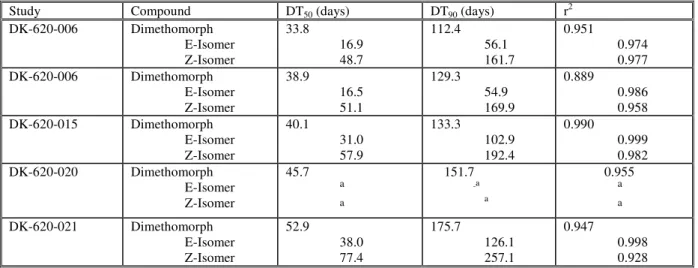
periods, the approximate E:Z isomer ratios changed 1:1 to 1:3 to 1:4. The best fit DT
50values ranged
from 14 days to 57 days and the DT
90values were from 133 – 226 days (Tables 15, 16).
Table 15. Best-fit field dissipation DT
50and DT
90values for dimethomorph reported in five field
dissipation studies in Germany
Study Soil Type DT50 (days) DT90 (days) Kinetics
DK-620-006 sandy loam 14 154 C=a/b√t
DK-620-007 sandy loam 25 226 C=1/(a+bt)
DK- 620-015 clay 26 133 C=1/(a+bt)2
DK-620-020 sandy loam 19 207 Not specified
DK-620-021 loamy sand 57 189 Not specified
Table 16. Estimated first-order dissipation DT
50and DT90 values for dimethomorph reported in five
field dissipation studies in Germany
Study Compound DT50 (days) DT90 (days) r2
DK-620-006 Dimethomorph E-Isomer Z-Isomer 33.8 16.9 48.7 112.4 56.1 161.7 0.951 0.974 0.977 DK-620-006 Dimethomorph E-Isomer Z-Isomer 38.9 16.5 51.1 129.3 54.9 169.9 0.889 0.986 0.958 DK-620-015 Dimethomorph E-Isomer Z-Isomer 40.1 31.0 57.9 133.3 102.9 192.4 0.990 0.999 0.982 DK-620-020 Dimethomorph E-Isomer Z-Isomer 45.7 a a 151.7 a a 0.955 a a DK-620-021 Dimethomorph E-Isomer Z-Isomer 52.9 38.0 77.4 175.7 126.1 257.1 0.947 0.998 0.928 a - Insufficient number of data points available
Field dissipation studies on a further three soil types in UK, France and Spain have been
reported by Bayer & Zangmeister, 2002 [DK-620-050] where dimethomorph (E:Z isomer ratio of
approximately 50:50) was applied to bare field plots at a target rate of 0.6 kg ai/ha and soil samples
(25 – 30 cm cores) were taken at regular intervals over a 7 month period. Soil types used in these
studies were loamy sand (2) and sand (1) with pH values between 6.5 and 6.7 and organic matter
contents of about 0.4 – 1.5%. Samples were extracted successively with acetone/HCl, partitioned in
dichloromethane with silica gel cleanup before GC/MS analysis. The mean fortification recovery rate
in the field samples was 86.1%
±
10.3% (n=36).
Dimethomorph residues were only found in the top 10 cm with trace amounts of the two
desmethyl metabolites (Z67 and Z69) being found in the top 20 cm layer but only during the first 2
months of the study. Initial residues of dimethomorph were about 0.3 – 0.4 mg/kg, decreasing to
< 0.05 mg/kg after 7 months. The first order DT
50values (Table 17) for dimethomorph ranged from
10 days to 61 days and the DT
90values were from 30 – 287 days.
Table 17. Estimated first-order dissipation DT
50and DT
90values for dimethomorph reported in three
field dissipation studies in Spain, France and UK
Study Compound DT50 (days) DT90 (days) r2
Spain Dimethomorph E-Isomer Z-Isomer 61 30 86 203 101 287 0.831 0.891 0.807 France Dimethomorph E-Isomer Z-Isomer 34 20 42 112 68 140 0.995 0.993 0.986 UK Dimethomorph E-Isomer Z-Isomer 10 11 9 33 38 30 0.98 0.966 0.977
Soil photodegradation
A study by Van Dijk, 1989 [DK-620-008] investigated the photodegradation of dimethomorph in a
sandy loam soil containing 5 mg/kg dimethomorph and irradiated under a xenon arc lamp for 15 days
continuous light. The results showed a small decrease in dimethomorph residues over the exposure
period (from 103% to 91% of the applied radioactivity) with two minor (unidentified) metabolites
being found at levels up to 4.2% AR. Small amounts of amount
14CO
2
were collected in the potassium
hydroxide traps, accounting for 1.2% of the applied radioactivity. There was a shift in the
dimethomorph E: Z isomer ratio from about 2:3 to 1:2 over the 15 day exposure period but not in the
dark control, suggesting that this shift was a result of photochemical reactions.
Soil photodegradation Van Dijk, 1989 [Ref: DK-620-008]
Test material: 14C-[chlorophenyl]-dimethomorph Dose rate: 5 mg/kg dry soil
Sandy loam (sterile) pH: 7 Organic matter: 1.86%
Duration: 15 days under xenon arc lamp Temp: 22 °C Moisture: 1:1 ratio of air-dried soil: water % dimethomorph remaining, day 15 = 91% AR Mineralization, day 15 = 1.2% AR
Dimethomorph
Total (%AR) %E-isomer %Z-isomer Unextracted residues (%AR)
Day 0 103.1 42.5 57.5 1.5 Day 1 95.8 44.8 55.2 2.9 Day 2 97.4 49.3 50.7 1.7 Day 4 96.7 43 57 3.7 Day 7 90.3 33.2 66.8 5.1 Day 15 91 33.8 66.2 6.4 Day 15 (dark) 96 42.6 57.4 3.8

![Table 5. Identification of 14 C residues in tissues and eggs of laying hens dosed orally for 8 days with 1.96 mg/kg bw/day [ 14 C-chlorophenyl]-dimethomorph (40 ppm equivalent in feed)](https://thumb-us.123doks.com/thumbv2/123dok_us/10032517.2902262/11.892.107.795.219.410/table-identification-residues-tissues-laying-chlorophenyl-dimethomorph-equivalent.webp)

![Table 13. Identification of 14 C residues in young tomato plants at intervals following a 7-day exposure to 14 C-[chlorophenyl]-dimethomorph (8 mg ai/litre) in a hydroponic nutrient solution](https://thumb-us.123doks.com/thumbv2/123dok_us/10032517.2902262/16.892.97.796.1013.1135/identification-residues-intervals-following-exposure-chlorophenyl-dimethomorph-hydroponic.webp)