A joint Initiative of Ludwig-Maximilians-Universität and Ifo Institute for Economic Research
Privatisation Experiences in the EU
Villa La Collina, Cadenabbia (Como)
1-2 November 2003
Privatization Experiences in France
Michel Berne & Gérard Pogorel
CESifo
Poschingerstr. 5, 81679 Munich, Germany Phone: +49 (89) 9224-1410 - Fax: +49 (89) 9224-1409
E-mail: [email protected] Internet: http://www.cesifo.de
CESifo Conference
Privatization Experiences in the EU
1-2/11/03
Privatization Experiences in France
Michel Berne
GET/INT
Département SGES
9 rue Charles Fourier
F-91011 EVRY cedex
[email protected]
Gérard Pogorel
GET/ENST
Département EGSH
46 Rue Barrault
F-75634 PARIS cedex 13
[email protected]
Abstract
France has long had a very large public sector following several rounds of nationalization of public services, banks and even industrial companies. Since 1986, privatization has occurred for a large proportion of these firms. Deregulation, poor state management and recurrent budget deficits explain why the public sector is now much smaller. However, the process is not complete yet and the Government faces major challenges with the remaining public services. France Telecom, the state operator, provides a good sample of the difficulties encountered in the privatization process : European deregulation requirements, policy changes due to elections, opposition by trade unions, risky international expansion, budget constraints etc. Since 1997, as much emphasis is put by the government on sound governance of public firms as on privatization policy.
Introduction
:
Nationalization and privatization in France, an historical
perspective
The approach used in this paper is two-fold. First a general introduction to the specific features of French privatization policies is set out, then their impact is studied using the example of France Telecom, the incumbent telecommunications operator, with additional information about other significant firms. France does not provide any dramatic examples of privatization policies as it has rather reluctantly followed the general trend in Europe. Rather, the interesting part of the story lies in the change of perspective that has led this country to stop being a champion of nationalization and to manage partially privatized firms.
•
Nationalization Policies
Indeed, French privatization cannot be understood without a long historical perspective : before privatization, France has lived through a long period of nationalization and has built at some time a “doctrine” about the coexistence of the private and the public sector. The traditional form for providing public services is a state-owned monopoly.
One can list three major periods when private companies have been nationalized in France :
- at the end of the XIX° century some railways and the telephone were nationalized. The PTT were created in 1889 by the merger of the state administration of Posts and Telegraphs and the privately-held Société Générale des Téléphones on the other side. The resulting PTT administration has lived until 1991;
- Before and after World War II, the railways, the central bank, the energy producers, the major banks and the car manufacturer Renault were nationalized;
- In 1981-1982, the socialist government (F. Mitterrand being President of the Republic) nationalized all the largest industrial companies and banks remaining in private hands.
The rationale behind these various moves can be summarized as follows :
- some private companies were in poor financial health, and/or provided substandard services (railways, telephones, steel-makers, computer manufacturers, etc. );
- some firms were thought to be too powerful to remain private companies : their resources and policies had a large impact on economic policies as a whole (banks, energy, transportation). So in order to have a free hand for its economic and social policy, the government concluded it had to own all the largest companies in the
country. This was especially crucial after World War II when the country infrastructure had to be rebuilt as fast as possible, but it also inspired the nationalization policy of 1982. As Jacques Attali [1994], special assistant to President Mitterrand from 1981 to 1991, put it bluntly :
“Had we not nationalized banks, banks would have been extremely hostile to all reforms. Maybe the Left has not transformed them into allies […] but we have at least weakened and neutralized a potential “enemy”.
We can add that the government wanted to use these firms as examples of well run companies with advanced social policies.
- Finally, a special case with Renault : because Louis Renault, then head of the company, had collaborated with the occupying German forces during World War II, his property was seized.
Starting with Colbert, the “mercantilist” finance minister of Louis XIV in the 17th century, French governments
have slowly built a doctrine of a “mixed economy” blending large public companies in heavy industries, energy, transportation and finance and small private companies. Nationalization was just one part of a global policy including five-year economic plans, price controls, “export management” etc. The peak of this policy can be found during the period when the Socialist Party and their allies ruled France from 1981 to 1986. According to Mamou [1996], at that time, the public sector including state-controlled companies represented 21 % of production, 23 % of wages earners, 28 % of GDP, 30 % of exports and 49 % of gross capital formation.
Table 1 - Public Firms Employment in France
Employees (thousands) % of total wage earners % of total active population
1947 1152 9.9 5.8 1960 1108 8.3 5.6 1970 970 6.0 4.5 1980 1088 6.0 4.6 1983 1852 10.3 7.8 1988 1355 7.2 5.6 1991 1763 (*) 9.1 7.0 1994 1505 7.7 6.0
Note : In 1991, La Poste and France Telecom abandoned their administrative status and became state enterprises; this move added 430000 employees to the total.
Table 2 - Companies controlled by the state
Year Number of firms controlled
Employees in France (millions)
Share of Total wage earners
2000 1500 1,1 5.3
Source : INSEE, Répertoire des entreprises contrôlées majoritairement par l’Etat
Note : Table 1 and Table 2 figures cannot be compared due to changes in statistical methodology
•
The case for privatization
However, it became clear over time that this situation could not go on forever for four major reasons :
1 - The state is a weak and erratic “shareholder”, looking for short-term financial or political benefits and getting limited strategic and macro-economic benefits from its investments in terms of employment, growth, external trade, etc. A recent and very severe audit of state management of public firms can be found in Diefenbacher [2003]. Adverse effects of poor state control can be felt by the firms themselves, by the Treasury as well as by the other French investors. One radical way to solve the problem is to privatize the firms. Another is to better manage state investments : a state agency, Agence des Participations de l’Etat, has been created in 2003 at the Ministry of Finance to bring more consistency and vision to the management of state participations [Barbier de la Serre 2003]. In 1999, the total value of shares detained by the state amounted to 400 billion Euros. The French state is a major player on the Paris Bourse (now called Euronext).
2 - The co-existence of state-run and private companies (as in the car industry since 1945 or in the telecom industry now) is awkward, and could prevent nationalized companies from expanding freely at home and abroad; indeed, any expansion by a state-owned firm leads the public sector to grow, even without any new nationalization measure
3 - Even though they can boast an outstanding technical record (as EdF with nuclear energy, SNCF with the high-speed train TGV, or France Telecom with digital switching), state monopolies at best suffered from time to time from traditional problems (high prices, low regard for customers); at worst engaged into uncontrolled and costly expansion policies because of the weakness of government control.
4 - A major liberalization and privatization drive started internationally in the 80s and France could not stay behind. Media provide a good example : the promoter of the public sector and major architect of nationalization, President Mitterrand, starting in 1982, opened the broadcasting sector to private operators. This paved the way later for the privatization of the largest public TV channel, TF1. Even though European competition policy does not demand privatization, it imposes severe restrictions on government intervention in the economy (like state aids); at the same time, deregulation policies (telecom, electricity, railways etc.) allow new entrants – private companies, that nearly automatically complain about the former state-owned monopoly.
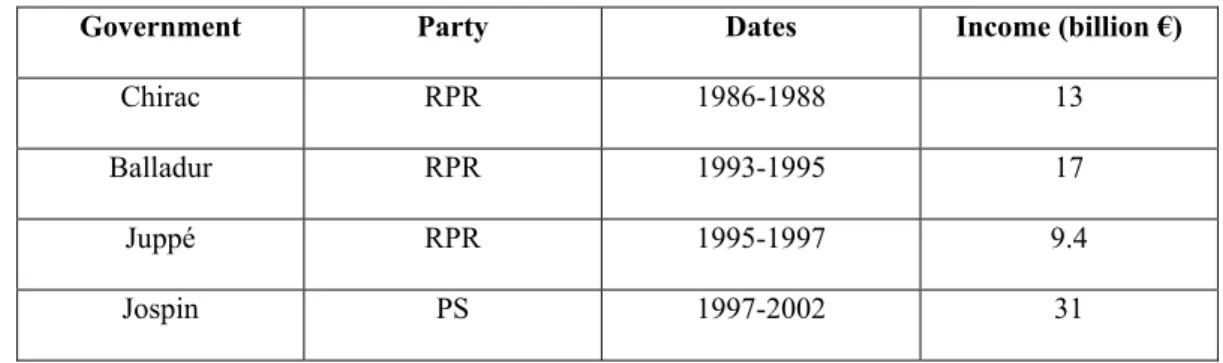
Privatization in France took place in several phases depending of the outcome of elections. In 1986-1998, the center-right parties were in power again and started dismantling the then enormous state sector. They benefited from favorable conditions on the Paris Bourse, at least until the 1997 stock crash. The Socialists came back to power in 1988, enforcing a policy that was then was dubbed “neither-neither” (“ni-ni” in French) : no privatization made by the previous government was overturned, but no further privatization was allowed. Limited capital openings happened neither the less. The Socialists lost the elections in 1993, and more privatization occurred, openly during the periods when the right-wing parties ruled, more quietly when the left-wing parties ruled (see the case of France Telecom below for a good illustration of the process). The speed and easiness of privatization in this period depended more on stock market conditions than on ideological inclinations of the governments.
Table 3 - Privatization Time Line
1982 Nationalization law (February 11, 1982) : 5 major industrial firms, 41 banks and finance groups 1986 Privatization law (July 2, 1986) : privatization of all companies nationalized after 1982 plus 12 others
(mostly insurance companies, banks)
1986 Privatization law for TF1 (major public TV channel)
1993 Privatization law (July 19, 1993) : privatization of 13 additional groups including Air France, Renault, SEITA (tobacco, now merged into Altadis), SNECMA (aviation engines), Usinor-Sacilor (Steel) 1997 France Telecom IPO
Since 2002, the center-right government of Jean-Pierre Raffarin has made clear he favors to get privatize state-owned companies. In his general Policy Address at the National assembly in July 2002, the Prime Minister said that :
“ We have a pragmatic approach to the state's role in the economy. As such, we will analyse capital release and privatisation projects case-by-case, taking particular account of companies' interests and the potential for alliances and development. This policy can only be envisaged over the full length of the term. In general, the state's aim is to withdraw from the competitive sector unless specific strategic interests make this undesirable. ” [Raffarin 2002].
One can add that the degraded government budget situation is a strong incentive to sell and raise funds. However, this government has been very pragmatic in his approach :
- selling when favorable conditions appeared (for example, Crédit Lyonnais, sold over a week-end to Crédit Agricole in 2003 after some hectic bidding)
- taking into account the long-term interests of the companies (as in the Air France – KLM merger planned at the end of 2003)
- and even trying to “re-nationalize” companies in deep trouble : such a rumor circulated regarding France Telecom in 2002 when the operator was close to financial breakdown. Considerable financial aid to France Telecom was given through other means. A bolder move was attempted to rescue Alstom, the troubled electric and transportation equipment manufacturer in the summer of 2003. The French government wanted to buy 300 M€ shares in Alstom. But this plan was not approved by the European authorities and the government had to devise a different plan for Alstom.
Table 4 - Privatization income 1986-2002
Government Party Dates Income (billion €)
Chirac RPR 1986-1988 13
Balladur RPR 1993-1995 17
Juppé RPR 1995-1997 9.4
Jospin PS 1997-2002 31
Note : from 1981 to 1999, privatization income minus nationalizations/capital costs amounted to 116 bn €; nearly 20 billion € had been spent in 1983 in the major nationalization plan.
Source : Mauduit [2002] based on Baert [2000], Orange & Rocco [1999]
1.
Impact of privatization
•
Changes of ownership
Two very different cases can be distinguished regarding changes of ownership. Some companies were swiftly and totally privatized (the smaller ones or the industrial firms nationalized in 1982), but a large number of state-controlled companies went through a very long and sometimes painful privatization process : after a partial IPO, the state gradually sold additional chunks of shares until its participation became nil. In a few extreme cases, this last step has not been possible yet either because of legal problems (as we will see in the case of France Telecom) or because of the poor financial health of the company (as for Bull, the troubled computer firm). If we take the case of France Telecom, the full privatization process requires three steps. The first one was the transformation of the PTT administration into two para-statal entities – this has been done by a 1990 law creating La Poste and France Telecom. A large scale public debate was organized on this occasion by the Ministry of PTT to prepare the move. The unions were satisfied by the guarantees offered that the personnel would remain mostly public servants.
The second step was the Initial Public Offering (IPO) of France Telecom in 1997. In 1996, a Telecommunications regulation law was adopted preparing the sector to full competition in 1998, in accordance with European policy. A second law was also adopted in 1996 transforming the para-statal entity France Telecom into a standard private company starting in 1997. The IPO was planned for the Spring of 1997 and a lengthy internal communication process took place to overcome opposition from the unions. But the center-right Juppé government lost the general elections at that time and was replaced by the Jospin government (socialist). The new Prime Minister asked for a “social audit” of the whole process (the socialists being traditionally against privatization) but finally gave the green light to the IPO. It took place in the Fall of 1997 and netted 29 billion Euros. The state kept 75 % of the capital; 4 millions individual shareholders asked 3 times the number of available shares and finally got 10.55 % of the capital. Financial institutions obtained 11.95 % (they had asked 20 times the number of available shares) and 70 % of personnel of France Telecom got 2.5 %. A second public offering took place in 1998 and netted 9 billion Euros.
As shown in Table 5, the percentage of France Telecom owned by the state has not decreased regularly. In 2002-2003, the government had to rescue France Telecom, then in dire financial straits due to its enormous debt (more than 70 billion Euros for 46.6 billion Euros of sales). On this occasion, part of the state participation was
allocated to a state-owned financial holding company, originally devoted to the oil sector, ERAP. It now holds 28.69 % of the capital of France Telecom.
The last step will happen when the state sells its last share of France Telecom. Back in 1997, more than 80 % of France Telecom personnel were civil servants and a decision by Conseil d’Etat, the Government counsel and higher administrative court, made it clear that civil servants could work in a private company only if (1) the government still held a majority of the shares and (2) the company was in charge of a public service. France Telecom met the two conditions. However, in 2003 two changes appeared. On one side, the new European telecom regulatory packet was enforced demanding that Universal Service be tendered. Therefore, France Telecom could, in theory, lose Universal Service. On top of that, the Raffarin government (center-right) opened the way to a sale of more France Telecom shares, a move designed to fill the state coffers as well a to free France Telecom from government control (useful for the international expansion of the firm). A law should be presented to Parliament at the end of 2003. In a derogatory way, it would allow the present the 104000 civil servants still working at France Telecom to remain in the company until they retire.
Table 5 - Shareholders of France Telecom
% Dec. 1997 Jan. 1999 Dec. 2002 Sept. 2003
State (direct & indirect) 75 63.6 56.5 58.89
General Public & Investors 22.5 31.2 32.1 34.9
Owned by France Telecom - - 8.3 4.29
Deutsche Telekom - 2.0 -
-Employees 2.5 3.2 3.1 1.92
Source : France Telecom
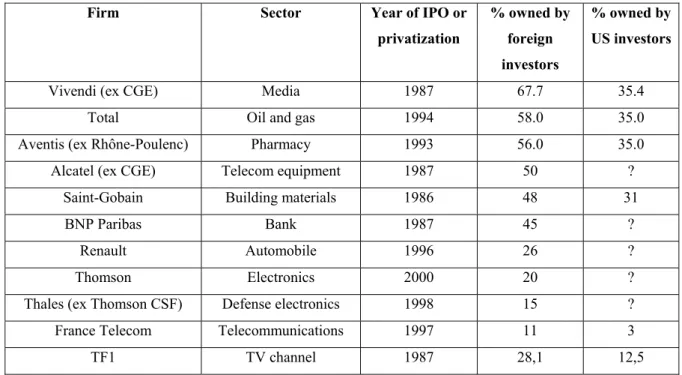
One major concern of the French government was to keep control of the companies while selling its capital, or at least to prevent the privatized companies from falling into foreign hands. During the first privatization phase, in 1986-1988, the government tried to set-up stable groups of investors (in French “Noyaux durs” for “hard kernels”). This decision generated a long controversy about the choice of these friendly and stable investors. And as there was a limited number of potential investors in France, this led to a fairly high level of “consanguinity” between all the groups. The largest banks played a major role in this process. As shown in Table 6, the percentage of foreign ownership has neither the less grown to very high levels for some companies. In an
extreme case, in 2003, Alcan has launched an offer on Pechiney – so the later will not longer be under French management. One can safely conclude that the globalization of business has dealt a fatal blow to any dreams of national independence that might have inspired French governments in the past.
Table 6 - Share of capital owned by foreign investors (2003)
Firm Sector Year of IPO or
privatization % owned by foreign investors % owned by US investors
Vivendi (ex CGE) Media 1987 67.7 35.4
Total Oil and gas 1994 58.0 35.0
Aventis (ex Rhône-Poulenc) Pharmacy 1993 56.0 35.0
Alcatel (ex CGE) Telecom equipment 1987 50 ?
Saint-Gobain Building materials 1986 48 31
BNP Paribas Bank 1987 45 ?
Renault Automobile 1996 26 ?
Thomson Electronics 2000 20 ?
Thales (ex Thomson CSF) Defense electronics 1998 15 ?
France Telecom Telecommunications 1997 11 3
TF1 TV channel 1987 28,1 12,5
Note : France Telecom and TF1 figures for 2002
Source : Ducourtieux [2003], based on a survey conducted by Georgeson Shareholder
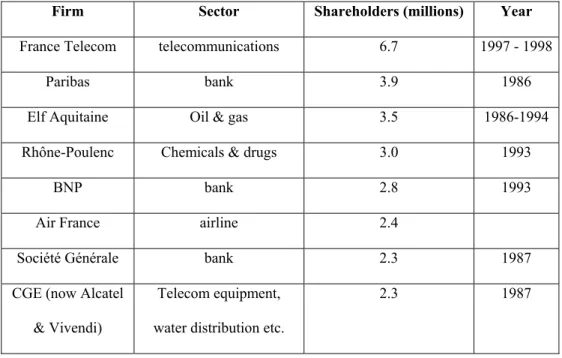
Another impact was the creation of a large class of small shareholders, tempted by the initial public offering of blue-chip stocks. As shown in Table 7, the largest groups of private shareholders were to be found in banks, large industrial firms and France Telecom. The France Telecom IPO generated a tremendous interest in the general public, who was severely rocked by the incredible rise and precipitous decline of the price of the share in the later years. The introduction price was 31.5 €; the share peaked at 219 Euros on March 2nd, 2000, then fell to
an all-time low of 6.94 € on September 30th, 2002. In October 2003 the price was around 21 €. However, private
investors have kept a hearty appetite for shares of privatized companies as proven by the various recent IPOs. [Observatoire, 2003]. France Telecom staff members investing in shares in their company have also suffered a lot : they have seen the value of their investment divided by 11 between 2000 and 2002. [de Tricornot & Picquet, 2002]
Table 7 - Private shareholders in privatized companies when the shares were sold
Firm Sector Shareholders (millions) Year
France Telecom telecommunications 6.7 1997 - 1998
Paribas bank 3.9 1986
Elf Aquitaine Oil & gas 3.5 1986-1994
Rhône-Poulenc Chemicals & drugs 3.0 1993
BNP bank 2.8 1993
Air France airline 2.4
Société Générale bank 2.3 1987
CGE (now Alcatel & Vivendi)
Telecom equipment, water distribution etc.
2.3 1987
Source : SBF, Bourse de Paris in : INSEE [1999], p. 137.
•
Changes in regulation
France does not have a long tradition of independent regulators because of the existence of strong monopolies in some sectors as well as because of a tradition of direct intervention by the administration. The central banker, Banque de France, created in 1800 as a private entity, had been nationalized in 1936 but obtained its full independence in 1993 only. With the arrival of new entrants following deregulation in most sectors, new bodies were set up. A good example is provided by the broadcasting regulator CSA which has been preceded by two short-lived and controversial bodies. Most of these regulators are independent regulatory authorities, as ART the telecom regulator. ART has been set up in 1997 before full deregulation took place in 1998. Its relations with France Telecom are tense : ART approves interconnection tariffs and gives its opinions on other tariffs of France Telecom; it solves interconnection issues and manages scare resources like frequencies and numbers. But there is at least one special case : in the railway industry, the network has been transferred to Réseau Ferré de France. This is a state company (“EPIC”). It manages the network and regulates rail transport. It receives tolls from the state company, SNCF and any other users. RFF decides on network expansion, subcontracts construction work and pays SNCF for network maintenance.
Table 8 - Sector Regulation in France – Main bodies
Sector Year
Created
Activity
ART
Autorité de Régulation des Télécommunications
Telecommunications 1997 Independent regulatory authority AMF
Autorité des Marchés Financiers
Finance 2003 Merger of the Commission des Opérations de Bourse and 2 other state bodies
Banque de France Banks
1800-1993
Bank, 100 % owned by the state CRE
Commission de Régulation de l’Energie
Electricity and gas 2000
Regulator; the electricity transport network (RTE) is being separated from EdF, the
state-owned electricity producer CSA
Conseil Supérieur de l’Audiovisuel
Radio & TV
broadcast 1989 Independent regulatory authority RFF
Réseau Ferré de France
Railways 1997 Regulator and owner of the main railway network; carries the network debt
•
Changes in competition
Privatization does not appear to be a key ingredient in changes in the competitive situation in France. Deregulation is the key factor, and privatization of any state-firm can only help as its clears the way for a “normal” competitive situation. It is indeed a very awkward situation when the state is at the same time promoting competition and the owner of the largest market player. Furthermore, the situation is quite different in the network industries and in the other sectors. In the last case, competition is the normal way to run markets and barriers to entry tend to be lower. In network industries, barriers to entry can be extremely high for economic reasons – the so-called natural monopoly problem, or the related “essential facilities” problem. There could be as well as legal reasons such as licensing but the current deregulation process taking place in Europe is slowly eliminating this last obstacle. Therefore, the privatization of a state monopoly will give various results depending on these elements as shown by the contrasted situation of airlines and telecommunications. Until the arrival of low-cost companies in the XXIth century, Air France has kept a strong grip on the French market and all moves to create a viable competitor to the flag carrier have failed, as testified by the attempts of British Airways, Swissair (with Air Lib), as well as several independent companies. On the other hand, France Telecom has steadily lost market share to its competitors : at the end of 2002, it held less than 50 % of the mobile market and
64 % of the long distance market. It keeps 81 % of the local telecommunications market, but the unbundling of the local loop is progressing fast.
One can add that an indirect impact on competition comes from privatization. When a firm leaves the private sector, it undergoes a drastic change in its corporate culture, usually becomes more aggressive on the market ad more flexible in its management. These points will be further expanded in a later paragraph on the performance of privatized companies.
2.
Sector issues
Several reasons explain why some sectors have been privatized faster than others :
- the existence of competition makes public management very complicated. As explained above, in the case of the car manufacturer Renault, the government was at the same time the owner of the largest car company and was regulating the car industry : any move by the government had conflicting impacts on its two missions;
- Some companies had been state-owned in the eighties for a short while only. Privatizating them was easier than the public services under public management for decades;
- European deregulation did accelerate privatization schemes : in telecoms and air transport, deregulation has taken place and national companies have been at least partially privatized; deregulation is under way in rail transport, energy and postal services. No privatization move have happened so far, but they are being contemplated in the electricity and gas sectors;
- It is always easier to privatize profitable companies. Privatizing he French railways SNCF, a regular money loser, would be a formidable task requiring imaginative plans;
- Strong union presence hinders privatization. The major union, Confédération Générale du Travail (CGT), a longtime close ally of the French Communist Party (PCF), is opposed to privatization in principle. It is very strong in some public companies like the electricity producer EdF. In the recent years a new union (SUD) was created from parts of other unions. SUD is radically opposed to privatization. It is a minor, but very vocal stakeholder in the railways and telecoms.
- Finally, timing of privatization plays a great role. Governments decide on a tentative calendar that will be followed - or not depending on stock exchange levels, election outcomes, economic outlook etc. The capital of Snecma, a major aviation equipment manufacturer, was planned to be opened by the Jospin government (before 2002). Finally, the move should be completed in 2003/2004 by the Raffarin government. Poor conditions on the Paris Bourse explain the delay.
Table 9 - Major state-owned companies in France (2003) Sector Sales (2002) Billion € Profits (2002) million € Employees (2002)
Air France airline 12.7 120 71500
Areva nuclear industry 8.3 240 50100
EdF utility 48.4 480 172000
France Télécom telecommunications 46.6 -20700 * 240100
GdF natural gas 14.6 840 37900
La Poste postal services 17.3 34 325000
SNECMA aerospace 6.5 106 39000
SNCF railways 22.2 63 182800
* including –18.2 bn € exceptional items (amortization and provisions) Source : company information
Table 10 - Privatization status of major state-controlled companies (2003) %
government-owned
Status Remarks
Air France 54 SA, on full privatization track Government share below 50 % when Air France and KLM merge
Areva 95 SA Part of the capital is held indirectly by
state entities (CEA, EdF) The public cannot buy shares but
“investment certificates”
EdF 100 EPIC, on privatization track
France Télécom 59 SA Full privatization possible after new law
is adopted
GdF 100 EPIC, on privatization track
La Poste 100 “Etablissement autonome de droit public”
Impacted by European deregulation SNECMA 97.2 SA, on privatization track Planned for end 2003/early 2004
SNCF 100 EPIC No privatization plans
Note : The normal legal status for large business firms in France is Société Anonyme (SA). SNCF, EdF and GdF are EPIC, “Etablissement public industriel et commercial”, that is industrial and commercial state entity. This
unique legal status makes them quasi-firms, but impedes their development. The status of La Poste is unique but it is close to an EPIC.
Source : company information
3.
Performance measures
It is extremely difficult to give clear and objective performance measures for French privatization. First, we have to exclude the privatization of the firms nationalized in 1982 as they soon returned to competition. If we look at the emblematic case of France Telecom, we can see consumer prices decreasing and significant marketing efforts taking place [ART 2003]. These moves enforce a complex tariff “rebalancing” strategy where local call prices and subscription fees increase while long distance call price decrease. It would be very difficult to assume that these results are due to privatization of the national operator. More likely, deregulation in the telecom sector and competition from new entrants explain most of the changes. Moreover, France Telecom (as all other state companies) has to get its main prices approved by the relevant ministry. From 1997 to 2000, a price cap had been imposed by the state (- 9 % per year in 1997-1998 and – 4.5 % per year in 1999-2000). On top of that, France Telecom has to submit most of its price changes to ART. The opinion of ART is public, but not binding. ART is especially careful about predatory pricing by France Telecom, so that it might not approve of too low tariffs. In at least two instances, France Telecom got the Ministry of Finance to approve very low tariffs despite negative opinions from ART, but these tariffs were eventually cancelled when the competitors complained.
One can also look at performance from a human resources point of view. If we use the France Telecom case again, the CGT union has computed that 32600 jobs had been cut by the operator since the 1997 IPO, most of them in France. These figures are difficult to guarantee as the size of the company has changed a lot. However, France Telecom reports a loss of 2.9 % of its workforce in 2002. These significant changes are accompanied by an enormous transfer program from operational divisions to sales : more than 50000 workers have changed their job in the last years, 9500 in 2002 alone [France Telecom 2003]. The unions fear that similar evolutions if EdF is privatized in the future.
4.
Conclusions
•
The changing role of ideology
The privatization process in France has been heavily loaded in terms of ideology, as had been the case for nationalizations themselves. The reluctance to privatizations had been especially high due to the combination of three political ideologies.
- The Socialist ideology states that “people” or state-ownership are in all cases superior to private ownership. - The “Dirigiste” (Colbertiste), Bonapartist, and Gaullist tradition, highlights the superior knowledge and
vision of the state
- A Christian inspired Social Doctrine advocates public property in the name of the public good and social solidarity.
This combination resulted not only in the above-mentioned nationalization, but in provisions for “public ownership” to be written down in the 1946 Constitution, as the Government coalition was composed of those three political forces. Until the early 80’, this combination had remained prevalent in terms of popular support. The radical changeover in ideology and reality in the United States and the United Kingdom did induce, but with some delay, changes in French political doctrines. It combined with the disastrous economic situation which followed the phase of nationalizations performed by the “Union of the Left” Coalition (1981-1986) to pave the way for the protracted, and not yet finalized privatization process.
•
Perception of privatization policies
Privatisations are now a widely accepted in principle. However, Unions and social forces are often fighting successfully to oppose them as much as they can, in order to preserve special workers and social conditions in the public sector. It often takes heralding imperious “strategic” moves, like in the Air France KLM merger case, to assuage this reluctance.
It has to be said that the show of exuberance, and reluctance to comply to the governance and information transparency rules they preach, given by the blue ribbon world corporation, has not helped in promoting the image of private corporations in the most recent period.
•
Lesson to be learned?
The implementation of sound governance rules for the private sector seems to have to go hand in hand with the promotion of the privatization process. The succeeding French governments have learnt the hard way that
privatization is a slow process and that one should pay as much attention to corporate governance of partially privatized firms as to privatization moves. As an example, the IPO of France Telecom was a resounding success in 1997; the results of the company were disastrous in 2001 and 2002, and not only because of the burst of the telecom bubble. Another sad example is provided by the computer manufacturer Bull : the state is unable to bring the firm back to profits, despite massive injections of public money (much disliked by the European Commission, as expected).
•
Reaction to EU directives
EU directives have played a very important role in the evolution of economic ideologies and realities. In many cases, French governments have played them to promote internal policies they actually supported without daring saying so. We know no directive can be taken without the explicit agreement of member countries Governments. “Brussels constraining demands”, however, have often been invoked by French governments as imposing upon them to take not-so-popular or unpopular measures and decisions.
SOURCES
Attali [1994], Les nationalisations ont sauvé notre industrie, Capital N° 35, Août 1994, pp. 116-117. ART [2003], Rapport public d’activité 2002, ART, p. 9.
Baert [2000], Comptes spéciaux du Trésor et entreprises publiques, Annexe N° 43, Rapport sur le projet de loi de finances pour 2001, Assemblée nationale, octobre 2003
Barbier de la Serre [2003], L’Etat actionnaire et le gouvernement des entreprises publiques, Ministère de l’Economie, des finances et de l’industrie, 24 fevrier 2003
Bureau [1997], La gestion des entreprises publiques, document de travail N° 97-5, Ministère de l’économie, des finances et de l’industrie
Chabanas & Vergeau [1996], Nationalisations et privatisations depuis 50 ans, INSEE Première N° 440, INSEE, avril 1996
De Tricornot et Piquet [2002], Les actionnaires salariés ont perdu 29 % de leurs avoirs en 2002, Le Monde, 4 octobre 2002
Diefenbacher [2003], Rapport de la Commission d’enquête sur la gestion des entreprises publiques afin d’améliorer le système de prise de décision, (Commission “Douste-Blazy”), Assemblée nationale, juillet 2003 Ducourtieux [2003], La France s’ouvre de plus en plus aux fonds anglo-saxons, Le Monde, 29 juillet 2003 INSEE [1999], Tableaux de l’économie française, 1999-2000, INSEE, 1999
[France Telecom 2003], Rapport d’activité 2002, France Telecom
Loiseau [2002], 1985-2000 : Quinze années de mutation du secteur public d’entreprises, INSEE Première N° 860, INSEE, juillet 2002
Mauduit [2002], En France, les privatisations ont rapporté 70 milliards d’Euros, Le Monde, 9 avril 2002 Observatoire [2003], Observatoire des privatisations / 1ère vague, 2003, TNS SOFRES Finance, available at :
http://www.tns-sofres.com/etudes/comfi/080403_privatisation.htm
Orange & Rocco [1999], Nationalisations-privatisations : l’Etat gagnant, Le Monde, 17 juillet 1999 Raffarin [2002], General Policy Address, July 3, 2002, available at : www.premier-ministre.gouv.fr