Run Run Shaw Library
Copyright Warning
Use of this thesis/dissertation/project is for the purpose of
private study or scholarly research only.
Users must comply
with the Copyright Ordinance.
Anyone who consults this thesis/dissertation/project is
understood to recognise that its copyright rests with its
author and that no part of it may be reproduced without the
author’s prior written consent.
香港城市大學
Jumping over the Network Threshold:
Information Diffusion on Information Sharing
Websites
跨越網絡的門檻:
信息分享類網站上的信息擴散
Submitted to
Department of Media and Communication 媒體傳播系
in Partial Fulfillment of the Requirements for the Degree of Doctor of Philosophy
哲學博士學位 By Wang Chengjun 王成軍 September 2014 二零一四年九月
Abstract
As a ubiquitous phenomenon, information diffusion has long been studied in
communication research. Recently, accompanied by the rise of Web 2.0, information sharing websites (ISWs) have emerged on the World Wide Web as a new platform for information diffusion. ISWs can be defined as social media through which users submit, share, and comment on news or other types of information, which underscores the transformation of information diffusion as a participatory process. Technically, ISWs are usually based on social networking services (SNSs), information aggregators, and search engines. The evolution of information and communication technologies (ICTs) and their interplay with the public have transformed the underlying mechanisms of information diffusion, which have important implications for diffusion research and call for systematic investigations.
This research starts from a puzzlement in online information diffusion —contrary to the proposition of global diffusion, researchers keep finding that large-scale diffusion is rare and fragile. From the perspective of threshold models, the present dissertation aims at systematically investigating information diffusion on ISWs. Drawing on classic diffusion theories (e.g., news diffusion theory) and communication models of information flow (e.g., the ABX model), I extended the ABXC model to the ABXCT model as a general framework to incorporate and explain the emerging ICTs for information diffusion on ISWs, networked individuals, and the interplay between them.
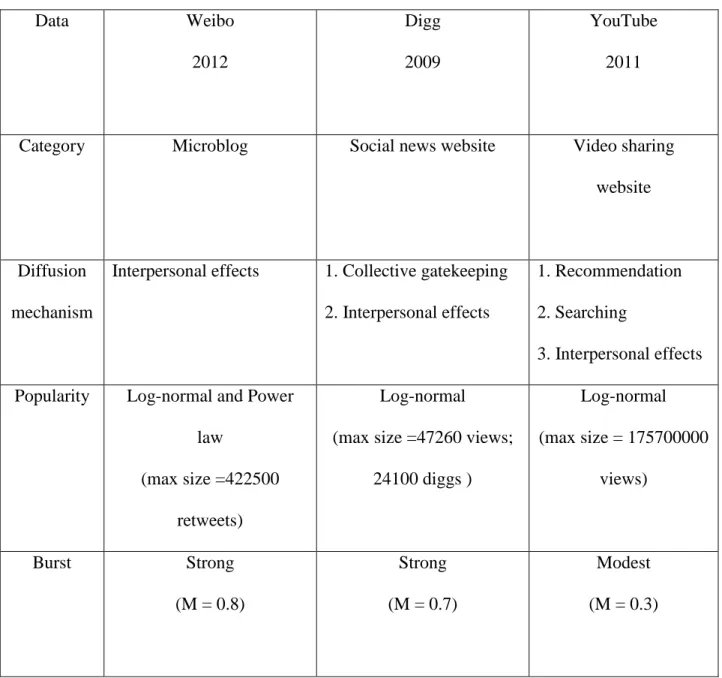
The rise of digital media makes the “digital fingerprints” of human communication publicly available. This, in turn, grants us an opportunity to unobtrusively investigate the underlying diffusion mechanisms. Using the digital traces of information diffusion on Sina Weibo, Digg, and YouTube, three studies are carried out in order to reformulate the threshold
hypothesis of interpersonal effects, to compare collective gatekeeping with interpersonal effects, and to test the temporality hypothesis for online information diffusion research, respectively.
First, the study of Sina Weibo reformulates the threshold hypothesis for interpersonal effects in light of both threshold models and the J-curve model of information diffusion. Using the data of information diffusion on Sina Weibo, the findings confirm the threshold hypothesis of interpersonal effects. In particular, for information of public interest, interpersonal effects have a positive influence on diffusion size; for information of personal taste, interpersonal effects have a negative impact on diffusion size. The depth of diffusion networks is limited and the temporal diffusion curves are characterized by strong bursts. Thus, information diffusion on microblogs is both structurally and temporally constrained. To make information go viral means to break the bottleneck of local clusters and to spread information to diverse communities.
Second, the study of Digg primarily focuses on collective gatekeeping. ISWs provide a testing ground for the debate on the primacy of collective gatekeeping over interpersonal effects. Emphasizing interpersonal effects on ISWs, recent studies of online information diffusion generally overlook another player — information aggregators of ISWs. Through the process of news aggregation based on collaborative filtering, ISWs carry out a “collective gatekeeping” process that differs from news disseminations by mass media and news transmissions among individuals. Using the news voting data collected from a social news website (Digg), I compare the relative effects of interpersonal sources and collective gatekeepers on information diffusion, and find that collective gatekeeping is the primary driver for online news diffusion. Considered together, the nature of ISWs itself has a strong impact on the outcome of information diffusion. In the case of Digg, the mechanism of public voting rather than local social influence dominates
the size of information diffusion. In addition, the daily diffusion curves of news diffusion on Digg are also characterized by strong bursts.
Third, to understand the origin of bursts in public attention, I shift to a more general framework by proposing the hypothesis of temporality in the study of the diffusion of YouTube videos. Public attention is the extent to which individuals collectively allocate their attentions to cultural products across space and time. In addition to fragmentation and polarization, recent studies have shown that the temporal distribution of public attention is also characterized by strong bursts. Measuring bursts using peak fraction, this study aims at systematically studying how bursts of public attention are related to the popularity of YouTube videos (both lifetime and size of diffusion), and how it grows out of system recommendation, social influence, use of search engine, and mobile communication. The results show that, first, bursts are negatively related to the popularity of online videos; second, bursts are negatively related to searches, but positively related to system recommendations and the use of mobile devices; third, compared with videos in other categories (such as entertainment videos and education videos), news videos experience stronger bursts, while copyright-protected videos exhibit weaker bursts. In all, the findings suggest the temporality underlying various influential factors results in the bursts of public attention. Viral videos tend to seek continuous, incremental improvements, not great ups and downs. Thus, “going viral” means long-term growth rather than a temporary eruption. If the fragmentation of public attention implies “winner takes all”, the temporality of public attention implies that the winner grows steadily over time.
To summarize, the present dissertation contributes to the research of information
diffusion in four aspects: first, it adopts the ABXCT model as a general theoretical framework to incorporate the emergence of ISWs, and to map concrete studies about information diffusion in a
systematic way; second, it formulates and confirms the threshold hypothesis of interpersonal effects; third, it conceptualizes collective gatekeeping as an alternative driving force of
information diffusion; fourth, it investigates the burst of public attention in information diffusion, and formulates the temporality hypothesis. Overall, by illustrating the driving forces, the hidden patterns, and the underlying principles of online information diffusion, the present dissertation underscores the communication power of networked individuals and new communication technologies in the age of social media, and sheds light on the puzzlement about the limited size of online information diffusion.
Acknowledgement
Diffusion is a ubiquitous phenomenon widely existing in many different systems, including social systems. However, it is a great challenge for researchers to capture the
underlying mechanisms and the hidden principles. Without a great deal of help from a number of individuals along the way, it would have been impossible for me to finish this dissertation. I would like to thank my teachers, friends, and family in following paragraphs of this
acknowledgement. The “diffusion” of ideas and encouragements from them to me always inspires my passion for academic inquiry.
First and foremost, I am grateful for the guidance and support provided by my supervisor Jonathan J.H. Zhu. I have had much intellectual stimulation and enlightenment from him every week. His imagination in conceptualization and theory-construction, and his passions for cutting-edge research always invigorate me to walk along the way of academic research. Without his tolerance, patience, kindness, and stringent requirements, it would be impossible for me to finish this dissertation.
Second, I owe my thanks to the other faculty members in the Department of Media and Communication, City University of Hong Kong, especially Chin-Chuan Lee, Tsan-Kuo Chang, Xi-Gen Lee, Wan-Ying Lin, Crystal Li Jiang. They showed me the importance of personal interest, academic writings, and logical reasoning. Conversations with them gradually made me realize the boundaries of my research. Additionally, I would like to thank Robert Ackland and Lexing Xie, from whom I benefitted a great deal when I was an exchange student at Australia National University. Rob is a good role model in many ways, and his enthusiasms for network science excite me greatly. Lexing’s constructive suggestions are very helpful for my study of the diffusion of YouTube videos.
Third, I would like to express my debts to a number of fascinating people that I have met in this small city. I would like to thank the members of the Web Mining Lab: Tai-Quan Winson Peng, Lun Zhang, Heng Lu, Lingfei Wu, Hai Liang, Jie Qin, Zhen-Zhen Wang, and He-Xin Chen. My special thanks go to Lingfei Wu. He persuaded me to use R and Mathematica, and we learned to use Python together. I would also like to thank my other friends in the department, especially Echo Liu, Pian-Pian Wang, and Xin-Zhi Zhang. Additionally, I would like to thank everyone who directly or indirectly offered his or her help on this dissertation. I want to thank Xiong Wang, whose lectures on “the four levels of scientific research” enlighten me to reflect on social scientific theories. I would also like to thank Wu Lin for his workshop on Python which paved the way for me to use Python. I also want to thank Fangjian Guo. As a visiting student from the University of Electronic Science and Technology of China, Fangjian helped me greatly in cleaning the huge data of Sina Weibo with Linux utilities, and in calculating the network threshold with C++.
Finally, I have to thank my family members, especially my father, my mother, my sister, and my wife, and I would like to dedicate this dissertation to them. Walking through the four years of Ph.D. training, I kept finding that I am increasingly ignorant about the outside world as well as about myself. Without their continually encouragements and understandings, I could not finish this dissertation.
Contents Abstract ... i Acknowledgement ... v Contents ... vii List of Tables ... x List of Figures ... xi Chapter 1. Introduction ... 1 1.1 Research Background ... 1
1.1.1. The Rise of Information Sharing Websites (ISWs) ... 1
1.1.2. A Puzzlement of Online Information Diffusion ... 3
1.2 Research Objectives ... 5
1.2.1. Research Questions ... 5
1.2.2. Theoretical Significance ... 9
1.3. Structure of the Dissertation ... 11
Chapter 2. Diffusion Research: Theories and Models ... 13
2.1. Theoretical Perspectives of Diffusion Research ... 13
2.1.1. Two-step Flow ... 14
2.1.2. News Diffusion ... 15
2.1.3. Diffusion of Innovations ... 18
2.1.4. Bass Diffusion Model ... 20
2.1.5. Epidemic Models ... 22
2.1.6. Threshold Models ... 28
2.1.7. Summary of Diffusion Theories and Models ... 31
2.2. Information Diffusion: A Research Agenda ... 34
2.2.1. From Offline to Online... 34
2.2.3. From Individuals to Network ... 36
2.2.4. From Information to Attention ... 37
Chapter 3. The Conceptual Framework of Online Information Diffusion ... 39
3.1. Theoretical Framework ... 39
3.1.1. Communication Models of Information Flow ... 39
3.1.2. Information Sharing Websites (ISWs) ... 44
3.1.3. A Communication Model of Information Diffusion—The ABXCT Model ... 46
3.2. Research Design ... 51
Chapter 4. Information Diffusion on Microblogs: Testing Threshold Hypothesis of Interpersonal Effects ... 53
4.1. Introduction... 53
4.2. Information Diffusion on Microblogs... 54
4.2.1. Microblogs and Information Diffusion ... 54
4.2.2. Diffusion Mechanisms on Microblog ... 56
4.3. Threshold Hypothesis of Interpersonal Effects ... 58
4.4. Method ... 63
4.4.1. Data Collection & Sampling ... 63
4.4.2. Measure ... 64
4.5. Results ... 67
4.6. Conclusion and Discussion ... 70
Chapter 5. Collective Gatekeeping of Information Diffusion on Social News Website ... 74
5.1. Introduction... 74
5.2. News Diffusion and Social News Websites ... 76
5.2.1. Traditions and Limitations of News Diffusion Research ... 76
5.2.2. Social News Websites (SNWs) ... 77
5.3. Collective Gatekeeping vs. Interpersonal Effects ... 79
5.4. Method ... 83
5.4.1. Data ... 83
5.4.2. Measure ... 84
5.5. Results ... 85
Chapter 6. The Origin of Bursts in Public Attention: The Temporality Hypothesis for the Diffusion
of YouTube Videos ... 91
6.1. Introduction... 91
6.2. Public Attention: Antecedents, Patterns and Principles ... 94
6.3. Temporality Hypothesis of Influences ... 97
6.3.1. Burst of Public Attention and the Popularity of YouTube Videos ... 101
6.3.2. Burst of Public Attention and Diffusion Channels ... 102
6.3.3. Burst of Public Attention and Audience Interest ... 104
6.3.4. Burst of Public Attention and Category of YouTube Videos ... 105
6.4. Method ... 106
6.4.1. Data and Sampling ... 106
6.4.2. Measure ... 106
6.5. Results ... 109
6.6. Conclusion and Discussion ... 110
Chapter 7. Conclusion and Discussion ... 116
7.1. Summary of Findings ... 116
7.1.1. Interpersonal Effects ... 116
7.1.2. Collective Gatekeeping ... 119
7.1.3. Bursts of Public Attention ... 120
7.1.4. The Limited Size of Information Diffusion ... 120
7.2. Contributions and Implications ... 123
7.2.1. ABXCT Model of Information Diffusion ... 124
7.2.2. Threshold Hypothesis of Interpersonal Effects ... 126
7.2.3. Collective Gatekeeping ... 127
7.2.4. Temporality Hypothesis of Diffusion Driving Forces ... 130
7.2.5. Theoretical and Practical Implications ... 133
7.3. Limitations and Directions for Future Research ... 134
References ... 137
List of Tables
Table 1. Comparison of Diffusion Theories ... 157
Table 2. Comparison of Diffusion Models ... 158
Table 3. Coding Scheme of Categories of Sina Weibo Tweets ... 159
Table 4. Summary of Linear Regression ... 160
Table 5. Collective Gatekeeping and Interpersonal Effects ... 161
Table 6OLS regression of interpersonal effect, collective gatekeeping, and news category on the size of news diffusion ... 162
Table 7. Temporal Property of Different Impacts ... 163
Table 8. Prediction of Burst of Public Attention Using OLS Regression ... 164
List of Figures
Figure 1. Structure of the Dissertation ... 166
Figure 2. Two-step Flow Model ... 167
Figure 3. J-curve Model of News Diffusion ... 168
Figure 4. Growth, Decline, and Revival of News Diffusion Research ... 169
Figure 5. A SI Epidemic Model: The Logistic Growth Curve ... 170
Figure 6. A SIR Epidemic Model ... 171
Figure 7. A SIS Epidemic Model ... 172
Figure 8. Clickstream Network of 3553 Digg News Stories in June 2009 ... 173
Figure 9. The Lasswell formula ... 174
Figure 10. The Newcomb ABX model ... 175
Figure 11. Westley and Maclean’s Conceptual Model of Mass Communication ... 176
Figure 12. Diffusion Model Underlying the J-Curve ... 177
Figure 13. Webpage of Information Aggregator on YouTube ... 178
Figure 14. The ABXCT Model of Information Diffusion ... 179
Figure 15. The Duality of Network Threshold in Information Diffusion ... 180
Figure 16. Distribution of the Size of Information Diffusion on Sina Weibo (N= 600’000) ... 181
Figure 17. Depth of Diffusion Network ... 182
Figure 18. Categories of Information on Sina Weibo ... 183
Figure 19. The Nonlinear Relationship between Threshold and Diffusion Size ... 184
Figure 20. The Scaling Relationship between Comments and Diffusion Size ... 185
Figure 21. Diffusion Depth and Diffusion Size ... 186
Figure 22. The Evolution of Information Diffusion on Sina Weibo over Time ... 187
Figure 23. The Rise and Fall of Information Diffusion on Sina Weibo during September 2010- May 2011 (N= 100) ... 188
Figure 24. Flow Chart of the Process of Online News Diffusion on SNWs ... 189
Figure 25 The Preface of Digg ... 190
Figure 26. Size of News Diffusion over Time on Digg ... 191
Figure 27. Google Search Queries of “Harry Potter” and “Hurricane” ... 192
Figure 28. Diffusion Channels of YouTube ... 193
Chapter 1. Introduction
Information diffusion is the spread of information among the members of a social system through certain channels over time. Individuals learn about the outside world, and even influence other people’s decisions through information diffusion. As a fundamental communication
phenomenon, information diffusion has great impacts on social life over a wide range, such as news consumption (Funkhouser & McCombs, 1971; Greenberg, 1964a, 1964b; Larsen & Hill, 1954; Miller, 1945), buying behavior (Ivković & Weisbenner, 2007), finding a job (Granovetter, 1973), collective action and political participation (González-Bailón, Borge-Holthoefer, Rivero, & Moreno, 2011; Lippe, 1994).
In the following sections of the introduction, I will first briefly discuss the research background which provides us a broad picture of online information diffusion. Next, I will explain the research objectives of this dissertation. Finally, I will introduce the structure of this dissertation.
1.1 Research Background 1.1.1 The Rise of Information Sharing Websites (ISWs)
Recently, accompanied by the rise of social media, especially social networking services and information aggregation services, information sharing websites (ISWs) emerged on the World Wide Web as a new platform for information diffusion. The evolution of information and communications technologies (ICTs), and their interplay with the public, has changed the underlying mechanisms of information diffusion, which has important implications for communication studies.
Information sharing websites (ISWs) can be defined as the social media through which users can submit, share, and comment upon information. Technically, ISWs are based on social
networking services (SNS) and information aggregation tools, which underscores the
transformation of online news diffusion from mass communication to a participatory process. Firstly, ISWs allow people in online social networks to spread their interpersonal influence through the ties, branches, and communities of social networks. Secondly, ISWs help users find required information through a variety of the other information channels (Chowdhury & Landoni, 2006) in addition to interpersonal networks. For example, the collective gatekeeping function of information aggregators helps users directly learn information from the information system of ISWs.
Information diffusion has been widely studied since the very beginning of
communication research. There are rich intellectual resources for diffusion research, including diverse theoretical perspectives, extensive empirical investigations, and many analytical models. Specificially, there are a number of lines of diffusion research, such as two-step flow (Katz, 1957; Katz & Lazarsfeld, 1955), news diffusion (Greenberg, 1964a, 1964b; Larsen & Hill, 1954; Miller, 1945), diffusion of innovations (Rogers, 1983), threshold models (Granovetter, 1978;
Granovetter & Soong, 1983, 1986, 1988; Valente, 1995), the Bass diffusion model (Bass, 1969, 2004), and epidemic models (Becker, 1992).
To date, information diffusion has evolved into one of the central concerns of social media research. It attracts many scholars from different disciplines to work on uncovering the hidden patterns of online information diffusion, as well as the underlying diffusion mechanisms. One of the most important diffusion mechanisms is the interpersonal effect based on social networks. The rise of ISWs revives diffusion research on interpersonal effect. However, in addition to interpersonal effects, there are many other influences, such as exogenous impacts,
individual attributes, features of information, as well as the mutual relationship between different information. To identify these driving forces has theoretical significance for diffusion research.
1.1.2 A Puzzlement of Online Information Diffusion
This research starts from a puzzlement of online information diffusion. The study of network epidemic models suggests that on complex networks, especially scale-free networks, information tends to infect a sizable proportion of the population (Pastor-Satorras & Vespignani, 2001). Given the long-tailed degree distribution of networks, “the threshold of generic epidemic models is vanishing or finite”, and thus there tends to be a global cascade of information
diffusion on the Internet (Pastor-Satorras & Vespignani, 2001). Global cascades denote sufficiently large diffusions. The existence of global cascades suggests that more than a fixed fraction of the large but finite networks have been activated to spread the information.
However, based on analytical models and numerical simulations, Watts (2002) contends
that “the global cascade” is a rare and fragile nature of complex systems. “A system may appear
stable for long periods of time and withstand many external shocks, then suddenly and apparently inexplicably exhibit a large cascade” (Watts, 2002). In another paper, Watts et al. (2007) posit that large cascades of influence are driven not by the “influential” but by a critical mass of easily influenced individuals. Therefore, there is a tension between theoretical models and social realities. However, epidemic models of this kind cannot ultimately resolve the debates.
To empirically study why some hit songs are much more successful than average,
Salganik, Doggs, and Watts (2006) designed an artificial “music market” to observe how 14,341 participants downloaded previously unknown songs. They found that “increasing the strength of social influence increased both inequality and unpredictability of success”, and the quality of music can only partly influence its success (Salganik, et al., 2006). Therefore, it is quite difficult
or even impossible to predict which information will go viral, which again confirms that “the
global cascade” is a fragile nature of complex systems (Watts, 2002).
In the real world, large-scale information diffusion seems to be rare or elusive. Against
the proposition of global diffusions, researchers keep finding that the diffusion size (e.g. cascade size) is limited (Bakshy, Hofman, Mason, & Watts, 2011; Lerman & Ghosh, 2010; Leskovec, Singh, & Kleinberg, 2006; Sun, Rosenn, Marlow, & Lento, 2009). The distributions of diffusion size are usually found to be very left-skewed or even scale-free. In other words, most
information cannot reach a sizable proportion of people in the online social network.
The questions of how information spreads and goes viral have attracted much attention from many different disciplines, such as communication (Fu, 2012), marketing (Aral, Muchnik, & Sundararajan, 2009; Aral & Walker, 2011; Berger & Milkman, 2012), computer science (Lou & Tang, 2013; Steeg, Ghosh, & Lerman, 2011; S. Wu, Hofman, Mason, & Watts, 2011), and network science (González-Bailón, Borge-Holthoefer, Baños, & Moreno, 2013; Ugander, Backstrom, Marlow, & Kleinberg, 2012). Yet, what determines the success of information diffusion is still elusive (Weng, Menczer, & Ahn, 2013). As we have discussed above, the
popular approach considers information diffusion as simple contagion, which assumes that
information spreads like a disease, each exposure has the same probability to infect an individual,
and employs the epidemic models (Pastor-Satorras & Vespignani, 2001; Watts, 2002; Watts & Dodds, 2007; F. Wu, Huberman, Adamic, & Tyler, 2004). However, recent studies reveal that
diseases and information spread in differently. Therefore, the perspective of complex contagion
which assumes that repeated exposures increase the possibility of spreading is more appropriate for modeling online information diffusion (Centola, 2010; Romero, Meeder, & Kleinberg, 2011).
Put together, our knowledge about the limited size of online information diffusion is still insufficient. Although there is an increasing interest in diffusion research in the past decade, the study of online information diffusion seems to be clogged by undigested facts. As a result, we are still ignorant about what makes global cascade possible, as well as what constrains the information from “infecting” a sizable population. Therefore, what stops the information going viral becomes a significant and specific research question, in terms of both theoretical
contributions and practical applications.
1.2 Research Objectives
To uncover the puzzlement about the limited diffusion size for online information diffusion, this present dissertation aims to look into the relationship between diffusion size and diffusion m0echanisms for information diffusion on some representative information sharing websites (ISWs).
1.2.1 Research Questions
First, confidence in network epidemic models (Pastor-Satorras & Vespignani, 2001)rests
on their most profound assumption that person-to-person influence has the potential to infect a nontrivial proportion of the population. Therefore, as the starting point of this study, the central concern is to identify the influence of interpersonal effects on information diffusion. Here, interpersonal effects are defined as the interpersonal influence on individuals’ information exposure and sharing. This dissertation aims to assess to what extent an individual is influenced by his or her online friends to share the information, especially the effect of repeated exposure. Repeated exposure has been loosely defined as social reinforcement both in the study of diffusion of innovations occurring in the offline setting (Valente, 1993) and in the study of the
spread of online healthy behavior (Centola, 2010) and the diffusion of tweets (Weng, et al., 2013).
To quantify interpersonal effects in information diffusion, the present research is
primarily based on the perspective of threshold models (Granovetter, 1978; Granovetter & Soong, 1983, 1986, 1988). The benefit of employing network threshold to quantify interpersonal effects lies in its power in capturing the social reinforcement for repeated exposures. Most diffusion models are constructed based on the assumption of either simple contagion or complex contagion. To investigate the relationship between network threshold and the size of information diffusion (i.e., virality) can test and verify the hypothesis of complex contagion—multiple exposures contribute to the transmission of online information.
In addition to investing the reinforcement feature of interpersonal effects, this dissertation also investigates the non-linear characteristics of interpersonal effects. In the literature of
diffusion research, the J-curve model is the first to address the curvilinear nature of interpersonal effect (Greenberg, 1964b). In the study of news diffusion, Greenberg found a non-linear
relationship between diffusion size and interpersonal effects, which further suggests that the salience of information plays an important role. Consistent with the J-curve model, Onnela and Reed-Tsochas’s research on the diffusion of Facebook applications reveals that there are also two regimes of social influence (2010). Once Facebook applications cross a particular threshold of popularity, social influence has significant influence on the diffusion of Facebook applications. Below this threshold, social influence appears to vanish. Therefore, it is also salient to test
whether the two regime phenomenon of interpersonal effects exists in the social setting of online information diffusion. Consolidating the thoughts elaborated above, I raise the first research question:
RQ 1: How do interpersonal effects influence information diffusion on ISWs?
Second, information technology has been changing our daily lives by transforming the underlying mechanisms of human communication. As I have argued in the definition of
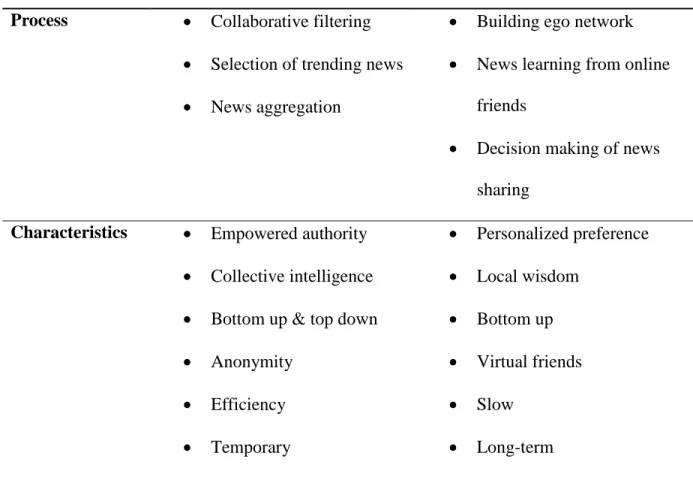
information sharing websites (ISWs), social networking services, and information aggregators of ISWs are becoming important in online information diffusion. Their influence is not merely a technical impact. Humans are also interacting with each other and the diffusion systems. The first research question concerns the interpersonal effects which are closely relevant to the social network services of ISWs. As an alternative influence, information aggregators are also playing an important role in information dissemination (Lerman & Ghosh, 2010). For example, on Twitter, the popular tweets have been aggregated as trending tweets appearing on the sidebar of the front page, and on Digg, the most popular news is aggregated onto its webpage of
information aggregation. If the direction of influence from interpersonal effects is bottom-up, the impact of information aggregators is top-down. Therefore, a second step should be taken to clarify the impacts of information aggregators, and then to conceptualize them within the framework of information diffusion.
RQ 2: How do information aggregators influence information diffusion on ISWs? Third, the bursts of public attention describe the situation of a sudden and violent growth and decline of public attention. Recent research shows that online information diffusion is also characterized by bursts of public attention (Crane & Sornette, 2008). Bursts of online
information diffusion underscore the time dimension of information diffusion, and concern the temporal patterns of online information diffusion, as well as their influences on the size of online information diffusion. S-shaped curves have been extensively employed to describe cumulative diffusion curves (Rogers, 2003). In addition to classic S-shaped diffusion curves, Chaffee (1975)
proposes that there are also three deviations: 1. Incomplete diffusion, where information fail in reaching 100 percent of the population; 2. Rapid diffusion, where there is a much more rapid acceleration than normal S-shaped diffusion. Rapid diffusion is usually stimulated by senders at the initial stage; 3. Slow diffusion, in the early stages, grows more slowly than normal S-shaped diffusion. However, since traditional classifications of diffusion curves are primarily based on the cumulative growth curves, they tends to neglect fluctuations in daily diffusion patterns, especially the temporality of diffusion which is reflected by bursts.
According to the temporal patterns of online information diffusion, especially the phenomenon of bursts, the most accepted explanation about the limited size of online information diffusion is the temporality of information diffusion. The term “temporality”
emphasizes two aspects of information diffusion: First, the temporality of different driving forces of information diffusion, which concerns the duration of the antecedents (i.e., the determinant factor) of attention allocation. Second, temporality emphasizes the persistence of information diffusion, which concerns whether the information can continue infecting the public over time. The temporality of driving forces governs the rise and fall of public attention towards specific media products, e.g., according to prior studies, the burst of diffusion slows down the diffusion process (Karsai et al., 2011). In practice, the temporality of information diffusion can be
indicated by the burst of diffusion curves. Thus, I formulate the research question about the burst of information diffusion to gauge the temporality of information diffusion:
RQ 3: How do bursts influence information diffusion on ISWs, and what is the origin of bursts in information diffusion on ISWs?
To summarize, this research starts with a puzzlement of online information diffusion— the absence of global cascade in online information diffusion. To answer this general question,
this dissertation focuses on the size and temporality of information diffusion, and examines the underlying diffusion mechanisms. The present dissertation is designed to conduct three studies about information diffusion on three kinds of information sharing websites (ISWs): microblogs (e.g., Twitter and Sina Weibo), social news websites (e.g., Digg), and video sharing websites (e.g., YouTube). Correspondingly, three data sets of information diffusion will be analyzed in this dissertation.
1.2.2 Theoretical Significance
First, this study aims to establish a theoretical framework, and to map the landscape of the research on information diffusion. Thus, one of the research objectives is to describe the overall picture of online information diffusion. The present dissertation draws on classic
communication models of information flow (e.g., the Lasswell formula, the ABX model, and the Westley and Maclean’s conceptual model of mass communication). Classic communication models start from the Lasswell formula (Lasswell, 1948) which formulates the process of communication as “who says what to whom in what channel and caused what effects” (“5W”). Newcomb (1953) extends this into a dynamic process by discussing the relationships among information sources (denoted by either A or B), information receivers (denoted by either A or B), and the information itself (denoted by X), which is the ABX model. Westley and Maclean (1957) later extend this model by adding the information channels (denoted by C).
With the rise of Web 2.0 and the other new technical features of computer-mediated communication, there are more and more driving forces of online information diffusion. Regarding social changes brought about by the advent of network society and especially social media, this study expands upon the adapted social roles of information sources, media, and audiences. Firstly, audiences have been connected with each other, and become networked
individuals. Secondly, networked individuals and organizational social media users can both act as information receiver and information source, which blurs the distinction between information source and information receiver. Thirdly, the social networking service and information
aggregating functions of ISWs creates another kinds of information channels. Further, departing from the static style of traditional models, this new model calls for attention to the temporal dimension of information diffusion (denoted by T). Thus, this new model is named as the ABXCT model.
Second, this study aims to analyze interpersonal effects from the perspective of threshold models. The rise of online social networks underscores the significance of interpersonal effects within communication networks. The most significant feature of online information diffusion is the interdependence of the communication networks. The most fundamental assumption about interpersonal effects asserts that one person’s information sharing behavior is contingent upon that of others. Based on the assumption of maximizing utility of cost and benefit from binary decision-making, threshold models deal with the extent to which an individual’s behavior is based on the extent to which his or her local network has been activated. Therefore, threshold models can be employed to capture interpersonal effects. Theoretically linking the threshold of interpersonal effects and the size of information diffusion, the present dissertation attempts to conceptualize the threshold hypothesis of interpersonal effects.
Third, one of the new features of online information diffusion is introduced by the
information aggregating function of ISWs. Thus, one central concern is to theorize the process of information aggregation. Actually, a great part of information aggregation is based on the
collaborative filtering of information. In the present dissertation, I conceptualize collaborative information filtering and the subsequent information aggregation process as collective
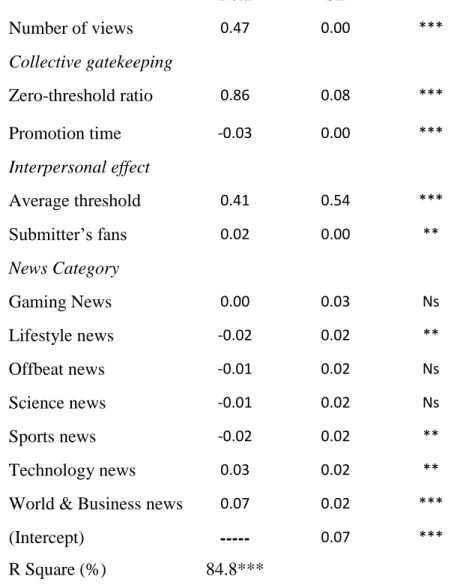
gatekeeping. Collective gatekeeping make aggregated popularity publicly available, which has the potential to shape online information diffusion. From the perspective of information cascade theory, this dissertation compares the influence of collective gatekeeping with interpersonal effects in news diffusion on a social news website.
Fourth, the present dissertation aims to capture one of the novel patterns of diffusion curves—bursts of public attention in various test grounds of information diffusion (e.g., microblogs, social news websites, and video sharing websites). Based on the positive relationship between bursts of public attention and diffusion size, this study highlights the importance of identifying the origin of bursts. To fulfill this purpose, I propose the temporality hypothesis, which aims to find the origin of bursts from the temporal features of the driving forces of information diffusion.
Overall, this dissertation is expected to contribute to our understanding of information diffusion in various aspects. The insights derived from this study help advance our knowledge about diffusion mechanisms and hidden principles. In the digital ages, online information diffusion is increasingly shaping our daily lives to a great extent. The theoretical generalizations of this dissertation have the potential to help explain or even predict the popularity of
information diffusion. The implications can be used to disseminate information quickly, widely, and sustainably. Taken together, the findings could contribute to our understandings of the limited size of online information diffusion.
1.3 Structure of the Dissertation
The present dissertation is composed of seven chapters, including this chapter of the Introduction (see Figure 1). Chapter 2 reviews an extensive body of literature about information
diffusion. Based on the relevant literature, I develop a conceptual framework about information diffusion on ISWs in Chapter 3.
_________________ Insert Figure 1 here _________________
Three kinds of ISWs (social news websites, video sharing websites, and micro-blogs) will be investigated in Chapters 4, 5, and 6. The reason for investigating online information diffusion with three kinds of ISWs is to avoid the risk of limited generalizability (e.g., mistaking the part for the whole), and to demonstrate the diversity of diffusion mechanisms. In Chapter 4, I primarily focus on verifying the threshold hypothesis of interpersonal effects in the context of information diffusion on microblogs (Sina Weibo). Chapter 5 mainly focuses on news diffusion on a social news website (Digg), within which, I focus on comparing the influence of two driving factors of news diffusion—interpersonal effects and collective gatekeeping. The strong bursts of information diffusion lead the present dissertation to investigate the temporality of information diffusion in Chapter 6. In Chapter 6, I formally propose the temporality hypothesis for
information diffusion, and verify it by gauging the origin of bursts for the diffusion of YouTube videos.
Finally, in Chapter 7, I discuss the overall findings of three empirical studies on information diffusion and summarize the theoretical generalizations, implications, and limitations of this dissertation.
Chapter 2. Diffusion Research: Theories and Models
There are many strands of research on information diffusion, including the seminal study of two-step flow (Katz, 1957; Katz & Lazarsfeld, 1955), news diffusion (Greenberg, 1964a, 1964b; Larsen & Hill, 1954; Miller, 1945), diffusion of innovations (Rogers, 1983), threshold models (Granovetter, 1978; Granovetter & Soong, 1983, 1986, 1988; Valente, 1995), Bass diffusion models (Bass, 1969, 2004), and epidemic models (Becker, 1992). This chapter contains two sections. I would firstly review relevant theoretical perspectives of information diffusion, based on which, secondly, I will discuss a research agenda for the research of online information diffusion in this present dissertation.
2.1 Theoretical Perspectives of Diffusion Research
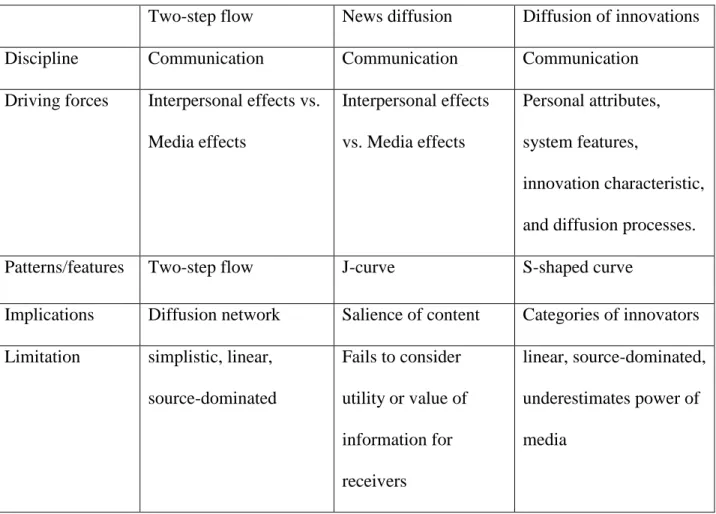
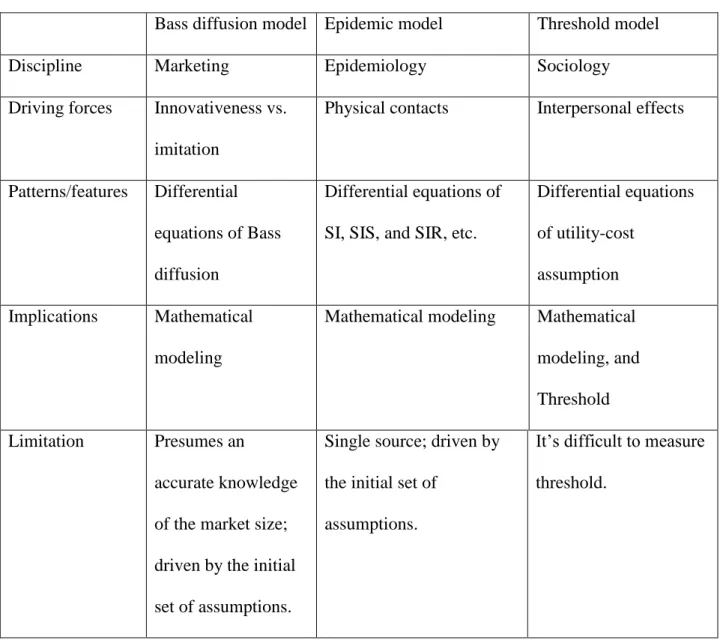
For the diffusion research in communication field, there are three related theories, including two-step flow (Katz, 1957; Katz & Lazarsfeld, 1955), news diffusion (Greenberg, 1964a, 1964b; Larsen & Hill, 1954; Miller, 1945), diffusion of innovations (Rogers, 1983). Rogers (2003) summarized the fields which have taken up the diffusion research approach: education, anthropology, public health, marketing, geography, sociology (including early sociology, rural sociology, and general sociology), political science, communication. Rogers’s effort at integrating information-flow research with the theory of diffusion of innovations was so successful that information-flow theory became known as information diffusion theory (Baran & Davis, 2011). In addition to the diffusion theories, there are also several well established
diffusion models. For example, threshold models (Granovetter, 1978; Granovetter & Soong, 1983, 1986, 1988; Valente, 1995), Bass diffusion models (Bass, 1969, 2004), and epidemic models (Becker, 1992) have been extensively employed in economics, sociology, medicine, and physics, and the findings shed light into the conceptual framework of information diffusion.
In the following sections of this chapter, I review six theories and models of diffusion research related to the following questions: First, what are the assumptions of the theories? Second, what are the driving forces of the diffusion? And third, what are the underlying principles which shape the diffusion process?
2.1.1 Two-step Flow
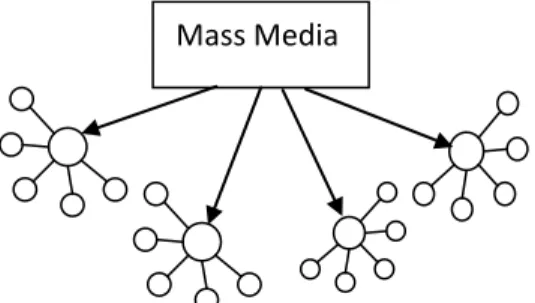
Against the backdrop of magic bullet theory of media effect, the theory of two-step flow is the first attempt to capture the pattern of information flow in the society of mass media. It asserts that information flows first from the mass media to opinion leaders, and then flows from opinion leaders to their followers (Katz & Lazarsfeld, 1955). Lazarsfeld et al. (1945) found little evidence that media played an important role in directly influencing the voters; On the contrary, these voters were much more likely to report that they had been influenced by other people.
Based on the preliminary findings, Lazarsfeld formulated the proposition of opinion leaders who act as “gatekeepers” and mediate media’s influence on the public. To empirically test this proposition, Lazarsfeld et al. carried out surveys with snow-ball sampling strategy in the
city of Decatur. Eight years later, Katz and Lazarsfeld (1955) published their book of Personal
Influence based on the Decatur data, in which they formally proposed the two-step flow theory (see Figure 2).
_________________ Insert Figure 2 here _________________
The model of two-step flow assumes that individuals connect with each other, rather than being isolated. However, individuals are not equal in passing and receiving information. The
active roles (e.g., opinion leaders) in personal network are attentive to media information, and they transmit the media message to the other people. Thus, against the stimulus-response model of communication, mass media do not operate in a social vacuum. Mass media have to compete with the other driving forces (e.g., the other information sources, power, and knowledge) to influence individuals. Actually, to study the relative strength of media effect and interpersonal influence becomes a key question in later diffusion research (e.g., new diffusion research).
2.1.2 News Diffusion
Another line of research on information diffusion focuses on one specific category of information—news. News diffusion is the process of news flowing from news sources to audiences. Beginning in the 1940s, increasing during the 1960s-1980s, and decreasing in the 1990s, classic studies of news diffusion compared media effect and interpersonal effects by studying the diffusion channels, cumulative diffusion curves, and the determinants of news diffusion (Larsen & Hill, 1954). As the first research of news diffusion, Miller’s study in 1945 established the tradition of assessing the impacts of various diffusion channels (Miller, 1945). Focusing on the diffusion of the news of Roosevelt’s death among143 students of Kent State University, Miller (1945) found that 85% of the students learned the news by word of mouth.
As a common body of knowledge, news stories filter into community life and inform people through mass media and interpersonal channels. As a social process, news diffusion is the cumulative growth of the number of news knowers on the aggregate level, and on the individual level, news diffusion concerns when and how individuals learn about news events. In the
diffusion process, social actors interact with the social structure, which makes news diffusion shaped by both agency and structure.
First, in the aspect of agency, conceptually, news diffusion is also a process of the flow of public attention. it is stimulated by individuals’ needs and motivations. Viewing news as one kind of knowledge, and news diffusion as a process of learning, individuals’ exposure to the news leads to awareness generated as a result of news-learning. In this process, two fundamental factors which will definitely influence the size of news diffusion should be highlighted: one is the limited capacity of individuals’ attention (Kahneman, 1973), and another one is the selective attention (A. Treisman & Fearnley, 1969; A. M. Treisman, 1964).
Second, social structure also shapes the diffusion process. J-curve model of news
diffusion states that there is a curvilinear relationship between percentage of news awareness and the percentage of interpersonal sources (DeFleur, 1987; Greenberg, 1964b). Greenberg (1964b) studied 18 news events in terms of size of diffusion, media differences, and found that the relationship between the extent of news diffusion and the percentage of interpersonal sources could be described as a J-curve: people learn breaking news primarily from interpersonal sources but other less important news from the mass media (see Figure 3).
_________________ Insert Figure 3 here _________________
The other forms of interpersonal effects can also influence the size of news diffusion. For example, news diffusion can be stimulated by interpersonal discussions. Im et.al (2011) argues that “previous meaning of news diffusion was virtually equivalent to the increasing awareness level among its audiences, the implicit assumption was that the news remains unchanged” (Im, et al., 2011, p. 612). By contrast, online comments can usually modify the original news.
Interpersonal discussions or conversations deepen the depth of news diffusion (Budd, MacLean Jr, & Barnes, 1966). For instance, those informed by the interpersonal communication are more likely to talk to a greater number of other persons (Greenberg, 1964a; Larsen & Hill, 1954).
Third, prior research on news diffusion also concerns the physical location of news learning (e.g. home, work) (Greenberg, 1964a) as well as the time dimension of news diffusion in terms of social time (e.g. daily life routine, time of the day) (Budd, et al., 1966). Therefore, how public discussions and news sharing behavior promote the diffusion process in the aspects of both time and space deserves more attentions.
Fourth, since most of the studies on news diffusion are case studies, the attributes of the news are not fully explored, as suggested by many studies since 1954, the diffusion of news of various types to different segments of society should be studied to undercover the value structure within the society (Larsen & Hill, 1954).
_________________ Insert Figure 4 here _________________
News diffusion research constitutes one of the most long-standing traditions in
communication research (more than 60 years, see Figure 4), and the theoretical developments have been generally summarized as Information-flow theory (Baran & Davis, 2011). Yet, limited by methods and theoretical framework, research on news diffusions has been criticized for producing very few theoretical generalizations, and most of the accumulated contributions are debatable (DeFleur, 1987). For example, although news diffusion studies concern the impact of diffusion channels, the problem of whether interpersonal communication is an important channel for news diffusion has remained largely unresolved (DeFleur, 1987).
To expand the scope of research and make this line of research flourish again, Rogers (2000) suggests future studies to move from the traditional paradigm to more theoretically-driven areas, and considers the news diffusion function of the Internet a promising direction. Currently, accompanied by the thriving of news diffusion in the virtual community, a fast-growing body of literature is starting to concern online news diffusion.
2.1.3 Diffusion of Innovations
The theory of diffusion of innovations focuses on the process through which innovations (e.g., ideas, practices, products, technologies, and services) spread in social systems over time. Rogers’s definition of diffusion is naturally relevant to innovations. For example, Rogers (2003) defined diffusion as a process in which (1) an innovation (2) is communicated through certain channels (3) over time (4) among the members of social system. There are four main concepts: the innovation, communication channels, time, and a social system. To be specific:
First, the characteristics of an innovation have impacts on its rate of diffusion. Five
attributes have been summarized by Rogers in his influential book Diffusion of Innovations: (1)
relative advantage, (2) compatibility, (3) complexity, (4) trialability, and (5) observability
(Rogers, 2003). Given the importance of innovations’ attributes, to modify or change the features of innovations has significant influence on users’ adoption of innovations.
Second, communication channels are the means by which information flow from one person to another. Similar to the tradition of news diffusion research, the studies on diffusion of innovations also pay great attention to the communication channels, especially the relative importance of media channel to interpersonal channel. Firstly, media effect plays an important role in spreading innovations. Secondly, peers’ attitudes and behaviors will influence individuals’ decision of adoption, in terms of social influence. Thirdly, confounded with social influence, the
theory of homophily (and heterophily) argues that people with similar (or different) attributes tends to interact with each other (Rogers & Bhowmik, 1970). Homophily concerns the degree to which individuals who interact are similar in certain attributes. Thus, it is necessary to
differentiate media effect, social influence, and homophily in the process of diffusion (Aral, et al., 2009).
Third, time is the third dimension in diffusion of innovations. The innovation-diffusion process can be conceptualized into five steps: knowledge, persuasion, decision, implementation, and confirmation (Rogers, 2003). It is necessary to note that, to reduce the uncertainty of
adopting an innovation, individuals seek information at various stages of the
innovation-diffusion process. Based on innovativeness, i.e., the degree to which adopters is relatively earlier in adopting new innovations than other members of a social system, adopters are classified into five categories: innovators, early adopters, early majority, late majority, and laggards (Rogers, 2003).
Fourth, diffusion occurs within a social system. The social structure, social norms, and opinion leaders of the social system constrain the diffusion process, making the human behavior regular, stable, and predicable. In addition, the decisions of adoption can be made by individuals, groups, or the collective (Rogers, 2003). Accordingly, innovation-decisions can be classified into three categories: optional innovation-decisions, collective innovation-decisions, and authority innovation-decisions (Rogers, 2003). Optional innovation decisions are choices to adopt or reject
an innovation that are made by an individual independent of the decision of the other members of
the system; collective innovation-decisions are choices of adoption made by consensus among the members of a system; and authority innovation-decisions are choices of adoption made by a group of elites in a social system.
Diffusion of innovations follows a ubiquitous pattern—an S-shaped curve. There are two ways to demonstrate the diffusion process (Rogers, 2003). On one hand, to draw the fraction of
new adoption of innovation over time, the growth curve follows a normal, bell-shaped curve. On
the other hand, to plot the cumulative growth of adopters over time, we can find a S-shaped curve of adoption (Ryan & Gross, 1943). As aforementioned, according to the continuum of innovativeness revealed by the sequential temporal diffusion curves, adopters can be partitioned into five adopter categories: innovators, early adopters, early majority, late majority, and
laggards. Although S-shaped curve gained a dominant position in early 1960s, the limitations should be noticed. The S-shaped curve is innovation-specific and system-specific, and it is only applicable to the cases of successful innovation, in which an innovation diffuses to most
potential adopters.
2.1.4 Bass Diffusion Model
Inspired by the original idea of diffusion of innovations, a tremendous expansion has emerged in the marketing literature since Frank M. Bass’s work on Bass diffusion model in 1969. Bass diffusion model assumes that diffusion is motivated by two mechanisms: innovativeness and imitation (Bass, 1969). Innovative early adopters adopted the products first, and the followers will imitate early adopters and adopt the products later. Accordingly, there are two parameters in the Bass model: the coefficient (parameter) of innovation and the coefficient (parameter) of imitation. The probability of adopting by those who have not yet adopted is a linear function of those who had previously adopted. Note that, although Bass’s 1969 paper used the term “imitation” to describe the interactive portion of adoption, the parameter of imitation could be “word of mouth”, learning, contagion, interpersonal communication, and internal influence (Bass, 2004).
In the Bass model, the parameter representing the potential market is denoted by M. As the ultimate number of purchasers of the product, M is a constant. Time intervals are numbered sequentially with the first full time interval (usually a year) of sales, and the time interval is
denoted by t. The portion (fraction) of the potential market that adopts at time t is f(t).
Accordingly, the portion (fraction) of the potential market that has adopted up to and including
time t is F(t). The number of the potential market that adopts at time t is a(t).The number of the
potential market that has adopted up to and including time t is A(t). The Bass model coefficient
(parameter) of innovation is p. The Bass model coefficient (parameter) of imitation is q.
The model construction starts from the idea of hazard rate which is defined as the portion
that adopts at t given that they have not yet adopted. Let h(t) denote the hazard rate at time t.
The probability of adoption at time t is f(t), and the proportion that having not adopted the
products by time t is 1- F(t). Thus, by definition of conditional probability, h(t) can be expressed
by:
Bass (1969) posits that “the probability of adopting by those who have not yet adopted is a linear function of those who had previously adopted”. Given the Bass model coefficient of innovation (P) and the coefficient of imitation (q), the probability of adopting a product at time t can be expressed as:
Combining the two equations together and solving the differential equation of bass diffusion model leads to the analytical formula for F(t) as a function of t, p, and q:
The most important contribution of Bass diffusion model lies in supplying a mathematical formula for diffusion research. Based on these assumptions, Frank M. Bass analytically constructs the mathematical relationship between the portion (fraction) of the
potential market that has adopted up to and including time t and innovativeness and imitation. By solving the differential equation, Frank M. Bass successfully got the function of cumulative growth. The second important contribution of the Bass diffusion model is to predict the total number of adopters in each time period. Based on the mathematical formula, it is very
convenient to forecast the adopters in the future by fitting the bass diffusion model. Note that such prediction deals with the market in an aggregate way, rather than the adoption or rejection on individual basis.
As one kind of S-shaped curve, Bass diffusion model is a special case of the
Gamma/shifted Gompertz distribution (G/SG). There are two special cases of Bass diffusion model. When the parameter of imitation equals zero, the model reduces to exponential distribution; and when the parameter of innovation equals zero, the model reduces to logistic regression. If the coefficient of imitation is greater than the coefficient of innovation, the growth rate of cumulative growth curve rises to a peak and then declines, which is a classic form of S-shaped form (Bass, 2004).
2.1.5 Epidemic Models
The epidemic model is another intellectual source for information diffusion research. The first known mathematical model of epidemiology is formulated by Daniel Bernoulli (1760) when he studied the mortality rates in order to eradicate the smallpox. However, it was not until the early twentieth century that deterministic modeling of epidemiology started. Ross (1911) developed differential equation models of epidemics in 1911. Later, Kermack and McKendrick
(1927) found the epidemic threshold and they argued that the density of susceptible must exceed a critical value to make the outbreak of an epidemic happen.
The mathematical models developed by epidemic research help clarify assumptions, variables, and parameters for diffusion research, lead to useful concepts (e.g., threshold, reproduction number), supply an experimental tool for testing theoretical conjectures, and forecast epidemic spreading in the future (Hethcote, 2009). Although epidemic models are simplifications of reality, they help us refine our understandings about the logic of diffusion beneath social realities (disease transmission, information diffusion through networks, and adoption of new technologies or behaviors). To understand the epidemic models in a better way, I will briefly review the basic epidemic models: SI, SIR, SIS, and the applications in networks.
The SI model is the simplest possible model of infection. In the SI model, there are only two phases in the SI epidemic spreading process: Susceptible and Infectious. Let S be the proportion of the population that are susceptible. Let I be the proportion of the population that
are infectious. At the initial time, the proportion of people who are infected is x0, the proportion
of people who are susceptible is S0. β is the transmission rate, and it incorporates the encounter
rate between susceptible and infectious individuals together with the probability of transmission. Consider a “closed population” with no births, deaths, or migrations, and assume the mixing is homogeneous (e.g., the susceptible individuals are uniformly spread in a geographic area, and the probability of contracting the infection is uniformly the same for all actors (T. G. Lewis, 2011)), yielding βSI as the transmission term. Thus, the equation for SI model is:
β
_________________ Insert Figure 5 here _________________
Given every individual in the system must be either susceptible or infected, I + S = 1. Thus, the equations above can be transformed to:
To solve this differential equation, we can get the cumulative growth curve as a function of time:
Interestingly, this is a logistic growth featured by its S-shaped curve. The curve grows exponentially shortly after the system is infected, and then saturates as the number of susceptible shrinks which makes it harder to find the next victims. Thus, it could be used to model the classic diffusion of innovations.
In the naive model of SI, once one is infected, it is always infectious. However, this is not realistic for many situations of disease spreading. For many diseases, people recover after a certain time because their immune systems act to fight with the diseases. There is usually a status
of recovery denoted by R. Let γ denote the removal or recovery rate1.
1
Usually, researchers are more interested in its reciprocal (1/γ) which determines the average infectious period.
There are two stages of the dynamics of the SIR model. In the first stage, susceptible individuals become infected by the infectious ones with who they contact. Similar to the SI model, β is the transmission rate between individuals; In the second stage, infected individuals recover at the average rate γ. Given the premise that underlying epidemiological rates are constant, the differential equations of simple SIR model (with no births, deaths, or migrations) are: β β
However, the differential equations above could not be analytically solved. In practice, researchers can evaluate SIR model numerically, as it is showed in the figure below.
_________________ Insert Figure 6 here _________________
Another extension of the SI model is the one that allows for reinfection. If infected individuals are not immune to the diseases after their recovery, they can be infected more than once. The most simple model that captures this features is the SIS model. There are only two states: susceptible and infected, and infected individuals become susceptible after recovery. The differential equations for the simple SIS epidemic model are:
β
β
_________________ Insert Figure 7 here _________________
Given S + I = 1, the differential equations have the solution:
C is the integration constant in the form of β
β γ β .
One important contribution of epidemic models is the threshold phenomenon of epidemic diffusions existing in SIR model. The threshold of SIR model asks what factors determine
whether an epidemic occur or fail. As the first step of analyzing the threshold of SIR model, the
differential equation of SIR β can be rewritten in the form:
β
If dI/dt is smaller than 0, the contagion will soon wither and die out. Thus, as a boundary
condition, β should be larger than 0, and S should be larger than β. This is the
threshold phenomenon (Kermack & McKendarick, 1927). Based on the rationales above, if the
initial fraction of susceptible (S(0)) is less than β, the infection would not be able to start the
To summarize, “for an infectious disease with an average infectious period give by
and a transmission rate β, its basic reproductive ratio R0 is determined by β. In a closed
population, an infection with a specified R0 can invade only if there is a threshold fraction of
susceptible greater than ” (Keeling & Rohani, 2011, p. 21).
In the section above, I mainly focus on the deterministic models of epidemics. However, despite the many advantages of deterministic models, it can be difficult to include realistic population networks, to incorporate realistic probability distributions for the time spent in the infectious period, and to assess the probability of an outbreak. Thus, the stochastic epidemic simulations, such as stochastic differential equations, Markov Chain Monte Carlo (MCMC), and agent based modeling, have been used to remedy the defect.
Network epidemic models have also been developed to investigate the widespread and rapid propagations (e.g., the contagion of computer virus) through a network. Typically, the network epidemic is brought about by adjacent nodes through propagations along one or more links. Network epidemic models consider the topology of the network as well as infection rate, death rate, and state transitions. This line of research is interested in the following questions: under what conditions will an initial outbreak spread to a nontrivial portion of the population? What percentage of the population will eventually become infected? What is the effect of immunization policies? For example, Pastor-Satorras et al. (2001) study the spreading of epidemics in complex networks using the mean-field method for network SIS model. Their findings indicate that in exponential networks (e.g., random graph network, small-world
network), there is the usual epidemic threshold below which there is no prevalence of epidemic. Yet, on a wide range of scale-free networks, there is an absence of an epidemic threshold, which implies that scale-free networks are prone to the spreading of epidemics, as well as other
spreading phenomena, e.g., information diffusion. Based on this rationale of the absence of epidemic threshold, network scientists expect online information diffuse to a great proportion of the population.
2.1.6 Threshold Models
As a shift from traditional diffusion research to diffusion networks studies, threshold models supplies important intellectual resources for diffusion research. Threshold has been used to study interpersonal effects of collective behavior, e.g., residential segregation (Granovetter & Soong, 1988; Schelling, 1971), spiral of silence (Glynn & Park, 1997; Granovetter & Soong, 1988; Krassa, 1988), consumer demand (Granovetter & Soong, 1986), and diffusion of innovations (Valente, 1996).
One illustration of threshold could be easily given with a simple case of collective
behavior. Suppose that one social system consists 10 people, and their individual thresholds are 0, 1, 1, 4, 4, 4, 5, 7, 8, and 9, respectively. The first one whose threshold is 0 initiates in engaging in the collective behavior without being influenced by others. Following the first actor, the second and third people whose thresholds are 1 spontaneously engage in the activity following the first people. Thus, so far there are three people engaging in the collective behavior. Given the smallest individual threshold of the other people is 4, nobody will engage in this activity. Thus, the diffusion stops with “infects” 3 people in the social system.
The significance of threshold lies in its determination of the diffusion curves. The threshold for different individuals in a social system varies. The innovators usually have very low thresholds, which makes them engage in the diffusion as soon as it is initiated. Later diffusers who are strongly against the innovation usually have very high thresholds. Their adoptions are only possible after many other individuals who have adopted the innovation in
their personal network. If the distribution is left-skewed, it means that the average threshold of the system is relatively small, thus the diffusion curve could take off relatively earlier and the diffusion can reach more people; if the distribution is right-skewed, it means that the average threshold is relatively big, and the diffusion stops earlier with a smaller diffusion size. If the distribution of the threshold is normally distributed, it is expected that the cumulative diffusion curve should be S-shaped.
Threshold models presume that individual behavior is based on the fraction of people in a social system who have already engaged in the behavior (Granovetter, 1978; Granovetter & Soong, 1983, 1986, 1988). Thus, one person’s threshold is the proportion of a community to engage in a behavior before the individual makes up his/her mind to do so. Individuals of lower thresholds tend to engage relatively earlier than those who have higher thresholds. The numeric value of threshold should be in the range of zero and one.
Threshold can be used to capture the impact of interpersonal effect. Based on the assumption of maximizing utility of cost and benefit from binary decision-making, threshold concerns the extent to which an individual’s behavior is contingent upon that of others. The first diffusion investigation to gauge the nature of diffusion networks is the study of new drug’s diffusion among medical doctors by Coleman et al. (1966). Valente (Valente, 1993, 1995) employed threshold models to reanalyzed the diffusion data of drug collected by Coleman et al. (1966). Each doctor has an individual threshold as the resistance to the medical innovation, which was gradually overcome by interpersonal effect. According to the utility-cost assumption of threshold models of human behavior, when the driving force equals the resistance of cost, individual starts to engage in the behavior. Based on the relationship between threshold and adoption of innovations, scholars of diffusion of innovations generalize that an individual is