17‐779
“Information Aversion "
Marianne Andries and Valentin Haddad
Information Aversion
∗
Marianne Andries
Toulouse School of Economics
Valentin Haddad
Princeton University and NBER
March 10, 2017
Abstract
We propose a theory of inattention solely based on preferences, absent cogni-tive limitations or external costs of information. Under disappointment aversion, agents are intrinsically information averse. In a consumption-savings problem, we study how information averse agents cope with their fear of information, to make better decisions: they acquire information at infrequent intervals only, and inattention increases when volatility is high, consistent with the empirical evi-dence. Adding state-dependent alerts following sharp downturns improves wel-fare, despite the additional endogenous information costs. Our framework accom-modates a broad range of applications, suggesting our approach can explain many observed features of decision under uncertainty.
∗Andries: [email protected]; Haddad: [email protected]. We gratefully acknowledge useful comments and
suggestions by Fernando Alvarez, Markus Brunnermeier, Xavier Gabaix, Jacob Sagi, Stavros Panageas, Martin Schneider, Costis Skiadas, Laura Veldkamp, and seminar participants in TSE, Princeton, Yale SOM, NYU Stern, Northwestern Kellogg, Berkeley Haas, NY Fed, and in the Miami Behavioral Finance, TIGER, Macro finance group, Finance theory group, SED, NAMES, European Summer Symposium in Financial Markets (Gerzensee) and SITE conferences.
1
Introduction
Experiencing the roller coaster of life can be stressful. A natural way to avoid this stress is to close your eyes for the ride. We propose a theory of inattention building on this idea. Our unique assumption is a recursive implementation of disappoint-ment aversion (Gul, 1991), a common model of risk attitude. These preferences imply
information aversion, a fear of information flows: disappointment averse agents op-timally decide to stay away from some sources of information. Our framework has rich implications reflecting key observations on information and risk-taking behav-ior in the lab and in the field, in particular among financial markets participants. As such, our approach provides a parsimonious, tractable, and empirically appealing preference-based model of inattention.
Our analysis is constructed around three questions. First, we characterize for-mally the utility costs of receiving signals in settings where information is not in-strumental, as documented in the experimental literature. Second, we study how information averse agents cope with their fear of information flows in order to make better decisions. To understand the interaction between information and allocation decisions, we study a problem of consumption and risky savings, where the agent can choose, at any time, to close her eyes and not observe information around her. Finally, we look for better ways to tailor the information received by an information averse agent.
Under disappointment aversion, agents inflate the probabilities of outcomes that disappoint, i.e. fall below an endogenous reference point which reflects their current expectations about the future. As information arrives, each piece of news creates scope for disappointment. The agent therefore prefers to receive less fragmented information and observe simultaneous bundles of news in which good news can cancel out bad, disappointing, news. Such information aversion is a direct consequence of her attitude towards risk.1 As an illustration, consider an investor owning a stock
she has decided to sell exactly a year from now. The investor has a lot of control over the information structure she faces. She can choose to follow the price of the stock
1Dillenberger (2010) provides a general characterization of the link between attitude towards risk
at different frequencies: continuously, daily, monthly or not at all until the end of the year. Observing intermediate signals is of no direct use to her as she will hold on to the asset anyways. Under expected utility, she would be indifferent between those information structures. A disappointment averse investor, however, unambiguously opts not to observe the price at all over the year. This behavior is widely supported by a number of empirical and experimental findings. Starting with Gneezy and Potters (1997) and Thaler et al. (1997), experiments have consistently showed that subjects’ valuations of risky outcomes diminish when they are given more frequent and more detailed information. Galai and Sade (2006) find similar results using field data on Israeli treasury bills and commercial banks deposits.2
Our first contribution is to characterize the magnitudes and properties of the en-dogenous costs of information implied by disappointment aversion. Information aver-sion differs fundamentally from both exogenous information costs and cognitive con-straints. With one signal, more information is not always more costly; Blackwell ordering is not respected. We analyze how the frequency of information observations impacts the valuation of risky lotteries, whose payoffs are determined by the final out-come of a stochastic process growing with i.i.d. increments, as is natural to assume for an asset price for instance. We derive a useful representation of these valuations as a certainty equivalent rate of returndepending of the observation frequency, gener-alizing the standard notion. The certainty equivalent rate of returns decreases with the frequency of observation (Section 3.2). The magnitude of this effect, however, varies greatly across characteristics of the process. As the frequency of observation increases, a disappointment averse agent is extremely averse to frequent small news, as in a diffusion process, but much less so to infrequent large news, as in a jump process.
Second, we analyze how information averse agents balance the endogenous util-ity cost of paying attention to the economic environment with the benefits of making better informed decisions. We study the interaction of risk-taking and information decisions through the lens of a standard consumption and savings problem. Going
2See also for example, the experiments of Benartzi and Thaler (1999), Barron and Erev (2003),
Gneezy et al. (2003), Bellemare et al. (2005), Haigh and List (2005), Fellner and Sutter (2009) and Anagol and Gamble (2011). While some of these were designed to test myopic loss aversion, their results are also consistent with our dynamic disappointment aversion model.
back to our illustrative example, assume now our investor manages her wealth in order to finance her consumption over time, and let her allocate her savings between a risk-free asset, and a risky asset yielding higher average returns. We show she op-timally decides to observe the value of her risky portfolio at equally spaced discrete points in time (Proposition 4). In between observations, she consumes deterministi-cally from a risk-less portfolio, and allocates the rest of her wealth to the risky asset. The marginal cost of infrequent observation is due to the loss in expected returns when more wealth is placed in the risk-free asset, captured by the spread between the certainty equivalent rate of the risky asset and the risk-free rate, like in the clas-sic models of Baumol (1952) and Tobin (1956). Novel to their frameworks, and specific to our approach, the marginal benefit comes from a relief from the stress of receiving information, formally represented by the sensitivity of the certainty equivalent rate to the observation interval.
This simple characterization helps understand conditions propice to inattention. Through the fundamental link between information aversion and risk aversion in our model, more risk averse investors are also more inattentive as documented in Alvarez et al. (2012). Periods of high volatility also correspond to more inattention, even when higher expected returns keep the difference between risk adjusted returns and the risk-free rate constant. This prediction reflects an increase in the marginal cost of information as risk increases and is in line with recent empirical evidence: Sicherman et al. (2014) document investors reduce the monitoring of their portfolios when stock market volatility increases. We further show the interplay of attention and taking is far from straightforward: when the agent receives more information, risk-taking can either decrease or increase. Echoing the basic mechanism of information aversion, if information increases to the point the agent no longer values the risky asset above the risk-free one, she exits the risky market, and risk taking decreases to zero. However, as long as information is infrequent enough that the risky asset remains attractive relative to the risk-free asset, another important force is present. If the investor receives more information, even though it is painful and lowers her valuation of the risky asset, she can nonetheless take advantage of this knowledge of the evolution of the risky asset to shift her savings away from the risk-free asset and towards the risky asset. This second force shows the observation of Beshears et al.
(2012), who document in a field experiment that investors do not reduce their risk-taking when receiving more information, does not provide a rebuttal for information aversion.
Third, we ask whether, with the help of a third party, better flow of informations can be obtained than the simple time-dependent rules our investor rules can do alone. Observe our framework allows us to consider arbitrary information structures, since the information costs are completely endogenous. In contrast to Abel et al. (2013), we find state-dependent rules do help. In particular, we show providing “distress” sig-nals following sharp market downturns increases welfare. Such a result echoes the fact extreme bad outcomes take a pregnant place in media, but also suggest financial institutions can foster more investment by providing such signals. We can go further and analyze whether delegating actions can avoid all information costs. In our ba-sic setting, the agent’s optimal consumption reveals information on her wealth, and delegation can only go so far. However, in settings where some decisions only have a long-term impact, delegation is a powerful tool to escape information costs.
Together, these results show a simple and parsimonious assumption for prefer-ences, disappointment aversion, leads to a rich theory of inattention. Not only does our framework provide a joint explanation for behavior observed in the lab and in the field, but also points out novel implications, distinct from the standard applied models on the topic. More than a simple alternative to theories based on exogenous information costs, on the positive side, our approach implies fundamentally different normative consequences. When information costs are due to technological limitations, finding ways to provide more information improves welfare. In contrast, such policies are not always desirable in our setting. More generally, we show opaqueness might be a positive feature of many economic activities.
After a review of the related literature, Section 2 introduces our recursive imple-mentation of disappointment aversion and characterizes the resulting information aversion. Section 3 derives the notion of certainty equivalent rate in a setting where information is not instrumental, and shows how it depends on the information en-vironment. Section 4 analyzes the consumption and savings problem, and the in-teraction between risk-taking and information decisions. Section 5 considers richer information structures as well as the potential for delegation. Section 6 briefly
out-lines applications of the model to other dimensions of risky decisions with endogenous information choices: leverage, diversification, learning, and agency issues. All math-ematical proofs are in the online Appendix.3
Related literature
Under disappointment aversion, “bad” outcomes are overweighted relative to positive ones. This model of preferences incorporates loss aversion, one of the main compo-nents of the seminal prospect theory of Kahneman and Tversky (1979). In addition to the large body of work providing direct support to loss aversion, disappointment aversion has proven useful in understanding risk-taking in financial markets.4
How-ever, the literature, so far, fails to account for disappointment aversion’s implications for information choices, our focus. Indeed, while Benartzi and Thaler (1995) point out the frequency of utility evaluation matters under loss aversion, they determine this frequency as the result of another behavioral trait: myopia. In contrast, in our setup, this frequency is a choice of the agent. It results from trading off the utility cost of a more frequent information flow with the benefits of better informed decision-making. Our paper provides a framework to formally analyze simultaneously endogenous in-formation and risk-taking decisions with a single assumption about preferences.
Caplin and Leahy (2001, 2004), who relate inattention to anticipatory feelings, as well as the optimal expectations model of Brunnermeier and Parker (2005), also pro-pose preferences in which information can have intrinsic costs. Closer to our analysis, Pagel (2014), in a contemporaneous paper, considers a consumption-savings problem under the news-utility theory of K˝oszegi and Rabin (2009), who explicitly model flows of information as costly in the utility function, with time inconsistent dynamics.5
Rather than aim at arbitrary information preferences, our approach is more parsi-monious: risk aversion implicitly results in information aversion, and both derive from the same unique parameter. Further, the aforementioned preferences, including
3https://sites.google.com//site/marianneandries/IAappendix.pdf
4Disappointment aversion can explain portfolio choices (Ang et al., 2005), equilibrium aggregate
prices (Routledge and Zin (2010), Bonomo et al. (2011)), and the cross-section of expected returns (Ang et al. (2006), Lettau et al. (2013).
5Hsiaw (2013) considers reference point goal setting as a solution to time inconsistency, with
loss aversion as in K˝oszegi and Rabin (2009), do not cause an unambiguous dislike for information: signals may be perceived as a benefit, whereas they always come at a utility cost under disappointment aversion (see Proposition 1). Disappointment averse preferences also have the appeal over standard loss aversion to be axiomati-cally funded. They have been broadly, and successfully, implemented in the finance literature. Our model is dynamically time consistent and the relative simplicity of our framework allows for a formal analysis of the implicit information costs, and can be readily applied to other optimal decisions problems.
We contribute to the literature on the optimal inattentive behavior of consumers or firms by introducing endogenous observation costs that derive from agents’ pref-erences for risk. Our preference-based framework provides an alternative to the two main approaches in this literature: cognitive limitations represented by entropy con-straints, and exogenous fixed costs of information.
Our endogenous cost structure differs from that implied by the entropy constraints of rational inattention, developed by Sims (1998) and Sims (2006). Intuitively, more than the quantity of information, the structure of the flow of information is the source of cost in our setting, which makes it particularly well suited for analyzing the ob-served discreteness of information acquisition. Discreteness only arises in particular situations under rational inattention whereas it is a generic feature of our model.6
Closer to our analysis is the literature using exogenous fixed costs of observa-tion, which also imply optimal observation at discrete points in time. Duffie and Sun (1990) solve a portfolio problem similar to ours, assuming observations and transac-tions must be synchronized, and come at a fixed cost. Abel et al. (2007) derive optimal inattention periods and portfolio decisions under exogenous monetary costs of infor-mation. Abel et al. (2013) add transaction costs, Alvarez et al. (2012) durable con-sumption. Gabaix and Laibson (2002) show slow portfolio readjustment, as a result of inattention, can have a profound impact on equilibrium asset prices.7 In those
mod-els, the benefit of information is similar to our setting’s and therefore optimal policies exhibit some similarities. However, our endogenous information costs yield additional
6Matejka and Sims (2010) provides a characterization of these situations in the context of a tracking
problem and Matˇejka (2010) is an application to a price-setting problem.
7Lynch (1996) also studies the equilibrium implications of infrequent transactions, without an
insights on the determination of attention policies, and how attention varies with the environment. Further, our preference-based approach makes possible the comparison of richer information structures, without introducing ad-hoc assumptions about the different costs. At a deeper level, technological or cognitive limitations to information acquisition differ fundamentally from our model, where agents desire to stay away from information. From a normative point of view, our approach shifts the emphasis from a view where facilitating information acquisition is key, to one where helping agents stay away from information or, in a more subtle way, where shaping the infor-mation flows they receive are useful policies.
2
Disappointment aversion and information
aver-sion
We introduce the preferences we use along the paper, a recursive implementation of the disappointment aversion model. Our choice of preferences is strongly supported by the recent macro and finance literature, in which they have been utilized to ex-plain both portfolio choices and asset prices.8 We detail how these preferences result
in an unambiguous aversion to information flows, the basic force of our model of inat-tention.
2.1
Dynamic disappointment aversion
Under loss aversion, one of the main components of the seminal prospect theory model of Kahneman and Tversky (1979), agents value outcomes relative to a ref-erence point, and losses relative to the refref-erence point create more disutility than comparable gains. Disappointment aversion, introduced by Gul (1991), provides a fully axiomatized model of preferences in which agents display such a micro-founded attitude towards risk. For the sake of simplicity, we focus on a piecewise linear
spec-8See, among others, Ang et al. (2005), Routledge and Zin (2010), Bonomo et al. (2011), Ang et al.
ification.9 For a static lottery with payoff distributed according to F, the certainty equivalentµθ(F)is given by µθ(F) = R xdF (x) +θRx≤µ θ(F)xdF (x) 1 +θRx≤µ θ(F)dF (x) , (1)
whereθ ≥0is the coefficient of disappointment aversion.10 µ
θ(F)is a weighted
aver-age of the potential payoffs, where disappointing payoffs receive a higher weight by a factor (1 +θ). What defines a payoff as disappointing is wether or not it is below the reference point, or “fair value”, the certainty equivalent itself: equation (1) is a fixed point problem in the certainty equivalentµθ(F)(which always admits a unique
solution). In this simple specification, the only source of risk aversion comes from the kink at the reference point, and the concavity it entails.
We are interested in the effect of the information flow on the valuation of risky outcomes. To consider this question, we extend these preferences to a dynamic set-ting. For now, we add intermediate signals; we include intermediate consumption in Section 4. Consistent with the framework of Epstein and Zin (1989) and Weil (1989), and the axiomatization of Kreps and Porteus (1978), we assume a recursive, and time-consistent, dynamic implementation of disappointment aversion. Given cer-tainty equivalent continuation valuesµθ(st+1)in each possible statest+1 at datet+ 1
and transition c.d.f F(st+1|st), the certainty equivalent for state st at date t is given
by µθ(st) = R µθ(st+1)dF (st+1|st) +θ R µθ(st+1)≤µθ(st)µθ(st+1)dF (st+1|st) 1 +θRµθ(s t+1)≤µθ(st)dF (st+1|st) . (2)
What are the stagest, t+ 1, . . .? Each step of the recursion corresponds to a poten-tial arrival of news. The instant before a piece of information is revealed, our agent fears receiving disappointing news, and adjust downwards her valuation of the lottery accordingly. While in all generality, the timing of information arrival need not
coin-9The link with information aversion is robust to adding strict concavity on both sides of the reference
point as in the more general case of Gul (1991).
10We always assume θ ≥ 0, even though Gul (1991)’s framework allows for negative θ, i.e. risk
cide with clock time, we assume they do in most of our applications, as is implicitly assumed in most standard applied models.
If one considers the certainty equivalent of Equation (2) as a form of distorted expectation, the corresponding law of iterated expectations is violated. Given the total information revealed, the composition of when the agent observes the information affects the valuation of risky payoffs. Our modeling choice for a recursive dynamic implementation thus determines attitudes towards information. We analyze how in the next section.
2.2
Attitudes towards information
To clarify attitudes towards information, we analyze the valuation of a final random payoffX, with distributionF, under two different information plans. In the first, no information is received until the payoff is realized, and the ex-ante valuation isµθ(F)
as in Equation (1). In the second, the agent receives an intermediate signal i ∈ I, with distributionα, and updates her belief on the distribution ofX, from F to Fi. We
note her ex-ante valuation under this information plan, derived from Equation (2),
µθ({Fi, α(i)}).
For expected utility agents, the valuations under the two information plans,F and
{Fi, α(i)}, are strictly equal. This equality, however, typically does not obtain for more
general preference specifications. Dillenberger (2010) characterizes an equivalence between a static property of preferences, negative certainty independence, and the preference for information plans without intermediate information.11 Our dynamic
disappointment aversion model satisfies negative certainty independence and there-fore implies an unambiguous aversion to receiving the intermediate signals. From Dillenberger (2010), we obtain the following proposition:
Proposition 1. An agent with dynamic disappointment, as specified in Equation 2,
11Cerreia-Vioglio et al. (2014) provides a general representation of preferences satisfying negative
certainty independence together with additional axioms, cautious expected utility. Their results pro-vides a framework for potential extensions of our analysis to other models of preferences.
prefers not to observe intermediate signals: ∀F,{Fi, α(i)}i∈I s.t. F = Z i∈I Fidα(i), µθ({Fi, α(i)})≤µθ(F).
We callinformation aversionthis dislike for receiving intermediate information.12
Information aversion is generic: for most cases of partial information, agents
strictly prefer not to receive the signal. The following corollary characterizes the particular cases for which there is indifference.
Corollary 1. Agents are indifferent to receiving intermediate information,µθ({Fi, α(i)}) = µθ(F), if and only if ∀i, µθ(Fi) = µθ(F) or Fi is degenerate
Receiving intermediate information is costless if and only if each potential signal either fully reveals the final payoff (the intermediate signal is degenerate), or it leaves the valuation for the risky payoff unchanged (e.g. no information, F = Fi). Our
model of preferences thus results in endogenous information costs that obey a “hump-shaped” type structure, where no information or full information have zero costs, but partial information has a strict positive cost.13
A useful insight from this corollary is that neither the standard informativeness constraints nor the exogenous information costs typically used in the inattention lit-erature can quantify the endogenous information costs in our framework.
Corollary 2. For any level of mutual entropy, there exist intermediate signals infor-mation plans with that level of mutual entropy and the same valuation µθ(F) as the one-shot lottery.
12Myopic loss aversion, as in Benartzi and Thaler (1995), or the news-utility theory of K˝oszegi and
Rabin (2009), can appear similar to information aversion. Note, however, the unambiguous dislike for information of Proposition 1 is not satisfied under those models.
13Observe this distinguishes information aversion from preferences for a late resolution of
uncer-tainty. For instance, in our framework, a fully revealing early signal is preferred to a partial late signal.
Corollary 3. Information costs under our model of preferences are not monotone in Blackwell ordering.
It is thus worthwhile exploring, under our information aversion framework, both the valuation of risk and the link between information and risk-taking decisions.
3
Attention and the cost of information
Starting with Gneezy and Potters (1997) and Thaler et al. (1997), experiments going beyond two-stage lotteries have consistently showed subjects’ valuations of risky out-comes diminish when they are given more frequent and more detailed information, absent any exogenous costs of information. This finding is hard to reconcile with the standard information literature. In this section, we analyze how the frequency of information observation as well as the distribution of the lottery’s payoffs affect its valuation when agents are information averse as in our model of preferences. This analysis provides a theoretical justification for the aforementioned experimental ev-idence as well as additional predictions on the structure of information costs in our approach.
3.1
The certainty equivalent rate
To fully isolate the costs of information in our framework, and stay close to the exper-imental evidence, we consider a lottery that cannot be affected by any intermediate decision of the agent. We determine the valuation, at datet= 0 of a lottery with pay-offs at date t =τ, determined by the timeτ value of an exogenous stochastic process
X ={Xt}t∈[0,∞], with i.i.d. growth.14 We assume the processX has an instantaneous
expected growth rateg, and finite quadratic variation. The agent observesXtat
reg-ular intervals of length T. We analyze how the valuation of the lottery depends on this observation interval.
This thought experiment is not only in the spirit of the lab experiments mentioned above, but it also echoes many real-life situations. For instance, one can think of an
14We focus on a framework with geometric growth, as is standard for asset prices. Most of our results
investor owning a stock and deciding how often to check its price before selling it, of the manager of an R&D project deciding on how often to monitor her employees, or of an individual deciding how often to check the evolution of her health using medical testing. For all those situations, while the potential benefits of being attentive are clear, substantial evidence of inattention is present.15 This section assumes away
potential benefits and characterizes the cost of attention arising from information aversion. We consider the tradeoff with benefits in Section 4.
For a risk-neutral agent, the value at time t = 0 of the lottery with payoff Xτ is V0(τ) =X0exp (gτ), independent of the observation intervalT. Under expected utility,
a simple application of the law of iterated expectations proves the certainty equiva-lent does not depend on the observation interval either. In contrast, under our model of preferences, we show the frequency of observation does matter. Taking advantage of the fact the certainty equivalent is homogenous of degree1, and growth is i.i.d., we can separate the distinct roles of the observation interval and of the horizon:16
V0(τ, T) =X0exp (v(T)τ), (3) where exp(v(T)T) =µθ XT X0 . (4)
We define v(T) as the certainty equivalent rate, which encodes the role of the ob-servation interval. It corresponds to the risk adjusted rate of return, standard to the finance literature, and takes into account the valuation of the lottery depends on the frequency of observation, when agents are information averse. v(T)is the sum of two element: the expected growth rate g, and a risk adjustment that depends on the in-formation flow, is always negative due to risk aversion, and is independent of g; we focus on this component by analyzing martingale processes hereafter. The following proposition gathers some general properties of the certainty equivalent rate.
Proposition 2. For information averse agents, the certainty equivalent ratev(T) ver-ifies the following properties
• −T v(T)is subadditive
15For instance, Oster et al. (2013) provides evidence in the context of testing for Huntington disease. 16For instance, with two observations, we have: V
0(2T, T) = X0µθ(XT/X0)µθ(X2T/XT) =
• limT→∞v(T) = g • limT→0T v(T) = 0
• v(T)is decreasing in the disappointment aversionθ for allT
These properties inform us on the structure of information costs. In the language of cost functions (see e.g. Tirole (1988)), −v(T) is an average cost function, −T v(T)
being the cost function. The subadditivity of information costs results from informa-tion aversion, and provides a justificainforma-tion for the experimental evidence: given a time horizon τ, the agent always prefers to observe a unique signal rather than to split the information over time. The first limit property shows the average cost of informa-tion vanishes as the observainforma-tion interval becomes large. The second limit property shows information costs disappear altogether when the lottery becomes short-lived, as there is no more information to be had. Finally, at all frequencies, information costs increase with the agent’s information aversion, as represented byθ.
To further analyze the properties of the certainty equivalent, we now turn to par-ticular distributional assumptions. These examples allow us to derive more precise implications on the behavior of information costs, and to analyze the specific role of the distribution of information.
3.2
Role of the distribution of information
We characterize the certainty equivalent rate for two fundamental cases, central to the asset pricing literature, geometric Brownian motions and Poisson jumps, and com-pare their properties.
Example 1. (Brownian motion) Assume the following law of motion: dXt
Xt =σdZt, with
{Zt}a standard Brownian motion, and volatilityσ. The certainty equivalent ratev(T) is the unique solution to
exp (v(T)T) = 1 +θΦ √ T σ v(T)− 1 2σ 2 1 +θΦ √ T σ v(T) + 1 2σ2 <1,
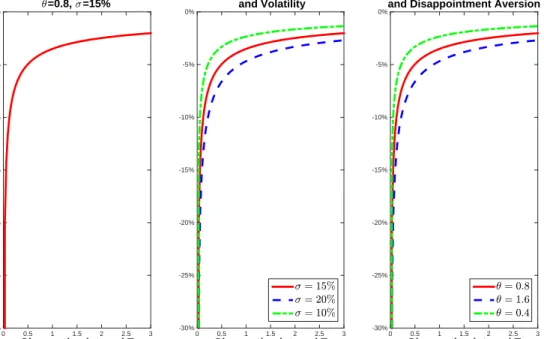
The certainty equivalent rate v(T) is increasing in the observation interval T, de-creasing in the disappointment aversionθ, and decreasing in the volatilityσ.
Observation interval T
0 0.5 1 1.5 2 2.5 3
Certainty equivalent rate v(T)
-30% -25% -20% -15% -10% -5% 0%
Certainty Equivalent Rate
3=0.8, <=15% Observation interval T 0 0.5 1 1.5 2 2.5 3 -30% -25% -20% -15% -10% -5% 0%
Certainty Equivalent Rate and Volatility <= 15% <= 20% <= 10% Observation interval T 0 0.5 1 1.5 2 2.5 3 -30% -25% -20% -15% -10% -5% 0%
Certainty Equivalent Rate and Disappointment Aversion
3= 0:8
3= 1:6
3= 0:4
Figure 1: Lottery values for a diffusion process: role of observation interval T, volatilityσ and disappointment aversionθ.
Figure 1 illustrates the instantaneous ratev, in the case of a Brownian motion, as it varies with the parameters.
Example 2. (Poisson jumps) Assume dXt
Xt− = λσdt −σdNt, where Nt is the counting variable for a Poisson process with intensity λ, and the jump fraction is σ < 1. The certainty equivalent ratev(T)is the unique solution to:
exp (v(T)T) = 1− θ 1+θ Γ(k+1,(1−σ)λT) k! 1− θ 1+θ Γ(k+1,λT) k! ,
for:
(v(T)−λσ)T
log (1−σ) −1≤k ≤
(v(T)−λσ)T log (1−σ) .
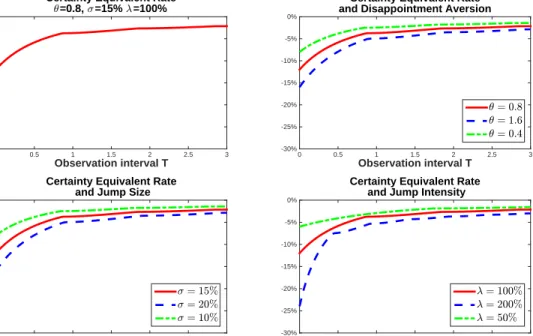
The certainty equivalent rate v(T) is increasing in the observation interval T, de-creasing in the disappointment aversionθ, and decreasing in the jump size and inten-sityσ andλ.
Observation interval T
0 0.5 1 1.5 2 2.5 3
Certainty equivalent rate v(T)-30%
-25% -20% -15% -10% -5% 0%
Certainty Equivalent Rate
3=0.8, <=15% 6=100% Observation interval T 0 0.5 1 1.5 2 2.5 3 -30% -25% -20% -15% -10% -5% 0%
Certainty Equivalent Rate and Jump Size
<= 15% <= 20% <= 10% Observation interval T 0 0.5 1 1.5 2 2.5 3 -30% -25% -20% -15% -10% -5% 0%
Certainty Equivalent Rate and Disappointment Aversion
3= 0:8 3= 1:6 3= 0:4 Observation interval T 0 0.5 1 1.5 2 2.5 3 -30% -25% -20% -15% -10% -5% 0%
Certainty Equivalent Rate and Jump Intensity
6= 100%
6= 200%
6= 50%
Figure 2: Lottery values for a jump process: role of observation interval T, disappointment aversionθ, jump sizeσand intensityλ.
Figure 2 illustrates the instantaneous ratev, in the case of jumps, as it varies with the parameters.
These two fundamental examples allow us to draw insights on the general prop-erties of information costs. As the fundamental risk of the lottery increases, infor-mation costs increase at all frequencies. Further, in our two examples, the average information cost −v(T) is decreasing in the observation interval: the more frequent the information, the more the agents want to stay away from the risky lottery. This
monotonicity property is stronger than the subadditivity of Proposition 2 and we con-jecture it holds for arbitrary Levy processes. Geometric Brownian motions and jump processes have similar long-run behavior, and, accordingly, the risk-aversion contri-bution to the valuation of risk, i.e. the asymptotic behavior ofv(T)asT goes to infinity, is the same under both processes.
However the local evolutions of diffusions and jumps are sharply distinct, which is reflected in the information aversion contribution to valuation. For the case of a Brownian motion, as the period of observation T tends to 0, the instantaneous cer-tainty equivalent ratev(T)satisfies:
v(T) = −κ√(θ)σ
T +o
−1/√T,
whereκ(θ)is positive, increasing inθ, with limit0in0. As the frequency of informa-tion increases towards its continuous limit, the value of the lottery converges to0, the worst possible outcome for the final payoffs, with a faster convergence the higher the coefficient of disappointment aversion θ, and the underlying risk σ. To understand this result, keep in mind that, even though the agent’s time horizon does not change with the frequency of information, she evaluates her utility each time she observes a signal, and, under Brownian risk, is almost surely disappointed no matter how small the time interval. As the time interval becomes smaller and smaller, the information aversion contribution to the valuation of the risky asset dominates more and more, and, at the continuous information flow limit, mimics an infinite risk aversion. An alternative way to describe this phenomenon is through the lenses of the myopic risk aversion of Benartzi and Thaler (1995). The first-order risk aversion effect, inherent to preferences with kinks, results in agents who are more averse, comparatively, for small risks than for large risks. A frequent re-evaluation of the lottery value, when information arrives at small time intervals, corresponds to an accumulation of small risk taking. Because agents are first-order risk averse, a repetition of small risks is more costly for their utility than one large risk taking, and the lottery value decreases as the frequency increases.
finite limit as the observation intervalT tends to 0, given by
v(T) =−θσλ+O(T).
This result draws a sharp contrast between jump and diffusion processes. The dif-ference is intuitive. With continuous information under a diffusion process, in any interval of time, there is an infinity of disappointing draws localized closely to the certainty equivalent, and priced with first-order risk aversion. Along the path of the jump process on the other hand, there is only a finite number of disappointing large draws, priced far from the kink and first-order risk aversion.
The strong differentiation across distributions in the continuous information limit is informative in terms of actual predictions. Under both processes, information aver-sion makes the valuation of risky assets decrease with the frequency of information, in line with the experimental evidence, however, one should expect more inattention to signals for which the value moves continuously than to those that display large sudden jumps. For instance, stock prices are subject to a lot of local variation, and our model implies, as is observed, that most investors do not monitor these small variations continuously. However, stock markets are also subject to large variations, or jumps, and the evidence (e.g. newspapers headlines) suggests investors are willing to pay attention to such shocks.
The results of this section provide a precise characterization of the costs of infor-mation flows. In our analysis so far, no informed action could affect, and improve, the payoff distribution. While this exercise allows us to relate to the experimental evidence, in practice agents collect information so as to make appropriate choices. The benefits of information must be accounted for, as highlighted by Beshears et al. (2012), who show the results of the lab experiments cited above cannot be replicated in a natural setting. We analyze how agents trade off the endogenous information costs we just described with the benefits of informed decision-making in the following section.
4
Optimal information decisions
When information can help in the decision-making, even information averse agents potentially choose to access it. In this section we study optimal information decisions, as well as how they interact with real allocation decisions, in a setup where informa-tion is instrumental. We consider a fundamental problem: the decision to consume and save, allocating savings between risky and risk-less assets. We relate the pre-dictions of our model to the expanding body of evidence on how households manage and pay attention to their savings. But the insights we draw are not limited to this particular problem and can apply to any situation where information and risk-taking decisions interact.
First, we set up the consumption and savings problem, and characterize optimal decisions and their relation to the empirical literature. Second, we consider how exogenous shifts in information affect risk-taking. We find a more subtle interaction than suggested by the analysis of the previous section.
4.1
Consumption and savings problem
We consider a standard consumption and risky savings problem following the classic setup of Merton (1969). We assume the investor has recursive disappointment averse preferences and allow her to close her eyes and not observe the value of her portfo-lio for arbitrary periods of her choice. The basic structure of the optimal policy we obtain is similar to models in which inattention stems from exogenous fixed costs of information, e.g. Duffie and Sun (1990) or Abel et al. (2013). We emphasize the dis-tinct predictions due to our endogenous, preference-based, foundation of the costs of information flows.
4.1.1 Preferences
We extend our definition of preferences to allow for intermediate consumption. To do so, we follow Epstein and Zin (1989), with a risk adjustment driven by disappointment aversion. We focus on a continuous-time setting as in Duffie and Epstein (1992). Heuristically, the value functionVtfor an information structure corresponding to the
filtration{Ft}t∈[0,∞) and an adapted consumption process{Ct}t∈[0,∞) is the solution to the recursion V1−α t =C 1−α t dt+ (1−ρdt) (µθ[Vt+dt|Ft])1 −α .
The parameter α > 0 controls the elasticity of intertemporal substitution between consumption at different times, ρ > 0 is the rate of time discount. The only source of instantaneous risk aversion comes from the disappointment aversion operatorµθ.
Our modeling choice readily invites comparisons to the commonly used version of the recursive utility model, in which risk-aversion is determined by the CRRA operator
E(.1−γ)1−1γ,γ >0, and we do so in the analysis that follows.
If the agent consumes deterministically over an interval of length T along which no information is revealed, the value function recursion takes the simple form:
V1−α t = Z T 0 e−ρτCt1+−ατ dτ +e−ρT (µθ[Vt+T|Ft]) 1−α . (5) 4.1.2 Opportunity sets
The opportunity set of the agent is constituted of two elements: allocation decisions and information decisions.
Investment opportunity set At each date, the agent can use her wealth Wt to
consume or save. She has access to two investment accounts to allocate her savings: a risk-free asset with constant continuously compounded interest rate r, and a risky asset with price determined by a stochastic processX, with i.i.d. growth as in Section 3. We still writegthe expected growth rate of the price of the risky asset andv(T)the certainty equivalent rate. To ensure finite utility, we assume r, g < 1−αρ . The agent can rebalance her wealth across assets at all time, at no transaction cost. However, we do not allow for borrowing, so the agent cannot lever up. If the asset price can drop to0, this assumption corresponds to the natural borrowing limit. NoteSt the number
is
dWt=−Ctdt+StdXt+r(Wt−StXt)dt (6) W0 =W, Wt ≥0.
Information choice The agent controls the information she receives by choosing when to open or close her eyes. Precisely, at any time t the agent decides either to receive no information, or to observe the full value of her risky portfolio, which she can do at no exogenous cost. In between observations, she makes decisions based on the last information she collected. Note this assumption does not correspond to lim-iting the cognitive ability of the agent, nor to assuming non-bayesian updating: the agent can always choose to access and process the maximal information available in the economic environment, and her expectations are driven by a standard increasing probabilistic filtration.
Formally, noting {F¯t} the filtration generated by the process {Xt} appropriately
completed and{Ft}that of the agent, the constraint on information is:
∀t,Ft = ¯Fτ(t), (7)
τ(t)≤t, increasing, c `adl `ag.
4.1.3 Optimization problem
Given initial wealthW, the agent optimally chooses her filtration{Ft}as in Equation
(7), and her consumption and savings{(Ct, St)Ft−measurable}, in order to maximize
the value function of Equation (5) under the budget constraint of Equation (6).
Because the value function is homogenous of degree 1, and the opportunity set is linear in the total wealth, and identical at all time, we can rewrite
V(W) =WV0({Ft})
where V0 solely depend on the information choice, and not on the initial value of
wealth. Information acquisition optimally happens at constant time intervals: at each observation, only the value of wealth changes, while the optimization problem for V0
remains the same.17 The recursive structure of the opportunity set and preferences
guarantees time consistency in the optimal policy. We note T the optimal length of time interval, andV0(T)the value function for a unit of wealth.
At any time t at which the agent observes her wealth, her optimization problem simplifies to choosing: i) T, the time until her next observation; ii) {Ct+τ}Tτ=0, her
deterministic consumption per unit of wealth betweentandt+T; and iii)S0 her risky
investment per unit of wealth. We note C0 =
RT
0 e
−rτC
t+τdτ the amount put in safe assets strictly to finance
con-sumption betweentandt+T.
4.2
Optimal risk-taking and attention decisions
We derive the optimal risk-taking and attention policies. This characterization al-lows us to better understand the interaction between attention and risk-taking, and, further, to obtain clear predictions on conditions propice to inattention.
4.2.1 Optimal strategy
Proposition 3. Given the observation interval T, the optimal consumption and sav-ings strategies are:
C0 = 1−exp −ρ α + 1−α α v(T) T , S0 = 1− C0 if v(T)> r C0 = 1−exp −αρ + 1−αα rT, S0 = 0 if v(T)≤r, (8)
wherev(T)is the certainty equivalent rate, when observing the stochastic processXat intervals of lengthT, in the notations of Section 3.
The agent’s investment strategy, for her wealth remaining once her deterministic consumption is accounted for, is in a corner solution: she is invested either solely in the risk-free asset, or solely in the risky asset. Whenv(T)> r, the portfolio problem, across observations, is equivalent to having standard isoelastic utility and a deter-ministic rate of return v(T), and the optimal consumption takes the simple form of
17This feature arises naturally in our setting, whereas the literature on exogenous cost often needs
Equation (8). In particular, current consumption is increasing in the rate of return
v(T)if and only if the elasticity of intertemporal substitution 1/αis lower than 1, in which case the income effect dominates: facing a better opportunity set the agent consumes more immediately. Conversely, when 1/α >1the substitution effect domi-nates: the agent pushes her consumption towards the future.
Before turning to the optimal attention decision, let us study how attention and risk-taking interact. Precisely, suppose exogenous changes are imposed on the ob-servation interval, and consider how they affect investment in the risky asset. From Proposition 2, as long as expected returns on the risky asset exceed the risk-free rate,
g > r, there exists a threshold for the observation interval over which v(T) > r so the agent only invests in the risky asset. If the interval T decreases, the risky asset becomes less appealing as it involves receiving more and more information, possibly to the point where the agent can opt to exit the risky market: she reduces her risky position (to zero) whenT decreases. However, as long asT remains high enough that
v(T) > r, a second opposing force affects her risky position when T varies. If the observation interval decreases, the risky asset may well become less and less appeal-ing but the investor spends shorter periods of time without knowappeal-ing the value of her portfolio so, in order to finance her consumption between observations she has to put away a smaller fraction of her wealth in the risk-free asset: she has room to increase her risky investments. In our setting where investment is in a corner solution, this second force always dominate. Therefore the observation in field experiments, as in Beshears et al. (2012), that investors do not reduce their risk-taking when receiv-ing more information, is consistent with our framework as well. The insight that more information does not always induce less risk-taking for an information averse agent extends beyond our particular portfolio problem. While additional information is painful, if the agent receives it (as an optimal choice, or through external forces), she may as well take advantage of it and take better actions, potentially by engaging in more risk-taking.
We now characterize the optimal observation interval T, when the instantaneous growth rate of the risky investment asset is greater than the risk-free rate,g > r.18
18Ifg≤r,v(T)≤r,∀T,by a standard risk-aversion argument, and the problem admitsC
0= 1,T =∞
Proposition 4. When g > r, the agent optimally observes her wealth at constant intervals of lengthT∗, whereT∗ is such thatv(T∗)> r, and the solution to:
∂v(T∗) ∂log(T) = ρ 1−α −v(T ∗ ) " 1− f ρ 1−α −r, T ∗ f 1−αρ −v(T∗), T∗ # (9) wheref(x, T) =x/ exp 1−αα xT−1.
At the optimum, the following approximation obtains:19 ∂v(T∗) ∂log(T) ≈ 1 2 1−α α T ∗ ρ 1−α −v(T ∗ ) (v(T∗)−r). (10)
The right-hand side of Equation (9) represents the opportunity cost incurred when setting wealth aside for consumption at the risk-free raterrather than at the superior risky rate v(T): it formalizes the benefits of information, and is standard to models with infrequent transactions `a la Baumol-Tobin. In our framework, it is increasing in the observation intervalT both directly, and through the certainty equivalent rate
v(T).
The novelty of our approach is to make the marginal benefit to inattention, the left-hand side of Equation (9), endogenous. The downside to receiving more information is not determined by an ad-hoc exogenous fixed cost, but by the elasticity of the certainty equivalent ratev(.), with respect to the observation intervalT. This quantity reflects how much the agent lowers the valuation of her risky portfolio, and thus of her wealth, when faced with more numerous observations.
The approximation of Equation (10) gives rise to interesting interpretations. First, observe, under the “standard” recursive utility model, with a CRRA certainty equiva-lent on the continuation value, information benefits increase linearly inT, and there are no endogenous costs (since v does not depend on T, it has elasticity zero). The “standard” recursive utility agent would thus simply observe her wealth continuously in our framework (as long as her certainty equivalent ratev is greater thanr), which makes clear the results we obtain under information aversion are unrelated to the
19Around ρ−(1−α)r
α ≈0and
ρ−(1−α)v(T∗)
question of a preference for early or late resolutions of uncertainty. Second, as demon-strated in Section 3, the elasticity of the certainty equivalent ratev(.)with respect to
T does not depend on the expected returnsg. An increase in expected returns, all else equal, unambiguously results in a decrease in the optimal length of time intervalT∗, under either endogenous or exogenous information costs. Third, under exogenously fixed information costs models, the optimal frequency of observations depends solely on the level for the certainty equivalent rate v, whereas it depends on both the level and first derivative in our information aversion framework. Parameter changes that affect the slope but not the level of v have implications for the optimal frequency of information that can fully differentiate our endogenous costs model from the existing exogenous costs literature. To better understand what affects the elasticity of the cer-tainty equivalent rate, we specialize to the case where the risky asset price follows a geometric Brownian motion.
4.2.2 The determinants of inattention
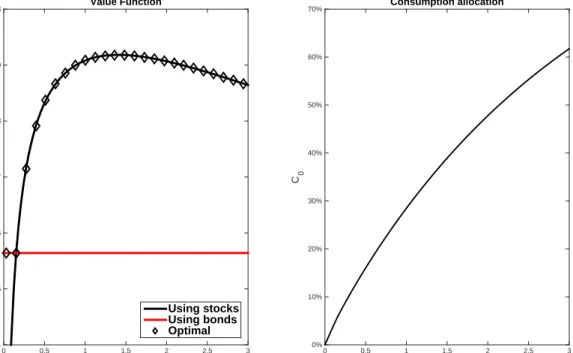
Consider the case of Brownian risk, with driftg and volatility σ, as in Section 3. Fig-ure 3 depicts the behavior of the value function and of the share of wealth allocated to the consumption account, as functions of the observation frequency, and highlights the existence and unicity of the optimal time interval between information acquisi-tion.20
To understand the determinants of inattention, we study the behavior of the unique optimal observation intervalT∗.
Proposition 5. The optimal attention intervalT∗, in the case of brownian returns, is • increasing in disappointment aversionθ,
• decreasing in expected returnsg, • increasing in volatilityσ,
20The back-of-the envelope calibration of Figure 3 yields an optimal time interval of a little over 1
year, consistent with existing surveys. See for instance the 2003 survey by Unicredit Bank, and the 2004 Bank of Italy Survey of Households Income and Wealth, in Alvarez et al. (2012).
Observation interval T 0 0.5 1 1.5 2 2.5 3 V0 2.4 2.5 2.6 2.7 2.8 2.9 3 Value Function Using stocks Using bonds Optimal Observation interval T 0 0.5 1 1.5 2 2.5 3 C0 0% 10% 20% 30% 40% 50% 60% 70% Consumption allocation
Figure 3: Utility as a function of T, the time interval between observations. For parameters values: θ= 0.8, α= 0.5, σ= 15%, g = 10%, r= 1%, ρ= 0.2.
• increasing in volatility even when the certainty equivalent rate remains constant (through an increase in expected returnsg)
The intensity of information aversion affects the attention policy: more disappoint-ment averse agents stay longer away from information. This prediction is consistent with the results of Alvarez et al. (2012), who find more risk averse investors check the value of their portfolios less often. Further, more volatile risky asset prices result in more inattention in our framework. Two elements drive this result: as volatility increases, the information flow is more intense, thus more costly; and the risky asset is less appealing because more risky. The first is specific to our approach; the second is also present in models of inattention with exogenous costs. Proposition 5 states inattention increases with the underlying risk even when expected returns increase together with volatility so as to maintain a constant valuation of the risky asset. This formal result differentiates our model from those with exogenous information costs. The stock market provides a natural setting to consider this implication. Sicherman
et al. (2014) document investors check the value of their investment accounts less of-ten, when the VIX, an index of stock market volatility, increases. Because increases in volatility are, empirically, compensated by increases in expected returns, this evi-dence provides specific support for our approach.
5
Richer information choices
So far, we have considered the decisions of an investor with access to only the simplest tool to manage her information: choosing when to observe or not the value of her port-folio. While this setup is likely accurate for many investors managing their wealth, a finer access to information is possible with either the help of computers or the help of other agents. In this section, we study how to do so. We start by considering how the information flow can be better tailored to the agent’s specific preferences. Then we consider the scope for delegating decisions. The insights we develop here can be considered both from a positive and a normative point of view: providing a rationale for information systems used in practice, or suggesting ways to help agents deal with their information aversion.
5.1
Information delegation
Our framework makes possible the comparison of arbitrary structures of information flows. Information policies must simply satisfy the following two conditions: the fil-tration {Ft} must be increasing, to respect Bayesian updating and no-forgetting; it
must be smaller than the maximum information available at datet,F¯t
∀t, Ft⊆F¯t, Ftincreasing. (11)
Given such a policy, one can determine the optimal allocation policy — consumption and savings in our model — and derive the value of wealth, including the endogenous costs of such an information flow. While this seems, at first glance, a straightforward extension to the problem analyzed in the previous section, it is one that fixed-cost models of information cannot address in a meaningful way. An investor might be
in-terested in seeing all her wealth at given intervals of time; and/or in receiving state-dependent signals telling her when her wealth reaches a certain threshold; and/or in checking at regular intervals if her wealth has gone up more or less than a certain percentage. These choices arguably entail different information costs. With exoge-nous costs models, in the style of Duffie and Sun (1990), these relative information costs can only be ascribed in an ad-hoc fashion. Under information aversion, on the other hand, each signal does yield a different cost, endogenously depending on how informative the signals are and on the risk-taking decisions the agent makes.
Rather than studying all the possible information structures satisfying Equation (11), we consider wether simple signals can help the investor. In addition to the time-dependent observations the agent can obtain on her own, and which we studied in the previous section, we include state-dependent alerts the agent receives when her risky account falls below a certain threshold. The following proposition shows alerts following poor performance do help the investor.
Proposition 6. When returns follow a Brownian motion, the agent is strictly better off if she can add to her regular full wealth observations a state dependent signal she observes only when her wealth falls below a pre-specified threshold of her choice.
The additional alert in bad times has three distinct effects on the investor. First, since the agent is information averse, more frequent information comes at a utility cost. Second, however, the additional information allows her to improve on her post-signal decision making, i.e. to adjust her consumption and portfolio in response to the bad news. Third, and more subtle, knowing she may receive additional information through an intermediate signal also impacts her ex-ante decision making. The signal acts as a backstop against running down the risky account. Because she knows she will be alerted before her risky account reaches0, she can engage in more risk-taking by financing some of her consumption from the risky rather than the risk-free as-set. For a low enough threshold and with Brownian returns, this last positive effect dominates. The utility gains from the increased risk-taking ex-ante are first-order in the threshold. On the other hand, both the ex-post reallocation gain as well as the information costs are of similar order as the probability of hitting the threshold; this
probability is of higher order in the threshold and therefore dominated.21
The result of Proposition 6 highlights an insight that extends beyond our partic-ular model of consumption and savings. Abel et al. (2013) find time-dependent rules to be optimal in a setting with fixed observation and transaction costs. In our setting with endogenous information costs, allowing for rich information structures, adding state-dependent rules dominates over pure time-dependent rules. Obtaining infor-mation precisely when it is needed is worth the additional utility cost.
In practice, the alarms we considered in this section are natural to implement: a broker or bank can easily contact their clients following poor portfolio performance. More generally, while staying away from news most of the time is valuable, becoming aware of extreme events is useful. The media representation of news, making large information arrivals unavoidable, is consistent with our result.
5.2
Decision delegation
To assist an information averse agent, one can go further and delegate allocations, thus removing the necessity to actively seek information. The investor in our model might want to ask a portfolio manager to take care of her savings. Delegation seems like the perfect tool against information aversion: pay somebody, or program a com-puter, to be fully informed and make all decisions, and you no longer have to look for information? Though intuitive it turns out to be partly false: delegated manage-ment cannot always shield the agent from receiving information, in particular in our consumption-savings model.
Adapting our framework to allow for delegated management is straightforward. We let decisions be taken according to all the information available, F¯t. Quantities
entering the current flow utility however must be observed by the agent, i.e. in the agent’s information set Ft: portfolio decisions can be made hidden from the agent,
21This argument generalizes to other distributions where the probability of reaching a threshold
consumption cannot. The measurability conditions are
Ct Ft-measurable, (12) St F¯t-measurable. (13)
These conditions make clear the benefits of delegation to erase information costs are limited in our framework: to better manage the investor’s wealth, the delegated man-ager must make consumption adjust with portfolio performance, thus automatically burdening the agent with information.
There are, however, cases in which delegated management can strongly mitigate information costs. Consider the following example. An investor whose only objective is to maximize her wealth at a final date τ, when she consumes, can invest in vari-ous risky and risk-free assets with observable time-varying expected returns. If she cannot delegate, the information averse investor will trade off the benefits of active portfolio management with the costs of information. If she could, on the other hand, she would delegate all portfolio management decisions and would only observe the final value of her wealth when she consumes at time τ. Delegation in this example can fully shield the agent from all information costs.
The key difference with our framework is the horizon at which the consequences of allocation decisions are realized. In our consumption-savings problem, delegated decisions concern consumption choices, and are immediately realized. With market-timing, delegated decisions concern portfolio allocations, and need not immediately impact consumption. These results provide some guidance as to when delegation should be observed in practice. Cases where optimal decisions’ implications are quickly observed, and cannot be bundled over time, limit the scope for delegation, in contrast to decisions with long-term implications only. Consistent with this argument, the del-egation of active portfolio management of retirement accounts is common in practice, while short term consumption and saving decisions are typically made by the agents themselves.
6
Extensions
Even in a simple consumption-savings framework, we showed the endogenous in-formations costs of our model provide novel insights, with broad empirical support. Besides, our approach has pervasive implications for decision-making under uncer-tainty, relative to models with exogenous information costs or constraints, of which this is but one example. We briefly revisit below several classic questions, and stress the novel tradeoffs when agents are information averse.
6.1
Diversification and the multiplication of information flows
A robust insight of portfolio theory is that diversification is valuable. When presented with two assets with imperfectly correlated returns, it is optimal to invest in both. Because our disappointment averse agents are risk-averse, the rationale for diversifi-cation obtains. However, in our framework, not only does the distribution of the final payoffs matter, but also the structure of the information flow. It is plausible investing in a larger number of assets corresponds to more frequent arrivals of information, which might diminish and even overcome the benefit of diversification.
To characterize the tradeoff between the costs and benefits of diversification in our model, we study a simple example. Suppose the agent receives at dateτ the final value λXτ(1) + (1−λ)Xτ(2), whereX(1) and X(2) are two arithmetic Brownian motions
with volatility σ and correlation ρ, and λ ∈ [0,1] can be thought of as a portfolio share. Let the agent’s observations, at intervals of lengthT, alternate systematically between the two processes.
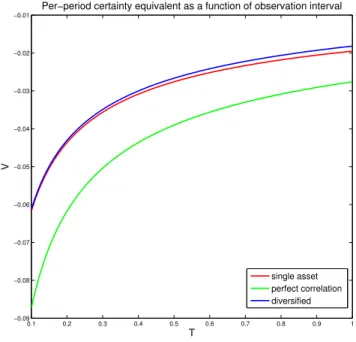
In Figure 4, we consider (a) investing in only one asset (λ = 0), (b) investing in two perfectly correlated assets (λ = 50%,ρ= 1), and (c) investing equally in two fully independent assets (λ = 50%, ρ = 0). Investments (a) and (b) share the exact same payoff structure, but have different information flows, with higher signal frequency for case (b), and thus a lower valuation. Investments (b) and (c) have same informa-tion flows, but different risk exposures: the diversified investment (c) yields a higher value. The most interesting comparison is between (a) and (c). In this particular ex-ample, when assets are perfectly uncorrelated, the diversification motive dominates over the information costs: the agent always prefers the diversified portfolio with
fre-0.1 0.2 0.3 0.4 0.5 0.6 0.7 0.8 0.9 1 −0.09 −0.08 −0.07 −0.06 −0.05 −0.04 −0.03 −0.02 −0.01 T V
Per−period certainty equivalent as a function of observation interval
single asset perfect correlation diversified
Figure 4: Role of diversification. Certainty equivalent as a function of the obser-vation interval for (a) a single asset portfolio (red), (b) an equal-weight perfectly cor-related portfolio (green), (c) and an equal weight independent payoff portfolio (blue). For arithmetic Brownian motions with volatilityσ = 0.1, and forθ = 1.
quent information (c) over the portfolio with one asset and infrequent information (a).22 The benefits of diversification, however, are greatly diminished by the
multipli-cation of information flows. At higher frequency, in particular, as information costs increase, the agent is close to indifferent between holding a diversified portfolio with more information versus holding a single asset.
6.2
Leverage and information decisions
In Section 4, we prohibited the investor from taking on any leverage, which corre-sponds to the natural borrowing limit under time-dependent rules, since an agent with levered positions cannot avoid bankruptcy. On the other hand, if the asset price
follows a geometric brownian motion, and if the agent observed it continuously, she could take arbitrary levered positions: levering up requires being and keeping in-formed.
As long as there is a finite (arbitrarily high) borrowing limit, an agent with access only to time dependent rules would not take any leverage. In the richer informa-tion filtrainforma-tions set of Secinforma-tion 5, downturn alerts allow the agent to lever up into the attractive risky asset, without incurring the dissuasive cost of continuous informa-tion flows. Even then, though, the agent would not choose to lever up above a given level: the more levered her portfolio, the higher the threshold she needs to set for her downturn alerts, and the more frequent, and thus costly, they become.
Information aversion thus yields non-trivial interconnections between leverage de-cisions and attention dede-cisions. The information costs due to the monitoring of levered positions are a likely complement to the margin costs emphasized by Mitchell et al. (2002).
6.3
Learning, information and risk-taking dynamics
Intuitively, for a given signal about a lottery, the information cost is hump-shaped in the quantity of information (see Corollary 1 and Corollary 3). This non-monotonicity has potentially rich implications for learning decisions.
As an illustration, take the framework of Section 4, and assume the agent does not know the growth rateg. She can learn aboutg by observing her wealth (provided she invests a given portion of her wealth in the risky asset), and from independent signals she receives when she observes her wealth. If these signals are very informative, they are comparatively not very costly, and she would optimally observe them very fast in order to fully learn the value ofg and then adjust her information frequency down to the optimal one of Section 4. If they are not very informative, they are still not extremely costly, but observing her wealth is, so she might maintain a very low frequency dynamics, where only a small part of her wealth is invested in the risky asset, up to the point she learns g > r, and she switches her whole portfolio to the risky asset, and increases her observation frequency to the optimal one at steady-state. Finally, if the signals are in a middle range of informativeness, they might be
too costly, on their own to be worth observing, and in this intermediate region, the investor might fully abstain from investing in the risky asset.
This simple example illustrates the complex interconnections between learning, information and risk-taking, and their dynamics, when agents are information averse. The existence of no-learning regions would not only affect investment decisions, but could have broad implications in other areas of decision making where learning is key, e.g. the decision to engage in medical testing, to collect information and invest in a new technology etc.
6.4
The supply of information
In practice, information is produced and disseminated by agents or institutions. In an economy populated by information averse agents, suppliers of information need to adapt and appropriately tailor the flow of information. As such our model provides the basis for a theory of optimal opaqueness. While providing an in-depth treatment of this question is left for future research, we briefly outline a few simple implications. One way to help information averse agents is to lump news together in bundles delivered at precise points in time. Such a behavior is consistent with firm’s disclosure policies organized around scheduled earnings announcement.23 Similarly, monetary
policy is disclosed at precise points in time, at 2:00p.m. following FOMC meetings, most of which are scheduled in advance. Other macroeconomic announcements, such as employment numbers, quarterly growth etc., also follow discretely spaced releases. A more detailed examination of our framework could provide further guidance for the design of such information release policies.
Agents do not want to receive information too often. However, when they do ob-serve information (either of their own choice or due to external forces), the result of Corollary 1 indicates they want it to be as precise and “transparent” as possible. Ours is a framework in which suppliers sometimes refraining from releasing any in-formation can be beneficial; but suppliers releasing partial or distorted inin-formation is not.
23Acharya and Lambrecht (2014) provides an alternative theory of earnings target set to manage