The Data Mining OPtimization Ontology
C. Maria Keeta, Agnieszka Ławrynowiczb, Claudia d’Amatoc, Alexandros Kalousisd, Phong Nguyene, Raul Palmaf, Robert Stevensg, Melanie Hilarioh
aDepartment of Computer Science, University of Cape Town, South Africa, [email protected]
bInstitute of Computing Science, Poznan University of Technology, Poland, [email protected] cDepartment of Computer Science, University of Bari, Italy, [email protected]
dDepartment of Business Informatics, University Of Applied Sciences, Switzerland, [email protected] eDepartment of Computer Science, University of Geneva, Switzerland, [email protected]
fPoznan Supercomputing and Networking Center, Poland, [email protected]
gSchool of Computer Science, University of Manchester, United Kingdom, [email protected] hArtificial Intelligence Laboratory, University of Geneva, Switzerland, [email protected]
Abstract
The Data Mining OPtimization Ontology (DMOP) has been developed to support informed decision-making at various choice points of the data mining process. The ontology can be used by data miners and deployed in ontology-driven information systems. The primary purpose for which DMOP has been developed is the automation of algorithm and model selection through semantic meta-mining that makes use of an ontology-based meta-analysis of complete data mining processes in view of extracting patterns associated with mining performance. To this end, DMOP contains detailed descriptions of data mining tasks (e.g., learning, feature selection), data, algorithms, hypotheses such as mined models or patterns, and workflows. A development methodology was used for DMOP, including items such as competency questions and foundational ontology reuse. Several non-trivial modeling problems were encountered and due to the complexity of the data mining details, the ontology requires the use of the OWL 2 DL profile. DMOP was successfully evaluated for semantic meta-mining and used in constructing the Intelligent Discovery Assistant, deployed at the popular data mining environment RapidMiner.
Keywords: Ontology, OWL, data mining, meta-learning, semantic meta-mining
1. Introduction
The primary goal of the Data Mining OPtimization Ontol-ogy (DMOP, pronounced dee-mope) is to support all decision-making steps that determine the outcome of the data mining (DM) process. It can be used by data mining practitioners to inform manual selection of various ingredients (algorithms, models, and parameters) that are used for constructing DM pro-cesses. Most of all, DMOP has been designed tosupport the au-tomation of such selectionsin order tooptimizeDM processes. The DM process is standardized by CRISP-DM [1], a high-level standard DM process model. According to CRISP-DM, the DM process is composed of the following phases: business understanding, data understanding, data preparation, modeling, evaluation, and deployment. DMOP focuses on those three phases that can be best automated: from data preparation to evaluation. CRISP-DM provides only methodological frame-work and guidelines, however, and not details on the internals of the DM process components. Similarly, other available DM models and ontologies (discussed in Sect. 2.2) treat DM algo-rithms as black boxes, focusing mostly on the inputs (data) and outputs (hypotheses) the algorithms specify. The optimization of a DM process requires knowledge not only on how com-ponents from its different phases interact, but also on how the components’ internal characteristics influence the process per-formance. Thus, despite the existence of DM domain models,
the optimization of the DM process was not possible because the necessary additional detailed knowledge was missing. This means that a comprehensive analysis of DM processes was not possible, and, consequently nor was theoptimizationof the per-formance of the DM process. DMOP fills this gap. It con-ceptualizes the internals of the DM algorithms: their multiple characteristics and building blocks, such as algorithm assump-tions, optimization problems they solve, decision strategies, and others. This distinguishing design feature (beyond the state of the art) allows one to use DMOP to optimizeDM processes withsemantic meta-mining[2], which is a novel form of meta-learning.
Meta-learning [3], or learning to learn, is defined as the ap-plication of machine learning techniques to meta-data about past machine learning experiments with the goal of modify-ing some aspects of the learnmodify-ing process in order to improve the performance of the resulting model. Traditional meta-learning focused only on the central (modeling) phase of the DM process, where machine learning algorithms are executed to build a model. However, the quality of the mined model depends strongly also on other phases of a DM process. Tra-ditional meta-learning regarded learning algorithms as black boxes, correlating the observed performance of their output (learned model) with characteristics of their input (data). How-ever, the algorithms that have the same types of input/output
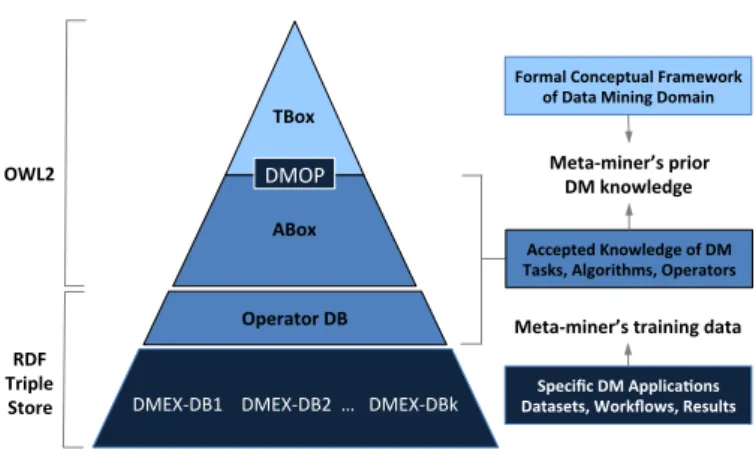
TBox% DMOP% ABox% Operator%DB% DMEX(DB1%%%%DMEX(DB2%%…%%%DMEX(DBk% OWL2% RDF% Triple% Store% Formal%Conceptual%Framework%% of%Data%Mining%Domain% Accepted%Knowledge%of%DM% Tasks,%Algorithms,%Operators%% Specific%DM%ApplicaFons% Datasets,%Workflows,%Results% MetaHminer’s%training%data% MetaHminer’s%prior%% DM%knowledge%
Figure 1: Architecture of the ontology, its associated knowledge base, operator database, and satellite triple stores, which are organised conceptually (right) and in implementation (left), resulting in an integrated pyramid of 4 layers.
may differ in internal characteristics.
Semantic meta-mining is distinguished from traditional meta-learning by the following three properties. First, it ex-tends the meta-learning approach tometa-mining, i.e. learning from the full DM process. Secondly, it is co-driven by knowl-edge of DM process and its components, which are represented in the DM ontology and knowledge base (KB), in contrast to purely data driven traditional meta-learning. Thirdly, it breaks open the black box by explicitly analyzing DM algorithms along various dimensions to correlate observed performance of learned hypotheses resulting from DM processes with both data and algorithm characteristics. Semantic meta-mining is thus an ontology-based, process-oriented form of meta-learning that exploits in-depth knowledge of DM processes.
To support semantic meta-mining, DMOP contains a de-tailed taxonomy of algorithms used in DM processes. They are each described in terms of their underlying assumptions, cost functions and adopted optimization strategies, generated classes of hypotheses (models or pattern sets), and other prop-erties. Following such a “glass box” approach makes explicit internal algorithm characteristics. This allows meta-learners us-ing DMOP to generalize over algorithms and their properties, including those algorithms that it did not learn from directly.
Performing semantic meta-mining requires knowledge about various layers of data mining experiments, which are reflected in the DMOP architecture (see Fig. 1): a top-layer with the for-mal conceptual framework of the data mining domain (e.g. al-gorithm class specification), a middle layer of accepted knowl-edge about the DM domain (e.g. particular algorithms and their known implementations), and a bottom layer of applica-tion specific DM data (e.g. datasets, workflows, results). The two-tiered top layer in the figure represents DMOP (denoted TBox) and its KB (denoted ABox), where the latter uses knowl-edge from DMOP to model existing data mining algorithms. Both, DMOP and its associated KB, are implemented in OWL 2. An RDF database (denoted Operator DB) contains descrip-tions of operators, i.e., implementadescrip-tions of algorithms described in DMOP and particularly those implementations that are a part
of popular DM software (such as RapidMiner1or Weka2). The ABox, together with the operator database, provides accepted knowledge about DM tasks, algorithms and operators. Alto-gether these are application-independent resources that consti-tute the meta-miner’s prior DM knowledge. Meta-data recorded during data mining experiments are described using DMOP and its associated resources, and thus constitute application-specific training and testing data for a meta-miner. They are stored in application-dedicated RDF triple stores (denoted DMEX-DBs) and describe datasets, workflow descriptions, and data mining experiments.
This paper describes v5.5 of DMOP, which has 723 classes, 96 object properties, 15 data properties, and 2425 logical axioms (4302 in total, including annotations), and has a SROIQ(D) DL expressivity; it can be downloaded fromhttp:
//www.dmo-foundry.org.
DMOP provides a unified conceptual framework for ana-lyzing DM tasks, algorithms, models, datasets, workflows and performance metrics, and their relationships, as described in Sect. 3 whilst methodological aspects are described in Sect. 2. To fulfil requirements of this in-depth analysis, we have en-countered a number of non-trivial modeling issues in DMOP development, of which the main ones are discussed in Sect. 4. DMOP’s goals and required coverage resulted in using almost all OWL 2 features. DMOP was successfully applied in se-mantic meta-mining, and deployed in RapidMiner data mining environment (download statistics provided), which is described in Sect. 5. Conclusions are drawn in Sect. 6.
2. Ontology development
There are several methodologies for ontology development in the literature, including Methontology[4], NeON [5], Melting
Point [6], and DiDOn [7]. Although these methodologies may differ in scope and focus, they have some commonalities that can be roughly mapped in three main stages of the ontology development process: 1) specification with a domain analysis (including use cases, competency questions), 2) conceptualiza-tion, formalizaconceptualiza-tion, and implementaconceptualiza-tion, and 3) maintenance with refinement and evolution of the ontology. Many devel-opers have contributed to DMOP over the years, who had dif-ferent perspectives on extant methodologies, and had different levels of modelling experience as to whether sticking to a single methodology is important, and if so, a lean one or a compre-hensive one. Therefore, the common components were taken as reference and guideline, and tailored it to the specific micro-level details as applicable to DMOP.
During the first stage, requirements with competency questions—i.e., questions that an ontology should be able to answer—were formulated (see Sect. 2.1), the use cases for se-mantic meta-mining specified, such as providing DM expertise to an intelligent knowledge discovery assistant (see Sect. 5.1), and related domain ontologies were investigated and assessed
1http://rapidminer.com/
to what extent they would be able to meet the requirements (see Sect. 2.2). The outcome of that stage fed into stage two, leading to a design of the DMOP architecture, and the subsequent on-tology authoring by people residing at different institutions and with overlapping and complementary knowledge of the subject domain. The tool used was Prot´eg´e 4.x3. The ontology has gone through various cycles of design and evaluation, including a testing phase on meeting the requirements. Besides content experts, also ontology experts were consulted, who provided additional modeling guidance and solutions. The ontology is in the third stage since late 2011, where novel methods and tools at the level of axiom enhancement and ‘debugging’ are being used, such as [8, 9], new sections have been added, such as on clustering, and, as the ontology became larger and more com-plex, more structure has been added to the ontology by aligning it to a foundational ontology (see Sect. 2.3), which are the main changes that resulted into a v5.3 and v5.4 of DMOP. Tidying up the ontology merited a v5.5, which entailed, among others, adding more annotations (n=166) and removing unused entities (n=108). The ontology is now also available in documentation format, generated by LODE [10].
We will highlight three salient aspects of the process fol-lowed: thecompetency questions—important for the success of deployment of the ontology; related domain ontologiesto as-sess to what extent we could reuse existing domain ontologies in data mining; and thealignment of DMOP with a foundational ontology.
2.1. DMOP Competency questions
The principal competency question for the DMOP was: CQ1.1 Given a data mining task/data set, which of the valid or
applicable workflows/algorithms will yield optimal results (or at least better results than the others)?
This competency question is decomposed into many other ques-tions and we present a selection of them here. Coarse-grained questions include:
CQ2.1 Given a set of candidate workflows/algorithms for a given task/data set, which data set characteristics should be taken into account in order to select the most appropri-ate one?
CQ2.2 Given a set of candidate workflows/algorithms for a task/data set, which workflow/algorithm characteristics should be taken into account in order to select the most appropriate one?
which can be refined into more detailed questions, such as: CQ3.1 Are there learning algorithms that I can use on
high-dimensional data without having to go through preliminary dimensionality reduction?
CQ3.2 Which induction algorithms should I use (or avoid) when my dataset has many more variables than instances? CQ3.3 Which learning algorithms perform best on microarray
or mass spectrometry data?
How they are satisfied will be discussed in Sect. 3.5 (CQ3.1) and 5.2 (CQ1.1, CQ2.x, CQ3.2, and CQ3.3).
3http://protege.stanford.edu
2.2. Related domain ontologies
An overview of early approaches to methodical descriptions of DM processes may be found in [2]. The majority of work concerning formal representation of data mining in ontology languages is aimed at the construction of DM workflows. One strand of this research deals with the development of distributed DM applications on the Grid [11, 12]. The pre-OWL DAMON ontology provides a characterization of available data mining software to enable semantic searching for appropriate DM re-sources and tools [11]. The ontology of GridMiner Assistant (GMA) [12] aims to support dynamic, interactive construction of DM workflows in Grid-enabled data mining systems.
Other ontologies developed for DM workflow construction are KDDONTO [13], KD ontology [14] and DMWF [15], all of them using OWL as a major representation language. These ontologies focus on modeling an algorithms’ inputs/outputs to enable generation of valid compositions of them. For instance, a Hierarchical Task Network (HTN) based planner eProPlan [15], uses DMWF to plan a set of valid workflows based on operator (algorithm implementation) preconditions and effects modeled in DMWF by means of SWRL4rules.
Few existing DM ontologies go beyond supporting workflow construction. OntoDM [16] aims to provide a unified frame-work for data mining and contains definitions of the basic data mining concepts, but lacks a particular use case. Expos´e [17] aims to provide a formal domain model for a database of data mining experiments. It uses OntoDM together with the data mining algorithms from DMOP, and a description of experi-ments (algorithm setup, execution, evaluation) to provide the basis of an experiment markup language. The primary use of OntoDM and Expos´e may thus be viewed as providing con-trolled vocabulary for DM investigations.
None of the related ontologies was developed with the goal of the optimization of the performance of DM processes, what is expressed by our principal competency question. They do not provide sufficient level of details needed to support seman-tic meta-mining. The ontologies that are focused on workflow construction do not model the internal characteristics of algo-rithms (cf. competency question CQ2.2) but just their inputs and outputs. Hence they help in answering the question how to build a valid workflow, but not necessarily how to build an optimalworkflow.
2.3. Alignment of DMOP with a foundational ontology There are multiple good reasons to use a foundational ontol-ogy in theory, and it has been shown to improve the ontolontol-ogy quality, understandability, and interoperability in praxis [18]. It comes at the ‘cost’ for figuring out how to align a domain ontol-ogy with it, and it can have implications for the language used for the overall ontology. The principal issues from a language viewpoint are: 1) to import or to extend, 2) if import, whether that should be done in whole or just the relevant module ex-tracted from the foundational ontology, 3) how to handle the differences in expressiveness that may exist—and possibly be
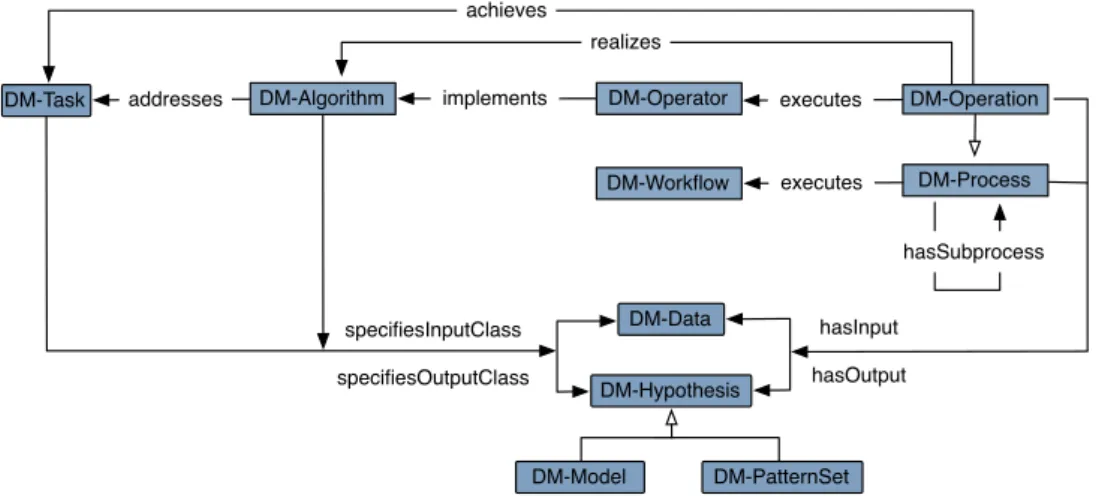
specifiesInputClass
specifiesOutputClass
hasInput
hasOutput
DM-Task addresses DM-Algorithm implements DM-Operator executes DM-Operation
achieves
realizes
DM-Workflow executes DM-Process
hasSubprocess
DM-Data
DM-Hypothesis
DM-Model DM-PatternSet
Figure 2: Simplified overview of the core concepts of DMOP.
required—between the foundational ontology and the domain ontology, and 4) how to rhyme different modeling ‘philoso-phies’ between what comes from Ontology, what is represented in foundational ontologies, and what is permitted in OWL5.
There were two main reasons to align DMOP with a founda-tional ontology; first, they have solutions to the modeling issue about attributes and data properties for measurements in data mining; second, the reuse of the foundational ontology’s object properties (see Sect. 3.4 and Sect. 4.3). In order to determine the most suitable foundational ontology to be used for model-ing DMOP, both a manual assessment was conducted and the automated recommender ONSET v1.2 [19] was used. The out-come of this study determined DOLCE [20] as the compara-tively ‘optimal’ foundational ontology for DMOP, given its re-quirements. The reasons were, among others, that there is an OWL version of it, that the modelling of measurements and parameters needed by DMOP was solved in DOLCE with its qualities and qualia (see Sect. 4.3), that it accommodates ab-stract entities (part of the DMOP domain), and that some of the object properties in DOLCE matched the ones in DMOP or were highly usable (see Sect. 3.4). In the meantime, it has been shown that it is not impossible to ‘swap’ DOLCE for BFO or GFO, but most alignments will be lost in the process due to the use of a substantial amount of entities specific to DOLCE [21]. Determining the suitable DOLCE category for alignment and carrying out the actual mapping has been done manually (see Sect. 3.4); some automation to suggest mappings would be a welcome addition.
2.4. Contributing to DMOP
There are now three ways of contributing to the ontology, each targeted to a different type of contributor. Mode 1 is the open, bottom-up collaborative ontology development approach for domain and/or ontology experts, which relies on Cicero Ar-gumentation Tool6 [22], the DMOP forum for input, and the
5i.e., features that are objectionable from an ontological viewpoint, such as class-as-instance, nominals, and data properties
6http://cicero.uni-koblenz.de/wiki/index.php/Main_Page
Editorial Board to review community input.
Mode 2: Data miners not familiar with ontology tools can fill in predesigned templates—alike user-friendly Ontology De-sign Content Patterns—to populate areas of the ontology with relatively stable concept and property definitions, e.g. relat-ing operators to their algorithms, which will be screened by the ontology’s Editorial Board prior to integration into the target ontology.
Mode 3: The contributor is a data mining expert and conver-sant with ontology development who not only contributes new data mining content, but also defines new concepts and relations needed for content formalization, so that the domain expert on her specific topic will impact ontology design (at least locally) and conceptualization. The expert contributor will develop the assigned module using her preferred ontology editor, and will submit it to the ontology’s Editorial Board in the form of an OWL file. After validation, the module becomes an integral part of the ontology. These modes of collaboration are accessi-ble fromhttp://www.dmo-foundry.org.
3. DMOP’s contents
The core concepts of DMOP (Fig. 2) are the different ingre-dients that go into the data mining process (DM-Process):
• The input of the process is composed of a task specifica-tion (DM-Task) and training/test data (DM-Data) provided by the user;
• Its output is a hypothesis (DM-Hypothesis), which can take the form of a global model (DM-Model) or a set of local patterns (DM-PatternSet).
Tasks and algorithms are not processes that directly manipu-late data or models, rather they are specifications of them:
• ADM-Taskspecifies a DM process (or any part thereof) in
terms of the input it requires and the output it is expected to produce.
• ADM-Algorithmis the specification of a procedure that
ad-dresses a givenDM-Task, while aDM-Operatoris a program that implements a givenDM-Algorithmand that is executed
• Instances of DM-Task andDM-Algorithmdo no more than specifying their input/output types (only processes have actual inputs and outputs).
Some of the object properties of DM processes are:
• It hasInput and it hasOutputsome IO-Object(DM-Data or
DM-Hypothesis);
• A process that executes a DM operator alsorealizes the DM algorithm thatisImplementedBythat operator; • A DM algorithm addresses a DM task, and the process
achievesthe DM task addressed by the algorithm.
Finally, aDM-Workflowis a complex structure composed of
DM-operators, while aDM-Experiment is a complex process
com-posed of operations (or operator executions). An experiment is described by all the objects that participate in the process: a workflow, data sets used and produced by the different data pro-cessing phases, the resulting models, and meta-data quantifying their performance.
3.1. DM Tasks
The top-level DM tasks listed below are defined by their in-puts and outin-puts.
ADataProcessingTaskreceives and outputs data. Its four
sub-classes produce new data by cleansing (DataCleaningTask), re-ducing (DataReductionTask), extracting a compact representa-tion (DataAbstractionTask) or otherwise transforming the input data (DataTransformationTask). These classes are further articu-lated in subclasses representing more fine-grained tasks.
AnInductionTaskconsumes data and produces hypotheses. It
can be either aModelingTask or aPatternDiscoveryTask, based on whether it generates hypotheses in the form of global mod-els or local pattern sets. Modeling tasks can be predictive (e.g. classification) or descriptive (e.g., clustering), while pattern dis-covery tasks are further subdivided into classes based on the nature of the extracted patterns: associations, dissociations, de-viations, or subgroups.
AHypothesisProcessingTaskconsumes hypotheses and
trans-forms (e.g., rewrites or prunes) them to produce enhanced—less complex or more readable—versions of the input hypotheses.
AHypothesisEvaluationTaskquantifies the quality of an induced
hypothesis with respect to a specific criterion (e.g., predictive performance). AHypothesisApplicationTaskapplies an induced hypothesis to new data.
3.2. Data
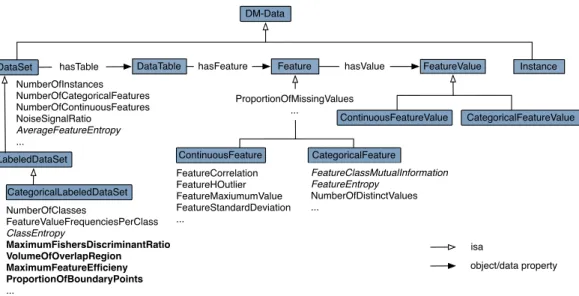
As the primary resource that feeds the knowledge discovery process, data have been a natural research focus for data miners. Over the past decades meta-learning researchers have actively investigated data characteristics that might explain generaliza-tion success or failure. Fig. 3 shows the characteristics associ-ated with the differentDatasubclasses (shaded boxes). Most of these are statistical measures, such as the number of instances or the number of features of a data set. Others are information-theoretic measures (italicized in the figure). Characteristics in bold font are geometric indicators of data set complexity, such as the maximum value of Fisher’s Discriminant Ratio that mea-sures the highest discriminatory power of any single feature in the data set (see [23] for detailed definitions).
3.3. DM Algorithms
The top levels of theDM-Algorithmhierarchy reflect those of
the DM-Task hierarchy, since each algorithm class is defined
by the task it addresses. However, theDM-Algorithmhierarchy is much deeper than theDM-Task hierarchy: for each leaf of the task hierarchy, there is often a dense subhierarchy of algo-rithms that specify diverse ways of addressing each task. For in-stance, the leaf conceptClassificationModelingTaskmaps directly onto theClassificationModelingAlgorithmclass, whose three main subclasses—generative, discriminative, and discriminate func-tion algorithms [24]—are illustrated here. A
GenerativeAlgo-rithmcomputes the class-conditional densities p(x|Ck) and the
priors p(Ck) for each classCk. Examples of generative meth-ods are normal (linear or quadratic) discriminant analysis and Naive Bayes. ADiscriminativeAlgorithm, such as logistic regres-sion, computes posterior probabilitiesp(Ck|x) directly to deter-mine class membership. ADiscriminantFunctionAlgorithmbuilds a direct mapping f(x) from input xonto a class label; neural networks and support vector classifiers (SVCs) are examples of discriminant function methods. These threeDM-Algorithm fami-lies spawn multiple levels of descendant classes that are distin-guished by the type and structure of the models they generate.
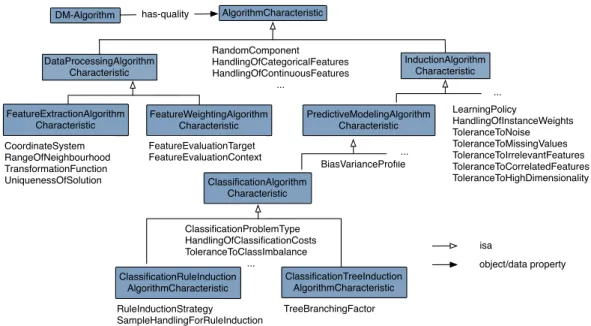
One innovative feature of DMOP is the modeling and ex-ploitation of algorithm properties in meta-mining. All previ-ous research in meta-learning has focused exclusively on data characteristics and treated algorithms as black boxes. DMOP-based meta-mining brings to bear in-depth knowledge of algo-rithms as expressed in their elaborate network of object prop-erties. One of these is the object propertyhas-quality, which relates aDM-Algorithmto anAlgorithmCharacteristic(Fig. 4). A few characteristics are common to all DM algorithms; examples are characteristics that specify whether an algorithm makes use of a random component, or handles categorical or continuous features. Most other characteristics are subclass-specific. For instance, characteristics such asLearningPolicy (Eager/Lazy)are common to induction algorithms in general, whereas
Tolerance-ToClassImbalanceandHandlingOfClassificationCostsmake sense
only for classification algorithms.
Note that has-quality is only one among the many object properties that are used to model DM algorithms. An induc-tion algorithm, for instance, requires other properties to fully model its inductive bias. Some examples are the properties:
as-sumeswhich expresses its underlying assumptions concerning
the training data;specifiesOutputClasswhich links to the class of models generated by the algorithm, making explicit its hy-pothesis language or representational bias; hasOptimizationProb-lemwhich identifies its optimization problem and the strategies followed to solve it, thus defining its preference or search bias. 3.4. Content alignment to DOLCE
The following subsumption axioms were added to align DMOP with DOLCE. DOLCE’s dolce:process in the per-durant branch has as subclasses DM-Experiment and
DM-Operation, whereas most DM classes, such as algorithm,
soft-ware, strategy, task, and optimization problem, are subclasses
NumberOfInstances NumberOfCategoricalFeatures NumberOfContinuousFeatures NoiseSignalRatio AverageFeatureEntropy ...
DataSet hasTable DataTable hasFeature Feature FeatureValue
DM-Data ContinuousFeature CategoricalFeature Instance LabeledDataSet CategoricalLabeledDataSet NumberOfClasses FeatureValueFrequenciesPerClass ClassEntropy MaximumFishersDiscriminantRatio VolumeOfOverlapRegion MaximumFeatureEfficieny ProportionOfBoundaryPoints ... hasValue ProportionOfMissingValues ... FeatureCorrelation FeatureHOutlier FeatureMaxiumumValue FeatureStandardDeviation ... FeatureClassMutualInformation FeatureEntropy NumberOfDistinctValues ... ContinuousFeatureValue CategoricalFeatureValue isa object/data property
Figure 3: Data characteristics modeled in DMOP. Rectangles: subclasses ofDM-Dataclass; unbounded text near the rectangles denote subclasses of the DataChar-acteristicclass associated to aDM-Dataclass through an OWL object property, where those in italics font are information-theoretic measures and the ones in bold are geometric indicators.
of such entities have been made subclasses of
dolce:abstract-quality, and for identifying discrete values, classes were added
as subclasses of dolce:abstract-region. Thus, each of the four DOLCE main branches have been used. Regarding object prop-erties, DMOP reuses mainly DOLCE’s quality, quale, and part-hood. DMOP’shasPartinitially had an equivalence alignment
todolce:part, but this duplication has been removed in v5.5 to
reduce the size of the ontology. Mapping DMOP into DOLCE had the most effect on representing DM characteristics and pa-rameters (‘attributes’), which is discussed in Sect. 4.3.
3.5. Answering competency questions
The competency questions may be divided into two groups: those that may be already answered by the DMOP’s KB and those that may be answered with use of the DMOP based meta-mined model, the product of semantic meta-mining. The latter ones that are related to performance of DM processes will be discussed in Sect. 5. The former ones are the questions that deal with characteristics of particular DM entities, which is illus-trated here with competency question CQ3.1, which can be an-swered by querying the ontology for the DM algorithms whose characteristicToleratesHighDimensionalityhas quale ‘Yes’ (i.e., not having to go through the dimensionality reduction). In Prot´eg´e’s DL Query notation, this is:
DM-Algorithm and
has-quality value ToleratesHighDimensionality
The query answer obtained consists of a list of algorithm fam-ilies (classesClassificationRuleInductionAlgorithm,
Classification-TreeInductionAlgorithm, andSVC-Algorithm) and particular
algo-rithms of those classes (among others,C4.5,C4.5Prob,CARTc,
CHAID, DecisionStump, ID3, LogisticModelTree, NBTree,
Ran-domTreeof theClassificationTreeInductionAlgorithmclass).
Once DMOP is classified by the reasoner, answering the DL Queries (for those tested with) takes less than a minute with
HerMiT 1.3.8, else the classification time of the ontology has to be added to the query evaluation time.
4. Modeling challenges
In this section we present the main modeling choices, issues arisen, and solutions adopted, therewith providing some back-ground as to why certain aspects from the overview in the pre-ceding section are modeled the way they are.
4.1. Meta-modeling in DMOP
Right from the start of DMOP development, one of the most important modeling issues concerning DM algorithms was to decide whether to model them as classes or individuals. Though DM algorithms may have different implementations, the com-mon view is to see particular algorithms as single instances, and not collections of instances. However, the modeling problem arises when we want to express the types of inputs and outputs associated with a particular algorithm. We describe this prob-lem and how it was solved using an example, shown in Fig. 5.
Recall that: i) only processes (executions of workflows) and operations (executions of operators) consume inputs and produce outputs; ii) DM algorithms (as well as oper-ators and workflows) can, in turn, only specify the type of input or output; iii) inputs and outputs (DM-Dataset
and DM-Hypothesis class hierarchy, respectively) are
mod-eled as subclasses of IO-Object class. Then expressing a sentence like “the algorithm C4.5 specifiesInputClass
Categori-calLabeledDataSet” became problematic. Based on our
orig-inal design (reflected in Fig. 5a), it would mean that a particular algorithm (C4.5, an instance of the DM-Algorithm
class) specifies a particular type of input (
CategoricalLabeled-DataSet, a subclass ofDM-Hypothesisclass), but classes cannot
BiasVarianceProfile ClassificationProblemType HandlingOfClassificationCosts ToleranceToClassImbalance ... DataProcessingAlgorithm Characteristic InductionAlgorithm Characteristic AlgorithmCharacteristic FeatureExtractionAlgorithm Characteristic FeatureWeightingAlgorithm Characteristic RandomComponent HandlingOfCategoricalFeatures HandlingOfContinuousFeatures ... CoordinateSystem RangeOfNeighbourhood TransformationFunction UniquenessOfSolution FeatureEvaluationTarget FeatureEvaluationContext PredictiveModelingAlgorithm Characteristic isa object/data property DM-Algorithm has-quality ... LearningPolicy HandlingOfInstanceWeights ToleranceToNoise ToleranceToMissingValues ToleranceToIrrelevantFeatures ToleranceToCorrelatedFeatures ToleranceToHighDimensionality ClassificationAlgorithm Characteristic ... ClassificationRuleInduction AlgorithmCharacteristic ClassificationTreeInduction AlgorithmCharacteristic RuleInductionStrategy SampleHandlingForRuleInduction TreeBranchingFactor
Figure 4: Data mining algorithm characteristics: the main top-level classes and a selection of their attributes (subclasses ofCharacteristic).
a) ”C4.5 specifiesInputClassCategoricalLabeledDataSet” 8
%
-Individual Class
(instance ofDM-Algorithm) (subclass ofDM-Hypothesis)
b) ”C4.5 specifiesInputClass Iris” ?
%
-Individual Individual
(instance ofDM-Algorithm) (instance ofDM-Hypothesis)
c) ”C4.5 specifiesInputClass CategoricalLabeledDataSet” 4
%
-Individual Individual
(instance ofDM-Algorithm) (instance ofIO-Class)
”DM-ProcesshasInput someCategoricalLabeledDataSet” 4
%
-Class Class
(subclass ofdolce:process) (subclass ofIO-Object)
Figure 5: Illustration of a modeling problem and its solution based on metamod-eling. a) Original design problem: expressing types of inputs/outputs associated with an algorithm; b) Initial solution: one artificial class per each single algo-rithm with a single instance corresponding to this particular algoalgo-rithm; c) Final solution: weak form of punning available in OWL 2;IO-Classas meta-class of all classes of input and output objects.
Our initial solution was to create one artificial class per each single algorithm with a single instance corresponding to this particular algorithm, as recommended in [25] (e.g.
C4.5Algorithm class with single instance C4.5). However,
such modeling led to technical problems. Since each of the four properties—hasInput, hasOutput, specifiesInputClass,
speci-fiesOutputClass—were assigned a common range—IO-Object—
it opened a way to make problematic ABox assertions likeC4.5
specifiesInputClass Iris, whereIrisis a concrete dataset. Clearly,
any DM algorithm is not designed to handleonlya particular dataset.
In our final solution, we decided to use the weak form of pun-ning available in OWL 2 (see Fig. 5c). We had noticed that
Cat-egoricalLabeledDataSetcould be perceived as an instance of a
meta-class—the class of all classes of input and output objects, namedIO-Classin DMOP. In this way, the sentenceC4.5
speci-fiesInputClass CategoricalLabeledDataSetdelivered the intended
semantics. However, we also wanted to express sentences like
DM-Process hasInput some CategoricalLabeledDataSet. The use
of the same IO object (likeCategoricalLabeledDataSet) once as a class (subclass ofIO-Object) and at other times as an instance required some form of meta-modeling. In order to implement it, we investigated some available options. This included an approach based on an axiomatization of class reification pro-posed in [26], where in a metamodeling-enabled versionOmeta of a given ontologyO, class-level expressions fromOare trans-formed into individual assertions such that each model ofOmeta has two kinds of individuals, those representing classes and those representing proper individuals, and meta-level rules are encoded in class level. We chose not to follow this technique due to its possible efficiency issues.
Punning in our approach is only applied to leaf-level classes
of IO-Object; non-leaf classes are not punned but represented
by associated meta-classes, e.g., theIO-ObjectsubclassDataSet
maps to theIO-ClasssubclassDataSetClass. Similarly, the in-stances of DM-Hypothesis class represent individual hypothe-ses generated by running an algorithm on the particular dataset, while the classDM-HypothesisClassis the meta-class whose in-stances are the leaf-level descendant classes ofDM-Hypothesis. Except for the leaf-level classes, theIO-Classhierarchy struc-ture mimics that of theIO-Objecthierarchy.
4.2. Property chains in DMOP
DMOP has 11 property chains, which have been investi-gated in detail in [8]. The principal issues in declaring safe property chains, i.e., that are guaranteed not to cause unsat-isfiable classes or other undesirable deductions, are declaring and choosing properties, and their domain and range axioms. To illustrate one of the issues in declaring property chains, we
usehasMainTable◦hasFeaturevhasFeature: chaining requires compatible domains and ranges at the chaining ‘points’, such as the range ofhasMainTableand domain ofhasFeature, and with the domain and range of the property on the right-hand side. In this case, hasFeature’s domain isDataTablethat is a sister-class of hasMainTable’s domain DataSet, but the chain forces that each participating entity in hasFeature has to be a sub-class of its declared domain sub-class, henceDataSetvDataTable
is derived to keep the ontology consistent. Ontologically, this is clearly wrong, andhasFeature’s domain is now set toDataSet
or DataTable. Each chain has been analysed in a similar fashion
and adjusted where deemed necessary (see [8] for the generic set of tests and how to correct any flaws for any property chain). DMOP contains more elaborate property chains than the aforementioned one. For instance, realizes ◦ addresses v
achieves, so that if a DM-Operation realizes a DM-Algorithm
that addresses aDM-Task, then theDM-Operationachieves that
DM-Task, and with the chain implements ◦ specifiesInputClass
v specifiesInputClass, we obtain that when a DM-Operator or
OperatorParameter implements an AlgorithmParameter or
DM-Algorithm that specifies the input class IO-Class, then the
DM-Operator or DM-OperatorParameterspecifies the input classIO-Class.
4.3. Qualities and attributes
A seemingly straightforward but actually rather intricate, and essentially unresolved, issue is how to handle ‘attributes’ and, in a broader context, measurements in OWL ontologies. For instance, eachFeatureExtractionAlgorithmhas as an ‘attribute’ a transformation function that is either linear or non-linear. One might be tempted to take the easy way out and reuse the “UML approach” where an attribute is a binary relation between a class and a datatype; e.g., with a simplified non-DMOP intu-itive generic example, given a data property hasWeight with as XML data type integer, one can declare Elephant v=1
hasWeight.integer. And perhaps ahasWeightPrecisewith as
data typerealmay be needed elsewhere. And then it appears later on that the former two were assumed to have been mea-sured in kg, but someone else using the ontology wants to have it in lbs, so we would need another hasWeightImperial, and so on. Essentially, with this approach, we end up with exactly the same issues as in database integration, precisely what on-tologies were supposed to solve. Instead of building into one’s ontology application decisions about how to store the data in the information system (and in which unit it is), one can gen-eralize the (binary) attribute into a class, reuse the very notion
of Weight that is the same in all cases, and then have diff
er-ent relations to both value regions and units of measuremer-ent. This means unfolding the notion of an object’s property, like its weight, from one attribute/OWL data property into at least two properties: one OWL object property from the object to the ‘rei-fied attribute’—a so-called “quality property”, represented as an OWL class—and then another property to the value(s). The latter, more elaborate, approach is favored in foundational on-tologies, especially in DOLCE, GFO and YAMATO. DOLCE uses the combinationEndurantthat has aqtrelation toQuality
(disjoint branches) that, in turn, has aqlrelation to aRegion(a subclass of the yet again disjointAbstractbranch). While this
solves the problem of non-reusability of the ‘attribute’ and pre-vents duplication of data properties, neither ontology has any solution to representing the actual values and units of measure-ments. But they are needed for DMOP too, as well as complex data types, such as an ordered tree and a multivariate series.
We considered related work on qualities, measurements and similar proposals from foundational ontologies, to general on-tologies, to domain ontologies for the experimental sciences [20, 27, 28, 29, 30]. This revealed that the measurements for DMOP are not measurements in the sense of recording the ac-tual measurements, their instruments, and systems of units of measurements, but more alike values for parameters, e.g., that
theTreeDepthhas a certain value and aLearningPolicyis eager or
lazy, and that some proposals, such as OBOE [28], are versions of DOLCE’s approaches7.
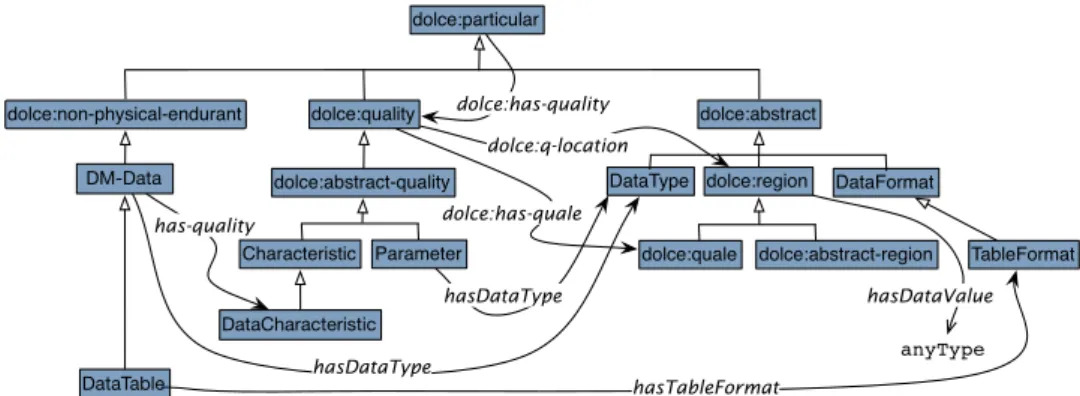
This being the case, we opted for the somewhat elaborate representation of DOLCE, and added a minor extension to that for our OWL ontology in two ways (see Fig. 6): i)DM-Data
is associated with a primitive or structuredDataType(which is a class in the TBox) through the object propertyhasDataType, and ii) the data property hasDataValue relates DOLCE’s Re-gionwith any data type permitted by OWL, i.e.,anyType. In this way, one obtains a ‘chain’ from the endurant/perdurant through thedolce:has-qualityproperty to the quality, that goes on through the dolce:q-location/dolce:has-quale property to re-gion and on with thehasDataValuedata property to the built-in data type (instead of one single data property between the en-durant and the data type). For instance, we have
ModelingAlgo-rithmv=1 has-quality.LearningPolicy, where LearningPolicy is a
dolce:quality, and thenLearningPolicyv=1 has-quale.Eager-Lazy,
whereEager-Lazy is a subclass ofdolce:abstract-region(that is a subclass ofdolce:region), and, finally,Eager-Lazyv ≤1
has-DataValue.anyType, so that one can record the value of the
learning policy of a modeling algorithm. In this way, the ontol-ogy can be linked to many different applications, who may even use different data types, yet still agree on the meaning of the characteristics and parameters (‘attributes’) of the algorithms, tasks, and other DM endurants.
A substantial number of classes have been represented in this
way:dolce:region’s subclassdolce:abstract-regionhas 44 DMOP
subclasses, which represent ways of carving out discrete value regions for the characteristics and parameters of the endurants
DM-Data,DM-Algorithm, andDM-Hypothesis. Characteristicand
Parameterare direct subclasses ofdolce:abstract-quality, which
have 110 and 46 subclasses, respectively.
4.4. Modelling object properties and their inverses
Early ontology development guidelines tended to favour adding both an object property and its inverse, e.g.,
re-alizes and realised-by and declaring them inverse with the
OWLInverseObjectProperties(OPE1 OPE2), and not doing
7DOLCE materials differ slightly, with quale as relation in [20] and as unary in [27] and inDOLCE-lite.owl, andRegionis a combination of a (data) value +measurement unit (e.g. “80 kg”) in [20] to deal with attribute values/qualia (there were no examples in [27] and theDOLCE-lite.owl)
DM-Data dolce:non-physical-endurant dolce:abstract DataType DataFormat dolce:quality dolce:region dolce:abstract-region dolce:quale dolce:abstract-quality anyType hasDataValue Characteristic Parameter hasDataType dolce:has-quale dolce:particular dolce:q-location TableFormat DataTable hasTableFormat DataCharacteristic has-quality hasDataType dolce:has-quality
Figure 6: Condensed section and partial representation of DMOP regarding ‘attributes’.
so counts as a pitfall in the OOPS! catalogue [9]. This practice was also followed in DMOP up to and including v5.4; how-ever, this was chosen purely for reasons of easier readability, for OWL 2 has a featureObjectInverseOf(OP)so that only one of the two object properties suffices in the ontology8. Given that DMOP had many object properties and non-trivial axioms in-volving them, and ‘slow’ classification times (10-20 minutes), we experimented with the ObjectInverseOf(OP) feature that affected 45 properties of v5.4, which resulted in a reasoner performance improvement of over a third [31]. This substan-tial performance improvement outweighed the readability argu-ment, and the explicit inverses have been removed and replaced with respectiveObjectInverseOf(OP)declarations in v5.5.
5. Usage of DMOP in semantic meta-mining
Today’s DM platforms offer many algorithm implementa-tions (operators) that support different steps of the DM process. For instance, RapidMiner (version 5.3, Community Edition) of-fers 688 operators, either implemented by developers of Rapid-Miner or acquired through the implementation of wrappers for popular DM libraries such as Weka. The user of the platform must select the appropriate operators, and their combination to build a DM workflow best addressing her goal. To assist the user in the design of an effective workflow, Intelligent Discov-ery Assistants (IDAs) have been proposed (a recent survey is presented in [32]). In the following, we describe how DMOP was used to construct the e-LICO IDA [2] that is the first IDA capable of both planning and ranking DM workflows. We dis-cuss the evaluation of DMOP-based semantic meta-mining and the deployment of the e-LICO IDA in RapidMiner. Finally, we describe some other applications of DMOP to meta-mining. 5.1. The e-LICO Intelligent Discovery Assistant
The e-LICO IDA architecture is grounded on planning-based data analysis system [33, 32] since it uses artificial intelligence (AI) planning to construct a set of workflows. The planned
8an axiom containing, e.g.,realised-byis easier to read than the cogni-tive jump required when reading (in Prot´eg´e notation) inverse(realizes)for ‘realised by’.
workflows are all valid for the given task, but there may po-tentially be billions of them. Therefore, the planner-based IDA exploits the results of semantic meta-mining to rank the work-flows before they are presented to the user.
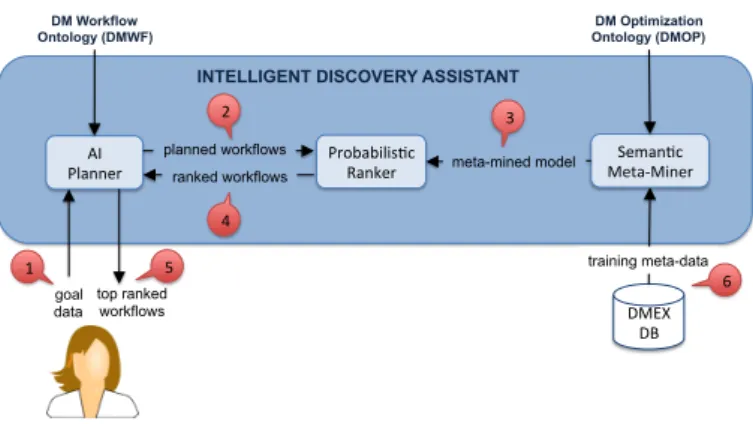
The architecture of the IDA is shown in Fig. 7. The user who interacts with the IDA is required to do no more than to upload annotated data (specifying roles and the types of the attributes) and to select the DM goal to be achieved (e.g., prediction) (1). Data characteristics together with the DM Workflow Ontology (DMWF) are used by the IDA’s AI-planner to generate a set of valid DM workflows (2). Valid workflows are those that fulfil the user goal, take the dataset characteristic into account, and combine operators in the way that all their pre-conditions and post-conditions are met.
Those workflows are passed to the probabilistic ranker that applies a default rule or a meta-mined model (3) computed by the semantic meta-miner to rank the workflows (4) which en-ables the AI planner to provide a list of top-ranked workflows to the user (5). The workflows are ranked according to the esti-mated values of the performance measure of the DM hypothe-ses they produce (for instance, for a workflow addressing the classification task, accuracy can be such a measure). Best work-flows, from the functional point of view, are those that achieve relatively best values for the measure.
The meta-mined model is computed off-line by the meta-miner, which is trained on a semantic repository of meta-data of data mining experiments (DMEX-DB) based on DMOP (6). 5.2. Evaluation of DMOP-based semantic meta-mining
The meta-mined model is induced from a DMEX-DB repos-itory that stores meta-data concerning all aspects of past DM experiments such as the dataset description, the workflow, the learned model, predictions, and performance results. The model generalizes this knowledge with use of patterns extracted from meta-data of the collection of DM workflows; DM work-flows are described in terms of the presence or absence of the extracted patterns. The extracted patterns capture (struc-tural) characteristics of the workflows and the characteristics of the workflow components. The model employs patterns to discriminate between configurations of dataset and work-flow/algorithm/operator characteristics associated with good or bad performance (cf. CQ2.x). The efficacy of the model in
!"## $%&''()# goal data * DM Workflow Ontology (DMWF) $)+,&,-%-./0## 1&'2()# planned workflows ranked workflows 3 4 5(6&'/0# 7(8&97-'()# meta-mined model : DM Optimization Ontology (DMOP) ;7<=# ;># training meta-data ? top ranked workflows @
INTELLIGENT DISCOVERY ASSISTANT
Figure 7: Intelligent Discovery Assistant; it is composed of the AI-planner, Probabilistic Ranker and Semantic Meta-Miner. The user provides the data and specifies the data mining goal (1). The AI-planner generates a (possibly huge) set of valid workflows (2). The Probabilistic Ranker ranks the workflows (4) based on the meta-mined model (3) previously computed off-line (6) by the Semantic Meta-Miner. Top ranked workflows are presented to the user (5).
making predictions depends on the discriminatory power of the characteristics used to induce it. The quality of the character-istics represented in DMOP is thus crucial for the meta-mined model’s efficacy.
The efficacy of meta-mined models that exploit DMOP has been evaluated empirically in the following problems: predict-ing whether a workflow is good or bad (in terms of perfor-mance) and planning good workflows.
5.2.1. Predicting the performance of DM workflows
Building a classifier that predicts whether a workflow is in the class of the best performing workflows or in the class of the rest of the workflows was addressed by [2] and [34].
The authors of [2] evaluated two scenarios. In the first sce-nario, meta-mined models exploited only data characteristics. In the second scenario, meta-mined models exploited data char-acteristics and patterns mined from parse trees of the DM-workflow. The parse trees, that represented the order of exe-cution of the workflow operators and their hierarchical relation, were augmented using terms from DMOP in order to derive fre-quent patterns over DMOP-based generalizations of the work-flow components.
The experiments were conducted on the meta-data of 2275 DM experiments performed on 65 high-dimensional datasets concerning microarray experiments on different types of can-cer; the datasets had many more variables than instances. The default rule (baseline) simply predicted the majority class and had 45.38 error rate. In the two semantic meta-mining scenar-ios, the models that were built using data and workflow char-acteristics performed better (38.24 error rate) than those based on data characteristics alone (40.44 error rate), and meta-mined workflow patterns proved to be discriminatory even for new al-gorithms and workflows (that is those not yet encountered in previous DM experiments) [2].
The capability of DMOP based meta-mined models to pre-dict the relative performance of DM workflows was confirmed in [34]. This study used 1581 RapidMiner workflows solving
a predictive modeling task on 11 UCI9 datasets with various characteristics, whose meta-data was stored in the DMEX-DB containing over 85 million of RDF triples10. The workflow pat-terns were represented as SPARQL queries using DMOP enti-ties. McNemar’s test for pairs of classifiers was performed with the null hypothesis that a classifier built using dataset charac-teristics and a mined pattern set has the same error rate as the baseline that used dataset characteristics and only the names of the learning DM operators. The test confirmed that classifiers trained using workflow patterns performed significantly better (accuracy of 0.927) than the baseline (accuracy of 0.890).
The experiments proved that DMOP-based semantic meta-mining was effective in answering competency questions deal-ing with performance of DM algorithms and/or DM work-flows. Learning algorithms performing best on microarray data (CQ3.3) and the ones that should be used or avoided when an input dataset has many more variables than instances (CQ3.2) were found in patterns resulting from meta-mining experiments described in [2]. In both mentioned studies, the computed meta-mined models proved to be effective in selecting better perform-ing workflows from among the valid ones (CQ1.1).
5.2.2. Planning well performing DM workflows
Recall from Fig. 7 that the AI Planner constructs valid DM workflows step by step by selecting applicable operators ac-cording to their pre/post-conditions [33]. The AI Planner alone does not have the means to differentiate between operators that have equivalent conditions since it does not take the quality of the resulting workflows into account. There may be several op-erators that have fitting conditions at each step.
The authors of [35] experimentally evaluated the Semantic Meta-Miner in the operator selection task. The goal was to se-lect at a given step among a set of candidate operators the best ones to build not only valid but also optimal DM workflows. The Semantic Meta-Miner used a quality function that scored a given plan by the quality of the operators that formed the plan. The quality optimized the performance measure associated with the data mining goal of the user and the input data set.
The experiments were conducted with the same set of DM workflows as in [2]. The baseline strategy was based on the popularity of the RapidMiner’s DM operators. The results were statistically significantly better for the meta-mining selection approach than for the baseline (with the average performance improvement of around 6%). The meta-mining strategy was better than the baseline in selecting the best workflow for 53 datasets out of 65. The results show the validity of the approach in planning good workflows for a given learning problem.
The experimental results for the operator selection task proved that the Semantic Meta-Miner was capable to answer which of the applicable DM algorithms would yield best results given a DM task and data set (CQ1.1). These were those im-plemented by best scoring DM operators and DM algorithms sharing similar characteristics with them, according to DMOP.
9http://archive.ics.uci.edu/ml/datasets.html 10all experimental data, datasets, and workflows, are available at
http:// www.myexperiment.org/packs/421.html
5.3. Deployment of the Intelligent Discovery Assistant
The meta-mined model resulting from DMOP-based seman-tic meta-mining is used in the IDA extension of RapidMiner developed within the e-LICO project [33].
After the IDA produces the top ranked workflows and sug-gests them to the user, he or she can execute the chosen work-flow in RapidMiner. The data mining services required to enact the workflow (data, text, image mining) are provided by Rapi-dAnalytics11. RapidAnalytics also serves as a centralized data mining experiment repository for different teams collaborating on a given application domain. It stores all relevant meta-data related to the execution of the workflow. The raw meta-data from the RapidAnalytics repository can then be parsed and or-ganized into a semantic repository of annotated experiments (DMEX-DB) based on DMOP. In this form, the parsed meta-data can be exploited by the meta-miner that uses DMEX-DB as the system’s long-term memory and the source of training data.
The RapidMiner IDA Extension is available in the Rapid-I marketplace12 since 1 September 2012. In March 2014, this RapidMiner plugin has been downloaded 8751 times and was bookmarked 23 times, and it continues to attract attention, with 10046 downloads and 52 bookmarks in November, 2014. It is among the Top Favourites listed in the Rapid-I marketplace.
The workflows generated by the IDA can also be executed in the Taverna [36] IDA extension using an instance of a RapidAn-alytics server providing RapidMiner operators as web-services. The user also can upload the workflow generated by the IDA to myExperiment, a web portal for sharing workflows and other resources [37]. This feature is available in both RapidMiner and Taverna.
5.4. Other applications of DMOP to meta-mining
DMOP’s conceptualization of data mining algorithms has been used elsewhere for constructing data mining experiment databases. Experiment databases [38, 39] provide a platform for DM researchers and practitioners for storing the thousands of their data mining experiments in a central repository and allowing them to exploit meta-knowledge of the experiments. This empirical data is linked to known theoretical characteris-tics of algorithms and datasets to provide insight into the behav-ior of learning algorithms on particular datasets, and the effect of parameters and data preprocessing, for which fine-grained knowledge, as represented in DMOP, was necessary. The stored meta-data can be queried (e.g., about the very building blocks of learning algorithms), or it can be mined to build predictive models of algorithm performance on particular datasets, or to answer why algorithms work or fail on certain datasets.
Another notable application of DMOP to meta-mining in-vestigations, described in [40], is in the domain of Quantita-tive Structure-Activity Relationship (QSAR) studies. QSAR modeling is an important step in drug discovery processes,
11http://rapid-i.com/content/view/182/196/ 12
http://marketplace.rapid-i.com/UpdateServer/faces/ product_details.xhtml?productId=rmx_ida
and a QSAR modeling algorithm is typically a DM algorithm. DMOP’s terms dealing with algorithm parameters, and dataset characteristics were used to annotate QSAR studies. The goal of that annotation is to run meta-learning studies, “meta-QSAR”, to determine what combinations of datasets, DM algo-rithms, and drug targets work best and subsequently to better apply existing QSAR methods.
6. Conclusions
In this paper, we have presented the DMOP ontology. It provides a conceptual framework for analyzing data mining domain–DM tasks, algorithms, models, datasets, workflows, performance metrics, and their relationships–in a way that en-ablesoptimizingDM processes.
While modeling data mining knowledge in DMOP, we have encountered a number of non-trivial modeling issues. These include: i) the hurdle of relating instances to classes and using classes as instances (and vv.), which has been solved by exploit-ing the weak form of metamodelexploit-ing with OWL’s punnexploit-ing avail-able in OWL 2; ii) finding and resolving in a systematic way the undesirable deductions caused by property chains; iii) rep-resentation of ‘attributes’, where its solution is ontology-driven yet merged with OWL’s data property and built-in data types to foster their reuse across applications; iv) linking to a founda-tional ontology. In order to properly solve these issues, we have used almost all of OWL 2’s features. The resulting ontology is highly axiomatized and complex in comparison to many state-of-art domain ontologies, especially those whose primary goal is to provide common vocabulary for annotation of resources.
We described the evaluation of DMOP-based semantic meta-mining in two tasks: predicting the performance of DM work-flows and planning well performing DM workwork-flows. Finally, we described the usage of DMOP for constructing the Intelli-gent Discovery Assistant deployed at the leading data mining environment RapidMiner.
The deep modeling of the DM domain in DMOP has moved forward the field of meta-learning: traditional meta-learning has been lifted to the level of semantic meta-mining; that is, to an ontology-based form of meta-learning capable of analyzing and optimizing whole DM processes.
Acknowledgements.This work was supported by the Euro-pean Union within FP7 ICT project e-LICO (Grant No 231519). Agnieszka Lawrynowicz acknowledges the support from the PARENT-BRIDGE program of Foundation for Polish Science, cofinanced from European Union, Regional Development Fund (Grant No POMOST/2013-7/8). We thank all our partners and colleagues who have contributed to the development of DMOP: Huyen Do, Simon Fischer, Dragan Gamberger, Lina Al-Jadir, Simon Jupp, Petra Kralj Novak, Babak Mougouie, Anze Vavpetic, Jun Wang, Derry Wijaya, Adam Woznica.
References
[1] Shearer, C.. The CRISP-DM model: The new blueprint for data mining. Journal of Data Warehousing 2000;5(4):13–22.
[2] Hilario, M., Nguyen, P., Do, H., Woznica, A., Kalousis, A.. Ontology-based meta-mining of knowledge discovery workflows. In: Meta-Learning in Computational Intelligence; vol. 358 ofStudies in Com-putational Intelligence. Springer; 2011, p. 273–315.
[3] Jankowski, N., Duch, W., Grabczewski, K., editors. Meta-Learning in Computational Intelligence; vol. 358 ofStudies in Computational Intelli-gence. Springer; 2011.
[4] Fern´andez, M., G´omez-P´erez, A., Pazos, A., Pazos, J.. Building a chemical ontology using METHONTOLOGY and the ontology design environment. IEEE Expert 1999;January/February:37–46.
[5] Suarez-Figueroa, M.C., de Cea, G.A., Buil, C., Dellschaft, K., Fernandez-Lopez, M., Garcia, A., et al. NeOn methodology for build-ing contextualized ontology networks. NeOn Deliverable D5.4.1; NeOn Project; 2008.
[6] Garcia, A., O’Neill, K., Garcia, L.J., Lord, P., Stevens, R., Corcho, O., et al. Developing ontologies within decentralized settings. In: Semantic e-Science. Annals of Information Systems 11. Springer; 2010, p. 99–139. [7] Keet, C.M.. Transforming semi-structured life science diagrams into meaningful domain ontologies with DiDOn. Journal of Biomedical In-formatics 2012;45:482–494.
[8] Keet, C.M.. Detecting and revising flaws in OWL object property ex-pressions. In: 18th International Conference on Knowledge Engineering and Knowledge Management (EKAW’12); vol. 7603 ofLNAI. Springer; 2012, p. 252–266. Oct 8-12, Galway, Ireland.
[9] Poveda-Villal´on, M., Su´arez-Figueroa, M.C., G´omez-P´erez, A.. Validat-ing ontologies with OOPS! In: 18th International Conference on Knowl-edge Engineering and KnowlKnowl-edge Management (EKAW’12); vol. 7603 ofLNAI. Springer; 2012, p. 267–281. Oct 8-12, Galway, Ireland. [10] Peroni, S., Shotton, D., Vitali, F.. Tools for the automatic generation
of ontology documentation: A task-based evaluation. Int J on Semantic Web and Info Sys 2013;9(1):21–44.
[11] Cannataro, M., Comito, C.. A data mining ontology for grid program-ming. In: Proceedings of 1st International Workshop on Semantics in Peer-to-Peer and Grid Computing. 2003, p. 113–134.
[12] Brezany, P., Janciak, I., Tjoa, A.M.. Ontology-based construction of grid data mining workflows. In: Data Mining with Ontologies. Hershey; 2007, p. 182–210.
[13] Diamantini, C., Potena, D., Storti, E.. Supporting users in KDD pro-cesses design: a semantic similarity matching approach. In: Proceedings of the Planning to Learn Works. 2010, p. 27–34–134.
[14] Z´akov´a, M., Kremen, P., Zelezn´y, F., Lavrac, N.. Automat-ing knowledge discovery workflow composition through ontology-based planning. IEEE Transactions on Automation Science & Engineering 2011;8(2):253–264.
[15] Kietz, J., Serban, F., Bernstein, A., Fischer, S.. Data mining workflow templates for intelligent discovery assistance and auto-experimentation. In: Proc of the ECML/PKDD’10 Workshop on Third Generation Data Mining (SoKD’10). 2010, p. 1–12.
[16] Panov, P., Dzeroski, S., Soldatova, L.N.. OntoDM: An ontology of data mining. In: ICDM Workshops. IEEE Computer Society; 2008, p. 752–760.
[17] Vanschoren, J., Blockeel, H., Pfahringer, B., Holmes, G.. Experiment databases - a new way to share, organize and learn from experiments. Machine Learning 2012;87(2):127–158.
[18] Keet, C.M.. The use of foundational ontologies in ontology development: an empirical assessment. In: Proceedings of the 8th Extended Semantic Web Conference (ESWC’11); vol. 6643 ofLNCS. Springer; 2011, p. 321– 335. Heraklion, Crete, Greece, 29 May-2 June, 2011.
[19] Khan, Z., Keet, C.M.. ONSET: Automated foundational ontology se-lection and explanation. In: 18th International Conference on Knowl-edge Engineering and KnowlKnowl-edge Management (EKAW’12); vol. 7603 ofLNAI. Springer; 2012, p. 237–251. Oct 8-12, Galway, Ireland. [20] Masolo, C., Borgo, S., Gangemi, A., Guarino, N., Oltramari, A..
Ontology library. WonderWeb Deliverable D18 (ver. 1.0, 31-12-2003).; 2003. Http://wonderweb.semanticweb.org.
[21] Khan, Z., Keet, C.. Feasibility of automated foundational ontology interchangeability. In: Janowicz, K., et al., editors. 19th International Conference on Knowledge Engineering and Knowledge Management (EKAW’14); vol. 8876 ofLNAI. Springer; 2014, p. 225–237. 24-28 Nov, 2014, Linkoping, Sweden.
[22] Dellschaft, K., Engelbrecht, H., Monte Barreto, J., Rutenbeck, S.,
Staab, S.. Cicero: Tracking design rationale in collaborative ontology engineering. In: Bechhofer, S., et al., editors. Proceedings of the 5th European Semantic Web Conference (ESWC’08); vol. 5021 ofLNCS. Springer; 2008, p. 782–786. Tenerife, Spain, June 1-5, 2008.
[23] Ho, T.K., Basu, M.. Measures of geometrical complexity in classification problems. In: Data Complexity in Pattern Recognition; chap. 1. Springer; 2006, p. 3–23.
[24] Bishop, C.. Pattern Recognition and Machine Learning. Springer; 2006. [25] Noy, N., Uschold, M., Welty, C.. Representing Classes As Prop-erty Values on the Semantic Web. 2005. W3C Working Group Note, http://www.w3.org/TR/swbp-classes-as-values/; URLhttp://www.w3. org/TR/swbp-classes-as-values/.
[26] Glimm, B., Rudolph, S., V¨olker, J.. Integrated metamodeling and diagnosis in OWL 2. In: Patel-Schneider, P.F., Pan, Y., Hitzler, P., Mika, P., Zhang, L., Pan, J.Z., et al., editors. Proceedings of the 9th International Semantic Web Conference; vol. 6496 ofLNCS. Springer; 2010, p. 257–272.
[27] Masolo, C., Borgo, S.. Qualities in formal ontology. In: Proceedings of the Workshop on Foundational Aspects of Ontologies (FOnt 2005). 2005,Koblenz, Germany, Sept. 2005.
[28] Saunders, W., Bowers, S., O’Brien, M.. Prot´eg´e extensions for scientist-oriented modeling of observation and measurement semantics. In: Proceedings of the 6th Workshop on OWL: Experiences and Direc-tions (OWLED 2011); vol. 796 ofCEUR-WS. 2011,.
[29] Bowers, S., Madin, J.S., Schildhauer, M.P.. A conceptual modeling framework for expressing observational data semantics. In: Proceedings of the International Conference on Conceptual Modeling (ER’06); vol. 5231 ofLNCS. Springer; 2008, p. 41–54.
[30] Hodgson, R., Keller, P.J.. QUDT - quantities, units, dimensions and data types in OWL and XML. Online; 2011. Http://www.qudt.org/. [31] Keet, C., d’Amato, C., Khan, Z., Lawrynowicz, A.. Exploring
reason-ing with the DMOP ontology. In: Bail, S., Glimm, B., Jim´enez-Ruiz, E., Matentzoglu, N., Parsia, B., Steigmiller, A., editors. 3rd Workshop on Ontology Reasoner Evaluation (ORE’14); vol. 1207 ofCEUR-WS. CEUR-WS; 2014, p. 64–70. July 13, 2014, Vienna, Austria.
[32] Serban, F., Vanschoren, J., Kietz, J.U., Bernstein, A.. A survey of intel-ligent assistants for data analysis. ACM Comput Surv 2013;45(3):31:1– 35.
[33] Nguyen, P., Kalousis, A., Hilario, M.. A meta-mining infrastructure to support kd workflow optimization. In: Proc of the Workshop on Planning to Learn and Service-Oriented Knowledge Discovery. 2011,.
[34] Ławrynowicz, A., Potoniec, J.. Pattern based feature construction in semantic data mining. Int J Semantic Web Inf Syst 2014;10(1):27–65. [35] Nguyen, P., Kalousis, A., Hilario, M.. Experimental evaluation of the
e-LICO meta-miner. In: Proceedings of the International Workshop on Planning to Learn (PlanLearn 2012); vol. 950 ofCEUR-WS. 2012,. [36] Wolstencroft, K., Haines, R., Fellows, D., Williams, A., Withers, D.,
Owen, S., et al. The taverna workflow suite: designing and executing workflows of web services on the desktop, web or in the cloud. Nucleic Acids Research 2013;41(W1):W557–W561.
[37] De Roure, D., Goble, C., Stevens, R.. The design and realisation of the myexperiment virtual research environment for social sharing of work-flows. Future Generation Computer Systems 2009;25:561–567. [38] Vanschoren, J., Blockeel, H., Pfahringer, B., Holmes, G.. Experiment
databases. A new way to share, organize and learn from experiments. Machine Learning 2012;87(2):127–158.
[39] Vanschoren, J.. Meta-learning architectures. Collecting, organizing and exploiting meta-knowledge. In: Grabczewski, K., Wlodzislaw, D., Jankowski, N., editors. Meta-Learning in Computational Intelligence; vol. 358 ofStudies in Computational Intelligence. Springer; 2011, p. 117– 155.
[40] Panov, P., Soldatova, L., Dˇzeroski, S.. Ontology of core data mining entities. Data Min Knowl Discov 2014;28(5-6):1222–1265.