Munich Personal RePEc Archive
Theoretical Framework Of Competition
As Applied To Banking Industry
Kv, Bhanu Murthy and Deb, Ashis Taru
Department of Commerce, Delhi School of Economics, College of
Vocational Studies, Delhi University
January 2008
THEORETICAL
FRAMEWORK
OF
COMPETITION
AS
APPLIED TO BANKING INDUSTRY
Ashis Taru Deb and K.V. Bhanu Murthy
K.V. Bhanu Murthy Ashis Taru Deb
Department of Commerce, College of Vocational Studies,
Delhi School of Economics, Delhi University Delhi University
All Correspondence to:
Prof. K.V. Bhanu Murthy
Department of Commerce,
Delhi School of Economics,
Delhi 110007
e-mail:[email protected]
Ph: +91-1127315331®, 9811601867(m) +91-11-27667891(o)
THEORETICAL
FRAMEWORK
OF
COMPETITION
AS
APPLIED TO BANKING INDUSTRY
Ashis Taru Deb and K.V. Bhanu Murthy
Abstract
Concepts evolve through time and over time they assume different
meanings. The concept of competition is no exception. This paper discusses the
evolution of the concept of competition in general with a view to derive a theoretical
framework for analyzing competition in banking industry. Starting from the classical
notions of competition it proceeds to some of the latest approaches (Northcott (2004),
Neuberger (1998), Toolsema (2003), Bolt and Tieman (2001)). The ordinary
Structure-Conduct-Performance approach does not involve any analysis of market
dynamics. Our approach introduces various aspects of industry dynamics and growth.
It provides a methodology to arrive at the market form in banking industry through an
analysis of all the aspects of basic conditions, structure, conduct and performance.
It is argued that sustained growth and dynamics of the industry is not price led.
Growth arises out of changing basic conditions and dynamics arises out of sharing
the new market created by basic conditions. Hence the prime mover of competition is
rivalry among firms to control market share and to internalize externalities rather than
THEORETICAL FRAMEWORK OF COMPETITION AS
APPLIED TO BANKING INDUSTRY
K.V. Bhanu Murthy and Ashis Taru Deb
I.0 INTRODUCTION
The present authors have noticed, in the industrial organization literature, a tendency
to conceptualizes and measures competition by resorting to a simplistic framework. In
recent literature, at one end of the spectrum, there are studies like Demstez (19995)
that virtually rules out conceptualization and measurement of concept. And at the
other end of the spectrum, there are certain studies that seek the convenient position
of equating concentration with competition.
Concepts evolve through time and over time they assume different meanings.
The concept of competition is no exception. This paper discusses the evolution of the
concept of competition in general with a view to derive a theoretical framework for
analyzing competition in banking industry. Starting from classical notions of
competition it proceeds to some of the latest approaches (Northcott (2004), Neuberger
(1998), Toolsema (2003), Bolt and Tieman (2001)). The extant approaches to
competition in industry in general and banking industry in particular invoke the
industrial organisation paradigm with two arguments. The first is based on price cost
margins, (Gerosky (1989), Mueller (1986), Shaffer, (1993)) while the second takes
recourse to oligopoly (Molnar-Marton and Horvath, 2007,Uchida and Tsutsui, 2004,
Capie and Billings, 2004).
There are various approaches to study competition in general and banking in
any analysis of market dynamics. Our approach introduces various aspects of industry
dynamics and growth. It provides a methodology to arrive at the market form in
banking industry through an analysis of all the aspects of basic conditions, structure,
conduct and performance.
The paper is divided into the following sections. Section II.0 analyses the
evolution of the notion of competition. Section III.0 points out the characteristics of
banking firm and industry. Section IV.0 looks at different approaches to analysing
banking industry. Section V.0 explains Industrial organisation approach to banking. A
critical review of the extant literature is provided in section VI.0. Section VII.0
highlights the special features of our approach to analyse competition in banking
industry. Section VIII.0 provides the summary and conclusions of the study.
II.0 EVOLUTION OF THE CONCEPT OF COMPETITION
In the following section we have undertaken a study of the process of
evolution of the concept of competition. Such a study would obviously be very vast
and cannot be completed in a single paper. Therefore, we have restricted ourselves to
gleaning out a notion of competition that is appropriate in the context banking. The
following review of the concept seeks to bring out the major elements in the process
of evolution of the concept, which deserve a detailed consideration. The literature on
competition is vast and so the review had to be selective. It covers the major
contributions to the concepts of competition due to Smith (1976), Chamberlain
(1933), Schumpeter (1934), Hayek (1948) and Stigler (1995). It also covers some old
and new commentaries on the concept including McNulty (1968) and Richardson
(1975) on the one hand and Vickers (1995) on the other. A number of attempts have
But during the process of evolution, the concept got mixed with other
entities, and any attempt to understand the true essence of competition has been
rendered difficult. There exists a voluminous literature in the area, but the concept
remains surrounded by ambiguities and confusions in a large measure. A few reviews
of the concept remained confined to only selected interpretations of competition.
Some of them also cut across each other. To substantiate the above point an example
is cited below.
According to McNulty (1968), there exist two fundamentally distinct
interpretations of the concept of competition, which have led to the ambiguity and
confusion surrounding the concept of competition.
• In one interpretation, competition is conceived as a descriptive term
characterized by an idealized market structure.
• In the second interpretation, it has been identified with a force, which through
equating prices with marginal costs assures allocative efficiency in the system.
According to the first interpretation, competition is a seemingly tranquil
equilibrium state in which informed agents treat price parametrically. This is the
concept of perfect competition, which is compared to the idea of a perfect vacuum. In
the second form, it has been identified with a force, which through equating prices
with marginal costs assures allocative efficiency in the system. Through competition
resources gravitate towards their most productive use and price is forced to the lowest
level to be sustained over the long run. This standpoint views competition as assuring
order and stability in the economic world as does the gravitation to the physical
world. As opposed to the earlier interpretation, the second interpretation looks at
As opposed to McNulty, Vickers argued that the concepts or competition as an
idealized market structure in which price is parametrically given and as a rivalry with
respect to prices are not two distinct concepts of competition. He analyzed Cournot
and Edgeworth models to show that the notion of perfect competition has its roots in
the broad concept of competition as rivalry.
We now set out for a review of the concept of competition. It is clear that the
current review cannot but begin with Adam Smith’s concept of competition. While Smith’s
contribution holds a pride of place in any discussion of competition, there are conflicting
interpretations of his notion of competition. These interpretations are analyzed in order to
understand the true substance of the concept of competition, as understood by Smith.
The former commentator has reduced Smith’s notion of competition to a
process of price competition alone. It is this view of competition as an ordering force,
which dominated the classical economics. Adam Smith referred to competition in
connection with the forcing of market price to its natural level and lowering of profits
to a minimum. The classical view of competition looks at competition as a process for
allocating resources to their optimal use through the instrument of price mechanism.
When price mechanism functions properly, equilibrium emerges with prices equal to
marginal social costs of production. When it does not function properly, equilibrium
exists with price above marginal cost. In such a situation, the society suffers a welfare
loss from the under consumption of these goods. Such malfunctions are immediately
attributed to an insufficient number of buyers or sellers. Monopoly is seen as an
antithesis of competition. This view sees competition as a process for determining
prices and quantities, the allocation of resources for a given set of tastes and
technological opportunities. Competition produces an equilibrium set of prices that
is anticipated so long as monopolistic elements are absent. There was no systematic
association between the idea of competition and market structure in classical
economics, which viewed competition as a price determining force operating in
market.
The private business firm and the market are the two primary institutions
through which resources are organized, transformed and channeled for ultimate
consumption as goods and services. Economic goods and services broadly possess
two characteristics: quality and price. Firm and market correspond to the two
characteristics possessed by economic goods. While quality is related to production
and takes place within the business firm, exchange i.e. the determination of economic
value, which in is in turn price, arises in the various markets in which the firm
operates. But the concept of competition has been usually associated only with
exchange, even when economic activity consists of both production and exchange.
It is argued that despite according competition a pride of place in economic theory,
Adam Smith contributed nothing to its precise economic meaning. The concept of
competition, which he incorporated in his Wealth of Nations, was already developed
in the then literature by a number of scholars like Cantillon, Turgot, Hume, and Stuart
etc. A reviewer expressed surprise how the mercantilist’s overwhelming concern with
price continued to be main subject matter with Smith, who was aware of the
importance of the dynamic changes in productive techniques and industrial
organization within the business enterprise in the era of English industrial revolution.
While first commentator argued that Adam Smith’s concept of competition
mainly related to price mechanism alone, the second pointed out that Adam Smith’s
vision of competition goes beyond price determination within markets. In order to
division of labor, new improvements in art, which would have been never thought of
in absence of competition among producers. However, the later reviewer apparently
agreed with the former when he argues that Adam Smith and other classical
economist’s related competition more to the issues of resource allocation and theory
of value than to productive efficiency.
Richardson (1975) argues that the concept of competition in the Wealth of
Nations relates to two distinct phenomena.
• The first meaning related to balancing of supply and demand in particular
markets.
• Evolution of structural and technological forces is the second interpretation.
Smith offers a theory of economic equilibrium on the one hand and a theory of
economic evolution on the other in Wealth of Nations. Competition has a role to play
in both of them. Let us elaborate.
Smith describes how actual prices tend to gravitate to their natural or cost
determined level. Competition is shown to be necessary to the process. It is pointed
out monopoly by raising prices and reducing supply would “derange more or less the
natural distribution of the stock of money”. Smith identifies the tendency towards
equilibrium and implies the resulting allocation of resources is optimal from society’s
point of view.
In his theory of economic evolution, Smith has advanced a disequilibrium
theory in which he views the economy as in a state of constant and internally
generated change. Perpetual motion results from the fact that division of labor is both
increases wealth on the one hand and widens market on the other. Widening of the
market would lead to increased wealth, which in turn would lead division of labor be
carried forward. The dynamic character of the interaction may not be fully
appreciated till one recognizes the extent of market also depends on wealth, which in
turn is created by division of labor (Young, 1928). Thus in the Wealth of Nations,
competition apart from equating demands and supplies within the context of a given
industrial structure and a given technology, has also to adapt both structure and
technology to the fresh opportunities created by expanding markets.
While there are two distinct interpretations of competition in Wealth of
nations, problems arose later. It is because of the fact theorists succeeding Smith
(except Marshall) attended things that could be easily handled. They focused on that
interpretation of competition, which is easier between the two. The equilibrating and
allocative functions of competition are discussed exclusively reducing technical
progress to an exogenous variable and ignoring structural evolution. Later writers,
concerned with more analytical rigor, developed the theory of equilibrium in a way,
which is clearly very different from that implicit in Smith’s theory of evolution.
Existence of Smith’s theory of economic evolution went unnoticed, and so the notion
of competition contained therein.
While the classical economists viewed competition as a market process, the
emergence of the concept of competition as a market structure is a distinctive
contribution of the neoclassical economics. The groundwork for this development was
laid by Cournot followed by attempts by Jevons and Edgeworth at marrying the
concepts of competition and market. Such an attempt finally led to the current
this marriage as unfortunate as each deserved a separate treatment. Interestingly, the
concept of competition has been accorded a subsidiary status to the concept of market.
Hayek argues that the theory of perfect competition has little claim to be
called competition. He stresses that perfect knowledge and foresight would create a
paralyzing influencing effect on all action. It is not possible to argue that perfect
competition is a model of competition because it is only through competition that
knowledge will be discovered. The real basis for comparison with existing
competition is not perfect competition; Perfect competition would exist if competition
in the Smithian sense were prevented from operating.
The classical view regards competition as the antithesis of monopoly. Thus
competition was viewed as absence of monopoly power is. It was left to Chamberlain
to reconcile economic theory with the fact that it is not possible for a firm to compete
without monopolizing and hence much of the business world is a mixture of
competition and monopoly. Every act of competition on the part of a businessman is
evidence of some degree of monopoly power in economic theory. Thus while he
recognized that most markets are to some extent both controlled and controlling, it has
limited relevance as a guide in implementing policies in order to be meaningful for
economic policy seeking to restrain monopoly and promote competition. While the
traditional distinction between competition and monopoly is a non-starter, the
merging of these two concepts in a theory of monopolistic competition avoided
defining a concept of competition.
Chamberlin’s concept of monopolistic competition as a market structure
characterised by large numbers with free entry and product differentiation but without
perfect competition and may be as rare as perfect competition. Product differentiation
takes place typically in a market environment of competition among the few.
Chamberlin’s contribution in section 4 of chapter 3 of his book relating to “mutual
dependence recognized” is not a core part of his contribution and constitutes original
contribution to theory of oligopoly.
The root of the ambiguity of the meaning of the term competition is attributed
to the failure to distinguish between the idea of competition and the idea of market
structure. The common feature of perfect competition and monopoly is that both rule
out the possibility of any competitive behavior. In monopoly, there is no one to
compete. Perfect competition, ironically is a state of passive adjustment. Neither is
there any competition through quality, because products are homogenous, nor is there
any price competition because there can be no price-cutting. Also there can be no
non-price competition, because there is no product differentiation. So the only form of
competition can be cost reducing competition. What is insufficiently emphasized is
that perfect competition is a state of affairs totally incompatible with the idea of any
and all competition. All other forms of competition except perfect competition are an
admixture of monopoly and competition.
Both perfect competition and monopoly mean absence of competition but
reasons are distinct in each case. Monopoly is a market situation in which
intra-industry competition has been done away with by means of identifying the firm as the
industry. Perfect competition, on the other hand is a market situation, which as a
result of free entry of a large number of formerly competing firms has evolved to the
Schumpeter’s notion of competition views of competition sees it less as a process for
allocating given stock of resources and reduction in prices for an existing set of
products and in the form of new and improved ideas, new products, new production
processes, new marketing techniques, new organizational structures etc. Such
competition strikes at the foundations of the life of the existing firms and not merely
at their outputs and profits. Twentieth century competition apparently resembles
Schumpeter’s notion of competition as price competition between firms has given
way to competition on the basis of product improvements and cost advantages
generated by developments in methods of production and organization. In this view,
innovation is the major mechanism by which firms compete. According to
Schumpeter, there are three stages in the process of change.
The first stage is invention: It relates to the generation of a new idea and its
subsequent development to a point where the conceptual and practical difficulties of
its implementation have been overcome.
The second stage is innovation, which occurs when entrepreneur believes that
it is worthwhile to commercialize the invention. He distinguishes among five types of
innovations. There is a tendency to narrowly focus on introduction of new products,
and processes, which incorporate technological change. His broader definition of
innovation covers more of the ways in which use of resource may be improved. This
includes improvement in the quality of existing products, development of a new
market, exploitation of new source of supply and adoption of improved organizational
routines.
The entrepreneur cannot know in advance whether his innovation will succeed
result of either increasing revenue or reducing costs and leads to creation of
temporary monopolistic advantages over competitors. But successful innovation
creating transitory monopolies create pockets of profits which in turn provide the
incentive for the imitators to step forward and thereby drive these profits to zero. This
is Schumpeter’s third stage: diffusion. As a result of widespread imitation, the
innovation becomes established as the basis for future invention and innovation.
Schumpeter’s notion of competition is a process of creative destruction.
Innovation creating monopoly, monopoly creating profits, profits creating imitators
until a state of normalcy returns only to be followed by new innovations and repeat of
a cycle. Thus, whereas the first view sees monopoly as antithesis of competition, the
second views monopoly as an integral part of dynamically competitive process and a
passing stage in industry's evolution. Competition displaces existing products and
methods of production by new ones. Hence from day to day there are winners and
losers. This representation of competitive process owes its origin to Joseph
Schumpeter.
Schumpeter’s notion of competition views of competition sees it less as a
process for allocating given stock of resources and reduction in prices for an existing
set of products and in the form of new and improved ideas, new products, new
production processes, new marketing techniques, new organizational structures etc.
Such competition strikes at the foundations of the life of the existing firms and not
merely at their outputs and profits. Twentieth century competition apparently
resembles Schumpeter’s notion of competition as price competition between firms has
given way to competition on the basis of product improvements and cost advantages
innovation is the major mechanism by which firms compete. According to
Schumpeter, there are three stages in the process of change.
The first stage is invention: It relates to the generation of a new idea and its
subsequent development to a point where the conceptual and practical difficulties of
its implementation have been overcome.
The second stage is innovation, which occurs when entrepreneur believes that
it is worthwhile to commercialize the invention. He distinguishes among five types of
innovations. There is a tendency to narrowly focus on introduction of new products,
and processes, which incorporate technological change. His broader definition of
innovation covers more of the ways in which use of resource may be improved. This
includes improvement in the quality of existing products, development of a new
market, exploitation of new source of supply and adoption of improved organizational
routines.
The entrepreneur cannot know in advance whether his innovation will succeed
or not. If expectations are correct, then the innovation generates abnormal profits, as a
result of either increasing revenue or reducing costs and leads to creation of
temporary monopolistic advantages over competitors. But successful innovation
creating transitory monopolies create pockets of profits which in turn provide the
incentive for the imitators to step forward and thereby drive these profits to zero. This
is Schumpeter’s third stage: diffusion. As a result of widespread imitation, the
innovation becomes established as the basis for future invention and innovation.
Schumpeter’s notion of competition is a process of creative destruction.
Innovation creating monopoly, monopoly creating profits, profits creating imitators
a cycle. Thus, whereas the first view sees monopoly as antithesis of competition, the
second views monopoly as an integral part of dynamically competitive process and a
passing stage in industry's evolution. Competition displaces existing products and
methods of production by new ones. Hence from day to day there are winners and
losers. This representation of competitive process owes its origin to Joseph
Schumpeter.
The ideas of the Austrian school originate in Karl Menger and proponents
include Mises and Hayek. Economic freedom is the hallmark of competition and is
deemed to be limited only in so far as the rights of other people are not infringed.
Hayek argued that individual freedom gives rise to spontaneous order which as not
been deliberately designed by any one. The spontaneity of individual behavior gives
rise to an open ended process the outcome of which can not predicted. While
economic freedom is the best suited for safeguarding the individual welfare, welfare
maximum cannot be identified in advance. As opposed to a static market structure of
perfect competition, Austrians see of competition as a process of discovery by which
economic agents seek to enhance their welfare and thus attempt to reach an optimum
over time in an uncertain and changing world. Most efficient techniques and products
appealing most to the consumers cannot be anticipated with certainty without putting
unknown and untried techniques and novel products to the test of the market. The
price of a successful product commands may exceed average costs. Success is thus
rewarded by profitability, which in turn provides incentives for further innovations. A
deficient state of knowledge is thus overcome by competition as a process of
discovery.
Within the new institutional economics, the Austrian and evolutionary
In both approaches competition is characterized by uncertainty and flux. Experiments
must be conducted by firms to identify, which actions lead to improved performance
and must judge for example, whether to imitate the other firms or innovate in more
fundamental ways. Uncertainty thus prevails not only with the strategy of the firms
but also the result of adoption of any particular strategy.
A significant difference prevails between these two notions of competitive
process. In Austrian economics, whatever the firm’s financial performance, the
entrepreneur actively seeks improvement. In the evolutionary approach, firms are less
aware and less proactive. If the firm’s current performance is acceptable (that is if
covers the opportunity cost of the resources deployed) no change will be initiated.
They react to the environment and seek improvement only when survival is
threatened. Truly speaking, the Austrian notion of the world is more desirable where
the firms always seek improvement despite their financial performance and thus
competition in Austrian notion of competition is also a self-propelled process, which
is not quite consistent with observations. In Austrian world there is no X-inefficiency.
A definition of competition has been provided by Stigler (1987) Competition
is rivalry between two individuals (or groups or nations) and it arises whenever two or
more parties strive for something that all cannot obtain. Vickers (1995) points out the
following characteristics of this definition.
• The breadth of the definition encompasses all forms, instruments and objects
of rivalry.
• It is a behavioural definition of competition as opposed to the analytical
• Identification of competition with rivalry does not mean more competition is
an end in itself.
III.0 CHARACTERISTICS OF BANKING FIRM AND INDUSTRY
Financial institutions may be defined as economic agents specializing in the
activities of buying and selling at the same time financial contracts and securities.
Banks may be seen as a subset of the financial institutions, which are retailers of
financial securities: they buy the securities issued by borrowers and they sell them to
lenders. In view of varied and complex operations of a bank, an operational definition
of a bank may be provided as follows. A bank is an institution whose current
operations consist in granting loans and receiving deposits from the public. Definition
of “Banking” as per the Banking Regulation Act, 1949 says-”banking” means the
accepting, for the purpose of lending or investment, of deposits of money from the
public, repayable on demand or otherwise, and withdrawable by cheque, draft, order
or otherwise”. The Act defined the functions that a commercial bank can undertake
and restricted their sphere of activities.
Banking theories provide us with insights into why banks exist in the
economy. If these theories are correct, banks exist because they perform certain
special functions that no other financial services firms can replicate. Thus, no matter
what course financial modernization takes in the future, we can count on certain
defining characteristics in banking to be preserved. Financial innovation has greatly
changed the business of banking. Instead of just accepting deposits and making loans
putting loans on their balance sheets, through either securitization of their asset
portfolio or outright loan sales (bonds/debts). Banks also are shifting from
interest-based revenues towards fee-interest-based activities, including lines of credit and many types
of credit guarantees.
Economists have been asking the question “what’s different about banks” for
ages. In his famous article, Corrigan (1982) argued that banks are special because: (1)
they provide transaction services and administer the nation’s payments system; (2) they
provide backup liquidity to the economy; and (3) they are transmitters of monetary
policy. Based on this argument, what makes banks special spans both the asset side and
the liability side of the bank’s balance sheet: banks make loans in the course of
providing liquidity, and they accept demand deposits in providing transaction services.
Since only commercial banks have the unrestricted power to make commercial loans
and accept demand deposits, it is their banking power that defines the distinctiveness of
banks.
One can go deeper into the distinctiveness of banks and ask a more
fundamental question: Why do banks make loans and provide deposit services? For
decades, banking researchers have studied the question of why banks exist and have
made considerable progress in developing banking theories to explain banks’ central
role in the economy. Although many of us may take the existence of banks for granted
in a “perfect” world, where savers can channel their surplus funds to borrowers
without friction, financial intermediaries like banks are not needed. As a corollary,
banks’ existence must be motivated by certain economic frictions, so that banks, as
financial intermediaries, can provide some “value added” from transferring funds
An important value added provided by banks, according to several theories, is
dealing with the information problems in lending and the incentive problems caused
by the moral hazard behavior of borrowers. Because a lender must evaluate a
borrower’s creditworthiness, banks’ investments in information technology allow
them to achieve scale economies in information production, making them more
efficient information producers than individual investors. Delegating the loan
monitoring function to banks avoids the redundancy of monitoring by numerous
individual depositors. Banks are credible monitors because their returns are more
predictable due to the diversification effect of making a large number of loans
(Diamond 1984). With credibility, banks can gather deposits at relatively low cost.
While information production represents a key function performed by banks,
banks by no means have monopoly access to information production technology.
Other non-bank lenders, such as finance companies, also engage in information
production and loan monitoring. Moreover, non-bank lenders could enjoy certain
advantages over banks because they are not subject to banking regulations. However,
empirical evidence suggests that there is something “special” about bank loans.
Specifically, research has found that bank loan approvals represent positive economic
signals that can lift the borrowing firms’ stock prices, while loan approval by
non-bank lenders does not have the same economic effect (for example, see James 1987).
Since loan making by itself does not seem to make banks special, banking
theorists also have focused on the role of liquidity provision in conjunction with loan
making to explain the unique economic function performed by banks. Calomiris and
Kahn (1991), Flannery (1994), and Diamond and Rajan (2001) showed that the fragile
capital structure in banks and, hence, their vulnerability to deposit runs serve
that limits banks’ incentives for risk-taking and misallocation of resources. This
provides some degree of quality assurance in banks’ loan portfolios. Because
non-bank lenders that cannot issue demand deposits do not have the “benefits” of a fragile
capital structure, they are less credible in their loan portfolio quality commitment.
This may explain why a loan approval by non-bank lenders does not carry the same
“good news” weight, as does a loan approval by banks. The same is true for fee-based
activities, where banks do not make loans but provide credit lines, credit
enhancements, or credit guarantees. Banks can provide these fee-based services
because of their credibility, which stems from their commitment to low-risk assets as
dictated by their fragile capital structure.
Both securities underwriting and loan making involve pricing financial assets.
In loan making, a bank underwrites a loan and then funds it by putting it on its book.
In securities underwriting, a bank underwrites a security but quickly turns around and
resells it to the public. Securities underwriting involves information production, an
expertise that banks already have in making loans. Further, information produced
during credit underwriting is potentially reusable for securities underwriting.
Furthermore, to the extent that certain characteristics are unique to banks, such as
gathering demand deposits in the course of providing payments services.
Unlike other enterprises, a commercial bank cannot afford to have a single
objective namely profitability. It is equally important for a commercial bank to
maintain liquidity without which it may loose public confidence resulting in a run on
the bank Thus unlike an ordinary firm; a banking firm always has to negotiate a dual
A bank is also distinguished from an ordinary firm by virtue of nature of risks it faces.
While it is true that existence an intermediary like bank has a net cost advantage
relative to direct lending and borrowing, banks face a double-edged risk, one from the
side of the lender and other one from the side of the borrower. This is because the
equity base of a bank is typically small relative to the liability. A substantial
component of liability of a bank consists of its deposits. Apart from current and
savings deposits, even term deposits can be subject to premature withdrawal. It faces
a withdrawal or liquidity risk when creditors are unwilling to extend or renew their
credit to the bank, or they are willing to renew at different terms alone. A default risk
arises when the debtors of the bank are not able or willing to meet their obligations to
the bank at the agreed upon time. Thus existence of both liquidity and default risk for
a bank differentiates it from an ordinary firm.
Unlike a firm, a bank provides a public good in terms of liquidity and means of
payment. This implies that the externalities of a bank failure are far greater those
emerging from a failure of a firm. Failure of a firm creates hardship for the labour
force employed in the firm, not for public in general. The economic and political costs
of failure of a large bank may be substantial forcing the governments to bail them out.
A recent event related to the Global Trust Bank provides such an example in India.
While there are differences between a bank and a firm there is basic similarity. Just
like a firm, a bank also produces value added. Banks borrow money from depositors
and lend them to the borrowers, it may be argued that, a production process consisting
of a transformation process of inputs into outputs, has not taken place. But it may be
pointed out that money lying with the depositors at their homes is not the same as
money ready to be used by the borrowers. The process of mobilising deposits and
the word. Hence there is value added even in the case of the single product bank, which
is only collecting deposits from surplus spenders and transferring them in the shape of
advances to deficit spenders. Thus, a bank produces a value added similarly to a firm.
Nevertheless, apartfrom transferring money from surplus spenders to deficit spenders,
a bank provides other kinds of services as well. Financial innovation has greatly
changed the business of banking. Instead of just accepting deposits and making loans
the old-fashioned way, banks nowadays are increasingly active in lending without
putting loans on their balance sheets, through either securitisation of their asset portfolio
or outright loan sales (bonds/debts). Banks also are shifting from interest-based
revenues towards fee-based activities, under-writing, including lines of credit and many
types of credit guarantees.
There is a basic contradiction between deregulation and competition in the case
of banking industry. The above contradiction may be established from certain basic
characteristics of banking industry as well. As far as the functions of the central bank
are concerned, a distinction is made between general monetary policy and specific
measures directed to banks. This dual role forms the basis of quantitative and
qualitative credit control by central banks. While quantitative credit control regulates
the supply of credit, selective credit control, amongst other things, regulates demand for
credit. If rate of interest in banking industry may be compared with price in the context
of industry, then control on bank rate by central bank is akin to price control. In a very
broad sense, therefore, banks would be reduced to price takers. Thus, in all the three
aspects of credit market, captured by supply, demand and price determination, the link
between credit control and control of competition is manifested.
A certain amount of control appears to be necessary to ensure that no
can exist with a central control, a bank cannot. There has to be a central bank in order
to closely monitor the operations of banks in trouble, provide guidance, and even to
bail them out by acting as a lender of the last resort. Exploration of nature of a
banking firm establishes that existence of commercial bank is possible only with
presence of a central bank. It is important to understand the content of deregulation in
banking industry despite the existence of a central bank. It appears that deregulation
in the context of banking industry does not tantamount to ushering of unfettered
competition. An interpretation of deregulation in banking as pure competition or
laissez faire would result in an anarchic situation.
Narasimham Committee which was the main policy document for ushering in
de-regulation in banking industry in India recommendations of do not question the
basic function of central bank, more particularly, the function of lender of the last
resort. On the other hand, it is sometimes being felt that even this basic function can
be dispensed with, in favor of capital adequacy norm. The issue at hand is as to
whether complete deregulation in banking is justified to the extent that the basic role
of central bank is done away with.
An analysis of the banks must be preceded by a clarification of certain basic concepts,
like a banking market, so as to provide out the contours of the study. Gibson’s (1984)
survey of literature on bank market structure and competition highlighted the
significance of defining a banking market. According to Haslem (1985), specification
of banking products i.e. services and definition of geographic pattern of banking
markets are the two basic problems in defining a banking market. He goes on to argue
that existence of one single market for banking services, or different markets for
various banking services, depends on whether, financial services provided by bank,
product. The relevant clue to the problem is whether consumers consider
non-identical financial services substitutes for one another or complementary services
consumed together. Haslem argued that the determination of geographic markets is a
function of the specification of financial services. In the present context, the
importance of the aspect of geographical spread of the market is diluted with
emergence of telephone banking, Internet banking and ATMs, which enable
countrywide access to banking services.
Haslem did not elaborate all aspects of a banking market. Apparently, three factors are
relevant in understanding the concept of a banking market. They are a) nature of the
products produced by a bank; b) size of bank; c) size of banking market. It may be argued
that the volume of both its deposits and advances may capture size of a bank. Such a
conceptualisation is derived from the basic functions of a bank and depicts the control of
the bank over the market. Provision of advances justifies deposit mobilization, on the one
hand, and deposits once mobilised are of no use, if advances are not made from these
deposits. If deposits expand but advances do not, profitable operation of the bank will be
adversely effected. In a reverse situation, where advances go on increasing but deposits
do not, there would occur a situation where the bank will neither be able to sustain
increased credit, nor maintain liquidity. In both the situation, the existence of a bank will
be endangered. From the above argument, it is clear that deposits and advances are
complements. As for the size of the bank, it would follow that it is the sum total of
deposits and advances. By the same token, the size of the market is the sum of the
respective sizes of the total number of banks operating in the market. Hereafter, in the rest
of the thesis, bank’s market structure relates to total deposits and advances.
In this context, it is important to sort out the similarities and differences between the
these two concepts throughout the study. Industry features production and is defined
by the technology and the materials used in a particular product by the group of
suppliers who make it. On the other hand, market features exchange and is defined by
the products which compete for the business of a set of buyers. The market may be
supplied by imports as well as the domestic industry. For example, Indian automobile
market refers to domestic trade in new cars, regardless of where automobiles are
produced. This is not so for a service industry like banking, where production and
exchange take place simultaneously. Thus, banking market and banking industry will
be used inter-changeably throughout the study.
IV.0 APPROACHES TO THE STUDY OF BANKING
The main approaches to the study of banking include
• Analysis of a bank as a financial institution, and its relationship to economic
development.
• Study of a bank from the point of view of financial management.
• A monetary economics approach which basically focuses on the relationship between
central and commercial bank.
• Industrial Organisation Approach
We shall now discuss the above approaches to find out their relevance fro study of
competition in banking. The first approach is based on institutional economics and does
not provide a framework for studying competition. The second approach relates to the
internal management of finances in the case of the individual banking firm. Wherever, we
have considered asset management, it is only in relation to industrial dynamics and not as
an independent study of finance. The third approach relates to pure theory of fractional
reserve banking which treats banks as mere passive entities leading to a mechanical
quantity of demand deposits is dictated by public’s desire for demand deposits on the one
hand and the monetary authority’s reserve requirements on the other. Clearly, the micro
foundations of banking theory were weak. Even the H theory of money supply, which
apparently attributes an active role to commercial banks in the endogenous determination
of money supply, does not present an explicit model of the banking firm. Gurley and
Shaw (1960) and Tobin (1963) observed that the theory of money creation neglected the
role of banks as firms1. However, early analysis of banks treated it as a mere rational
investor operating in an environment characterised by risk or uncertainty and not
primarily as a firm. Conceptual difficulties in drawing analogy between a bank and the
typical firm in neoclassical analysis led researchers to concentrate on only one specific
problem of a bank: allocation of bank’s funds among competing stocks of assets This
approach is grossly inadequate as it completely neglects the production and cost
constraints under which banks operate and the role they play in determining the
equilibrium output mix and scale size of a bank.
These three approaches may be to some extent overlapping. While there have been
extant studies that are based on other approaches, there have been few detailed
investigations into the area of banking in India using industrial organisation approach.
V.0 OUR APPROACH TO COMPETITION AND BANKING
The extant approaches to competition in industry in general and banking industry in
particular invoke the industrial organisation paradigm with two arguments. The first is
based on price cost margins, (Gerosky (1989), Mueller (1986), Shaffer, (1993)) while
the second takes recourse to oligopoly (Molnar-Marton and Horvath, 2007, Uchida
and Tsutsui, 2004, Capie and Billings, 2004). In the long run, competitive forces
1
tend to wipe out the margin. In the short run, because of restrictions on entry, the
scarcity price creates supernormal profits which act as an incentive for new producers
to enter. In the long run, entry would ease out the supply. But once entry takes place
and long run equilibrium is established in the industry, then price cost margin is
wiped out and it no longer acts as a signal form entry. Therefore, further growth
beyond long run industry equilibrium is independent of price. Under monopolistic
competition, the further prognosis of industry is a mere dropping off of inefficient
firms to be replaced by new firms. Such an understanding of industry and its growth
in the dynamic context is faulted. This conservative approach can not explain the
phenomenal growth of industry. It can not be price-led. Needless to say, the industrial
organisation approach can not be restricted to short run analysis on the one hand and
long run equilibrium on the other hand is incapable of explaining industrial dynamics
and growth. Even the extended textbook approach of long run supply curve of
industry does not explain the basis of further growth. All that it explains is the long
run cost conditions which are usually expected to be a case of rising costs.
Anomalously though, under such conditions, the long run supply gets re-linked to
rising price.
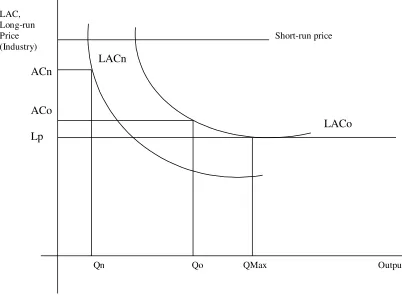
The long run supply curve of industry is more likely to be facing declining cost rather
than increasing cost. The implication is that in the dynamic context, price can not be
instrumental in raising the supply in industry. Since basic conditions augment both
supply and demand, and both the demand curve and supply curve are rising over time
Long-run industry supply curve
Long-run price of industry
Long-run supply Increasing costs
Decreasing costs
Dynamic equilibrium
Long-run supply and demand of industry Dt
St
Time
The problem with the second approach is still more straightforward. Firstly, the
oligopolistic models are usually set in the short run. Therefore they are not aimed at
explaining industrial growth and dynamics. The limited dynamics which is inferred
incumbent upon oligopolistic markets, and hence all questions of industrial growth.
Since the main question of interest in understanding competition in banking industry
relate to growth and dynamics arising out of entry, this second approach is not
adequate for the purpose. The real question does not pivot on restrictive behaviour
because the present study is set in at a time period which augurs for growth in
industry rather than any trend towards restriction. The moot question then is as to
which is the market form that promotes competition and what is the nature of
competition that permits such growth? Which is the theoretical framework that allows
such analysis? In as much as oligopolistic models do essentially concentrate on
conduct on existing firms; such approaches are faulted in two ways. Firstly, a basic
objection to this approach is that it presupposes oligopoly as the market form.
Secondly, they do not arise out of a complete framework that spans all dimension of
S-C-P.
We are therefore led to believe that the only complete framework that could help in
understanding competition in general and in banking in particular is the
Structure-Conduct-Performance paradigm. Even here, the three primary dimensions of the
S-C-P paradigm are not sufficient to explain the phenomenon of competition and growth
in banking industry. Unless the basic conditions argument is invoked, we can not
explain the phenomenon nor can we reconcile it to the evolved and modern notion of
competition.
Basic conditions clearly determine the growth in demand and supply. In the very long
run, both demand and supply functions could be upward sloping. They are not
equilibrated by price. Therefore, the very instrument of competition called price cost
margin is no longer of any great relevance. On the other hand, independent of price,
other things, one of the most important basic conditions is technology. It is therefore
clear that the long run supply curve of industry is more likely to be facing declining
cost rather than increasing cost. The implication is that in the dynamic context, price
can not be instrumental in raising the supply in industry. Since basic conditions
augment both supply and demand, and both the demand curve and supply curve are
rising over time price no longer plays an equilibrating role
The source of growth of industry (banking industry) lies in basic conditions. Basic
conditions include technology, structure of the economy, institutions, availability of
substitutes, availability of trained manpower, and public policy and rules. It influences
growth of industry by creating new demand and attracting new resources. The change
in basic conditions creates different types of externalities – technological and
pecuniary. Therefore the sustained growth and dynamics of the industry is not price
led. Growth arises out of changing basic conditions and dynamics arises out of
sharing the new market created by basic conditions. Hence the prime mover of
competition is rivalry among firms to control market share rather than adjustments
brought about by the price mechanism.
There are two variants of S-C-P paradigm. One attributes larger market shares of
firms to their monopoly power and the other relates it to efficiency. Price is
considered to be the main instrument or mechanism for generating efficiency. While
price represents static efficiency growth any dynamics are associated with changes in
market share. If the market share and ranks change then firms would be under
pressure and this would lead to efficiency. Similarly, changing basic conditions create
externalities and lead to dynamics. There are differences in the rate, the manner and
the efficiency with which firms internalize these externalities. The two versions of
originates from two sources, namely, rivalry amongst firms for acquiring and
retaining market, share on the one hand, and rivalry due to internalization of
externalities created by change in basic conditions, on the other hand.
A caveat on the analysis of changing basic conditions relates to the Schumpeterian
line of argument on evolutionary competition. While apparently Schumpeter also
talks of technological progress and growth, it must be understood that his notion of
innovation and growth is distinct from the present one. In Schumpeter we have
endogenous technical progress generated from within the firm that is supported by
monopoly and patents. Our concept of competition goes against monopoly.
In our framework technological progress arises outside the individual firms and is
incorporated in the basic conditions such that it is available to all firms provided they
have the willingness to internalize it. The more efficient and dynamic firms
internalize faster and better and thereby can capture a greater market share. In as
much as they do it at the cost of other firms this creates rivalry. Efficiency occurs on
the rebound.
The impetus to change in industry arises from innovations from the basic conditions
which could be due to public policy and the State but is not necessarily so. Such
externalities are available to banks with minimal risk as compared to the risk-ridden
process of ‘creative-destruction’.
Rivalry could arise due to three forces. One, it could be due to new entrants which
relates to conduct and is most often quoted in literature. Third, it arises out of
externalities which are captured by basic conditions.
Nuberger (1998) has separated public policy from basic conditions and put it in a
separate box. Aspects of public policy including restrictions on entry, size of
investment and public monopoly (public sector banks) have mostly been dismantled.
This led to a blurring of the box containing public policy in Neuberger’s scheme of
S-C-P paradigm. Whatever remains of public policy boils down to monetary and
prudential controls. The monetary controls involve cash reserve ratio, bank rate,
variable reserve ratio etc. While prudential regulations relate to asset classification
and income recognition norms and norms related to NPA and capital adequacy ratio.
All these may be subsumed under basic conditions which again affect all the three
dimensions of S-C-P. Most of monetary controls are general and therefore they can be
subsumed under basic conditions because rules are essentially part of basic
conditions. Rules include regulations. By this count since most of the regulations
would be subsumed under the basic conditions, what remains are specific regulations
that relate to specific segment or specific market forms. For instance, antitrust
regulations could be applicable only if the market form approached monopoly. The
liberalisation of interest rate is across the board. Our point is how efficiently do firms
internalise the liberalised policy regime. Efficient firms internalise these changes
better and they are adding to efficiency. We have shown that efficiency in the
dynamic context implies growth unlike the Austrian world. It is not governed by
price which is responsible for static efficiency. However, it must be stated that in
profitability alone can not be criterion of efficiency the case of banking. An equally
efficiency can not be equated with Paretian efficiency which may suffice for any other
ordinary market.
The way we envisage the process of competition is through the basic conditions
influencing structure, conduct and performance. In fact the source of competition and
efficiency arise out of dynamics of basic conditions. By keeping basic conditions
constant, we will be constrained to observe only one aspect of competition. Our view
of competition would be restricted to inter-firm rivalry. Such rivalry is often
explained in extant studies through oligopoly models. The broader view of
competition as we envisaged includes the right market structure and competitive
conduct along with rivalry for internalising the externalities caused by basic
conditions. Last but not the least any notion of competition especially if it is to
address growth and dynamics must also account for stability. Some of the new
approaches to competition are restricted to rivalry for deposits and loans while some
of them touch upon risk. From the above discussion, it becomes clear that there is a
need to have comprehensive framework which encompasses all the aspects enlisted
above. There is none better than the S-C-P framework including feedbacks with
changing basic conditions incorporated in it such that competition can be defined
and understood as a process that unfolds from basic conditions up to performance.
The market from that defines competition has be set in reference to and captured
through the entire S-C-P framework.
As a caveat, it has to noted that this Smithian framework emphasises two notions of
competition. The former equilibrates demand and supply, while the later is driven by
technology and structure. Our notion veers to the latter. However, the re is a
fundamental difference between the two notions. In the Smithian case, structure and
is enabled by a growth in the market. In our case, the logic is precisely the converse.
Structure and technology change and so do basic conditions. This enables growth in
markets and hence creates the competitive conditions through dynamics. Another
difference is that in the Smithian case, the impact of technology and structure
influence productivity and allocative efficiency, whereas the change in basic
conditions leads to technical efficiency.
Most of the extant literature takes a partial view. It either restricts the notion of
competition to structure, concentration, entry and monopoly power or to conduct and
oligopoly, where the market form is pre supposed. Our approach not only develops
the S-C-P framework for establishing the appropriate notion of competition. It also
modifies the S-C-P framework suit banking and finally develops the empirics that are
necessary to analyse and estimate competition in banking so as to pronounce an
overall market form.
Initially having questioned the role of price and price cost margin that acts as an
incentive in the competitive market form as well as a barrier to entry under monopoly,
we wish to state in finality that it is possible to reconcile the two positions. If in the
dynamic context, long run price stabilises price cost margin could still emerge while
basic conditions are dynamic and create declining costs. The role of competition and
public policy is that it should be directed at allowing price cost margin to act as an
incentive rather than a restriction to entry. This process would be successful if the
approach to competition in general and banking in particular is promoted by the new
concept of entry facilitators which we have identified.
There is a traditional notion that questions the desirability of competition in banking.
scale only if we assume a context market size. With a dynamically growing market
surcharged by dynamic basic conditions and positive public policy, the new entrants
would always find enough space in the banking market. At the margin however, if
new banks that nevertheless start with a disadvantage edge on the existing banks, this
is likely to lead to rivalry and competition, even if there is the fear of failure it has
been proven in recent times that such banks choose to merge rather than exit. In fact
the new rules that are incorporated in the changing basic conditions permit such
merger.
VI.0 Critical Appraisal of S-C-P Approach
The theoretical framework of the study is provided by theory of industrial
organisation. Within the broader industrial organization approach, there are three
strands in literature:
• The Structure –Conduct-Performance approach
• The information theoretic approach
• Strategic groups approach
While there are apparent differences between these strands, the focus of all these
approaches is to theorize about industry. The broad approach in this thesis is based on
S-C-P, while the information theoretic approach has not been broached at all. The
information theoretic approach is relevant to certain issues arising out of the new
policy recommendations, nevertheless. The issue of NPAs for instance merits such an
approach. For such a treatment of NPAs, one may please refer to Biswas and Deb
(2004). While information theoretic approach questions the informational efficiency
of the market, S-C-P paradigm takes it for granted and analyses market forms. On the
framework is directed towards change in the market form. It has introduced a host of
measures ranging from interest rate deregulation to allowing entry to mould the
market form so that competition and efficiency is generated. Hence the S-C-P
paradigm naturally emerges as the theoretical framework of the study of competition.
Instead of simply considering the banking sector as a passive aggregate, as in the standard
approach to monetary policy often found in macro textbooks, commercial banks need to
be modelled as independent entities that optimally react to their environment. In Industrial
economics, a bank, like a firm, is conceptualised as operating under a certain kind of
market structure providing a service to its customers and in the process incurs costs in
order to produce this service. In the process, it has to compete with other banks in the
industry, using price and non-price instruments and earn a return enough to justify its
existence in the industry. Industrial organization framework is a general expression of
relationship between the attributes, which seem to characterize an industry. The unit of
analysis is market or industry on the one hand or the firm on the other. The framework
uses a technique of analysis called partial equilibrium, which is introduced by Marshall.
The S-C-P paradigm assumes that certain attributes, designated as basic conditions, are
given and a chain of causation logically determines all the other attributes as follows. The
basic content of the paradigm is captured by the following few lines. The basic conditions
are the primary determinants of the market or industry structure. In the next step, the
structure of the industry influences the conduct by participants in the industry. Conduct,
Figure 1.I Schema of Traditional S-C-P Paradigm
VI.1 Basic conditions
In a discussion of S-C-P paradigm, the phenomenon of basic conditions does not
ordinarily receive much attention (Hay and Morris, 1979; Ferguson and Ferguson,
1994). Basic conditions shape market irrespective of market forms. It is determined
by the basic conditions of demand and supply. Demand side conditions include:
direct and cross-elasticities of demand; market growth in its trend, cyclical and
seasonal aspects; taste, requirement and purchasing habit of customers. Supply side
conditions include: location and ownership of raw materials; technology;
unionisation; product durability; industry history; and the legal, ethical and political
framework within which business activity takes place. Gavin Reid (1987) pointed out
that many treatments of S-C-P framework assimilate several of these basic
determinants into market structure category. For example, Mason (1939) who first
proposed and cogently argued the merits of S-C-P approach defines market structure
to include all those considerations the seller takes into account in determining his
business policies and practice. He would include demand conditions in his list of
Structure
Conduct