A Predictive controller for object tracking of a mobile
robot
Xiaowei Zhou, Plamen Angelov, and Chengwei Wang Intelligent Systems Research Laboratory
Lancaster University
Lancaster, LA1 4WA
United Kingdom
Abstract: In this paper a predictive controller for real-time target tracking in mobile robotics is proposed based on adaptive/evolving Takagi-Sugeno fuzzy systems, eTS. The predictive controller consists of two modules; i) a conventional fuzzy controller for robot motion control, and ii) a modelling tool for estimation of the target movements. The prediction of target movements enables the controller to be aware and to respond to the target movement in advance. Successful prediction will minimise the response delay of the conventional controller and improve the control quality. The model learning using eTS is fully automatic and performed ‘on fly’, ‘from scratch’. Data are processed in ‘one-pass’ manner, therefore it requires very limited computational resource and is suitable for on-board implementation on the mobile robots. Predictions are made in real-time. The same technique also has the potential to be used in the process control. Two reference controllers, a controller based on the Mamdani-Type fuzzy rule-base, and a controller based on the simple linear model, are also implemented in order to verify the proposed predictive controller. Experiments are carried out with a real mobile robot Pioneer 3DX. The performance of the three controllers is analyzed and compared.
1 Introduction
recommended in such cases [4]. Instead of a response to the directly observed measurements, the so called model-based predictive controller (MBPC) makes the control decision based on the predicted values. Therefore, a predictive model is an indispensable part of any MBPC scheme [4]. In [5] a Takagi-Sugeno (TS) fuzzy model has been used as a model predictor. This model, however, was pre-trained off-line and was with a fixed strtucture. The eTS concept introduced recently [6]-[8] allows the TS fuzzy model to be designed on-line, ‘on fly’ during the process of control and operation. This is especially suiatble and convenient for applications such as robotics where the autonomous mobile robots may be required to operate in a completely unknown, dynamic, or harsh environment [9].
The main problems in controllers design [10] are; i) their stability; ii) their tuning. The former problem is not treated in this paper. The latter one is usually approached in off-line mode and also from the point of view of adpative control theory [2] which is well developed for the linear case [11]. In a dynamcially changing environment eTS fuzzy systems have their advantage of flexibility and open structure. Moreover, they have been used in conjunction with so called indirect learning proposed by Psaltis in 1998 [12] described in [6] and [12]. While Psaltis and Anderson et al. [14] used off-line pre-trained and with fixed structure neural networks for their indirect learning scheme in [6] and [13] evolving FLC is used that learns ‘on fly’, ‘from scratch’ based on the operational data alone and no pre-training.
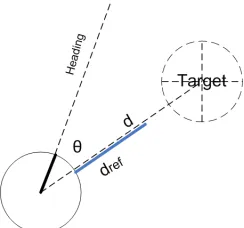
In this tracking problem, the desired velocity of the two side wheels of the robot is controled. The distance, d and the angle to the moving target, θ are measured at each
sampling time, Figure 1. The objective of the control is to maintain a predefined distance to the target so that the target is closely followed without a collison (reference distance, dref). A heading angle of 0
o
[image:2.612.245.367.410.524.2]to the target is also required.
Fig. 1 Target tracking by a mobile robot.
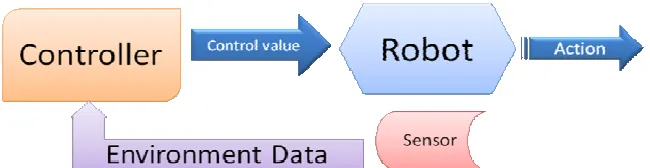
Fig. 2. Controller schematic.
1.1 First principles-based controller
The first principles-based controller used for this task is based on the explicit linear description of the problem. In order to follow the moving target, the acceleration of the robot is assumed to be proportional to the distance to the target, d. Due to the inertia of the real systems it takes a short period of time after a velocity command is received by the motor the desired velocity to be reached. Therefore, the velocities of both wheels (left and right) are selected as control values. The turning of the robot is achieved by control of the velocity difference between the left and right wheels. When the velocity of the left wheel is higher than the velocity of right wheel, the robot makes a right turn and vice versa. Based on these principles, the wheel velocity control model is described by the following equations:
r f right
l f left
V V V
V V V
+ =
+ =
(1) It consists of two components; Vf, the component for maintaining dref and the pair of
velocities, Vl, and Vr which determine the heading of the mobile robot. The two
components are defined by equations (2)-(3) below, also illustrated in Figure 3. Figure 3a) and 3b) illustrate the linear components which describes the control response in proportion to the distance and heading difference to the target respectively. When the distance to the target is Far the velocity component, Vf is set
to High, which leads to a larger acceleration of the robot. While the distance is below dref(set in our experiments to 400mm), the velocity component, Vf is set to Negative.
[image:3.612.146.455.498.612.2]) (
1 ref
f k d d
V = −
(2) > < =
θ
θ
θ
θ
θ
2 0 k Vl ; > − < =θ
θ
θ
θ
θ
2 0 k Vr (3) Whereθ
,θ
are threshold values; k1 and k2 are coefficients.1.2 Fuzzy Controller
In an attempt to achieve a more flexible and accurate tracking, a Mamdani type fuzzy logic controller (FLC) has also been implemented [10]. It consists of five fuzzy rules:
The fuzzy rule base of the Mamdani type FLC:
Rule 1:
IF (d is Crash) AND (
θ
is Negative)THEN (Vl is Quick Back) AND (Vr is Quick Back)
Rule 2:
IF (d is Close) AND (
θ
is Straight)THEN (Vl is Slow Back) AND (Vr is Slow Back)
Rule 3:
IF (d is proper) AND (
θ
is Small Positive) THEN (Vl is Hold) and (Vr is Hold)Rule 4:
IF (d is Not Far) AND (
θ
is Small Negative)THEN (Vl is Slow Forward) AND (Vr is Hold)
Rule 5:
IF (d is Far) AND (
θ
is Positive)THEN (Vl is Slow Forward) AND (Vr is Quick Forward)
Fig. 4. Fuzzy Sets for Distance
The fuzzy controller is tuned by an off-line optimization testing a group of randomly chosen fuzzy sets settings.
1.3 Predictive Controller
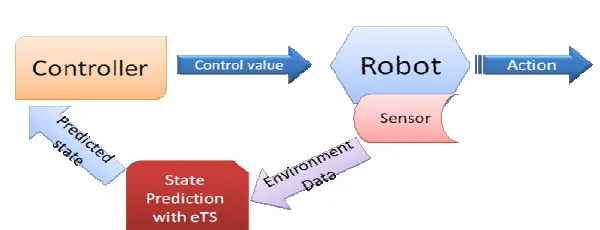
Fig. 5. System Structure of the predictive controller
[image:5.612.154.454.354.469.2]I
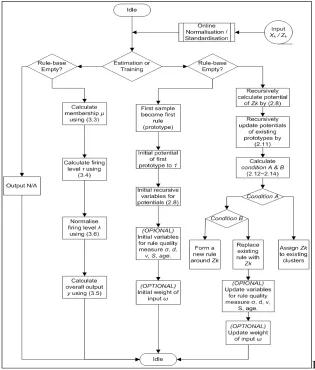
Fig. 6. Flow chart of the evolving Takagi-Sugeno (eTS) Predictor Algorithm
2 Experimental Study
2.1 The robots
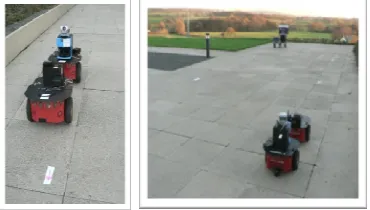
returns the distance and headings to the closest obstacle in this fan area. The detectable range of the laser is [150mm, 10,000mm]. In the experiment, another mobile robot played the role of the moving object to be tracked, following automatically a predefined routine (see Figures 7 and 8). There is no external links such as GPS and the wireless data connection is used only to download data. Thus, the task is performed fully unsupervised by the mobile robot.
Fig. 7. The robots and the experiment
Fig. 8. Route of the target object.
2.2 Experimental settings
Four variables were measured in real-time: 1 distance to the object;
2 angle to the object;
3 the real velocity of the left wheel
4 the real velocity of the right wheel of the robot being controlled.
[image:7.612.222.391.325.437.2]Table I. An example of the data collected in real-time with the control outputs
Time d, mm θθθθ,o Real Left,
mm/s
Real Right, mm/s
Ctrl Left, mm/s
Ctrl Right, mm/s
0 205.295 -5.04 -110 -118 -763.923 -799.234
200 201.297 -5.53 -42 -10 -773.8 -812.551
400 207.336 -16.9 -43 -88 -716.216 -835.137
600 216.334 0.068 -93 -133 -750.034 -749.551
801 207.263 10.47 -107 -167 -739.24 -812.532
1001 246.715 3.49 -282 -274 -676.127 -651.682
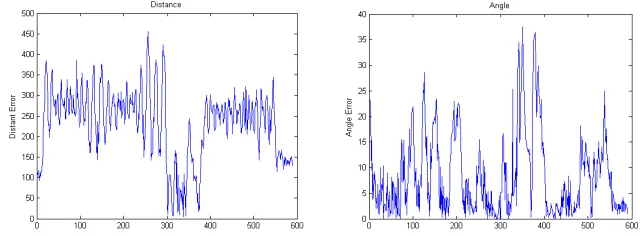
The experiment was carried out outside Infolab21, Lancaster University, UK. For each of the tested controllers a group of ten tests were carried out along the same test route as shown in Figure 8. During the test the target object performed a series of behaviours including acceleration, deceleration, turning, reversing, etc. The mobile robot that is performing the tracking task has the controllers uploaded on its on-board PC written in C language. The tracking task is performed fully automatically. Only the laser ranging device was used to measure both the angle and the distance. The velocity is measured by the tachometer (odometer) of the robot [15].An example of the measured distance and angle difference to the target is illustrated in figure 9a) and 9b). Several pre-tests were also carried out to find the suitable parameters for the FLC. The distance and the angle to the target were measured in real-time. The discrepancy between the real observation and the target values of distance and angle has been used to calculate the errors. The mean absolute error (MAE), the standard deviation (STD) and the root mean square (RMSE) are used as the criteria for the comparison of the three controllers.
[image:8.612.143.463.414.532.2]Fig. 10. Control values versus real observations for velocity of the wheels.
3 Results Analysis and Conclusions
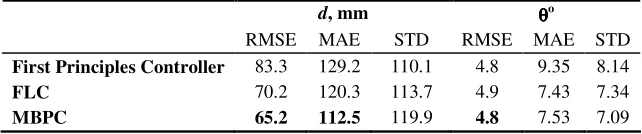
The results are tabulated in table II. They show that the prediction module in the predictive controller has assisted the fuzzy controller to achieve better control precision in terms of the distance and to some extent in terms of the tracking angle minimising the delay in control response. Note that as shown in table I and Figure 10, there is some overshot (the control values generated by the fuzzy controller and the predictive controller are larger than the desired velocity of the wheels). This is because it has already taken into account the response delay in time required for the acceleration/deceleration.
Table II. Result Comparison
In table II, on can see that the angle tracking by the FLC is worse than that of the First principles-based controller. To improve on this aspect, more rules describing the response to different observation in angles can be added to the fuzzy controller to achieve higher control accuracy. Off-line techniques such as ANFIS [16] can be used in order to get the optimal parameters of the fuzzy controller for the task.
In the future, real time image classification [9] and tracking techniques [17] can be integrated with the proposed predictive controller. In this way, image-based information can be used by the prediction module of the MBPC which is expected to further improve the precision.
d, mm θθθθo
RMSE MAE STD RMSE MAE STD
First Principles Controller 83.3 129.2 110.1 4.8 9.35 8.14
FLC 70.2 120.3 113.7 4.9 7.43 7.34
[image:9.612.145.466.417.484.2]REFERENCES
1. Liu P. X., M. Q.-H. Meng (2004) Online Data-Driven Fuzzy Clustering with Applications to Real-Time Robotic Tracking, IEEE Transactions on Fuzzy Systems, vol.12, No 4, 2004, pp.516-523.
2. Astrom K. and B. Wittenmark (1984) Computer Controlled Systems: Theory and Design, Prentice Hall: NJ USA, 1984.
3. Carse B., T.C. Fogarty, A. Munro (1996) Evolving Fuzzy Rule-based Controllers using GA, Fuzzy Sets and Systems, v.80, pp.273-294.
4. Clarke D, Advances in Model-based Predictive Control, Oxford University Press, Oxford, UK, 1994.
5. Babuska R (1998) Fuzzy Modelling for Control, Kluwer Publishers, Dordrecht, The Netherlands.
6. Angelov, P., Evolving Rule-based Models: A Tool for Design of Flexible Adaptive Systems. Berlin, Germany: Springer Verlag, 2002.
7. Angelov, P., Filev, D., “An Approach to On-line Identification of Takagi-Sugeno Fuzzy Models”, IEEE Transactions on System, Man, and Cybernetics, part B - Cybernetics, vol.34, No1, 2004, pp.484-498. ISSN 1094-6977.
8. Angelov P and X Zhou (2006) Evolving Fuzzy Systems from Data Streams in Real-Time, In Proc. 2006 International Symposium on Evolving Fuzzy Systems, Ambelside, Lake District, UK, IEEE Press, pp.29-35, ISBN 0-7803-9719-3.
9. Zhou. X., P. Angelov, An Approach to Autonomous Self-localization of a Mobile Robot in Completely Unknown Environment using Evolving Fuzzy Rule-based Classifier, First 2007 IEEE International Conference on Computational Intelligence Applications for Defense and Security, April 1-5, 2007, Honolulu, Hawaii, USA, pp.131-138.
10. Yager R R and D P Filev (1993) Learning of Fuzzy Rules by Mountain Clustering, Proc. of SPIE Conf. on Application of Fuzzy Logic Technology, Boston, MA, USA, pp.246-254. 11. Kailath, T, Linear systems, Prentice Hall, US, 1980.
12. Psaltis D, A Sideris, A A Yamamura (1998) A Multilayered Neural Network Controller, Control Systems Magazine, vol. 8, pp. 17-21.
13. Angelov P P (2004) A Fuzzy Controller with Evolving Structure, Information Sciences, ISSN 0020-0255, vol.161, pp.21-35.
14. Andersen H.C., F.C. Teng, A.C. Tsoi (1994) Single Net Indirect Learning Architecture, IEEE Transactions on Neural Networks, v.5 (6), pp.1003-1005.
15. Pioneer-3DX (2004) User Guide, ActiveMedia Robotics, Amherst, NH, USA.
16. Jang, J.-S., RANFIS: adaptive-network-based fuzzy inference system, IEEE Transactions on System, Man, and Cybernetics, vol.23, No3, 1993, pp.665-685.