Munich Personal RePEc Archive
Locating foresight
Havas, Attila
Institute of Economics, Hungarian Academy of Sciences
September 2007
Locating foresight
Attila Havas
Institute of Economics, Hungarian Academy of Sciences
paper presented at the Foresight Summit, Budapest, 27-29 September 2007
1 Foresight programmes and other approaches to future-‐oriented analyses
Decision-makers, experts and laymen in different historical periods and in different socio-economic systems shared at least one desire: to know their future in advance or even to influence it for their advantage. They used very different approaches and methods from spiritual/ religious ones to scientific investigations and various modes of planning.1 Without going into details here, it is worth recalling some of the major methods/ approaches in order to locate – and distinguish – foresight programmes:• visionary thinking (in ancient times by prophets, more recently mainly by consultants)
• forecasting (at different levels, using different methods, e.g. trend analysis, extrapolation)
• futures studies (for academic purposes)
• prospective analyses (for business or policy purposes, e.g. [technology] roadmapping, list of critical/ strategic/ key technologies)
• strategy formation (at firm, sectoral, regional or national levels)
• scenario planning (at a firm level; see e.g. Godet, 2001)
• indicative national planning
• central planning (at a national level)
• foresight programmes.2
Obviously, the above approaches have a number of common characteristics. All of them (a) deal with the future(s) in one way or another; (b) collect and analyse various pieces of information, and (c) can apply a wide range of methods, mainly scientific ones. Three key features can be used to differentiate the above approaches, and thus distinguish foresight programmes from other methods. These approaches can:
• be action-oriented vs. ‘contemplative’ (passive)
• be participatory vs. non-participatory
• consider alternative futures vs. a single future state (already ‘set’ by external forces). Action-oriented endeavours aim at shaping/ influencing/ acting upon the future,3 while passive ones are ‘contemplating’ about it (e.g. ‘pure’ futurologist studies, without any policy
1 Hence, a special chapter of the history of mankind can be devoted to these different attitudes, methods and
approaches towards the future. 2
The term ‘foresight programme(s)’ is used throughout this paper as an attempt to distinguish individual (personal) foresight and ‘collective’ foresight programmes, i.e. the ones launched (and sponsored) by an organisation (or several ones), and conducted by a number participants. Moreover, an increasing number of articles published by researchers working in the field of future studies, in which ‘foresight’ is used as a new label for their work (although still following the ‘futures studies’ or futurology paradigm), see e.g. the recent issues of
Futures, especially Vol. 36, No. 2. It does not seem to be a productive, promising dispute trying to establish the ‘real’ meaning of foresight, and then attempting to ‘enforce’ it across various communities of practice.
3
2
implications. In other words, the latter ones merely try to develop a better-informed anticipation of the future, e.g. for being better prepared by having more precise information.
Participatory future-oriented programmes/ projects meet all the three following criteria: they (i) involve participants from at least two different stakeholder groups (e.g. researchers and business people; experts and policy-makers; experts and laymen); (ii) disseminate their preliminary results (e.g. analyses, tentative conclusions and policy proposals) among interested ‘non-participants’,4 e.g. face-to-face at workshops, electronically via the internet with free access for everyone, or in the form of printed documents, leaflets, newsletters; and (iii) seek feedback from this wider circle (again, either face-to-face or in a written form). Conversely, if any of these criteria is not met, that activity cannot be regarded a participatory programme or project.
Finally, certain approaches are based on the assumption that the future is not pre-determined yet; and thus the future can evolve in different directions, to some extent depending on the actions of various players and decisions taken ‘today’. In other words, there is a certain degree of freedom in choosing among the alternative, feasible futures, and hence increasing the chance of arriving at the preferred (selected) future state. Clearly, there is a close link between being action-oriented and considering alternative futures.5 Other approaches, on the contrary, can only think of a single future, already ‘fixed’ by certain factors, and thus the task is to explore (forecast, predict) ‘the’ future scientifically.6
In sum, foresight programmes are action-oriented, participatory and consider alternative futures.
2 Focus of foresight programmes
Foresight programmes may have rather dissimilar foci, ranging from the identification of priorities in a strict S&T context to addressing broad societal/ socio-economic challenges.
Georghiou (2001) and (2002) identified three generations of prospective/ strategic technological analyses. This classification is used here as point of departure to develop a typology of foresight programmes to analyse their potential and actual role in policy-making.
The first generation is the classical technological forecasting, aimed at predicting technological developments, based on extrapolation of perceptible trends.7
The main aim of a second-generation foresight programme is to improve competitiveness by strengthening academy-industry co-operation, correcting the so-called market failure8 and trying to extend the usually too short time horizon of businesses.9
4 ‘Non-participants’ are those persons who have not been members of panels or working groups set up by the
programme, and have not been involved directly in any other way, e.g. by answering (Delphi) questionnaires. 5 Some foresight programmes, e.g. the second Swedish Technology Foresight Programme, consider alternative
futures with the explicit aim of identifying key choices confronting their ‘constituency’ or ‘target audience’, but do not intend to single out any preferred future. In other words, these programmes do not follow a normative approach. (This approach, and the example, has been mentioned by Göran Pagels-Fick among his comments on an earlier draft.)
6 Cuhls (2003) offers an excellent, comprehensive discussion on the differences between forecasting, prediction,
planning and foresight. The possibility of a single future vs. “many” futures is a central element of her analysis. 7 These predictions are produced by a relatively small group of experts: futurologists and/or technological
A third-generation foresight programme tackles broad/er/ socio-economic challenges, and hence besides researchers and business people government officials and social stakeholders are also involved.
Three ‘ideal types’ of foresight programmes can be defined as major ‘reference points’. Identifying ‘ideal types’ is a long-established practice in social sciences (and somewhat similar to ‘models’ used in all fields of sciences): “The fact that none of these three ideal types (…) is usually to be found in historical cases in ‘pure’ form, is naturally not a valid objection to attempting their conceptual formulation is the sharpest possible form.”10 (Weber, 1947, reprinted in Pugh, 1988, p. 16)
Note, however, that all three ideal types of foresight programmes should meet the criteria defined above in Section 1: they should be action-oriented, participatory and should consider alternative futures. The underlying difference among them is their focus:
• S&T issues: type A foresight programmes
• techno-economic issues: type B foresight programmes
• broad societal/ socio-economic issues: type C foresight programmes.11
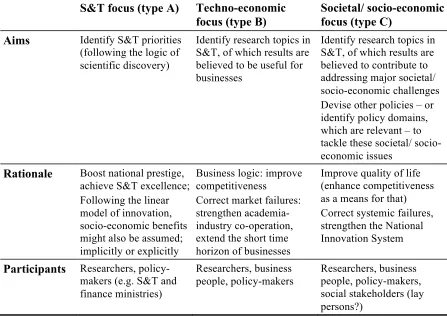
Their further characteristics, in terms of their aims, rationales and participants, are summarised in Table 1. One would notice immediately that these ideal types are not distinguished by their themes (topics): for example, they all deal with S&T issues, but by doing so, they pursue different aims, and follow different (policy) rationales. In other words, they address different challenges, ask different questions, use different approaches/ ways of thinking,12 and involve different participants. In other words, these ideal types should not be thought of as “Russian dolls”: the biggest one, type C incorporating the middle one, i.e. type B, and, in turn, type B encompassing the smallest one (the ‘core’), Type A.
8
In short, private returns on R&D are smaller than social returns (as firms cannot appropriate all the profits stemming form R&D), and thus firms do not invest into R&D at a sufficient – socially optimal – level. 9
Accordingly, a different set of actors is involved in these programmes: researchers working on various S&T fields and business people, bringing knowledge on markets into the process. These programmes are organised by following the structure of economic sectors (various industries and services).
10 It is just a coincidence that Weber also talks of three ideal types when discussing legitimate authority.
11
In short, the most important modification compared to the three generations identified by Georghiou is to replace technology forecasting with foresight programmes focussing on S&T issues. Technology forecasting projects usually do not consider alternative futures, and most of them are not participatory either (as defined in Section 1). However, there is no reason to assume that S&T issues cannot be tackled in a participatory manner, considering alternative futures, and aiming at informing and influencing present actions. For example, the recent Turkish Foresight Programme – the Vision 2023 Project – has focussed on S&T issues. (Tümer, 2004)
12 See e.g. Havas (2005) for more details on the differences in terms of questions, approaches – when analysing
4
Table 1: Foci of foresight programmes
S&T focus (type A) Techno-economic
focus (type B)
Societal/ socio-economic focus (type C)
Aims Identify S&T priorities
(following the logic of scientific discovery)
Identify research topics in S&T, of which results are believed to be useful for businesses
Identify research topics in S&T, of which results are believed to contribute to addressing major societal/ socio-economic challenges Devise other policies – or identify policy domains, which are relevant – to tackle these societal/ socio-economic issues
Rationale Boost national prestige, achieve S&T excellence; Following the linear model of innovation, socio-economic benefits might also be assumed; implicitly or explicitly
Business logic: improve competitiveness
Correct market failures: strengthen academia-industry co-operation, extend the short time horizon of businesses
Improve quality of life (enhance competitiveness as a means for that) Correct systemic failures, strengthen the National Innovation System
Participants Researchers, policy-makers (e.g. S&T and finance ministries)
Researchers, business people, policy-makers
Researchers, business people, policy-makers, social stakeholders (lay persons?)
Potential users usually constitute a broader group than the actual participants; they might include e.g. funding organisations, other policy implementation bodies and public service providers (including ‘quangos’ [quasi-NGOs]), professional associations representing the interests of their members (and thus involving them to some extent in strategy and policy formation processes in various ways), venture capitalists, trade unions, etc. Depending on the focus of a foresight programme (the types of challenges/ issues considered), as well as the political culture of a given country or region, some of these potential users and stakeholders might become participants, too. In any case, it is not possible to establish a one-to-one relationship between an ‘ideal type’ of foresight and its participants beyond the ‘typical’ participants indicated in Table 1. The type and number of participants, the methods, channels and for a used their ‘internal’ and ‘external’ dialogues,13 as well as the intensity, quality and impacts of these dialogues is obviously a question for the individual description, analysis or evaluation of actual foresight programmes.
Types A and B programmes have a longer tradition, and thus in general they are better known. Obvious examples are the Turkish Vision 2023 Project (type A) and the first UK Foresight Programme (Type B). (Tümer, 2004, and Georghiou, 1996, respectively)
Therefore, only type C programmes are explained here in some detail. The shift in focus is reflected in the structure, too: these programmes are organised along major societal/ socio-economic concerns (e.g. health, ageing population, crime prevention in the case of the
13 Internal dialogues take place among the participants of a given programme, e.g. among panel members,
Hungarian, the first Swedish or the second UK foresight programmes; see Boxes 1-2 in Section 4.3). A new element in the underlying rationale can also be discerned, the so-called systemic failure argument: the existing institutions (written and tacit codes of behaviour, rules and norms) and organisations are not sufficient to improve quality of life and enhance competitiveness, and thus new institutions should be ‘designed’ by intense communication and co-operation among the participants. In other words, the existing gaps should be bridged by new networks, appropriate policies aimed at correcting systemic failures, and establishing or strengthening relevant organisations. A foresight programme, based on this rationale, can deliver solutions in various forms: by strengthened, re-aligned networks as ‘process’ results of the programme, as well as by policy recommendations (‘products’).
An actual foresight programme is likely to combine certain elements from various types. In most cases, however, one type of rationale would be chosen as a principal one; it thus would underlie the more detailed objectives and structure of a programme, as well as the choice of its participants. Otherwise, it would likely to lead to an incoherent – even chaotic – exercise, characterised by tensions between (a) the various objectives, (b) elements of its structure, (c) the objectives and methods, (d) the participants and objectives, and/or (e) among the participants themselves. A certain level of tension, however, might be quite useful – or even essential – to produce creative, innovative ideas and solutions, of course, but too intense and too frequently occurring – structural, inherent – conflicts would most likely tear a foresight programme apart.
References
Cuhls, K. (2003): From forecasting to foresight processes: New participative foresight activities in Germany, Journal of Forecasting, Vol. 22, No. 2-3, pp. 93-111.
Georghiou, L. (2001): Third Generation Foresight: Integrating the Socio-economic
Dimension, in: Technology Foresight – the approach to and potential for New Technology Foresight, Conference proceedings, NISTEP Research Material 77.
Georghiou, L. (2002): Policy rationales, sponsors and objectives, presentation at the eFORESEE Workshop on Foresight Basics, Malta, 24-26 July 2002.
Georghiou, L. (1996): The UK Technology Foresight Programme, Futures, Vol. 28, No. 4, pp. 359-377.
Godet, M. (2001): Creating Futures: Scenario planning as a strategic management tool, London: Economica.
Havas, A. (2005): Terminology and methodology for benchmarking foresight programmes, ForSociety Transnational Foresight ERA-Net, paper prepared for Tasks 1.4 and 3.1. Tümer, T. (2004): Technology Foresight in Turkey: Vision 2023 Project, presentation at a
UNIDO seminar on Technology Foresight for Organizers, 13-17 December, Gebze, Turkey.