A Critical Analysis on the Security Concerns of
Internet of Things (IoT)
M.U. Farooq
Electronic Engg. Dept. PAF-Karachi Institute of
Economics and Technology, Pakistan
Muhammad Waseem
Telecommunication Engg. Dept. Sir Syed University of Engg. and Technology,
Pakistan
Anjum Khairi
Electronic Engg. Dept. Sir Syed University of Engg. and Technology,
Pakistan
Sadia Mazhar
Electrical Engg. Dept. Sir Syed University of, Engg. and Technology,
Pakistan
ABSTRACT
Internet of Things (IoT) has been a major research topic for almost a decade now, where physical objects would be interconnected as a result of convergence of various existing technologies. IoT is rapidly developing; however there are uncertainties about its se-curity and privacy which could affect its sustainable development. This paper analyzes the security issues and challenges and provides a well defined security architecture as a confidentiality of the user’s privacy and security which could result in its wider adoption by masses.
Keywords:
Internet of Things, IoT, IoT security goals, IoT security challenges and issues, IoT security architecture.
1. INTRODUCTION
The term, Internet of Things, a system of interconnected devices, was first proposed by Kevin Ashton in 1999 [1]. It is a major tech-nological revolution that has updated the current Internet infras-tructure to a concept of much more advanced computing network where all the physical objects around us will be uniquely identifi-able and ubiquitously connected to each other [2]. By this contin-ually emerging technology everything around us like televisions, refrigerators, cars and clothes etc will be collecting some useful data with the help of various existing technologies, which will then be autonomously flowing the data to the concerned devices and on the basis of which automated actions will be taken.
With a number of researches being carried out, the vision of IoT is likely to be a reality very soon. According to Gartner, around 25 billion uniquely identifiable objects are expected to be a part of this global computing network by the year 2020 [3], which is impressively a big number, however prevalence of such a big net-work of interconnected devices will pose some new security and privacy threats and put all those devices at a high risk of hackers as they clutch at the security gaps to make the devices work for their personal benefits.
IoT definitely has a great potential for flexibility and promises a great future but it has a potential of security disaster too. There are many questions for its wide adoption and without answering them
and coming up with proper solutions for the newly posed threats, it does not seem to have any future [4]. Due to easy accessibility of the objects, it can be easily exploited by the evil-minded hack-ers [5]. No matter how much secure companies think their products are, they are still prone to various kinds of attacks so they must ensure proper security by making the patches available as soon as any vulnerability is detected in the system. Since the devices have a direct impact on the lives of users so security considerations must be a high priority and there must be some proper well-defined se-curity infrastructure with new systems and protocols that can limit the possible threats related to scalability, availability and security of IoT [6].
The paper is organized as follows. Section 2 describes the generic architecture of IoT. Section 3 describes the security goals. Section 4 discusses the major security challenges and issues on each layer. Section 5 presents the security architecture of IoT and finally Sec-tion 6 concludes the paper.
2. GENERIC ARCHITECTURE
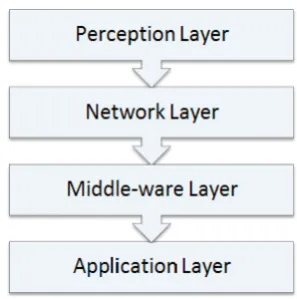
[image:1.595.359.508.524.674.2]Generally, IoT has four main key levels as shown in Fig. 1, which are described below [7]:
2.1 Perception Layer
This layer consists of different kinds of data sensors like RFID, Barcodes or any other sensor network [8]. The basic purpose of this layer is to identify the unique objects and deal with its collected data obtained from the real world with the help of its respective sensor(s).
2.2 Network Layer
The purpose of this layer is to transmit the gathered information obtained from the perception layer, to any particular information processing system through existing communication networks like Internet, Mobile Network or any other kind of reliable network [9].
2.3 Middle-ware Layer
This layer consists of information processing systems that take au-tomated actions based on the results of processed data and links the system with the database which provides storage capabilities to the collected data. This layer is service-oriented which ensures same service type between the connected devices [10].
2.4 Application Layer
This layer realizes various practical applications of IoT based on the needs of users and different kinds of industries such as Smart Home, Smart Environment, Smart Transportation and Smart Hos-pital etc [11].
3. SECURITY GOALS
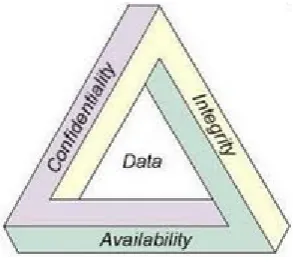
[image:2.595.99.246.462.593.2]The major security goals of IoT are to ensure proper identity au-thentication mechanisms and provide confidentiality about the data etc. The Security triad or CIA triad, a distinguished model for the development of security mechanisms, implements the security by making use of the three areas which are Data confidentiality, in-tegrity and availability as shown in the Fig. 2. A breach in any of these areas could cause serious issues to the system so they must be accounted for. The three areas are described below:
Fig. 2. The CIA Triad
3.1 Data Confidentiality
Data confidentiality is identical to providing freedom to user from the external interference. It is the ability to provide confidence to user about the privacy of the sensitive information by using differ-ent mechanisms such that its disclosure to the unauthorized party is prevented and can be accessed by the permitted users only. There
are many security mechanisms to provide confidentiality of the data including, but not limited to, Data Encryption in which the data is converted into ciphertext form which makes it difficult to access for the users having no proper authorizations, the Two-step veri-fication, which provides authentication by two dependent compo-nents and allows the access only if both the compocompo-nents pass the authentication test and the most common Biometric Verification in which every person is uniquely identifiable. For the IoT based de-vices, it ensures that the sensor nodes of the sensor networks don’t reveal their data to the neighboring nodes, similarly the tags don’t transmit their data to an unauthorized reader [12].
3.2 Data Integrity
During the communication, data could be altered by the cybercrim-inals or could be affected by various other factors that are beyond human control including the crash of server or an electromagnetic disturbance. Data Integrity refers to the protection of useful infor-mation from the cybercriminals or the external interference during transmission and reception with some common tracking methods, so that the data cannot be tampered without the system catching the threat [13]. The methods to ensure the accuracy and original-ity of data includes methods like Checksum and Cyclic Redun-dancy Check (CRC) which are simple error detector mechanisms for a portion of data. Moreover, continuous syncing of the data for backup purposes and the feature like Version control, which keeps a record of the file changes in a system to restore the file in case of fortuitous deletion of data can also ensure the integrity of data such that the data on IoT based devices is in its original form when accessed by the permitted users.
3.3 Data Availability
One of the major goals of IoT security is to make data available to its users, whenever needed. Data Availability ensures the im-mediate access of authorized party to their information resources not only in the normal conditions but also in disastrous conditions. Due to dependency of companies on it, it is necessary to provide firewalls to countermeasure the attacks on the services like Denial-of-service (DoS) attack which can deny the availability of data to the user-end. Data Availability also ensure the prevention of bot-tleneck situations which prevent the flow of information. The Re-dundancy and Failover backup methods provide duplication of the system components in conditions of system failure or various sys-tem conflictions to ensure reliability and availability of data.
4. SECURITY CHALLENGES AND ISSUES
There have been many achievements in the research field of IoT, however there are still some open challenges that needs to be ad-dressed for the ubiquity of this technology. In this section some of the threats in each architectural layer that needs special attention are discussed.
4.1 Perception Layer Challenges
Perception layer consists of different sensor technologies like RFID which are exposed to many kinds of threats which are discussed below:
4.1.2 Tag Cloning. Since tags are deployed on different objects which are visible and their data can be read and modified with some hacking techniques therefore they can be easily captured by any cy-bercriminal who can create a replica of the tag and hence compro-mising it in a way that the reader cannot distinguish between the original and the compromised tag [15].
4.1.3 Eavesdropping. Because of the wireless characteristics of the RFID it becomes very easy for the attacker to sniff out the con-fidential information like passwords or any other data flowing from tag-to-reader or reader-to-tag which makes it vulnerable because the attacker can make it to use in despicable ways [16].
4.1.4 Spoofing. Spoofing is when an attacker broadcasts fake in-formation to the RFID systems and makes it to assume its original-ity falsely which makes it appearing from the original source [17]. This way attacker gets full access to the system making it vulnera-ble.
4.1.5 RF Jamming. RFID tags can also be compromised by kind of a DoS attack in which communication through RF signals is disrupted with an excess of noise signals [18].
4.2 Network Layer Challenges
Network layer consists of the Wireless Sensor Network (WSN) which transmits the data from the sensor to its destination with re-liability. The related security issues are discussed below:
4.2.1 Sybil Attack. Sybil is a kind of attack in which the attacker manipulates the node to present multiple identities for a single node due to which a considerable part of the system can be compromised resulting in false information about the redundancy [19].
4.2.2 Sinkhole Attack. It is a kind of attack in which the adver-sary makes the compromised node look attractive to the nearby nodes due to which all the data flow from any particular node is diverted towards the compromised node resulting in packets drop i.e. all the traffic is silenced while the system is fooled to believe that the data has been received on the other side. Moreover this attack results in more energy consumption which can cause DoS attack [20].
4.2.3 Sleep Deprivation Attack. The sensor nodes in the Wireless Sensor Network are powered with batteries with not so good life-time so the nodes are bound to follow the sleep routines to extend their lifetime. Sleep Deprivation is the kind of attack which keeps the nodes awake, resulting in more battery consumption and as a result battery lifetime is minimized which causes the nodes to shut down [21].
4.2.4 Denial of Service (DoS) Attack. The kind of attack in which the network is flooded with a useless lot of traffic by an attacker, resulting in a resource exhaustion of the targeted system due to which the network becomes unavailable to the users [22].
4.2.5 Malicious code injection. This is a serious kind of attack in which an attacker compromises a node to inject malicious code into the system which could even result in a complete shutdown of the network or in the worst case, the attacker can get a full control of the network [23].
4.2.6 Man-in-the-Middle Attack. This is a form of Eavesdrop-ping in which target of the attack is the communication channel due to which the unauthorized party can monitor or control all the pri-vate communications between the two parties hideously. The
unau-thorized party can even fake the identity of the victim and commu-nicate normally to gain more information [24].
4.3 Middle-ware Layer Challenges
This layer is composed of data storage technologies like cloud com-puting. The security challenges of this layer are discussed below:
4.3.1 Unauthorized Access. Middle-ware Layer provides differ-ent interfaces for the applications and data storage facilities. The attacker can easily cause damage to the system by forbidding the access to the related services of IoT or by deleting the existing data. So an unauthorized access could be fatal for the system.
4.3.2 DoS Attack. It is similar to the DoS attack discussed in the previous two layers i.e. it shuts down the system which results in unavailability of the services.
4.3.3 Malicious Insider. This kind of attack occurs when some-one from the inside tampers the data for personal benefits or the benefits of any 3rd party. The data can be easily extracted and then altered on purpose from the inside.
4.4 Application Layer Challenges
The related security issues of this layer are described below:
4.4.1 Malicious Code Injection. An attacker can leverage the at-tack on the system from end-user with some hacking techniques that allows the attacker to inject any kind of malicious code into the system to steal some kind of data from the user.
4.4.2 Denial-of-Service (DoS) Attack. DoS attacks nowadays have become sophisticated, it offers a smoke screen to carry out attacks to breach the defensive system and hence data privacy of the user, while deceiving the victim into believing that the actual attack is happening somewhere else. This put the non-encrypted personal details of the user at the hands of the hacker.
4.4.3 Spear-Phishing Attack. It is an email spoofing attack in which victim, a high ranking person, is lured into opening the email through which the adversary gains access to the credentials of that victim and then by a pretense retrieves more sensitive information.
4.4.4 Sniffing Attack. An attacker can force an attack on the sys-tem by introducing a sniffer application into the syssys-tem, which could gain network information resulting in corruption of the sys-tem [25].
5. SECURITY AT DIFFERENT LAYERS
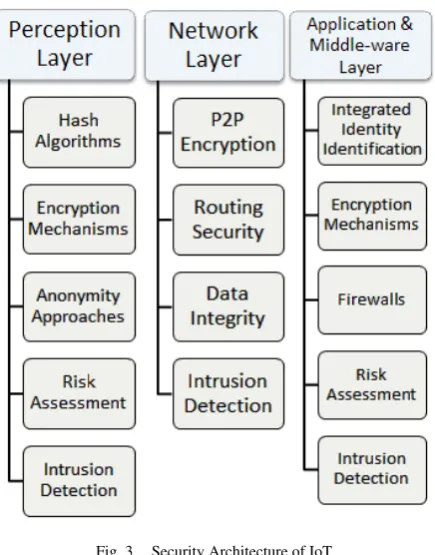
There are many researches being carried out to provide a reliable well-defined security architecture which can provide confidential-ity of the data securconfidential-ity and privacy. W. Zhang et al. [26] proposed an architecture for the security against the possible threats, as shown in Fig. 3.
5.1 Perception Layer
Perception Layer is the bottom layer of the IoT architecture which provides various security features to the hardware. It serves four basic purposes which are Authentication, Data Privacy, Privacy of sensitive information and Risk Assessment which are discussed be-low:
Fig. 3. Security Architecture of IoT
terminals that could withstand all the possible known attacks like Side-channel attack, Brute force attack and Collision attack etc.
5.1.2 Data Privacy. Privacy of the data is guaranteed by sym-metric and asymsym-metric encryption algorithms such as RSA, DSA, BLOWFISH and DES etc which prevents an unauthorized access to the sensor data while being collected or forwarded to the next layer. Due to their low power consumption benefit, they can be eas-ily implemented into the sensors.
5.1.3 Privacy of sensitive information. As for hiding the sensi-tive information, anonymity of the location and identity is obtained using K-Anonymity approach which ensures the protection of the information like identity and location etc of the user [27].
5.1.4 Risk Assessment. It is a fundamental of IoT security which discovers the new threats to the system. It could help preventing the security breaches and determining the best security strategies. An example of it is the Dynamical Risk Assessment method for IoT [28].
Even with such security measures, if an intrusion is detected in the system, an automated Kill-command from the RFID reader is sent to the RFID tag which prevents an unauthorized access to the RFID tag data [29].
5.2 Network Layer
The network layer which could be both wired or wireless is exposed to various kinds of attacks. Due to the openness of the wireless channels, communications can be monitored easily by some hack-ers. The network layer security is further divided into three types which are discussed below:
5.2.1 Authentication. With the help of a proper authentication process and point to point encryption, illegal access to the sensor
nodes to spread fake information could be prevented [30]. The most common kind of attack is the DoS attack which impacts the net-work by driving a lot of useless traffic towards it through a number of botnets fueled by the system of interconnected devices.
5.2.2 Routing Security. After the Authentication process, routing algorithms are implemented to ensure the privacy of data exchange between the sensor nodes and the processing systems [31]. There have been many researches carried out for the routing ways includ-ing Source Routinclud-ing [32], in which data to be transmitted is stored in the form of packets which is then sent to the processing system after being analyzed by the intermediate nodes, And the Hop-by-Hop routing in which only address of the data destination is known. The security of routing is ensured by providing multiple paths for the data routing which improves the ability of the system to detect an error and keep performing upon any kind of failure in the system [33].
5.2.3 Data Privacy. The safety control mechanisms monitors the system for any kind of intrusion and finally Data integrity methods are implemented to make sure that the data received on the other end is the same as the original one.
5.3 Middle-ware and Application Layer
This layer amalgamates the Middle-ware and Application layer to form an integrated security mechanism. The security categorization is discussed below:
5.3.1 Authentication. Firstly it goes through the authentication process which prevents the access to any miscreant user by inte-grated identity identifications. This is exactly similar to that of the identification process in either of the layers except that this layer encourages authentications by some certain cooperating services which means users can even choose the associated information to be shared with the services.
The major technologies used in this layer are Cloud computing and Virtualization, both of which are ripe to various attacks. The cloud technology can be easily compromised, one of the worst threat is the insider threat. Similarly Virtualization is exposed to DOS and data theft etc. A lot of research is needed in both domains to provide secure environment.
5.3.2 Intrusion Detection. Its intrusion detection techniques pro-vide solutions for various security threats by generating an alarm on occurrence of any suspicious activity in the system due to the continuous monitoring and keeping a log of the intruder’s activities which could help to trace the intruder. There are different existing intrusion detection techniques [34] including the data mining ap-proach [35] and anomaly detection.
5.3.3 Risk Assessment. The risk assessment gives justification for the effective security strategies and provides improvements in the existing security structure.
5.3.4 Data Security. Data security is ensured by various encryp-tion technologies which prevent the data stealing threats. Moreover, to prevent other malicious activities from the miscreant users, Anti-Dos firewalls and up to date spywares and malwares are introduced.
6. CONCLUSION AND FUTURE WORK
effective implementation of a security infrastructure for IoT, these achievements must need to be further expanded instead of focusing the attention towards seeking the new possible security solutions, to make IoT able to provide services to the futuristic data-hungry billions of devices with the ability to thwart the adversaries. So the adequate privacy and security measures through substantial re-searches must be made and the answers for the number of open questions in this research field must be provided, before it gets de-ployed in the society. This paper discussed the security goals and possible security challenges and issues of the IoT system. Then a well-defined architecture for the IoT security was presented. In the future, more authentications, risk assessment and intrusion de-tection techniques in each architectural layer must be explored in parallel to the implementation of the security infrastructure using existing IT security features. Moreover, legal frameworks, proper regulations and policies must be devised to ensure stable develop-ment of the secure technologies.
7. REFERENCES
[1] Kevin Ashton, That Internet of things thing, It can be accessed at:http://www.rfidjournal.com/articles/view?4986
[2] D. Singh, G. Tripathi, A.J. Jara, A survey of Internet-of Things: Future Vision, Architecture, Challenges and Services, inInternet of Things (WF-IoT), 2014
[3] Gartner, Inc. It can be accessed at:
http://www.gartner.com/newsroom/id/2905717
[4] Rolf H. Weber, ”Internet of Things - New security and privacy challenges,” inComputer Law and Security Review (CLSR), 2010, pp. 23-30
[5] Rodrigo Roman, Pablo Najera and Javier Lopez, ”Securing the Internet of Things,” inIEEE Computer, Volume 44, Num-ber 9, 2011, pp. 51-58
[6] Friedemann Mattern and Christian Floerkemeier, ”From the Internet of Computers to the Internet of Things,” inLecture Notes In Computer Science (LNCS), Volume 6462, 2010, pp 242-259
[7] Hui Suo, Jiafu Wan, Caifeng Zou, Jianqi Liu, Security in the Internet of Things: A Review, inComputer Science and Elec-tronics Engineering (ICCSEE), 2012, pp. 648-651
[8] Ying Zhang, Technology Framework of the Internet of Things and Its Application, inElectrical and Control Engineering (ICECE), pp. 4109-4112
[9] Xue Yang, Zhihua Li, Zhenmin Geng, Haitao Zhang, A Multi-layer Security Model for Internet of Things, in Communica-tions in Computer and Information Science, 2012, Volume 312, pp 388-393
[10] Rafiullah Khan, Sarmad Ullah Khan, R. Zaheer, S. Khan, Fu-ture Internet: The Internet of Things ArchitecFu-ture, Possible Applications and Key Challenges, in10th International Con-ference on Frontiers of Information Technology (FIT 2012), 2012, pp. 257-260
[11] Shi Yan-rong, Hou Tao, Internet of Things key technologies and architectures research in information processing in Pro-ceedings of the 2nd International Conference on Computer Science and Electronics Engineering (ICCSEE), 2013 [12] Daniele Miorandi, Sabrina Sicari, Francesco De Pellegrini
and Imrich Chlamtac, ”Internet of Things: Vision, applica-tions and research challenges,” inAd Hoc Networks, 2012, pp.1497-1516
[13] Luigi Atzori, Antonio Iera, Giacomo Morabito, ”The Internet of Things: A Survey,” inComputer Networks, pp. 2787-2805 [14] Mr. Ravi Uttarkar and Prof. Raj Kulkarni, ”Internet of Things: Architecture and Security,” inInternational Journal of Com-puter Application, Volume 3, Issue 4, 2014
[15] Mike Burmester and Breno de Medeiros, ”RFID Security: At-tacks, Countermeasures and Challenges.”
[16] Benjamin Khoo, ”RFID as an Enabler of the Internet of Things: Issues of Security and Privacy,” inIEEE International Conferences on Internet of Things, and Cyber, Physical and Social Computing, 2011
[17] Aikaterini Mitrokotsa, Melanie R. Rieback and Andrew S. Tanenbaum, ”Classification of RFID Attacks.”
[18] Lan Li, ”Study on Security Architecture in the Internet of Things,” inInternational Conference on Measurement, Infor-mation and Control (MIC), 2012
[19] John R. Douceur, ”The Sybil Attack,” inPeer-to-Peer Systems - IPTPS, 2002, pp. 251-260
[20] Nadeem AHmed, Salil S. Kanhere and Sanjay Jha, ”The Holes Problem in Wireless Sensor Network: A Survey,” in Mobile Computing and Communications Review, Volume 1, Number 2
[21] Tapalina Bhattasali, Rituparna Chaki and Sugata Sanyal, ”Sleep Deprivation Attack Detection in Wireless Sensor Net-work,” in International Journal of Computer Applications, Volume 40, Number 15, 2012
[22] Dr. G. Padmavathi, Mrs. D. Shanmugapriya, ”A survey of AT-tacks, Security Mechanisms and Challenges in Wireless Sen-sor Networks,” inInternational Journal of Computer Science and Information Security, Volume 4, Number 1, 2009 [23] Priyanka S. Fulare and Nikita Chavhan, ”False Data Detection
in Wireless Sensor Network with Secure Communication,” in International Journal of Smart Sensors and AdHoc Networks (IJSSAN), Volume-1, Issue-1, 2011
[24] Rabi Prasad Padhy, Manas Ranjan Patra, Suresh Chandra Sa-tapathy, ”Cloud Computing: Security Issues and Research Challenges,” in International Journal of Computer Science and Information Technology & Security (IJCSITS).
[25] Bhupendra Singh Thakur, Sapna Chaudhary, ”Content Sniff-ing Attack Detection in Client and Server Side: A Survey,” in International Journal of Advanced Computer Research, Vol-ume 3, Number 2, 2013
[26] W. Zhang, B. Qu, Security Architecture of the Internet of Things Oriented to Perceptual Layer, inInternational Jour-nal on Computer, Consumer and Control (IJ3C), Volume 2, No.2 (2013)
[27] K.E. Emam, F.K. Dankar, Protecting Privacy Using kAnonymity, in Journal of the American Medical Infor-matics Association, Volume 15, Number 5, 2008
[28] C. Liu, Y. Zhang, J. Zeng, L. Peng, R. Chen, Research on Dy-namical Security Risk Assessment for the Internet of Things inspired by immunology, inEighth International Conference on Natural Computation (ICNC), 2012
[30] Yassine MALEH and Abdellah Ezzati, ”A Review of secu-rity attacks and Intrusion Detection Schemes in Wireless Sen-sor Networks,” inInternational Journal of Wireless & Mobile Networks (IJWMN), Volume 5, Number 6, 2013
[31] Z. Xu, Y. Yin, J. Wang, A Density-based Energy-efficient Clustering Algorithm for Wireless Sensor Networks, in Inter-national Journal of Future Generation Communication and Networking, Volume 6, Number 1, 2013
[32] Shashank Agrawal and Dario Vieira, A survey on Internet of Things.
[33] Chen Qiang, Guang-ri Quan, Bai Yu and Liu Yang, Research on Security Issues of the Internet of Things, inInternational Journal of Future Generation Communication and Network-ing, Volume 6, Number 6, 2013, pp. 1-10
[34] Animesh Patcha, Jung-Min Park, An overview of anomaly de-tection techniques: Existing solutions and latest technological trends, inComputer Networks, Volume 51, Issue 2, 2007 [35] Jayavardhana Gubbi, Rajkumar Buyya, Slaven Marusic and