http://dx.doi.org/10.4236/cs.2014.52006
A Domain Extension Algorithm for Digital Error
Correction of Pipeline ADCs
Ting Li1, Chao You2
1
Electrical and Computer Engineering Department, North Dakota State University, Fargo, USA
2
Information Engineering School, Nanchang University, Nanchang, China Email: [email protected], [email protected]
Received 6 January 2014; revised 6 February 2014; accepted 13 February 2014
Copyright © 2014 Ting Li, Chao You. This is an open access article distributed under the Creative Commons Attribution License, which permits unrestricted use, distribution, and reproduction in any medium, provided the original work is properly cited. In accor-dance of the Creative Commons Attribution License all Copyrights © 2014 are reserved for SCIRP and the owner of the intellectual property Ting Li, Chao You. All Copyright © 2014 are guarded by law and by SCIRP as a guardian.
ABSTRACT
A domain extension algorithm to correct the comparator offsets of pipeline analog-to-digital converters (ADCs) is presented, in which the 1.5-bit/stage ADC quantify domain is extended from a three-domain to a five-domain. This algorithm is designed for high speed and low comparator accuracy application. The comparator offset cor-rection ability is improved. This new approach also promises significant improvements to the spurious-free dy-namic range (SFDR), the total harmonic distortion (THD), the signal-to-noise ratio (SNR) and the minor analog and digital circuit modifications. Behavioral simulation results are presented to demonstrate the effectiveness of the algorithm, in which all absolute values of comparator offsets are set to |3Vref/8|. SFDR, THD and SNR are improved, from 34.62-dB, 34.63-dB and 30.33-dB to 60.23-dB, 61.14-dB and 59.35-dB, respectively, for a 10-bit pipeline ADC.
KEYWORDS
Behavioral Simulation; Comparator Offsets; Domain Extension Algorithm; Pipeline ADCs
1. Introduction
ADCs are widely used in many areas, such as music re- cording, healthcare, radar systems and communication [1]. A trend of the modern ADC design is the use of dig- ital background calibration to compensate for the raw performance of analog circuits [2-9]. However, many digital background calibrations can only correct gain errors [10,11], which are caused by finite op-amp gain and capacitor mismatches. This leaves the comparator offsets corrected by the traditional digital error correction technique or not corrected at all. The traditional 1.5- bit/stage ADC can only correct the comparator offsets within ±Vref 4 [12]. For small-geometry transistors,
typical mismatches in the width, length and threshold voltage can lead to significant comparator offsets [13]. Comparator offsets greatly limit the accuracy of a switched capacitor pipeline ADC. In this paper, a new algorithm is developed to improve the comparator offset correction ability for the 1.5-bit/stage pipeline ADC. This innovative algorithm increases the comparator offset
toleration ability by 50%. In addition, the algorithm also provides crucial information on both overflow and un- derflow situations.
2. Domain Extension Algorithm
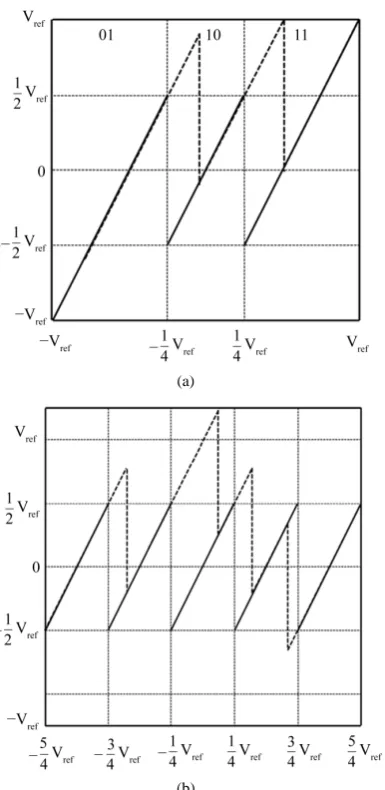
Figure 1(a) shows the residue plot of the traditional 1.5- bit/stage ADC. In Figure 1(a), two ideal threshold vol- tages are −Vref 4 and Vref 4 shown with dotted lines.
The coded range is from −Vref to Vref. The residue plot
of a real ADC with comparator offsets is shown using dashed lines. In this case, the maximum comparator off-set is Vref 4 and the corresponding maximum output
equals to Vref. Since the output of the current stage is the
input of the next stage, and the input range is from −Vref
to Vref, the out of range output leads to code loss. In
order to prevent the ADC from code loss, the comparator offsets should be within the range of −Vref 4∼Vref 4.
Figure 1(b) shows the residue plot of the proposed 1.5-bit/stage ADC. Here, the ideal threshold voltages are
ref
3V 4
(a)
[image:2.595.79.272.81.477.2](b)
Figure 1. (a) Residue plot of the traditional 1.5-bit/stage ADC and (b) residue plot of the five-domain 1.5-bit/stage ADC.
range is from −5Vref 4 to 5Vref 4. By adding two
comparators with comparison voltages of −3Vref 4 and ref
3V 4 to the lower and upper sides of traditional 1.5- bit/stage ADC, the analog quantify domain is a five-do- main rather than a three-domain; therefore, this proposed configuration is referred to as a five-domain 1.5-bit/stage ADC. Like in Figure 1(a), the residue plot of a real ADC with comparator offsets in Figure 1(b) is shown in the dashed lines. In this case, the maximum comparator off- set is 3Vref 8 and the corresponding outputis 5Vref 4.
Since the input range is changed to −5Vref 4∼5Vref 4,
the comparator offsets that the developed ADC can tole- rate without code loss should be within the range of
ref ref
3V 8 3V 8
− ∼ .
However, the traditional 1.5-bit/stage ADC can only correct the comparator offsets within ±Vref 4. In this
research, a five-domain 1.5-bit/stage ADC is developed
to increase the comparator offset correction ability to
ref
3V 8
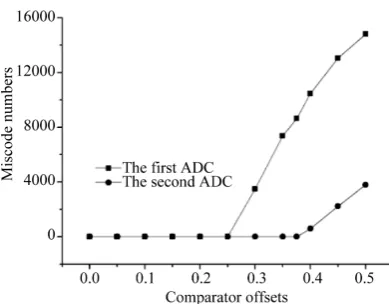
± with an added overflow/underflow judgment. Two Matlab behavioral simulations are used to illustrate the improvement of the comparator offset correction ability for the proposed ADC. The first ADC behavioral simulation includes eight traditional 1.5-bit/stage con- verters followed by a flash ADC, and the second ADC behavioral simulation includes eight trial 1.5-bit/stage converters also followed by a flash ADC. In these simu- lations, the absolute values of the comparator offsets are set between 0 and 0.5Vref . In order to control and nar- row research findings, all 1.5-bit/stage ADCs are only- complicated by the comparator offsets. In addition, the flash ADCs setting are ideal. In these simulations, the total number of conversions is 2 . The total miscode 14 numbers, and their related comparator offsets, are show in Figure 2. According to Figure 2, for the ADC based on the traditional digital error correction technique, mis- codes occur when the absolute values of the comparator offsets are higher than Vref 4. By comparison, no mis- codes occur for the absolute values of the comparator offsets lower than 3Vref 8 , for the ADC based on the proposed algorithm.
The transfer function of the traditional 1.5-bit/stage pipeline ADC is given by the following equation [14]:
in ref
out in ref
in ref
2 1 , 01
2 0 , 10
2 1 , 11
V V D
V V V D
V V D
+ =
= + =
− =
. (1)
The transfer function of the proposed five-domain 1.5- bit/stage pipeline ADC is given by the following equa- tion:
in ref
in ref
out in ref
in ref
in ref
2 2 , 000 2 1 , 001 2 0 , 010 2 1 , 011 2 2 , 100
V V D
V V D
V V V D
V V D
V V D
+ =
+ =
= + =
− =
− =
. (2)
Figure 2. Miscode numbers for various comparator offsets.
Stage 1 Stage 2 Stage 3 Flash ADC
Add 1 to the left side
Minus 1
Dislocation-add and minus 1
Dislocation-add and digital error correction logic 3b
4b
4b 3b
5b 3b 2b
[image:3.595.63.285.259.428.2]10b
Figure 3. Five-domain 1.5-bit/stage ADC algorithm process.
range; otherwise when they are “10”, the remaining ten bits are usable digital output bits.
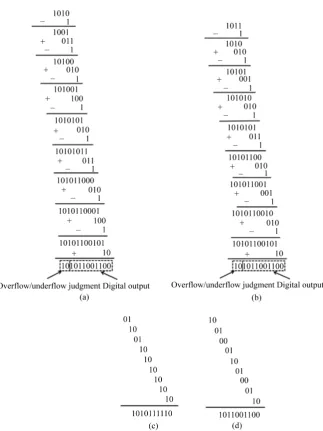
The proposed algorithm of the ADC, shown in Figures 4(a) and 4(b), uses Vref of 1 V and the input voltage of
0.4 V. The traditional algorithm is shown in Figures 4(c) and 4(d) uses the same Vref and input values. To
pre-vent the influences from flash-ADCs, all of the threshold voltages are set to be the ideal. In Figure 4(a), the abso-lute values of comparator offsets are set to be 3Vref 8 . In this case, for the first eight stages, the threshold vol-tages are
(
−3 4 3 8−)
Vref,(
−1 4 3 8−)
Vref ,(
1 4 3 8+)
Vref , and(
3 4 3 8+)
Vref for all of the comparators. The first two bits are “10” indicating that the remaining ten bits are usable output codes. In Figure 4(b), all the comparators do not suffer from comparator offsets. Figure 4(c) shows the process- ing of output codes based on the traditional digital error correction technique with the comparator offsets the same as Figure 4(a), but the threshold voltages are(
−1 4 3 8−)
Vref and(
1 4 3 8+)
Vref. Figure 4(d) shows the processing of output based on the traditional tech- nique with the comparator offsets set to be zero. These three cases, Figures 4(a), 4(b), and 4(d), have the correctdigital output, while Figure 4(c) is different from the other three because the traditional technique cannot cor-rect the absolute values of comparator offsets higher than |Vref/4|.
The circuit level implementation of Equation (2) is given by
1 2 2
in dd
1 1
1 2 2
in ref
1 1
1 2 2
out in
1 1
1 2 2
in ref
1 1
1 2 2
in dd
1 1
, 000
, 001
, 010
, 011
, 100
C C C
V V D
C C
C C C
V V D
C C
C C C
V V GND D
C C
C C C
V V D
C C
C C C
V V D
C C + + = + + = + = + = + − = + − = (3)
In Equation (3), the two capacitors are equal. When the required gain is one, the circuit level realization is the same as the traditional technique, and capacitor C2 con-
nects to the corresponding reference voltage. However, a gain of two for Vref cannot be realized through the tra-
ditional technique since one of the capacitors is the feedback capacitor. The maximum gain for Vref is the
non-feedback capacitor divided by the feedback capaci- tor, which is one. To extend the domain, a new method is proposed. In this new method Vdd need to be set to twice the Vref. The first and the last equations of (3) are
1 2 2
in dd in ref
1 1
2 1 2
C C C
V V V V
C C
+
+ = × + × × . (4)
1 2 2
in dd in ref
1 1
2 1 2
C C C
V V V V
C C
+ − = × − × ×
. (5)
Figures 5(a) and 5(b) are the circuit configurations based on the traditional technique and the proposed algo-rithm, respectively. Vref is simplified by Vr in the
fig-ures. Although the actual configurations are fully dif- ferential, the sing-ended the configurations are shown for simplicity. When Φ is high, the converters work on the 1
sample phase, input is sampled on the two capacitors simultaneously. When Φ is high, they work on the 2
amplification phase, the feedback capacitor C1 connects
to the output and the non-feedback capacitor C2 con-
nects to the corresponding reference voltage.
[image:3.595.342.537.487.553.2]Figure 4. (a) Example of the proposed algorithm with the comparator offset of 3Vref/8; (b) Example of the proposed algorithm
with no comparator offset; (c) Example of the traditional algorithm with the comparator offset of 3Vref/8; (d) Example of the
traditional algorithm with no comparator offset.
[image:4.595.68.535.565.709.2]ferential, −Vref can be realized by connecting the
ground to the positive input side of the amplifier and the
ref
V to the negative input side of the amplifier in both configurations. The realization of −Vdd is similar to the
realization of −Vref. In the digital domain, only several
dislocation and subtraction blocks need to be added.
3. Simulation Results
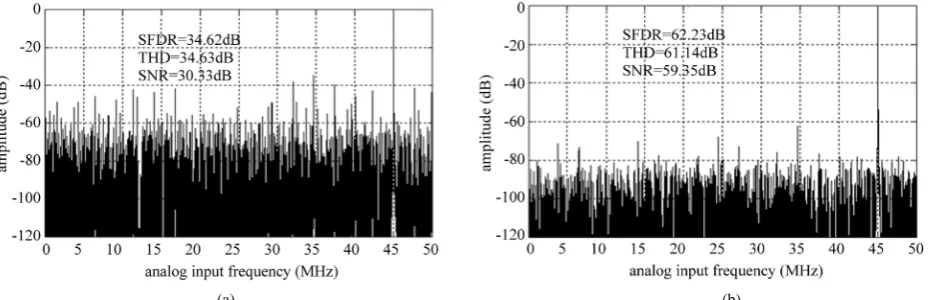
In order to demonstrate the effectiveness of the domain extension algorithm, a 10-bit pipeline ADC was simu- lated in MATLAB. The ADC consisted of eight five- domain 1.5-bit/stage converters and a 2-bit flash ADC. In the simulation, all absolute values of comparator offsets were set to 3Vref 8 , input frequency was set to 45-MHz, and sample rate was set to 100-MS/s. The Fast Fourier Transform (FFT) plot of this simulation using the tradi- tional method is shown in Figure 6(a). The dynamic performance as shown in the FFT plot is recorded as 34.62-dB SFDR, 34.63-dB THD, and 30.33-dB SNR. Figure 6(b) shows the FFT plot using the domain exten- sion algorithm. In this case, the ADC achieves a dynamic
performance of 60.23-dB SFDR, 61.14-dB THD, and 59.35-dB SNR. The resulting improvements are then 25.61-dB, 26.51-dB, and 29.02-dB for SFDR, THD, and SNR respectively.
The simulated dynamic performance of the ADCs at an 100-MS/s sample rate and a 45-MHz input frequency is summarized in Figure 7. The absolute values of the comparator offsets are from 0 to 0.4Vref . As shown in Figure 7(a), SFDR, THD, and SNR decrease minimally from the low comparator offsets to the absolute values of comparator offsets of Vref 4. However, they decrease significantly when the absolute values of comparator off- sets are higher than Vref 4, because the traditional dig-ital error correction technique can only correct the abso- lute values of compactor offsets lower than Vref 4. As shown in Figure 7(b), SFDR and THD decrease mini- mally from the low comparator offsets to the absolute values of comparator offsets of 3Vref 8 , because the lease significant bit (LSB) cannot be corrected and the bit error rate (BER) increases with the increased comparator offsets.
[image:5.595.68.533.358.508.2]
(a) (b)
Figure 6. FFT plots of a 10-bit pipeline ADC using (a) the traditional digital error correction technique and (b) the proposed algorithm.
[image:5.595.100.496.552.707.2]4. Conclusion
The decrease of the transistor geometry causes proble- matic mismatches in width, length and threshold voltage, which leads to significant comparator offsets. These comparator offsets, in turn, greatly limit the performance of ADCs. However, the traditional digital error correc- tion technique can only correct the absolute value of comparator offsets lower than Vref 4 . Therefore, in order to improve the comparator offset toleration ability, a domain extension algorithm has been presented, which can correct the absolute value of comparator offsets with- in 3Vref 8 . This new approach involves minor analog and digital modifications and increases the comparator offset toleration ability by 50% with overflow/underflow judgment. Simulation results have revealed significant improvements of SFDR, THD and SNR performance.
REFERENCES
[1] B. Peng, H. Li, P. Lin and Y. Chiu, “An Offset Double Conversion Technique for Digital Calibration of Pipelin- ed ADCs,” IEEE Transactions on Circuits and Systems-II:
Express Briefs, Vol. 57, No. 12, 2010, pp. 961-965. [2] C. Tsang, Y. Chiu, J. Vanderhaegen, S. Hoyos, C. Chen,
R. Brodersen and B. Nikolic, “Background ADC Calibra- tion in Digital Domain,” Proceedings of IEEE Custom Integrated Circuits Conference, San Jose, 21-24 Septem- ber 2008, pp. 301-304.
[3] Y. Chiu, C. W. Tsang, B. Nikolic and P. R. Gray, “Least Mean Square Adaptive Digital Background Calibration of Pipelined Analog-To-Digital Converters,” IEEE Transac- tions on Circuits and Systems I: Regular Papers, Vol. 51, No. 1, 2004, pp. 38-46.
http://dx.doi.org/10.1109/TCSI.2003.821306
[4] W. Liu, P. Huang and Y. Chiu, “A 12b 22.5/45MS/s 3.0 mW 0.059 mm2 CMOS SAR ADC Achieving over 90 dB SFDR,” Proceedings of IEEE ISSCC Digest of Technical Papers, San Francisco, 7-11 February 2010, pp. 380-382. [5] J. McNeill, M. C. W. Coln and B. J. Larivee, “‘Split ADC’
Architecture for Deterministic Digital Background Cali- bration of a 16-Bit 1-MS/s ADC,” IEEE Journal of Solid- State Circuits, Vol. 40, No. 12, 2005, pp. 2437-2445.
http://dx.doi.org/10.1109/JSSC.2005.856291
[6] J. Li and U.-K. Moon, “Background Calibration Tech- niques for Multistage Pipelined ADC’s with Digital Re- dundancy,” IEEE Transactions on Circuits and Systems II,
Analog & Digital Signal Processing, Vol. 50, No. 9, 2003, pp. 531-538.
[7] J. A. McNeill, S. Goluguri and A. Nair, “‘Split ADC’ Di- gital Background Correction of Open-Loop Residue Am- plifier Nonlinearity Errors in a 14b Pipeline ADC,” Pro- ceedings of IEEE ISCAS, New Orleans, 27-30 May 2007, pp. 1237-1240.
[8] L.-H. Hung and T.-C. Lee, “A Split-Based Digital Back-ground Calibration Technique in Pipelined ADCs,” IEEE Transactions on Circuits and Systems-II: Express Briefs, Vol. 56, No. 11, 2009, pp. 855-859.
[9] M. Taherzadeh-Sani and A. A. Hamoui, “Digital Back-ground Calibration of a 0.4-pJ/step 10-Bit Pipelined ADC without PN Generator in 90-nm Digital CMOS,” Pro-ceedings of IEEE Asian Solid-State Circuits Conference, Fukuoka, 3-5 November 2008, pp. 53-56.
[10] J. P. Keane, P. J. Hurst and S. H. Lewis, “Background Interstage Gain Calibration Technique for Pipelined ADCs,” IEEE Transactions on Circuits and Systems I:
Regular Papers, Vol. 52, No. 1, 2005, pp. 32-43. http://dx.doi.org/10.1109/TCSI.2004.839534
[11] S. Yang, J. Cheng and P. Wang, “Variable-Amplitude Dither-Based Digital Background Calibration Algorithm for Linear and High-Order Nonlinear Error in Pipelined ADCs,” Microelectronics Journal, Vol. 41, No. 7, 2010, pp. 403-410.
http://dx.doi.org/10.1016/j.mejo.2010.04.012
[12] H. S. Lee, “A 12-b 600 ks/s Digitally Self-Calibrated Pipe- lined Algorithmic ADC,” IEEE Journal of Solid-State Circuits, Vol. 29, No. 4, 1994, pp. 509-515.
http://dx.doi.org/10.1109/4.280701
[13] B. Razavi and B. A. Wooley, “A 12-b 5-Msample/s Two- Step CMOS A/D Converter,” IEEE Journal of Solid-State Circuits, Vol. 27, No. 12, 1992, pp. 1667-1678.
http://dx.doi.org/10.1109/4.173092