A corpus-based study of interaction
between Chinese perfective -le and situation types
Zhonghua Xiao, Lancaster University
Mandarin Chinese as an aspect language (Norman, 1988:163) has a rich inventory of aspect markers,
including perfective -le
1, -guo and imperfective -zhe, zai. Of these -le is the most studied marker
because of its mysterious behaviors. For example, is it necessary to differentiate between the perfective
-le and the COS le? Does -le indicate completion or termination? Are there any constraints on the
interaction of -le with various situation types? All of these issues have aroused much controversy
because different authors have invented different “acceptable” examples to support their arguments.
Many of these examples, however, are rarely found in real language, though they are good for the
purpose of argumentation.
In this study, I will take another approach to address these issues and find evidence from authentic
language data. An L1 Chinese corpus of 124,164 Hanzi (Chinese characters) was compiled for this
purpose. The corpus was first automatically segmented and POS-tagged, and post-editing was
conducted by hand for the tagging of the marker LE to ensure consistency and accuracy. Then all the
clauses containing -le and le are extracted into two databases and the situation type of each instance is
judged on the basis of human decision. A total of 1,208 occurrences of LE are found in our data, of
which 1019 are the perfective -le and 166 are the COS le. In the other 23 instances where LE appears
in the sentence-final position, the morpheme has the dual function indicating both perfectivity and
change of state. Other functions of LE, e.g., as a full verb, as a modal particle and as a bounded
morpheme, are also found in the corpus. Because they are irrelevant to our study here, these functions
are not counted. The high frequency of LE and its rich functions justify this corpus as a good basis for
the case study of this morpheme, albeit the small corpus size.
This paper is concerned with the three questions raised at the beginning and is organised as follows:
Section 1 discusses the one-morpheme approach vs. the two-morpheme approach; Section 2 considers
the type of closure indicated by the perfective -le; Section 3 examines the interaction between the
perfective -le and situation types and Section 4 concludes.
1. Verbal
-le
vs. sentential le
There is an unanimous agreement that -le is a perfective aspect marker (e.g., Chao, 1968; Henne &
Rongen & Hansen, 1977; Smith, 1991, 1997; Zhang, 1995, Dai, 1997). Yet much controversy arises
when it comes to whether the perfective -le and the COS le have the same functions. While the
two-morpheme approach focuses on their differences in terms of syntactic distributions, semantic
functions, and etymological sources, the one-morpheme approach focuses on their semantic
similarities. Zhang (1995: 120), for example, supports the unified treatment of LE and describes its
major functions as denoting a change of state by termination and establishing a boundary between two
different situations. However, despite her explicit favour for the one-morpheme approach, she has to
turn to the two-morpheme approach to explain the interchangeability of -le and -guo (see Zhang,
1995:217-219).
I argue in favour of the two-morpheme approach. As suggested above, the perfective -le and the COS
le differ in terms of syntactic distributions, semantic functions, and etymological sources. The terms
“verb-final suffix” -le and “sentence-final particle” le (Li & Thompson, 1981) best illustrate their
difference in syntactic distributions. Syntactically, the perfective -le occurs post-verbally while the
COS le appears in post-sentential position. However, when an intransitive verb
2takes the sentence
final position, we have to take into account the different semantic functions of the two morphemes to
determine which LE we have in front of us. The perfective -le focuses the actualisation of a situation
and presents it as a whole; the COS le, on the other hand, mainly indicates a change into a new
situation and signals its current relevance
3. There are three possibilities for LE taking the sentence
1
In this study, the morpheme LE in the verb-final position indicating perfectivity is glossed as -le while that in the sentence-final position indicating change of state (COS) is glossed as le. The capitalised LE refers to either.
final position. It can be either the COS le if the sentence only allows a change-of-state reading, or the
perfective -le if the sentence only has a perfective reading, or it has dual function if the sentence has
both the change-of-state and perfective readings (c.f. Li & Thompson, 1981:296). In this last case, the
additional COS le is absorbed into the first perfective -le, as Chinese “always avoids a repetition of the
same syllable by way of haplology: -le le”(Chao, 1968:247)
4.
Historically, the perfective -le and the COS le developed at different stages of evolution. The COS le
is derived from the verb liao “to finish, to come to an end” (the same syllable with a different
pronunciation), as in siliao “to settle out of court ”. When its sentence-final function was well
established, it also developed a use in which it appears directly after the main verb (whether or not it
is sentence-final) functioning to signal perfectivity. Therefore diachronically, the COS le developed
earlier and gave rise to the perfective -le (c.f. Bybee, 1993:84-85). The evolution of these two
morphemes also furnishes evidence in favour of the two-morpheme approach: if they are the same and
one morpheme can function adequately, why is it necessary for the other to be derived?
The differentiation between the perfective -le and the COS le is also supported by the quantitative data
in our corpus. Of a total of 1,208 occurrences of LE, 1,019 (84.36%) are the perfective -le, 166
(13.74%) are the COS le, and in 23 instances (1.9%) the morpheme denotes both COS and
perfectivity. The ratio of the perfective -le over the COS le is 6.139. The higher frequency of the
former over the latter is predicated because our corpus mainly contain narrative discourses, of which
the perfective aspect is a prominent syntactic feature. Our finding here is in conformity with
Christensen (1994), who finds a ratio of 6.818 for the written narratives, as shown in Table 1 below:
Table 1: Frequency data for LE:
data
total
-le
le dual
-le/le
Our
corpus 1208 1019 84.36% 166 13.74% 23 1.90% 6.139
C’s written
86
75
87.21% 11
12.79%
0
6.818
The table shows that the perfective -le is more productive than the sentential le and dual-function LE.
Christensen’s written data show a higher frequency of -le because his data are purely narrative.
It can be seen from the discussions above that the perfective -le is different from the COS le in many
respects: (i) syntactically, -le appears in the verb-final position whereas le in sentence-final position;
(ii) semantically, -le signals perfectivity whereas le indicates change of state; (iii) etymologically, -le
is derived later than le, and (iv) empirically, -le is more productive than le. All of these argue strongly
for the two-morpheme approach.
2.
Completion vs. termination
Another issue which is as controversial as the one discussed above is the type of closure signalled by
the perfective -le. Traditionally, the perfective -le is considered to indicate completion of the action
denoted by the verb. Chao (1968:247), for example, argues that the verbal -le has the class meaning of
“completed action”. Following Chao, Henne & Rongen & Hansen (1977:117) claim -le indicates “the
completed action of the verb to which it is attached”. Similar views can also be found in Zhu (1981),
Lü (1981:314-321) and Tiee (1986:96). But the traditional view cannot account for the puzzle in (1)
below:
(1a)
zhe-ben xiaoshuo wo kan-le san-tian
this-CL novel I read-le three-day
I read the novel in three days (I finished reading it).
(1b)
zhe-ben xiaoshuo wo kan-le san-tian le
this-CL book I read-le three-day le
I have been reading this book for three days (I haven’t finished reading it).
4 According to Chao (1968), in certain dialects such as Cantonese and the Wu dialects, there are separate morphemes to indicate
Clearly (1a) and (1b) have different aspectual meanings. While the former indicates the completion of
the reading event, the latter gives no such indication. If LE indicates completion, “why a completed
reading is derived when one LE is used, but it is not allowed when an additional LE is used?”
5Interestingly, all of the scholars quoted above relate completion to the action of a verb rather than a
situation. Their approach is clearly incompatible with the definition of the aspect
6. In fact, the
compositional nature of aspect is widely observed in the literature (e.g., Verkuyl, 1972; 1993; Smith,
1991; 1997; Brinton, 1988). Therefore the aspectual value of a situation is contributed to by the
semantic features of all sentential elements, though a verb plays an important role.
More recent studies, however, realize that the perfective -le does not necessarily indicate completion.
While perfectives with a resultative verb complement (RVC) unequivocally indicate completion,
“simple perfectives” (Smith, 1997:264)
sentences with -le alone but without RVCs
only present
situations without indication of the closure type
7(Smith, 1988:216,218; Tai, 1984:291-292; Chu,
1976: 48). This view has won growing popularity in the literature (e.g., Li & Thompson,
1981:215-216; Zhang, 1995: 115-116; Christensen, 1994; Smith , 1997: 264-265; Dai, 1997: 21).
While I agree to this recent view in principle, I argue that the type of closure indicated by -le is not so
arbitrary as Smith (1988:228) claims: “Semantically, sentences without completive RVCs do not
present a completed event; but pragmatically, they often do just that.” Such arbitrariness has led to
much confusion in her own studies. Let us consider Smith’s examples (1988:218-219):
(2a)
wo zuotian xie-le yi-feng xin
I yesterday write-le one-CL letter
I wrote a letter yesterday.
(2b)
*wo zuotian xie-le yi-feng xin, keshi mei xie-wan
I yesterday write-le one-CL letter, but not write-finish
Lit.: I wrote a letter yesterday, but didn’t finish it.
(2c)
wo zuotian xie-wan-le yi-feng xin
I yesterday write-finish-le one-CL letter
I finished writing a letter yesterday.
Smith (1988:218) argues that sentences like (2a) “present events as terminated but not necessarily
completed”, but in Smith (1997) she contradicts her own assertion by admitting that in fact, the most
natural interpretation of (2a) would be that the letter was finished, though in order to remedy the
self-contradiction, she adds immediately that “the completive interpretation is conversationally only: it can
be cancelled by other information” (1997:265), as shown in (2b). But I argue that (2b) in fact sounds
unacceptable semantically, if not grammatically, to a native ear (c.f. also Teng, 1986). And like (2c)
in which -le co-occurs with the RVC -wan “to finish”, (2a) also indicates the completion of the
writing event, i.e., the letter was finished. If we followed Smith’s assumption that completive readings
denoted by “simple perfectives” can be cancelled, we would have the following absurd situation:
(3)
*shanggeyue ta sheng-le yi-ge nanhai, keshi mei sheng-wan
last month she give:birth-le one-CL boy but not give:birth-finish
Lit.:
Last month, she gave birth to a baby boy, but did not finish it.
It is true that “simple perfectives” may indicate either completion or termination, but the type of
closure depends on the type of situation. That is, telic situations
8are presented as completed whereas
atelic situations are presented as terminated. When a telic situation is presented perfectively as a
single unanalysable whole, its inherent final endpoint is naturally included, thus resulting in a
completive reading. On the other hand, an atelic situation does not have an inherent end point, so
when it is presented perfectively, only an arbitrary final endpoint is included, and thus a terminated
reading is appropriate. (2b) above will become acceptable if the quantified direct object is replaced by
a bare noun
9, as shown in (4):
5 Translated from Dai’s (1997:21) quotation of Lü (1961) “The current task for researchers of Mandarin Chinese.”
6 In our model, we follow Smith’s (1997:1) and define aspect as “the semantic domain of the temporal structure of situations and their
presentation.”
7
Chu (1976), in his study of action verbs, also finds that the structure of “action verb+-le” only indicates active attempt and actual performance rather than attainment of goal, while the structure of “action verb+RVC” indicates all of the three.
8
Telic/atelic distinction is an important distinguishing feature for aspectual classification. A situation is telic if it has an inherent spatial final endpoint.
9 As there is no articles in Chinese, and the plural suffix -men is syntactically optional, bare nouns in Chinese can be regarded as bare
(4)
wo zuotian xie-le xin, keshi mei xie-wan
I yesterday write-le letters but not write-finish
I wrote letters yesterday, but I didn’t finish them.
The acceptability of (4) can be explained as follows. In this sentence, the object xin “letters” is a bare
noun, which is at best ambiguous between specific and non-specific readings. When it interacts with
the accomplishment verb xie “to write”, the resulting situation can be naturally understood as atelic.
Thus the situation conveyed by the first clause in (4) has a terminated reading and further assertion
can be made that the letters were not finished.
The above analysis suggests that the type of closure indicated by the perfective -le is related to
situation types. Smith (1988: 218) also realizes this point when she claims:
The choice between termination and completion arises only with telic events, of course. Atelic events have no other possibility besides termination.10
While agreeing to the second part of this claim, I argue that no choice is open to telic situations either.
That is, for telic situations, only completive readings are possible. Let us examine the three
examples
11Smith (1988) uses to support her claim.
(5a)
Zhangsan xue-le Fawen, keshi mei xue-hui
Zhangsan study-le French but not learn-know
Zhangsan studied French, but he still didn’t know it.
(5b)
*wo mai-le san-ben shu, keshi mei mai-dao
I buy-le three-CL book but not buy-succeed
Lit.: I bought three books, but I didn’t buy them.
(5c)
Zhangsan zhao-le ta de shoubiao, keshi mei zhao-dao
Zhangsan look:for-le he DE watch but not look:for-succeed
Zhangsan looked for his watch, but he didn’t find it.
The first point to be noted here is that Smith asserts that completive readings in (5a)-(5c) are
cancelled by the conjuncts (Smith, 1988:288). On a closer examination, however, we find xue Fawen
“study French” and zhao ta de shoubiao “look for his watch” are both atelic events, because only
xue-hui Fawen “to learn French” and zhao-dao tade shoubiao “to find his watch” are telic (c.f. Smith,
1988:220, 234; Tai, 1988: 290). If in (5a) and (5c) -le did signal completive readings which were
cancelled by the conjuncts, Smith would be contradicting her own claim quoted above that only
termination is possible for atelic situations. Secondly, while Smith is right in saying that the first
clauses in (5a) and (5c) do not have completive readings, she is wrong in the case of (5b). For the
same reason discussed in the analysis for (2) above, mai san-ben shu “buy three books” in (5b) is a
telic event, and thus its completive reading cannot be cancelled. Therefore, this is an invalid example
to serve her purpose. Smith is on the right track when she realizes that “because telic events involve
completion, they may be used to implicate completion” (Smith, 1988:228). But regrettably, she
attributes the final decisive role of the closure type to pragmatics.
Tai (1984: 291-292) also observes that “Vendler’s examples of accomplishment expressions such as
‘to paint a picture’ and ‘to write a letter’ may or may not imply attainment of goal in Chinese”
(ibid:291). Tai’s observation is true to the fact, but the reason he provides for this
“depending on
the particular context which a native speaker happens to be in” (ibid:291)
is not. It is argued here
that the closure types of these situations depend on how we translate these phrases. If we translate “to
paint a picture” as huahua and “to write a letter” as xiexin, then they are atelic. When they are
presented perfectively with the verbal -le, only terminated readings are possible; but if we translate “to
paint a picture” as hua yi-fu hua and “to write a letter” as xie yi-feng xin, then they are telic situations
and only allow completive readings when presented perfectively
12.
Tai (1984:291) argues that sentences like (2a) may imply the attainment of goal “for many native
speakers”, but sentences like (2b) “suffice to show the implication is not absolute.” Tai’s argument is
10 But regrettably, even this claim is negated later by herself: “But in Chinese perfectives termination and completion are expressed
separately for all situation types” (1997:73), which in turn is contradicted by her own assertion that accomplishments may be either terminated or completed with simple perfective viewpoint (1997:264).
11 This pair of examples are taken from (Smith 1988:220). But the English translations of (a) and (c) are modified, because in (a),
according to Tai (1984:290-291), xue and hui in Chinese can find equivalents in English: “study” for xue and “learn” for xue-hui. While xue and “study” are atelic, xue-hui and “learn” are telic. In (c), the same applies: while zhao and “look for” are atelic, zhao-dao and “find” are telic.
even less convincing than Smith’s claim that “the completive interpretation is conversational only”
(1997:265). One problem with Tai’s argument is its unreliable theoretical basis. “For many native
speakers” is a rather vague concept: how many? what percentage? Unfortunately Tai has not made a
demographic survey. Another problem is the acceptability of his counter-examples. As noted above,
sentences like (2b) are in fact unacceptable semantically. If Tai had followed the convention of
treating Chinese as a “non-article” language and had not translated these two phrases so literally, he
might have come to the point.
Our argument for the correlation between closure type and situation type
13does not go far away from
Smith (1988:218), because she also agrees that atelic events
14can only be interpreted as terminated.
We differ in our treatment of telic events. Smith’s accomplishments are of two types: one is the simple
form like xie yi-feng xin “to write a letter”, the other is the RVC form like xie-wan yi-feng xin “to
write-finish a letter”. Her second type of accomplishment falls within the category of achievements in
our model
15. As an achievement encodes result in itself and is punctual by nature, it is expected that
once such a situation is realised, it is completed. This prediction is supported by the empirical
evidence. Of the 510 achievements taking the perfective -le found in our corpus, all have completive
readings without exception. Here are some examples:
(6a)
na jiahuo shao-cheng-le hui, wo ye neng ren-chulai (File 9558601)
that guy burn-become-le ash I too can recognise
Even if that guy was burnt into ashes, I would recognize him.
(6b)
ta...zhidao yu-shang-le gaoshou (File 9560501)
he...know encounter-le master-hand
He knew that he had encountered a master-hand.
Our difference with Smith in this respect revolves around the closure type of accomplishments (her
simple form accomplishments) when they take the perfective -le. My argument is that
accomplishments can only be interpreted as completed, whereas Smith assumes that this type of
situation may have a choice between termination and completion. This assumption, however, is
ungrounded, because the counter-examples she uses for the contradiction test, e.g., (2b) and (5b), are
semantically unacceptable. Smith’s assumption also lacks empirical evidence. Even if her intuition is
correct when she invents such examples, these utterances are not supposed to be found in real
language. In our corpus data, all of the 326 accomplishments taking the perfective -le can only allow
completive readings. Let us consider an example cited from the corpus:
(7a)
wo jimang yi gaojia zhu-le yiliang Beijing jipuche, zhishi Wangzhuang (File
9560601)
I hurriedly with high:price hire-le one-CL Beijing jeep direct:drive Wangzhuang
I hurriedly hired a “Beijing” jeep at a high price, and headed direct for Wangzhuang.
(7b)
*wo jimang yi gaojia zhu-le yiliang Beijing jipuche, keshi mei zhu-dao
I hurriedly with high:price hire-le one-CL Beijing jeep but not hire-succeed
Lit.:
I hurriedly hired a “Beijing” jeep at a high price, but didn’t succeed hiring it.
The situation “I hired a Beijing jeep” in (7a) is an accomplishment presented perfectively. (7b) shows
that even if a conjoined second clause could cancel its completive reading, the second clause would
clash with some other sentential element, i.e., “at a high price”. We normally assume that when the
price is settled, the deal is done. Furthermore, if the completive reading of the actualised
accomplishment could be cancelled, there would be no subsequent event “headed for Wangzhuang”.
Therefore, our argument for the positive relation between telicity value of a situation and its closure
type is supported by both theoretical analysis and empirical evidence.
3. Interaction
between
-le and situation types
Before we go on to examine the interaction between the perfective -le and situation types, it is
necessary to make a brief introduction to our aspect model. Following Smith (1991; 1997), aspect is
taken to have two components, namely, situation aspect and viewpoint aspect. The former is
concerned with the inherent temporal features of a situation while the latter provides a perspective to
view the situation. Aspect is the synthetic result of these two components.
13
Pan (1993) also observes that “different situation types influence the interpretation of perfective”, with an accomplishment, -le indicates that the event started and finished later; with an activity, -le indicates it started and terminated later.
In our model, situation aspect is concerned with both the lexical and the sentential levels. This
two-level approach is different from Vendler (1967) and Smith (1991, 1997). At the lexical two-level, verbs are
grouped into six classes based on five distinguishing features
16, as shown in Table 2:
Table 2: Feature matrix system of verb classes:
classes [±dynamic] [±durative] [±bounded] [±telic] [±result]
activities + + − − −
semelfactives + − ± − −
accomplishments + + + + −
achievements + − + + +
individual-level states − + − − −
stage-level states ± + − − −
These verb classes interact with their arguments and adjuncts at three different levels according to the
following rules:
A: Lexical
level:
Rule 1: Verb
[−telic/±bounded]+ RVCs
⇒
Derived Verb
[+result/+telic]Rule 2: Verb
[−telic/±bounded]+ reduplicant
⇒
Derived Verb
[+bounded]B:
Core sentence level:
Rule 3: NP+Verb
[+telic]+ NP
[αcount]⇒
Situation
[αtelic]17Rule 4: NP
[αcount]+ Verb
[+telic](+ NP)
⇒
Situation
[αtelic]Rule 5: NP+Verb
[–telic]+PP
[Goal]⇒
Situation
[+telic]C: Full
sentence
level:
Rule 6: Core-sentence
[−bounded]+for-PP/from...to
⇒
Full-sentence
[+bounded]Rule 7: Core-sentence
[+telic]+for-PP/from...to
⇒
Full-sentence
[−telic]Rule 8: Core-sentence
[±bounded]+Quantity NPs
⇒
Full-sentence
[+bounded]Rule 9: Core-sentence
[+telic]+Progressive
⇒
Full-sentence
[−telic]Rule 10: Core-sentence
[−result]+ ba/bei-construction
⇒
Full-sentence
[+result][image:6.595.90.516.474.639.2]
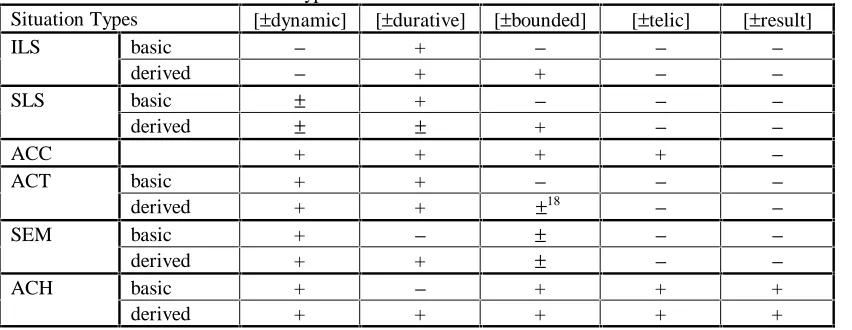
The interaction at these levels result in six basic situation types and five derived types as shown
below:
Table 3: Feature matrix of situation types:
Situation Types
[
±
dynamic] [
±
durative] [
±
bounded] [
±
telic] [
±
result]
ILS basic
−
+
−
−
−
derived
−
+ +
−
−
SLS basic
±
+
−
−
−
derived
±
±
+
−
−
ACC
+
+
+
+
−
ACT basic
+
+
−
−
−
derived
+
+
±
18−
−
SEM basic
+
−
±
−
−
derived
+
+
±
−
−
ACH basic
+
−
+ + +
derived
+
+
+
+
+
16 In addition to the three traditional ones, two new features, [±bounded] and [±result], are introduced to separate verb classes from
situation types. Both telicity and boundedness are related to final endpoint, but the former is spatially defined while the latter is temporally defined. The feature of [±result] refers to whether or not a verb encodes result in itself.
17α is a variable with the value of either plus or minus. +Count] NPs should be understood as singular or specific plural countable
NPs or “quantised” arguments in Krifka’s (1987, 1989) terms, while [-count] NPs include mass nouns and bare plurals. The [±count] distinction is similar to Smith’s count/mass opposition or Verkuyl’s (1993) [±SQA].
18 Derived activities have the value of [±bounded] because they represent a complicated categories. When basic activities are
It should be noted that situations types discussed here are the final result of composition processes at
the full-sentence level. When basic states and activities are temporally bounded by delimiting
mechanisms, bounded states and bounded activities come as a result. Derived activities can also be
obtained from accomplishments taking the progressive, semelfactives occurring the progressive or
temporal adverbials indicating indefinite time frame, and achievements taking the progressive or
[
−
count] NPs. Accomplishments do not have derived situation type
19. The basic semelfactives have
single-event reading; when they occur with quantity NPs or temporal adverbials indicating definite
time frame, they become derived semelfactives. When basic achievements take [+count] NPs, derived
achievements come as a result. Having discussed the temporal features of situation types, we are now
in a position to examine the interaction between the perfective -le and situation types.
More recently, this topic has attracted much interest. Smith (1997:70,264) and Pan (1993), for
example, assert that the perfective -le is not available to states. Pan (1998) becomes aware of the
distinction between stage-level and individual-level predicates and corrects his generalization as
“perfective marker -le can be used only with stage-level predicates which include some of the
statives”. “Some of the statives” here refer to stage-level states (SLS) like ta bing-le san-tian “He was
ill for three days”. Smith and Pan’s assertions suggest that the perfective -le is sensitive to the feature
of dynamicity.
On the other hand, Li (1999) argues that the perfective -le only appears in telic situations
20like
accomplishments and achievements, but not in atelic situations like states and activities
21. Yang
(1995) is aware of the different natures of spatial and temporal endpoints. She argues that all
situations with a spatial final endpoint (i.e., telic situations) can be presented with the perfective
viewpoint marked by -le. In addition, atelic situations (including states), when they are temporally
bounded by delimiting mechanisms, can also take the perfective -le. But without such delimiting
devices providing a temporal boundary, atelic situations cannot felicitously co-occur with -le. The
arguments made by these two authors suggest that the perfective -le is sensitive to spatial or temporal
endpoint.
[image:7.595.91.378.566.607.2]Yang’s observations appear to be closer to the fact, but her categorical statement that no [
−
bounded]
situation can take -le (ibid:115) is arguable, because our data does not allow for a clear-cut distinction.
Based on our corpus data, I argue the perfective -le is more sensitive to the feature of telicity and
boundedness than to dynamicity as Smith and Pan suggest. But the sensitivity is rather a matter of
degree. As can be seen in Table 3, activities and two types of states are inherently [
−
bounded] and
[
−
telic], while accomplishments and achievements are intrinsically [+bounded] and [+telic].
Semelfactives are [
−
telic] but shift between [+bounded] and [
−
bounded]. Therefore, we expect the
perfective -le to be more likely to co-occur with accomplishments and achievements. This prediction
is in fact borne out of the corpus data. A breakdown of the situations taking -le in the corpus is given
as follows:
Table 4: A breakdown of situations taking the verbal -le:
ILS SLS ACT SEM
ACC ACH Total
29 19 109 26 326 510 1019
2.85% 1.86% 10.70% 2.55% 31.99% 50.05% 100%
From these figures, it is clear that more than 80% of the total are telic situations. Furthermore, of the
atelic situations (accounting for around 18% of the total), more than half involve a temporal boundary
provided by delimiting devices. Specifically, 82 out of 109 activities, 16 out of 26 semelfactives, and 2
out of 19 SLS are temporally bounded, taking up 9.81% of the total. When these [+telic] and
[+bounded] situations are taken together, they account for more than 90% of the situations taking the
perfective -le in our data. The chi-square test shows that our result is highly significant. This indicates
19 Because the derived situation types of accomplishments have exactly the same feature values as their basic types, these two are
combined into one.
20
Although Li (1999) also uses the term “bounded”, she actually intends the term to mean “telic”, because in her model, “boundedness” actually refers to “the natural final point signaling change of state”.