Wavelet phase coherence analysis: Application to skin
temperature and blood flow
Andriy Bandrivskyy¶, Alan Bernjak∗, Peter McClintock¶ and Aneta Stefanovska∗
¶Department of Physics, Lancaster University, Lancaster LA1 4YB, UK
∗Group of Nonlinear Dynamics and Synergetics, Faculty of Electrical Engineering,
University of Ljubljana, Trˇzaˇska 25, 1000 Ljubljana, Slovenia
Abstract. The technique of wavelet phase coherence analysis is introduced and used to explore relationships between oscillations on blood flow and temperature in the skin of 10 healthy subjects. Their skin temperature and blood flow were continuously recorded: under basal conditions for 30 minutes; during local cooling of the skin with an ice-pack for 20 minutes: and 30 minutes thereafter. The group mean basal skin temperature of 33.4o
C was decreased to 29.2o
C during the cooling period, and had recovered to 32.1o
C by the end of the recording. The wavelet transform was used to obtain the time-frequency content of the two signals, and their coherence. It is shown that cooling increases coherence to a statistically significant extent in two frequency intervals, around 0.007 and 0.1 Hz, suggesting that these oscillatory components are involved in the regulation of skin temperature when cold is applied as a stress.
Keywords: Blood flow, skin temperature regulation, oscillations, time series anal-ysis, wavelets, phase coherence
1. Introduction
Analysis of time series is crucial to the understanding of complex sys-tems and how they work. The existence of complexity implies that several different processes are present in the system’s dynamics. Often, time series of two or more different variables can be measured. An ap-propriately chosen form of time series analysis may be able to establish the interrelationships, if any, between the time series and thus yield information relevant to the underlying processes that generate them.
The analysis of multivariate data of this kind has recently attracted much attention, including applications such as synchronization analysis (Pikovsky et al., 2001) and the detection of coupling direction (Rosen-blum et al., 2002; Paluˇs and Stefanovska, 2003). The methods suggested by these authors require, however, that distinct oscillatory modes are present and that they can be unambiguously distinguished in the time series under study.
as a few oscillatory modes (Stefanovska et al., 2001), not all the modes can be measured independently. In addition, partly on account of the finite time of observation, the low frequencies modes cannot easily be decomposed or separated from the noisy background. Additional com-plications are that signals from complex systems often involve modes at several frequencies and that the latter may themselves be time-variable. The cross-spectrum can be used to detect whether two processes involve oscillations within the same frequency region. However, the lim-itation of this technique lies in its inability to distinguish whether the oscillations at a given frequency are independent or mutually related. A different approach is therefore required, able to detect phase coherence in different frequency regions of two given signals. We use the term phase coherence here in the generalised sense that a phase difference between two oscillations is allowed provided that it remains constant throughout the whole time of observation.
In what follows, we apply a wavelet-based technique to detect phase coherence, enabling us to introduce a technique for studying interac-tions between skin blood flow and temperature regulatory mechanisms (Johnson et al., 1986; Shusterman et al., 1997; Nuzzaci et al., 1999).
2. Methods
2.1. Measurements
Simultaneous measurements were made of skin temperature and blood flow for 10 healthy subjects, 7 male and 3 female, aged between 24 and 62 years (median age 30), as follows. The subject relaxed supine on a bed for 15 minutes. A temperature sensor (Thermilinearr, YSI Incorporated, Ohio, USA) connected to a signal conditioning unit (Car-diosignals, Joˇzef Stefan Institute, Slovenia) and a laser-Doppler blood flow sensor (DP1T-V2 probe connected to DRT4, Moor Instruments, Axminster, Devon, UK) were placed together on the volar aspect of the forearm, positioned so as to avoid large blood vessels or blemishes, held in position with a double-sided adhesive annulus.
28 30 32 34
a )
temp (
°
C)
−0.02 −0.01 0 0.01
0.02 b )
0 20 40 60 80
4 8 12
time (min)
blood flow (AU)
c )
temp (
°
[image:3.595.175.421.94.252.2]C)
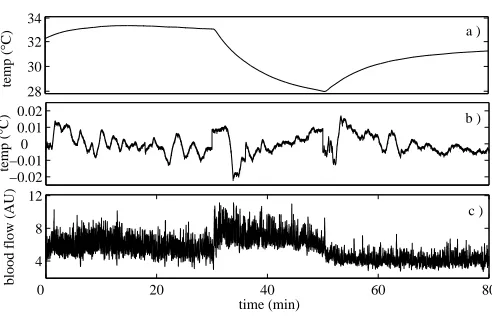
Figure 1. Temperature (a), its detrended value (b) and the skin blood flow (c) recorded on the volar side of the left arm as described in Sec. 2.1.
The resolution of temperature θ was 0.0003 oC within 20 < θ <40oC
using 16-bit bipolar A/D conversion scaled to ±5V. A typical set of data, measured in this way for one subject, is shown in Fig. 1.
2.2. Generalized phase coherence
To provide for time-frequency analysis of these bivariate data, we have developed a technique that makes use of the wavelet transform. It is based on the idea that the way of the splitting of the time interval T
(the whole length of time series) should be different for different basic frequencies ωk, and that the scaling of ωk should be logarithmic. The
continuous wavelet transform is defined as
X(ω, t) =
Z ∞
−∞
Ψω,t(u)x(u)du, (1)
where Ψω,tis a family of generally nonorthogonal basis functions. These
are obtained by scaling and shifting the basic window functionψ(u) in the time domain
Ψω,t = √
ω
√
2πψ( n−t
2π ω).
Different window functions can be used. We have chosen the Morlet wavelet. Its simplified expression in the time domain is
ψ(u) = √41
πe
−i2πue−u2
In numerical applications, frequency and time are restricted to dis-crete values only. An approximation of the continuous wavelet trans-form was calculated using a discrete wavelet family. The basic frequency is scaled according to ωk = ωk−11.05 and the time is discretised by tn = nτ;τ = 1s. The choice of the length of the window is a tradeoff
between good and bad resolution in frequency and time domains. In our case the length of the window was determined by the amplitude of the window. The boundary value of the window was reached, when it’s amplitude was smaller than 0.00001. For a discussion of wavelet analysis, its application to cardiovascular signals, and optimal choice of parameters, see the review by Braˇciˇc and Stefanovska (1998).
The complex spectral functionX(ωk, tn)=Xk,n=ak,n+ibk,ndescribes
the spectral properties of the signalx(t) in the time-frequency domain. For each time tn and frequency ωk amplitude |Xk,n|=(a2k,n+b2k,n)1/2
and phaseφk,n= arctan (bk,n/ak,n) are evaluated. For two signalsx1(t)
and x2(t) one gets two phases φ1k,n and φ2k,n and the relative phase
difference ∆φk,n =φ2k,n−φ1k,n can be computed. Then
cos ∆φk,n =
a1k,na2k,n+b1k,nb2k,n
q a2
1k,n+b21k,n
q a2
2k,n+b22k,n
,
sin ∆φk,n=
b1k,na2k,n−a1k,nb2k,n
q a2
1k,n+b21k,n
q a2
2k,n+b22k,n
.
Coefficients cos ∆φk,n and sin ∆φk,n can be averaged in time for the
whole length of the time series
hcos ∆φk,ni=
1
Mk Mk
X
n=1
cos ∆φk,n,
hsin ∆φk,ni=
1
Mk Mk
X
n=1
sin ∆φk,n,
and the time-averaged wavelet phase coherence function is then defined as
Cφ(ωk) =
q
hcos ∆φk,ni2+hsin ∆φk,ni2.
The function Cφ(ωk) takes values between 0 and 1. If Cφ(ωk) ≃ 0,
then there is no phase coherence between the signalsx1(t) andx2(t) at
the frequency ωk. The case when Cφ(ωk) >0 is less well defined. The
meaning of a nonzero phase coherence function for any given frequency
0.01 0.03 0.1 0.3 1 0
0.2 0.4 0.6 0.8 1
frequency ω k/2π (Hz) C φ
(
ω k
/2
π
)
[image:5.595.153.452.81.205.2]mean std. dev.
Figure 2. The mean (red line) and standard deviation (blue lines) ofCφ(ωk) for two
uncorrelated white Gaussian noise signals of finite length.
that limits our ability to average in time the coefficients cos ∆φk,n and
sin ∆φk,n. For example, in the extreme case when Cφ(ωk) is evaluated
for the lowest possible frequency ω1 = 2πq/T1 = 2πq/T one gets a trivial result Cφ(ω1) = 1. Thus the function Cφ(ωk) has an
uninfor-mative low frequency maximum, by construction. Therefore only the part of the coherence function for the higher frequencies (ωk≫ω1) can
be used with confidence to evaluate the phase coherence between two signals. Within this range Cφ(ωk) = 1 would correspond to complete
coherence, and 1> Cφ(ωk)>0 would correspond to partial coherence.
The lower frequency region (ωk≥ω1) can be still used in a statistical
sense, albeit with caution, when the properties of a set of signals are being compared.
An example of the uninformative low frequency peak is shown in Fig. 2 which shows the mean and standard deviation ofCφ(ωk) for two
uncorrelated white Gaussian noise signals: 30 pairs of noise signals, each 30 minutes in length, were sampled at 10 Hz, corresponding to the real data as measured.
3. Skin temperature and blood flow interactions
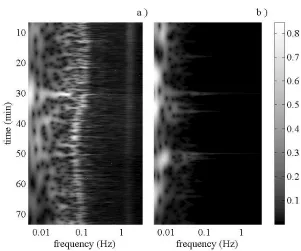
Figure 3. Time-frequency representation of (a) blood flow and (b) temperature signals obtained by wavelet transform.
in this low frequency range, there is clear evidence of a spectral peak at around 0.007 Hz that becomes intensified from about the time (30 minutes) when the ice-pack is applied. It is seen both in blood flow and in temperature. Note that the (lighter shaded) peaks near 30 and 50 minutes, affecting all frequencies, are artifacts due to the mechanical disturbance; the significant feature in (a) is the lighter shaded ridge at about 0.007 Hz running between ∼30 and∼54 minutes.
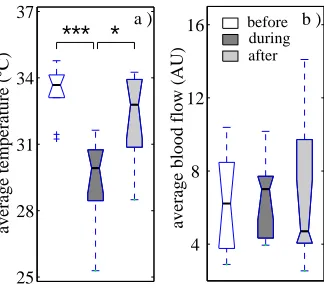
The data have been subjected to statistical analyses to establish more quantitatively the response to cooling. Fig. 4 shows that the tem-perature decreases, and increases, significantly. Blood flow is slightly affected by the temperature stress (the time evolution obtained for one subject is shown in figure 1), but the differences are not statistically significant for the group as a whole. For the data labelled ⋆⋆⋆, p = 0; and for that labelled ⋆,p <0.01.
An example of the calculated coherence functionCφ(ωk) is plotted in
25 28 31 34 37
average temperature (
°
C)
*** *
a )4 8 12 16
average blood flow (AU)
b ) before
[image:7.595.218.380.98.244.2]during after
Figure 4. Group median, and boxplots of time averages of (a) skin temperature and (b) blood flow signals before, during and after cooling.
0.01 0.03 0.1 0.3 1
0 0.2 0.4 0.6 0.8 1
[image:7.595.160.440.293.400.2]frequency ωk/2π (Hz) Cφ ( ωk /2 π ) before during after
Figure 5. An example of the coherence between the skin temperature and blood flow oscillations as a function of frequency before, during and after cooling.
0 0.2 0.4 0.6 0.8 1
5 − 9.5 mHz
* C φ ( ω k /2 π )
9.5 − 21 mHz 21 − 52 mHz 52 − 145 mHz
*
0.145 − 0.5 Hz 0.5 − 2 Hz before during after
Figure 6. Group median, and boxplots of the coherence calculated within six frequency intervals (see text).
[image:7.595.147.451.453.545.2]a statistically significant extent during cooling in two intervals: around 0.007 Hz and around 0.1 Hz. While oscillations in the latter inter-val are hypothesized to originate from myogenic activity in the vessel walls (Kvandal et al., 2003), the slowest oscillations have not to our knowledge been discussed previously.
4. Conclusion
Wavelet-based coherence analysis has proved its worth by revealing the two frequency ranges that are apparently involved in temperature regulation. The existence of the higher of these, near 0.1 Hz, is well-established. The lower range, around 0.007 Hz, may perhaps relate to biochemical processes at the level of endothelium (Gustafsson et al., 1993; Kellogg et al., 2003; Kvandal et al., 2003) involved in the heat production that is increased in order to resist the reduction in temper-ature. Further work will be needed to establish whether this is in fact the case.
Acknowledgements
The work was supported by the Slovenian Ministry of Education, Sci-ence and Sport, the Engineering and Physical SciSci-ences Research Coun-cil (UK), Leverhulme Trust, the British CounCoun-cil and INTAS.
References
Braˇciˇc, M. and A. Stefanovska: 1998, ‘Wavelet based analysis of human blood flow dynamics’. Bull. Math. Biol.60(5), 919–935.
Gustafsson, H., M. J. Mulvany, and H. Nilsson: 1993, ‘Rhythmic contraction of isolated small arteries from rat – Influence of the endothelium’. Acta Physiol. Scand.148(2), 153–163.
Johnson, J. M., G. Brengelmann, J. R. S. Hales, P. M. Vanhoutte, and C. B. Wenger: 1986, ‘Regulation of the cutaneous circulation’. Federation Proceedings45(13), 2841–2850.
Kellogg, D. L., J. L. Zhao, C. Friel, and L. J. Roman: 2003, ‘Nitric oxide concentra-tion increases in the cutaneous interstitial space during heat stress in humans’.
J. Appl. Physiol.94(5), 1971–1977.
Kvandal, P., A. Stefanovska, M. Veber, H. D. Kvernmo, and K.-A. Kirkebøen: 2003, ‘Regulation of human cutaneous circulation evaluated by laser Doppler flowmetry, iontophoresis, and spectral analysis: importance of nitric oxide and prostaglandines’. Microvasc. Res.65(3), 160–171.
Nuzzaci, G., A. Evangelisti, D. Righi, G. Giannico, and I. Nuzzaci: 1999, ‘Is there any relationship between cold-induced vasodilatation and vasomotion?’. Microvasc. Res. 57(1), 1–7.
Pikovsky, A., M. Rosenblum, and J. Kurths: 2001, Synchronization – A Universal Concept in Nonlinear Sciences. Cambridge: Cambridge University Press. Rosenblum, M. G., L. Cimponeriu, A. Bezerianos, A. Patzak, and R. Mrowka:
2002, ‘Identification of coupling direction: Application to cardiorespiratory interaction’. Phys. Rev. E.65(4), 041909.
Shusterman, V., K. P. Anderson, and O. Barnea: 1997, ‘Spontaneous skin tem-perature oscillations in normal human subjects’. Am. J. Physiol.: Regulatory Integrative Comp. Physiol. 273(3), R1173–R1181.