Technology (IJRASET)
©IJRASET: All Rights are Reserved
687
Voice Oriented Interactive Electrical System
Sparsh Tripathi1, Ayush Mishra2, Sonu Kumar Singh3, Ravi Kumar Gupta4, Ashtabhuj Srivastava5, O.P. Yadav6 1,2,3,4,5
Student, 6Asst Prof , IMS Engineering College, Ghaziabad
Abstract---- The project aims on controlling any electrical system with the help of human VOICE commands, so it is voice ORIENTED. The project not only receives and processes the commands given by the user but also acknowledges the user that the command is understood and under process or has been carried out, thereby making the system INTERACTIVE hence in a way it can also be called as “SMART CONTROL OF ELECTRICAL APLLIANCES”. The system uses Wi-Fi to send and receive data. The project would be very significant in the near future as in India the home automation technology is not much developed & this technology needs to be developed where this project could be used as a reference for further advancements. Considering The Govt.’s project to make Smart Cities this project would help a lot in realizing the dream of Digital India. Keywords— Home Automation, Cost-efficient, Voice, Control, Wi-Fi, Global, Android, Sensors, LCD Display
I. INTRODUCTION
Energy efficient as well as intelligent control of home appliances is the need of modern and smart globe [1-2]. All the presently available systems which are used as home automation systems limit their use only to the switching of electrical appliances which means they can only turn on or turn off the devices. Also all the systems present today use HTML & PHP1 for the server side which confines the applicability as well as capacity of the system [3-5]. Present systems do not provide users with real-time monitoring of the system parameters. There is no such system which provides home automation along with Smart Sensing technology which automatically trips the circuit when no one is present or the equipment is no longer in use [4]. The system not only uses switching of electrical appliances but also controls them i.e. controls the various equipment e.g. – Speed of fan, Intensity of light etc. The project uses HTML5, NODE.JS and JAVASCRIPT as web development tools which makes the system robust as well as increases the efficiency of the overall system & makes the data processing real-time and much more reliably fast. The system also provides the user with real time parameters of the system using On-board LCD display & the user can see what device are being controlled on the screen provided. Also the project combines the advantages of various automating modules into a single module which makes it new in itself. The module is controlled using an android device which is very common today and almost everyone has an android powered device. This makes the project reach to more people & thus affect more lives. Also the module provides a response to acknowledge the user commands thereby making the system interactive and thus making it way ahead in the field of automation.
II. NEED OF AUTOMATION
Earlier, while talking about the automated device the focus was on looking into the face of the future, with which anything on controller’s instruction could be done, but at present it has been converted into reality.
A remarkable amount of human work force is replaced by automated devices; the work done by such devices in any condition is much more error free or almost zero error than that which is being done by human.
Such devices have replaced human operators from the task which involves hard physical or prosaic work.
Such technology has also replaced human from the tasks which are being done in treacherous or menacing environments (nuclear facilities, underwater, extreme climatic condition, volcanoes, etc.).
The tasks beyond human capabilities are performed by such devices such as weight, speed, size, etc.
Economy improvement2-Economy of enterprises and most of humankind can be improved by automation.
To control various electrical and electronic systems this project is being constructed and implemented by implying a system using hardware.
III. SMART HOME AUTOMATION SYSTEM
©IJRASET: All Rights are Reserved
688
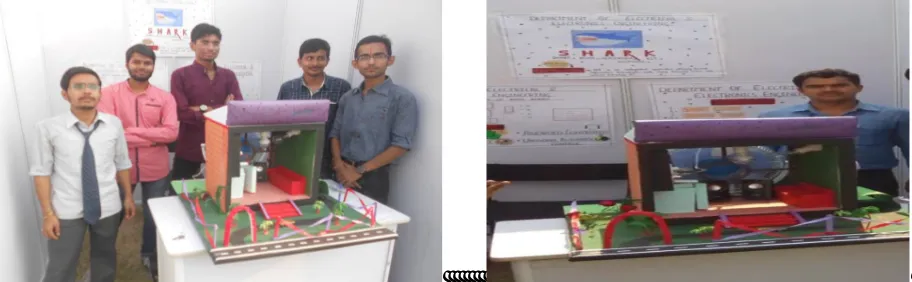
which interact with the central controller. This system doesn’t require wiring changes hence is suitable for pre-furnished houses. Home automation is not just restricted to houses but has various applications like in hospitals, industries etc. The project is based on IOT (Internet of Things).The automated home appliances using the above technology have been shown in figure 1. This system has all the excellent features required by a modern society. In order to get Excellency, mobile APP has been designed on JAVA platform with unique IP address to remotely control the 5 home appliances. The project has been exhibited at technical fest held at IMSEC and ranked second position. The project has been appreciated by various industrialists and got offer to share the idea used to designed it.
Figure1. Project Exhibition in Technical Fest 2015, at IMSEC, Ghaziabad by Team
A. Technical Specifications
POWER SUPPLY WIRELESS IC ESP8266 ARDUINO MEGA 2560
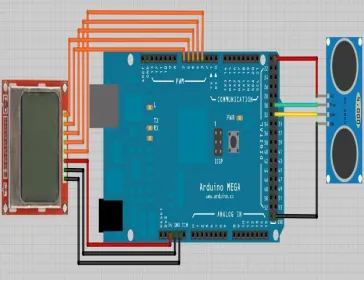
DISPLAY LCD MODULE FOR NOKIA-5110
1) Power Supply: The adapter used for supplying ARDUINO MEGA 2560 has following ratings- INPUT: 220V, 5A
OUTPUT: 9V, 500mA
[image:3.612.81.537.192.333.2]2) Wireless IC ESP82663: It is a self-contained SOC with integrated TCP/IP protocol stack that can give any microcontroller access to your Wi-Fi network. It is capable of hosting an application or offloading all Wi-Fi networking functions from another application processor.
Figure 2: Wireless IC ESP8266
Technology (IJRASET)
©IJRASET: All Rights are Reserved
689
Figure 3: ARDUINO MEGA 2560 IC Platform [image:4.612.224.406.243.384.2]4) Display LCD Module for Nokia-5110: It is used to display the number of active devices at any given point of time.
Figure 4. Display device used in project
IV. KEY FEATURES OF THE PROJECT
A. Cost Efficient.
B. Automatic control of appliances.
C. Smart Sensing Technology.
D. On Board LCD Display.
E. On Board Buzzer to interact with the user.
F. Controlling the devices using android.
G. User Friendly Interface.
H. Turns off all Lights and Fans once everybody leaves the room hence ENERGY EFFICIENT.
I. Automatically turns on the light as soon as person enters the room.
J. Smart control of Fan speed according to ambient temperature.
K. Smart control of light intensity so as per user’s convenience.
V. CONCLUSION
The project would be very significant in the near future as in India the home automation technology is not much developed & this technology needs to be developed where this project could be used as a reference for further advancements.
REFERENCES
[1] Dhiren Tejani, Ali Mohammed A. H. Al-Kuwari, Energy Conservation in Smart Home, 5th IEEE International Conference on Digital Ecosystems and Technologies, Daejeon, Korea, May 2011.
[2] N. Skeledzija , J. Cesic , E. Koco and V. Bachler, “ Smart home automation system for energy efficient housing” IEEE, International Conference on Information and Communication Technology, Electronics and Microelectronics (MIPRO), pp-166-171, 2014.
©IJRASET: All Rights are Reserved
690
(kindle Edition) , pp. 273-294, 2005.[5] Ying-Wen Bai and Chi-Huang Hang “ Remote Power ON/OFF control and current measurement for home electric outlets based on a low-power embedded board and ZigBee Communication”, Proceedings of IEEE International Symposium on Consumer Electronics, April 14- 16, Vilamoura, pp.1-4, 2008.