M E T H O D
Open Access
BayesCCE: a Bayesian framework for
estimating cell-type composition from DNA
methylation without the need for methylation
reference
Elior Rahmani
1, Regev Schweiger
2, Liat Shenhav
1, Theodora Wingert
3, Ira Hofer
3, Eilon Gabel
3,
Eleazar Eskin
1,4and Eran Halperin
1,3,4*Abstract
We introduce a Bayesian semi-supervised method for estimating cell counts from DNA methylation by leveraging an easily obtainable prior knowledge on the cell-type composition distribution of the studied tissue. We show
mathematically and empirically that alternative methods which attempt to infer cell counts without methylation reference only capture linear combinations of cell counts rather than provide one component per cell type. Our approach allows the construction of components such that each component corresponds to a single cell type, and provides a new opportunity to investigate cell compositions in genomic studies of tissues for which it was not possible before.
Keywords: DNA methylation, Cell-type composition, Tissue heterogeneity, Cell counts, Bayesian model, Epigenetics, Epigenome-wide association studies
Background
DNA methylation status has become a prominent epige-netic marker in genomic studies, and genome-wide DNA methylation data have become ubiquitous in the last few years. Numerous recent studies provide evidence for the role of DNA methylation in cellular processes and in dis-ease (e.g., in multiple sclerosis [1], schizophrenia [2], and type 2 diabetes [3]). Thus, DNA methylation status holds great potential for better understanding the role of epi-genetics, potentially leading to better clinical tools for diagnosing and treating patients.
In a typical DNA methylation study, we obtain a large matrix in which each entry corresponds to a methylation level (a number between 0 and 1) at a specific genomic position for a specific individual. This level is the fraction of the probed DNA molecules that were found to have
*Correspondence:[email protected]
1Department of Computer Science, University of California Los Angeles, Los
Angeles, CA, USA
3Department of Anesthesiology and Perioperative Medicine, University of
California Los Angeles, Los Angeles, CA, USA
Full list of author information is available at the end of the article
an additional methyl group at the specific position for the specific individual. Essentially, these methylation levels represent, for each individual and for each site, the prob-ability of a given DNA molecule to be methylated. While simple in principle, methylation data are typically com-plicated owing to various biological and non-biological sources of variation. Particularly, methylation patterns are known to differ between different tissues and between dif-ferent cell types. As a result, when methylation levels are collected from a complex tissue (e.g., blood), the observed methylation levels collected from an individual reflect a mixture of its methylation signals coming from different cell types, weighted according to mixing proportions that depend on the individual’s cell-type composition. Thus, it is challenging to interpret methylation signals coming from heterogeneous sources.
that are significantly correlated with a phenotype of inter-est across the samples in the data. In this case, unless accounted for, correlation of the phenotype of interest with the cell-type composition of the samples may lead to numerous spurious associations and potentially mask true signal [4]. In addition to its importance for a correct statistical analysis, knowledge of the cell-type composi-tion may provide novel biological insights by studying cell compositions across populations.
In principle, one can use high-resolution cell counting for obtaining knowledge about the cell composition of the samples in a study. However, unfortunately, such cell counting for a large cohort may be costly and often logis-tically impractical (e.g., in some tissues, such as blood, reliable cell counting can be obtained from fresh sam-ples only). Due to the pressing need to overcome this limitation, development of computational methods for estimating cell-type composition from methylation data has become a key interest in epigenetic studies. Sev-eral such methods have been suggested in the past few years [5–10], some of which aim at explicitly estimating cell-type composition, while others aim at a more spe-cific goal of correcting methylation data for the potential cell-type composition confounder in association studies. These methods take either a supervised approach, in which reference data of methylation patterns from sorted cells (methylomes) are obtained and used for predict-ing cell compositions [5], or an unsupervised approach (reference-free) [6–10].
The main advantage of the reference-based method is that it provides direct (absolute) estimates of the cell counts, whereas, as we demonstrate here, current reference-free methods are only capable of inferring com-ponents that capture linear combinations of the cell counts. Yet, the reference-based method can only be applied when relevant reference data exist. Currently, ref-erence data only exist for the blood [11], breast [12], and brain [13], for a small number of individuals (e.g., six sam-ples in the blood reference [11]). Moreover, the individuals in most available data sets do not match the reference individuals in their methylation-altering factors, such as age [14], gender [15,16], and genetics [17]. This problem was recently highlighted in a study in which the authors showed that available blood reference collected from adults failed to estimate cell proportions of newborns [18]. Furthermore, in a recent work, we showed evidence from multiple data sets that a reference-free approach can pro-vide substantially better correction for cell composition when compared with the reference-based method [19]. It is therefore often the case that unsupervised methods are either the only option or a better option for the analysis of EWAS.
As opposed to the reference-based approach, although can be applied for any tissue in principle, the
reference-free methods do not provide direct estimates of the cell-type proportions. Previously proposed reference-free methods allow us to infer a set of components, or general axes, which were shown to compose linear combinations of the cell-type composition [8,9]. Another more recent reference-free method was designed to infer cell-type proportions; however, as we show here, it only provides components that compose linear combinations of the cell-type composition rather than direct estimates [10]. Unlike cell proportions, while linearly correlated components are useful in linear analyses such as linear regression, they cannot be used in any nonlinear downstream analysis or for studying individual cell types (e.g., studying alterations in cell composition across conditions or populations). Cell proportions may provide novel biological insights and contribute to our understanding of disease biology, and we therefore need targeted methods that are practical and low in cost for estimating cell counts.
In an attempt to address the limitations of previous reference-free methods and to provide cell count esti-mates rather than linear combinations of the cell counts, we propose an alternative Bayesian strategy that uti-lizes prior knowledge about the cell-type composition of the studied tissue. We present a semi-supervised method, BayesCCE (Bayesian Cell Count Estimation), which encodes experimentally obtained cell count infor-mation as a prior on the distribution of the cell-type com-position in the data. As we demonstrate here, the required prior is substantially easier to obtain compared with stan-dard reference data from sorted cells. We can estimate this prior from general cell counts collected in previous stud-ies, without the need for corresponding methylation data or any other genomic data.
data, we find that measuring cell counts for a small group of samples (a couple of dozens) can lead to a further significant increase in the correlation of BayesCCE’s com-ponents with the cell counts.
Results
Benchmarking existing reference-free methods for capturing cell-type composition
We first demonstrate that existing reference-free meth-ods can infer components that are correlated with the tissue composition of DNA methylation data collected from heterogeneous sources. For this experiment, as well as for the rest of the experiments in this paper, we used four large publicly available whole-blood methylation data sets: a data set by Hannum et al. [20] (n = 650), a data set by Liu et al. [21] (n = 658), and two data sets by Hannon et al. [22] (n = 638 andn = 665; denote Hannon et al. I and Hannon et al. II, respectively). In addi-tion, we simulated data based on a reference data set of methylation levels from sorted leukocyte cells [11] (see the “Methods” section). While cell counts were known for each sample in the simulated data, cell counts were not available for the real data sets. We therefore esti-mated the cell-type proportions of six major blood cell types (granulocytes, monocytes, and four subtypes of lym-phocytes: CD4+, CD8+, B cells, and natural killer cells) based on a reference-based method [5], which was shown to reasonably estimate leukocyte cell proportions from whole-blood methylation data collected from adult indi-viduals [18,23,24]. Due to the absence of large publicly available data sets with measured cell counts, these esti-mates were considered as the ground truth for evaluating the performance of the different methods.
For benchmarking performance of existing methods, we considered three reference-free methods, all of which were shown to generate components that capture cell-type composition information from methylation: ReFAC-Tor [8], non-negative matrix factorization (NNMF) [9], and MeDeCom [10]. Although the reference-free meth-ods can potentially allow the detection of more cell types than the set of predefined cell types in the reference-based approach, we evaluated six components of each of the reference-free methods—six being the number of estimated cell types composing the ground truth. We found all methods to capture a large portion of the cell composition information in all data sets; particu-larly, we observed that ReFACTor performed consider-ably better than NNMF and MeDeCom in all occasions (Additional file1: Figure S1).
In spite of the fact that all three methods can capture a large portion of the cell composition variation, each com-ponent provided by these methods is a linear combination of the cell types in the data rather than an estimate of the proportions of a single cell type. As a result, as we show
next, in general, these methods perform poorly when their components are considered as estimates of cell type pro-portions. ReFACTor was not designed for estimating cell proportions but rather for providing orthogonal princi-pal components of the data that together capture variation in cell compositions. In contrast, NNMF and MeDe-Com, which extends the underlying model in NNMF, were designed to provide estimates of cell type proportions. In addition to empirical support from the data, as we report next, we also provide a mathematical proof for the non-identifiability nature of the NMMF model, which drives solutions towards undesired linear combinations of cell-type proportions rather than direct estimates of cell-cell-type proportions (see the “Methods” section).
BayesCCE: a Bayesian semi-supervised approach for capturing cell-type composition
Every method that has been developed so far for capturing cell composition signal from methylation can be classified as either reference-based, wherein a reference of methy-lation patterns of sorted cells is used, or reference-free, wherein cell composition information is inferred in an unsupervised manner. Our proposed method, BayesCCE, combines elements from the underlying models of pre-vious reference-free methods with further assumptions. BayesCCE does not use standard reference data of sorted methylation levels, but rather it leverages relatively weak prior information about the distribution of cell-type com-position in the studied tissue. This allows BayesCCE to direct the solution towards the inference of one component for each cell type that is encoded in the prior information. BayesCCE is fully described in the “Methods” section.
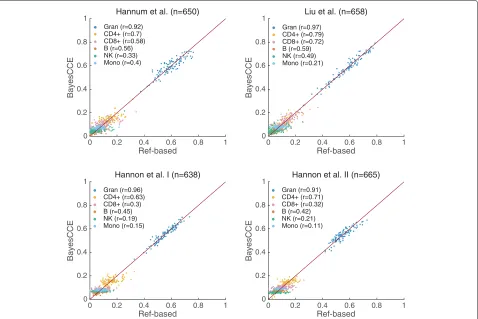
0 0.2 0.4 0.6 0.8 1 Ref-based
0 0.2 0.4 0.6 0.8 1
BayesCCE
Hannum et al. (n=650)
Gran (r=0.92) CD4+ (r=0.7) CD8+ (r=0.58) B (r=0.56) NK (r=0.33) Mono (r=0.4)
0 0.2 0.4 0.6 0.8 1
Ref-based 0
0.2 0.4 0.6 0.8 1
BayesCCE
Liu et al. (n=658)
Gran (r=0.97) CD4+ (r=0.79) CD8+ (r=0.72) B (r=0.59) NK (r=0.49) Mono (r=0.21)
0 0.2 0.4 0.6 0.8 1
Ref-based 0
0.2 0.4 0.6 0.8 1
BayesCCE
Hannon et al. I (n=638)
Gran (r=0.96) CD4+ (r=0.63) CD8+ (r=0.3) B (r=0.45) NK (r=0.19) Mono (r=0.15)
0 0.2 0.4 0.6 0.8 1
Ref-based 0
0.2 0.4 0.6 0.8 1
BayesCCE
Hannon et al. II (n=665)
Gran (r=0.91) CD4+ (r=0.71) CD8+ (r=0.32) B (r=0.42) NK (r=0.21) Mono (r=0.11)
Fig. 1BayesCCE captures cell-type proportions in four data sets under the assumption of six constituting cell types in the blood (k=6):
granulocytes, monocytes, and four subtypes of lymphocytes (CD4+, CD8+, B cells, and NK cells). The BayesCCE estimated components were linearly transformed to match their corresponding cell types in scale (see the “Methods” section). For convenience of visualization, we only plot the results of 100 randomly selected samples for each data set
component represented the proportions of one cell type up to a multiplicative constant and addition of a con-stant). These symptoms are expected due to the nature of the prior information used by BayesCCE. For more details about the assignment of components into cell types and evaluation measurements, see the “Methods” section.
We next considered a simplifying assumption of only three constituting cell types in blood tissue (k = 3): granulocytes, lymphocytes, and monocytes. We applied BayesCCE on each of the four data sets and observed high correlations between the estimated components of gran-ulocytes and the granulocyte levels (r ≥ 0.91 in all data sets) and between the estimated components of lympho-cytes and the lymphocyte levels (r≥0.87 in all data sets), yet much lower correlations for monocytes (r ≤ 0.27 in all data sets; Additional file 1: Figure S2 and Tables S1 and S2). We note that poor performance in capturing some cell type may be partially derived by inaccuracies introduced by the reference-based estimates, which are used as the ground truth in our experiments. Notably, three recent studies, which consisted of samples for which
both methylation levels and cell count measurements were available, demonstrated that while the reference-based estimates of the overall lymphocyte and granulocyte levels were found to be highly correlated with the true levels, the accuracy of estimated monocytes was found to be substantially lower [8, 18, 25]. This may explain the low correlations we report for monocytes in our experi-ments. Low correlations with some of the cell types may be driven by various reasons, such as utilizing inappropri-ate reference or failing to perform a good feature selection. We later provide a more detailed discussion about these issues.
[image:4.595.61.539.87.406.2]Hannum et al.
Liu et al.
Hannon et al.
I
Hannon et al. II Simulated data Hannum et al.
Liu et al.
Hannon et al.
I
Hannon et al. II Simulated data Hannum et al.
Liu et al.
Hannon et al.
I
Hannon et al. II Simulated data Hannum et al.
Liu et al.
Hannon et al.
I
Hannon et al. II Simulated data Hannum et al.
Liu et al.
Hannon et al.
I
Hannon et al. II Simulated data Hannum et al.
Liu et al.
Hannon et al.
I
Hannon et al. II Simulated data
0 0.1 0.2 0.3 0.4 0.5 0.6 0.7 0.8 0.9 1
Mean Absolute Correlation (MAC)
ReFACTor NNMF MeDeCom BayesCCE BayesCCE imp BayesCCE imp ext
Hannum et al.
Liu et al.
Hannon et al.
I
Hannon et al. II Simulated data Hannum et al.
Liu et al.
Hannon et al.
I
Hannon et al. II Simulated data Hannum et al.
Liu et al.
Hannon et al.
I
Hannon et al. II Simulated data Hannum et al.
Liu et al.
Hannon et al.
I
Hannon et al. II Simulated data Hannum et al.
Liu et al.
Hannon et al.
I
Hannon et al. II Simulated data Hannum et al.
Liu et al.
Hannon et al.
I
Hannon et al. II Simulated data
0 0.1 0.2 0.3 0.4 0.5 0.6 0.7
Mean Absolute Error (MAE)
ReFACTor NNMF MeDeCom BayesCCE BayesCCE imp BayesCCE imp ext
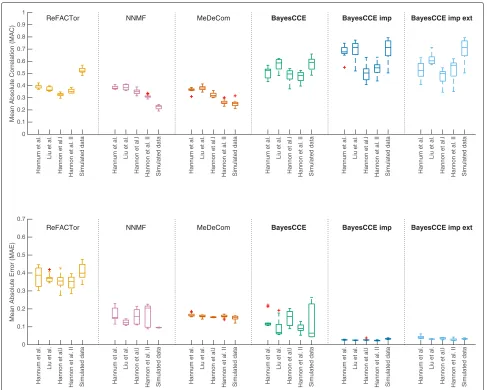
Fig. 2The performance of existing reference-free methods and BayesCCE under the assumption of six constituting cell types in blood (k=6): granulocytes, monocytes, and four subtypes of lymphocytes (CD4+, CD8+, B cells, and NK cells). For each method, box plots show for each data set the performance across ten sub-sampled data sets (n=300), with the median indicated by a horizontal line. For each of the methods, ReFACTor, NNMF, MeDeCom, and BayesCCE, we considered a single component per cell type (see the “Methods” section). Additionally, we considered the scenario of cell count imputation wherein cell counts were known for 5% of the samples (n=15; BayesCCE imp) and the scenario wherein samples from external data with both methylation levels and cell counts were used in the analysis (n=15; BayesCCE imp ext). Top panel: mean absolute correlation (MAC) across all cell types. Bottom panel: mean absolute error (MAE) across all cell types. For BayesCCE imp and BayesCCE imp ext, the MAC and MAE values were calculated while excluding the samples with assumed known cell counts
types (k = 3) revealed similar results (Additional file1: Figure S3).
BayesCCE impute: cell count imputation
We next considered a scenario in which cell counts are known for a small subset of the samples in the data. This problem can be viewed as a problem of imputing missing cell count values (see “Methods” section). We repeated all previous experiments, only this time we assumed that cell counts are known for randomly selected 5% of the samples in each data set. As opposed to the previous experi-ments, in which each one of the BayesCCE components constituted a scaled estimate of the proportions of one
[image:5.595.56.543.85.475.2]0 0.2 0.4 0.6 0.8 1 Ref-based
0 0.2 0.4 0.6 0.8 1
BayesCCE
Hannum et al. (n=650)
Gran (r=0.95) CD4+ (r=0.84) CD8+ (r=0.59) B (r=0.9) NK (r=0.62) Mono (r=0.36)
0 0.2 0.4 0.6 0.8 1
Ref-based 0
0.2 0.4 0.6 0.8 1
BayesCCE
Liu et al. (n=658)
Gran (r=0.98) CD4+ (r=0.8) CD8+ (r=0.65) B (r=0.6) NK (r=0.5) Mono (r=0.46)
0 0.2 0.4 0.6 0.8 1
Ref-based 0
0.2 0.4 0.6 0.8 1
BayesCCE
Hannon et al. I (n=638)
Gran (r=0.95) CD4+ (r=0.73) CD8+ (r=0.4) B (r=0.62) NK (r=0.33) Mono (r=0.31)
0 0.2 0.4 0.6 0.8 1
Ref-based 0
0.2 0.4 0.6 0.8 1
BayesCCE
Hannon et al. II (n=665)
Gran (r=0.97) CD4+ (r=0.74) CD8+ (r=0.59) B (r=0.81) NK (r=0.62) Mono (r=0.49)
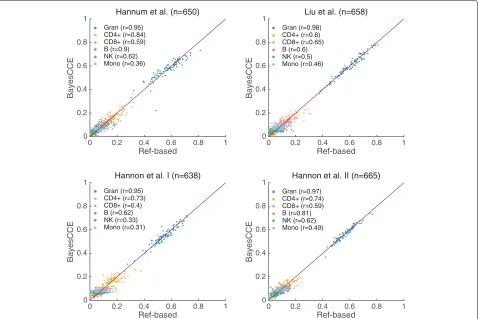
Fig. 3BayesCCE captures cell-type proportions in four data sets under the assumption of six constituting cell types in blood (k=6): granulocytes, monocytes, and four subtypes of lymphocytes (CD4+, CD8+, B cells, and NK cells), and assuming known cell counts for randomly selected 5% of the samples in the data. All correlations were calculated while excluding the samples with assumed known cell counts. For convenience of visualization, we only plot the results of 100 randomly selected samples for each data set
types to be 0.71, 0.66, 0.56, and 0.71 in the Hannum et al., Liu et al., Hannon et al. I, and Hannon et al. II data sets, respectively. In addition, in contrast to our previous experiments, inclusion of some cell counts resulted in low mean absolute error, which reflects a correct scale for the components. We observed similar results when assum-ing three constitutassum-ing cell types (k = 3), providing an improvement of up to 28% in correlation and a substantial decrease in absolute errors compared with the previous experiments (Additional file 1: Figure S4 and Tables S1 and S2).
In the absence of cell counts for a subset of the indi-viduals in the data, we can incorporate into the analysis the external data of samples for which both cell counts and methylation levels (from the same tissue) are avail-able. We repeated again all previous experiments (k = 3 andk = 6); only this time for each data set, we added a randomly selected subset of samples from one of the other data sets (5% of the original sample size) and used both their methylation levels and cell-type proportions in the analysis. Specifically, we used randomly selected sam-ples and corresponding estimates of cell-type proportions
from the Hannon et al. I data set for the experiments in all three other data sets, and samples from the Hannon et al. II data set for the experiment with the Hannon et al. I data set. In order to pool samples from two data sets together, we considered only the intersection of CpG sites that were available for analysis in the two data sets. In addition, unlike in the previous experiments, here, we potentially introduce new batch effects into the analysis, as in each experiment the original sample is combined with external data. We therefore accounted for the new batch informa-tion by adding it as a new covariate into BayesCCE. As in the case of known cell counts for a subset of the samples, we found that the inclusion of external samples with both methylation and cell counts substantially improved the performance in terms of correlation and absolute errors (Additional file1: Figures S5 and S6 and Tables S1 and S2). These results clearly show that estimates can be dramati-cally more accurate given the measured cell counts for as few as a couple of dozens of samples in the data (or such samples from external data).
[image:6.595.61.539.87.406.2]sets we used before (n = 300), while assuming known cell counts for a subset of the samples. In one scenario, we assumed cell counts are known for 5% of the sam-ples in each data set (n = 15), and in a second sce-nario, we included into the analysis methylation levels and cell-type proportions of 15 samples from external data. These experiments revealed in most cases a sub-stantial improvement in correlation over a standard exe-cution of BayesCCE (i.e., without inclusion of cell counts) and revealed in all cases a substantial improvement in the mean absolute error. The results are summarized in Fig.2 for the case of six constituting cell types (k = 6) and in Additional file 1: Figure S3 for the case of three constituting cell types (k=3).
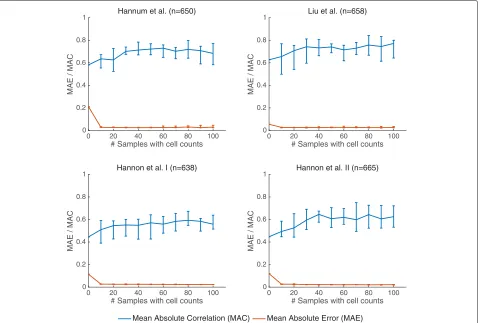
We further tested the performance of BayesCCE as a function of the number of samples for which cell counts are available. Remarkably, we found that known cell counts for only a couple of dozens of the samples are needed in order to achieve the maximal improvement in performance, including more samples with known cell
counts did not provide a further improvement (Fig. 4). In addition, we evaluated the performance of BayesCCE as a function of the sample size. Interestingly, while performance did not improve by increasing the sample over a few hundred of samples in the case of unknown cell counts, we found that knowledge of cell counts for as few as 15 samples in the data allowed a mono-tonic improvement in performance in larger sample sizes (Additional file1: Figure S7).
Finally, we considered an alternative approach for ver-ifying the results of BayesCCE. Although our study aims at estimating cell-type proportions without the need for reference methylation data, BayesCCE jointly learns cell-type composition and cell-type-specific mean methylation levels (methylomes). Hence, as a by-product of the BayesCCE algorithm, we also obtain cell-type-specific methylomes across the CpG sites selected by BayesCCE as part of its feature selection process (see the “Methods” section). Our experiments found BayesCCE to provide one component per cell type; however, these
0 20 40 60 80 100
# Samples with cell counts
0 0.2 0.4 0.6 0.8 1
MAE / MAC
Hannum et al. (n=650)
0 20 40 60 80 100
# Samples with cell counts
0 0.2 0.4 0.6 0.8 1
MAE / MAC
Liu et al. (n=658)
0 20 40 60 80 100
# Samples with cell counts
0 0.2 0.4 0.6 0.8 1
MAE / MAC
Hannon et al. I (n=638)
0 20 40 60 80 100
# Samples with cell counts
0 0.2 0.4 0.6 0.8 1
MAE / MAC
Hannon et al. II (n=665)
Mean Absolute Correlation (MAC) Mean Absolute Error (MAE)
[image:7.595.62.542.341.664.2]components are not necessarily appropriately scaled, which implies that estimated cell-type-specific methyla-tion profiles are also not necessarily calibrated. Never-theless, in the scenario where cell counts were known even for a small subset of the individuals in the study, BayesCCE provided calibrated cell count estimates. In such cases, we therefore expect BayesCCE to pro-vide calibrated cell-type-specific methylation profiles. Using correlation maps, for each of the four whole-blood methylation data sets we analyzed, we verified high similarity between the cell-type-specific methylomes obtained by BayesCCE to those estimated by a reference methylation data collected from sorted blood cells [11] (Additional file1: Figure S8). In spite of an overall high similarity between these two approaches, the correla-tion patterns detected by BayesCCE did not perfectly match those estimated using the reference data. While this may demonstrate the expected accuracy limitations of BayesCCE to some extent, we also attribute these imper-fect matches, at least in part, to inaccuracies introduced by the reference data set, owing to the fact that it was con-structed only from a small group of individuals (n = 6), which do not represent well all the individuals in other data sets in terms of methylome altering factors such as age [14], gender [15,16], and genetics [17].
Robustness of BayesCCE to biases introduced by the cell composition prior
BayesCCE relies on prior information about the distribu-tion of the cell-type composidistribu-tion in the studied tissue. In practice, the available prior information may not always precisely reflect the cell composition distribution of the individuals in the study. For instance, in a case/control study design, cases may demonstrate altered cell compo-sitions compared with healthy individuals. Therefore, in this scenario, a prior estimated from a healthy popula-tion (or a sick populapopula-tion) is expected to deviate from the actual distribution in the sample. This potential prob-lem is clearly not limited to case/control studies, but also applies to studies with quantitative phenotypes, in case these are correlated with changes in cell composition of the studied tissue. In principle, we can address this issue by incorporating several appropriate priors and assigning different priors to different individuals in the study. How-ever, in practice, population-specific priors may be hard to obtain, mainly owing to the fact that numerous known and unknown factors can affect cell composition.
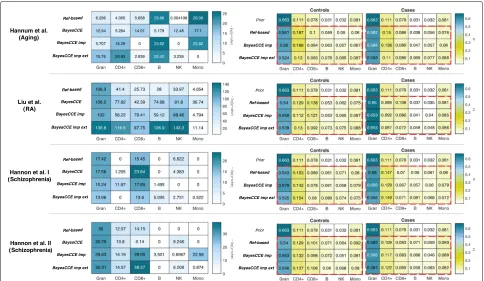
We revisited our analysis from the previous subsections in an attempt to assess the robustness of BayesCCE to non-informative or misspecified priors. A desired behav-ior would allow BayesCCE to overcome a bias introduced by a prior which does not accurately represent all the indi-viduals in the sample. Particularly, we considered three whole-blood case/control data sets, two schizopherenia
data sets by Hannon et al., and a rheumatoid arthritis data set by Liu et al., all of which are expected to demonstrate differences in blood cell composition between cases and controls [26,27]. In fact, in our analysis, we had an inher-ently misspecified prior since we learned the prior from hospital patients (outpatients), which are overall expected to represent a sick population better than a more general population. Specifically, out of the 595 individuals used for learning the prior, 64% are known to have taken at least one medication at the time of blood draw for cell counting and 24% were admitted to the hospital due to various conditions within 2 months before or after the time of their blood draw (70.4% either were admitted or took medications). We expect these conditions to be cor-related with alterations in blood cell composition, and therefore, the prior information we used is expected to represent deviation from a healthy population and, as a result, to misrepresent at least the control individuals in the case/control data sets we analyzed. We further consid-ered an additional fourth data set by Hannum et al., which was originally studied in the context of aging (age range 19–101, mean 64.03, SD 14.73). Our prior was calculated using sample with a different distribution of ages (range 20–88, mean 49.19, SD 16.69), thus potentially misrepre-senting the cell composition distribution in the Hannum et al. data to some extent.
Remarkably, we found the cell composition estimates given by BayesCCE to effectively detect differences between populations in the data sets, in spite of using a single prior estimated from one particular popula-tion. Specifically, we found that BayesCCE correctly detected the cell types which differentiate between cases and controls and between young and older populations; notably, in some of the data sets, we found BayesCCE to demonstrate some differences between cases and con-trols which were not captured by the reference-based estimates (Fig. 5). For example, NK cell abundance is known to change in aging in a process known as NK cell immunosenescence [28,29], and monocyte levels are known to increase in RA patients compared with healthy individuals [30–32]. These differences in cell populations were detected by BayesCCE but not by the reference-based method, thus suggesting that BayesCCE could uncover signal which was undetected by the reference-based method (Fig. 5). That said, some other cell com-position differences that were reported by BayesCCE but not by the reference-based method or vice versa may be the result of inaccuracies introduced by BayesCCE. Quan-tifying more accurately and reliably to what extent each method can detect cell composition differences would require several large data sets with known cell counts.
Fig. 5The robustness of BayesCCE to prior misspecification and its ability to capture population-specific variability in cell-type composition, under the assumption of six constituting cell types in blood (k=6): granulocytes, monocytes, and four subtypes of lymphocytes (CD4+, CD8+, B cells, and NK cells). Left side:ttest results (presented by the negative log of the Bonferroni-adjustedpvalues) for the difference in proportions of each cell type between cases and controls. Right side: the Dirichlet parameters of estimated cell counts stratified by cases and controls; red dashed rectangles emphasize the high similarity in the estimated case/control-specific cell composition distributions yielded by the different methods, regardless of the prior used (“prior”). Results are presented for four different data sets and using cell count estimates obtained by four approaches: the reference-based method, BayesCCE, BayesCCE with known cell counts for 5% of the samples (BayesCCE imp), and BayesCCE with 5% additional samples with both known cell counts and methylation from external data (BayesCCE imp ext). For the Hannum et al. data set, for the purpose of presentation, cases were defined as individuals with age above the median age in the study. In the evaluation of BayesCCE imp and BayesCCE imp ext, samples with assumed known cell counts were excluded before calculatingpvalues and fitting the Dirichlet parameters
capture two distinct distributions (cases and controls or young and older individuals), regardless of the single dis-tribution encoded by the prior information (Fig.5). While BayesCCE provides one component per cell type, these components are not necessarily appropriately scaled to provide cell count estimates in absolute terms. Therefore, for the latter analysis, we considered only the scenarios in which cell counts are known for a small number of individuals.
We further evaluated the scenario in which two differ-ent population-specific prior distributions are available. Specifically, one prior for cases and another one for con-trols in the case/control studies, and one for young and another one for older individuals in the aging study. For the purpose of this experiment, we estimated the pri-ors using the reference-based estimates of a subset of the individuals (5% of the sample size) that were then excluded from the rest of the analysis. Interestingly, we found the inclusion of two prior distributions to provide no clear improvement over using a single general prior
(Additional file1: Table S3). Thus, further confirming the robustness of BayesCCE to inaccuracies introduced by the prior information due to cell composition differences between populations.
[image:9.595.57.541.86.367.2]sparse low-rank assumption it takes, which seems to han-dle more efficiently with the high-dimension nature of the computational problem (see the “Methods” section). We note that in the presence of a non-informative prior, BayesCCE conceptually reduces to the performance of ReFACTor, and therefore, it captures the same cell compo-sition variability in the data. Yet, owing to the additional constrains, BayesCCE allows to overcome ReFACTor in capturing a set of components such that each component corresponds to one cell type.
Discussion
We introduce BayesCCE, a Bayesian method for estimating cell-type composition from heterogeneous methylation data without the need for methylation ref-erence. We show mathematically and empirically the non-identifiability nature of the more straightforward reference-free NNMF approach for inferring cell counts, which tends to provide only linear combinations of the cell counts. In contrast, while we do not provide conditions for the uniqueness of a BayesCCE solution, our empirical evidence from multiple data sets clearly demonstrates the success of BayesCCE in providing desirable results of one component per cell type by leveraging readily obtainable prior information from previously collected data.
The parameters of the prior required by BayesCCE can be estimated by utilizing previous studies that collected cell counts from the tissue of interest. In our evaluation of the method, we used whole-blood methylation data, and we considered the classical definition of leukocyte cell types, which relies on cell surface markers. Considering other definitions of cell types is of potential interest; par-ticularly, it would be interesting to examine to what extent BayesCCE and the reference-free methods can capture cell-type composition following a methylation-based defi-nition of cell types (i.e., when defining cell types according to their methylation patterns). Since BayesCCE captures cell composition variation under the classical definition of cell types by using the most dominant components of variation in the data, the main cell types of a natural methylation-based definition are expected to be a linear combination of the cell types under the classical defini-tion. Much like in the experiments we presented here, wherein given a prior about the distribution of the cell types BayesCCE directed the solution towards an appro-priate linear transformation, we would expect BayesCCE to perform similarly in the case of a methylation-based definition of cell types (given appropriate prior informa-tion about the distribuinforma-tion of cell types). Nevertheless, obtaining such a definition and evaluating BayesCCE under that definition would require obtaining appropri-ate single cell methylation data, which is currently scarcely available. Moreover, deriving an actual meaningful defini-tion of cell types given such data is a non-trivial problem.
Therefore, until such definition and appropriate data are available, we are bounded to consider the classical defini-tion of cell types.
Since BayesCCE requires a prior which can be estimated from previously collected cell counts without the need for any other genomic data, obtaining such as prior is relatively easy for many tissues, such as the brain [33], heart [34], and adipose tissue [35]. Particularly, such data should be substantially easier to obtain compared to refer-ence data from sorted cells for the corresponding tissues. Ideally, in order to learn the prior, one would want to use cell counts coming from the same population as the target population. Nevertheless, empirically, we observe that BayesCCE leverages the prior to direct the solu-tion while still allowing enough flexibility, which makes it robust even to substantial deviations of the prior from the true underlying cell composition distribution. In fact, our results demonstrate that BayesCCE handles biases intro-duced by the prior remarkably well. Particularly, it allows to capture differences in cell compositions between dif-ferent populations in the same study, thus providing an opportunity to study cell composition differences between different populations even in the absence of methylation reference.
Since no large data sets with measured cell counts are currently publicly available, we used a supervised method [5] for obtaining cell-type proportion estimates, which were used as the ground truth in our experiments. Even though the method used for obtaining these estimates was shown to reasonably estimate leukocyte cell pro-portions from whole-blood methylation data in several independent studies [18,23,24], these estimates may have introduced biases into the analysis. Particularly, any inac-curacies introduced by the reference-based method could have directly affect the results of our evaluation. Our results indicate that such inaccuracies are more likely in some particular cell types over others. Failing to accu-rately estimate a particular cell type may be the outcome of various reasons. Notably, utilizing inappropriate refer-ence data or failing to select a set of informative features that mark a particular cell type may dramatically affect its estimated values. Other reasons which are not method-ological may also lead to inaccuracies of the estimates. For example, two cell types with very similar methyla-tion patterns will be hardly distinguishable. In spite of the potential pitfalls of using estimates as a baseline for evaluation, we believe that our results on several indepen-dent data sets, including simulated data, and the use of a prior estimated from a large data set of high-resolution cell counts, provide a compelling evidence for the utility of BayesCCE.
our experiments, only as few as a couple of dozens of samples with known cell counts are needed in order to substantially improve performance. Moreover, in the gen-eral setup of BayesCCE, where no cell counts are known, each component corresponds to one cell type, however, not necessarily in the right scale and there is no automatic way to determine the identity of that cell type. In contrast, in the case of cell count imputation, where cell counts are known for a subset of the samples, the assignment of com-ponents into cell types is straightforward. In addition, as we showed, BayesCCE is able to reconstruct cell counts up to a small absolute error (i.e., each component is scaled to form cell proportion estimates of one particular known cell type).
We note that in our evaluation of BayesCCE, we con-sidered only whole-blood data sets. Studying other tissues or biological conditions is clearly of interest. However, in the absence of other tissue-specific methylation references that were clearly shown to allow obtaining reasonable cell-type proportion estimates, evaluation of performance based on tissues other than the whole blood will not be reliable. We therefore opt to focus on evaluating the performance of BayesCCE using multiple large whole-blood data sets. Importantly, beyond its potential utility for complex biological scenarios in which reference data is unavailable, BayesCCE may also provide an oppor-tunity to improve cell count estimates in whole-blood studies in scenarios where the currently available refer-ence data is not appropriate. Notably, in a recent work, we have shown using multiple whole-blood data sets that ReFACTor outperforms the reference-based method in correcting for cell composition [19]. Differences in perfor-mance between ReFACTor (upon which BayesCCE relies for obtaining a starting point that captures the cell com-position variation in the data) and the reference-based method are expected to be especially large in studies where the available reference data do not represent the individuals in the study well. We argue that this is likely to typically be the case, as the current go-to whole-blood reference consists of only six individuals [11], which rep-resent a very specific and narrow population in terms of methylome altering factors, such as age [14], gender [15,16], and genetics [17]. That said, large data sets with experimentally measured cell counts are required in order to fully investigate and demonstrate these claims.
We further note that in our benchmarking of BayesCCE with existing reference-free methods, we considered only a subset of the available methods in the literature. Other reference-free methods that have been suggested in the context of accounting for cell composition in methylation data exist; however, these do not provide explicit nents, but rather only implicitly account for cell compo-sition variability in association studies. While in principle these methods can be modified to produce components,
in this work, we focused only on methods that can be readily used to provide explicit components for evalua-tion. We further note that several supervised and unsu-pervised decomposition methods have been suggested for estimating cell composition from gene expression [36–40]. However, these were refined for gene expression data and, to the best of our knowledge, none of these methods takes into account prior knowledge about the cell composition distribution as in BayesCCE. It remains of interest to investigate whether BayesCCE can be adapted for estimating cell composition from gene expression without the need for purified expression profiles.
Finally, our approach is based on finding a suitable lin-ear transformation of the components found by ReFAC-Tor [8]. It is therefore important to follow the guidelines for the application of ReFACTor, such as incorporation of methylation-altering covariates; these guidelines were recently highlighted elsewhere [19, 41]. Since BayesCCE relies on the ReFACTor components, it is limited by their quality, and particularly, if the variability of some cell type is not captured by ReFACTor, BayesCCE will not be able to estimate that cell type well. Such a result is possible in scenarios where the variation of a particular cell type is substantially weaker than other sources of variation in the data (which are unrelated to cell-type composition); we note, however, that this potential limitation is not exclu-sive for ReFACTor or BayesCCE but rather a general lim-itation of all existing reference-free methods. BayesCCE will effectively provide the same result as ReFACTor if used for correcting for a potential cell-type composi-tion confounder in methylacomposi-tion data. Since ReFACTor does not allow to infer direct cell count estimates but rather linear transformations of those, we suggest to use BayesCCE in cases in which a study of individual cell types is performed and therefore ReFACTor cannot be used. In case merely a correction for cell composition is desired, we suggest to use BayesCCE when cell counts are known for a subset of the samples, and otherwise to use ReFACTor.
Conclusion
couple of dozens of the samples or the external data of samples with measured cell counts be utilized.
Methods
Notations and related work
LetO ∈Rm×nbe anmsites bynsample matrix of DNA methylation levels coming from a heterogeneous source consistingkcell types. For methylation levels, we consider what is commonly referred to as beta-normalized methy-lation levels, which are defined for each sample in each site as the proportion of methylated probes out of the total number of probes. Put differently,Oji∈[ 0, 1] for each site
jand sample i. We denoteM ∈ Rm×k as the
cell-type-specific mean methylation levels for each site and denote a row of this matrix, corresponding to thejth site, using Mj,·. Additionally, we denote R ∈ Rn×k as the cell-type
proportions of the samples in the data. A common model for observed mixtures of DNA methylation is
Oji=Mj,·RTi +ji (1)
ji∼N(0,σ2) (2)
∀i∀h:Rih≥0 (3)
∀i:
k
h=1
Rih=1 (4)
∀j∀h: 0≤Mjh≤1 (5)
where the error termjimodels measurement noise and
other possible unmodeled factors. The constraints in (3) and in (4) require the cell proportions to be positive and to sum up to one in each sample, and the constraints in (5) require the cell-type-specific mean levels to be in the range [ 0, 1]. This model was initially suggested for DNA methylation in the context of reference-based esti-mation of cell proportions by Houseman et al. [5]. We are interested in estimatingR. Taking a standard maximum likelihood approach for fitting the model results in the following optimization problem:
ˆ
R,Mˆ =argmin
R,M
O−MRT2F (6)
s.t ∀i∀h:Rih≥0 (7)
∀i:
k
h=1
Rih=1 (8)
∀j∀h: 0≤Mjh≤1 (9)
where·2Fis the squared Frobenius norm. The reference-based method [5] first obtains an estimate of M from reference methylation data collected from sorted cells of the cell types composing the studied tissue. Once an estimate of Mis fixed, Rcan be estimated by solving a standard quadratic program.
If the matrixMis unknown, which is a reference-free version of the problem, the above formulation of the
problem can be regarded as a version of non-negative matrix factorization (NNMF) problem. NNMF has been suggested in several applications in biology; notably, the problem of inference of cell-type composition from methylation data has been recently formulated as an NNMF problem [9]. In order to optimize the model, the authors used an alternating optimization procedure in whichMorRare optimized while the other is kept fixed. However, as demonstrated by the authors [9], this solu-tion results in the inference of a linear combinasolu-tion of the cell proportions R. Put differently, more than one com-ponent of the NNMF is required for explaining each cell type in the data. This was recently further highlighted and explained using geometric considerations [10], which nicely showed the non-identifiable nature of the NNMF model in (6) in case that a perfect factorization of O into M,R exists (i.e., O = MRT). However, in prac-tice, perfect factorization never exists in real biological data. Thus, in addition to empirical evidence from sev-eral data sets on which we apply the NNMF method (see the “Results” section), in the next subsection, we pro-vide a mathematical proof for the non-identifiability of the NNMF model in (6) under a more general case, where a perfect factorization does not necessarily exist.
In an attempt to overcome the non-identifiability of the model in (6) and to provide cell-type proportions when reference methylation data are not available, a recent modification of the NNMF model has been suggested [10]. The method, MeDeCom, solves the optimization of the NNMF model while including additional penalty term in the objective function. Derived from biological knowl-edge about mean methylation levels, the penalty nega-tively weights mean methylation levels diverging from a known bimodal behavior of methylation levels, wherein CpGs tend to be overall methylated or unmethylated [10]. While the modified objective suggested in MeDe-Com overcomes the non-identifiability of the NNMF model for a given weight of the penalty (λ), it is not entirely clear how to select λ. To circumvent this prob-lem, the authors proposed a cross-validation procedure for the selection ofλ. However, our empirical results from four large whole-blood methylation data sets, as well as from simulated data, show sub-optimal performance for MeDeCom, similar to the solutions of the simpler NNMF model. Our results suggest that the modification intro-duced by MeDeCom may not effectively avoid the non-identifiability nature of the NNMF model, possibly due to insufficient prior information or inability to effectively determine an appropriate value forλ.
and it only finds principal components (PCs) that form linear combinations of the cell proportions rather than directly estimates the cell proportion values [8].
Non-identifiability of the NNMF model
We hereby show by construction the non-identifiability nature of the NNMF model in (6). For this proof, instead of the constraints in (9), we consider a slightly modified version of the constraints:
∀j∀h: 0<Mjh<1 (10)
While in theory we may have an equality (i.e.,Mjh = 0
orMjh= 1), in practice, such sites are typically not
mea-sured or excluded from the analysis, since they would not be demonstrating any variability.
Proposition 1Let Rˆ,M be a solution to the prob-ˆ lem in (6). There exist R˜ = ˆR,M˜ = ˆM such that
O− ˆMRˆT2
F =
O− ˜MR˜T2F and the constraints in(7), (8), and(10)are satisfied.
ProofLet 0<c<1, defineQ∈Rk×kto be the identity matrix up to two entries:Q11 = 1−c,Q12 = c. It
fol-lows thatQ−1is also the identity matrix up to two entries: Q−111= 1−1c,Q−121= c−c1.
DenoteR˜ = ˆRQand denoteM˜ = ˆMQ−1T, we get that
O− ˜MR˜TF2= O− ˆMQ−1TQTRˆT2F= O− ˆMRˆT2F The constraints in (7) hold sinceR˜ih≥0 for each 1≤i≤
n, 1 ≤ h ≤ k. The constraints in (8) hold since for each 1≤i≤n
k
l=1
˜
Ril= k
h=1
k
l=1
ˆ
RilQlh
=(1−c)Rˆi1+cRˆi1+
k
h=2
ˆ
Ril = k
h=1
ˆ
Ril=1
In addition,M˜hjT ∈ (0, 1)for 2 ≤ h ≤ k, 1 ≤ j ≤ m. In order to completely satisfy the constraints in (10), we also require these constraints to be satisfied forh=1, 1≤j≤ m. It is easy to see that for eachjthe latter is satisfied if
0<c<min
1− ˆMT1j
1− ˆMT2j ,Mˆ
T 1j ˆ
MT2j
Therefore, we can simply select a value ofcin the range
0<c<minj
min
1− ˆMT 1j
1− ˆMT2j ,Mˆ
T 1j ˆ
MT2j
Note that we necessarily have either
0<c<minj
min
1− ˆMT 1j
1− ˆMT 2j
,Mˆ T 1j ˆ MT 2j <1 or
0<c<minj
min
1− ˆMT2j
1− ˆMT1j ,Mˆ
T 2j ˆ
MT1j
<1
In the latter case, we can switch the positions of the first two columns inM. Equality of the minimum to 1 in both cases would mean thatM1=M2, which would mean that
the problem is non-identifiable, as the first two cell types cannot be distinguished in this scenario. As a result of the above, the constraints in (10) can be satisfied for a range of values ofc.
Model
We suggest a more detailed model by adding a prior onR and taking into account potential covariates. Specifically, we assume that
RTi ∼Dirichlet(α1, ...,αk) (11)
where α1, ...,αk are assumed to be known. In practice,
the parameters are estimated from external data in which cell-type proportions of the studied tissue are known. Such experimentally obtained cell-type proportions were used to test the appropriateness of the Dirichlet prior in describing cell composition distribution (data not shown). Also, we consider additional factors of variation affect-ing observed methylation levels, in addition to variation in cell-type composition. Specifically, denoteX ∈ Rn×p as a matrix ofpcovariates for each individual and S ∈ Rm×pas a matrix of corresponding effects of thep
covari-ates on each of themsites. As before, we are interested in estimating R, the cell-type proportions of the k cell types. Deriving a maximum likelihood-based solution for this model and repeating the constraints for completeness result in the following optimization problem:
ˆ
R,Mˆ,Sˆ = argmin
R,M,S
1 2σ2
O−MRT−SXT2
F
−
k
h=1
(αh−1) n
i=1
log(Rih) (12)
s.t ∀i∀h:Rih≥0 (13)
∀i:
k
h=1
Rih=1 (14)
∀j∀h: 0≤Mjh≤1 (15)
Algorithm
Our algorithm uses ReFACTor as a starting point. Specif-ically, we estimate R by finding an appropriate lin-ear transformation of the ReFACTor principal compo-nents (ReFACTor compocompo-nents). In principle, any of the reference-free methods we examined (ReFACTor, NNMF, and MeDeCom) could be used as the starting point for our method. However, we found that ReFACTor captures a larger portion of the cell composition variance compared with the alternatives (Additional file1: Figure S1).
Applying ReFACTor on our input matrixO, we get a list of tsites that are expected to be most informative with respect to the cell composition inO. LetO˜ ∈ Rt×nbe a truncated version ofOcontaining only thetsites selected by ReFACTor. We apply PCA onO˜ to getL ∈ Rt×d,P ∈
Rn×d, the loadings and scores of the first d ReFACTor
components. Then, we reformulate the original optimiza-tion problem in terms of linear transformaoptimiza-tions ofLandP as follows:
ˆ
A,Vˆ,Bˆ =argmin
A,V,B
1
2σ2O˜ −LAV
TPT−LBXT2 F (16)
−
k
h=1
(αh−1) n
i=1
log ⎛ ⎝d
l=1
PilVlh
⎞ ⎠
s.t ∀i∀h:
d
l=1
PilVlh≥0 (17)
∀i:
k
h=1
d
l=1
PilVlh=1 (18)
∀j∀k: 0≤
d
l=1
LjlAlh≤1 (19)
where A ∈ Rd×k is a transformation matrix such that
˜
M=LA(M˜ being a truncated version ofMwith thetsites selected by ReFACTor), V ∈ Rd×k is a transformation
matrix such thatR= PV, andB∈ Rd×pis a
transforma-tion matrix such thatLBcorresponds to the effects of each covariate on the methylation levels in each site. The con-straints in (17) and in (18) correspond to the constraints in (13) and in (14), and the constraints in (19) correspond to the constraints in (15).
Given Vˆ, we simply returnRˆ = PVˆ as the estimated cell proportions. Note that in the new formulation we are now required to learn only d(2k+p) parameters—d,k, and p being small constants—a dramatically decreased number of parameters compared with the original prob-lem which requiresnk+m(k+p)parameters. By taking this approach, we make an assumption thatO˜ consists of a low-rank structure that captures the cell composition usingd orthogonal vectors. While a natural value for d would bek,dis not bounded to bek. Particularly, in cases
where substantial additional cell composition signal is expected to be captured by later ReFACTor components (i.e., components beyond the firstk), we would expect to benefit from increasing d. Clearly, overly increasingdis expected to result in overfitting and thus a decrease in performance. Finally, taking into account covariates with potentially dominant effects in the data should alleviate the risk of introducing noise into Rˆ in case of mixed low-rank structure of cell composition signal and other unwanted variation in the data. We note, however, that similar to the case of correlated explaining variables in regression, considering covariates that are expected to be correlated with the cell-type composition may result in underestimation ofA,Vand therefore to a decrease in the quality ofRˆ.
Imputing cell counts using a subset of samples with measured cell counts
In practice, we observe that each of BayesCCE’s compo-nents corresponds to a linear transformation of one cell type rather than to an estimate of that cell type in absolute terms. That is, it still lacks the right scaling (multiplication by a constant and addition of a constant) for transform-ing it into cell-type proportions. Furthermore, we would like the ith BayesCCE component to correspond to the ith cell type described by the prior using theαi
parame-ter. Empirically, this is not necessarily the case, especially in scenarios where some of the αi values are similar. In
order to address these two caveats, we suggest incorpo-rating measured cell counts for a subset of the samples in the data.
Assume we haven0reference samples in the data with
known cell countsR(0)andn
1samples with unknown cell
countsR(1)(n=n0+n1). This problem can be regarded as
an imputation problem, in which we aim at imputing cell counts for samples with unknown cell counts. We can find
ˆ
Mby solving the problem in (12) under the constraints in (15) for then0reference samples while replacingRwith
R(0)and keeping it fixed. Then, givenMˆ, we can now solve the problem in (16), after replacing LAwithMˆ (i.e., we find onlyV,Bnow), under the following constraints:
∀(1≤i≤n0)∀h:
d
l=1
P(il0)Vlh=R(ih0) (20)
∀(1≤i≤n1)∀h:
d
l=1
Pil(1)Vlh≥0 (21)
∀(1≤i≤n1):
k
h=1
d
l=1
P(il1)Vlh=1 (22)
where P(0) containsn
0rows corresponding to the
refer-ence samples inPandP(1)containsn
1rows
problems of estimating Mand solving (16) while keep-ingMˆ fixed are convex—the first problem takes the form of a standard quadratic problem and the latter results in an optimization problem of the sum of two convex terms under linear constraints. Using Mˆ, estimated from cell counts and corresponding methylation levels of a group of samples, and adding the constraints in (20) are expected to direct the inference ofRtowards a set of components such that each one corresponds to one known cell type with a proper scale.
We note that given an estimateMˆ as described above, we can also solve directly the problem in (12) rather than the problem in (16). This approach may be more desired in cases where P does not effectively capture the cell composition variation in the data. In the context of our study, however, it is not possible to reliably evaluate the approach of solving directly the problem in (12), owing to the fact that the ground truth we set for evaluation is based on the same matrixM. Specifically, in this case, the cell proportions of the reference individuals are expected to recover the same matrix M that was used for com-puting the ground truth proportions of the non-reference individuals. As a result, the estimated proportions of the non-reference individuals will be exactly the ground truth that is used in the evaluation (up to a statistical error arising from the estimation ofM), regardless of the true accuracy of the estimate Mˆ with respect to the true M and regardless of the true accuracy of the cell proportion estimates.
Implementation and practical issues
We estimateσ2in (16) as the mean squared error of
pre-dictingO˜ withPandX. Theα1, ...,αkDirichlet parameters
of the prior can be estimated from cell counts using max-imum likelihood estimators. In practice, we add a column of ones to bothLandPin (16) in order to assure feasi-bility of the problem—these constant columns are used to compose the mean methylation level per site across all cell types and the mean cell proportion fraction in each cell type across all samples. In addition, we slightly relax some of the constraints in the problem to avoid problems due to numeric instability and inconsistent noise issues. First, the inequality constraints in (17) and in (21) are changed to require the cell proportions to be greater than >0, as a result of the logarithm term in the objective ( =0.0001). In addition, we do not impose the equality constraints in (18) and in (22) but rather allow a small deviation from equality (5%), and given cell counts for a subset of the samples, we allow a small deviation from the equality con-straints in (20) due to expected inaccuracies of cell count measurements (1%). The last two constraints are required for assuring a feasible solution, owing to the fact that we fitMˆ,Rˆjointly. Specifically, since the starting point for the optimization is essentially a set of principal components
(given by ReFACTor), which are not guaranteed to capture only cell composition variation, in practice, obtaining lin-ear transformations that precisely satisfy the constraints is expected to be an exception rather than the rule. We verified this empirically (data not shown), and we further observed that these relaxations eventually result in feasi-ble solutions which typically tend to tightly concentrate around the original constraints.
We performed all the experiments in this paper using a Matlab implementation of BayesCCE. Specifically, we solved the optimization problems in BayesCCE using the fmincon function with the default interior-point algo-rithm, and we used the fastfit [42] Matlab package for calculating maximum likelihood estimates of the Dirich-let priors. All executions of BayesCCE required less than an hour (and typically several minutes) on a 64-bit Mac OS X computer with 3.1 GHz and 16 GB of RAM. Corresponding code is available at https://github.com/ cozygene/bayescce.
Evaluation of performance
The fraction of cell composition variationR2captured by each of the reference-free methods, ReFACTor, NNMF, and MeDeCom, was computed for each cell type using a linear predictor fitted with the first k components pro-vided by each method. In order to evaluate the perfor-mance of BayesCCE, for each componenti, we calculated its absolute correlation with theith cell type and reported the mean absolute correlation (MAC) across thek esti-mated cell types. While the Dirichlet prior assigns a spe-cific parameter αh for each cell type h, empirically, we observed that in the case of k = 6 with no known cell counts for a subset of the samples, theith BayesCCE com-ponent did not necessarily correspond to theith cell type. Put differently, the labels of the k cell types had to be permuted before calculating the MAC. In this case, we considered the permutation of the labels which resulted with the highest MAC as the correct permutation. In the rest of the cases, we did not apply such permutation (all the experiments using k = 3 and all the experiments usingk = 6 with known cell counts for a subset of the samples).
Implementation and application of the reference-free and reference-based methods
We calculated the ReFACTor components for each data set using the parametersk=6 andt=500 and according to the default implementation and recommended guide-lines of ReFACTor as described in the GLINT tool [41] and in a recent work [19], while accounting for known covariates in each data set. More specifically, in the Hannum et al. data [20], we accounted for age, sex, ethnic-ity, and batch information; in the Liu et al. data [21], we accounted for age, sex, smoking status, and batch infor-mation; and in the two Hannon et al. data sets [22], we accounted for age, sex, and case/control state. We used the first six ReFACTor components (d=6) for simulated data in order to accommodate with the number of simu-lated cell types, and the first ten components (d=10) for real data, as real data are typically more complex and are therefore more likely to contain substantial signal in latter components.
The NNMF components were computed for each data set using the default setup of the RefFreeEWAS R pack-age from the subset of 10,000 most variable sites in the data set, as performed in the NNMF paper by the authors [9]. Similarly, the MeDeCom components were computed for each data set using the default setup of the MeDeCom R package [10] from the subset of 10,000 most variable sites in the data set, as repeatedly running the method on the entire set of CpGs was revealed to be computationally prohibitive. The regularization parameterλwas selected according to a minimum cross-validation error criterion, as instructed in the MeDeCom package.
We used the GLINT tool [41] for estimating blood cell-type proportions for each one of the data sets, according to the Houseman et al. method [5], using 300 highly infor-mative methylation sites defined in a recent study [24] and using reference data collected from sorted blood cells [11].
Data sets
We evaluated the performance of BayesCCE using a total of six data sets, as described below. For the real data exper-iments, we downloaded four publicly available Illumina 450K DNA methylation array data sets from the Gene Expression Omnibus (GEO) database: a data set by Han-num et al. (accession GSE40279) from a study of aging rate [20], a data set by Liu et al. (accession GSE42861) from a recent association study of DNA methylation with rheumatoid arthritis [21], and two data sets by Hannon et al. (accessions GSE80417 and GSE84727; denote Hannon et al. I and Hannon et al. II) from a recent association study of DNA methylation with schizophrenia.
We preprocessed the data according to a recently suggested normalization pipeline [43]. Specifically, we retrieved and processed raw IDAT methylation files using R and the minfi R package [44] as follows. We removed
65 single nucleotide polymorphism (SNP) markers and applied the Illumina background correction to all inten-sity values, while separately analyzing probes coming from autosomal and non-autosomal chromosomes. We used a detection p value threshold of p value < 10−16 for intensity values, setting probes withpvalues higher than this threshold to be missing values. Based on these miss-ing values, we excluded samples with call rates < 95%. Since IDAT files were not made available for the Hannum et al. data set, we used the methylation intensity levels published by the authors.
As for data normalization, following the same suggested pipeline [43], we performed a quantile normalization of the methylation intensity values, subdivided by probe type, probe sub-type, and color channel. Beta-normalized methylation levels were eventually calculated based on intensity levels (according to the recommendation by Illu-mina). On top of that, we excluded probes with over 10% missing values and used the “impute” R package for imputing remaining missing values. Additionally, using GLINT [41], we excluded from each data set all CpGs coming from the non-autosomal chromosomes, as well as polymorphic and cross-reactive sites, as was previously suggested [45].
We further removed outlier samples and samples with missing covariates. In more details, we removed six sam-ples from the Hannum et al. data set and two samsam-ples from the Liu et al. data set, which demonstrated extreme values in their first two principal components (over four empir-ical standard deviations). Furthermore, we removed from the Liu et al. data set two additional remaining samples that were regarded as outliers in the original study of Liu et al., and we removed from the Hannon et al. data sets samples with missing age information. The final numbers of samples remained for analysis weren= 650,n= 658, n=638, andn=656, and the numbers of CpGs remained were 382,158, 376,021, 381,338, and 382,158, for the Han-num et al. data set, Liu et al. data set, and the Hannon et al. I and Hannon et al. II data sets, respectively.