Signature Recognition Using Matlab
Vineeta Malik1, Anil Arora2
1
M. Tech. Scholar, 2Assistant Professor Department of Computer Science & Engineering Gateway Institute of Engineering & Technology (GIET), Sonepat
Abstract— Signature has been a distinguishing feature for person identification. Even today, an increasing number of transactions, especially related to financial and business are being authorized via signatures. Hence, the need to have methods of automatic signature verification must be developed if authenticity is to be verified and guaranteed successfully on a regular basis. When a large number of documents, e.g. bank cheques, have to be authenticated in a limited time, the manual verification of account holders’ signatures is often unrealistic. Signature provides secure means of authentication and authorization. So, there is a need of Automatic Signature Verification and Identification systems. Handwritten signatures are different from other textual types because people usually do not use text in it; rather they draw a shape as their signature. Therefore, a different approach should be considered to process such signatures. The present research work is done in the field of offline signature recognition system by extracting some special features that make a signature difficult to forge. In this research work, existing signature recognition systems have been thoroughly studied and a model is designed to develop an offline signature recognition system.
Keywords— Signature Recognition, MATLAB, Accuracy Recognition, Training Set
I. INTRODUCTION
Biometrics refers to automatic recognition of individuals based on their physiological and behavioral characteristics. The world is crying out for the simpler access controls to personal authentication systems and it looks like biometrics may be the answer. Instead of carrying bunch of keys, all those access cards or passwords you carry around with you, your body can be used to uniquely identify you. Furthermore, when biometrics measures are applied in combination with other controls, such as access cards or passwords, the reliability of authentication controls takes Giant step forward. The various application using biometrics are passports, driving licenses, banking, refraining imposters from hacking into networks, stealing mails etc. The traditional security systems are Token based system, in this fakers are prevented from accessing protected resources using ID cards, smart cards etc, Knowledge based systems, in this identity is proving by using information like user id and password associated with the system. In some system both the above mentioned approaches are used. Main advantages of biometric system over conventional approach is the reliability, it cannot be stolen or misplaced. In a biometric system various biometric features are extracting after capturing the biometric images of the user and authenticating individual by checking against the templates previously stored in the database. How an individual to be authenticated is depending upon application of the biometric system is used. The types of operating modes of biometric system are verification and identification. Till date many biometrics technique are been proposed but still in the financial sectors, administration and legal sectors relay more on the signature. A lot of researches have been performed on the signature biometric system but still more such system can be applied universally.
II. SIGNATURERECOGNITION
Off-line verification just deals with signature images acquired by a scanner or a digital camera. In an off-line signature verification system, a signature is acquired as an image. This image represents a personal style of human handwriting. As compared to on-line signature verification systems, off-line systems are difficult to design as many desirable characteristics such as the order of strokes, the velocity and other dynamic information are not available in the off-line case. The verification process has to fully rely on the features that can be extracted from the trace of the static signature image only. Although difficult to design, off-line signature verification is crucial for determining the writer identification as most of the financial transactions in present times are still carried out on paper. Therefore, it becomes all the more essential to verify a signature for its authenticity. The design of any signature verification system generally requires the solution of five sub-problems:
data acquisition, pre-processing, feature extraction,
Comparison process & performance evaluation.
III. MATLAB
MATLAB is a high-performance language for technical computing. It integrates computation, visualization, and programming in an easy-to-use environment where problems and solutions are expressed in familiar mathematical notation. Typical uses include:
Math and computation Algorithm development Data acquisition
Modeling, simulation, and prototyping Data analysis, exploration, and visualization Scientific and engineering graphics
Application development, including graphical user interface building
MATLAB is an interactive system whose basic data element is an array that does not require dimensioning. This allows you to solve many technical computing problems, especially those with matrix and vector formulations, in a fraction of the time it would take to write a program in a scalar non interactive language such as C or FORTRAN. The name MATLAB stands for matrix laboratory. MATLAB was originally written to provide easy access to matrix software developed by the LINPACK and EISPACK projects. Today, MATLAB engines incorporate the LAPACK and BLAS libraries, embedding the state of the art in software for matrix computation. MATLAB has evolved over a period of years with input from many users. In university environments, it is the standard instructional tool for introductory and advanced courses in mathematics, engineering, and science. In industry, MATLAB is the tool of choice for high-productivity research, development, and analysis. MATLAB features a family of add-on application-specific solutions called toolboxes. Very important to most users of MATLAB, toolboxes allow you to learn and apply specialized technology. Toolboxes are comprehensive collections of MATLAB functions (M-files) that extend the MATLAB environment to solve particular classes of problems. Areas in which toolboxes are available include signal processing, control systems, neural networks, fuzzy logic, wavelets, simulation, and many others. There are many built-in functions in MATLAB. The help command can be used to identify MATLAB functions, and also how to use them. For example, typing help at the prompt in the Command Window will show a list of help topics that are groups of related functions. This is a very long list; the most elementary help topics appear at the beginning. For example, one of these is listed as matlab\elfun; it includes the elementary math functions. Another of the first help topics is matlab\ops, which shows the operators that can be used in expressions.
IV. IMPLEMENTATION&RESULTS
The developed signature identification system mainly used binary image analysis provided by MATLAB environment. In order to train and test the developed signature identification system, an in-house hand signatures database is created, which contains hand signatures of 5 persons (2 males and 3 females) each of which is repeated 10 times. Therefore, a total of 50 hand signatures are collected.
The collected hand signatures have gone through pre-processing steps such as producing a digitized version of the signatures using a scanner, converting input images type to a standard binary images type, cropping, normalizing images size, and reshaping in order to produce a ready-to-use hand signatures database for training and testing the signature identification system. Feature such as “Euler Number” is then selected to be used in the system, which reflects information about the structure of the hand signature image. Overall, the handwritten signatures based system obtained an average recognition rate of 80% for all persons.
A. Dataset
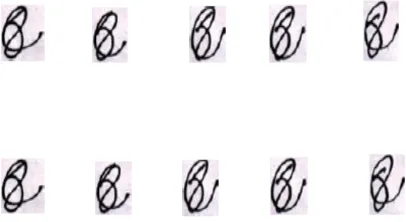
For experimentations of signature recognition signature dataset is used. The present worker has worked with 5 classes of that dataset and I have chosen 10 images of each class for my algorithm. The images are named in numeric from 1.1 to 1.10 where 1 is the class number and number after the dot specifies the image number. I have used 5 images of each class as train image and the rest 5 images for the test purpose.
Number of Class: 5
Number of Train Image for Each Class: 5 Number of Test Image for Each Class: 5 Total Image: 5*10=50
Image Extension: “.jpg”
Figure 1: Signature images 1.1 to 1.10 for First Class
Figure 2:Signature images 2.1 to 2.10 for Class2
Figure 3:Signature images 3.1 to 3.10 for Third Class
[image:4.612.199.406.382.492.2] [image:4.612.204.407.536.647.2]Figure 5:Signature images 5.1 to 5.10 for Class 5
A. Recognition Accuracy
The recognition accuracy is shown in table 1 below.
Table 1:Recognition accuracy
Overall Recognition Percentage: 80
B. Plots
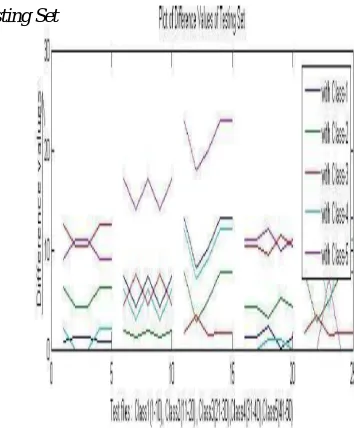
Various types of plots generated for signature recognition are shown in figure 5.6, 5.7 and 5.8 below.
C. Plot of Feature Values of Training Set
[image:5.612.195.421.461.671.2]D. Plot of Feature Values of Testing Set
Figure 7: Plot of Feature Values of Testing Set
E. Plot of Difference Values of Testing Set
Figure 8: Plot of Difference Values of Testing Set
V. CONCLUSION
Image processing is a vast field with various applications. Recognize the signature is a major stream. In this thesis, signatures of different people have been studied on for their recognition using Euler Number. In the first module, the features of training images from the dataset and the features of the testing images are extracted. Thus, two groups of feature vectors are created. The second phase of the system has the purpose of comparing the training image feature with the set of features of the testing images by Manhattan distance classifier. Finally, the third stage of the system will display the accuracy (recognition rate) result to the user. This algorithm is tested on the dataset where the train and test data are slightly changed. This algorithm can be extended on the dataset where the train and test data are vastly changed, not only in expression but also in illumination.
REFERENCES
[1] B. Fang, C.H. Leung, Y.Y. Tang, K.W. Tse, P.C.K. Kwok and Y.K. Wong, "Offline signature verification by the tracking of feature and stroke positions", Pattern Recognition 36, pp. 91–101, 2003
[2] J. Coetzer, B. M. Herbst, J. A. du Preez, “Offline Signature Verification Using the Discrete Radon Transform and a HiddenMarkovModel”, EURASIP Journal on Applied Signal Processing 2004:4, 559–571, Revised 27 June 2003
[image:6.612.198.375.318.532.2]Conference on Document Analysis and Recognition, USA, 2001, pp.110- 114
[4] R. Sabourin, R. Plamondon, G. Lorette, Offline identification with handwritten signature images: survey and perspectives, Structured Image Analysis, Springer, New York, 1992, pp 219-234. Advanced in Information Sciences and Service Sciences Volume 2, Number 3, September 2010
[5] C. Quek, R.W. Zhou. Antiforgery: a novel pseudo-outer product based fuzzy neutral network driven. Signature verification system, Pattern Recognition Lett. 23(2002) 1795-1816.
[6] E. Frias-Martinez, A. Sanchez, J. Velez, “Support vector machines versus multi- layer perceptrons for efficient off-line signature recognition”. Engineering Applications of Arti Intelligence 19 (2006), page 693–704
[7] F.Z Marcos, “signature recognition state–of–the-art”, IEEE A&E Systems magazine July 2005, page: 28-32.
[8] M.A. Ismail, Samia Gad, “Off-line Arabic signature recognition and verification”, Pattern Recognition Society 2000, page 1727-1740 School of Education Technology, Jadavpur University Page 35
[9] E. Ozgündüz, T. entürk, M.E. Karslıgil, "Off-Line Signature Verification and Recognition by Support Vector Machine". European Signal Proc. Conf. Turkey. Sep 2005.
[10] T. Kaewkongka, K. Chamnongthai, B. Thipakom, “Off-Line Signature Recognition using parameterized Hough Transform”, ISSPA Brisbane, Australia, 1999.
[11] M.Radmehr, S.M.Anisheh, I.Yousefian, “Offline Signature Recognition using Radon Transform”, World Academy of Science, Engineering and Technology 62 2012.
[12] Banshider Majhi, Y Santhosh Reddy, D Prasanna Babu, “Novel Features for Offline Signature Verification”, International Journal of Computers, Communications & Control Vol. I, No. 1, pp. 17-24, (2006)