Simulation of AODV Routing protocol
Isha Gautam
Vadodara Institute of Engineering /ECE/Vadodara/India [email protected]
Abstract—A Mobile Ad hoc NETwork is a kind of Wireless ad-hoc network, and is a self configuring network of Mobile routers connected by wireless links. Mobile Ad-Hoc
Network (MANET) is a wireless network without
infrastructure. Self configurability and easy deployment feature of the MANET resulted in numerous applications in this modern era. Efficient routing protocols will make MANETs reliable. In this paper, an attempt has been made to know protocols AODV.The simulation of AODV has been done by using simulation tool NS2 which is the main simulator, NAM (Network Animator) and excel graph
which is used for preparing the graphs from the trace files.
Keywords— MANET, Application of MANET, Classification
of Adhoc routing protocol, AODV, Simulation & Result.
I. INTRODUCTION
An ad-hoc network is a collection of wireless mobile hosts forming a temporary network without the aid of any stand-alone infrastructure or centralized administration. Mobile Ad-hoc networks are self- organizing and self-configuring multihop wireless networks where, the structure of the network changes dynamically. This is mainly due to the mobility of the nodes. Nodes in these networks utilize the same Random access wireless channel, cooperating in a friendly manner to engaging themselves in multihop forwarding. The node in the network not only acts as hosts but also as routers that route data to/from other nodes in network. Each device in a MANET is free to move independently in any direction, and will therefore change its links to other devices frequently. Each must forward traffic unrelated to its own use, and therefore be a router. Routing in ad-networks has been a challenging task ever since the wire-less networks came into existence. The major reason for this is the constant change in network topology because of high degree of node mobility. A number of protocols have been developed for accomplish this task. Routing is the process of selecting paths in a network along which to send network traffic. In packet switching networks, routing directs packet forwarding, the transit of logically addressed packets from their source toward their ultimate destination through intermediate nodes. An ad hoc routing protocol is a convention, or standard, that controls how nodes decide which way to route packets between
computing devices in a mobile ad-hoc network. In adhoc networks, nodes do not start out familiar with the topology of their networks; instead, they have to discover it. The basic idea is that a new node may announce its presence and should listen for announcements broadcast by its neighbors. Each node learns about nodes nearby and how to reach them, and may announce that it, too, can reach them. Wireless ad-hoc networks have gained a lot of importance in wireless communications. Wireless communication is established by nodes acting as routers and transferring packets from one to another in ad-hoc networks. Routing in these networks is highly complex due to moving nodes and hence many protocols have been developed. In this paper we have selected three main and highly proffered routing protocols for analysis of their performance. Figure1 below represents the scenario of MANET.
II. APPLICATION OF MANET
With the increase of portable devices as well as progress in wireless communication, ad hoc networking is gaining importance with the increasing number of widespread applications.
Military battlefield. Military equipment now routinely contains some sort of computer equipment. Ad hoc networking would allow the military to take advantage of commonplace network technology to maintain an information network between the soldiers, vehicles, and military information head quarters. The basic techniques of ad hoc network came from this field. Commercial sector. Ad hoc can be used in
emergency/rescue operations for disaster relief efforts, e.g. in fire, flood, or earthquake. Emergency rescue operations must take place where non-existing or damaged communications infrastructure and rapid deployment of a communication network is needed. Information is relayed from one rescue team member to another over a small handheld. Other commercial scenarios include e.g. ship-to-ship ad hoc mobile communication, law enforcement, etc.
notebook computers or palmtop computers to spread and share information among participants at an e.g. conference or classroom. Another appropriate local level application might be in home networks where devices can communicate directly to exchange information. Similarly in other civilian environments like taxicab, sports stadium, boat and small aircraft, mobile ad hoc communications will have many applications.
III. CLASSIFICATION OF ADHOC ROUTING PROTOCOL
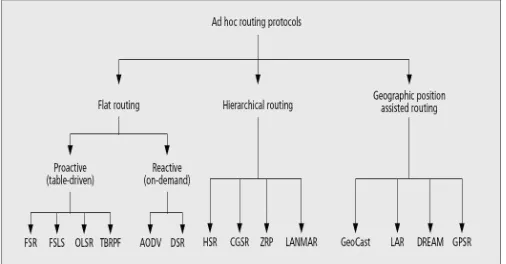
[image:3.612.30.283.354.486.2]Routing protocol in MANET can be classified into several ways depending upon their network structure, communication model, routing strategy, and state information and so on but most of these are done depending on routing strategy and network structure Based on the routing strategy the routing protocols can be classified into two parts: 1.Table driven and 2. Source initiated (on demand) while depending on the network structure these are classified as flat routing, hierarchical routing and geographic position assisted routing. Flat routing covers both routing protocols based on routing strategy.
Figure 1. Classification of Adhoc Routing Protocol
IV. AODV(ADHOC ON DEMANDDISTANCE VECTOR)
AODV is a variation of Destination-Sequenced Distance-Vector (DSDV) routing protocol which is collectively based on DSDV and DSR. It aims to minimize the requirement of system-wide broadcasts to its extreme. It does not maintain routes from every node to every other node in the network rather they are discovered as and when needed & are maintained only as long as they are required.
The key steps of algorithm used by AODV for establishment of Uni-cast routes are explained below.
initiated. AODV initiates a route discovery process using Route Request (RREQ) and Route Reply (RREP). The source node will create a RREQ packet containing its IP address, its current sequence number, the destination’s IP address, the destination’s last sequence number and broadcast ID. The broadcast ID is incremented each time the source node initiates RREQ. Basically, the sequence numbers are used to determine the timeliness of each data packet and the broadcast ID & the IP address together form a unique identifier for RREQ so as to uniquely identify each request. The requests are sent using RREQ message and the information in connection with creation of a route is sent back in RREP message. The source node broadcasts the RREQ packet to its neighbors and then sets a timer to wait for a reply. To process the RREQ, the node sets up a reverse route entry for the source node in its route table. This helps to know how to forward a RREP to the source. Basically a lifetime is associated with the reverse route entry and if this entry is not used within this lifetime, the route information is deleted. If the RREQ is lost during transmission, the source node is allowed to broadcast again using route discovery mechanism.
The source node broadcasts the RREQ packet to its neighbors which in turn forwards the same to their neighbors and so forth. Especially, in case of large network, there is a need to control network-wide broadcasts of RREQ and to control the same; the source node uses an expanding ring search technique. In this technique, the source node sets the Time to Live (TTL) value of the RREQ to an initial start value. If there is no reply within the discovery period, the next RREQ is broadcasted with a TTL value increased by an increment value. The process of incrementing TTL value continues until a threshold value is reached, after which the RREQ is broadcasted across the entire network.
When the destination node or an intermediate node with a route to the destination receives the RREQ, it creates the RREP and Unicast the same towards the source node using the node from which it received the RREQ as the next hop. When RREP is routed back along the reverse path and received by an intermediate node, it sets up a forward path entry to the destination in its routing table. When the RREP reaches the source node, it means a route from source to the destination has been established and the source node can begin the data transmission.
received by the source node, it can either stop sending the data or reinitiate the route discovery mechanism by sending a new RREQ message if the route is still required
A. Benefits and limitation of AODV
The benefits of AODV protocol are that it favors the least congested route instead of the shortest route and it also supports both Unicast and multicast packet transmissions even for nodes in constant movement. It also responds very quickly to the topological changes that affects the active routes. AODV does not put any additional overheads on data packets as it does not make use of source routing.
The limitation of AODV protocol is that it expects/requires that the nodes in the broadcast medium can detect each others’ broadcasts. It is also possible that a valid route is expired and the determination of a reasonable expiry time is difficult. The reason behind this is that the nodes are mobile and their sending rates may differ widely and can change dynamically from node to node.
IV SIMULATION AND RESULT
The following metrics are used in this paper for the analysis of AODV routing protocols.
i) Packet Delivery Ratio ii) Average End to End Delay iii) Throughout
iv) average control packet
Packet delivery ratio
packet delivery ratio
90.190
89.9
89.8
0.2
0.15
0.1
0.05
0
0 50 100 150 200 250 300
no of nodes
by route discovery propagation, transfer times etc.While the nodes are less than 400 nodes, the delay of AODV is a little more because of cluster forming.
Throughput Analysis
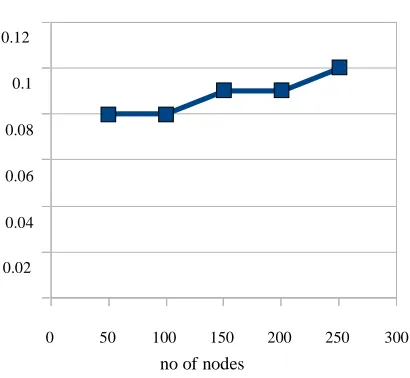
Throughput analysis of AODV
0.12
0.1
0.08
0.06
0.04
0.02
89.7
89.6
0 50 100 150 200 250 300
no of nodes
89.5
89.4
89.3
0 50 100 150 200 250 300
no of nodes
As the number of node increase throughput is increase. Throughput increasing from node 50 to node 250.
[image:4.612.326.531.329.518.2]Average control packet
The packet delivery ratio in this simulation is defined as the ratio between the number of packets sent by constant bit rate sources and the number of received packets by the CBR sink at destination. It describes percentage of the packets which reach the destination. AODV shows high packet delivery ratio.
CONCLUSION
In this paper we proposed a new routing model which maintain node hierarchical based on AODV.our routing scheme hybrid in nature as it uses both flat and hierarchical approach for finding the route to destination
The Simulation result show that AODV provide better packet delivery rate with less route latency and overhead. The result confirm achieve better scalability.
VI. REFERENCES
[1] G. Eason, B. Noble, and I. N. Sneddon, “On certain integrals of
Lipschitz-Hankel type involving products of Bessel functions,” Phil. Trans. Roy.
Soc. London, vol. A247, pp. 529–551, April 1955. (references) [2] J. Clerk Maxwell, A Treatise on Electricity and Magnetism, 3rd ed., vol.
2. Oxford: Clarendon, 1892, pp.68–7
[3] I. S. Jacobs and C. P. Bean, “Fine particles, thin films and exchange
anisotropy,” in Magnetism, vol. III, G. T. Rado and H. Suhl, Eds. New
York: Academic, 1963, pp. 271–350.
[4] K. Elissa, “Title of paper if known,” unpublished.
[5] R. Nicole, “Title of paper with only first word capitalized,” J. Name
Stand. Abbrev., in press.
[6] Y. Yorozu, M. Hirano, K. Oka, and Y. Tagawa, “Electron spectroscopy studies on magneto-optical media and plastic substrate interface,” IEEE Transl. J. Magn. Japan, vol. 2, pp. 740–741, August 1987 [Digests 9th Annual Conf. Magnetics Japan, p. 301, 1982]. [7] ns-2http://www.isi.edu/nsnam/ns
[8] Charles Perkins, Elizabeth Royer, and Samir Das. “Ad hoc on demand distance vector (AODV) routing”. IETF RFC No. 3561, July 2003
9] Josh Broch, David Johnson, and David Maltz. “The dynamic source routing protocol for mobile Adhoc networks for IPv4 IETF RFC 4728, Feb 2007.
[10] D. Johnson and D. Maltz. “Dynamic source routing in ad hoc wireless networks”. In T. Imielinski and H. Korth, editors, Mobile computing, chapter 5. Kluwer Academic, 1996.
[11] Perkins C,Bhagwat P, ”Highly Dynamic Destination-Sequenced Distance-Vector Routing(DSDV)