http://dx.doi.org/10.4236/jbise.2014.75031
How to cite this paper: García-Herrero, V., et al. (2014) A Model Metabolic Cycle Simulated with the Mathematica Program. J. Biomedical Science and Engineering, 7, 286-295. http://dx.doi.org/10.4236/jbise.2014.75031
A Model Metabolic Cycle Simulated with the
Mathematica Program
Víctor García-Herrero, Francisco López-Cánovas, Antonio Sillero*
Departamento de Bioquímica, Facultad de Medicina, Instituto de, Investigaciones Biomédicas Alberto Sols UAM/CSIC, Madrid, Spain
Email: *[email protected]
Received 2 March 2014; revised 5 April 2014; accepted 13 April 2014
Copyright © 2014 by authors and Scientific Research Publishing Inc.
This work is licensed under the Creative Commons Attribution International License (CC BY). http://creativecommons.org/licenses/by/4.0/
Abstract
A system of differential equations has been used to simulate a model metabolic cycle, containing only one initial substrate and 8 irreversible enzymes. The metabolic course of the intermediates (products/substrates) was also explored in different situations: changes in the kinetic constants of one of the enzymes of the cycle; introduction of one reversible step; consecutive increments in the Km values of each enzyme of the cycle and the presence of two initial substrates. A decrease or an increase in the Km value of one of the enzymes of the cycle promotes a decrease or an increase in the steady state level of its own substrate, respectively; by the contrary, a decrease or an increase in the Vmax value promotes, respectively, an increase or a decrease in the stationary level of the corresponding substrate. A comparison between a linear and a cyclic metabolic pathway is also presented.
Keywords
Metabolic Pathways, Metabolic Cycle, Mathematical Simulations, Differential Equations
1. Introduction
V. García-Herrero et al.
It seemed to us that a similar approach could be followed to analyze a metabolic cycle where continuous and consecutive transformations among different substrates catalyzed by different enzymes are taking place. It is common knowledge that the biochemical machinery of a cell, or of any organism as a whole, is partially based on the occurrence of linear, branched and circled pathways, interrelated among them by metabolic crossroads and by diverse control mechanisms [3]-[7]. The resulting panorama is so complex that, both experimental and mathematical treatments [2] [8] [9] might be necessary to apprehend even particular zones of this complex or-ganization.
Whereas simulations of linear pathways are widely documented [2], similar studies on metabolic cycles are, to our knowledge, rather scarce in spite of the crucial relevance of some of these cycles in biochemical processes. In this work, diverse aspects of a particular example of a model metabolic cycle composed of 8 enzymes have been explored. Similar studies could be performed with cycles composed by a different number of substrates/ enzymes. The effect of changing the kinetic constants (Vmax and Km values) of one or several enzymes of the cycle has been also examined. The Vmax and Km values are two parameters widely used in the study of enzyme kinetics [3] [4]. As shown below, the metabolic situation generated by a group of enzymes acting linearly or forming a cycle presents both similar and different metabolic consequences.
2. Experimental Procedures
ComputationThe Mathematica Program 9.0 [10] was used throughout this work to solve the differential equations describing metabolic pathways (seeTable 1), with the following main commands: derivatives, D[f(x), x]; plot representa-tions, Plot[f(x), x, xmin, xmax]; solution of a system of differential equarepresenta-tions, NDSolve [eqns, vars]. In the Ma-thematica Program: a’[t], b’[t], etc., correspond to da/dt, db/dt, etc.; one space is equivalent to a multiplication sign; x = y is an imperative statement that actually causes an assignment to be done; x = y merely tests whether x and y are equal and causes no explicit action. The model cycle containing 8 substrates is schematically represented in Figure1, and its mathematical treatment listed inTable 1.
Table 1. Mathematica protocol used to simulate a cyclic or linear pathway, with potential changes in enzyme kinetic con-stants. More details are in Figure 1and in the Text.
1) v1 = Vmax1 a [t]/(a[t] + km1);
v2 = Vmax2 b [t]/(b[t] + km2);
v3 = Vmax3 c [t]/(b[t] + km3);
v4 = Vmax4 d [t]/(d[t] + km4); v4N = (Vmax4f*d[t]/(km4f) − Vmax4r*e[t]/(km4r))/(1 + d[t]/(km4f) + e[t]/(km4r));
v5 = Vmax5 e[t]/(e[t] + km5);
v6 = Vmax6 f[t]/(f[t] + km6);
v7 = Vmax7 q[t]/(q[t] + km7);
v8 = Vmax8 h[t]/(h@t) + km8);
2)Vmax1 = 1; km1 = 1; Vmax2 = 1; km2 = 1; Vmax3 = 1; km3 = 1; Vmax4 = 1; km4 = 1; Vmax4f = 1; km4f = 1;
Vmax4r = 1; km4r = 1; Vmax5 = 1; km5 = 1; Vmax6 = 1; km6 = 1; Vmax7 = 1; km7 = 1; Vmax8 = 1; km8 = 1;
3) NDSolve[{a'[t] == v8 − v1, b' [t] == v1 − v2, c' [t] == v2 − v3,
d'[t] == v3 − v4, e'[t] == v4 − v5, f'[t] == v5 − v6, q'[t] == v6 − v7, h'[t] == v7 − v8, a[0] == 1, b[0] == 0, c[0] == 0, d[0] == 0, e[0] ==0,
f[0] == 0, q[0] == 0, h[0] == 0}, {a, b, c, d, e, f, q, h}, {t, 0, 15}];
4) Plot[{Evaluate[a[t] /. %], Evaluate[b[t] /. %],
Evaluate[c[t]/. %], Evaluate[d[t]/. %], Evaluate[e[t]/. %],
Evaluate[f[t]/. %], Evaluate[q[t]/. %], Evaluate[h[t]/. %]},
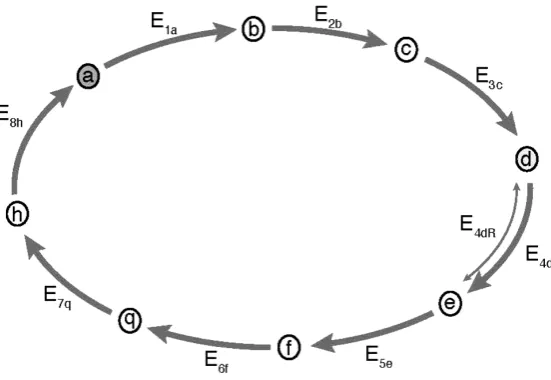
Figure 1. Biochemical cycle, Schematic representation of a biochemical cycle composed of 8 different substrates a- > b- > c- > d- > e- > f- > q- > h- > a and by 8 enzymes: E1a, E2b, E3c, E4d, E5e, E6f, E7q, E8h. The transfor-mation of this cyclic into a linear pathway is mathematically obtained by simply eliminating enzyme E8h (i.e. E8h = 0) from the cycle. In this case the transformation h- > a does not take place, and (a) and (h) are then the first and the last substrates of the linear pathway, respectively. Note as: i) because of problems with the correct recognition of the letter “g” by the Mathematica Program, “q” replaces letter “g” in the sequence of substrates of the cycle; ii) the substrates will be indicated in parentheses, hence (a) is simultaneously the first and the last substrate of the cycle; iii) the enzymes (E) are numbered with two sub-indexes: indicating their order in the reaction (from 1 to 8) and the corresponding substrate. For example E5e, stands for the fifth enzyme of the sequence acting on substrate (e); iv) substrate (a) is marked in the figure to indicate that it is the first substrate of the cycle; v) in two particular cases: substrate (a) and (d) were considered as initial substrates of the cycle, and step 4 was considered reversible.
To facilitate the presentation of the model (Figure1), the enzymes (E) are named, in general, as E1 to E8 or, more specifically, as E1a, E2b, E3c, E4d, E5e, E6f, E7q, E8h; the sub indexes representing the order (from 1 to 8) and the sequence of the reactions (from a to h): a- > b- > c- > d- > e- > f- > q- > h- > a; because a problem of ade- quate recognition of letter “g” by the Mathematica Program, this letter was replaced by “q” as a substrate of the cycle
(Figure1). In one particular case, the reaction catalyzed by enzyme E4d was considered reversible 4 E dR
d⇐⇒e, and the enzyme named as E4dR, with the following kinetic constants: in the forward (f) and reverse direction (r), Km4f, Vmax4f , Km4r, Vmax4r (Table 1). The equation velocity v4N (N, for Net velocity) between the two substrates (d and e) is shown inTable 1and in Equation (2) (see below). Note as: i) when convenient, the name of the substrates are indicated in the text, between brackets; ii) the substrate (a) is simultaneously the initial and the final substrate of the cycle.
The following parts can be considered in Table 1: 1) equations of the actual velocities of the enzymes E1 to E8, (named from v1 to v8), expressed with the classical Michaelis-Menten equations: maximal velocities (Vmax) are indicated as Vmax1 to Vmax8 and Km values as Km1 to Km8; the sequence of the reactions are indicated in Figure1; 2) actual values for the kinetic constants for each enzyme; the value assigned to all the constants in the control pathway is the unity; 3) differential equations used to calculate the changes in the concentration of the substrates along the reaction time, together with the initial conditions, unknowns be solved and time of reaction; 4) the statementsrequired for the Mathematica Program to solve the differential equations shown above, and to present the graph shown both in Figure2, panel A.
V. García-Herrero et al.
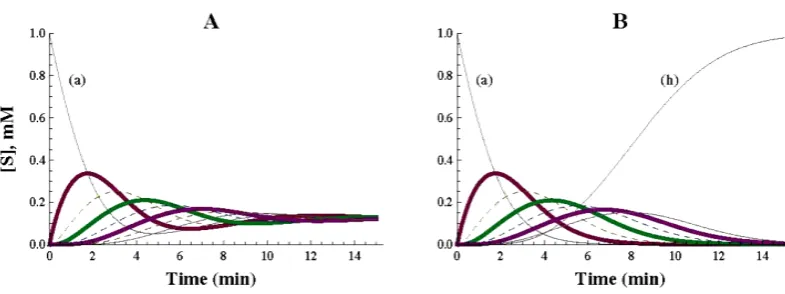
Figure 2.Representation of a cyclic pathway (A) and of a linear irreversible pathway (B), simulated with the Mathematica Program. In panel A, the specifications consigned inTable 1 were strictly followed. For the draw-ing of panel B,Table 1 was essentially modified as follows: the enzyme E8h was eliminated (i.e. v8 = 0) and
hence the concentration of (a) considered for the calculations of the differential equations was a’ [12] = v8 − v7 = −v7. In A and B the kinetic values of the concerned enzymes were the unity for both the Vmax and Km values.
3. Results and Discussion
3.1. A Model Cycle Primed with Only One Initial Substrate and Composed of 8 Enzymes Comparison with a Similar, but Linear, Irreversible Pathway
After applying the differential equations described in Table 1, the plot represented in Figure2, A was obtained. As soon as the simulation is initiated, the concentration of the initial substrate (a) starts to decrease and is promptly (min 0 to 8 of reaction) converted to changes in all the intermediates of the cycle. As the 8 enzymes of the control cycle have the same kinetic constants (Vmax = 1 micromole/min; Km = 1 mM), it is expected that the amount of the initial substrate (a) is equally distributed among the 8 substrates of the cycle when the steady state is reached: 1/8 = 0.125 mM (Figure2(A)). The Mathematica commands (Table 1) allow different times of reaction (see part 3), what can be used for different purposes. If the steady state is expected to be reached (and examined) at longer incubation times, a poor vision of the initial profiles of the reaction could be obtained. By contrast, if the objective is to examine the initial steps, shorter reaction times are more convenient. In this work, a compromise with respect to the reaction time (from 0 to 15 min) was used to get a good view on both the ini-tial and the final stages of the reaction.
As an illustrative complement to this cycle, a linear irreversible pathway composed of 7 substrates and 7 en-zymes was mathematically simulated and presented in Figure 2, panel B. The change of a cyclic to a linear pathway was obtained by simply eliminating enzyme E8h, which transforms the last substrate of the cycle (h) into the first one (a), (what is equivalent to make v8 = 0). With this modification, the first substrate (a) is totally transformed into the end product (h) of the now linear pathway. As the kinetic characteristics of the enzymes of the cyclic and linear pathways are identical (Km and Vmax values are equal to 1 the comparison between both pathways is easily visualized. Initially, the profiles of the components of both pathways follow a similar course, but diverge when they tend to reach quite different steady states (compare panels A and B in Figure2).
3.2. Influence of Changing the Vmax or the Km Values of One, or Several Enzyme(s) in a Metabolic Cycle
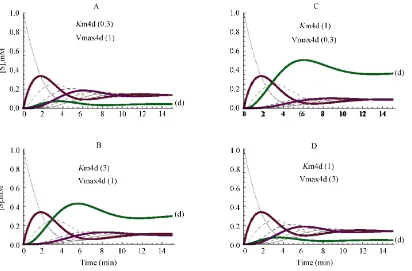
Changes in the kinetic parameters were firstly simulated on the enzyme E4d; its Km value was modified from 1 mM (control, Figure2(A)) to 0.3 mM (Figure3(A)), or to 3 mM (Figure 3(B)). The decrease (Figure3(A)) or the increase (Figure 3(B)) of the Km value of the enzyme E4d promoted a decrease, or an increase, respectively, in the steady state concentration of its substrate (d) (as marked in Figure3(A) and Figure 3(B)), whereas, the other substrates (a, b, c, e, q, h) of the cycle reached almost similar steady state concentrations (Figure3(A) and Figure 3(B)).
[image:4.595.116.509.81.228.2]Figure 3. Influence of changing the Vmax or the Km values of only one enzyme (E4d) of the cycle. The Km value of E4d was changed from the standard value of 1 to 3 mM (panel A) or to 0.3 mM (panel B), and the reaction fol-lowed up to the metabolites approaching their steady state level. The figures between brackets correspond to the values for Km4d (mM) and Vmax4d (micromole/min), respectively.
substrate (d) of the enzyme reached comparatively higher and lower steady state levels, respectively, whereas the other components of the cycle reached similar stationary levels in Figure3, panels C and D.
Comparatively results were obtained when similar changes in the Km or Vmax values were simulated in any of the other enzymes of the cycle (results not shown); a metabolic cycle operates as a functional unit, and similar changes in different enzymes promote similar overall changes in the cycle.
A diversity of alternatives, obtained by increasing or decreasing the Km or the Vmax values of several, con-secutive or alternating enzymes, can be simulated by simply changing the adequate parameters in Table 1 (not shown). As an example of the versatility of the Program for the handling of the cycle, only the results promoted by simultaneous modifications of the Km values of the 8 enzymes of the cycle are shown in panels A and B of Figure4. In this example the Km modified values are indicated between brackets: E1a (0.2); E2b (0.4); E3c (0.6); E4d (0.8); E5e (1.0); E6f (1.2); E7q (1.6); E8h (1.8). Two scales for the y-axis, 1 and 0.5 mM, were used in panels A and B, respectively. In panel B it is clearly appreciated as these changes in the Km values promoted different steady state levels for each one of the substrates of the cycle (Figure4).
3.3. Reversibility of One of the Reactions in a Model Cycle
A different type of simulation was now explored by introducing a different enzyme (named as E4dR) (Figure1) catalyzing the reversible reaction (1), with the equation velocity (𝑣𝑣4N) detailed in (2) and in part Table 1, part 1)).
4 E dR
d⇐⇒e (1)
[ ]
[ ]
[ ]
[ ]
4 4
4 4
4
1
4 4
d e
Vmax f Vmax r
Km f Km r
v N
d e
Km f Km r
− =
+ +
V. García-Herrero et al.
Figure 4. Different Km values applied to the 8 enzymes of the cycle. The Km values (mM) are indicated between brackets: E1a (0.2); E2b (0.4); E3c (0.6); E4d (0.8); E5e (1.0); E6f (1.2); E7q (1.6); E8h (1.8). Two scales for the y-axis, 1 and 0.5 mM, were used in panels A and B, respectively. In panel B it is clearly appreciated that the changes in the Km values promoted different steady state levels for each one of the substrates of the cycle.
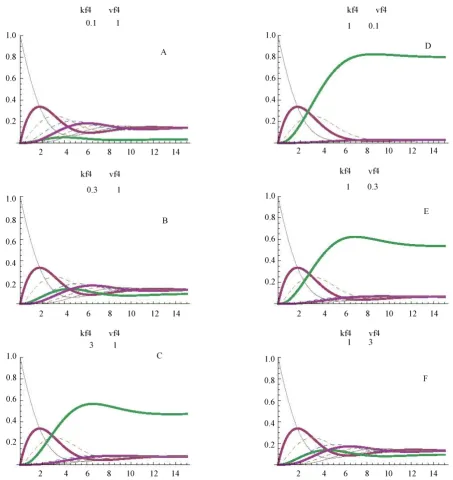
The Mathematica program detailed inTable 1 is so arranged that a simple replacement of v4 by v4N in part 3 of Table 1 (one of the commands of NDSolve) is enough to simulate this reversible step. Nevertheless it is con-venient to note that all the kinetic constants (Km4f; Vmax4f; Km4r and Vmax4r) are settled at the value of 1.The operator can modify these values at will, to obtain modified values for E4dR. In this work we have considered only the following alternatives in the forward (f) direction d- > e: Km4f with values of: 0.1, 0.3 and 3 mM, (Figure5, panels A, B, C, respectively); Vmax4f with values of: 0.1, 0.3 and 3 micromole/min, (Figure5, pa-nels D, E, F, respectively). The profiles in Figure5, panels B, C, D, E and F can be compared with those of the control cycle (Figure2(A)): i) the lowering of the Vmax4f value tends to increase the stationary level of (d) (Figure5, D): this level is around 0.8 mM, what implies an almost complete transformation of the initial sub-strate (a = 1 mM) into subsub-strate (d = 0.8 mM); ii) concerning changes in the Km4f values, higher values of this parameter convey higher steady state levels of the substrate (d) (around 0.5 mM) (Figure5(C)), and lower Km4f values elicit a significant decrease in the stationary level of (d) t (Figure5(A)).
3.4. Insertion of Two Initial Substrates in the Cycle
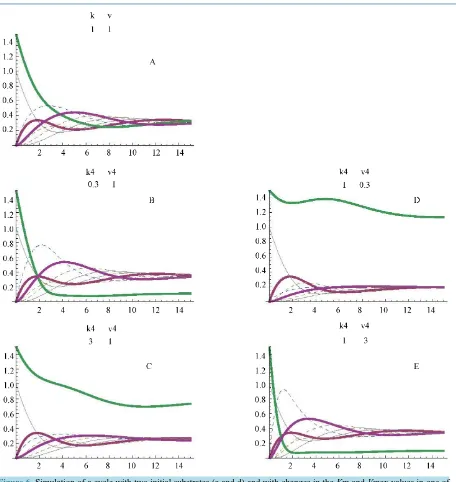
Up to now, substrate (a) was considered as the first and unique initial substrate of the control cycle. To approach a different example, substrates (a) and (d) were considered initiating simultaneously the pathway (Figure 6). The direction of the cycle is as indicated in Figure1, and metabolite (a) is still considered as the very first initial substrate. To better appreciated the profiles of substrates (a) and (d), two different initial concentrations were theoretically considered, 1 and 1.5 mM, respectively; here, only the kinetic constants corresponding to enzyme E4d were modified (Figure 6). The control profiles obtained with Vmax and Km values equal to 1 are repre- sented inFigure6(A). Those obtained for Km values settled at 0.3, 1 and 3 mM are represented inFigure 6(A), Figure 6(B)andFigure 6(C), respectively; those obtained for Vmax values of 0.3, 1 and 3 micromole/min are represented inFigure 6(E) and, Figure 6(A), respectively.
4. Concluding Remarks
Figure 5.Reversibility of one of the step (E4dR) of the cycle (see alsoFigure 1). The changes were simulated only in the forward direction, with Km4f values of 0.1, 0.3 and 3 mM (panels A, B, and C respectively). The profiles obtained with
Vmax4f values of 0.1, 0.3 and 3 micromoles/min are shown in panels D, E. and F, respectively. The figures between brackets, in the upper part of the panels, correspond to the values for the Km4f (mM) and Vmax4f (micromoles/min), respectively.
Illustrative results can be obtained by modifying the kinetic constants of the cycle enzymes. In general,
in-creasing the Km and/or decreasing the Vmax values of any of the enzyme of the cycle, promoted an increase in
the steady state level of the corresponding substrate.
The performance of the cycle was also tested considering three different additional conditions: i) reversibility
of the reaction catalyzed by one enzyme (E4dR) (Figure5); ii) consecutive increments in the Km values of the
eight enzymes of the cycle (Figure4) and iii) presence of two initial substrates (a) and (d) (Figure6).
V. García-Herrero et al.
Figure 6. Simulation of a cycle with two initial substrates (a and d) and with changes in the Km and Vmax values in one of the enzymes (E4d) of the cycle. The profiles obtained at Km4d values of 1, 0.3 and 3 mM are shown in panels A, B and C; those obtained at Vmax4f values of 1, 0.3 and 3 micromoles/min are in panels A, D and E. Figures between brackets, in the upper part of the panels, correspond to the values for Km4f (mM) and Vmax4f (micromoles/min), respectively for enzyme E4d. figures under k and v applied to the corresponding values of all other enzymes of the cycle.
([2] [5]-[8] [11]). Cyclic pathways, of similar pivotal importance, have attracted a minor number of these studies with the exception of the classical Krebs/glyoxylate ([12]-[17]) and urea cycles ([18]-[20]). In addition, there are a considerable number of metabolic networks, that include both linear and cyclic pathways, that could be viewed as encompassing a bigger cycle, as is the case of the functional unit formed by glycolysis, gluconeogenesis, Krebs and pentose pathway cycles ([21] [22]). On certain occasions, these works are difficult to be followed by researchers other than those with a specific background on these topics.
Acknowledgements
We thank Javier Pérez for very helpful drawing assistance and Antonio Sillero Perles for technical assistance; María Antonia Günther Sillero and José Gonzalez Castaño for helpful comments on the manuscript, and Fran-cisco Pérez-Zúñiga for bringing in contact VG-H and AS. VG-H is a second year student in the School of Ma-thematics, Complutense University of Madrid. FL-P is a second year MIR (Internal Medical Resident) in the Psychiatric Service, Hospital La Paz, Madrid. This investigation was supported by Grant BFU2009-08977.
References
[1] López-Cánovas, F.J., Gomes, P.J. and Sillero, A. (2013) Mathematica Program: Its Use to Simulate Metabolic Irre-versible Pathways and Inhibition of the First Enzyme of a Metabolic Pathway as Visuaized with the Reservoir Model.
Computers in Biology and Medicine, 42, 853-864. http://dx.doi.org/10.1016/j.compbiomed.2013.04.003
[2] Voet, D. and Voet, J.G. (2004) Biochemistry, XV +1591, 482-493.
[3] Cleland, W.W. (1970) Steady State Kinetics in the Enzymes. 3rd Edition, Academic Press, New York, 1-65.
[4] Krauss, M., Schaller, S., Borchers, S., Findelsen, R., Lippert, J. and Kuepfer, L. (2012) Integrating Cellular Metabol-ism into a Multiscale Whole-Body Model. PLOS Computational Biology, 8, e1002750.
http://dx.doi.org/10.1371/journal.pcbi.1002750
[5] Fell, D. (1997) Understanding the Control of Metabolism. Portland Press; Distributed by Ashgate Pub. Co. in North America, London; Miami Brookfild, VT.
[6] Segel, I.H. (1975) Enzyme Kinetics: Behavior and Analysis of Rapid Equilibrium and Steady State Enzyme Systems. Wiley, New York.
[7] Klipp, R., Herwig, R., Kowald, A., Wierling, C. and Lehrach, H. (2005) System Biology in Practice. Wiley-VCH Ver-lag GmbH &Co, Winheim (FRG). http://dx.doi.org/10.1002/3527603603
[8] Alberty, R.A. (2011) Enzyme Kinetics. Rapid-Equilibrium Applications of Mathematica, Hoboken.
http://dx.doi.org/10.1002/9780470940020
[9] Alon, U. (2006) An Introduction to System Biology. Design Principles of Biological Circuits. CRC Pres, Taylor & Francis Group, London.
[10] Wolfram, S. (2013) Wolfram Mathematica Tutorial Collection.
http://www.wolfram.com/learningcenter/tutorialcolection
[11] Bisswanger, H. (2004) Enzyme Kinetics. Principle and Methods, Wiley-VCH, Weinheim (FRG).
[12] Albe, K.R. and Wright, B.E. (1992) Systems Analysis of the Tricarboxylic Acid Cycle in Dictyostelium Discoideum. II. Control Analysis. Journal of Biological Chemistry, 267, 3106-3114.
[13] Oliveira, J.S., Bailey, C.G., Jones-Oliveira, J.B., Dixon, D.A., Gull, D.W. and Chandler, M.L. (2003) A Computational Model for the Identification of Biochemical Pathways in the Krebs Cycle. Journal of Computational Biology, 10, 57- 82. http://dx.doi.org/10.1089/106652703763255679
[14] Wu, F., Yang, F., Vinnakota, K.C. and Beard, D.A. (2007) Computer Modeling of Mitochondrial Tricarboxylic Acid Cycle, Oxidative Phosphorylation, Metabolite Transport, and Electrophysiology. Journal of Biological Chemistry, 282, 24525-24537. http://dx.doi.org/10.1074/jbc.M701024200
[15] Nazaret, C., Heiske, M., Thurley, K. and Mazat, J.P. (2009) Mitochondrial Energetic Metabolism: A Simplified Model of TCA Cycle with ATP Production. Journal of Theoretical Biology, 258, 455-464.
http://dx.doi.org/10.1016/j.jtbi.2008.09.037
[16] Amador-Noguez, D., Feng, X.J., Fan, J., Roquet, N., Rabitz, H. and Rabinowitz, J.D. (2010) Systems-Level Metabolic Flux Profiling Elucidates a Complete, Bifurcated Tricarboxylic Acid Cycle in Clostridium Acetobutylicum. Journal of Bacteriology, 192, 4452-4461. http://dx.doi.org/10.1128/JB.00490-10
[17] Smith, A.C. and Robinson, A.J. (2011) A Metabolic Model of the Mitochondrion and Its Use in Modelling Diseases of the Tricarboxylic Acid Cycle. BMC Systems Biology, 5, 102. http://dx.doi.org/10.1186/1752-0509-5-102
[18] Bachmann, C. and Colombo, J.P. (1981) Computer Simulation of the Urea Cycle: Trials for an Appropriate Model.
Enzyme, 26, 259-264.
[19] Morris Jr., S.M. (2002) Regulation of Enzymes of the Urea Cycle and Arginine Metabolism. Annual Review of Nutri-tion, 22, 87-105. http://dx.doi.org/10.1146/annurev.nutr.22.110801.140547
V. García-Herrero et al.
[21] Sillero, A., Selivanov, V.A. and Cascante, M. (2006) Pentose Phosphate and Calvin Cycles: Similarities and Three- Dimensional Views. Biochemistry and Molecular Biology Education, 34, 275-277.
http://dx.doi.org/10.1002/bmb.2006.494034042627