E
2
ACM: Energy Efficient Adaptive Cluster
based Multilevel Routing Protocol for
Wireless Sensor Networks
Amandeep Kaur
Research Scholar
Computer Engineering Department
M.M.Engineering College, M.M University Mullana, Ambala, India
Rajneesh Kumar Gujral
Professor
Computer Engineering Department M.M.Engineering College, M.M University Mullana,
Ambala, India
ABSTRACT
It is a great challenge for designing a routing protocol that can maximize the network lifetime of Wireless Sensor Network (WSN), due to the limited energy of Sensor Node (SN). As a well-known hierarchical routing protocol in WSN, LEACH protocol could extend the WSN lifetime effectively. It assumes that all nodes can communicate with Base Station (BS) directly. With the expansion of WSN scale, the average distances between cluster head (CH) node and BS increase significantly, results in communication energy cost. For the large-scale WSN, this paper proposes a multimetric-based Energy Efficient Adaptive Cluster Based Multilevel (E2ACM) Routing Protocol. It regards the distance between CHs, nodes registered and residual energy of CH to construct a multihop path between CH and BS. Simulation results shows that proposed work significantly reduce the overall energy consumption of WSNs.
Keywords
WSN, LEACH, Cluster based routing, Energy Efficiency.
1.
INTRODUCTION
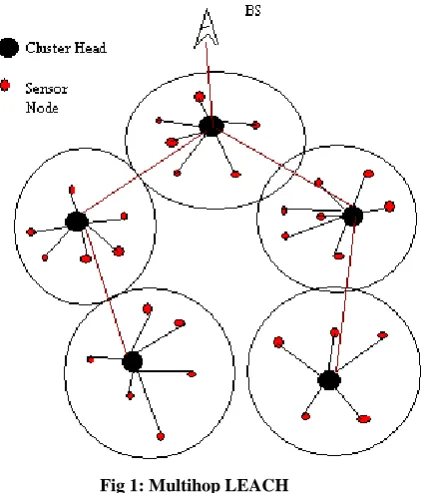
A Wireless Sensor Networks (WSNs) is a group of homogeneous or heterogeneous SNs, which are independent and work in a collaborative manner. SNs compute, transmit, receive and forward the data to adjacent SNs, Cluster Head (CH) and further to the Base Station (BS). Sensor networks are limited in computations, node energy, buffer size and signal strength.The potential applications of WSNs are highly varied, such as environmental monitoring, target tracking and military surveillance [2]. Energy Conservation [1] methods such as LEACH help to reduce energy consumption to prolong the Network Lifetime of WSN. In case when network size increased, distance between CH and BS is also increased extremely. This large network is not suitable for LEACH, in which BS is assumed at single-hop to all CHs. In this case transmission energy cost of CHs is not affordable. To address this problem Multi-hop LEACH routing protocol as shown in Figure 1 is proposed. Furthermore, the routing protocols must be able to cope with the low capacity resources. For instance, it is possible that a route that was earlier found meet certain requirements no longer does so due to the dynamic nature of the topology. In such a case, it is important that the network intelligently adapt according to its changed conditions. In this
[image:1.595.331.543.315.562.2]would allow CHs to maintain more reliable route to sink.
Fig 1: Multihop LEACH
2.
RELATED WORK
The main goal of cluster-based routing protocol is to utilize the energy consumption of SNs through multihop communication. Hasan Farooq et al. [3] use energy level, traffic load, and link quality of the nodes to establish appropriate route from CH to the sink. Deng Zhixiang and Qi Bensheng [4] propose Three Layered LEACH (TL-LEACH) which divides clusters into levels. Each CH is elected during set up phase of LEACH. They don‟t communicate directly to BS. Another set of CHs is selected to send data to the BS which is second level. Zuo Chen et al. [5] propose LEACH-MM which selects the CH node whose residual energy is greater than the average residual energy of adjacent cluster node to become the minsuper cluster head node. Cluster member node send data packet to the CH node, then CH node fuses data and sends the data packet to the ms-clusterhead node. Ms-cluster head node fuses data and forwards the data packet to the SINK node via the selected super cluster head node. Jiguo Yu et al. propose the EADC algorithm [6] in which CH chooses the neighbor CH with higher residual energy and fewer cluster members to construct the multihop path
3.
SYSTEM MODEL
3.1
Network Model
To simplify the network model, we adopt following assumptions:
1. N sensors are randomly dispersed within a square field. 2. The BS is located at centre of sensing area.
3. All sensors and the BS are stationary after deployment. 4. SNs are location-aware. The location of the BS is known by each node.
5. All SNs are homogeneous, i.e., they have the same energy.
3.2
Energy Model
E2ACM routing protocol uses energy model discussed in [15].To transmit an L-bit data to a distance d, the radio expands energy.
where is energy consumed by a node to transmit L bit packet at distance D, is the electronic energy that depends on factors such as the digital coding, coding, modulation or, is the amplifier energy that depends on the transmission distance and the acceptable bit-error rate. While receiving, the radio expands energy:
is energy dissipated by a node to received L bit packet .
3.3
Routing Metrices
E2ACM consider energy level, total number of the nodes registered with CH and distance metrics during route selection to improve the performance.
3.3.1
Energy Level
Energy is valuable resource for battery powered SNs since their life directly depends upon how much energy is available to them [7]. The energy level of the nodes involved in most of multihop transmission will be depleted quickly, and so the protocol should consider energy states of the nodes during route formation with highest energy nodes. E2ACM protocol keeps track of the energy state of the CH on the basis of residual energy of the node.
3.3.2
Link Quality
SNs communicate in outdoor environment, and active route breaks occur even on stationary nodes due to the effect of shadowing and consequently cause the network degradation [3]. Shortest available path is not always the best path available since routing over short path with weak RF link quality leads to increased packet loss and retransmissions. Consequently, E2ACM protocol use multi metrics based of the CHs while choosing candidates for route formation
.
3.3.3
Multimetric Combination
Routing based on multiple criteria is a classification problem, and we can combine multiple criteria (energy level, total number of nodes registered with CH and distance) into a single criterion to prolong network lifetime. Most of the multimetric routing protocols use the weighted sum approach to combine multimetric over an available path.
3.4
CH Strength Factor (
)Calculation
Considering a WSN, where there are multiple CHs. The of CH is function of where b is battery life of CH, n is the number of nodes registered with the CH and d is distance between neighbour CHs which is calculated as Eq.(4).
.
Where
w
1, w
2 andw
3 are the respective weights to be assigned to the corresponding parameters. Here all the weights are assumed to be 1. The following values as shown in Table 1 are used to determine of a CH. To avoid registration with a node which has a remaining battery life of less than 10%, the value of b and the function have been chosen in such a way that it should lead to a zero value.Table 1. For determining the remaining battery life ‘b’
Value Battery life ‘b’ %tage
3 If b >80%
2 If b is within 50–79%
1 If b is within 10–49%
4.
E
2ACM: PROPOSED PROTOCOL
In this section, we describe E2ACM routing protocol which is aware of residual energy, link quality, and distance between the CH to overcome the fore mentioned issues. In this protocol the route formation improved in such a way that CH embed their residual energy, number of nodes, and distance information in the route request packets, and CH is able to select the best reliable path to the sink.
4.1
The protocol phases
The functionality of the E2ACM protocol is divided into two phases: Set-up and Route Formation Phase:
4.1.1
Set-up Phase
The main objective of this phase is election of CH among the SNs which are randomly deployed in sensing area and calculating of each CH according to Eq. (4). LEACH [8] forms clusters by using a distributed algorithm, where nodes make autonomous decisions without any centralized control. Initially a node decides to be a CH with a probability (p) and broadcasts its decision. Each non-CH node determines its cluster by choosing the CH that can be reached using the least communication energy. The role of being a CH is rotated periodically among the nodes of the cluster in order to balance the load. The rotation is performed by getting each node to choose a random number „„T‟‟ between 0 and 1. A node becomes a CH for the current rotation round if the number is less than the threshold.
4.1.2
Route Formation
In this phase, E2ACM construct a multihop based routing path on the elected CH set. CH chooses the nearest neighbor CH with higher . From Eq. (4), it can be analyzed that the CH with shortest distance, higher residual energy and fewer cluster members will have a larger “strength”. This multihop route process continues until data reaches to the sink as shown in Figure 2.The pseudo-code in Figure 4 illustrate the E2ACM routing algorithm.
[image:3.595.318.564.387.617.2]Fig 2: Route Formation with E2ACM Routing Protocol (When Rounds=5, Initial Energy=0.5J p=0.4)
4.1.3
Route Maintenance Phase
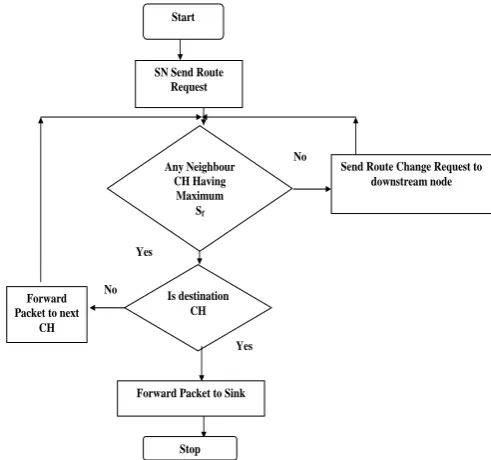
In WSNs, few SNs or CH may fail or be blocked due to lack of power, physical damage, or environmental interference. The failure of SNs should not affect the overall task of the sensor network. If many nodes fail, medium access control (MAC) and routing protocols must accommodate formation of new routes to the sink. In E2ACM routing protocol, CH can
the CH dies or is blocked, leading a certain area to be unreachable. However, re-clustering a whole network only to solve one failure may result in significant waste of resources. To guarantee the delivery, each CH, which forwarded a data, is responsible for ensuring that alternate successor of maximum has successfully received the packet. Seeking an alternative successor CH starts by the immediate downstream node of the broken link to find alternate CH having maximum .
Fig 3: E2ACM Routing pseudo code
This process repeats until route formation/reconfiguration from source to sink. This route maintenance phase depicted in Figure 4 improves the reliability and network lifetime of E2ACM routing protocol.
No
Is destination CH No
Yes Start
SN Send Route Request
Any Neighbour CH Having Maximum
Sf
Send Route Change Request to downstream node
Yes
Forward Packet to Sink
Stop Forward
Packet to next CH
[image:3.595.58.278.497.649.2]5.
SIMULATIONS
A set of simulations are performed to analyze the E2ACM routing protocol in MATLAB 7. For simulation environment the following parameters are given in Table 2.
Table2: Simulation Parameters
Simulation parameter Value
Topology size 100*100m2
Number of Nodes(n) 200
Initial Energy 0.1-0.5J
Transmission Range 50-90m
Probability (p) 0.1-0.5
5.1
Average Remaining Energy
Energy Constrained SNs require energy efficient protocol for prolonging the network lifetime.The comparative analysis of E2ACM protocol and randomly CH selection based approach is performed on basis of average remaining energy.Figure 5 shows the average remaining energy during different rounds. When compared to random CH selection protocol, the total remained energy of E2ACM protocol increase up to 36%.
0 2 4 6 8 10 12 14 16 18 20
5 10 15 20
Number of Nodes
A v e r a g e E n e r g
y Random Cluster Head
Selection
Cluster Head Selection based on Link Quality and Energy of Sensor Node
Fig 5: Remaining Average Energy Vs No. of Nodes
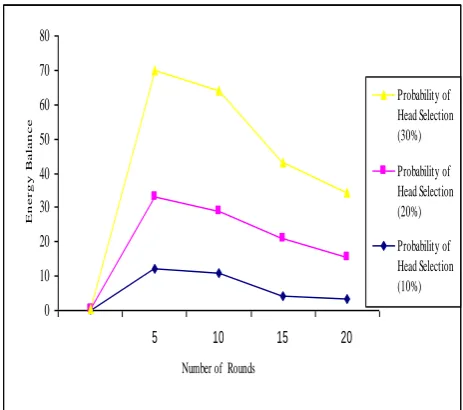
In Figure 6 we analyse that the overall energy consumption of the network reduces as the probability of CH selection increases. This is because when more CHs are elected, each
CH has more candidate CHs to get selected in route formation. 0 10 20 30 40 50 60 70 80
5 10 15 20
Number of Rounds
[image:4.595.316.548.73.278.2]E n e r g y B a l a n c e Probability of Head Selection (30%) Probability of Head Selection (20%) Probability of Head Selection (10%)
Fig 6: Energy Balance after 5-20 Rounds with Different Probabilities (p) on E2ACM
5.2
Network Lifetime
Performance metric to estimate when studying the energy consumption in a WSN is the lifetime of the WSN, e.g. the time until the first sensor dies [10]. In Figure 7, Network Lifetime is plotted on y-axis with varying number of initial energy on x-axis. It can be observed that the network lifetime increase as the initial energy of node and probability of CH selection increases. The reason for increasing network lifetime in proposed E2ACM routing protocol is that the next node in route is selected having maximum energy and reliable link based on .
[image:4.595.318.544.461.646.2].
Fig 7: Network Lifetime for different level of Energy of SNs on E2ACM protocol
6.
CONCLUSION AND FUTURE WORK
The WSNs have been envisioned to help in numerous monitoring applications. Energy efficient cluster based routing is paramount to extend the lifetime of the system. LEACH assume that all the nodes communicate with BS directly.With the expansion of WSN the average distance between node and BS increase that results in much energy consumption.For this reason E2ACM protocol establish
0 10 20 30 40 50 60 70
0.1 0.2 0.3 0.4
Intial Energy of Sensor Node (Joules)
N e tw ork L ife ti m e (N um be r of Ro und s )
Probability of Head Selection (40%)
Probability of Head Selection (30%)
Probability of Head Selection (20%)
multihop path between CHs toward sink.The E2ACM protocol enable the nodes to graceful handle the link failure, as topology dynamically changes to improve network lifetime in terms of number of rounds. Simulations are carried out to evaluate the performance which shows that the use of aforementioned parameters for route selection in E2ACM protocol significantly reduces the overall energy consumption of whole network. Further direction of this work will deal with utilising the same for the data aggregation or duty cycling to improve the overall network performance.
7.
REFERENCES
[1] Giuseppe, C. Marco, D. F. Mario and P. Andrea 2009 Energy conservation in wireless sensor networks: A survey. Elsevier Ad Hoc Networks, vol.7,537–568 [2] Akyildiz,I.F.,Su,W.Sankarasubramaniam,Y.andcayirci.2
002. A Survey onSensor Networks.IEEE communication Magazine. vol.40 (8) 102-114.
[3] Hasan Farooq and Low Tang Jung 2013. Energy, Traffic Load, and Link Quality Aware Ad Hoc Routing Protocol for Wireless Sensor Network Based Smart Metering Infrastructure Proceedings of International Journal of Distributed Sensor Networks 1-13.
[4] Deng Zhixiang,Qi Bensheng Three-layered routing protocol for WSN based on LEACH algorithm Wireless Mobile and Sensor Networks 2007(CCWMSN07),72-75.
[5] Zuo Chen, Kai Chen An improved Multi-hop Routing protocol for Large-Scale Wireless Sensor Network Based on Merging Adjacent Clusters 2013 JOURNAL OF SOFTWARE, vol. 8, NO. 8,2080-2086
[6] Jiguo Yu, Yingying Qi, Guanghui Wang, Xin Gu A cluster-base routing protocol for wireless sensor networks with nonuniform node distribution 2012 International Journal of Electronics and Communications AEÜ), vol. 66 (1), 54-61.
[7] Dilip Kumar, Trilok C. Aseri, and R.B. Patel EEHC: Energy efficient heterogeneous clustered scheme for wireless sensor networks 2009 Journal of Elsevier Computer Communication, 662-667.
[8] Heinzelman WR, Chandrakasan A, Balakrishnan Energy efficient communication protocol for wireless microsensor networks 2000 proceedings of the 33rd Annual Hawaii International Conference on System Sciences, 1–10.
[9] Jamal n. Al-karaki, Ahmed e. Kamal Routing techniques in wireless sensor networks: a survey 2004, IEEE Wireless Communication, vol. 11(6), 6-28.
[10]Y. Chen and Q. Zhao On the lifetime of wireless sensor networks 2005 IEEE communication Letters, vol. 9(11), 976–978.