N A N O E X P R E S S
Ab Initio Prediction of Boron Compounds Arising from Borozene:
Structural and Electronic Properties
G. Forte•A. La Magna•I. Deretzis• R. Pucci
Received: 15 September 2009 / Accepted: 2 October 2009 / Published online: 21 October 2009 Óto the authors 2009
Abstract Structure and electronic properties of two unusual boron clusters obtained by fusion of borozene rings have been studied by means of first principles calculations based on the generalized-gradient approximation of the density functional theory. Moreover, a semiempirical tight-binding model has been appropriately calibrated for transport calculations on these clusters. Results show that the pure boron clusters are topologically planar and char-acterized by (3c–2e) bonds, which can explain, together with the aromaticity (estimated by means of NICS), the remarkable cohesive energy values obtained. Such feature makes these systems competitive with the most stable boron clusters to date. The energy gap values indicate that these clusters possess a semiconducting character, while when the larger system is considered, zero-values of the density of states are found exclusively within the HOMO– LUMO gap. Electron transport calculations within the Landauer formalism confirm these indications, showing semiconductor-like low bias differential conductance for these structures. Differences and similarities with carbon clusters are highlighted in the discussion.
Keywords Boron clustersBorozeneDFTNICS
Transport
Introduction
Boron is the first element in group IIIA of the periodic table, presents the external electronic configuration s2p1 and possesses a variety of compounds second only to carbon. In several boron compounds [1,2] the existence of multicenter bonds has been discovered, which arise from the electron deficiency of this element. Moreover, boron has a special place among the elements of the periodic table because of the wide variety of crystalline structure forms, i.e., polymorphism, which include nanotubes [3], nanoribbons [4], and nanoclusters [5,6].
The interest in boron-based nanostructures has recently increased due to new studies of both the synthesis of single walled boron nanotubes (SWBNTs) and the prediction of ballistic conduction in SWBNTs [3, 6]; these findings, together with the properties that all boron nanotubes (a) are predicted to be metallic [7] and (b) are superconducting at low temperatures [8,9], promoted their prospective appli-cations in fabrication of novel electronic devices. The most stable boron structure is the a-rhombohedral bulk where boron icosahedra are centered on the edges of a rhombo-hedral unit cell [10].
Unlike the bulk boron compounds, boron clusters Bn (n\20) are quasiplanar, or even planar, with a symmet-rical bond distribution, aromatic [11–13] and their exis-tence is confirmed by the experiment [14]. From the Aufbau principle postulated by Boustani [5] it follows that these quasiplanar isomers are more stable than their ico-sahedral counterparts. Recently Szwacki et al. [15] have predicted the existence of a planar and aromatic boron G. Forte (&)
Dipartimento di Scienze Chimiche, Facolta` di Farmacia, Universita` di Catania, Viale Doria 6, I-95126 Catania, Italy e-mail: [email protected]
A. La MagnaI. Deretzis CNR-IMM, I-95121 Catania, Italy
I. Deretzis
Scuola superiore, Universita` di Catania, I-95123 Catania, Italy
R. Pucci
Dipartimento di Fisica e Astronomia, Universita` di Catania, 95123 Catania, Italy
compound, named borozene, which has strong similitudes with benzene.
Motivated by these findings we present a work regarding a first principles study, within the generalized gradient approximation (GGA), in terms of structural and electronic properties of two boron compounds, B60H12and B228H24,
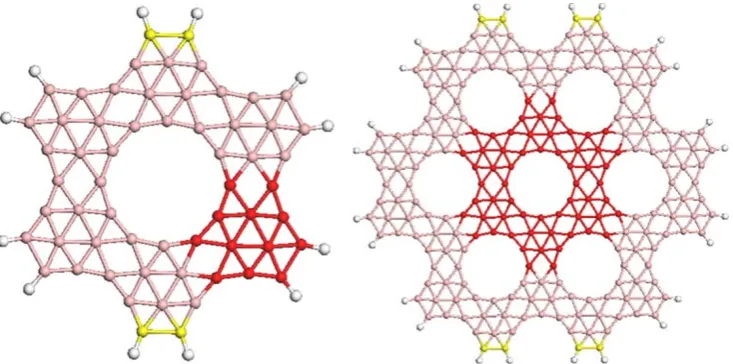
in which the molecule of borozene can be considered as the building block, as the benzene ring represents the embryo of compounds such Coronene, Coronene 19 etc. In general, we will refer to these compounds as boron clusters whose external dangling bonds are saturated by hydrogen atoms; they are obtained by fusing together the outer boron pairs of borozene molecules bonded to a hydrogen atom, see Fig.1. We have organized the rest of the paper as follows: the computational methods adopted are presented in ‘‘Computational Method’’ section. In ‘‘Results’’ section we present and discuss our results in comparison also with carbon compounds, and, finally, we give a summary in ‘‘Conclusions’’ section.
Computational Method
The molecule B60H12 here considered was built by fusing
six borozene rings, for this reason it can be considered as the boron counterpart of coronene, whereas the structure of B228H24 was obtained by surrounding B60H12 with one
series of borozene rings, therefore this cluster is constituted by a total of 24 borozene rings. A first optimization energy procedure was performed in the framework of the molec-ular mechanics approximation applying the CVFF Force Field [16, 17] which is enclosed in the Materials Studio package [18]. The geometries obtained were fully
optimized at a B3LYP/STO-3G [19–23] and B3LYP/ 6-311G [24,25] level by using the quadratically convergent Self Consistent Field procedure [26].
In detail, due to the large size, the optimizations of B228H24 were carried out by means of the minimal basis
set STO-3G whereas the more extended Pople basis set 6-311G was used in the optimizations of B60H12. In order
to estimate the degree of aromaticity, the calculation of Nuclear Independent Chemical Shifts [27] on the plane of the aromatic system (NICS0) was computed using the Gaussian 03 package [28], applying the GIAO method [29,
30]. To obtain the contour plot of NICS, ghost atoms were placed on the plane of the molecule with a step size of about 1 A˚ .
Finally, electronic transport has been evaluated in the framework of the Nonequilibrium Green’s Function theory using a Landauer expression for the calculation of the current–voltage (I–V) characteristics [31]. Consistently to the electron structure findings we assume that only pz
orbitals contribute to the low bias transport along the molecules and that the Fermi energy is at the center of HOMO–LUMO gap. The molecular device configuration considered consists of two vertical gold leads in contact with the horizontal molecules forming ideal bonds with the boron atoms indicated in Fig. 1.
Results
Structural Properties
The analysis of the smaller cluster, henceforth namedB6, was performed by using both basis sets mentioned above in
[image:2.595.116.483.497.679.2]order to make a consistent comparison with B228H24,
henceforth named B24, analyzed only with the minimal basis set. We point out that the results obtained in the two cases are qualitatively equivalent, for this reason, unless specified, the data shown below are referred to the minimal basis set. As far as the boron–boron bond length is con-cerned, a shorter value has been found in the STO-3G optimized structure, in particular, taking into account clusterB6, the average value of this parameter is calculated to be, respectively, 1.649 and 1.638 A˚ for 6-311G and STO-3G basis set, while a bond length average of 1.629 A˚ is obtained for the clusterB24.
The decrease of the bond length average by increasing the size of the cluster is also seen in the Coronene 19, i.e., a molecule of Coronene surrounded by a series of benzene rings, where, by using the same level of calculation, a 0.021 A˚ decrease of the same parameter is found with respect to the Coronene. It is also interesting to note that the reduction of the bond length takes place in particular in the inner bonds which tend to have the same value. The cohesive energies, evaluated in the minimal basis set for both clusters, were of 6.437 eV forB6 and 6.449 eV for B24. These values were calculated from
ECoh¼EBinding=n ð1Þ
where
EBinding¼EclusterXEALL ATOMSXEALL BH BONDS
ð2Þ
In the expressions abovenis the number of boron atoms and the value of the B–H bond energy is calculated in the first approximation as 1/3 of the binding energy value of BH3. Structural parameters evaluated are competitive, in
terms of stability, with the more stable flat two-dimensional structures considered up to date [32,33]. It is well known that Boron has a variety of compounds containing multicenter bonds, in particular the three-center, two-electron (3c, 2e) bond is present in molecules such diborane [34], boron clusters [32] and boron sheets [35].
Previous works have shown that (3c, 2e) bonds preclude the formation of boron rings in boron clusters [6, 36], whereas, on the other hand, more recently the three-center bonding has been proposed to explain the stability of boron fullerenes [34,37]. This peculiar feature is also seen forB6 andB24,while it is not present in Coronene and its larger clusters such Coronene 19, Coronene 37 and Coronene 61. Hence it is logical to assume that, as for boron fullerenes, it plays a pivotal role in maintaining a two-dimensional sta-ble planar structure.
The presence of (3c, 2e) bonds can be evaluated by means of the Mayer Bond Order indices, calculated from the canonical MOs in the canonical AO basis [34,38–40],
which, for closed-shell species with 3 center bonds involving the atoms A, B and C, can be expressed as follows:
IABC¼
XA
a
XB
b
XC
c PS
ð ÞabðPSÞbcðPSÞca ð3Þ
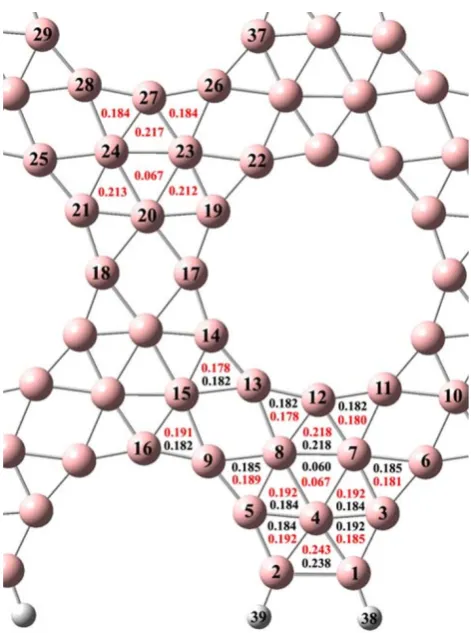
where P is the total density matrix and S is the overlap matrix. The bond order indices of three-center bonds are positive with a theoretical maximum of&0.296. In Fig.2, we report the more relevant values ofIfor both clusters, in general one can affirm that each boron is involved at least in two different three-center bonds, i.e., each boron is directly linked at least with four boron atoms.
Electronic Properties
It has been suggested that the anomalous stability of the boron planar clusters depends on the aromaticity which arises from the delocalization ofp-electrons and involves unoccupied 2pzatomic orbitals [11,12,14]. As it will be
discussed below, B6 andB24show these features; before analyzing in detail we underline that a more extended electronic delocalization gives rise to a smaller GAP in
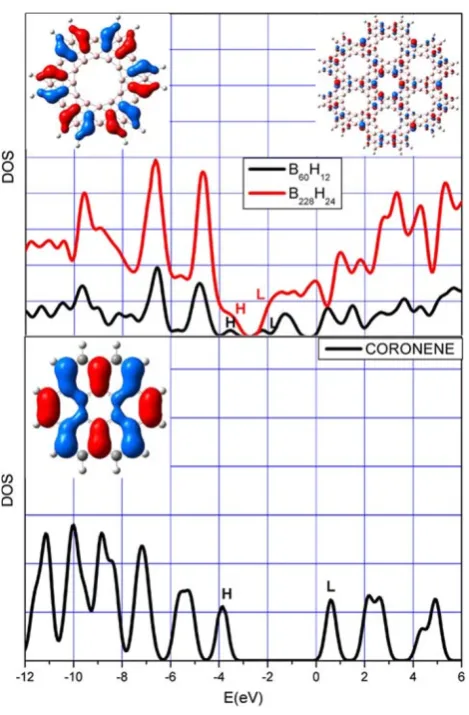
[image:3.595.307.543.359.676.2]carbon clusters [41], described as the HOMO–LUMO energy difference. In accordance with these calculations, the GAP values obtained for B6 and B24 are 1.33 and 1.17 eV, respectively; their density of states (DOS) as a function of energy (eV) is shown in Fig.3. At energyEthe density of states is written as
DOSð Þ ¼E X i
dðEeiÞ ð4Þ
where the summation indexi goes over all energy levels andd is the Delta function.
From Fig.3we note that: (a) both curves show a similar profile, cluster B24 has a larger density of states, while differently from clusterB6, it shows a zero value of the DOS only within the HOMO–LUMO gap; (b), the composition of the molecular orbitals, calculated by means of Mulliken Population Analysis, reported in Table1, clearly highlights how this contributes to the HOMO of both clusters, shown in the insets of Fig.3and to their nearer molecular orbitals, are mainly due to the pz atomic orbitals, confirming the
stabilizing effect of p-delocalization. This result is in agreement with the one evidenced in Coronene, whose HOMO and DOS are reported, in Fig.3; (c), as already observed for the set of Carbon clusters previously studied [41], the peaks near the HOMO energy can be joined by an almost straight line, reproducing the linear dependence shown by the infinite system near the Fermi level.
Now we turn to aromaticity which, as already men-tioned, is considered as the basis of stability for boron planar clusters. Szwacki et al. [15] have discussed about the regions of aromaticity of borozene and since this molecule can be indicated as the embryo of B6 andB24, we find it necessary to investigate this aspect. Figure4
shows the plot of the nucleus independent chemical shift (NICS), which represents the magnetic criterion to evaluate the ring current for clusterB24.
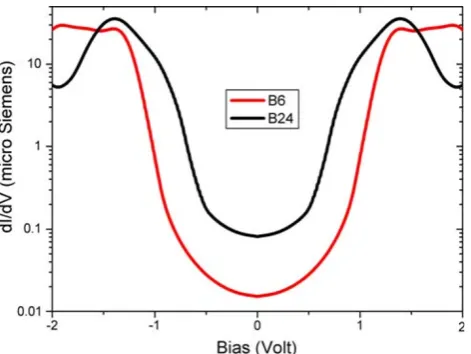
Negative value of NICS arise when diatropic ring cur-rent dominates, meaning that the system considered is aromatic, on the other hand a paratropic current gives rise to a positive value of NICS, therefore the corresponding system is antiaromatic. From Fig. 4it is evident that inner bonds give rise to a paratropic current inside the round areas which can be considered as the expansion of the inner triangle antiaromatic area found in borozene [15], whereas a flow of diatropic current is homogeneously present in the rest of the cluster. In Fig. 5the low bias differential con-ductance of the two clusters ideally contacted with two gold leads is shown.
The symmetry of the plots reflects the assumed sym-metry in the device configuration. A semiconductor-like behavior is evidenced in both structures. However, the zero bias differential conductance is one order of magnitude higher for theB24cluster, this is due not only to the lower HOMO–LUMO gap but also to the larger value of the DOS. Delocalized (along the cluster)pzmolecular orbitals
allow an efficient charge transport through the cluster for larger bias (of the order of the gap) and a diode-like characteristic can be observed.
[image:4.595.306.545.82.225.2]Fig. 3 AboveDensity of states and HOMO (in the insets) for cluster B6 (black line) and B24 (red line). Below Density of states and HOMO (in the inset) for Coronene
Table 1 Energies and percentual contributes of pz orbitals to the composition of HOMO, LUMO and their nearest MOs
B6 B24
E(eV) %pz E(eV) %pz
HOMO-3 -4.73 0.36 -3.67 100.00
HOMO-2 -4.52 99.87 -3.67 99.94
HOMO-1 -4.52 99.80 -3.43 99.99
HOMO -3.56 99.97 -3.28 99.99
LUMO -2.23 99.81 -2.12 100.00
LUMO?1 -1.50 91.19 -2.06 100.00
LUMO?2 -1.36 95.71 -1.89 99.93
[image:4.595.53.288.322.680.2]Conclusions
In this work first principles and semiempirical calculations were carried out to investigate both structural and elec-tronic properties of two clusters obtained by condensation of 6 and 24 borozene molecules, considered as the analogs of Coronene and Coronene 19. Calculations predict a pla-nar geometry for the pure clusters. Both (3c–2e) bonds and wide regions of aromaticity contribute to this stabilization, with cohesive energy values that are comparable with the most stable boron clusters considered to date.
Due to the high connectivity among boron atoms, we hypothesize that planar geometry could be compromised when impurities are introduced. Density of states spectra evidence a small gap, which decreases by increasing the cluster size, suggesting, at variance with carbon clus-ters, a semiconducting character in small sized clusters;
furthermore the population analysis shows that the main contribution to the molecular orbitals near the GAP is due to p-bonds which derive frompzorbitals. Calculated low
bias differential conductance for these structures confirms this semiconductor-like character.
Acknowledgment G. Forte wishes to thank the Consorzio Inter-universitario Cineca for the computational support.
References
1. A. Janotti, C.G. Van de Walle, Nat. Phys.6, 44 (2007). doi: 10.1038/nmat1795
2. X. Li et al., Science 315, 356 (2007). doi:10.1126/science. 1133767
3. D. Ciuparu, F.R. Klie, Y. Zhu, L.J. Pfefferle, Phys. Chem. B108, 3967 (2004). doi:10.1021/jp049301b
4. T.T. Xu, J. Zheng, N. Wu, W.A. Nicholls, R.J. Roth, A.D. Dikin, R.S. Ruoff, Nano Lett.4, 963 (2004). doi:10.1021/n10486620 5. I. Boustani, Phys. Rev. B55, 16426 (1997). doi:10.1103/Phys
RevB.55.16426
6. K.C. Lau, R. Pandey, Comput. Lett.1, 259 (2005) (Special Issue: Clusters). doi:10.1163/157404005776611312
7. I. Boustani, A. Quandt, Europhys. Lett. 39, 527 (1997). doi: 10.1209/epl/il1997-00388-9
8. M. Kociak et al., Phys. Rev. Lett. 86, 2416 (2001). doi: 10.1103/PhysRevLett.86.2416
9. I. Takesue et al., Phys. Rev. Lett. 96, 057001 (2006). doi: 10.1103/PhysRevLett.96.057001
10. M. Fujimori, T. Nakata, T. Nakayama, E. Nishibori, K. Kimura, M. Takata, M. Sahata, Phys. Rev. Lett.82, 4452 (1999). doi:10.1103/ PhysRevLett.82.4452
11. I. Boustani, Int. J. Quantum Chem.52, 1081 (1994). doi:10.1002/ qua.560520432
12. J. Aihara, H. Kanno, T. Ishida, J. Am. Chem. Soc.127, 13324 (2005). doi:10.1021/ja053171i
13. A.P. Sergeeva, D.Y. Zubarev, H.J. Zhai, A.I. Boldyrev, L.S. Wang, J. Am. Chem. Soc. 130, 7244 (2008). doi:10.1021/ ja802494z
14. H.J. Zhai, B. Kiran, J. Li, L.S. Wang, Nat. Mater.2, 827 (2003). doi:10.1038/nmat1012
15. N.G. Szwacki, V. Weber, C.J. Tymczak, Nanoscale Res. Lett.4, 1085 (2009). doi:10.1007/s11671-009-9362-2
16. A.T. Hagler, P. Dauber, S. Lifson, J. Am. Chem. Soc.101, 5131 (1979). doi:10.1021/ja00512a003
17. A.T. Hagler, P. Dauber, S. Lifson, J. Am. Chem. Soc.101, 5122 (1979). doi:10.1021/ja00512a002
18. Accelrys Inc., MS Modeling Getting Started, San Diego: Accel-rys Inc., (2003)
19. A.D. Becke, Phys. Rev. A38, 3098 (1988). doi:10.1063/1.455005 20. C. Lee, W. Yang, R.G. Parr, Phys. Rev. B37, 785 (1988). doi:
10.1103/PhysRevB.37.785
21. A.D. Becke, J. Chem. Phys. 98, 5648 (1993). doi:10.1063/ 1.464913
22. W.J. Hehre, R.F. Stewart, J.A. Pople, J. Chem. Phys.51, 2657 (1969). doi:10.1063/1.1672392
23. J.B. Collins, P. von Rague´ Schleyer, J.S. Binkley, J.A. Pople, J. Chem. Phys.64, 5142 (1976). doi:10.1063/1.432189 24. A.D. McLean, G.S. Chandler, J. Chem. Phys.72, 5639 (1980).
doi:10.1063/1.438980
25. R. Krishnan, J.S. Binkley, R. Seeger, J.A. Pople, J. Chem. Phys. 72, 650 (1980). doi:10.1063/1.438955
Fig. 4 In plane contour plot of NICS (X,Y) forB24. The step size of the ghost atoms is about 1 A˚
[image:5.595.56.289.63.219.2] [image:5.595.54.290.267.444.2]26. G.B. Bacskay, Chem. Phys. 61, 385 (1981). doi:10.1016/ 0301-0104(81)85156-7
27. P. von Rague Schleyer, C. Maerker, A. Dransfeld, H. Jiao, N.J.R. van Eikema Hommes, J. Am. Chem. Soc.16, 6317 (1996). doi: 10.1021/ja960582d
28. Gaussian 03, Revision D.02, M.J. Frisch, G.W. Trucks, H.B. Schlegel, G.E. Scuseria, M.A. Robb, J.R. Cheeseman, Jr., J.A. Montgomery, T. Vreven, K.N. Kudin, J.C. Burant, J.M. Millam, S.S. Iyengar, J. Tomasi, V. Barone (Gaussian, Inc., Wallingford CT, 2004)
29. R. McWeeny, Phys. Rev. 126, 1028 (1962). doi:10.1103/Phys Rev.126.1028
30. R. Ditchfield, Mol. Phys. 27, 789 (1974). doi:10.1080/00268 977400100711
31. I. Deretzis, A. La Magna, Nanotechnology17, 5063 (2006). doi: 10.1088/0957-4484/17/20/005
32. S. Ismail-Beigi, H. Tang, Phys. Rev. Lett.99, 115501 (2007). doi: 10.1103/PhysRevLett.99.115501
33. X. Yang, Y. Ding, J. Ni, Phys. Rev. B77, 041402 (2008). doi: 10.1103/PhysRevB.77.041402
34. A.B. Sannigrahi, T. Kar, Chem. Phys. Lett.173, 569 (1990). doi: 10.1016/0009-2614(90)87254-O
35. J. Kunstmann, A. Quandt, Phys. Rev. B74, 035413 (2006). doi: 10.1103/PhysRevB.74.035413
36. S. Chacko, G.D. Kanhere, I. Boustani, Phys. Rev. B68, 035414 (2003). doi:10.1103/PhysRevB.68.035414
37. N.G. Szwacki, A. Sadrzadeh, B.I. Yakobson, Phys. Rev. Lett.98, 166804 (2007). doi:10.1103/PhysrevLett.98.166804
38. T. Kar, E.S. Marcos, Chem. Phys. Lett. 192, 14 (1992). doi: 10.1016/0009-2614(92)85420-F
39. M.S. deGiambiagi, M. Giambiagi, M.D. Fortes, J. Mol. Struct. Theochem391, 141 (1997). doi:10.1016/S0166-1280(96)04815-4 40. R. Ponec, I. Mayer, J. Phys. Chem. A 101, 1738 (1997). doi:
10.1021/jp962510e