BIROn - Birkbeck Institutional Research Online
Artale, A. and Kontchakov, Roman and Ryzhikov, V. and Zakharyaschev,
Michael (2014) A cookbook for temporal conceptual data modelling with
description logic. ACM Transactions on Computational Logic 15 (3), ISSN
1529-3785.
Downloaded from:
Usage Guidelines:
Please refer to usage guidelines at
or alternatively
A Cookbook for Temporal Conceptual Data Modelling with
Description Logics
ALESSANDRO ARTALE and VLADISLAV RYZHIKOV, KRDB Research Centre, Free University of Bozen-Bolzano, Italy
ROMAN KONTCHAKOV and MICHAEL ZAKHARYASCHEV, Department of Computer Science and Information Systems, Birkbeck, University of London, U.K.
We design temporal description logics suitable for reasoning about temporal conceptual data models and investigate their computational complexity. Our formalisms are based onDL-Litelogics with three types of concept inclusions (ranging from atomic concept inclusions and disjointness to the full Booleans), as well as cardinality constraints and role inclusions. The logics are interpreted over the Cartesian products of object domains and the flow of time(Z, <), satisfying the constant
domain assumption. Concept and role inclusions of the TBox hold at all moments of time (globally) and data assertions of the ABox hold at specified moments of time. To express temporal constraints of conceptual data models, the languages are equipped with flexible and rigid roles, standard future and past temporal operators on concepts and operators ‘always’ and ‘sometime’ on roles. The most expressive of our temporal description logics (which can capture lifespan cardinalities and either qualitative or quantitative evolution constraints) turns out to be undecidable. However, by omitting some of the temporal operators on concepts/roles or by restricting the form of concept inclusions we construct logics whose complexity ranges between NLOGSPACEand PSPACE. These positive results are obtained by reduction to various clausal fragments of propositional temporal logic, which opens a way to employ propositional or first-order temporal provers for reasoning about temporal data models.
Categories and Subject Descriptors: I.2.4 [Knowledge Representation Formalisms and Methods]: Representation lan-guages; F.4.1 [Mathematical Logic]: Temporal logic; F.2.2 [Nonnumerical Algorithms and Problems]: Complexity of proof procedures; H.2.1 [Logical Design]: Data models.
General Terms: Languages, Theory.
Additional Key Words and Phrases: Description Logic, Temporal Conceptual Data Model.
ACM Reference Format:
Artale, A., Kontchakov, R., Ryzhikov, V., Zakharyaschev, M. 2014. A Cookbook for Temporal Conceptual Data Modelling with Description Logics.ACM Trans. Comput. LogicV, N, Article A (January YYYY), 45 pages.
DOI:http://dx.doi.org/10.1145/0000000.0000000
1. INTRODUCTION
The aim of this article is twofold. On the one hand, we investigate the complexity of reasoning about temporal conceptual data models depending on the available modelling constructs. On the other hand, we achieve this by encoding temporal conceptual data models in carefully crafted temporal description logics (TDLs, for short). As a result, we obtain a new family of TDLs and a clear under-standing of how their constructs affect the complexity of reasoning. Most of the constructed TDLs feature an unexpectedly low complexity—compared to other known TDLs—such as NLOGSPACE, PTIME, NP and PSPACE, which is good news for automated temporal conceptual modelling. How-ever, some combinations of the constructs (which involve temporal operators on relationships) result in undecidability, giving a new type of undecidable fragments of first-order temporal logic.
This work was partially supported by the U.K. EPSRC grant EP/H05099X/1.
Permission to make digital or hard copies of part or all of this work for personal or classroom use is granted without fee provided that copies are not made or distributed for profit or commercial advantage and that copies show this notice on the first page or initial screen of a display along with the full citation. Copyrights for components of this work owned by others than ACM must be honored. Abstracting with credit is permitted. To copy otherwise, to republish, to post on servers, to redistribute to lists, or to use any component of this work in other works requires prior specific permission and/or a fee. Permissions may be requested from Publications Dept., ACM, Inc., 2 Penn Plaza, Suite 701, New York, NY 10121-0701 USA, fax+1 (212) 869-0481, or [email protected].
c
Conceptual data modelling formalisms, such as the Extended Entity-Relationship model (EER) and Unified Modelling Language (UML), provide visual means to describe application domains in a declarative and reusable way, and are regarded as standard tools in database design and software engineering. One of the main tasks in conceptual modelling is to ensure that conceptual schemas satisfy various ‘quality properties’: for instance, one may wish to check whether a given schema is consistent, whether its entities and relationships can be populated, whether a certain individual is an instance of a certain class, etc. That was where conceptual modelling met description logics (DLs), a family of knowledge representation formalisms specifically designed to efficiently reason about structured knowledge [Baader et al. 2003]. Since 2007, DLs have been recognised as the backbone of the Semantic Web, underlying the standard Web Ontology Languages OWL and OWL 2.1
Connections between conceptual data models (CMs, for short) and DLs have been investigated since the 1990s (see, e.g., [Calvanese et al. 1999; Borgida and Brachman 2003; Berardi et al. 2005; Artale et al. 2007a] and references therein), which resulted in a classification of CMs according to the computational complexity of checking schema consistency depending on the available mod-elling constructs. The standard EER/UML constructs include generalisation (inheritance) for entities (classes), relationships and attributes with disjointness and covering constraints on them, cardinal-ity constraints for relationships and their refinements, multipliccardinal-ity constraints for attributes and key constraints for entities. Reasoning over CMs equipped with the full set of constructs is EXPTIME-complete, which was shown by mapping CMs into the DLsDLRandALCQI [Calvanese et al. 1999; Berardi et al. 2005]. With the invention of theDL-Litefamily [Calvanese et al. 2005; 2007; Artale et al. 2007b; 2009a], it became clear that reasoning over CMs can often be done using DLs much weaker than DLRandALCQI. For example, the NP-completeDL-Lite(boolHN)was shown to be adequate for representing a large class of CMs with generalisation and both disjointness and covering constraints, but no upper cardinality bounds on specialised relationships; see [Artale et al. 2007a] and Section 2.2 for details. If we are also prepared to sacrifice covering constraints, then the NLOGSPACE-complete fragmentDL-Lite(coreHN)can do the job. (Note thatDL-Lite
(HN)
core contains the
OWL 2 QL profile2of OWL 2 and the DL fragment of RDF Schema, RDFS.3)
Temporal conceptual data models (TCMs) extend CMs with means to represent constraints over temporal database instances. Temporal constraints can be grouped into three categories: timestamp-ing,evolutionandtemporal cardinalityconstraints. Timestamping constraints discriminate between those classes, relationships and attributes that change over time and those that are time-invariant (or,rigid) [Theodoulidis et al. 1991; Gregersen and Jensen 1999; Finger and McBrien 2000; Ar-tale and Franconi 1999; Parent et al. 2006]. Evolution constraints control how the domain elements evolve over time by migrating from one class to another [Hall and Gupta 1991; Mendelzon et al. 1994; Su 1997; Parent et al. 2006; Artale et al. 2007e]. We distinguish between qualitative evolu-tion constraints describing generic temporal behaviour, and quantitative ones specifying the exact time of migration. Temporal cardinality constraints restrict the number of times an instance of a class can participate in a relationship: snapshot cardinality constraints do it at each moment of time, while lifespan cardinality constraints impose restrictions over the entire existence of the instance as a member of the class [Tauzovich 1991; McBrien et al. 1992; Artale and Franconi 2009].
Temporal extensions of DLs have been constructed and investigated since Schmiedel [1990] and Schild’s [1993] seminal papers (see [Gabbay et al. 2003; Artale and Franconi 2001; 2005; Lutz et al. 2008] for detailed surveys), with reasoning over TCMs being one of the main objectives. The first attempts to represent TCMs by means of TDLs resulted in fragments of DLRU S and
ALCQIU Swhose complexity ranged from EXPTIMEand EXPSPACEup to undecidability [Artale and Franconi 1999; Artale et al. 2002; Artale et al. 2003]. A general conclusion one could draw from the obtained results is that—as far as there is a nontrivial interaction between the temporal
1www.w3.org/2007/OWL, www.w3.org/TR/owl2-overview 2www.w3.org/TR/owl2-profiles
and DL components—TDLs based on full-fledged DLs such asALCturn out to be too complex for effective practical reasoning (in more detail, this will be discussed in Section 3.3).
The possibility to capture CMs using logics of theDL-Lite family gave a glimpse of hope that automated reasoning over TCMs can finally be made practical. The first temporal extension of
DL-Lite(boolHN) was constructed by Artale et al. [2007c]. It featured rigid roles, with temporal and Boolean operators applicable not only to concepts but also to TBox axioms and ABox assertions. The resulting logic was shown to be EXPSPACE-complete. (To compare: the same temporalisation ofALC is trivially undecidable [Artale et al. 2002; Gabbay et al. 2003].) This encouraging result prompted a systematic investigation of TDLs suitable for reasoning about TCMs.
Our aim in this article is to designDL-Lite-based TDLs that are capable of representing various sets of TCM constructs and have as low computational complexity as possible. Let us first formulate our minimal requirements for such TDLs. At the model-theoretic level, we are interested in temporal interpretations that are Cartesian products of object domains and the flow of time(Z, <). At each
moment of time, we interpret the DL constructs over the same domain (thus complying with the constant domain assumption adopted in temporal databases [Chomicki et al. 2001]). We want to be able to specify, using temporal ABoxes, that a finite number of concept and role membership assertions hold at specific moments of time. We regard timestamping constraints as indispensable; this means, in particular, that we should be able to declare that certain roles and concepts are rigid (time-invariant) in the sense that their interpretations do not change over time. Other temporal and static (atemporal) modelling constraints are expressed by means of TBox axioms (concept and role inclusions). In fact, we observe that to represent TCM constraints, we only require concept and role inclusions that hold globally, at every time instant; thus, temporal and Boolean operators on TBox axioms [Artale et al. 2007c; Baader et al. 2008; 2012] are not needed for our aims (but may be useful to impose constraints on schema evolution). Finally, in order to represent cardinality constraints (both snapshot and lifespan), we require number restrictions; thus, we assume this construct to be available in all of our formalisms.
The remaining options include the choice of (i) the underlying dialect ofDL-Litefor disjointness and covering constraints; (ii) the temporal operators on concepts for different types of evolution constraints, and (iii) the temporal operators on roles for lifespan cardinality constraints. For (i), we consider three DLs:DL-Lite(boolHN)and its sub-Boolean fragmentsDL-Litekrom(HN)andDL-Lite(coreHN). For (ii), we take various subsets of the standard future and past temporal operators (since and until, next and previous time, sometime and always in the future/past, or simply sometime and always). Finally, for (iii), we only use the undirected temporal operators ‘always’ and ‘sometime’ (referring to all time instants); roles in the scope of such operators are called temporalised.
Our most expressive TDL, based on DL-Lite(boolHN), captures all the standard types of temporal constraints: timestamping, evolution and temporal cardinality. Unfortunately, and to our surprise, this TDL turns out to be undecidable. As follows from the proof of Theorem 6.1, it is a subtle interaction of functionality constraints on temporalised roles with the temporal operators and full Booleans on concepts that causes undecidability. On a more positive note, we show that even small restrictions of this interaction result in TDLs with better computational properties.
We can reduce the complexity even further by restrictingDL-Lite(boolHN)to its sub-Boolean frag-mentsDL-Lite(kromHN)andDL-Lite(coreHN), which are unable to capture covering constraints. This re-sults in logics within NP and PTIME. And if the temporal operators on concepts are limited to ‘always’ and ‘sometime’ then the two sub-Boolean fragments are NLOGSPACE-complete. To ob-tain these results we consider sub-Boolean fragments ofPT Lby imposing restrictions on both the type of clauses in Separated Normal Form [Fisher 1991] and the available temporal operators. We give a complete classification of such fragments according to their complexity (see Table III).
The rest of the article is organised as follows. Section 2 introduces, using a simple example, con-ceptual data modelling languages and illustrates how they can be captured by various dialects of
DL-Lite, which are formally defined in Section 2.2. Section 3 introduces temporal conceptual mod-elling constraints using a temporal extension of our example. In Section 3.2, we designDL-Lite
based TDLs that can represent those constraints. Section 3.3 gives a detailed overview of the results obtained in this article together with a discussion of related work. Section 4 gives the reduction of TDLs toPT Lmentioned above. In Section 5, we establish the complexity results for the clausal fragments of propositional temporal logic. Section 6 studies the complexity of TDLs with tempo-ralised roles. We discuss the obtained results, open problems and future directions in Section 7.
2. CONCEPTUAL MODELLING AND DESCRIPTION LOGIC
Description logics (DLs; see, e.g., [Baader et al. 2003]) were designed in the 1980s as logic-based formalisms for knowledge representation and reasoning; their major application areas include on-tologies in life sciences and the Semantic Web. Conceptual modelling languages [Chen 1976] are a decade older, and were developed for abstract data representation in database design. Despite apparent notational differences, both families of languages are built around concepts (or entities) and relationships using a number of ‘natural’ constructs; a close correspondence between them was discovered and investigated in [Calvanese et al. 1999; Borgida and Brachman 2003; Berardi et al. 2005; Artale et al. 2007a].
The DL-Lite description logics [Calvanese et al. 2005; 2007; Poggi et al. 2008; Artale et al. 2007b; 2009a] and theDL-Lite-based profile OWL 2 QL of OWL 2 have grown from the idea of linking relational databases and ontologies in the framework of ontology-based data access [Dolby et al. 2008; Heymans et al. 2008; Poggi et al. 2008]. The chief aims that determined the shape of the
DL-Lite logics are: (i) the ability to represent basic constraints used in conceptual modelling, and (ii) the ability to support query answering using standard relational database systems. In this article, we concentrate onDL-Liteas a modelling language and briefly return to the issue of ontology-based data access (OBDA) in Section 7.
In this section, we give an intuitive example illustrating the main constructs of conceptual data models and theirDL-Literepresentations. In the example, we use the Extended Entity-Relationship (EER) language [Elmasri and Navathe 2007]; however, one can easily employ other conceptual modelling formalisms such as UML class diagrams (www.uml.org). Then we formally define the syntax and semantics of theDL-Litelogics to be used later on in this article.
2.1. A Motivating Example
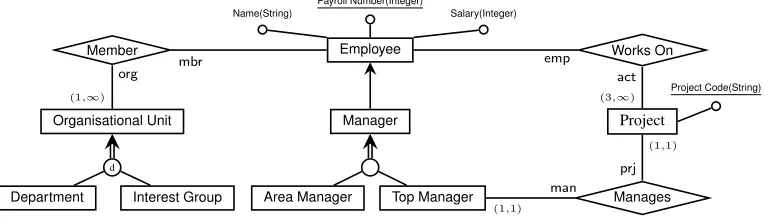
Let us consider the EER diagram in Fig. 1 representing (part of) a company information system. The arrow from the entityManagerto the entityEmployeestands for the statement ‘all managers are employees.’ The double arrow with a circle belowManagermeans that the set of managers is the union of the set of area managers and the set of top managers. These statements can be represented in the language of description logic as inclusions between concepts:
Manager v Employee, AreaManager v Manager,
Manager v AreaManagertTopManager, TopManager v Manager.
Department Interest Group d
Organisational Unit Member
(1,∞)
org
Area Manager Top Manager
Manager Employee
mbr
Salary(Integer) Name(String)
Payroll Number(Integer)
Manages
man
(1,1)
Works On
emp
Project
Project Code(String)
prj
(1,1)
act
(3,∞)
Fig. 1. A conceptual data model of a company information system.
way we read and represent the part of the EER diagram located belowOrganisational Unit; the only new ingredient here is the circledd, indicating that the union isdisjoint:
Department v OrganisationalUnit, OrganisationalUnit v DepartmenttInterestGroup,
InterestGroup v OrganisationalUnit, DepartmentuInterestGroup v ⊥.
Here⊥denotes the empty set anduthe set-theoretic intersection.
The entityEmployeein Fig. 1 has threeattributes:Name, which is a string, andPayroll Number
andSalary, both of which are integers. The attributePayroll Number(underlined) is akeyfor the en-tityEmployee. In description logic, we can encode attributes by means ofroles(binary predicates). For example, to say that every employee has a salary, which is an integer number, we can represent the attributeSalaryby a role,salary, together with the concept inclusions
Employee v ∃salary, ∃salary− v Integer,
where∃salarydenotes the domain ofsalary, andsalary−is the inverse ofsalary, so that∃salary− is the range ofsalary. Then the fact that each individual has a uniquesalaryattribute value can be expressed by the concept inclusion
≥2salary v ⊥,
where≥2salarystands for the set of all domain elements with at least two values ofsalaryattached to them (which must be empty according to this inclusion, i.e.,salaryis afunctionalrole). The at-tributesPayroll NumberandNameare represented in a similar manner. The fact thatPayroll Number
is a key forEmployeecan be encoded by the inclusion
≥2payrollNumber− v ⊥.
Relationshipsare used to describe connections among objects from (possibly) different entities.
Works On,MemberandManagesin Fig. 1 are binary relationships. The argumentempofWorks On
is of typeEmployeein the sense that its values always belong to the entityEmployee(in other words,
Employee participates inWorks Onas emp). Likewise, the argumentactof Works Onis of type
Project. In description logic, a binary relationship such asWorks Oncan be represented by a role, say,worksOn. If we agree that the first argument ofworksOncorresponds toempand the second to
act, then the domain ofworksOnbelongs toEmployeeand its range toProject:
∃worksOn v Employee, ∃worksOn− v Project.
The expression(3,∞)labelling the argumentactofWorks Onis acardinality constraintmeaning that every element of the setProjectparticipates in at least three distinct tuples in the relationship
Works On(each project involves at least three employees). This can be represented by the inclusion
[image:6.612.115.499.98.209.2]The expression(1,1)labelling the argumentprjof the relationshipManagesmeans that each ele-ment ofProjectparticipates in at least one and at most one (that is, exactly one) tuple inManages, which is represented by two inclusions:
Project v ∃manages−, Project v ≤1manages−.
Relationships of arity greater than 2 are encoded by using reification[Calvanese et al. 2001] (binary relationships can also be reified). For instance, to reify the binary relationshipWorks On, we introduce a new concept name, sayC-WorksOn, and two functional roles,empandact, satisfying the following concept inclusions:
C-WorksOnv ∃emp, ≥2empv ⊥, ∃empvC-WorksOn, ∃emp−vEmployee, (2) C-WorksOnv ∃act, ≥2actv ⊥, ∃actvC-WorksOn, ∃act−vProject. (3) Thus, each element ofC-WorksOnis related, via the rolesempandact, to a unique pair of elements ofEmployeeandProject. Cardinality constraints are still representable for reified relations, e.g., the cardinality expressed by the formula (1) becomes
Project v ≥3act−. (4)
Of the data modelling constructs not used in Fig. 1, we mention hererelationship generalisation, i.e., a possibility to state that one relationship is a subset of another relationship. For example, we can state that everyone managing a project must also work on the project. In other words:Manages
is a sub-relationship ofWorks On, which can be represented in description logic as the role inclusion
manages v worksOn
if both relationships are binary and not reified. On the other hand, if both relationships are reified then we need a concept inclusion between the respective reifying concepts as well as role inclusions between the functional roles for their arguments:
C-Manages v C-WorksOn, prj vact, man vemp.
To represent database instances of a conceptual model, we use assertions such asManager(bob)
for ‘Bob is a manager’ andmanages(bob,cronos)for ‘Bob manages Cronos.’
As conceptual data models can be large and contain non-trivial implicit knowledge, it is important to make sure that the constructed conceptual model satisfies certainquality properties. For example, one may want to know whether it is consistent, whether all or some of its entities and relationships are not necessarily empty or whether one entity or relationship is (not) subsumed by another. To automatically check such quality properties, it is essential to provide an effective reasoning support during the construction phase of a conceptual model.
We now define the reasoning problems formally, by giving the syntax and semantics of description logics containing the constructs discussed above.
2.2. DL-LiteLogics
We start with the logic called DL-LiteNboolin the nomenclature of Artale et al. [2009a]. The lan-guage ofDL-LiteNboolcontainsobject namesa0, a1, . . .,concept namesA0, A1, . . ., androle names
P0, P1, . . ..RolesR,basic conceptsBandconceptsCof this language are defined by the grammar:
R ::= Pk | Pk−,
B ::= ⊥ | Ak | ≥q R,
C ::= B | ¬C | C1uC2,
whereqis a positive integer represented in binary. ADL-LiteNboolTBox,T, is a finite set ofconcept inclusion axiomsof the form
AnABox,A, is a finite set of assertions of the form
Ak(ai), ¬Ak(ai), Pk(ai, aj), ¬Pk(ai, aj).
Taken together,T andAconstitute theknowledge base(KB, for short)K= (T,A).
AninterpretationI= (∆I,·I)of this and otherDL-Litelanguages consists of adomain∆I 6=∅ and an interpretation function·Ithat assigns to each object namea
ian elementaIi ∈∆I, to each
concept nameAka subsetAIk ⊆∆I, and to each role namePka binary relationPkI⊆∆I×∆I. As
in databases, we adopt theunique name assumption(UNA):aIi 6=aIj for alli6=j(note, however, that OWL does not use the UNA). The role and concept constructs are interpreted inIas follows:
(Pk−)I = {(y, x)∈∆I×∆I |(x, y)∈PkI}, ⊥I = ∅,
(≥q R)I = x∈∆I|]{y∈∆I |(x, y)∈RI} ≥q , (¬C)I = ∆I\CI,
(C1uC2)I = C1I∩C2I,
where]X denotes the cardinality ofX. We use the standard abbreviations:
C1tC2=¬(¬C1u ¬C2), >=¬⊥, ∃R= (≥1R), ≤q R=¬(≥q+ 1R).
Concepts of the form≤q Rand≥q Rare callednumber restrictions, and those of the form∃Rare calledexistential concepts.
Thesatisfaction relation|=is defined as expected:
I |=C1vC2 iff C1I⊆C2I,
I |=Ak(ai) iff aIi ∈AIk, I |=Pk(ai, aj) iff (aiI, aIj)∈PkI,
I |=¬Ak(ai) iff aIi ∈/ AIk, I |=¬Pk(ai, aj) iff (aiI, aIj)∈/ PkI.
A knowledge baseK = (T,A)is said to besatisfiable(orconsistent) if there is an interpretation
I satisfying all the members ofT andA. In this case we writeI |= K(as well asI |= T and
I |= A) and say thatI is amodel of K(and of T andA). Thesatisfiability problem—given a KBK, decide whetherKis satisfiable—is the main reasoning problem we consider in this article. Subsumption (given an inclusionC1 v C2 and a TBoxT, decide whetherI |= C1I ⊆ C2I for
every modelI ofT; orT |=C1 vC2in symbols) andconcept satisfiability(given a conceptC
and a TBoxT, decide whether there is a modelI ofT such thatCI 6= ∅; orT 6|=C v ⊥) are reducible to satisfiability. For example, to check whetherT |= C1 vC2we can construct a new
KBK= (T ∪ {AvC1, Av ¬C2},{A(a)})with a fresh concept nameA, and check whetherK
isnotsatisfiable.
The two sub-languages ofDL-LiteNboolwe deal with in this article are obtained by restricting the Boolean operators on concepts. InDL-LiteNkromTBoxes,4concept inclusions are of the form
B1 v B2, B1 v ¬B2 or ¬B1 v B2. (krom)
(Here and belowB1,B2are basic concepts.)DL-LiteNcoreonly uses concept inclusions of the form
B1 v B2 or B1uB2 v ⊥. (core)
AsB1v ¬B2is equivalent toB1uB2v ⊥,DL-LiteNcoreis a sub-language ofDL-Lite
N
krom. Although
the Krom fragment does not seem to be more useful for conceptual modelling thanDL-LiteNcore, we shall see in Remark 3.2 that temporal extensions ofDL-LiteNkromcan capture some important tempo-ral modelling constructs that are not representable by the corresponding extensions ofDL-LiteNcore.
Most of the constraints in the company conceptual model from Section 2.1 were represented by means of DL-LiteNcore concept inclusions. The only exceptions were the covering constraints
4The Krom fragment of first-order logic consists of formulas in prenex normal form whose quantifier-free part is a
Table I. Complexity of theDL-Litelogics.
concept role inclusions inclusions DL-LiteN
α DL-Lite (HN)
α DL-LiteHNα
Bool NP NP EXPTIME
Krom NLOGSPACE NLOGSPACE EXPTIME core NLOGSPACE NLOGSPACE EXPTIME
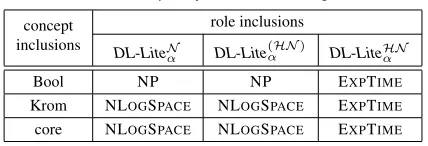
ManagervAreaManagertTopManagerandOrganisationalUnitvDepartmenttInterestGroup, which belong to the language DL-LiteNbool, and the role inclusionmanages v worksOn. The ex-tra expressive power, gained from the addition of covering consex-traints toDL-LiteNcore, comes at a price [Artale et al. 2007b]: the satisfiability problem is NLOGSPACE-complete forDL-LiteNcoreand
DL-LiteNkromKBs and NP-complete forDL-LiteNboolKBs.
The straightforward extension ofDL-LiteNcorewith role inclusions of the form
R1 v R2 (with I |=R1vR2 iff RI1 ⊆R
I
2)
leads to an even higher complexity: satisfiability becomes EXPTIME-complete [Artale et al. 2009a]. The reason for this is the interaction of functionality constraints and role inclusions such as
R1vR2 and ≥2R2v ⊥.
Note that inclusions of this sort are required when we use relationship generalisation with reification (see Section 2.1). If we restrict this interaction in TBoxesT by requiring that no roleRcan occur in T in both a role inclusion of the formR0 v R and a number restriction ≥q R or ≥q R− withq ≥ 2, then the complexity of satisfiability checking with such TBoxes matches that of the language without role inclusions. The extension ofDL-LiteNα, whereα∈ {core,krom,bool}, with
role inclusions satisfying the condition above is denoted byDL-Lite(αHN); without this condition, the extension is denoted byDL-LiteHNα . Table I summarises the complexity of the KB satisfiability problem forDL-Litelogics (for details, consult [Artale et al. 2009a]).
Thus, already in the atemporal case, a conceptual data model engineer has to search for a suitable compromise between the expressive power of the modelling language and efficiency of reasoning. In the temporal case, the trade-off between expressiveness and efficiency becomes even more dramatic. In the next section, we extend the atemporal conceptual data model considered above with a number of temporal constructs and use them to design a family of temporal description logics that are suitable for temporal conceptual modelling.
3. TEMPORAL CONCEPTUAL MODELLING AND TEMPORAL DESCRIPTION LOGIC
Temporal conceptual data models extend standard conceptual schemas with means to visually rep-resent temporal constraints imposed on temporal database instances [Theodoulidis et al. 1991; Tau-zovich 1991; Jensen and Snodgrass 1999; Artale et al. 2003; Parent et al. 2006; Combi et al. 2008]. When introducing a temporal dimension into conceptual data models, time is usually modelled by a linearly ordered set of time instants, so that at each moment of time we can refer to its past and future. In this article, we assume that the flow of time is isomorphic to the strictly linearly ordered set(Z, <)of integer numbers. (For a survey of other options, including interval-based and branching
models of time, consult, e.g., [Gabbay et al. 1994; Gabbay et al. 2000; Gabbay et al. 2003].) We will now introduce the most important temporal conceptual modelling constructs by extend-ing the company information system example from Section 2.1.
3.1. The Motivating Example Temporalised
com-Department S Interest Group d
Organisational Unit
Member S
(1,∞)
org
Area Manager Top Manager
DEV Manager T PEX
Employee S
DEX−
mbr
Salary(Integer)
T
Name(String)
S
Payroll Number(Integer)
S
Manages
man
[1,5] (1,1)
Works On T
emp
Project
ExProject TEX
Project Code(String)
S
prj
(1,1)
act
(3,∞)
Fig. 2. A temporal conceptual model of a company information system.
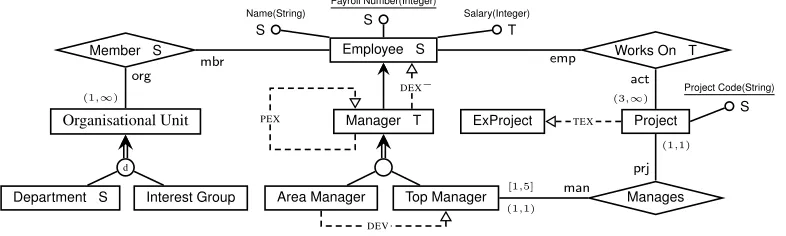
ponents of conceptual schemas. We group these constructs into three categories—timestamping, evolutionandtemporal cardinality constraints—and illustrate them by the model in Fig. 2.
Timestamping constraints[Theodoulidis et al. 1991; Gregersen and Jensen 1998; 1999; Finger and McBrien 2000; Artale and Franconi 1999; Parent et al. 2006] distinguish between entities, relationships and attributes that are
– temporaryin the sense that no element belongs to them at all moments of time,
– snapshot, or time-invariant, in the sense that their interpretation does not change with time, – unconstrained(all others).
In temporal entity-relationship diagrams, the temporary entities, relationships and attributes are marked with Tand the snapshot ones withS. In Fig. 2,Employee andDepartmentare snapshot entities,Name,Payroll NumberandProject Codeare snapshot attributes and Member a snapshot relationship. On the other hand,Manageris a temporary entity,Salarya temporary attribute, and
Works Ona temporary relationship.
There are (at least) two ways of representing timestamping constraints in temporal description logics. One of them is to introduce special names for temporary and snapshot concepts and roles, and interpret them accordingly. Another way is to employ atemporal operator2∗, which is read
as ‘always’ or ‘at all—past, present and future—time instants.’ Intuitively, for a concept C, 2∗C
contains those elements that belong to C at all time instants. Using this operator, the constraints ‘Employeeis a snapshot entity’ and ‘Manageris a temporary entity’ can be represented as follows:
Employee v 2∗Employee, 2∗Manager v ⊥.
The first inclusion says that, at any moment of time, every element ofEmployeehas always been and will always be an element ofEmployee. The second one states that no element can belong to
Managerat all time instants. Note that both of these concept inclusions are meant to holdglobally, that is, at all moments of time.
The same temporal operator2∗ together withrigidroles (i.e., roles that do not change over time)
can be used to capture timestamping of reified relationships. If the relationshipMemberis reified by the conceptC-Memberwith two functional rolesorgandmbr, satisfying the concept inclusions similar to (2) and (3), then the requirement that both rolesorgandmbrare rigid ensure thatMember
is a snapshot relationship. On the other hand, for the reified temporary relationshipWorks Onwe require the concept inclusion
2∗C-WorksOn v ⊥
and twoflexiblerolesempandact, which can change arbitrarily. Rigid roles are also used to repre-sent both snapshot attributes and snapshot binary relationships. Temporary attributes can be captured by flexible roles or by using temporalised roles:
[image:10.612.111.504.98.216.2]where2∗salarydenotes the intersection of the relationssalaryat all time instants.
Evolution constraintscontrol how the domain elements evolve over time by ‘migrating’ from one entity to another [Hall and Gupta 1991; Mendelzon et al. 1994; Su 1997; Artale et al. 2007e]. We distinguish betweenqualitativeevolution constraints that describe generic temporal behaviour but do not specify the moment of migration, andquantitativeevolution (or transition) constraints that specify the exact moment of migration. The dashed arrow marked withTEX(TransitionEXtension5) in Fig. 2 is an example of a quantitative evolution constraint meaning that each project expires in exactly one time unit (one year) and becomes an instance ofExProject. The dashed arrow marked withDEV(DynamicEVolution) is a qualitative evolution constraint meaning that every area manager will eventually become a top manager. The DEX− (Dynamic EXtension) dashed arrow says that every manager was once an employee, while the PEX(PersistentEXtension) dashed arrow means that a manager will always be a manager and cannot be demoted.
In temporal description logic, these evolution constraints are represented using temporal operators such as ‘at the next moment of time’F, ‘sometime in the future’3F, ‘sometime in the past’3P and ‘always in the future’2F:
Project v FExProject, AreaManager v 3FTopManager, Manager v 3PEmployee, Manager v 2FManager.
Again, these concept inclusions must hold globally. In the following, the evolution constraints that involve3F and3Pwill be calledmigration constraints.
Temporal cardinality constraints [Tauzovich 1991; McBrien et al. 1992; Gregersen and Jensen 1998] restrict the number of times an instance of an entity participates in a relationship.Snapshot cardinality constraints do that at each moment of time, whilelifespancardinality constraints impose restrictions over the entire existence of the instance as a member of the entity. In Fig. 2, we use
(k, l)to specify the snapshot cardinalities and[k, l]the lifespan cardinalities: for example, at any moment, every top manager manages exactly one project, but not more than five different projects over the whole career. If the relationshipManagesis not reified and represented by a role in temporal description logic then these two constraints can be expressed by the following concept inclusions:
TopManager v ∃managesu ≤1manages, TopManager v ≤53∗manages,
where3∗ means ‘sometime’ (in the past, present or future), and so 3∗managesis the union of the
relationsmanagesoveralltime instants. Snapshot and lifespan cardinalities can also be expressed in a similar way even for reified relationships (see, e.g., (4) which captures snapshot cardinalities). Observe that the above inclusions imply, in particular, that no one can remain a top manager for longer than five years (indeed, each top manager manages at least one project a year, each project expires in a year, and no top manager can manage more than five projects throughout the lifetime). However, this is inconsistent with ‘every manager always remains a manager’, and so the entity
Managercannot be populated by instances, which, in turn, means thatProjectmust also be empty (since each project is managed by a top manager). One can make these entities consistent by, for example, dropping the persistence constraint onManageror the upper lifespan cardinality bound on the number of projects a top manager can manage throughout the lifetime. In large schemas, situations like this can easily remain undetected if the quality check is performed manually.
To represent temporal database instances, we use assertions likePManager(bob)for ‘Bob was a manager last year’ andFmanages(bob,cronos)for ‘Bob will manage Cronos next year.’
3.2. TemporalDL-LiteLogics
It is known from temporal logic [Gabbay et al. 1994] that all the temporal operators used in the pre-vious section can be expressed in terms of the binary operatorsS‘since’ andU ‘until’ (details will be given below). So we formulate our ‘base’ temporal extensionTU SDL-LiteNboolof the description
logicDL-LiteNboolusing only these two operators. The language ofTU SDL-LiteNboolcontainsobject
namesa0, a1, . . .,concept namesA0, A1, . . .,flexible role namesP0, P1, . . ., andrigid role names
G0, G1, . . ..Role namesSandrolesRare defined by taking
S ::= Pi | Gi and R ::= S | S−.
We sayRis arigid roleif it is of the formGi orG−i , for a rigid role nameGi.Basic conceptsB,
conceptsCandtemporal conceptsDare given by the following grammar:
B ::= ⊥ | Ai | ≥q R,
C ::= B | D | ¬C | C1uC2,
D ::= C | C1UC2| C1SC2,
where, as before,qis a positive integer given in binary. (We use two separate rules forCandDhere because in the definitions of the fragments ofTU SDL-LiteNboolbelow these rules will be restricted to
the corresponding sub-Boolean and temporal fragments.) ATU SDL-LiteNboolTBox,T, is a finite set
ofconcept inclusionsof the formC1vC2. AnABox,A, consists of assertions of the form
nAk(ai), n¬Ak(ai), nS(ai, aj) and n¬S(ai, aj),
whereAkis a concept name,Sa (flexible or rigid) role name,ai,aj object names and, forn∈Z,
n=F· · ·F
| {z }
ntimes
, ifn≥0, and n =P· · ·P
| {z }
−ntimes
, ifn <0.
Note that we usenas an abbreviation and take the size ofnto ben(in other words, the numbers
n in ABox assertions are given in unary). Taken together, the TBox T and ABox A form the knowledge base(KB)K= (T,A).
Atemporal interpretationis a pairI = (∆I,·I(n)), where∆I is a non-empty interpretation domain andI(n)gives a standard DL interpretation for each time instantn∈Z:
I(n) = ∆I, aI0, . . . , A
I(n) 0 , . . . , P
I(n) 0 , . . . , G
I
0, . . .
.
We assume, however, that the domain ∆I and the interpretationsaI
i ∈ ∆I of object names and
GIi ⊆∆I×∆Iof rigid role names are the same for alln∈Z. (For a discussion of the constant
domain assumption, consult [Gabbay et al. 2003]. Recall also that we adopt the UNA.) The inter-pretationsAIi(n)⊆∆I of concept names andPiI(n)⊆∆I×∆Iof flexible role names can vary. The atemporal constructs are interpreted inI(n)as before; we writeCI(n)for the extension ofC
inI(n). The interpretation of the temporal operators is as follows:
(C1UC2)I(n) = [
k>n
C2I(k)∩ \
n<m<k
C1I(m),
(C1SC2)I(n) = [
k<n
C2I(k)∩ \
n>m>k
C1I(m) .
Thus, for example,x ∈ (C1U C2)I(n) iff there is a momentk > n such thatx ∈ C2I(k)and
x ∈ CI(m)
1 , for all moments m betweenn andk. Note that the operatorsS andU (as well as
the2and3operators to be defined below) are ‘strict’ in the sense that their semantics does not include the current moment of time. The non-strict operators, which include the current moment, are obviously definable in terms of the strict ones.
As noted above, for the aims of TCM it is enough to interpret concept inclusions inIglobally:
I |=C1vC2 iff CI (n) 1 ⊆C
I(n)
ABox assertions are interpreted relatively to theinitial moment, 0. Thus, we set:
I |=nAk(ai) iff aIi ∈A
I(n)
k , I |= nS(a
i, aj) iff (aIi, a
I
j)∈S
I(n),
I |=n¬Ak(ai) iff aIi ∈/A
I(n)
k , I |= n¬S(a
i, aj) iff (aiI, aIj)∈/SI (n).
We callI amodelof a KBKand writeI |=KifIsatisfies all elements ofK.Kissatisfiableif it has a model. A conceptC(roleR) issatisfiablewith respect toKif there are a modelIofKand
n ∈Zsuch thatCI(n) 6=∅(respectively,RI(n)6=∅). It is readily seen that the concept and role
satisfiability problems are equivalent to KB satisfiability.
We now define a few fragments and extensions of the base languageTU SDL-LiteNbool. Recall that
to say thatCis a snapshot concept, we need the ‘always’ operator2∗ with the following meaning:
(2∗C)I(n) = \ k∈Z
CI(k).
The dual operator ‘sometime’ is defined as usual:3∗C = ¬2∗¬C. In terms ofS andU, it can be represented as3∗C=> U(> SC). DefineTUDL-LiteN
boolto be the sublanguage ofTU SDL-LiteNbool
the temporal conceptsDin which are of the form
D ::= C | 2∗C. (U)
Thus, inTUDL-LiteNbool, we can express timestamping constraints (see Section 3.1).
The temporal operators3F (‘sometime in the future’) and3P (‘sometime in the past’) that are required for qualitative evolution constraints with the standard temporal logic semantics
(3FC)
I(n) = [
k>n
CI(k) and (3PC)
I(n) = [
k<n
CI(k)
can be expressed viaU andS as3FC => U Cand3PC = > SC; the operators2F (‘always in the future’) and2P (‘always in the past’) are defined as dual to3F and3P:2FC = ¬3F¬C and2PC=¬3P¬C. We define the fragmentTFPDL-Lite
N
boolofTU SDL-LiteNboolby restricting the
temporal conceptsDto the form
D ::= C | 2FC | 2PC. (FP)
Clearly, we have the following equivalences:
2∗C=2F2PC and 3∗C=3F3PC.
In what follows, these equivalences will be regarded as definitions for2∗ and3∗ in those languages
where they are not explicitly present. Thus, TFPDL-LiteNbool is capable of expressing both time-stamping and qualitative (but not quantitative) evolution constraints.
The temporal operatorsF (‘next time’) andP(‘previous time’), used in quantitative evolution constraints, can be defined asFC=⊥ UCandPC=⊥ SC, so that we have
(FC)I(n)=CI(n+1) and (PC)I(n)=CI(n−1).
The fragment ofTU SDL-LiteNboolwith temporal concepts of the form
D ::= C | 2FC | 2PC | FC | PC (FPX)
will be denoted byTFPXDL-LiteNbool. In this fragment, we can express timestamping, qualitative and quantitative evolution constraints.
Thus, we have the following inclusions between the languages introduced above:
Similarly to the atemporal case, we can identify sub-Boolean fragments of the above languages. A temporal TBox is called aKromor acoreTBox if it contains only concept inclusions of the form
D1vD2, D1v ¬D2, ¬D1vD2, (krom)
D1vD2, D1uD2v ⊥, (core)
respectively, where theDiare temporal concepts defined by (FPX), (FP) or (U) with
C ::= B | D.
Note that no Boolean operators are allowed in theDi. This gives us 6 fragments:TFPXDL-LiteNα, TFPDL-LiteNα andTUDL-LiteNα, forα∈ {core,krom}.
Remark 3.1. We do not consider the core and Krom fragments of the full language with since (S) and until (U) because, as we shall see in Section 4.4 (Theorem 4.5), these operators allow one to go beyond the language of binary clauses of the core and Krom fragments, and the resulting languages would have the same complexity asTU SDL-LiteNbool(but less expressive).
Remark 3.2. The introduced fragments of the full languageTU SDL-LiteNbooldo not contain3F and3P. Both operators, however, can be defined in the Krom and Bool fragments. For example, the concept inclusion3PB1v3FB2can be represented by means of the inclusions
2FA2v2PA1 and Ai v ¬Bi, ¬Bi vAi, fori= 1,2.
In the core fragments, where we do not have negation in the left-hand side, this trick does not work. Therefore, evolution constraints involving3P or3F (such asManager v 3PEmployee) are not expressible in the core fragments (but timestamping remains expressible).
As we have seen in our running example, in order to express lifespan cardinality constraints, temporal operators on roles are required. For a roleRof the form
R ::= S | S− | 3∗R | 2∗R,
we define the extensions of3∗Rand2∗Rin an interpretationIby taking
(3∗R)I(n)= [ k∈Z
RI(k) and (2∗R)I(n)= \ k∈Z
RI(k).
In this article we consider three extensions ofDL-LiteNboolwith such temporalised roles, which are denoted by Tβ∗DL-LiteNbool, for β ∈ {X,FP,U}, whereT
∗
XDL-Lite
N
bool allows onlyP,F as the temporal operators on concepts.
We can also extend our languages with role inclusions, which are interpreted globally (in the same way as concept inclusions):
I |=R1vR2 iff R
I(n) 1 ⊆R
I(n)
2 , foralln∈Z.
These extensions are denoted byTU SDL-LiteHNbool,TFPDL-Lite (HN) bool , etc.
In the remaining part of the article, we investigate the computational complexity of the satisfia-bility problem for the temporal extensions of theDL-Litelogics designed above. But before that we briefly summarise the obtained results in the more general context of temporal description logics.
3.3. Summary of the Complexity Results and Related Work
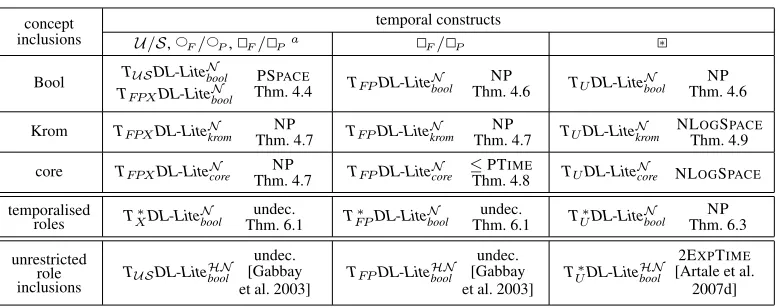
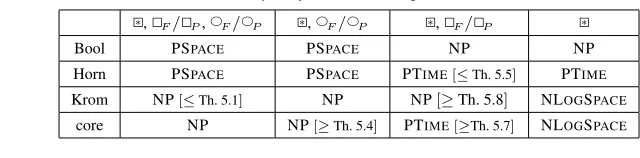
The temporalDL-Lite logics we analyse here are collected in Table II together with the obtained and known complexity results. (Note that the complexity bounds in Table II are all tight except the case ofTFPDL-LiteNcore, where we only have an upper bound.) To avoid clutter, we omitted from the
table the logics of the formTβDL-Lite(αHN), whose complexity is the same as the complexity of the respectiveTβDL-LiteNα.
Table II. Complexity of the temporalDL-Litelogics.
concept temporal constructs
inclusions U/S,
F/P,2F/2Pa 2F/2P 2∗ Bool TU SDL-Lite
N
bool
TFPXDL-LiteNbool
PSPACE
Thm. 4.4 TFPDL-Lite
N
bool Thm. 4.6NP TUDL-LiteNbool Thm. 4.6NP Krom TFPXDL-LiteNkrom Thm. 4.7NP TFPDL-LiteNkrom Thm. 4.7NP TUDL-LiteNkrom NLOGSPACEThm. 4.9
core TFPXDL-LiteNcore Thm. 4.7NP TFPDL-LiteNcore ≤Thm. 4.8PTIME TUDL-LiteNcore NLOGSPACE temporalised
roles T
∗
XDL-Lite
N
bool Thm. 6.1undec. T
∗
FPDL-Lite
N
bool Thm. 6.1undec. T
∗
UDL-Lite
N
bool Thm. 6.3NP
unrestricted role
inclusions TU SDL-Lite
HN
bool undec. [Gabbay et al. 2003]
TFPDL-LiteHNbool undec. [Gabbay et al. 2003]
TU∗DL-LiteHNbool
2EXPTIME [Artale et al.
2007d]
aSub-Boolean fragments of the language withU/Sare not defined (see Remark 3.1).
domains and the flow of time(Z, <), in which (1) the future and past temporal operators can be
ap-plied to concepts; (2) roles can be declared flexible or rigid; (3) the ‘undirected’ temporal operators ‘always’ and ‘sometime’ can be applied to roles; (4) the concept and role inclusions are global, and the database (ABox) assertions are specified to hold at particular moments of time.
The minimal logic required to capture all of the temporal and static conceptual modelling con-straints isTFPX∗ DL-LiteHNbool; alas, it is undecidable. In fact, even the logicTX∗DL-LiteNbool, capturing only the quantitative evolution constraints, lifespan cardinalities and covering, is undecidable. Re-placing ‘quantitative’ with ‘qualitative’—i.e., consideringTFP∗ DL-LiteNbool—does not beat undecid-ability in the presence of lifespan cardinalities. Both these undecidundecid-ability results will still hold if we replace arbitrary cardinality constraints (N) with role functionality. To regain decidability in the presence of temporalised roles, we have to limit the temporal operators on concepts to the undirected operators3∗/2∗—thus restricting the language to only timestamping and lifespan cardinalities. We
show that the logicTU∗DL-Lite
N
boolis NP-complete using the quasimodel technique.
Logics in the last row have arbitrary role inclusions, which together with functionality constraints are expressive enough to model allALCconstructors [Artale et al. 2007a; Artale et al. 2009a], and so the resulting TDLs are as complex as the corresponding temporal extensions ofALC.
On a positive note, logics with restricted role inclusions and no temporal operators on roles ex-hibit much better computational properties. Our smallest logic,TUDL-Lite(coreHN), is
NLOGSPACE-complete. In the temporal dimension, it can only express timestamping constraints. It can also cap-ture all the static constraints that are different from covering and do not involve any interaction between role inclusions and number restrictions. Extending the language with covering leads to the loss of tractability inTUDL-Lite
(HN)
bool . When covering is not needed and we are interested in
tempo-ral constraints different from lifespan cardinalities, we can regain tractability if we restrict the lan-guage to timestamping and evolution constraints that only capture persistence (TFPDL-Lite(coreHN)).
If we also require migration constraints (that involve3Pand3F; see Remark 3.2) then we can use the Krom languageTFPDL-Lite
(HN)
krom , which is again NP-complete. Surprisingly, the addition of the
full set of evolution constraints makes reasoning NP-complete even inTFPXDL-Lite(coreHN).
Numerouspoint-basedtemporal DLs have been constructed and investigated since Schild’s semi-nal paper [1993]. One of the lessons of the 20-year history of the discipline is that logics interpreted over two- (or more) dimensional structures are very complex and sensitive to subtle interactions between constructs operating in different dimensions. The first TDLs suggested for representing TCMs were based on the expressive DLsDLRandALCQI[Artale and Franconi 1999]. However, it turned out that already a single rigid role and the operator3F (orF) onALC-concepts led to un-decidability [Wolter and Zakharyaschev 1999]. In fact, to construct an undecidable TDL, one only needs a rigid role and three concept constructs:u,∃R.Cand3F, that is, a temporalisedEL[Artale et al. 2007c]. There have been several attempts to tame the bad computational behaviour of TDLs by imposing various restrictions on the DL and temporal components as well as their interaction.
One approach was to disallow rigid roles and temporal operators on roles, which resulted in EXPSPACE-complete temporalisations ofALC[Artale et al. 2002; Gabbay et al. 2003]. Such tem-poralisations reside in the monodic fragment6of first-order temporal logic [Hodkinson et al. 2000], for which tableau [Lutz et al. 2002; Kontchakov et al. 2004] and resolution [Degtyarev et al. 2006] reasoning algorithms have been developed and implemented [Hustadt et al. 2004; Guensel 2005; Ludwig and Hustadt 2010]. Another idea was to weaken the whole temporal component to the ‘undirected’ temporal operators2∗ and3∗(which cannot discriminate between past, present and
fu-ture) on concepts and roles, resulting in a 2EXPTIME-complete extension ofALC [Artale et al. 2007d]. The third approach was to allow arbitrary temporal operators onALCaxioms only (but not on concepts or roles) [Baader et al. 2008; 2012], which gave an EXPTIME-complete logic. The addi-tion of rigid concepts to this logic increases the complexity to NEXPTIME, while rigid concepts and roles make it 2EXPTIME-complete. Finally, the fourth approach, which dates back to Schild [1993], was to use only global axioms. In this case,ALCwith temporal operators on concepts is EXPTIME-complete, which matches the complexity ofALCitself (in contrast, temporal operators on axioms and concepts make the less expressiveDL-LiteboolEXPSPACE-complete [Artale et al. 2007c]).
As argued above, global axioms are precisely what we need in TCM. On the other hand, to capture timestamping and evolution constraints we need the full set of temporal operators on concepts, while to capture lifespan cardinalities and timestamping on relations we need temporalised or rigid roles. To achieve decidability in the case with rigid roles, we also weakenALCtoDL-Lite, which, as we have seen above, perfectly suits the purpose of conceptual modelling. We thus start from the first promising results of Artale et al. [2009b], which demonstrated that even with rigid roles temporal extensions of DL-LiteNboolcould be decidable, and extend them to various combinations of temporal operators and different sub-Boolean fragments of DL-LiteNbool, proving encouraging complexity results and showing how these logics can represent TCM schemas.
The results in the first three rows of Table II are established by using embeddings into the propo-sitional temporal logicPT L. To cope with the sub-Boolean core and Krom logics, we introduce, in Section 5, a number of new fragments ofPT Lby restricting the type of clauses in Separated Normal Form [Fisher 1991] and the available temporal operators. The obtained complexity classifi-cation in Table III helps understand the results in the first three rows of Table II.
4. REDUCING TEMPORALDL-LITETO PROPOSITIONAL TEMPORAL LOGIC
In this section we reduce the satisfiability problem for TU SDL-LiteNbool KBs to the satisfiability
problem for propositional temporal logic. This will be achieved in two steps. First, we reduce
TU SDL-LiteNboolto the one-variable first-order temporal logicQT L
1[Gabbay et al. 2003]. And then
we show that satisfiability of the resultingQT L1-formulas can be further reduced to satisfiability of
QT L1-formulas without positive occurrences of existential quantifiers, which are essentially
propo-sitional temporal formulas. To simplify presentation, we consider here the logicTU SDL-LiteNbool
(without role inclusions). The fullTU SDL-Lite
(HN)
bool requires a bit more elaborate (yet absolutely
routine) reduction that is similar to the one given by Artale et al. [2009b] for the atemporal case.
4.1. First-Order Temporal Logic
The language offirst-order temporal logicQT LcontainspredicatesP0, P1, . . .(each with its arity),
variablesx0, x1, . . . andconstantsa0, a1, . . ..FormulasϕofQT Lare defined by the grammar:
ϕ ::= Pi(t1, . . . , tki) | ⊥ | ∀x ϕ | ¬ϕ | ϕ1∧ϕ2 |ϕ1Uϕ2 | ϕ1Sϕ2, whereki is the arity ofPi and thetj are terms—i.e., variables or constants. These formulas are
interpreted infirst-order temporal modelsM, which, for everyn∈Z, give a first-order structure
M(n) = (∆M, aM0 , a1M, . . . , P0M,n, P1M,n. . .)
with the same domain∆M, the sameaMi ∈ ∆, for each constantai, and wherePiM,nis aki-ary
relation on∆M, for each predicateP
iof aritykiand eachn∈Z. AnassignmentinMis a function, a, that maps variables to elements of∆M. For a termt, we writeta,Mfora(x)ift=x, and foraM ift=a. The semantics ofQT Lis standard (see, e.g., [Gabbay et al. 2003]):
M, n|=aP(t1, . . . , tk) iff (ta1,M, . . . , t
a,M
k )∈P
M,n,
M, n6|=a⊥,
M, n|=a∀x ϕ iff M, n|=a0 ϕ, for all assignmentsa0that differ fromaonxonly,
M, n|=a¬ϕ iff M, n6|=a ϕ,
M, n|=aϕ1∧ϕ2 iff M, n|=aϕ1andM, n|=aϕ2,
M, n|=aϕ1Uϕ2 iff there isk > nwithM, k|=aϕ2andM, m|=aϕ1, forn < m < k, M, n|=aϕ1Sϕ2 iff there isk < nwithM, k|=aϕ2andM, m|=aϕ1, fork < m < n.
We use the standard abbreviations such as
>=¬⊥, ϕ1∨ϕ2=¬(¬ϕ1∧ ¬ϕ2), ∃x ϕ=¬∀x¬ϕ,
3Fϕ=> Uϕ, 2Fϕ=¬3F¬ϕ, Fϕ=⊥ Uϕ as well as the past counterparts for3P,2PandP; we also write2∗ϕfor2F2Pϕ.
If a formulaϕcontains no free variables (i.e.,ϕis a sentence), then we omit the valuationain
M, n|=a ϕand writeM, n|=ϕ. Ifϕhas a single free variablex, then we writeM, n|=ϕ[a]in place ofM, n|=aϕwitha(x) =a.
AQT L1-formulais aQT L-formula which is constructed using at most one variable. Satisfia-bility ofQT L1
-formulas is known to be EXPSPACE-complete [Gabbay et al. 2003]. In the propo-sitional temporal logic,PT L, only 0-ary predicates (that is, propositional variables) are allowed. The satisfiability problem forPT L-formulas is PSPACE-complete [Sistla and Clarke 1982].
4.2. Reduction toQT L1
Given aTU SDL-LiteNboolKBK= (T,A), letobAbe the set of all object names occurring inAand
roleKthe set of rigid and flexible role names occurring inKand their inverses.
In our reduction, objectsa∈obAare mapped to constantsa, concept namesAto unary predicates
A(x), and number restrictions≥q Rto unary predicatesEqR(x). Intuitively, for a role nameS, the
predicatesEqS(x)andEqS−(x)represent, at each moment of time, the sets of elements withat
least qdistinctS-successors andat leastqdistinctS-predecessors; in particular,E1S(x)can be
thought of as the domain ofSandE1S−(x)as the range ofS. By induction on the construction of
aTU SDL-LiteNboolconceptC, we define theQT L
1-formulaC∗(x):
A∗=A(x), ⊥∗=⊥, (≥q R)∗=EqR(x),
(C1UC2)∗=C1∗UC2∗, (C1SC2)∗=C1∗SC2∗, (C1uC2)∗=C1∗∧C2∗, (¬C)∗=¬C∗.
It can be easily seen that the map·∗ commutes with all the Boolean and temporal operators: e.g.,
inclusions inT hold globally:
T† = ^
C1vC2∈T
2∗∀x C1∗(x)→C2∗(x) .
In the translation above, we replaced binary predicates (i.e., roles) by collections of unary predicates, the EqR(x). Clearly, we have to ensure that these predicates behave similarly to the respective
number restrictions. In particular, the following three properties trivially hold inTU SDL-LiteNbool
interpretations, for all rolesRat all moments of time:
– every point with at leastq0R-successors has at leastq R-successors, for eachq < q0;
– ifRis a rigid role, then every point with at leastq R-successors at some moment has at leastq R-successors at all moments of time;
– if the domain of a role is not empty, then its range is not empty either.
These conditions can be encoded by the followingQT L1-sentences: ^
R∈roleK
^
q,q0∈QTwithq0>q
2∗ ∀x (≥q0R)∗(x)→(≥q R)∗(x)
, (5)
^
R∈roleKis rigid
^
q∈QT
2∗ ∀x (≥q R)∗(x)→2∗(≥q R)∗(x)
, (6)
^
R∈roleK
2∗ ∃x(∃R)∗(x) → ∃x(∃inv(R))∗(x), (7)
whereQT is the set containing 1 and all the numbersqsuch that≥q Roccurs inT, andinv(R)is the inverse ofR, i.e.,inv(S) =S−andinv(S−) =S, for a role nameS. As we shall see later, these three properties are enough to ensure that the real binary relations for rolesSinTU SDL-LiteNboolcan
be reconstructed from the collections of unary predicatesEqS(x)andEqS−(x)satisfying (5)–(7).
It is easy to extend the above reduction to ABox concept assertions: take nA(a) for each nA(a) ∈ A, and n¬A(a)for each n¬A(a) ∈ A. However, ABox role assertions need a more elaborate treatment. For everya ∈ obA, ifahasq R-successors in Aat momentn—i.e., nR(a, b1), . . . ,nR(a, bq)∈ A, for distinctb1, . . . , bq—then we include(n≥q R)∗(a)in the
translation ofA. When counting the number of successors, one has to remember the following prop-erty of rigid rolesS: if an ABox containsmS(a, b)thennS(a, b)holds for alln ∈Z, and so
mS(a, b)contributes to the number ofS-successors ofaandS−-successors ofbateachmoment. In what follows, we assume thatAcontainsnS−(b, a)whenever it containsnS(a, b). For eachn∈Zand each roleR, we define thetemporal sliceARn ofAby taking
AR n =
R(a, b)|mR(a, b)∈ Afor somem∈Z , Ris a rigid role,
R(a, b)|nR(a, b)∈ A , Ris a flexible role.
The translationA†of theT
U SDL-LiteNboolABoxAis defined now by taking
A† = ^
nA(a)∈A
nA(a) ∧ ^
n¬A(a)∈A
n¬A(a) ∧ ^
nR(a,b)∈A
n(≥qAR,n(a)R)∗(a) ∧ ^
n¬S(a,b)∈A
S(a,b)∈AS n
⊥,
whereqAR,n(a)is the number of distinctR-successors ofainAat momentn:
qAR,n(a)= max
q∈QT |R(a, b1), . . . , R(a, bq)∈ ARn, for distinctb1, . . . , bq .
We note thatA†can be effectively computed for any givenKbecause we need temporal slicesAR n
only for thosenthat are explicitly mentioned inA, i.e., thosenwithnR(a, b)∈ A.
of (6) and (7) is linear in the size ofT, while the size of (5) is cubic in the size ofT (though it can be made linear by taking account of only thoseqthat occur in≥q R, for a fixedR, and replacing
q0 > qin the conjunction index with a more restrictive condition ‘q0 > qand there is noq00∈QT withq0> q00> q’; for details, see [Artale et al. 2009a]).
The main technical result of this section is thatKandK†are equisatisfiable; the proof (based on the unravelling construction) is given in Appendix B.
THEOREM 4.1. ATU SDL-LiteNboolKBKis satisfiable iff theQT L 1
-sentenceK†is satisfiable.
Meanwhile, we proceed to the second step of our reduction.
4.3. Reduction toPT L
Our next aim is to construct aPT L-formula that is equisatisfiable withK†. First, we observe that
K†can be represented in the formK†0∧V
R∈roleKϑR, where
K†0 = 2∗∀x ϕ(x) ∧ ψ and ϑ
R=2∗ ∀x (∃R)∗(x)→ ∃x(∃inv(R))∗(x)
,
for a quantifier-free first-order temporal formulaϕ(x)with a single variablexand unary predicates only and a variable-free formula ψ. We show now that one can replaceϑR by a formula without
existential quantifiers. To this end we require the following lemma:
LEMMA 4.2. For everyTU SDL-LiteNboolKBK, if there is a modelMsatisfyingK†0such that M, n0|= (∃R)∗[d], for somen0∈Zandd∈∆M, then there is a modelM0extendingMwith new
elements and satisfyingK†0such that, for eachn∈
Z, there isdn ∈∆M
0
withM0, n|= (∃R)∗[dn].
PROOF. Consider a new modelM0with domain∆M∪ {d} ×
Zby setting
BM0,n=BM,n∪
(d, k)|d∈BM,n−k, k∈Z , for eachBofK†0 andn∈Z.
In other words,M0 is the disjoint union of Mand copies ofd‘shifted’ along the timeline byk
steps, for eachk ∈Z. It follows that, at each momentn∈ Z, the element(d, n−n0)belongs to
(∃R)∗, thus making(∃R)∗ non-empty at all moments of time. Moreover,M0,0 |= K†0 because
ϕ(x)expresses a property of a single domain element and holds ateachmoment of time,ψdepends only on the part of the model that corresponds to constants (and which are interpreted as inM).
Next, for each R ∈ roleK, we take a fresh constantdR and a fresh propositional variablepR
(recall thatinv(R)is also inroleK), and consider the followingQT L1-formula:
K‡=K†0∧V
R∈roleKϑ 0
R, whereϑ0R = 2∗∀x (∃R)∗(x)→2∗pR
∧ pinv(R)→(∃R)∗(dR)
(pinv(R)andpRindicate thatinv(R)andRare non-empty whereasdRanddinv(R)witness that at0).
LEMMA 4.3. ATU SDL-LiteNboolKBKis satisfiable iff theQT L
1-sentenceK‡is satisfiable.
PROOF. (⇒) IfKis satisfiable then, by Theorem 4.1 and repeated application of Lemma 4.2,
K†0 is satisfied in a modelMsuch that, for eachR ∈roleK, the predicates(∃R)∗and(∃inv(R))∗ are either both empty at all moments of time or both non-empty at all moments of time. To satisfy theϑ0R, forR∈roleK, we extendMtoM0as follows: if(∃R)∗and(∃inv(R))∗are non-empty, we setpMR0,nto be true at alln ∈Z, and takedR to be an element in((∃R)∗)M,0; otherwise, we set
pMR0,0to be false and take some domain element asdR. It follows thatM0,0|=K‡.
(⇐) Conversely, supposeM,0 |= K‡. By repeated application of Lemma 4.2,K†0 is satisfied in a modelM0such that, for eachR∈roleK, the predicates(∃R)∗and(∃inv(R))∗are either both empty at all moments of time or both non-empty at all moments of time. It follows thatM0,0|=ϑR
Finally, asK‡ contains no existential quantifiers, it can be regarded as a propositional temporal formula because all the universally quantified variables can be instantiated by all the constants in the formula (which only results in a polynomial blow-up). Observe also that the translation·‡can be done in logarithmic space in the size ofK. This is almost trivial for all conjuncts ofK‡apart from
(≥qAR,n(a)R)∗inA†, where the numbers can be computed using a LOGSPACE-transducer as follows: initially setq= 0; then enumerate all object namesbiinAincrementingqfor eachR(a, bi)∈ AnR
and stop ifq= maxQT or the end of the object names list is reached; letqR,nA(a)be the maximum
number inQT not exceedingq. Note that in the case ofTU SDL-Lite(boolHN), the translation is feasible
only in NLOGSPACE(rather than LOGSPACE) because we have to take account of role inclusions (and graph reachability is NLOGSPACE-complete).
4.4. Complexity ofTU SDL-LiteNbooland its Fragments
We now use the translation·‡to obtain the complexity results announced in Section 3.3.
THEOREM 4.4. The satisfiability problem for TU SDL-LiteNbool and TFPXDL-Lite
N
bool KBs is
PSPACE-complete.
PROOF. The upper bound follows from the reduction·‡above and the fact thatPT Lis PSPACE-complete over(Z, <)[Rabinovich 2010; Reynolds 2010; Sistla and Clarke 1982]. The lower bound is an immediate consequence of the observation thatTFPXDL-LiteNboolcan encode formulas of the formθ∧2∗V
i(ϕi → Fψi), whereθ, theϕi andψiare conjunctions of propositional variables:
satisfiability of such formulas is known to be PSPACE-hard (see e.g., [Gabbay et al. 1994]).
In fact, using theU-operator, we can establish the following:
THEOREM 4.5. The satisfiability problem for the core fragment of TU SDL-LiteNbool KBs is
PSPACE-hard.
PROOF. The proof is by reduction of the non-halting problem for deterministic Turing machines with a polynomial tape. Lets(n)be a polynomial andM a deterministic Turing machine that re-quiress(n) cells of the tape given an input of lengthn. Without loss of generality, we assume that M never runs outside the firsts(n)cells. LetM = hQ,Γ,#,Σ, δ, q0, qfi, where Qis a
fi-nite set of states, Γ a tape alphabet, # ∈ Γ the blank symbol, Σ ⊆ Γ a set of input symbols,
δ: (Q\ {qf})×Γ→Q×Γ× {L, R}a transition function, andq0, qf∈Qthe initial and accepting
states, respectively. Let~a= a1. . . an be an input forM. We construct a KB that is unsatisfiable
iffM accepts~a. This will prove PSPACE-hardness. The KB uses a single object name dand the following concepts, fora∈Γ,q∈Qand1≤i≤s(n), representing configurations ofM:
– Hiq, which containsdif the head points to celliand the current state isq;
– Sia, which containsdif tape cellicontains symbolain the current configuration;
– Di, which containsdif the head pointed to celliin thepreviousconfiguration.
LetTM contain the following concept inclusions, fora, a0∈Γ,q, q0 ∈Q, and1≤i, j≤s(n):
Hiqv ⊥ UH(i+1)q0, Hiqv ⊥ USia0, ifδ(q, a) = (q0, a0, R)andi < s(n), (8)
Hiqv ⊥ UH(i−1)q0, Hiqv ⊥ USia0, ifδ(q, a) = (q0, a0, L)andi >1, (9)
Hiqv ⊥ UDi, (10)
DiuDjv ⊥, ifi6=j, (11)
SiavSiaUDi, (12)
Hiqf v ⊥, (13)
and letA~aconsist of the following ABox assertions: