Papera, Massimiliano and Cooper, Richard P. and Richards, Anne (2014)
Artificially created stimuli produced by a genetic algorithm using a saliency
model as its fitness function show that Inattentional Blindness modulates
performance in a pop-out visual search paradigm. Vision Research 97 , pp.
31-44. ISSN 0042-6989.
Downloaded from:
Usage Guidelines:
Please refer to usage guidelines at or alternatively
Artificially created stimuli produced by a genetic algorithm using a
saliency model as its fitness function show that Inattentional Blindness
modulates performance in a pop-out visual search paradigm
Massimiliano Papera, Richard P. Cooper and Anne Richards
Mace Experimental Research Laboratories in Neuroscience (MERLiN), Psychological
Sciences, Birkbeck College, University of London, UK.
Text Pages: 43
Figures: 8
Tables: 0
Abstract: 240
Text: 8838
Key words: Saliency, Genetic Algorithm, Inattentional Blindness,
Visual Search, Pop-out Stimuli
Corresponding Author: Massimiliano Papera e-mail: [email protected]
ABSTRACT
Salient stimuli are more readily detected than less salient stimuli, and individual
differences in such detection may be relevant to why some people fail to notice an
unexpected stimulus that appears in their visual field whereas others do notice it. This failure
to notice unexpected stimuli is termed ‘Inattentional Blindness’ and is more likely to occur
when we are engaged in a resource-consuming task. A genetic algorithm is described in
which artificial stimuli are created using a saliency model as its fitness function. These
generated stimuli, which vary in their saliency level, are used in two studies that implement a
pop-out visual search task to evaluate the power of the model to discriminate the performance
of people who were and were not inattentionally blind (IB).
In one study the number of orientational filters in the model was increased to check if
discriminatory power and the saliency estimation for low-level images could be improved.
Results show that the performance of the model does improve when additional filters are
included, leading to the conclusion that low-level images may require a higher number of
orientational filters for the model to better predict participants’ performance. In both studies
we found that given the same target patch image (i.e. same saliency value) IB individuals
take longer to identify a target compared to non-IB individuals. This suggests that IB
individuals require a higher level of saliency for low-level visual features in order to identify
1
Introduction
Inattentional blindness (IB) occurs when someone fails to notice a stimulus when it
unexpectedly appears in front of them. This phenomenon is more likely to occur when the
person is engaged in a task that consumes resources (Dehaene & Changeux, 2005; Mack &
Rock, 1998; Hannon & Richards, 2010; Most, Scholl, Clifford, & Simons, 2005; Most,
Simons, Scholl, Jimenez, Clifford, & Chabris, 2001; Richards, Hannon, & Derakshan, 2010;
Richards, Hannon, & Vitkovitch, 2010). Understanding the IB phenomenon may give insight
into the functioning of the attentional system. For example, one hypothesis is that IB is due in
part to a processing failure, that is, when working memory resources are fully involved in
another task, there are insufficient resources remaining for processing of the unexpected
stimulus. Another possibility is that the stimulus may be processed but because it is irrelevant
to the primary task it is inhibited and therefore does not reach awareness (Richards, Hannon,
Iqbal Vohra, & Golan, 2013; Morey & Cowan, 2004). Inattentional blindness may have
important implications for safety procedures such as those related to flying aeroplanes
(Green, 2005), air traffic control or for eye witness accounts of crimes occurring a few metres
away (Chabris, Weinberger, Fontaine, & Simons, 2011).
There are individual differences in the propensity to be IB as, given the same physical
environment and conditions, some people will notice the unexpected stimulus whereas other
will not. An unexpected stimulus is more likely to be detected if it is salient (Wickens,
Helleberg, Kroft, Talleur, & Xu, 2001), and therefore one possible contributing factor in
individual propensity to IB in a visual task is how sensitive people are to detect saliency
The attentional system could be viewed as a seeking-features mechanism where what
we perceive depends on what the mechanism is focused upon (Driver, 2001). Therefore some
details of the visual input may not be processed when the system does not attend them.
However, there are some visual aspects that automatically modulate our attention towards
salient stimuli (e.g., face stimuli have the power to attract attention over other stimuli; see
Mack, Pappas, Silverman, & Gay, 2002), although even salient stimuli may go unnoticed if
they are not relevant/expected to the task at issue; this may lead to Inattentional Blindness
(Mack & Rock, 1998).
In a typical sustained IB task, participants are asked to track a series of white Ls and
Ts as they move around the screen and to silently count how many times these letters
(targets) hit the frame on the screen but to ignore a similarly moving series of black Ls and Ts
(distractors). Several seconds after subjects have started this primary task, a red cross appears
on the right hand side of the screen and moves across the centre to the left hand side.
Participants who, when questioned at the end of the task, report seeing the red-cross are
classified as non-IB, whereas those who fail to report having seen it are classified as IB. This
is one possible dynamic task to address this phenomenon (see Most et al., 2001; Simons,
2003). One limiting factor in IB research is that subjects are categorized into one of just two
groups (i.e., IB and non-IB groups, Inattentionally and Non-Inattentionally Blind,
respectively) on the basis of a one-trial task. This is a general problem in the literature related
to this psychophysical phenomenon (Hannon & Richards, 2010). However, several
alternatives are present in the literature; see for example Kuhn and Findlay (2010) for the
relationship between IB and misdirected attention, or Simons and Chabris (1999) for IB in
dynamic events.
Unfamiliar objects/targets are more readily detected than familiar objects/targets if the
& Beck, 2002; Treisman & Souther, 1985). One way to control for this effect is to create a set
of stimuli (both target and distracters) that are completely unfamiliar to the subject. To do
this, a saliency model based on that of Verma and McOwan (2009) was used to create to
stimuli whose representations do not induce detection as a result of the possible confounding
effect of their familiarity. A genetic algorithm (GA) uses the saliency model as its fitness
function to perform an artificial process of selection in order to achieve certain levels of
saliency for stimuli. Although the model reported here is very similar to that presented by
Verma and McOwan (2009), changes were made to the pipeline of events (e.g., changes to
the drawing algorithm and the way stimuli are coded in chromosomes). Verma and McOwan
(2009) showed that visual searching behaviour was modulated by the saliency of the scene,
namely high saliency portions of an image were inspected by the subjects more readily than
low saliency areas. This affected the time taken to identify a change in that changes made in
high saliency regions were noticed much faster than those made in low saliency portions of
the image. This was also confirmed when the saliency of the region was reversed (e.g. when a
low saliency region that presents a change is manipulated to become a high saliency region,
the time a subject takes to identify the same change is shortened; see Verma and McOwan,
2010).
We report a genetic algorithm that uses two versions of this saliency model as its
fitness function to create a series of stimuli that are then used in two studies. Both studies test
whether a low-level saliency model (e.g. bottom-up processing based) is able to discriminate
two different trends in searching behaviour: given the same levels of saliency participants
classified as IB subjects may be slower to detect a target in target-present images, compared
to those participants showing quicker responses in terms of reaction times (i.e., non-IB
2
The Saliency Model
The model developed by Verma and McOwan (2009) is based on an earlier model
(Itti, Koch, & Niebur, 1998) which computes a saliency map of an image from feature
contrasts derived from spatial filters, colour filters, a luminance filter and orientational filters,
as well as modelling top-down factors. However, the model presented in Verma and
McOwan (2009) does not make use of either top-down factors or features such as flicker and
motion (Itti & Baldi, 2008). Our goal is achieve a reasonably good saliency estimation that
allows us to predict human behaviour and discriminate between IB and non-IB subjects,
rather than mirroring a large number of attentional mechanisms. (Several implementations of
saliency models can be found in Desimone & Duncan, 1995; Milanese, 1993; Itti, Koch &
Niebur, 1998; Peters, Iyer, Itti & Koch, 2005; Li and May, 2007; Field, 1987; Koene &
Zhaoping, 2007; Li & May, 2007.)
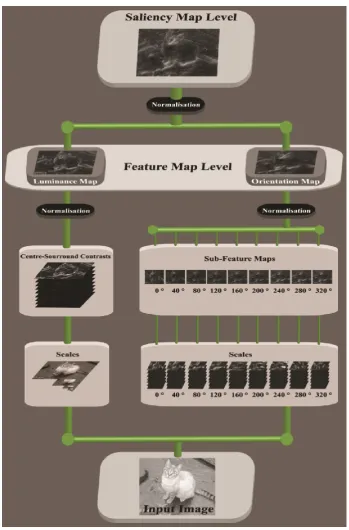
For an image , the model provides a global saliency value and a saliency map (Koch
& Ullman, 1985). The saliency estimation is achieved through the computation of orientation
and luminance Scales, which are then further combined to form Sub-Features Maps and
Feature Maps (see Figure 1). Since our saliency model is inspired by the one described in
Verma and McOwan (2009), only differences and crucial details of our approach are
discussed.
The model makes use of a hierarchical structure which was inspired by Marr’s (1982)
model of visual processing, and in particular, by the so-called primal sketch of a given visual
scene that employs feature extraction of basic components including regions, edges, textures,
etc. The outcome of the model can be defined as:
is the saliency model that returns two main outputs: , a global saliency value
[image:8.595.141.491.133.664.2]estimated on the basis of the saliency map (i.e., ) obtained from a given image .
represents the weighting function used to combine maps at each step as depicted in
Figure 1 (see section 2.3). is the luminance channel and relates to the
channel that comprises 9 orientational filters. No colour channels are implemented as only
greyscale pictures were used.
The following two sections illustrate how luminance and orientation features are
extracted and then combined to form the saliency map and to compute its numerical
estimation.
2.1 Extraction of visually low-level information
Luminance
For the feature extraction we chose the implementation of a biologically inspired
centre-surround filter for luminance (Hubel & Wiesel, 1962). This involves obtaining a
Gaussian Pyramid of the image of interest (Burt & Adelson, 1983) and creating contrasts
according to a given rule (i.e. inter-scale subtraction; see Itti, Koch, & Niebur, 1998). The
construction of the pyramid starts from the original greyscale image. This scaling technique is
used to simulate centre-surround receptive fields in neuro-computational modelling and has
resulted in reasonably successful modelling of on/off simple receptive fields with a
Difference in Gaussian function (DoG) (Field & Tolhurst, 1986; Jones & Palmer, 1987; Marr
& Hildreth, 1980). This method is grounded in the assumption that simple cells in the visual
cortex V1 are sensitive to visual features that pop out against a homogenous background, e.g.,
when a foreground elicits a different neural activity compared to the background (Knierim &
van Essen, 1992; Nothdurft, Gallant, &Van Essen, 1999).
In order to build centre-surround filters we used the MatLab™ function impyramid
of a 2-dimensional Gaussian kernel to subsample the image in n scales by applying a scaling
factor of 2 (i.e. scales are progressively smaller copies of the same image), resulting in the
resolution of the image at the top of the pyramid being of its original dimension. To
determine the number of scales we applied the following formula:
[ ] (Equation 2)
and are the width and height of the input image . We used a 1000 1000 pixel
resolution to build images; this led to a constant number of scales (i.e., ). To allow
inter-scale subtractions among the previously obtained inter-scales, the down-sampled images were
resized to the original size using bilinear interpolation (see ‘scales’ and ‘centre-surround
contrasts’ in Figure 1). The number and the type of subtractions performed are based on the
following formulae:
(Equation 3)
where (Equation 4)
Because the number of Scales is equal to 7, we obtained a total of 9 luminance
contrasts, as follows: .
Orientation
The implementation of orientational filters cannot be successfully achieved by
standard DoG filters for several issues. One main problem is that that the orientation features
are more complex than those of uniform foregrounds or backgrounds, because the receptive
& Jessell, 2000). A log-Gabor filter is more suitable to model this computational aspect
(Valois, Albrecht, & Thorell, 1982).
A Log-Gabor filter is made from two components: a radial part (Fr) and an angular
part (Fa). The former defines the spatial frequency that the filter is sensitive to, whereas the
latter adjusts a periodic wave to the filter. This can be formulated as follows:
[ ( )] [ ( )]
(Equation 5)
(Equation 6)
represents the orientation that the filter is selective to, is the centre of the
frequency domain, whereas and are respectively the bandwidths of the radial and
angular parts (measured in octaves). To avoid overlap between filters being selective to
different orientations, the ratio between the bandwidth of the radial part and the centre
frequency of filter is held constant.
The radial part is split into seven Scales (labelled 1 to 7). That is performed for all
nine orientation filters used in our implementation:
and . The higher number of orientation filters should enhance the performance of the
model compared to the Verma and McOwan (2009) implementation, where four filters were
used1.
1
The function used to compute Log-Gabor filters was scripted by Kovesi (2001, 2010) and available from the author’s website:
The two parts can be further combined to get the polar coordinates in the frequency
domain:
(Equation 7)
Following Valois, Albrect and Thorell (1982) the bandwidth was set to approximately
1.5 octaves, which is thought to be the norm to simulate orientation filters; whereas and
are respectively equal to 2 octaves and . For each orientation filter the wavelength is
set at 75Hz at the beginning (e.g. scale 1), and then reduced by a scaling factor of (with n =
1,…,7). Eventually the calculation of the orientation scales results in 63 scales (7 for each of
the 9 orientations).
2.2 Saliency Estimation
In order to quantify the amount of saliency present in a given image we utilised a peak
analysis approach according to the findings presented in Hu, Xie, Ma, Chia and Rajan (2004),
Verma and McOwan (2009) and Verma (2009). This is carried out for both the luminance
and orientation channels. The Hurst exponent estimation was implemented (Hurst, 1951;
Blok, 2000; Racine, 2011), which measures the amount of signal (i.e., quantifying the
saliency) present in a given map. Its value ranges between 0 and 1, approaching 1when the
map at issue contains a highly visible target-patch. This estimation can be achieved using
several methods (see Taqqu, Teverovsky, & Willinge, 1995). The Aggregated Variance
method (Taqqu et al., 1995) was chosen as this has the best trade-off between accuracy and
economy in terms of computational demand against the disadvantages of the methodologies
discussed in Hu, Xie, Ma, Chia, and Rajan (2004) and Li and May (2003). Moreover, this
approach appears to be biologically plausible in terms of sensory information analysed by the
To compute the Hurst estimation, pixels present in each shown in Figure 1 were
collapsed into two 1-dimensional data series. This was done by computing the standard
deviation of the image pixel values first by the x-dimension (i.e., pixel row) and then by the
y-dimension (i.e. pixel column). The two estimations are then summed to form a global Score
as follows:
( ) ( ) (Equation 8)
Where is the saliency value for a given , whereas and are
respectively the standard deviations of the data series computed on the x and y dimensions.
Since is the sum of two Hurst estimation, its range is from 0 to 2. When
approaches 2 there is a strong cross-correlation in terms of spatial similarity of the orientation
filter response across the data series. The main advantage of using the Hurst exponent is that
it favours isolated peaks against a series of peaks irrespective of the amplitude (e.g. low
frequencies against high frequencies; see Verma, 2009). The same applies to the luminance
contrasts. A single peak (e.g., a target-patch against a homogeneous background) is more
likely to be self-similar across a data series (e.g. having a low standard deviation), whereas
several peaks (e.g. a uniform background such as a target-absent image) determine a high
standard deviation and thus a lower is assigned.
2.3 Feature Combination
Combining scales, contrasts and maps is useful to reduce the number of maps per
feature being analysed, but maps containing higher amounts of signal need to be more
heavily weighted than others. Several methods are available to combine different scales and
contrasts (Itti & Koch, 2001; Verma & McOwan, 2009). A review of these combination
Logarithmic combination strategy (PA-Log). According to Verma (2009), PA-Log is more
reliable than other methods because it picks up a smaller spread of false detections, in that
maps with the highest scores (e.g. a strong localised peak detecting one target) will be given
a much higher weight than those with the lowest scores (e.g. a uniform background).
In order to weigh heavily those maps with the highest scores, maps are sorted in
descending order, so that the highest weights are assigned to maps with the highest scores.
This is achieved with the formula:
(
) (Equation 9)
Where M is the total number of maps to be combined: this equals to 9 for the
luminance centre-surround contrastsand 7for the orientation scales; see the maps in Figure 1
at the centre-surround and scale level. This value varies as the process of obtaining the final
saliency map proceeds. For example, M = 2 at the feature map level (see Figure 1 at the
feature map level box). The symbol in Equation 9 represents the -th position that a given
sub-map occupies when they are sorted according to their scores.
When weights are obtained the following strategy is used to form a map that
combines different sub-maps:
∑ (Equation 10)
Where the -th represents the map to be combined (e.g. from the
sub-map with the strongest signal to the one with the weakest); whereas is the corresponding
weight according to the sorted scores (i.e. from the highest to lowest).
We normalised the newly generated maps to the range [ ]. A linear normalisation
(Equation 11)
Where is a newly produced map resulting from the combination of those
present at a lower level. Normalisation is an efficient method to overcome two potential
issues related to the estimation of the saliency. Firstly, the use of two different methods to
obtain the saliency present in the luminance and orientation channel (i.e., centre-surround
contrasts and log-gabor filters), may favour one feature over another. Secondly, the weighting
function produces overpowered pixels (i.e., outside the range [ ]) that need to be rescaled
to within [ ] without altering the result of the weighting process.
Normalisation takes place when luminance centre-surround contrasts and orientation
filters are combined to form respectively one luminance feature map and one single
orientation map, and again to obtain the final saliency map. Figure 1gives an illustration of
the normalisation points.
Several estimations can be computed in order to obtain the global saliency score for
the final saliency map (see top of Figure 1). However, according to Verma (2009) the best
estimate for the saliency is the sum of the maximum scores obtained from both luminance
centre-surround contrasts and orientational scales:
(∑ ) (Equation 12)
Where is the -th maximum saliency score obtained from one of the
9 orientation piles at scale level (bottom right of Figure 1); whereas isthe
to range between 0 and 20 for a 9 orientation filter model, and between 0 and 10
for a 4 orientation model (see later in Study 2 for a comparison between these two saliency
models).
The next section explains how the saliency model and its two main outputs, i.e. the
final saliency map and its numerical estimation are embedded into a Genetic Algorithm (GA)
used to produce pop-out pictures.
2.4 The Genetic Algorithm
A genetic algorithm (GA) is a function that uses several variables to find a solution or
group of solutions that maximise or minimise some quantity. It does this through a process
akin to reproduction and a fitnessfunction. Over time unfit individuals tend not to pass on to
the next generation whereas fitter individuals reproduce and pass on their traits to future
generations (Holland, 1975; Goldberg, 1989; De Jong, 1975; Koza, 1990). The fitness
function is the crucial aspect allowing evolution to take place over generations. In our
implementation the saliency model was used as a fitness function within a GA operating over
image stimuli. This allows an artificial process of selection to be performed to achieve
different levels of saliency for unbiased stimuli (from a minimum to a maximum level of
saliency). To create these stimuli we used a form of “Biomorph” based on the work of
Richard Dawkins presented in his book The Blind Watchmaker (1986).
In contrast to Dawkins, we avoided the use of the symmetry to prevent our artificially
generated stimuli from appearing to be related to real life stimuli and therefore we called
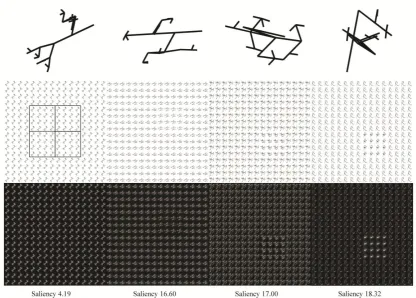
Figure 2. Top panel: four different randmorphs created in our implementation and used to produce a target-patch. Mid panel: one target-absent and three target-present patches at several levels of saliency. Left image shows a grid with the four possible positions for the target-patch. Bottom panel: the saliency maps obtained by the run of the saliency model with their saliency values given below.
Both our Randmorphs and Verma’s Biomorphs are a form of texton, fundamental
elements in visual perception that are used to form texture segregation images (Julesz, 1981;
Bergen & Julesz, 1983; Julesz, Gilbert, &Victor, 1978).
The GA in this implementation is a complex function that takes as an input several
components to give one output, which is a population of increasingly more salient pictures:
Where is the population bin: is the saliency model as described earlier
in the previous section, the set of centred coordinates for the target-patch, a
random parameter used to select the orientation of the branches for the randmorphs to be
drawn (see further), and the chromosome that stores the information for the drawing
of a pair of two randmorphs.
In order to operate the selection process we used both binary and integer encoding to
encode the chromosomes (Holland, 1975; Chakraborty, 2010; Davis & Mitchell, 1991;
Goldberg, 1989). A binary “genotype” chromosome consisting of 282-bits is employed to
express a pair of Randmorphs used to build a target patch image. Genes codify for integers
representing radians in the continuum between 0 and (rather than the range 0-2 ).
Simulations of the GA show that more occurrences of the same cosine and sine values for a
given radian lead to a smoother spread of the saliency values across the generations (see
Figure 3). To draw a pair of randmorphs a radian ( ) rounded to its nearest integer is
randomly selected to obtain 8 different orientations separated by an arbitrary unit of .
However, for simplicity, a set of orientations in degrees, rather than radians, is used to draw a
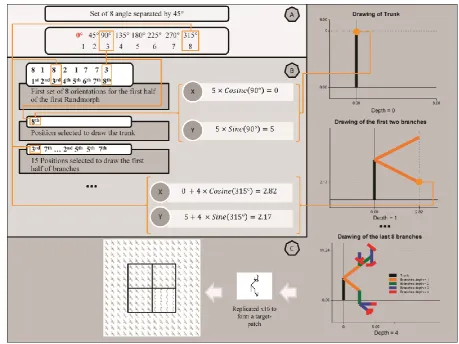
Figure 3. A wider range in the radian space was used to obtain more occurrences of the same cosine and sine values for a given radian (i.e., 57.32 ; see part A). For instance, (i.e. Z is a set of positive integer numbers including zero). This allows the drawing algorithm to build a broader range of randmorphs that leads the selection process to an evenly distributed continuum of saliency values, preventing the algorithm from producing sudden changes to the structure of the randmorphs (i.e. a smoother increase of the pop-out effect across images; see part B).
A “phenotype” chromosome is obtained from the 282-bit chromosome to form a
94-integer positions sequence, with each 94-integer represented by 3 bits and having a value ranging
between 1 and 8. Each phenotype chromosome is divided into two halves, each containing 5
segments coding for the following: first and second set of angles used to draw the two parts
of a randmorph (8 int. each), trunk of the randmorph (1 int.), left and right part of the
randmorph (respectively 15 int. positions; see Figure 4b and 4c). To draw a target-patch, a set
of centred coordinates in a 4 4 block lattice are randomly produced (i.e., ). Each
lattice block allows 16 replications of a randmorph. One randmorph is assigned as target and
reproduced 16 times to fill 1 out of 4 blocks surrounding the central area of the image (see
Figure 4. Part A: an angle is selected randomly to obtain a set of 8 angles separated by 45 degrees. For simplicity, we show here the drawing of a randmorphs in degrees (rather than radians). Part B: depicts the first 3 genome segments (out of 5) to construct the trunk and the first branch of the first half for the randmorph used as the target in the pop-out image. The first 8 genes codify the 8 orientation utilised to draw the first randmorphs. The next single-gene and the 15 that follow represent the positions of the angles selected in the first 8-integers sequence. Please note that this encryption allows two different loci to code for the same orientation. This allows branches to overlap and therefore to obtain a wide variety of patterns. Once the angle position has been retrieved from the chromosome, its corresponding angle is used to obtain the coordinates for the first segment to be drawn (trunk); this is done using cosine and sine functions. A scaling factor for the depth of the drawing is used to limit the pattern from getting too complex (starting from 5, i.e. depth = 0; see part C). Part C: represents the building of a randmorph by the drawing algorithm. Randmorphs are drawn in a two-dimensional space, with the first coordinate being (0,0). The drawing algorithm uses a recursive rule which diminishes the length of each segment by a factor of 1 at each depth. The final end of each segment is the starting point for the next two branches until the algorithm “runs out” at depth =4. Once the pair of randmorphs has been produced, one randmorph is used to construct the target-patch and therefore is replicated 16 times to form a square. A 4x4 lattice, each consisting of 16 positions, is used to form the image. The target-patch is allocated to 1 of 4 central positions. Overall, 256 randmorphs are used to produce a picture (240 to form the background plus 16 to create the target-patch).
Once the image has been obtained, a saliency map and a global saliency value are
produced by the fitness function (i.e., the saliency model); this provides the GA with the
The GA starts with a population of 12 images that is produced by the process
described above. An elitism approach was used (De Jong, 1975), which allows the fittest
images to be transferred to the next generation. This parameter was set to 0.2 which implies
that in our population of 12 individuals, 2 are selected as the fittest and passed on (e.g.,
individuals/images with the highest saliency values); whereas, the two least fit individuals in
the population are selected and passed on after the mutation function has applied a random bit
change. The mutation function changes the structure of the two binary chromosomes from
this starting population (the bit change probability is equal to 0.5)2. The first bit change is
always applied at depth = 4, proceeding through the generations towards depth = 0 (i.e., trunk
level) where a change usually determines a substantial change in the saliency of the image.
3
Studies
Two studies were performed to investigate differences between IB and non-IB
individuals in detecting the presence/absence of a target-patch on a uniform background. The
performance of the model will be also discussed.
Subjects in the two studies were classified as IB or non-IB on the basis of their
performance on a dynamic IB Task. In addition, the Randmorphs task was performed in the
two studies where the maximum stimulus exposure duration was 10s (Study 1) and 1s (Study
2). The model used to produce the saliency estimations in Study 1 was implemented with 9
orientational filters. Study 2 compared the performance of the 9 orientational filters model
2 The model does not make use of a crossover function. This is because in our implementation
with a 4 orientational filters model, the latter being theoretically equivalent to the one
presented in Verma and McOwan (2009).
3.1 Study 1: 10-seconds Randmorphs task
We used a sample of 250 target-present images, along with an equal number of null
trials depicting a uniform texture of Randmorphs (i.e., target-absent). The goal was to
evaluate whether this model produced a reliable saliency estimate which allows predicting
human behaviour in terms of RTs to detect target-patches, and therefore discriminate between
IB and non-IB individuals.
In Study 1 the Randmorphs Task required participants to decide whether a target
region was present or not in each of the images. Each image had a saliency score as obtained
from the procedure outlined above. It was hypothesised that the time taken to respond to each
image would be negatively correlated with the saliency scores.
3.1.1 Apparatus
For the Randmorphs task stimulus images were presented on a 19-inch standard LCD
monitor (Samsung Sync Master 931BF) with a spatial resolution of 1280 1024 pixels and a
temporal resolution of 75Hz. Participants viewed the presented stimuli at a viewing distance
of 57 cm. The dimensions of the active display area were 33.9 27.1 cm. A chin rest was
used to constrain head movements. Subjects responded to stimuli using the Eprime S-R box.
The size of each stimulus image was 10.6 10.6 cm (378 378 pixels), so each image
subtended 10.6o of visual angle. Eye movements were monitored using an LC Technologies
video eye tracker with Eprime 2.0 (Schneider, Eschman, & Zuccolotto, 2002).
The same setting was used for the IB standard task apart from the following changes:
3.1.2 Participants
Twenty-five undergraduate students (3 male) from the Birkbeck College took part in
the study for course credit. The participants were naive about the purpose of the research. All
subjects had normal or corrected-to-normal vision and were aged 18 to 51 (mean=31.46;
SD=8.74).
3.1.3 Stimuli
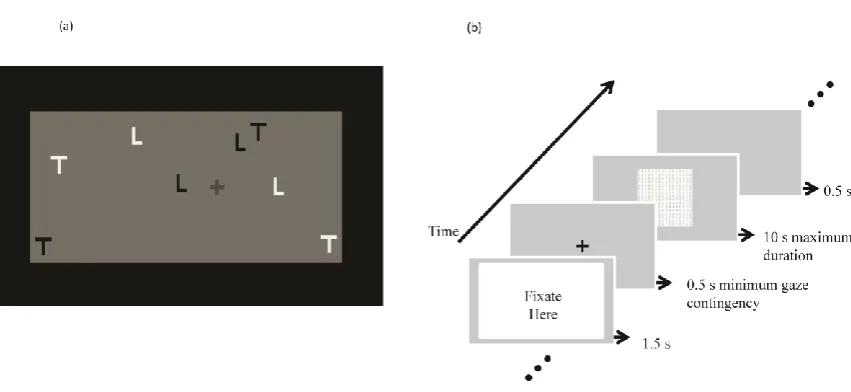
The IB Task (Figure 5a) was created using MatLab,and was very similar to the
dynamic IB task developed by Most et al. (2001; based on the video clip courtesy of Simons,
2003). The IB task comprised black and white letters (Ls and Ts) on a grey background
moving around the screen hitting the borders of the display. When the video begins there is a
still frame for 8.5 s showing the starting positions of the targets (white letters) and distractors
[image:23.595.117.543.436.632.2](black letters).
The primary task required that participants track the targets but ignore the distractors,
and report the number of times the targets bounced off the border of the display (i.e., ‘hits’) at
the end of the 32.5 s video. After 20 s from the onset of the video a red cross (in dark grey in
Figure 5a) moves across the screen, taking 11 s to traverse the screen starting from the right
hand side and exiting at the left side. Participants who failed to notice the red cross when
questioned at the end of the video were classified as IB subjects, whereas those noticing the
red cross as non-IB.
The randmorphs task consisted of 500 images, 250 of which were target-present
images. Each image display comprised a 4 4 grid. In 250 displays, one texton was
presented in each of these 16 positions, creating a seamless uniform background (i.e., target
absent displays). In the other 250 displays, one texton was used as the background (15
positions) but one of the four grid positions surrounding the central point was filled by a
second texton that served as the target (i.e., target-present). For the target-absent displays,
the saliency of the display ranged between 1.80 and 4.40 whereas for the target-present
displays, the saliency ranged between 11.79 and 18.20.
3.1.4 Procedure
Participants first completed the Randmorph task. Following the calibration procedure,
participants were instructed to view each display and to decide if there was a target present or
absent by pressing one of two keys on the response box. At the beginning of each trial a
screen displaying ‘Fixate Here’ was presented for 1.5 s. A gaze-contingent procedure was
then employed such that participants were required to maintain a central fixation for an
additional 500ms during which a fixation cross was displayed prior to the onset of the image.
This was implemented to standardise the starting position of the participants' fixation at the
asked to perform a 1 interval forced choice (1IFC) deciding whether or not a target region
was present (see Figure 5b). Participants were told they could freely look around from the
onset of the image and make a response anytime within the 10 s limit. Once the participant
has made a response, a 500 ms blank screen was presented before the beginning of the next
trial.
Participants were then presented with the IB task. They were instructed to silently
count the number of times the moving targets (white Ls and Ts) hit the border of the display
whilst ignoring the moving distractors (black Ls and Ts) – this was the primary task. At the
end of the task, participants were asked how many target hits they had counted and then
asked if they had seen anything else. Those participants reporting having seen the red cross
were classified as being non-IB whereas those who did not report it were classified as IB. All
participants who were classified as IB spontaneously reported seeing the red cross when they
were shown the task again but this time instructed not to do the counting task (i.e., full
attention task).
3.1.5 Results
The time taken to detect the target in the target-present trials was correlated with the
saliency level of the 250 trials (collapsed over all participants; IB status was not considered).
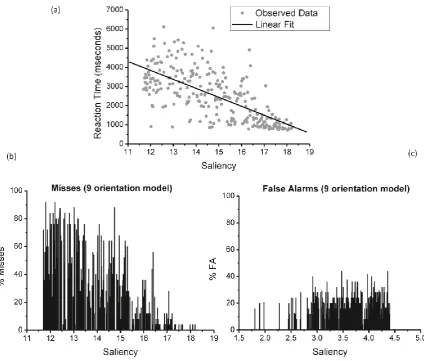
This showed a significant Spearman’s rho coefficient between the estimated saliency values
and reaction times (rs(248) = -.687; p<.001; one-tailed; see Figure 6a).
In addition, the same pattern is present if we consider the number of misses as a
function of saliency. As Figure 6b shows, the number of misses drops as the level of saliency
increases (rs(248) = -.736; p<.001; one-tailed). Interestingly, the number of false alarms
increases as saliency gets higher (rs(248) = 0.136, p<.05; two-tailed), although this
more inclined to see a target patch as the saliency increases, even though this is not present
(see Figure 6c; note that the saliency range for target-absent images is much lower because
[image:26.595.120.545.172.533.2]the saliency is simply based on a uniform background).
Figure 6. (a) Plot of the linear fit, irrespectively of the IB status. Reaction times were fitted as a function of the saliency estimation for the target-present patches. This clearly shows that as the saliency increases the time taken to recognise a target-patch is longer, whereas the subject response for low saliency pictures is, albeit variable, significantly slower. (b) Histogram of miss rates as a function of the saliency, showing a proportional decrease as the saliency increases. (c) Histogram of false alarm rates as a function of the saliency, depicting an equally distributed pattern.
A linear fit was carried out (see Figure 6a, dashed line) that accounted for 44.6% of
the total variability (F(1,248) = 199.449, p<.001; R2 =0.446), with the predictor ‘saliency’
With respect to Inattentional Blindness, 6 subjects were not-IB whereas the remaining
15 subjects were IB. Two subjects were excluded as they appeared not to perform the primary
task properly (e.g. less than 11 out of 21 hits); moreover, two more subjects had to be
excluded because it was unclear from their report whether or not they notice the unexpected
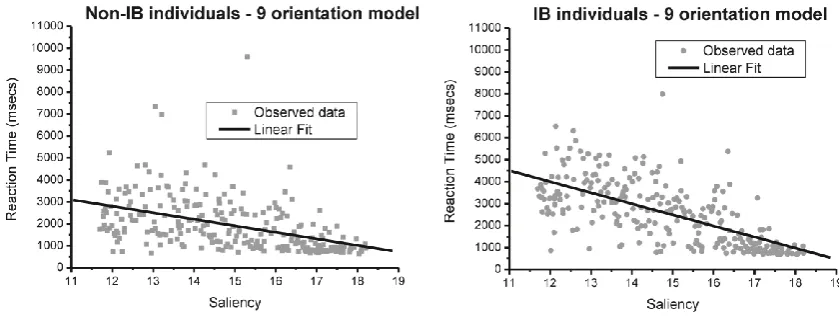
stimulus. Response times showed a different trend in the two groups. A multiple regression
with saliency and IB-status as predictors showed that the beta parameter saliency for the IB
group interpolates longer response times compared to the Non-IB group, with the latter
assumed as the baseline ( for dichotomous variable IB-status: = 0.934; t = 3.174, p<0.01;
see Figure 7). This was also confirmed from the negative estimate of the interaction term
(Saliency IB-status: = ; ): the regression line for IB
individuals, compared to Non-IB individuals, presents a more negative slope (i.e. inverse
[image:27.595.116.536.440.600.2]relationship).
Figure 7. Linear fit for (left) non-IB individuals, and (right) IB individuals in study 1.
This shows that IB subjects are overall less sensitive to changes in the saliency of the
visual scene, whereas Non-IB individuals tend to pick up target-patches that are relatively
perform as quickly as Non-IB subjects (i.e., less sensitive). There was a significant
interaction between the two factors, and the addition of the interaction term increased the
amount of explained variance although only by 0.79 % ( ).
To evaluate saliency sensitivity differences between the two subgroups, was
calculated and an independent-samples t-test performed. Results show that although the two
samples present a different pattern for RT, the saliency difference are in the predicted
direction but not significant. The IB individuals are non-significantly poorer to identify a
signal among the noise ( , one-tailed; equal variances assumed;
̅ ̅ )3.
3.2 Study 2: one-second Randmorphs task
In order to check the replicability and generality of the findings of Study 1, a second
study was conducted using a shorter time window and so the presentation time for images
was reduced from 10 s to 1 s following by a 1 s blank interval. Participants were required to
respond within this shorter interval, which should reduce the influence of strategic processing
on performance. Secondly, we wanted to evaluate whether or not the removal of 5
orientational filters in the saliency model has an impact on the power of the model to
discriminate between IB and non-IB individuals. Thus a 4-orientational filters model
3
We also carried out the same analysis using more conservative criteria for the IB task (i.e., excluding those who counted less than 17 out of 21 hits or whose report was unclear). This resulted in the loss of 6 IB subjects whose performance was below the above criteria, although their report was clear. A t-test shows a difference in sensitivity ( ; two-tailed; equal variances assumed; ̅
(theoretically equivalent to the one present in Verma & McOwan, 2009), was compared with
the 9 orientation model.
3.2.1 Apparatus
The same experimental apparatus was used as for Study 1, but here the eye-tracker
was not used to monitor gaze contingent viewing. This is because a short presentation time
encourages participants to look at the centre of the screen as this is the most efficient strategy
(i.e., targets that appeared randomly in one of the four positions that surround this central
point are more likely to be detected if fixation is central rather than peripheral).
3.2.2 Participants
Twenty-nine subjects (9 males) took part in the study. All participants were naive
about the purpose of the research, had normal or corrected-to-normal vision and were aged
from 19 to 41 (mean=27.74; SD=6.02).
3.2.3 Stimuli
The saliency range was reduced because target-present images with the lowest
saliency values (e.g. 11-12) were too difficult to detect (an average of 55% of misses was
found in Study 1 between 11.70 and 13.00). Fifty-three target-present images in the
11.70-12.99 range were replaced with an equal number of new images evenly distributed along the
new range 13.00-18.70 for the 9 orientation model. The run of the 4 orientation filter model
on this modified image set gave a range of 3-10 for the same target-present images given as
input to the 9 orientation model. The same target-absent images used in Study 1 were utilised.
The saliency estimations from the 4 orientation filter model for these images ranged between
3.2.4 Procedure
The procedure remained the same as for Study 1 apart from reducing the duration of
image presentation. Subjects attended a screenshot showing a fixation cross for 2 s, followed
by a blank screen for 300 ms, and then the image appeared up to 1 s. Once the participant
made a response the image disappeared and a 1.5 s blank screen was presented before the
onset of the next trial. Responses were accepted within 2 s from the stimulus onset.
3.2.5 Results
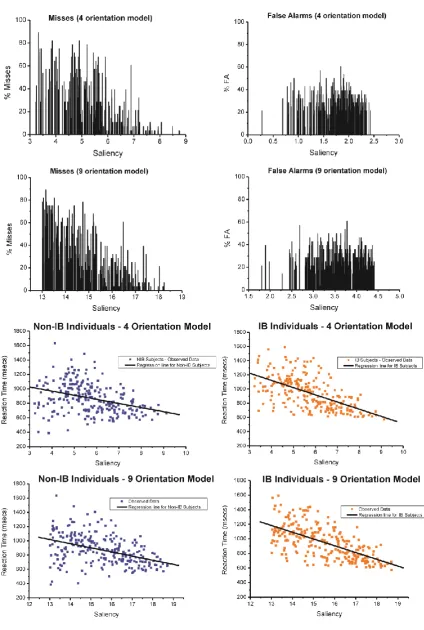
We compared the False Alarm (FA) rates for the target-absent images for the 9
orientation model here with those from Study 1, to evaluate the consistency of the saliency
values for the target-absent images across the two studies. Figure 6c and Figure 8a-b (right
panel) show that the FA rates follow the same pattern. We found no significant rho
correlations for both of the saliency estimations produced (4-filters model: rs(248) = -.08, p =
.205; two-tailed; 9-filters model: rs(248) = -.054, p = 0.39; two-tailed).
The saliency scores from the 4 orientation filter model showed a weaker correlation
(4-filters model: rs(248)= -.612, p<.001; one-tailed;) with target detection response latencies
compared to the ones from the 9 filter model (9 filter model: rs(248)= -.668, p<.001;
one-tailed; see Figure 8c and 8d). In order to compare the two correlations the Fisher’s r-to-z
transformation was utilised. Using the Fisher’s z-test (Howell, 1987), we found that the 9
filter model is not significantly better than the 4 filter model to predict participant’s reaction
times ( =1.06, p=0.146; one-tailed). However, an analysis of the misses showed
significant correlations with saliency for both models (4-filters model: rs(225)= -.717, p<.001
one-tailed; 9-filters model: rs(225)= -.790, p<.001; one-tailed), with the 9-filters model better
The goodness of fit of the two models was examined showing that, although both are
significant, they account for a different proportion of variance (4-filters model:
F(1,248)=139.500, p<.001, =0.360; 9-filters model: F(1,248)=193.525, p<.001;
=0.438). We then used a Cox test4 to compare the two non-nested models. Results from the
Cox test show that the two models are significantly different, with the 9-filters model
producing better saliency estimations when compared to the one with 4 filters only (
).
Fourteen participants were assigned to the IB group and seven to the non-IB group on
the same basis as for Study 1 (i.e., same exclusion criteria). No subjects were excluded on the
basis of the number of hits. However, 9 subjects were excluded as it was not possible to
determine whether they were inattentionally blind or not, as it was unclear from their reports
whether or not they noticed the unexpected stimuli (e.g., “something floating on the screen”,
“something red”, etc.). We therefore excluded these participants from further analysis.
A multiple regression with IB-status and the saliency estimations on RTs was
performed. Results show that IB subjects again were slower in detecting target patches
compared to the non-IB (4-filters model: IB-status: = 0.759; t = 4.24, p<0.001; 9-filters
model: IB-Status: = 1.412; t = 3.752, p<0.001). As for Study 1, we then included the
interaction term and we found it to be significant in both models (4-orientation model:
Saliency IB-status: = ; ; 9-orientation model: Saliency
IB-status: = ; ).
4
The inclusion of the interaction term in both models increased the proportion of
explained variance respectively of 1.7% for the 4 orientation model and 1.3% for the 9
orientation model (4 orientation model: ; 9 orientation model:
). However, there was a 6% difference in the amount of the
variance explained by the full 9 orientation model (main effect of saliency, group and their
interaction) when compared with the full 4 orientation model.
Because the two multiple regressions used to evaluate the saliency models are not
nested, we assessed which model produced a better estimation to predict the human
performance given the same number of regressors (i.e. the two main effects and their
interaction). A Cox test was again used to evaluate the two non-nested multiple regressions,
showing that the inclusion of the subjects’ status and its interaction with the regressor
‘saliency’ still favours the model with 9-filters ( ).
In summary, the addition of more orientational filters does increase the discriminatory
power of the 9 orientation filter model – compared to the 4-filters model – even for simple
images such as the ones that were used here (i.e., low-level images).
As for Study 1, we carried out a analysis between the two groups. No difference in
sensitivity was found in this study between IB and non-IB individual (
; one-tailed; equal variances assumed; ̅ ̅
)5.
5 This is also confirmed when we use a more conservative exclusion criteria, which led to the exclusion
4
Discussion
The studies presented here show that the two models used to estimate saliency values
are able to pick up crucial visual details in the images used (e.g., luminance and orientation).
Changes in the pictures relate to the visual properties of the Randmorphs, and once the
structure of a pair of Randmorphs is sufficiently different, a human subject is able to detect
them as two separate entities on a screen. However, the saliency of the target patches was
estimated not only on the basis of the Randmorphs pair but also on the overall saliency scene
resulting from the replication of the pair throughout the lattice. This was done in order to
follow Gestaltic principles of perception (Von Ehrenfels, 1890; Koffka, 1935). It appears that
a target patch emerges from a higher-order pattern or gestalt, and the models presented here,
especially the one with 9 orientation filters, demonstrate that measuring this emergent
property may be possible. However, to test whether gestalts are leading to a pop-out effect, it
would be interesting to use pairs of Randmorphs of different saliency values in a visual
search task with varying set-sizes (targets and distractors previously used to form pop-out
images). This might give some insight into the strategies used by subjects: whether they are
using the saliency of the scene to identify the target, or they are performing a same-different
task. For instance, in our study we showed that performance is quicker when the saliency of
the image is high and the same number of target and distractors is used. This would suggest
an automatic processing at high saliency levels. However, set-size may play a role in
detection, inducing strategic processing when a small set-size is used (i.e., longer reaction
time; see for example: Schubö, Wykowska, & Müller, 2007; Schubö, Schröger, & Meinecke,
2004). In summary, it may be interesting to assess more closely the relationship between
The 9-filters model accounts for a significantly higher proportion of the variance than
the 4-filters model, even though this difference is small. However, it is likely that is due to
the low-level images utilised in the experiments, and that the difference would be more
pronounced if real-life images were used.
Furthermore, what is striking is that these visual features involve only low-level or
bottom-up properties and are sufficient on their own to provide a good prediction for how
long it takes for a human subject to identify patches on a monitor. This implies that
measuring the saliency may be carried out from the elementary constituents of a visual scene.
The importance of using this approach is that it prevents any possible confounding factors
from the manual selection or creation of images by the experimenter, which may introduce
top-down factors.
In order to reduce the influence of top-down processing, Study 2 reduced the
presentation of the images to 1 s. Even though the influence of strategic processing was
attenuated, we were still able to observe two different RT patterns for IB and non-IB subjects.
This supports the idea that not seeing something in a visual scene is influenced by low-level
factors (i.e., bottom-up). In an MEG study of working memory maintenance, van Dijk, van
der Werf, Mazaheri, Medendorp and Jensen (2010) found a modulation in the oscillatory
power, substantially in the alpha band of the posterior regions (but also in the beta), that
could be interpreted as a mechanism to inhibit task-irrelevant information (Klimesch, 1999;
Palva & Palva, 2007). When a stimulus (i.e., target patch) is processed, the alpha power
increases in those regions not necessary for the storage of information (Palva & Palva, 2007;
Jensen, Gelfand, Kounios, & Lisman, 2002). Conversely, finding no power modulation
(background alpha power remains unchanged or increases) during the presentation of a target
may be interpreted as an inhibition of the target from being processed. For instance, a low
robust level of saliency to allow this stimulus to be processed by the early attentional
mechanisms as sufficiently salient and therefore made accessible to consciousness.
However, this may not be the result of a low-level process. Some researchers argue
that that top-down factors may be influential when something is present but not noticed
(Dehaene & Changeux, 2005; Baluch & Ittti, 2011), and performance cannot be entirely
explained by low-level saliency factors (i.e., bottom-up factors) even when short durations
are used. The availability of a stimulus to awareness can depend on the state of the top-down
networks. For instance, Dehaene and Changeux (2005) showed in their model of
consciousness that the availability of a stimulus to awareness depends on the oscillatory
top-down activity, which can prevent the stimulus from being available to consciousness, even
though these stimuli have been processed to a lower level.
An EEG study may help to test this hypothesis, as a neural response can be observed
when the brain detects a target patch even when there is no associated behavioural response
(i.e., oscillatory top-down activity hindering the access of the stimulus to conscious
awareness). This may correlate with a decrease in the alpha power during the stimulus
presentation, showing that the stimulus has been processed at an early stage (Van Dijk et al.,
2010). Because we can quantify the saliency, we are able to give an estimate of the amount of
“salient” information necessary for the visual system to detect a target patch.
When a stimulus is processed at a low-level, high-level activity (mainly intrinsic
oscillatory activity in the gamma band) among cortical neurons can “ignite” a spontaneous
activity that can block external sensory stimuli from being available to awareness (Dehaene
& Changeux, 2005). This “covertly-processed-but-not-overtly-available-to-consciousness”
dissociation may explain why, for example, the same stimulus can be processed but not
activity. The images produced with our approach may be useful to further investigate this
phenomenon as they provide an easy way to measure the threshold for which a visual
unbiased stimulus is detected but not consciously available to the subject.
The models presented in this paper do not take into account the inter-element spacing
in the lattice (Julesz, 1981; Reddy & VanRullen, 2007; Franconeri, Jonathan, & Scimeca,
2010). Although this was addressed implicitly via the estimation of the Hurst exponent, there
is no modelling of such an attribute from which the models would benefit. This also applies
to the implementation of those mechanisms that evaluate the size, spatial distribution and the
density of elements in a visual scene (for instance bigger objects should have a higher
saliency and so on) 6. In addition, as the model used here is a low-level one, the modelling of
high-level factors (Baluch & Itti, 2011), may be beneficial to obtain a better saliency
estimation; this is particularly important for real life images, when the impact of semantics is
deemed to have a stronger effect (see for example the recent advances in computer science on
this point: Borji, Sihite, & Itti, in press). The two saliency models in the present paper are
likely to have performed better had real-life images been used rather than artificial
Randmorphs. Real-life images are by definition more complex and therefore the use of
additional orientational filters would help to discriminate small differences in saliency of the
scenes.
The amount of information picked up by the model is computed via the Hurst
exponent estimation, and one conspicuous limitation of this approach, for instance, is that one
target (e.g., single peak) is weighted more heavily than two targets (e.g. two similar peaks in
the same image; see Verma, 2009). As Verma (2009) suggests “a display with one red target
6 In our model there are no specific mechanisms to evaluate these visual features separately. The Hurst
amongst a series of green targets produces a higher saliency value than a display with a group
of red targets amongst a background of green targets” (p.73). This means that a bias is present
only if we compare the saliency of two images with a different number of targets (e.g., one
with one target and one with two targets), whereas in the case of two images with the same
number of targets (e.g., one target each) the model is able to evenly estimate the saliency.
In summary, the approach presented here has demonstrated its accuracy in predicting
human performance under the condition of a visual pop-out search and has provided the
groundwork for this methodology to be used in the study of psychological processes such as
Inattentional Blindness. We have shown that IB subjects are on average slower than non-IBs
to detect targets on uniform backgrounds. However, previous research (e.g., Richards,
Hannon,Vohra, & Golan, 2013) has shown that this classification is affected by the visual
features of the paradigm, the primary task and the ability to cope with the cognitive demands
of the task . For example, in both studies reported here we used an IB Task that was very
similar to the one developed by Simons (2003). One possible issue with this standard IB task
is that the status of the unexpected stimulus is ambiguous. It does not form part of the
primary goal of the task, which is to count white targets and ignore black distractors, and it is
therefore not clear whether the most efficient or best strategy is to process the red cross and
remember it or to ignore it by either not processing it or by processing it and inhibiting it to
prevent it from interfering with the primary task (Richards, Hannon, Vohra, & Golan, 2013).
Previous research has shown that IB individuals, who typically have low working memory
resources, spend more time fixating irrelevant distractor stimuli compared to non-IB
individuals (e.g., Richards, Hannon, & Vitkovitch, 2010). One could argue that IB subjects
are less efficient than non-IB subjects just because they spend too much time looking at
irrelevant objects (i.e. not part of the primary task), and that training may be required for the
on a subsequent IB task (Richards, Hannon, & Derakshan, 2010; Richards et al., 2013).
Moreover, different types of IB tasks would inevitably produce different classifications. One
possible solution may be to use the saliency model on the visual aspects of the IB task in
order to manipulate their saliency and see how this affects the likelihood of noticing an
unexpected stimulus. Another interesting direction is to try to systematically investigate the
saliency difference necessary for IB subjects to perform as quickly as the Non-IB
subjects. This could be done by selectively manipulating the saliency of the pictures until no
difference in terms of RT performance is found. The difference would then give the extra
amount of saliency necessary for IB subject to perceive and therefore perform as Non-IB
subjects.
Taken together these findings suggest that further research is necessary on those
aspects of the visual processing that have an influence on the behaviour of the observer and in
its turn on brain activity. Nevertheless, we acknowledge that further model developments,
such as the inclusion of high-level processing (i.e. top-down), are necessary to achieve a
better saliency estimation. However, our results show that Non-IB individuals are better able
than IB individuals to pick up the saliency of a visual scene which is based on a low-level
saliency estimation (i.e., purely bottom-up). Non-IB subjects appear to be less influenced by
the saliency, giving a quicker response throughout the entire saliency range; whereas IB
subjects present longer reaction times when the saliency of the images is relatively low. At
high saliency values, the difference between the two groups is minor, and both present a
5
Acknowledgements
We would like to thank Manuela Andolfi (Motion & Graphic Designer,
http://vimeo.com/manuelaandolfi, [email protected]) for her contribution to the
6
References
Baluch, F., & Itti, L. (2011). Mechanisms of top-down attention. Trends in
Neurosciences, 34(4), 210-224.
Baluch, F., & Itti, L. (2011). Mechanisms of top-down attention. Trends in
Neurosciences, 34(4), 210-224.
Bergen, J., & Julesz, B. (1983). Parallel versus serial processing in rapid pattern
discrimination. Nature, 303, 696-698.
Blok, H. J. (2000). On the nature of the stock market: Simulations and experiments.
PhD thesis, University of British Columbia.
Borji, A., Sihite, D. N., & Itti, L. (in press). What/Where to Look Next? Modeling
Top-down Visual Attention in Complex Interactive Environments. IEEE Transactions on
Systems, Man, and Cybernetics, Part A - Systems and Humans, pp. 1-16.
Burt, P. J., & Adelson, E. H. (1983). The Laplacian pyramid as a compact image
code. IEEE Transactions on Communications, COM-31(4):532-540.
Chabris, C. F., Weinberger, A., Fontaine, M., & Simons, D. J. (2011). You do not talk
about Fight Club if you do not notice Fight Club: Inattentional blindness for a simulated
real-world assault. I-Perception, 2, 150-153.
Chakraborty, R.C. (2010). Fundamentals of Genetic Algorithms. Lecture slides,
Technology (JUET), Guna. Online source:
http://www.myreaders.info/html/artificial_intelligence.html.
Davis, L. D., & Mitchell, M. (1991). Handbook of Genetic Algorithms. Van Nostrand
Reinhold, New York.
Dawkins, R. (1986). The Blind Watchmaker. Penguin Books, London.
De Jong, K. (1975). An Analysis of the Behavior of a Class of Genetic Adaptive
Systems. PhD thesis, University of Michigan, Ann Arbor, Michigan. Department of Computer
and Communication Sciences.
Dehaene, S., & Changeux J.-P. (2005). Ongoing Spontaneous Activity Controls
Access to Consciousness: A Neuronal Model for Inattentional Blindness. PLoS Biol 3(5):
e141. doi:10.1371/journal.pbio.0030141
Desimone, R., & Duncan, J. (1995). Neural mechanisms of selective visual attention.
Annual Review of Neuroscience, 18:193-222.
Driver, J. (2001). A selective review of selective attention research from the past
century. British Journal of Psychology 92, pp. 53-78.
Ehrenfels von C. (1890). Über Gestaltqualitäten. Vierteljahresschr. fürPhilosophie,
14, 249-292.
Field, D. J. (1987). Relations between the statistics of natural images and the response
properties of cortical cells. Journal Optical Society of America, A, 4, 2379–2394.
Field, D. J., & Tolhurst, D. J. (1986). The structure and symmetry of simple-cell
receptive-field profiles in the cat’s visual cortex. Proceedings of the Royal Society of London,
Franconeri, S. L., Jonathan, S. V., & Scimeca. J. M. (2010). Tracking multiple
objects is limited only by object spacing, not by speed, time, or capacity. Psychological
Science, 21(7): 920-5.
Goldberg, D. E. (1989). Genetic Algorithms in Search, Optimization, and Machine
Learning. Addison-Wesley Longman Publishing Co., Inc., Boston, MA, USA.
Greene, W. H. (1993), Econometric Analysis, 2nd ed. Macmillan Publishing
Company, New York.
Greene, W. H. (2003). Econometric Analysis, 5th ed. New Jersey, Prentice Hall.
Hannon, E. M., & Richards, A. (2010). Is inattentional blindness related to individual
differences in visual working memory capacity or executive control functioning? Perception,
39, 309-319.
Holland, J. H. (1975). Adaptation in natural and artificial systems. University of
Michigan Press, Ann Arbor.
Howell, D. C. (1987). Statistical Methods for Psychology. Second edition. PWS
Publishers; revised Edition of 1st Edition 1982 edition. Duxury Press: Boston.
Hu, Y., Xie, X., Ma, W.-Y., Chia, L.-T., & Rajan, D. (2004). Salient region detection
using weighted feature maps based on the human visual attention model. Advances in
Multimedia Information Processing - PCM 2004, pages 993-1000.
Hubel, D. H., & Wiesel, T. N. (1962). Receptive fields, binocular interaction and
functional architecture in the cat’s visual cortex. Journal of Physiology, 160, 106–154.
Hurst, H. (1951). Long-term storage in reservoirs. Transactions of the American
Itti, L., & Baldi, P. (2008). Bayesian surprise attracts human attention. Vision
Research, Volume 49(10), pp. 1295–1306.
Itti, L., & Koch, C. (2001). Computational modelling of visual attention. Nature
Reviews Neuroscience, 2(3):194-203.
Itti, L., Koch, C., & Niebur, E. (1998). A Model of Saliency-Based Visual Attention
for Rapid Scene Analysis. IEEE Transactions on Pattern Analysis and Machine Intelligence,
20(11), 1254-1259.
Jensen, O., Gelfand, J., Kounios, J., Lisman, J.E. (2002) Oscillations in the alpha band
(9-12Hz) increase with memory load during retention in a short-term memory task. Cerebral
Cortex, 12, 877-882.
Jones, J. P., & Palmer, L. A. (1987). An evaluation of the two-dimensional Gabor
filter models of simple receptive fields in cat striate cortex. Journal of Neurophysiology, 58,
1233–1258.
Julesz, B. (1981). Textons, the elements of texture perception, and their interactions.
Nature, 290, 91–97.
Julesz, B., Gilbert, E. N., & Victor, J. D. (1978). Visual discrimination of textures
with identical third-order statistics. Biological Cybernetics, 31(14), 137-140.
Kandel, E. R., Schwartz, J. H., & Jessell, T. M. (2000). Principles of Neural Science.
McGraw-Hill Education.
Klimesch, W. (1999) EEG alpha and theta oscillations reflect cognitive and memory
Knierim, J. J., & van Essen, D. C. (1992). Neuronal responses to static texture
patterns in area V1 of the alert macaque monkey. Journal of Neurophysiology,
67(4):961-980.
Koch, C., & Ullman, S. (1985). Shifts in selective visual-attention towards the
underlying neural circuitry. Human Neurobiology, 4, 219–227.
Koene, A. R., & Zhaoping, L. (2007). Feature-specific interactions in salience from
combined feature contrasts: Evidence for a bottom-up saliency map in V1. Journal of Vision,
7(7:6): 1-14.
Koffka, K. (1935). Principles of Gestalt psychology. Oxford, England, Harcourt,
Brace.
Kovesi, P. (2010). Peter Kovesi Homepage. The university of western Australia.
Retrieved from http://www.csse.uwa.edu.au/~pk/Research/MatlabFns/index.html
Koza, J. R. (1990). Genetic programming: A paradigm for genetically breeding
populations of computer programs to solve problems. Technical report, Stanford University
Computer Science Department.
Kuhn, G., & Findlay, J. (2010). Misdirection, attention and awareness. Inattentional
blindness reveals temporal relationship between eye movements and visual awareness.
Quarterly Journal of Experimental Psychology, 63, 136-146.
Levin, D. T., Drivdahl, S. B., Momen, N., & Beck, M. R. (2002). False predictions
about the detectability of visual changes: The role of beliefs about attention, memory, and the
continuity of attended objects in causing change blindness. Consciousness and Cognition,