ISSN Online: 2153-1188 ISSN Print: 2153-117X
Preparation and Characterization of
La
0.67
−
x
Li
3x
TiO
3
Solid-State Electrolyte
Used for Electrochromic Mirrors
Le Dinh Trong
1, Nguyen Nang Dinh
2, Do Hong Thanh
31Hanoi Pedagogical University 2, Phuc Yen, Vietnam
2University of Engineering and Technology, Vietnam National University, Hanoi, Vietnam 3Department of Science and Technology of Tuyen Quang Province, Tuyen Quang City, Vietnam
Abstract
With the aim of producing all-solid-state electrochromic mirrors, La0.67−xLi3xTiO3 (LLTO) and the WO3 were prepared by electron beam deposition. The LLTO (with x = 0.11) powder was synthesized by thermally ball-grinding method and the Li+ ionic conductivity of the LLTO ceramic targets was found to be of ca. 3.25 × 10⁻³ S/cm. Using LLTO targets for e-beam evaporation, 300 nm-thick films with the Li+ ionic conductivity of 5.50 × 10⁻⁵ S/cm were deposited. Combining LLTO films with WO3/ITO and LiMn2O4 layers, all-solid-state electrochromic mirrors with a laminar structure of Al/LiMn2O4/LLTO/WO3/ITO were prepared. The reversible reflectance of the mirrors was well controlled by applying polarized potentials onto the ITO electrode. The obtained results suggest useful applications for electrochromic win-dows working as a smart reflectance mirror that can be used for auto rear-view mir-rors.
Keywords
Ionic Conductivity, Electron Beam Deposition, All-Solid-State Electrochromic Mirror, Impedance Measurement, Reflectance Spectra
1. Introduction
Electrochromism is a topic that has attracted a great deal of interest from researchers because of its potential application in various areas, such as photonics, optics, electron-ics, architecture, etc. Electrochromic (EC) properties can be found in almost all the transition-metal oxides and their properties have been investigated extensively in the
How to cite this paper: Trong, L.D., Dinh, N.N. and Thanh, D.H. (2016) Preparation and Characterization of La0.67−xLi3xTiO3 Sol-id-State Electrolyte Used for Electrochromic Mirrors. Materials Sciences and Applica-tions, 7, 702-709.
http://dx.doi.org/10.4236/msa.2016.711056
Received: October 12, 2016 Accepted: November 8, 2016 Published: November 11, 2016
Copyright © 2016 by authors and Scientific Research Publishing Inc. This work is licensed under the Creative Commons Attribution International License (CC BY 4.0).
last decades [1]. These oxide films can be coloured anodically (Ir, Ni) or cathodically (W, Mo); however, WO3 is clearly the preferred material for applications. This is prin-cipally due to the fact that WO3-based electrochromic devices (ECD) have normally a faster response time to a change in voltage and a larger coloration efficiency (CE) as compared to devices based on other electrochromic materials. Recently Gran-qvist et al. [2] have made a comprehensive review of nanomaterials for benign indoor environ-ments. In this report, the authors show the characteristic data for a 5 × 5 cm2 flexible EC foil incorporating WO3, and NiO modified by the addition of a wide bandgap oxide such as MgO or Al2O3, PMMA-based electrolyte, and ITO films. Durability of the EC devices was demonstrated in performing several tens of thousands of coloration/ bleaching cycles, and the device optical properties were found to be unchanged for many hours. Using solid-state electrolytes like lithium-ion conducting materials, one can make all-solid-state windows. Among numerous Li conductors, perovskite-type oxides (ABO3) show promising lithium high ion conductivity at room temperature.
Recently, many works [3] [4] [5] [6] have shown that the new family of perovskite structure La0.67−xLi3xTiO3 materials (hereafter called as LLTO) give a large Li+ ionic conductivity. At room temperature, the conductivity of LLTO films possesses a value up to 10−5 S/cm.Recently, Li et al. [7] reported the preparation of LLTO thin films by electron beam deposition, and their results showed that amorphous LLTO thin films deposited by e-beam with ionic conductivity of 10−5 S/cm that is suitable for application as a large-area electrolyte for thin-film batteries and electrochromic windows. We have shown that at room temperature LLTO bulk materials prepared by conventional sol-id-state reaction possess a larger Li+ ion conductivity from 10−4 ÷ 10−3 S/cm [8].
In this work, the e-beam evaporation method was also used for deposition of LLTO thin films. The solid-state electrolyte LLTO films were used in WO3-based ECD devices working as all-solid-state electrochromic mirror mirrors. The performance of the elec-trochromic mirrors was also presented.
2. Experiment
The La0.67−xLi3xTiO3 crystalline powder was synthesized by ball grinding method ac-cording to the following reaction:
(
0.67−x)
La O2 3+3 Li COx 2 3+2TiO2+2La(0.67−x)Li TiO3x 3+xCO2 ↑ (1)these targets. The base pressure of the evaporation chamber was 1.5 × 10⁻⁴ Pa. Oxygen gas flux was regulated to maintain the chamber pressure at about 5.5 × 10⁻² Pa. Corning glasses coated by ITO (Indium Tin Oxide) were used as substrates, the temperature of the substrates was kept at 450˚C. The substrate-target distance was about 25 cm. The deposition was maintained by use of a vibrating quartz crystal microbalance. 300 nm- thick LLTO films used for electrochromic display were deposited onto previously depo-sited WO3/ITO (namely LLTO/WO3/ITO). 350 nm-thick WO3 films coated on ITO substrates (WO3) were prepared also by e-beam deposition according to the procedure which was described in Ref. [9]. LiMn2O4 served as a Li+ ion resource (or cathode in all-solid-state battery) was e-beam deposited onto LLTO/WO3/ITO, then Al coating onto the LiMn2O4 layer was metallized successively by thermal vacuum evaporation in the same chamber. Thus ECD devices working as a smart reflective mirror was pre-pared in a laminar structure of Al/LiMn2O4/LLTO/WO3/ITO (further abbreviated to “LWM” mirror). For characterization of transmittance, LTTO films were e-beam depo-sited on glass substrates. For conductivity measurements, an Al/LLTO/ITO sandwich structure was made by vacuum evaporation of Al coatings on the surface of LLTO/ITO samples with a working electrode of 5 × 5 mm2.
The structure of LLTO films was characterized by X-ray diffraction (XRD) patterns recorded by a Siemens D-5000 X-ray diffractometer with Cu-Kα radiation. The
mor-phology and cross-section of the LLTO thin films were investigated by field emission scanning electron microscopy (FE-SEM). The ionic conductivity of thin films was cha-racterized on Auto. Lab Potentiostat-PGS30 with a FRA-2 impedance spectra tech-nique. Optical measurement was carried-out on a Jasco V-570 photospectrometer.
3. Results and Discussion
3.1. Crystalline Structure, Morphology and Ionic Conductivity of the
Samples
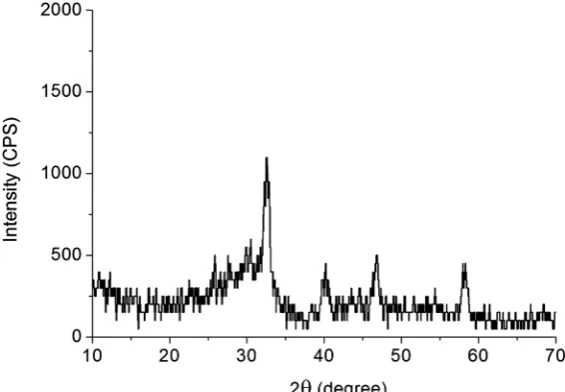
Figure 1 shows X-ray diffraction patterns of a deposited film. XRD patterns demon-strated that the LLTO films were crystallized with submicrostructured grains. From the XRD peaks one can determine grain size (τ)using the Scherrer formula:
0.9 cos
λ τ
β θ
= (2)
where λ is wavelength of the X-ray used, β the peak width of half height in radians and θthe Bragg angle of the considered diffraction peak [10]. The calculation result showed
that the average size of the crystalline grains in the LLTO film is ∼100 nm.
Figure 2 shows SEM images of surface and cross-section of the LLTO thin film (x =
0.11). It is seen that, the as-deposited films have a very dense surface with grain size of ca. 100 nm (Figure 2(a)) and thickness of the film is about 300 nm (Figure 2(b)). The film has a good adherence with the substrate.
Figure 1. XRD patterns of a LLTO film sample with x = 0.11.
Figure 2. FE-SEM image of LLTO thin film (a) and Cross-section of SEM image of a LLTO thin film (b). The film thickness d = 300 nm.
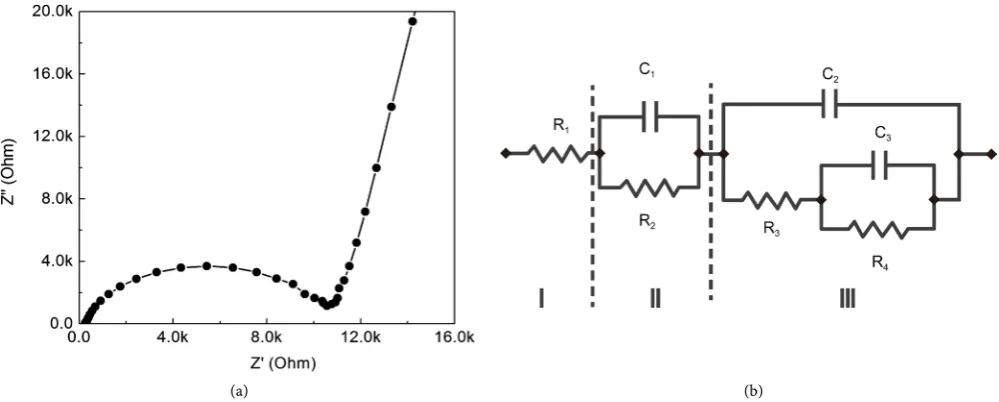
Figure 3(a) shows the complex impedance plot (Z’ versus Z” plot) measured in the fre-quency range 100 Hz to 1.0 MHz at room temperature for a LLTO film. The impedance plot consists of two semicircles, respectively characterizing by a Li+ ion conducting process in electrolyte and a process at interface of electrolyte and electrodes. The resis-tance of thin films was determined by using a software program for fitting experimental data and theoretical spectrum of equivalent circuit available. The proposed equivalent circuit schema is shown in Figure 3(b). In part (I), R1 marks serial resistance of circuit. In part (II), R2 and C1 are the resistance of electrolyte and capacitance of the passive film of the electrolyte surface, respectively. In part (III), R3 and C2 are the resistance and capacit-ance of the passive film on the electrodes, respectively; R4 and C3 are resistcapacit-ance and double-layer capacitance of electrolyte/electrode interfaces. The ionic conductivity (σ) can be calculated from the value of electrolyte resistance R2 according to the formula:
2 d R S
σ = (3)
[image:5.595.49.549.69.270.2]
(a) (b)
Figure 3. Cole-Cole plots of the impedance of LLTO with Li contents x = 0.11 (a) and the equivalent circuit schema (b).
From the equivalent circuit schema fitting with the experimental curve, R2 was found to be of 2.18 Ω. In this case, the ionic conductivity of the films determined from for-mula (3) is as large as σ = 5.50 × 10⁻⁵ S/cm, that is comparative with the conductivity of the LLTO thin films prepared by the pulsed laser deposition [11]. In comparison with bulk conductivity of the target material, the ionic conductivity of thin films is lower in two orders by magnitude. Such ion conducting decreased of thin film could be origi-nated from i) decomposition of a part of lithium amount during evaporation process caused a lack of Li in LLTO thin films, ii) the presence of gain boundaries, and iii) an interface enhancement effect.
3.2. Electrochromic Properties
As-deposited LLTO thin films have slightly yellow color in visible range. Figure 4 shows transmittance spectrum of the film in wavelength range from 350 nm to 850 nm. The transmittance spectra of thin films is high in visible range, it is of 80% to 95%. This shows that the films prepared by electron beam deposition from the LLTO targets exhi-bit both the high Li-ionic conductivity and the high transmittance in visible wave-lengths range.
Figure 4. Transmittance spectra of a LLTO (x = 0.11) thin film.
Figure 5. Electrochromic performance of the LWM device of a laminar structure of ITO/WO3/LLTO/LiMn2O4/Al as shown in the insertion.
performance, the reflectance of the LWM mirror is determined mainly by the colora-tion (or absorpcolora-tion) of the WO3 electrochromic layer.
The electrochromic performance of the WO3 electrode in LiClO3 + PC was described by cathodic reactions [12] [13]:
(
)
3 3
WO +x Li++e− ↔Li WOx (4)
[image:6.595.232.517.301.525.2]ap-plying a polarized voltage onto ITO electrode proves that all-solid-state electrochromic devices can be utilized for fabrication of auto rear-view mirrors. Using these mirrors, the drives can prevent accidents which may be caused by radiating from the headlamp of the behind cars.
4. Conclusion
By using thermally ball-grinding method, submicro-structured La0.67−xLi3xTiO3 (with x = 0.11) powder was synthesized for the targets in e-beam deposition of the LLTO films. The best ionic conductivity of the films possesses a value as high as 5.50 × 10⁻⁵ S/cm. All-solid-state electrochromic devices of a laminar structure of Al/LiMn2O4/LLTO/ WO3/ITO were prepared. The reversible reflectance of the device was well controlled by polarization of potentials applied onto the ITO electrode. The obtained results suggest useful applications for electrochromic windows working as a smart reflectance mirror that can be used for auto rear-view mirrors.
Acknowledgements
This research was funded by the operational fund for science and technology of Hanoi Pedagogical University 2, under grant number C2015-18-05.
References
[1] Granqvist, C.G. (1995) Handbook of Inorganic Electrochromic Materials. Elsevier, Ams-terdam.
[2] Granqvist, C.G., Azens, A., Heszler, P., Kish, L.B. and Österlund, L. (2007) Nanomaterials for Benign Indoor Environments: Electrochromics for “Smart Windows”, Sensors for Air Quality, and Photo-Catalysts for Aircleaning. Solar Energy Materials and Solar Cells, 91, 355-365. http://dx.doi.org/10.1016/j.solmat.2006.10.011
[3] Inaguma, Y., Liquan, C., Itoh, C., Nakamura, T., Uchida, T., Ikuta, H. and Wakihara, M. (1993) High Ionic Conductivity in Lithium Lanthanum Titanate. Solid State Communi- cations, 86, 689-693. http://dx.doi.org/10.1016/0038-1098(93)90841-A
[4] Inaguma, Y., Chen, L., Itoh, M. and Nakamura, T. (1994) Candidate Compounds with Pe-rovskite Structure for High Lithium Ionic Conductivity. Solid State Ionics, 70/71, 196-202.
http://dx.doi.org/10.1016/0167-2738(94)90309-3
[5] Dokko, K., Akutagawa, K., Isshiki, Y., Hoshina, K. and Kanamura, K. (2005) Preparation of Three Dimensionally Ordered Macroporous Li0.35La0.55TiO3 by Colloidal Crystal Templating
Process. Solid State Ionics, 176, 2345-2348. http://dx.doi.org/10.1016/j.ssi.2005.05.018
[6] Ibarra, J., Varez, A., Leon, C., Santamarıa, J., Martinez, T.L.M. and Sanz, J. (2000) Influence of Composition on the Structure and Conductivity of the Fast Ionic Conductors La2/3-xLi3xTiO3
(0.03 ≤ x ≤ 0.167). Solid State Ionics, 134, 219-228.
http://dx.doi.org/10.1016/S0167-2738(00)00761-X
[7] Li, C.L., Zhang, B. and Fu, Z.W. (2006) Physical and Electrochemical Characterization of Amorphous Lithium Lanthanum Titanate Solid Electrolyte Thin-Film Fabricated by E-Beam Evaporation. Thin Solid Films, 515, 1886-1892.
http://dx.doi.org/10.1016/j.tsf.2006.07.026
Conductiv-ity of La(2/3-x)Li3xTiO3 Ceramics Used for All-Solid-State Batteries. Solid State Ionics, 278,
228-232. http://dx.doi.org/10.1016/j.ssi.2015.05.027
[9] Dinh, N.N., Bich, V.T., Hoang, N.H. and Minh, L.Q. (1988) Photochromic Properties of Tungsten Trioxide Films Made by Electron Beam Deposition. Physica Status Solidi (a), 108, K157-K162.
[10] Cullity, B.D. (1978) Elements of X-Ray Diffraction. 2nd Edition, Addison-Wesley Publish-ing Company, Inc., ReadPublish-ing, MA, 102.
[11] Ahn, J.K. and Yoon, S.G. (2005) Characteristics of Amorphous Lithium Lanthanum Tita-nate Electrolyte Thin Films Grown by PLD for Use in Rechargeable Lithium Microbatteries. Electrochemical and Solid-State Letters, 8, A75-A78. http://dx.doi.org/10.1149/1.1843571
[12] Faughnan, B.W., Crandall, R.S. and Heyman, P.M. (1975) Electrochromism in WO3
Amorphous Films. RCA Review, 36, 177-197.
[13] Cordoba de Torresi, S.I., Gorenstein, A., Torresi, R.M. and Vazquez, M.V. (1991) Elec-trochromism of WO3 in Acid Solutions: An Electrochemical, Optical and
Electrogravime-tric Study. Journal of Electroanalytical Chemistry, 318, 131-144.
Submit or recommend next manuscript to SCIRP and we will provide best service for you:
Accepting pre-submission inquiries through Email, Facebook, LinkedIn, Twitter, etc. A wide selection of journals (inclusive of 9 subjects, more than 200 journals)
Providing 24-hour high-quality service User-friendly online submission system Fair and swift peer-review system
Efficient typesetting and proofreading procedure
Display of the result of downloads and visits, as well as the number of cited articles Maximum dissemination of your research work