Munich Personal RePEc Archive
Does Implicit Voting Matter? Coalitional
Bargaining in EU the Legislative Process
Garcia Perez de Leon, Cesar
Sciences Po, Paris, American Political Science Association
3 September 2011
Online at
https://mpra.ub.uni-muenchen.de/47045/
Does implicit voting matter? Coalitional bargaining in the EU legislative process
Prepared for delivery at the Annual Meeting of the American Political Science Association, Seattle, WA, August 30-September 3, 2011
Cesar Garcia Perez de Leon
Marie Curie Research Fellow
Centre for European Studies- Sciences Po [email protected] www.cee.sciences-po.fr
Abstract
Introduction
In the legislative process of the European Union, member governments and supranational institutions regularly negotiate the passage of new legislation involving policy change. Inductive accounts of the legislative process show that decision makers of the EU commonly take decisions through “implicit voting” (Hayes-Renshaw et al.,
2006; Golub, 1999; 2007; Novak, 2010). Implicit voting refers to the mechanism by which decision makers participating in the process estimate the existence of an effective qualified majority coalition in negotiations preceding the final agreement, so that an actual vote may not take place and decisions are officially adopted “by consensus”. The testimony of Dutch national representative Leendert Bal is illustrative in this regard:
If an observer were to attend Council Meetings he or she would notice next to no
evidence of a qualified-majority voting. It is unusual for presidencies to ask delegations
to vote. The official explanation is that presidencies will seek consensus around the table
and will thus avoid isolating colleagues. The expression of noblesse oblige is, of course,
very welcome but it is only part of the explanation. Qualified-majority voting is like the
sword of Damocles hanging above the negotiation table. It is in the mind of everyone.
The Presidency, the Commission and delegations assess the state of the negotiation –
almost permanently and automatically – in terms of whether there is a qualified majority
In spite of the attested occurrence of implicit voting in the EU, there is very little research on how the mechanism operates (Naurin and Wallace, 2008: 5). Theoretical models dealing with negotiations in the EU have commonly focused on unanimous consent (Thompson et al., 2006; Schneider et al., 2010), leaving open the question of whether the “shadow of the vote” has any influence on the consensus building. This
article delineates a new model of coalition formation explaining how decision makers reach legislative decisions under the implicit application of a qualified majority rule, and empirically evaluates the implications of the model across a large number of negotiations in the EU legislative process.
The model is a spatial voting game in which coalitions of decision makers with spatial policy preferences simultaneously offer proposals for a policy compromise to a sufficient number of voters who will implicitly be necessary to complete the qualified majority that constitutes a winning coalition. The model crucially assumes that the decision maker incentives to choose a policy compromise strictly depend on the balance between the policy gains they obtain from the coalitional compromise and the policy concessions they need to give to other members of the coalition in order to see this
alternative, such a compromise will be selected as the final policy to be implemented as common legislation.
Decision makers have three characteristics by which they can influence policy outcomes: their position in the policy space, their voting power, and the salience they attach to issues. The composition of a winning coalition and the content of its compromise proposal are then consequent upon a bargain reflecting the relative positions, power and salience of decision makers. According to the behavioural rationale stating that both considerations of policy gains and policy concessions intervene in the configuration of compromises, each decision maker payoff for accepting a coalitional compromise depends on a combination of these two components. A decision maker who is to make a compromise with other actors in a given coalition may consider the opportunity to switch to an alternative coalition offering a compromise closer to her ideal preference. However, if the concessions she has to make to the members of this second coalition outweigh the policy gains she obtains, in comparison to the previous coalition, the decision maker will not have incentives to switch and will accept the original compromise. The model predicts that decision makers will select the policy compromise offered by the more compact coalition: the winning coalition in which the differences among each of the decision makers‟ policy
Analytically, the formation of compact coalitions implies that legislative outcomes will have the imprint of the ideological choice preferred by a majority of decision makers. The empirical estimation of this implication relies on a comparison between the compact coalition model and a model of unanimous bargaining for 44 proposals and 111 issues requiring qualified majority voting (QMV), obtained from Decision Making in the European Union (DEU) dataset (Thomson et al., 2006).
The article is organised as follows. In the first part, I discuss the literature on modelling EU decision making and the implications of implicit voting. Subsequently, the model is presented and a case of an EU legislative negotiation under co-decision is introduced to illustrate the reasoning of the model. The second part addresses the quantitative evaluation of the model.
Modelling decision making in the cooperative environment of the EU
and the general reform capacity of the EU. However, their non-cooperative assumptions, positing a strategic advantage of decision makers preferring the status quo, have proved ill-equipped to explain the tendency of EU decision makers to frequently reach consensual compromises (Achen, 2006b; König and Junge, 2009; Mattila and Lane, 2001; Selck, 2005). In this respect, cooperative models, allowing informal interactions among decision makers, offer a more plausible explanation of decision-making outcomes in the cooperative environment of the EU, and have provided more accurate forecasts (Thomson et al., 2006). The vast majority of cooperative models applied to the EU are bargaining models which emphasize different factors influencing consensus building, such as issue logrolling (Arregui et al. 2006), domestic constraints (Bailer and Schneider, 2006), salience (Schneider et al. 2010) or interest accommodation (Achen, 2006a; Van den Bos, 1991). In bargaining models, the formal rule of qualified majority voting does not condition the behaviour of decision makers, so that decisions are taken by unanimity. Thus, the decision-making process appears as universally inclusive, representing the interests of all decision makers.
generate compromises that reflect a more ideological direction towards one side of the political spectrum than unanimous consent. The informal process by which decision makers take a decision by applying majority voting procedures had been extensively studied by spatial models of coalition formation in the tradition of cooperative game theory (Bräuninger, 2007; Grofman, 1982; Mckelvey et al., 1978; Owen, 1995; Schofield, 1995, 2008; Sened, 1996). In context of the EU legislative process, however, there has been very little theoretical research on how the mechanism operates. To date, the coalition formation perspective has an isolated representative in the cooperative approach of Boekhoorn et al. (2006). Building on Axelrod‟s conflict of interest theory (Axelrod, 1970), this work assumes that players have incentives to form a winning coalition with minimal conflict. Upon this behavioural assumption for collective utility, their models predict stable outcomes implemented by coalitions that have less internal conflict.
points (see Fiorina and Plott, 1978) or the willingness to avoid internal conflict within a coalition (Boekhoorn et al., 2006).
The model
Structure of the decision-making game
We set up a committee simple voting game (see Machover and Felshental, 1998; Mckelvey et al., 1978; Owen, 1995) in order to characterize how decision makers take decisions under the implicit application of a majority rule. Let N be the set of players, who are decision makers attempting to influence the outcome of legislative negotiations. Let C N the coalitions that players can form, and v a mapping that
assigns payoffs to each coalition. In the simple game, only the winning coalition, W, gathering at least a qualified majority of the weighed votes of the committee can assure the acceptance of a final policy proposal and impose it to the whole assembly of the
players, so that 3
4
W C N C , where C denotes the number of weighted votes
{ ( ) 1}
W C v C . The characteristic function thus states that any player can only
secure a payoff from the game by being member of the winning coalition. Even if a player considers the status quo as a valuable outcome, the characteristic function tells us that the player can only secure this outcome if she obtains it through the formation of a winning coalition. Otherwise she will end up with no payoff, or equivalently, with a utility loss worse than the status quo, such as the damaging of institutional relationships1. Finally, we need to spell out that a simple game is proper if for every
coalition C N, exactly one C, N Cis winning. That is, only one contemporary subset of players may form a winning coalition, so that there can be no ties.
We develop this scheme further by integrating empirically-oriented features of a legislative process. Suppose that conflict among decision-makers occurs over issue alternatives concerning how a policy is to be defined, as when they have to choose between adopting more or less stringent regulatory measures for environmental policy, or higher or lower harmonisation standards of safety in transport policy. We further note that most proposals submitted for legislation are multi-dimensional, so that decision-makers are to decide simultaneously on two or more issues to adopt the final policy. In particular, let us adopt a spatial representation. Let M {1, 2,3 ... }m be the set of all
1
Specifically, let uibe the utility that any player can secure by acting alone, then ui wifor all i Cand ( )
issues represented in a m-dimensional Euclidean metric space Rm. Let A be the real number segment describing the set of alternative outcomes the players confront among
the larger set M, so that A Rmis the convex hull representing the Pareto set of the
game. Let any player have an ideal position or bliss point in the space, denoted as xi.
I define the utility function of a player as incorporating the policy gains the player is to obtain from an outcome and the policy concessions that the player will need to give other players in order to get this outcome accepted. In evaluating alternative outcomes, any player will choose the outcome for which the combination of policy gains and policy concessions will offer her a greater utility. To capture this behavioural rationale, I thus define the preference of a player for an outcome as the sum of the player‟s Euclidean metric distance between the ideal position of the player and the
policy outcome and the distance between each of the other players‟ position and the outcome, divided by the number of partners integrating the assembly or group in which the player participates. Formally, let U be a utility function representing the preference profile of all players on A. Then, for any actor i N and any outcome A, there is a
point xi Rmsuch that
( ) j N i j
i
j N
x x
where h is a decreasing function on the outcome and i j. The first term in the numerator of the main expression equals the “policy gains” that player i estimates from
the policy outcome, these gains being larger the less the Euclidian distance of the ideal position of the player to the outcome. The second term in the numerator equals the “policy concessions” that each of the other players, j, will claim in exchange for
implementing this outcome. The assumption that a player will be willing to give policy concessions follows naturally, in the context of a voting game, from the fact that only players who are represented in the winning coalition get any payoff from the game. If a player does not give other players sufficient concessions, the derived increase of disutility for these other players will make them choose a different partner, and a fortiori, a different outcome. Players who are distant from the policy outcome will be more “expensive” to the rest of the players and will need to give more concessions. It is
Finally, the division by the total number of partners in the group corrects for the effect that assemblies or groups of players with more members will automatically give less utility to the player, as the player will need to give more concessions, even if other players are close in the policy space.
Coalitional bargaining: the compact coalition solution
In the voting spatial game just defined, players have to select a policy outcome over all possible alternatives that will be supported by a winning coalition. How is this policy outcome to be found? Following Mckelvey et al. (1978) conception of competition among coalitions, I represent the selection of an outcome as a process in which potential coalitions compete in offering proposals for a policy compromise to individual players so as to gain the sufficient support to form a winning coalition that will enforce the policy.
In order to define these compromise proposals, we first need to know more about the players. Following standard assumptions of cooperative bargaining models (Achen, 2006a; Arregui et al., 2006; Bueno de Mesquita and Stokman, 1994; Van den Bos, 1991), I define a player i as holding three characteristics by which the player can exert influence over the content of a policy, and these characteristics are common knowledge, so that decision making occurs under complete information. First, as
Other things being equal, players can exert more influence in negotiations when their position is proximate to that of other players. Conversely, a player holding extreme preferences will be less influential. Secondly, a player holds a certain amount of voting power or capabilities, c, which makes the player more or less decisive in the adoption of
a decision by the whole assembly. Finally, a player attaches a certain degree of salience to issues. Salience captures how much the policy space means to the player, and hence determines how much effort the player is willing to spend on negotiations. In this view, salience represents an actualisation of decisiveness (see Bueno de Mesquita, 1994).
Thus, a player can be described by a vector of three values, (x c si, ,i i), always in a
Euclidian space with metric properties.2
When players form a coalition with other players, they will bargain the composition of the policy position that the coalition is to adopt as a collective entity. Given the characteristics of the players, the bargaining process will derive a policy position of the coalition, which is defined as the vector consisting of the weighed
average of the positions of all players, where the weights are their voting power and saliency. The specific way in which the bargaining is conducted could, of course, be different. Any existing cooperative bargaining model could be used to obtain a policy
2
position of the coalition without modifying the logical consistency of the model. The weighted average of positions or “gravity centre” has, however, well-established
support in the literature of coalition formation (see Boekhoorn et al., 2006; Grofman, 1982; Schofield, 1995, 2008). The specification of a bargaining process for defining coalition positions implies that any coalition position will be a feasible outcome, A, and guarantees that the Pareto set A will be finite.
We can now define a compromise proposal as a policy position of a coalition which can gather the sufficient number of votes to be winning. More precisely:
of is an ordered pair ( ; )
such that ( ) (Mckelvey et al. 1978: 606).
A compromise proposal C N C
v C Definition 1
of a decision rule. The set of undominated policies in the Pareto set A is known as the core.
Traditional theories of coalition formation commonly face the prediction problem of an empty core with more than one policy dimension (Mckelvey, 1976; Owen, 1995). Under a supermajority rule, the existence of a core can be guaranteed for two dimensions (Schofield et al., 1988). However, the size of the core may still be extremely large in these situations. I will show, however, that the behavioural assumption introducing motivations of policy gains and concessions into the preference profile of players induces a strict reduction of undominated points with any voting rule and, under conditions of asymmetry of player positions and weights, allows us to find unique policy choice. I start presenting these results by first introducing a general definitions derived from Mckelvey et al. (1978: 606) stating that only the players that are in the intersection of coalitions, “pivotal players”, are relevant for the choice of a policy compromise:
For any two policy compromise proposals ( ; ) and ( '; '),
( ; ) is by ( '; ') if it is the not case that ( ') i ( ) for all '.
C C
C undominated C u u i C C
Definition 2
coalition reveal that undominated coalitions will be the coalitions in which the differences among each of the members‟ policy position and the coalitional compromise will be less pronounced than in any other coalitions. I will refer to these coalitions as compact coalitions3. The following result restates this finding:
Proposition 1 For any two proposals( ; )C and( ';C'),( ; )C is undominated by
( ';C') if, given the preference profile U, it is not the case that C is more compact '
than C, for all i C C (see proof in Appendix). '
From this proposition it follows that the existence of a set of compact coalitions in a simple game guarantees stable outcomes. We now demonstrate that such a set always exists if a game is proper and finite.
In a proper voting game, such as the one concerning the EU legislative process, the odd number of votes allocated to players assures that only a contemporary subset of winning coalitions will form. Moreover, when the number of players is finite, and each coalition makes only one proposal, the set of feasible outcomes will be finite. Under these two conditions, the formation of a unique set of winning coalitions more compact
3
The word “compact” is unrelated to and should not be confused with the notion of “compactness” and
“compact set” which is used to refer to closed and bounded sets which contain an infinite number of
than any other coalition outside this set is assured. It is also clear that there will always be an ordering of compact coalitions, so that it is impossible that compact coalitions “mutually dominate” each other. Therefore, all points in the set will be undominated
and the set will not be empty.
Proposition 2 In any finite and proper spatial voting game, there is always a set of
compromise proposals offered by compact coalitions which dominate any other point
outside the set, and which are undominated by any other point in the set. Let
com
Adenote the set of compromise proposals offered by compact coalitions, then:
'
( ; ) for no ( '; ') it is the case that ( ) ( ) for all ( )
{
}
com
i
C A C A u u i v C (2)
com
(3)
The expression (2) is a standard definition of the core. It differs only in the nonstandard definition of winning compromise proposals, as induced by the utility functions of players based on combined policy gains and concessions. The expression (3) simply restates that the compact-coalition core is not empty.
The existence of a non-empty compact-coalition set constitutes the general solution of the game. As in other core related solutions, there is no insistence that the set
com
weakly preferred to other alternatives in the set by all the pivotal actors. Yet, the cases where we find several stable outcomes are special cases in which there is perfect symmetry in the distribution of player positions and player weights in the policy space. Such conditions of symmetry are rare (Schofield, 2008; Sened, 1996). In most cases we will have only one element in the set. More precisely,under conditions of asymmetry in the player positions and strengths, a unique coalition more compact than the rest will be found.
Proposition 3 In any finite and proper spatial voting game, under conditions of
asymmetry in the distribution of player positions and player weights, the set of
compromise proposals offered by compact coalitions contains a unique point which
strictly dominates any other point outside the set (see proof in Appendix).
member in the coalition, as compared to other alternatives. While symmetric conditions produce several compact coalitions between which players are indifferent, asymmetric conditions bring together like-minded legislators in a unique compact coalition. A single compact coalition is thus expected to form in policy-making situations in which decision makers compete to bring about a policy change in a determined ideological direction.
Coalition formation in the EU legislative process
The model is illustrated for the case concerning the negotiation for the adoption of the EU directive 2002/7/EC by co-decision, relating to maximum authorised dimensions and weights for road vehicles circulating within the Community. The data for this case is part of a larger dataset of Decision Making in the European Union (DEU), which collects information about legislative proposals for the Europe of 15 countries. More details about the structure of these data are explained in the next section, dedicated to the quantitative evaluation of the model. The interest now is to show the reasoning of the coalitional model.
under co-decision (Art.169 TEU, amended by the Art 294 of the Treaty of Lisbon as “ordinary legislative procedure”), I adopt the DEU modelling strategy for cooperative
games. This strategy “endogenizes” the procedural power of EU institutions by always including them as members of the winning coalition (see Thomson and Stokman, 2006: 49-50). For the specific co-decision procedure, we only consider the members of the Council and the EP as decisive players. Although the European Commission introduces the legislative proposal in the co-decision procedure, its exclusion as a decisive actor is justified because the capacity of the Commission to strategically vary its proposal is limited to the first stages of the procedure4.
These features are operationalized more precisely with the use of the normalised Banzhaf Power Index, which measures the relative capacity of decision makers to turn a coalition from winning to losing (see Felsenthal and Machover, 1998). In the rule structure of the voting game for the EU-15 regime, the governments in the Council need to gather 62 votes out of 87 to form a winning coalition, and, under co-decision, the EP is always required to complete the winning coalition. This is equivalent to saying that a winning coalition can form when the Council has gathered 0.69 of the total voting
4
power and the EP 0.31. Translating the voting power scores into a voting rule or quota, the voting game for the EU co-decision procedure then takes the following form5:
[62+25; 25, 10, 10, 10, 10, 8, 5, 5, 5, 5, 4, 4, 3, 3, 3, 2]
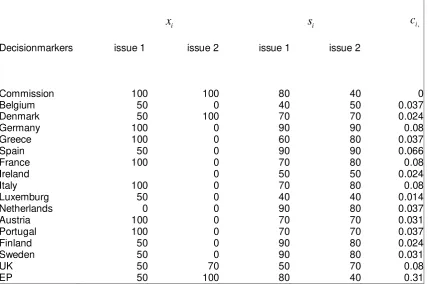
The data concerning the factors by which decision makers can influence the
negotiation are their voting power, ci,, the initial declaration of preferences for the
issues under discussion, xi, and the importance they attach to the issues, si. Table 1
presents the information about these values for the proposal on the directive 2000/7/EC.
The voting power of each decision maker, ci,, is calculated with the normalised Banzhaf
Power Index. The voting power is proportional to the number of votes of each decision maker. Thus, big member states, with 10 votes, have voting power scores of 0.08, while a small state like Luxemburg has a 0.014 score. As noted, the EP always holds a voting power score of 0.31.
The two other values, xiandsi, are derived from empirical information, and are
hence specific to the issues under negotiation. During the discussions of the proposal for
5
the directive 2000/7/EC, decision makers declared discrepancies concerning two issues: the maximum length authorised to vehicles and whether the type of manoeuvrability of vehicles should correspond to the criteria laid down by the UN Economic Commission for Europe (UNECE) or by the EU directive 97/27/EC. The positions of decision makers and the importance they attach to these two issues are presented as a continuum for each issue of the proposal, representing the gradation between two extremes of a controversy, issue-by-issue. The SQ is located at the position 0, and the position 100 corresponds to the position of the decision maker favouring the most radical policy change in regard to the SQ.
It should be noted the location of the status quo is not relevant to deduce which coalition will form in the cooperative voting game, as players will determinately prefer the policy that affords them more rewards in terms of gains and concessions, no matter how close or far this policy is from the status quo. However, the reference to the SQ as the point “0” in the policy space allows us to infer the degree of policy change
generated by the legislative process (see Achen, 2006b; Konig and Junge, 2009).
With this information we can distinguish three groups of decision makers which are to be involved in the process of coalition formation. The first group of member governments is formed by Germany, Greece, France, Italy, Austria and Portugal.
This group prefers to set a maximum of 12 meters for two-axle buses, and to apply the criteria of manoeuvrability set by the UNECE. Its position is at (100, 0). A second group, formed by Belgium, Spain, Luxemburg, Finland and Sweden also prefers the criteria of manoeuvrability set by the UNECE. However, on the first issue they hold a position for permitting a maximum length of buses of 13.5 meters, at point (50, 0). The third group consists of the EP, Denmark and the UK. The EP holds a position at (50, 100), preferring the 13.5 meters maximum of buses‟ length but also preferring to adopt the less stringent criteria of manoeuvrability specified in the EU directive of 1997. Denmark holds the same position as the EP. However, the position of the EP is specifically relevant for the process of coalition formation because the supranational institution is always needed to form a winning coalition. The UK adopts an intermediate position at (50, 70), preferring the 13.5 meters length maximum, but not agreeing to any of the proposed criteria of manoeuvrability. The position of the UK is closer to the EP than to the position of any other government, except Denmark. Finally, the Netherlands happens to be isolated in these legislative negotiations, its position situated at the SQ, at the point (0, 0).
does not attach much salience to the second issue of manoeuvrability, its influence in the legislative bargaining will be directed towards the first issue.
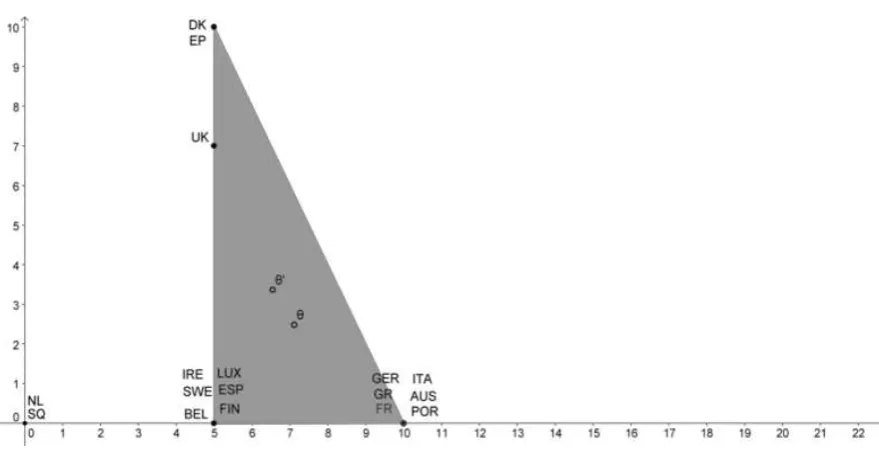
The positions of decision makers are represented in the two-dimensional graph of Figure 1.6 Since the Netherlands is not likely to lure other decision makers to form a winning coalition, the legislative bargaining is to be restricted to the triangle-shaped area of the figure. Two potential winning coalitions appear as candidates to enter a competition for proposals that would ultimately gather support for implementing a policy. A first coalition would be formed by governments of the two first groups mentioned. In particular, the group of Germany and other big states seems well positioned to offer a proposal in its favour, since this group gathers alone 44 votes. They would need to offer a bargaining compromise first to the EP and, secondly, to a number of governments of the second group sufficient enough so as to obtain the 18 votes needed to complete a winning coalition. The second competing coalition would be led by the EP, which is a decisive player and holds a distant position with respect to the members of the other groups. In this view, the EP may attempt to form a coalition that includes Denmark and the UK, as these two governments are much closer to its ideal point. As we will see, once the coalitional bargaining unfolds, it will be apparent that the EP has no incentives to form this coalition.
6
(Figure 1 about here)
The model predicts that the compact coalition will be the first. This coalition offers the following compromise proposal: (71.03, 24.60; Germany, Greece, France, Italy, Austria, Portugal, Belgium, Spain, Luxemburg, Finland, EP). No pivotal decision
maker in the coalition has incentives to renege on this compromise. As a consequence, the coalition is dominant.
Figure 1 represents the outcome of the compact coalition at point . To see why this point is dominant, recall that, according to the preference function of decision makers, the combination of policy gains they obtain for a compromise and the policy concessions they would need to offer to the members of the coalition is to provide a better deal for them than any other alternative. In this instance, we may naively presume that the representatives of the EP would be tempted to look for another more favourable deal. The EP, in reality, could offer a compromise proposal at (65.43, 33. 66; EP, Denmark, UK, Germany France, Italy, Belgium, Spain, Luxemburg, Sweden). This is
outcome farther away from the majority of governments. As a consequence, their inclusion in a coalition makes this coalition less compact, in comparison to the dominant coalition. For the EP this means that the majority of governments in the non-compact coalition will claim more policy concessions, and the EP will need to pay a substantial portion of them. In the comparison among alternative proposals, the combination of total gains and concessions of the compact coalition offers a maximising choice to the EP.
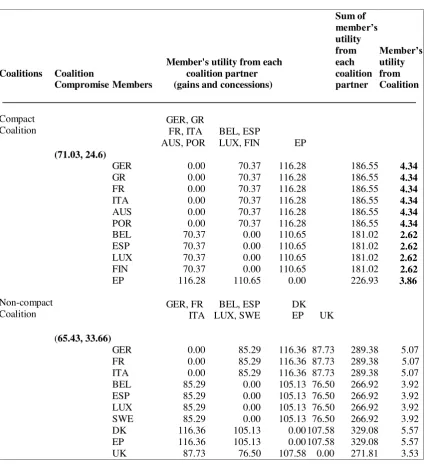
The exact measures are shown in Table 2. The EP‟s utility from the compact
coalition is 3.86, while the alternative coalition gives a utility of 5.57 units of combined distance of gains and concessions7.
(Table 2 about here)
Leaving the compact coalition will entail a utility loss for the EP, as it would require more expensive adjustments between policy gains and concessions. Therefore, the supranational institution has no incentives to change its choice for the compact coalition. Because this is also the case for all the pivotal decision makers in the compact coalition, this coalition will be dominant.
7
Empirical accuracy of the compact coalition model: the relevance of implicit voting
for EU policy change
This section quantitatively evaluates the performance of the compact coalition model for 44 EU legislative proposals, containing 111 issues, which were decided under QMV. The objective of this evaluation is to assess whether implicit voting, and its coalitional dynamics, is a relevant mechanism by which decision makers reach consensual decisions in the EU.
outcome towards the ideological direction they prefer. In contrast, when decisions are taken by unanimous consent, we should expect that ideological factors play a minor role and that decision makers are willing to take into account the preferences of all legislators. In this view, I will tease out the influence of implicit voting on consensus building by addressing the extent to which coalitional predictions tend to correspond to observed outcomes reflecting a choice from one side of the ideological spectrum.
In the operationalization of the comparison between coalitional and unanimous mechanisms of consensus, the compromise model has been chosen among other possible bargaining models because it uses the same “parameters” as the compact
coalition model. It also weights the positions of the players, where the weights are their voting power and salience, but it does so for all the players of the committee. Since the compromise model appeals to the same inputs as the compact coalition model, it allows us to obtain a direct comparison between implicit voting and unanimous consent.8 In addition, the compromise model performs better than most of the alternative bargaining
8
models (see Achen, 2006b), providing us with a strong test for the compact coalition model to satisfy.
The evaluation of the models uses the standard testing procedure for deterministic models consisting of comparing the distance existing between the predicted outcomes and the observed outcomes (see Bueno de Mesquita and Stokman, 1994; Thomson, 2011; Thomson et al., 2006; Schneider et al., 2010). More precisely, the testing measure employed is the Mean Absolute Error (MAE), that is, the average size of the forecasting error. The accuracy of predictions is then estimated by the degree of the forecasting error they produce. As itis well known, deterministic models are not amenable to probabilistic statistical evaluation because they predict equilibrium points which are assumed to occur with certainty (see Achen, 2006b; Junge, 2010; Morton, 1999; Signorino, 1999). Alternative tests to estimate the quality of the model, such as normalised predictions (Bueno de Mesquita and Stokman, 1994) or hit rates (Achen, 2006b; Schneider et al. 2010), could have been used. However, given the structure of the data generation process of deterministic models, the discrepancies between observed and predicted outcomes provide a sensible measure of forecasting accuracy (Morton, 1999; Achen, 2006b) and serve well the purpose of comparing implicit voting and unanimous consent.
predictions, and therefore, serves as a baseline to evaluate the quality of the two theoretical models. Table 3 reports the predictions of the models. Both models perform better than the median. The compromise model fares slightly better for all issues under QMV, with a MAE of 25.56 against the 26.19 of the compact coalition model. The differences, however, are not very big and for the most relevant procedure of the EU, the co-decision procedure, the compact coalition model performs better, with a MAE of 26.84 against the 27.28 of the compromise model. Overall, coalition formation and generalised bargaining tend to offer very similar results in this comprehensive test. We can confirm that consensus is generally preferred by EU decision makers but not whether a majority of decision makers will be enough to make a consensual decision.
(Table 3 about here)
Despite this similarity of predictions, the association between the forecasts of the two models in a linear transformation turns out to be lower than we may have presumed, with a Pearson correlation of 0.58. This indicates that the different causal mechanisms the two models posit have also a reflection on the data.
the structure of our data, ideological choices are represented as outcomes pointing to more or less pronounced policy change. I thus perform a MAE test for different levels of policy change, ranging from minimum to pronounced policy change. I expect that, if ideological factors are influential, decision makers will tend to build majoritarian coalitions, which in turn will be reflected on outcomes that fall at a determined level of policy change. By contrast, I expect that if ideological factors have a minor effect, decision makers will prefer to form the grand coalition, and this will be reflected by a lesser impact of coalition formation on the level of policy change. Naturally, our evaluation of implicit voting in this design needs to be posited in relative terms. If the compact coalition model performs better for a determined level of policy change relative to the compromise bargaining model, then policy change will be driven more
by implicit voting and less by unanimous consent. If, on the contrary, this is not the case, we should conclude that implicit voting has no influence on consensus building and that decision makers are inclined to adopt all-inclusive compromises by unanimity.
(Table 4 about here)
This result suggests that implicit voting does have an influence on the way consensus is taken, and, ultimately, on the ideological direction of this consensus. The fact that both minimal policy change and pronounced policy change are better predicted by the compact coalition model informs us that decision makers attempt to align themselves with other like-minded partners in order to influence the policy outcome they prefer, and that they are willing to make policy concessions to those partners so as to increase the chances that a policy close to this outcome will be selected by a majority.
decision makers have a tendency to act unanimously. However, when issues are more ideologically polarised, implicit voting appears to be a more determinant mechanism in the configuration of consensual decisions.
Conclusion
At the theoretical level, the compact coalition model yields the finding of a stable solution for finite and proper spatial voting games which usually have an empty core. The proposed solution thus relates to other classic core solutions of well-established cooperative theories, and suggests a refinement to these solutions. While the article does not mean to suggest that the decision maker motivations for exchanging policy gains and concessions in order to reach an agreement with a like-minded majority exist for every political situation, it is natural enough to assume that they do exist in cooperative decision making environments where the penalisation for not reaching an agreement is high. The EU legislative process is commonly perceived as such a cooperative environment. At the empirical level, the quantitative evaluation of the model yields mixed results. The evidence suggests that in the EU legislative process ideological majorities vote implicitly in order to drive consensus towards minimum or pronounced levels of policy change. However, when majorities have moderate policy choices, they are inclined to take everybody on board and unanimous consent remains a powerful mechanism.
Appendix
Proposition 1. Proof. We begin by recalling the structure of the social choice game.
Let A { ,...,1 n}be subset of feasible outcomes in G, so that ( )v C Aif C is winning
and v C( ) 0 if C is losing. Recall that U is the utility function specifying the
preference profiles of players on A. From U, define the distance between the realisation
of player i’ preference,xi, and a given outcome, A, as follows:
i j
j N
j N
x x
d (4)
where xj denotes the preference of any player j in the a assembly, so that j i.
Applying this definition to any two policy proposals in G implemented by potential winning coalitions, ( ; ) and ( ';C C'), assume the following inequality among
coalitional outcomes :
'
d d (5)
Substituting, we obtain:
'
'
' i ' j i j
j C j C
j C j C
x x x x
From the inequalities (5) and (6), it follows that the difference among the distances between each member in coalition C and the outcome of their coalition, , is less pronounced than the difference among the distances between the members of coalition
'
C and the outcome of their coalition, ' . We say that C is more compact than C'. Since d ' d implies u( ) i u( '), it follows that C is undominated by C'.□
Proposition 2. Proof. Let G=(N, v, U) be finite and proper and let com A be the set
of ordered pairs offered by compact coalitions:
'
( ; ) for no ( '; ') it is the case that ( ) ( ) for all ( )
{
}
com
i
C A C A u u i v C (2)
Then, com iff the expression (2) holds true for any finite and proper simple game,
that is, iff the points in the set comare undominated in G. In order to prove that this is
the case, we need to show that a weak preference profile U on com is reflexive, complete and acyclic, for alli v C( ):
Completeness: For all ( ; )C and( '; ')C com, since G is proper,C C' . Let
'
i C C . Since U is complete, then either ( )u i u( ') or ( )u i u( ').
Acyclicity: Let ( '';C''), ( ';C'), ( ; )C com. Then, for all i C'' C', u( '') iu( '),
and for all i C' C, u( ') i u( ). By completeness we know that if u( '') iu( '),
then ( '') iu( '), and hence, u( '') iu( ). Since G is proper, for all
i C'' C . Therefore, u( '') i u( ') i u( ), and hence, d '' d ' d . Otherwise
(since U is complete) there exist ( ''';C''') com\
{
( '';C''), ( ';C'), ( ; )C}
such that,for all i C''' C'',u( ''') iu( ''). By acyclicity it must be that u( ''') iu( ')and
( ''') i
u u( ) as well. Since G is proper, for all i C''' C' and for all
i C''' C as well. Therefore, u( ''') i u( '') iu( ') iu( ), and hence,
''' '' '
d d d d . Because the number of outcomes in A is finite (and hence the
number of outcomes in com is also finite) we can continue this logic to conclude that
there must exist an alternative weakly preferred to all other alternatives in com
. □
Proposition 3. Proof. The proof of the Proposition 3 on uniqueness of the compact
coalition set is the same as the proof of Proposition 2 for a strict preference profile U on
com
References
Achen, Christopher (2006a) „Institutional Realism and Bargaining Models‟ in Robert
Thomson, Frans Stokman, Christopher Achen and Thomas König (eds) The European Union Decides. New York: Cambridge University Press. 86-123.
Achen, Christopher (2006b) „Evaluating Political Decision-making Models‟ in Robert
Thomson, Frans Stokman, Christopher Achen and Thomas König (eds) The European Union Decides. New York: Cambridge University Press. 264-98.
Arregui, Javier, Stokman, Frans and Thomson, Robert (2006) „Compromise, Exchange and Challenge in the European Union‟ in Robert Thomson, Frank Stokman, Christopher Achen and Thomas König (eds) The European Union Decides. New York: Cambridge University Press, pp. 153-77.
Axelrod, Robert (1970) Conflict of Interest: A Theory of Divergent Goals with Application to Politics, Markham: Chicago.
Bailer, Stefanie and Schneider, Gerald (2006) „Nash versus Schelling? The Importance
Bal, Leendert Jan (2004), „Member States Operating in the EU Council of Ministers:
Inside Impressions‟ in Paul Meerts and Franz Cede (eds) Negotiating European Union. New York: Palgrave Macmillan. Pp.127-42.
Boekhoorn, Vincent, Van Deemen, Adrian and Hosli, Madeleine (2006) „A Cooperative Approach to Decision-making in the European Union‟ in Robert Thomson, Frans Stokman, Christopher Achen and Thomas König (eds) The European Union Decides. New York: Cambridge University Press, pp. 178-210.
Bräuninger, Thomas (2007) „Stability in Spatial Voting Games with Restricted
Maximizing‟, Journal of Theoretical Politics, 19 (2): 173-191
Bueno de Mesquita, Bruce (1994) „Political Forecasting. An Expected Utility Method‟
in Bruce Bueno de Mesquita and Frans Stokman (eds) European Community Decision Making. New Haven, CT: Yale University Press, pp.71-104.
Bueno de Mesquita, Bruce (2004) „Decision making models, rigor and new puzzles‟,
European Union Politics 5 (1): 125-138.
Bueno de Mesquita, Bruce and Stokman, Frans (1994) European Community Decision Making. New Haven, CT: Yale University Press.
Crombez, Cristophe (2000) „Institutional Reform and Co-decision in the European Union‟, Constitutional political Economy 2: 41-57.
Fiorina, Morris and Plott, Charles (1978) „Committee Decisions under Majority Rule:
An Experimental Study‟, American Political Science Review 72: 575-98.
Hayes-Renshaw, Fiona, Van Aken, Wim and Wallace, Hellen (2006) „When and Why the EU Council of Ministers Votes Explicitly‟, Journal of Common Market Studies 44 (1): 161-94.
Golub, Jonathan (1999) „In the Shadow of the Vote? Decision Making in the European Community‟, International Organisation 53 (4): 733-764.
Golub (2007). „Survival Analysis and European Union Decision-Making‟, European Union Politics 8 (2):155-179.
Grofman, Bernard (1982) „A Dynamic Model of Protocoalition Formation in
Ideological „N‟ Space‟, Behavioral Science 27 (1): 77-90.
Junge, Dirk (2010) „Game Theoretic Models and the Empirical Analysis of the EU‟ in
Thomas König, George Tsebelis and Marc Debus, Reform Processes and Policy
Change: Veto Players and Decision-Making in Modern Democracies, Springer
Verlag: New York.
König, Thomas (2007) „Divergence of Convergence? From Ever-Growing to Ever-slowing European Legislative Decision Making‟, European Journal of
Political Research 46(3): 417-444.
Mattila, Mikko and Lane, Jan-Erik (2001) „Why Unanimity in the Council? A Roll-Call Analysis of Council Voting‟, European Union Politics 2 (1): 31-52.
Mckelvey, Richard (1976) „Intransitivities in Multidimensional Voting Models and Some Implications for Agenda Control‟, Journal of Economic Theory 12: 472
482
Mckelvey, Richard, Odeshook, Peter and Winer, Mark (1978) „The Competitive Solution for N-person Games without Transferable Utility. With an Application to Committee Games‟, The American Political Science Review 72 (2): 599-615.
Morton, Rebecca (1999) Methods and Models. Cambridge: Cambridge University Press.
Naurin, Daniel and Hellen Wallace, Hellen (2008) Unveiling the Council of the European Union. Games Governments play in Brussels. New York: Palgrave
MacMillan.
Novak, Stephanie (2010) „Decision Rules, Social Norms and the Expression of Disagreement: the Case of Qualified Majority Voting in the Council of the
European Union‟, Social Science Information 49 (1): 49-83
Owen, Guillermo (1995) Game Theory. 3rd ed. San Diego: Academic Press.
Schofield, Norman (1995) „Coalition Politics: A Formal Model and Empirical Analysis‟, Journal of Theoretical Politics 7 (3):245-81.
Schofield, Norman (2008) The Spatial Model of Politics, Abingdon: Routledge.
Schofield, Norman, Grofman, Bernard and Feld, Scott (1988) „The Core and the Stability of Group Choice in Spatial Voting Games‟, American Political Science
Review 82 (1): 195-211.
Selck, Torsen (2005)‘Explaining the Absence of Inertia in European Union Legislative Decision-making‟,Journal of Common Market Studies43 (5): 1055–1070.
Sened, Itai (1996) „Coalition Formation. Theory and Evidence‟ Journal of Politics, 58
(2): 350-75.
Signorino, Curtis (1999) „Strategic Interaction and Statistical Analysis of International Conflict‟, American Political Science Review 93(2): 279-297
Steunenberg, Bernard and Selck, Torsen (2006) „Testing Procedural Models of EU Legislative Decision-Making‟ in Robert Thomson, Frans Stokman, Christopher Achen and Thomas König (eds) The European Union Decides: New York: Cambridge University Press, pp. 54-85.
Thomson, Robert (2011) Resolving controversy in the European Union. Cambridge Cambridge University Press.
Thomson, Robert and Stokman, Frans (2006) „Research Design: Measuring actors‟
Christopher Achen and Thomas König (eds) The European Union Decides. New York: Cambridge University Press, pp. 25-53.
Thomson, Robert, Stokman, Frans, Achen, Christopher and König, Thomas (2006) The European Union Decides. New York: Cambridge University Press.
Tsebelis, George (1994) „The Power of the European Parliament as a Conditional
Agenda Setter‟, American Political Science Review 88(1): 128-142.
Tsebelis, George (2002) Veto Players: How Political Institutions Work, Princeton, NJ: Princeton University Press.
Tsebelis, George and Garrett, Geoffrey (2001) „The Institutional Foundations of Intergovernmentalism and Supranatioanlism‟, International Organization 55: 357
90.
Tables and Figures
Table 1 Positions, saliencies and voting power in the proposal for the directive 2000/7/ECa
Decisionmarkers
xi si ci,
issue 1 issue 2 issue 1 issue 2
Commission Belgium Denmark Germany Greece Spain France Ireland Italy Luxemburg Netherlands Austria Portugal Finland Sweden UK EP 100 50 50 100 100 50 100 100 50 0 100 100 50 50 50 50 100 0 100 0 0 0 0 0 0 0 0 0 0 0 0 70 100 80 40 70 90 60 90 70 50 70 40 90 70 70 90 90 50 80 40 50 70 90 80 90 80 50 80 40 80 70 70 80 80 70 40 0 0.037 0.024 0.08 0.037 0.066 0.08 0.024 0.08 0.014 0.037 0.031 0.037 0.024 0.031 0.08 0.31 a
Table 2 Competing coalitions for the adoption of directive 2000/7/ECab Coalitions Compact Coalition Non-compact Coalition Coalition
Compromise Members
Member's utility from each coalition partner (gains and concessions)
Sum of member’s utility from each coalition partner Member’s utility from Coalition (71.03, 24.6) GER GR FR ITA AUS POR BEL ESP LUX FIN EP GER, GR FR, ITA AUS, POR BEL, ESP LUX, FIN EP 186.55 186.55 186.55 186.55 186.55 186.55 181.02 181.02 181.02 181.02 226.93 4.34 4.34 4.34 4.34 4.34 4.34 2.62 2.62 2.62 2.62 3.86 0.00 0.00 0.00 0.00 0.00 0.00 70.37 70.37 70.37 70.37 116.28 70.37 70.37 70.37 70.37 70.37 70.37 0.00 0.00 0.00 0.00 110.65 116.28 116.28 116.28 116.28 116.28 116.28 110.65 110.65 110.65 110.65 0.00
(65.43, 33.66)
GER FR ITA BEL ESP LUX SWE DK EP UK GER, FR ITA BEL, ESP LUX, SWE DK EP UK 0.00 0.00 0.00 85.29 85.29 85.29 85.29 116.36 116.36 87.73 85.29 85.29 85.29 0.00 0.00 0.00 0.00 105.13 105.13 76.50 116.36 116.36 116.36 105.13 105.13 105.13 105.13 0.00 0.00 107.58 87.73 87.73 87.73 76.50 76.50 76.50 76.50 107.58 107.58 0.00 289.38 289.38 289.38 266.92 266.92 266.92 266.92 329.08 329.08 271.81 5.07 5.07 5.07 3.92 3.92 3.92 3.92 5.57 5.57 3.53
aThe member‟s
utility from the coalition is the sum of utilities from joining each of the coalition partners divided by the total votes of the partners in the coalition.
b
Table 3 Mean Absolute Error of models for all decisions under Co-decision and Consultation Procedures of EU legislative process
Table 4 Mean Absolute Error of Compact Coalition Model and Compromise Model for different levels of policy change of EU legislative output
COD CNS All issues QMV QMV QMV Model (n=56) (n=55) (n=111) Median voter model 30. 64 30.62 30.63
Compromise model 27.28 23.84 25.56
Compact coalition model 26.84 25.54 26.19
Minimal Moderate Pronounced policy change policy change policy change
Outcome range: 0-30 Outcome range: 30-60 Outcome range : 60-30 Model (n=27) (n=36) (n=48)
compromise model 42.92 13.84 25.1
[image:48.595.85.537.441.525.2]Figure 1 Spatial model of coalitional bargaining in the negotiations of the directive 2000/7/EC.