Study of Raman Spectroscopy to detect the Underlying
Substance Concealed below Diffusely Scattering Medium
Xiaohua Zhang*, Ji Zhang, Haifeng Zhang, Jianxin Lu, Leijian Wang, Yongsheng Xu China Institute of Atomic Energy, Beijing, China
Email: *[email protected]
Received 2013
ABSTRACT
Measurement and comparison of NaNO3 powder concealed in opaque and semi-transparent plastic bottles are carried out through conventional Raman spectroscopy and spatially offset Raman spectroscopy individually. The action mechanism why the spatially offset Raman spectroscopy can effectively detect the medium concealed in the non- transparent bottle is analyzed. The spatially offset Raman spectroscopy breaks through the detection neck of the con-ventional Raman spectroscopy (the detection depth is small and cannot detect the ingredient of the subsurface under non-transparent medium), and the measurement and identification of the substance concealed in the non-transparent medium (opaque/semi-transparent plastic) bottle have been realized.
Keywords: Spatially Offset Raman Spectroscopy; Opaque/sub-transparent Plastic Bottle; Ingredient of the Subsurface; Diffuse Scattering
1. Introduction
Raman spectroscopy is a measurement method based on the inelastic scattering through interaction between light and matter. It can test samples noncontactly and non- destructively, and offers a substantially higher degree of chemical specificity, so this technique is one of the re-search focuses of analytical science. To conventional Raman spectroscopy adopted generally, the sampling depth is only limited in the area no more than several hundred microns of depth [1], or subsurface in transpar-ent medium. However, diffusely scattering surface layers are frequently encountered in many medical and biologi-cal applications, such as food products, colloids, poly-mers, catalysts, powders in general, coating technology, dermatology applications involving the detection of can-cerous tissue, biochemical identification for medical studies, and noninvasive authentication of pharmaceuti-cal products. Such samples are often highly heterogene-ous and can be made of variheterogene-ous layers, each having a different chemical make-up. The major goal for analyti-cal science is to provide a method capable of determining the chemical composition of subsurface layers in turbid media in a non-destructive way, by which the sample can be authenticated or the disease can be diagnosed. If the conventional Raman spectroscopy is employed, the fluo-rescence and Raman spectra of the target are collected simultaneously, whereas the Raman spectrum of the sub-
surface is relatively very weak, and it is often interfered seriously or even overwhelmed by the fluorescence and Raman spectra from the surface layer, so it becomes ex-tremely complicated or even impossible to separate the spectrum of the surface and the one of the subsurface. In the face of these emerging challenges, a new technique based on Raman scattering, spatially offset Raman spec-troscopy (SORS), which is capable of retrieving the sub-surface concealed by opaque or sub- transparent diffusely scattering medium, is discovered by the workers of Rutherford Appleton laboratory [2]. And it has been used in the fields such as researches and applications of au-thentication of the packed pharmaceutical products [3-5], disease diagnoses [6-8], anti-smuggling [9], airport screening for explosives especial liquid ones [10-12], and has gained extraordinary attention and approval from the whole society.
In this paper, measurement and contrasting analysis for NaNO3 powder concealed in opaque and sub-trans- parent bottles have been carried out through conventional Raman configuration and SORS configuration individu-ally. And the action mechanism how the SORS can real-ize the efficient detection of the media concealed in non-transparent plastic bottles has been analyzed.
2. Thoery and Method
During Raman scattering, the incoming light passing through the sample will be inelastically scattered from the molecular vibration, which causes the energy
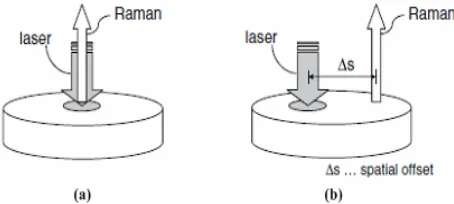
length/ frequency) of the photons to be altered. In the conventional mode, backscattering geometry is often adopted whose focus of the collecting lens is strictly overlapped with the illuminated spot. However, the SORS is based on the collection of the Raman spectrum emanating from spatially offset regions away from the point of illumination Δs on the sample surface, see Fig-ure 1, where the relative intensity ratio of Raman spec-trum of the surface to the one of the subsurface varies with the different offset distance. If the spectra data of spatial offset distance Δs ≠ 0 and Δs = 0 are processed, the pure Raman spectrum of the subsurface covered by the opaque/sub-transparent medium will be retrieved.
3. Experiment
3.1. Experiment Apparatus
The setup diagram of the SORS of the experiment is shown in Figure 2, the probe beam is generated by a tem-perature stabilized 532 nm constant wave laser (MGL-Ⅲ
-532, Changchun New Industries), the output power of which is 150mW with spectral line width is < 0.2 nm. The illuminating laser light is incident on the sample at ~45o after it is focused by lens F1. Here, mirror M and the sample are all placed on a 1D micro-positioning stage, keeping the point of incidence on the sample fixed with respect to the sample. In the configuration, a lens F2 with 20mm diameter and 50mm focal length is adopted for spectra collecting and collimating, then the interaction zone of laser and the sample is imaged onto the fiber detector (a single fiber with 1mm diameter) with the ratio of 1:1 by F3 with specifications as same as F2. The holo-graphic notch filter centered at 532 nm (Kaiser Optical Systems, Inc.) between F2 and F3 is the crucial element, which can reduce the intensity of Rayleigh scattering by three orders of magnitude, whereas the Raman scattering light is of no attenuation. The spectra collected are measured by the miniature spectrometer (BTC112E se-ries) produced by B&W Tek Inc.
If the mirror S in Figure 2 is removed, then the setup will be the conventional one, where the illuminating laser is coupled into the Raman collecting system directly and normally incident on the sample as Figrue 1(a).
3.2. Samples and Measurements
The samples used in the experiments are chemical re-agent NaNO3 produced by Beijing Red Star Chemical Factory, white plastic bottle(opaque) with thickness of 1mm and Olay oil moisture protection cream bottle (sub- transparent hard plastic, thickness of about 6 mm), and NaNO3 packed in the bottles aforementioned. The chemi-cal reagent NaNO3 is fine powder ground by a pestle and mortal, which is loosely packed in the bottles or piled on a metal plate without any mechanical tapping.
Raman spectra of powder NaNO3, opaque and sub- transparent plastic bottles, and bottles containing NaNO3 are measured by the conventional setup, and the spatially offset ones with different offset distance of bottles con-taining powder NaNO3 are then measured by the SORS configuration in Figure 2.
4. Results and Discussion
[image:2.595.310.537.247.349.2]Firstly, Raman spectra of powder NaNO3, opaque plastic bottle with thickness of about 1mm, and the bottle con-taining NaNO3 powder are individually measured by the conventional setup, and the results are shown in Figure 3.
Figure 1. Schematic diagram for (a) backscattering Raman spectroscopy and (b) spatially offset Raman spectroscopy.
Notch F1
F2
F3
Sample
M
Laser
Spectrometer
[image:2.595.310.538.386.506.2]S
Figure 2. Setup of spatially offset Raman spectroscopy.
Figure 3. Conventional Raman spectroscopy of NaNO3
pow-der, white plastic bottle (thickness of ~1 mm), and the bottle containing NaNO3: (a) NaNO3; (b) bottle containing NaNO3;
[image:2.595.309.539.530.685.2]As shown in the figure, there is a sharp Raman peak of the NO3− in the spectrum of NaNO3 piled on the metal plate, however, the Raman spectrum of NaNO3 concealed in the plastic bottle is remarkably similar to the one of the empty bottle, without obviously peak near 1062cm-1 at all. All these results indicate that it is very efficient for the conventional Raman spectroscopy to probe the near surface ingredient, nevertheless, this approach is ham-pered or fails when facing to the detection of the subsur-face concealed in the opaque plastic bottle, because the illumination and collection zones are coincided, the fluorescence and Raman spectra generated from the bot-tle are intense enough to ‘swamp’ the detector, thus de-grading or precluding entirely, the detection of the rela-tively much weaker Raman photons from the deep layer. Spectra shown in Figure 4 are the Raman spectra of the NaNO3 powder in Figure 3, where the Raman spec-trum collection zones are offset from the illumination zone with different distances, here the Raman peak in-tensity of the plastic bottle is normalized. Seen from above figure, the ratio of the relative Raman intensities of NO3−to the plastic bottle increases with the spatial offset distance, that is, SORS depresses the interference of the Raman and fluorescence coming from the surface layer. However, when the offset distance is more than 6mm, the ratio of the signal to the noise becomes worse, and the increase of the relative intensity of NO3− Raman spectrum becomes unobvious. Nevertheless, the penetra-tion depth of the SORS to the opaque medium is far more than the conventional Raman spectroscopy, and the de-tection and identification of the subsurface in the opaque plastic bottle can be realized.
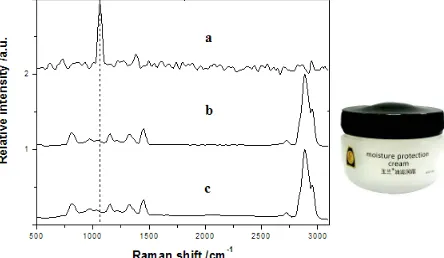
To the detection of the subsurface concealed in the sub-transparent medium, Raman spectra of powder NaNO3, OLAY® moisture protection cream bottle (thickness of about 6mm, sub-transparent) containing NaNO3 and the empty bottle measured by the conventional Raman spec-trum configuration are shown in Figrue 5. As same as the spectra in Figure 3, the Raman spectrum of the bot-tled NaNO3 is extremely similar with the one of the empty bottle, without obvious NO3− Raman peak near 1062cm-1 at all. And compared with spectrum of the empty bottle, there is only a little difference near 1062 cm-1. Therefore, it is difficult to authenticate the ingredient in the subtrans-parent bottle according to the spectral data in Figure 5.
The SORS of NaNO3 contained in the sub-transparent plastic bottle with different spatially offset distance are shown in Figure 6, where Raman peak intensity of the bottle is normalized. Compared with the conventional one, the relative intensity of NO3− near 1062 cm-1 in the SORS increased with the spatial offset distance, and the clear Raman peak is already present at Δs=3mm, that is, the interference of the Raman and fluorescence signals from the surface has been depressed to a great extent.
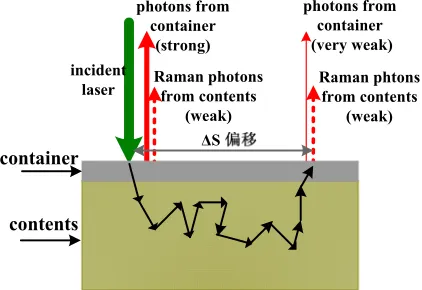
[image:3.595.308.538.326.490.2]Seen from above experimental study, the conventional Raman spectrum emphasizes the signals emitted from the container wall (although a contribution from the con-cealed substances may also be apparent). The SORS is also taken at the surface of the container, but at a position spatially offset from the illumination zone, and this measurement is effective at capturing subsurface photons, owing to the ability to achieve significant suppression of the surface Raman and fluorescence signals, thereby the efficient detection of the substance concealed in non-transparent diffusely scattering bottles can be carried out. The action principle of the latter is as follows (Figure 7): When the illuminating laser incident on the sample pene-trates (with exponentially intensity) into the diffusely scattering sample, the original straight trajectory of the photons is rapidly converted to a range of sideways scat-ters, which eventually completely randomize the path of the photons after being scattered several times. Provided the bottle wall is not too thick, some of the photons will
Figure 4. SORS with different spatial offset of NaNO3
con-tained in white plastic bottle (Raman peak intensity of the bottle is normalized): (a) 1.5 mm offset; (b) 3.0 mm offset; (c) 4.5 mm offset; (d) 6.0mm offset; (e) 7.5 mm offset.
Figure 5. Conventional Raman spectroscopy of NaNO3,
OLAY® moisture protection cream bottle containing NaNO 3
and the empty bottle: (a) NaNO3; (b) bottle(thickness of
[image:3.595.312.534.555.684.2]Figure 6. Contrast between SORS with different spatially offset and conventional Raman spectrum of OLAY®
mois-ture protection cream bottle containing NaNO3 (Raman
peak intensity of the bottle is normalized): (a) conventional Raman spectrum; (b) 1 mm offset; (c) 3 mm offset; (d) 5 mm offset.
ΔS
contents container
photons from container
(strong)
Raman photons from contents
(weak)
Raman phtons from contents
(weak) photons from
container (very weak) incident
laser
Figure 7. Diagram of the SORS action principle.
reach the NaNO3 in the bottle, whereafter they will be randomized by NaNO3 powder. And those photons that are randomly scattered back toward the bottle wall will reemerge. On average, the deeper the photon has trav-elled into the bottle, the further away from the original point of entry that it reemerges from the bottle surface[2]. Most of the photons collected from the point offset from the entry point Δs are Rayleigh scattered ones. Neverthe-less, some of them will involve Raman scattering ones taking information of the sample. Collecting these pho-tons originating at an appropriate offset will thereby bias the collection towards the Raman signals of the underly-ing NaNO3. In comparison, the Raman photons originat-ing from the plastic bottle decay very rapidly with in-creasing offset from the illuminating point, since they have had much less opportunity to travel sideways by scattering, than those emerging from the underlying lay-ers[2]. Consequently, SORS technique has the ability to
depress the Raman and fluorescence signals emanating from the surface (bottle wall) significantly, breaking through the neck of the Raman spectroscopy detection and realizing the probing of the substance concealed in the diffusely medium (opaque or sub-transparent plastic bottle). Therefore, SORS has advantages that the con-ventional Raman spectroscopy can’t provide at the detec-tion of the underlying substance below diffusely scater-ing nontransparent medium.
5. Conclusions
Raman spectra of NaNO3 powder concealed in nontrans-parent media (opaque and semi-transnontrans-parent plastic bottles) are studied using conventional Raman spectroscopy and the SORS individually. The comparison between the two kinds of technique for detection shows that the conven-tional one only adapts to the probe of near surface ingre-dient of the nontransparent media, whereas SORS has further penetration depth than the former, and it can de-press the fluorescence and Raman spectrum of the sur-face (plastic bottles) to a great extent, by which the probe for the subsurface concealed in the nontransparent me-dium (opaque and sub-transparent plastic bottles) can be realized. The further work is in progress.
REFERENCES
[1] Colin J. H. Brenan and Ian W. Hunter. “Volumetric Ra-man microscopy through a turbid medium,” Journal of Raman Spectroscopy, Vol. 27, 1996, pp. 561-570.
doi:10.1002/(SICI)1097-4555(199608)27:8<561::A ID-JRS7>3.0.CO;2-9
[2] P. Matousek, I. P. Clark, E. R. C. Draper, M. D. Morris, A. E. Goodship and N. Everall, “Subsurface probing in diffusely scattering media using spatially offset Raman spectroscopy,” Applied Spectroscopy, Vol. 59, 2005, pp. 393-400. doi:10.1366/0003702053641450
[3] W. J. Olds, E. Jaatinen, P.M. Fredericks, B. Cletus, H. Panayiotou and E. L. Izake, “Spatially Offset Raman Spectroscopy(SORS) for the Analysis and Detection of Packaged Pharmaceuticals and Concealed Drugs,” Fo-rensic Science International, Vol. 212, 2011, pp. 69-77.
doi:10.1016/j.forsciint.2011.05.016
[4] C. Ricci, C. Eliasson, N. A. Macleod, P. N. Newton, P. Matousek and S. G. Kazarian, “Characterization of Genuine and Fake Artesunate Anti-Malarial Tablets Us-ing Fourier Transform Infrared ImagUs-ing and Spatially Offset Raman Spectroscopy through Blister Packs,” Ana-lytical BioanaAna-lytical Chemistry, Vol. 389, 2007, pp. 1525-1532.doi:10.1007/s00216-007-1543-1
[5] C. Eliasson and P. Matousek, “Noninvasive Authentica-tion of Pharmaceutical Products through Packaging Using Spatially Offset Raman Spectroscopy,” Analytical Chem-istry, Vol. 79, 2007, pp. 1696-1701.
[image:4.595.66.277.345.490.2][6] N. Stone, R. Baker, K. Rogers, A. W. Parker and P. Ma-tousek. “Subsurface Probing of Calcifications with Spa-tially Offset Raman Spectroscopy (SORS): Future Possi-bilities for the Diagnosis of Breast Cancer,” Analyst, Vol. 132, 2007, pp. 899-905.doi:10.1039/b705029a
[7] P. Matousek, “Deep Non-Invasive Raman Spectroscopy of Living Tissue and Powders,” Chemical Society Re-views, Vol. 36, 2007, pp. 1292-1304.
doi:10.1039/b614777c
[8] P. Matousek, E.R.C.Draper, A. E. Goodship, I. P. Clark, K. L. Ronayne and A. W. Parker, “Noninvasive Raman Spectroscopy of Human Tissue in Vivo,” Applied Spec-troscopy, Vol. 60, 2006, pp. 758-763.
doi:10.1366/000370206777886955
[9] M. D. Hargreaves, N. A. Macleods and P. Matousek, “Application of Portable Raman Spectroscopy and Benchtop Spatially Offset Raman Spectroscopy to
Inter-rogate Concealed Biomaterials,” Journal of Raman Spec-troscopy, Vol. 40, 2009, pp. 1875-1880.
doi:10.1002/jrs.2335
[10] B. J. Cletus, W. Olds, E. L. Izake, S. Sundarajoo, P. M. Fredericks and E. Jaatinen, “Field Portable Time Re-solved SORS Sensor for the Identification of Concealed Hazards,” Proceedings of SPIE, Vol. 8374, 2012, p. 837403.doi:10.1117/12.918981
[11] M. D. Hargreaves and P. Matousek, “Threat Detection of Liquid Explosive Precursor Mixtures by Spatially Offset Raman Spectroscopy(SORS),” Proceedings Of SPIE, Vol. 7486, 2009, p. 74860B.doi:10.1117/12.840195
[12] M. Bloomfield, P. W. Loeffen and P. Matousek, “Detec-tion of Concealed Substances in Sealed Opaque Plastic and Colored Glass Containers Using SORS,” Proceedings Of SPIE, Vol. 7838, 2010, p. 783808.