Munich Personal RePEc Archive
Evolution of the Governmental
Accounting Reform implementation in
Greek Public Hospitals: Testing the
institutional framework
Stamatiadis, Filippos and Eriotis, Nikolaos
Technological Educational Institute of Athens, National and
Kapodistrian University of Athens
31 January 2011
Online at
https://mpra.ub.uni-muenchen.de/28816/
“Evolution of the Governmental Accounting Reform implementation
in Greek Public Hospitals: Testing the institutional framework”
Filippos Stamatiadis1 and Nikolaos Eriotis2
Abstract
In an attempt to promote efficiency, effectiveness and economy in health service production, the Greek government imposed in 2003 an accrual basis financial and cost accounting system in all public hospitals of the National Health System (NHS).
The purpose of this article is not to investigate thoroughly the accounting reform implementation and adoption in specific organizations, but rather to obtain an overall idea of the reform adoption process in Greek public hospitals by identifying major areas of non-compliance with the mandatory legislative accounting framework and various organisational contingencies that influence the level of reform adoption within a broad institutional framework.
Our analysis is based on the results of an empirical survey that took place during 2009. For the purposes of this survey, a compliance index is constructed and applied on a sample of 94 Greek public hospitals using a structured questionnaire and semi-structured interviews with six public hospital Financial and Accounting executives.
The empirical evidence reveals that the level of accrual basis financial and especially cost accounting adoption in Greek public hospitals is realized only to a limited extent. In particular, results show that the relationship between the institutional isomorphic pressures and accounting reform implementation process is restricted by organizational capability factors (i.e., the quality of existing Information Technology systems, the education level of finance and accounting staff, and the professional support of consultants).
The main contribution of this study is the empirical evidence it provides on the approaches and processes used by the Government of Greece to implement accrual accounting systems and the role certain human, organizational and situational factors played in such implementations.
Key words: Accrual Accounting, Public Sector Accounting, Compliance Index, Public Hospitals, Isomorphism.
JEL classification: M4, M48.
Paper prepared to be presented in the 34th Annual Congress of the European Accounting Association
Rome, 20-22 April 2011
1
Research Associate, Department of Management and Economics, Technological Educational Institute of Athens, 122 10 Athens, Greece, e-mail: [email protected] (corresponding author).
2
1. INTRODUCTION
During the last decades, several countries worldwide have introduced financial management reforms, as an important part of the New Public Management (NPM) initiative at one or more levels of government sector, by either replacing or transforming their traditional budgetary cash accounting systems towards a business-like accrual accounting concept in search of higher efficiency, effectiveness and economy in public service production.
This wave of change in public accounting systems towards accrual basis accounting seems necessary given that the traditional budgetary cash accounting system is now perceived to be outdated and no longer satisfactory, mainly due to its inability to present the “true” financial position as well as planning and control process of public sector entities (Cohen, Kaimenakis, Zorgios, 2007; Lapsley, 1999).
Within the context of NPM and following the example of numerous other countries in Europe and worldwide, the Greek public sector has encountered a number of financial accounting changes and reforms over the last ten years in order to meet the challenges that increased globalization has brought in. As a result, in 1997 the Greek government introduced the accruals as the new basis of depiction of public sector entities financial position and performance. The most important examples of the Greek public sector entities in which an accounting reform took place towards accruals are: Social Securities funds (1997), Public law entities (1998), local government institutions; Municipalities, (1999) and finally, public owned hospitals (2003).
According to Christiaens et al. (2004, 2007) the governmental accounting reform has often been the first step of government’s modernization policies for public organizations. Therefore, an effective and successful implementation of the accounting reform plays an important and dominant role in the implementation and success of other subsequent NPM practices and techniques within public organizations. Without an adequate and successful implementation, all the anticipated gains, the presupposed objectives and expectations of the reforms will be lost due to the fact that the new accounting system will not be able to provide relevant and accurate managerial and financial information to support and facilitate them. (Christiaens and VanPeteghem, 2007).
The research objective of the present study is an attempt to examine the central government’s accruals initiative in the public health sector from an empirical point of view. In particular, this study aims at investigating the adoption and implementation of accrual accounting reform in the Greek public hospitals by quantifying the extent of accrual financial and cost accounting implementation and testing the cross-sectional differences on a number of explanatory and implementation factors that influence the level of reform adoption within a broad institutional framework. The assumption that is made is that both hospital organizational aspects as well as wider institutional forces that surround it might feasibly be associated with alternative implementation scenarios adopted by different public hospitals. In order to capture this variation of the level of accounting reform adoption the study draws on the insights of the institutional isomorphism as well as on the signaling theory.
analysis of the empirical research conducted and the final section contains a discussion of research findings and limitations of this research.
2. INSTITUTIONAL PRESSURE FOR ACCOUNTING PRACTICES ADOPTION
Institutional theory (DiMaggio and Powell, 1983; Powell and DiMaggio, 1991) provides a theoretical foundation for the study as it can reveal important interactions and power relationships among key stakeholders and shed light on forces and processes important for successful implementation and adoption of institutionally induced practises such as accrual and cost accounting systems in our case.
Previous studies based on institutional theory suggest that practises “travel” from one organization to another because of the operationalization of isomorphism in a social system and that organizations interact with their wider environment in ways perceived as acceptable by various constituents in that environment. In which case, they may adopt prevailing management techniques and procedures, such as new accounting systems, for documenting institutional conformity and creating the impression that they are tightly controlling their operations to receive support and legitimacy as well as portray themselves as “modern organizations” (Scott, 1995; Meyer and Rowan, 1977; Meyer and Scott, 1992; Berry et al., 1985; Ansari and Euske, 1987; Covaleski et al., 1985; Lapsley, 1994; Hoque and Hopper, 1994; Geiger and Ittner, 1996; DiMaggio and Powell, 1983)
practices and procedures struggle to obtain the medical profession’s acceptance and commitment whilst trying to gain legitimacy.
Thus, from the institutional perspective, the organizations are facing conformity pressures from regulatory bodies or from other peer organizations, or through the mechanism of professionalization and that although these three types of isomorphism originate from distinctly different sources, may co-exist within the public hospitals focus of this paper.
This is consistent with Powell and DiMaggio’s model of isomorphism (1991), which acknowledges that these three external institutional forces can collectively or separately contribute to the homogeneity of accounting practices across organizations. Nevertheless, this theoretical perspective is weak in analysing the internal dynamics of organizational change as it neglects issues of organizational “capacity for action”, internal conflict, distributions of power and place organizational practices and characteristics beyond the reach of interests and politics (Dillard et al., 2004). As a consequence, institutional theory is silent on why some organizations adopt radical change whereas others do not, despite experiencing the same institutional pressures, such as coercive and mimetic pressures in our case (Modell, 2002; Greenwood and Hinings, 1996).
Thus, our research departs from this deterministic claim, by early NIS theorists, predicting great homogeneity in organizational action in response to external legitimacy pressures, and argues that understanding change is about understanding cross-sectional variation in strategic responses to institutional conformity, which can only be done by analysing the features of organizations that produce compliance with the reform mandated requirements rather than resistance and inertia (Greenwood and Hinings, 1996; Windels and Christianes, 2005; Oliver, 1991; Pfeffer, 1982). In other words, this research assumes that the relationship between institutional pressures and receptiveness of an organization to accrual financial and cost accounting systems is influenced, strengthen or weaken it, by a number of organizational characteristics
3. ACCOUNTING REFORM IN THE GREEK PUBLIC HEALTH SECTOR
Greek public hospitals have experienced a number of organizational, administrative and financial reforms since the mid-1980s in the name of improved efficiency, effectiveness, and accountability.
The Greek NHS can be characterised as a “dual-mixed” system, in which elements from both the Bismarck (increased importance of social insurance in funding health care) and the Beveridge (health care primary funded by state budget) model co-exist. The GNHS was founded in 1983 by the Greek Law 1397/83 which declared that health is a “social good” and all citizens should have the right to high quality health care. Therefore, the health care system aims at guaranteeing universal and free access to medical services for the entire population, based on the principles of everyone’s equal treatment to health services and solidarity.
for retrospectively subsidising the GNHS and health insurance funds, and finally, the Ministry of Development is responsible for setting drug prices.
There are three major categories of health care providers: (1) the GNHS (public hospitals, health centres, rural surgeries and emergency rooms per hospital care) administered by the MHSC; (2) insurance funds health services with their representative units and polyclinics (mostly established within the biggest Greek insurance fund called IKA) and (3) the private sector (private hospitals, diagnostic centres, independent practices, surgeries and laboratories).
Regarding secondary hospital health care provision, approximately 75% of hospital beds are in the public sector (67% in the GNHS) and 25% in the private sector. The average bed capacity for public hospitals is 233 beds and for private hospitals only 55. Health care services, in the public sector, (mainly Secondary and tertiary health care) are provided in 132 general and specialized public hospitals which operate within the NHS.
The NHS public owned hospitals have a total capacity of 34.134 beds. Moreover, 195 Health Centres operate in rural areas. Rural Surgeries, attached to the Health Centres, provide primary health care services. The Health Centres provide also emergency services, short hospitalisation and follow up of recovering patients, dental treatment, family planning services, vaccinations, and health education.
Health care expenditures in Greece are funded mainly through the central annual government budget (general taxation 30.4%), the numerous state insurance funds (compulsory employer and insured people contributions 25.9%), private health insurance schemes (voluntary payments 2.3%) and out-of-pocket payments (for the remaining 41.6%). The GNHS budget allocation is set annually by the General Accounting Office (GAO) of the MoF, - the central budget authority in Greece - and is based on historical figures. In 2006, Greece’s total spending on health accounted for 9.1% of GDP, slightly above the median of 8.9% in OECD2 countries of which an extremely high 4.1% accounted for private health spending. Yet, its per capita GDP is one of the lowest and its citizens are the least satisfied with the quality of the health services provided overall (OECD, 2008).
Traditionally the basis of accounting used generally at all three levels of public governance -central, regional and local- in Greece has been cash oriented. Similarly, the governmental accounting regulations applying to Greek public hospitals – which date back to 1974 with the legislative decree 496/74 – are also based on a cash-based input focused budgeting system (i.e., line item budgeting), and single-entry book-keeping accounting system by making incremental adjustments to allocations from previous periods.
More specifically, the main purpose and concern of the traditional hospital budgetary accounting system is to register and control expenditures and receipts of a hospital on a cash basis as a legislative control mechanism and relatively straightforward stewardship of public funds and expenditures, and not to provide strong insight into the financial position and cost of activities of hospital, nor act as an effective means of stimulating operational performance improvement. As a result and according to Mossialos et al, (2005, p.151): “Resource allocation mechanisms of public hospitals in Greece are historical and political with no relation to performance or output; therefore providers have little incentive to improve their productivity”.
The initial efforts of introducing accrual accounting in public hospitals in Greece started in 1997 under the Law 2519/97. This Law presented for the first time the government’s intention and attempt to introduce a double-entry bookkeeping financial and cost accounting system in public hospitals based on the accrual basis.
For this purpose, the development and preparation of an Official Health Sector Accounting Plan (HSAP), aimed at developing the conceptual framework for accrual and cost accounting in public hospitals, was assigned by the Ministry of Finance to the national Council of Accounting (ESYL) and to the Chamber of Finance (OEE).
The developed HSAP mainly included broad guidelines regarding principles for accrual basis accounting implementation, the charts of accounts, asset classification, examples of journal entries, templates of the layout, the content of the published financial statements (i.e. balance sheet, income statement, the Statement of Income Distribution, Budget report and Actual report) and finally some suggested financial and costing ratios (Venieris et al., 2003).
Actually, the proposed HSAP was mostly based on the existing conceptual framework of business accounting but with a unique characteristic. As the budgetary cash accounting system is still the point of departure for financial accounting, the two accounting systems, the cash accounting system and the accrual accounting system, are technically linked by means of integrated account numbers permitting the simultaneous posting of accounting entries to both of them. Finally, it is worth mentioning that even though controlling operational costs was one of the main issues which initiated the accounting reform initiative, the HSAP had less a management accounting orientation and more a financial accounting orientation, as only a few costing ratios were proposed for management control and performance measurement (Venieris et al., 2003).
In 1999 a pilot implementation project, under the experimentation clauses of the HSAP, started in order to test the suitability of the new accounting system and its readiness for full implementation. Five Public owned hospitals that would implement the HSAP as pioneers were selected. The governmental efforts to reform the accounting system of the health sector escalated in 2003, after taking the pilot implementation experiences into account and making the necessary modification and amendments to the HSAP, when a law, the Presidential Decree 146/03 (P.D. 146/03), was passed.
The P.D. 146/03 enforced the mandatory adoption of the accrual basis financial and cost accounting on all the public hospitals that are part of the Greek NHS. In particular, the new conceptual accounting framework introduced by the P.D. 146/03 defined two accounting systems, the cash accounting system and the accrual accounting system, linked by means of integrated account numbers, and that should work simultaneously under three independent accounting cycles; the financial accounting cycle, the budgeting cycle and the cost accounting cycle, within the same general ledger and while each one would still retain its autonomy. The legislator believed that the solution of introducing this combined approach through two separate accounting systems should be the most beneficial in order to reap the best of the two accounting systems, as each one has its own strengths and weaknesses (Venieris and Cohen, 2004). The financial accounting system aims at reporting the financial position and the yearly profit and loss of hospitals, the budgeting system aims at authorizing and controlling the public spending (Christiaens and Rommel, 2008) and the cost accounting system aims at calculating the health services’ full cost by using the accounting data of the financial accounting cycle (accrual accounting) and processing them within a rather complicated framework of double entry journal entries and detailed costing model (Venieris and Cohen, 2004).
hospitals was the 1st of January 2004, while the deadline for cost accounting introduction was the 1st of January 2005.
4. RESEARCH QUESTIONS AND HYPOTHESES DEVELOPMENT
Although we are sharing the assumption held by previous institutional theorists that organizational behaviours are bounded by the constraints of the external environment, in our case, we are not sure that the adoption of the accounting reform, even coercively imposed from regulatory bodies, will eventually take place immediately and completely within public hospitals. This is consistent with Pfeffer (1982, p.172) who reports that: “firms do not merely respond to external constraint and control through compliance to environmental demand. Rather, a variety of strategies may be undertaken to somehow alter the situation confronting the organization to make compliance less necessary”.
Thus, the first objective of this study is to identify major areas of compliance or non-compliance with the accounting reform in order to examine the level of accounting reform adoption by the public hospitals. This leads to the first research question:
RQ1: At what extent do public hospitals comply with the new accounting standards set out in the PD 146/03?
Furthermore and among research on NPM practises, a considerable number of researchers report that the implementation of accounting systems changes by public organizations is often accompanied by a plethora of drawbacks and problems which hinder or delay the adoption and implementation process despite the intuitional pressures (see for example, Christiaens et al., 2004; Cohen et al., 2007; Guthrie, 1998; Hodges and Mellett, 2003; Brusca, 1997; Hepworth, 2003).
Thus, a second objective is to explain cross-sectional differences in the adoption and implementation of accounting reform by identifying several contingent factors (i.e., human, organizational and situational) of public hospitals that play an influential role to the level of accounting reform adoption within a broad institutional framework in order to provide a more complete account for understanding organizational and especially accounting change among public hospitals. This leads to the second research question:
RQ2: Can the cross-sectional differences in the level of compliance with the new accounting legislation be associated on organizational capability factors derived from previous and current research?
Based in previous studies, and supporting the view that while accepting the institutional effects organizations might show different behaviour toward accounting reform adoption resulting from the influences of organizational contingencies, a number of related hypotheses can be formulated:
4.1 Education level of the accounting staff (EDUC)
accounting system adoption in Greek public hospitals. Based on the above discussion the following hypothesis is formulated:
H1: The level of accounting reform adoption is positively associated with education
level of accounting department personnel
4.2 Training (TRAIN)
Prior studies support this hypothesis that adequate training has a positive influential effect on the successful adoption of cost accounting systems, as understanding of how to design, implement and use these systems is enhanced (Krumwiede 1998; Shields 1995). Similarly, public sector studies point out that the transition from cash based accounting to accrual and cost accounting requires significant training costs (see for e.g. Brusca, 1997).
According to Ouda (2004), the fact that employees are neither sufficiently informed of the direction of the change nor empowered to contribute to the process, constitutes one typical reason for which many accounting changes in the public sector have failed in the past. Therefore, the introduction of a new accounting system in the public sector requires an overall training strategy to disseminate objectives and prerequisites of the change process, to clarify potential misunderstandings, to convey a common understanding of the key principles of the accounting changes and to convince for the potential benefits of the new system. In other words, training has to provide a mechanism for employees to understand, accept, and feel comfortable with the NPM ideas and instruments, and prevents employees from feeling pressured or overwhelmed by the implementation process (Cavalluzzo and Ittner, 2004). If training resources are insufficient, then normal development procedures may not be undertaken, increasing the risk of failure (McGowan and Klammer, 1997; Venieris et al., 2003). Based on the above discussion the following hypothesis is formulated:
H2: The level of accounting reform adoption is positively associated with a higher level
of reform-related training of the accounting staff
4.3 The quality of information technology (ITQUAL)
Consistent with information system and management accounting change models, surveys in the private sector, report that information systems’ inefficiencies and data limitations, such as the inability of existing information systems to provide reliable, accurate, and up-to-date data in a cost effective manner, represent a major impediment to management accounting systems implementation and use (Krumwiede, 1998; McGowan and Klammer, 1997; Kwon and Zmud, 1987; Anderson, 1995; Shields and Young, 1989). Krumwiede (1998), for example, suggests that organizations with more advanced information technology may be more able to implement new management accounting systems than organizations with less sophisticated information systems because of lower processing and measurement costs. Enterprise Resource Planning (ERP) systems have commonly been promoted as an appropriate technical platform. According to Reeve, 1995 and Anderson, 1995 (cited in Al-Omiri and Drury, 2007) organizations with ERP systems can integrate business processes across functional areas and accumulate operational data needed for resource and activity analysis from multiple sources in one central database. This can streamline processes, reduce processing time, and increase control within organizations.
implementation of NPM initiatives (Ouda, 2004). These arguments lead to the formulation of the following hypothesis:
H3: The level of accounting reform adoption is positively associated with a higher level
of existing information technology quality.
4.4 Professional support from consultants (CONSUL)
There is a large amount of governmental accounting literature which describes management consultants as epistemic communities of specialized knowledge and expertise – their assistance and hands on support is deemed as necessary in the current reforming climate of NPM. Thus, management consultants have been identified as key levers in the process of changing management practices in the public sector and facilitating the implementation process as a technical implementation support but also as a “knowledge source” (Arnaboldi and Lapsley, 2003; Hood, 1995; Lapsley and Oldfield, 2001; Laughlin and Pallot, 1998; Ouda, 2004). In Christiaens’ study (1999) the assistance of professional consultants is the most important positive explanatory factor highlighting compliance differences among Flemish municipalities. Therefore, hospitals employing management consultants in their operations are expected to exhibit a higher level of reform adoption. Hence, the following hypothesis is formulated:
H4: The level of accounting reform adoption is positively associated with Professional
support of management consultants’ use.
4.5 Long term experience in accrual accounting (EXPER)
Hospitals with long term experience in accrual accounting are assumed to have gathered all the relevant necessary experience and to be familiar with the accrual concept by now. These hospitals are assumed to have resolved most of the accounting and implementation problems and shortcomings emerged during the accrual accounting system installation and to have progressively overcome most of these difficulties as they are getting familiarized with it. Thus, it could be expected that hospitals with long-term experience in implementing accrual accounting will attain a superior level of accounting compliance (Christianens, 1999). Therefore, the following hypothesis is formulated:
H5: The level of accounting reform adoption is positively associated with hospitals
long-term experience in accrual accounting
4.6 Organizational support (ORGSUP)
In accounting literature, while technical factors are expected to significantly influence the implementation of accounting systems, their impact may be secondary to that of organizational factors (Shields and Young, 1989). Shields (1995), for example, reports that top management support is crucial to the new accounting system implementation success because these managers can focus on resources goals, strategies and initiatives they deem worthwhile, deny resources to initiatives they do not support, and provide the help needed to motivate or push aside individuals or coalitions who resist the innovation (Cavalluzo and Ittner, 2004).
However, hospital facilities are unique organizations in a sense that administrators have to work with different organizational actors, like health care professionals (physicians and nurses) that are “responsible” for the largest part of hospital overhead and resources consumption but possess low commitment to managerial values (Comerford and Abernethy, 1999). Prior studies have pointed out the strength of health care professionals’ autonomy and the presence of strong professional structures and dominance of professional groups in hospitals. This situation implies a de-coupling of health care delivery processes from the formal administrative structures such as accounting practises. (Meyer and Scott, 1992; Nyland and Pettersen, 2004; Eeckloo et al., 2004; Berndtson, 1986)
Thus, in such inconsistent as well as multi-service and multi-output organizational environments, such as those to be found in the health sector, the support of medical professionals together with top management support may be an important factor for accrual and cost accounting system adoption (Cardinaels et al. 2004). Therefore, the following hypothesis is formulated:
H6: The level of accounting reform adoption is positively associated with a higher level
of organizational support.
4.7 CEO educational background (CEOEDUC)
Results of prior organizational change studies suggest that CEOs with a predominant administrative background may be more likely to advocate and support administrative innovations that promise to further managerial efficiency and effectiveness, whereas CEOs with a predominant clinical background would be more likely to be interested in with the adoption of innovations in the core technology (e.g., new surgical procedures, new drugs, new equipments etc) rather than administration (kimberely and Evanisko, 1981; Emsley et al., 2006; Finkelstein and Hambrick, 1996; Naranjo-Gil, Hartmann, 2007).
Based on the above discussion the assumption is made that Managers with an administrative/business-oriented educational background against clinical educational background would rely more on formal and hierarchical forms of management and thus would be more motivated to adopt accrual accounting systems and reap the expected benefits of the more accurate, reliable and relevant accounting information they provide for achieving efficient decision-making process, to disseminate objectives and prerequisites of the change process, to clarify potential misunderstandings, to convey a common understanding of the key principles of the accounting changes, and to convince users for the potential benefits of the new system. Therefore, the following hypothesis is formulated:
H7: The level of accounting reform adoption is positively associated with CEOs
business-oriented educational background
4.8 Management–physician conflict (CONFLICTF)
Burns and Scapens (2000) suggest that in order to successfully implement changes in an organization a thorough examination of the identification of potential organizational conflicts is needed. The various interest groups that are involved in a strategic change process are likely to have different goals, values and problem solving styles and different rationalities. According to Venieris et al, 2003 conflicts may arise from the existence of different and opposing rationalities between actors, those that promote change and those who resist it in fear of losing privileges. Consequently, the success level of reform adoption in public organizations can be hampered because of perceived incompatibility with the needs and values of different subculture groupings (Markus and Pfeffer, 1983; and Scapens and Roberts, 1993).
2001; Pettersen, 1999). Additionally, the study of health sector in Norway by Pettersen (1999) reports the existence of different professional cultures between hospital management staff and physicians. Pettersen (1999, pp.392) concludes that:
“Hospitals are professional bureaucracies with very strong and specific norms which control medical actions. These norms are very different from ideas of accounting norms, which are suppose to control accounting action. In such situation, two different cultures are inside hospitals, the clinical and the administrative cultures.The clinical world follows the logic of appropriateness, whereas the administrative world’s decisions are based on the logic of consequentiality. In such situation, organizational learning and change can be a very difficult process”.
In the GNHS the hospital is operating as a professional bureaucratic organization under the structure of which physicians constitute the dominant operating core, whereas accountants and the rest of administrative staff are considered as secondary; thus, overall management style seems to favor clinical to financial objectives. In this context, physicians often perceive and interpret management and accounting reform initiatives in quite a different way from management staff because of different norms and training and diverse purposes (Ballas and Tsoukas, 2004). Thus, implementation of the accrual-based accounting systems may be achieved more easily in hospitals where the relationship between management and physicians portrayed as an area with minimum conflict. In this sense the following hypothesis is formulated in order to test the intra-organizational power relationships:
H8: The level of accounting reform adoption is positively associated with the absence
management-physician conflict.
4.9 Size of the Hospital (SIZE)
The size-effect variable of the public organization in question has also been incorporated in other previous governmental accounting studies as an important factor influencing the level of management and cost accounting systems adoption. However, the impact of the size variable on the level of compliance is not clear. In particular, some of the previous studies noted a positive relation between the organization size and the level of businesslike management instruments adoption (Christiaens, 1999 and 2001; Cardinaels et al. 2004; Krumwiede, 1998; Innes and Mitchell, 1995; Bjornenak, 1997). However, there are studies which found no significant relationship (Evans and Patton, 1983; Robbins and Austin, 1986) and even studies where a negative relationship is observed (Cohen et al., 2007; Lüder, 1992).
This study assumes that larger hospitals, in terms of bed capacity, are more likely to have implemented an accrual accounting system to a greater extent. A possible reason for this is that larger organizations have relatively greater access to resources to introduce and implement management systems and techniques. Another reason would be that as organizations become larger, the need to handle greater quantity and quality of information increases to a point where the introduction of management systems deems necessary. For these reasons the following hypothesis is formulated:
H9: The level of accounting reform adoption is positively associated with hospital size.
5. RESEARCH METHOD 5.1 Research sample
organizations. Eventually, out of 132 distributed questionnaires, 94 usable questionnaires were returned, yielding a total response rate of 71.21%.
Secondly, a series of semi-structured interviews was conducted with six (6) finance and accounting staff to discuss the findings and to delve beyond the respondents’ answers to the survey questionnaire. The six participants were persons holding senior positions in finance and accounting departments from six different public hospitals, with an average of 19.4 years of experience in health industry and with an average tenure of 5.6 years in the current position.
[image:13.595.140.496.245.770.2]Prior to the presentation of research findings, we would like to refer to the demographic characteristics of the public hospitals included in the sample. Table 1 shows the hospitals’ financial, geographical and organizational characteristics, such as geographic region, financial turnover, number of employees, number of beds and type of hospital.
Table 1.
Demographic Characteristics of Public Hospitals that participated in the survey
Number of Hospitals
Geographical Area (N=94)
Attica - Piraeus - Aegean 34 Macedonia & Thrace 23
Thessalia 9
Peloponnese - Ionian Islands - Western 23
Crete 5
Total 94
Financial Turnover (€ thous.) (N=94)
Up to 3.000 25
3.000 – 15.000 26
15.000 – 30.000 10
30.000 – 50.000 4
Over 50.000 29
Total 94
Size - No of beds (N=94)
Up to 200 39
200 -500 31
Over 500 24
Total 94
Number of employees (N=94)
Up to 100 17
100 – 400 22
400 – 700 22
Over 700 33
Total 94
General hospitals 76
Specialized hospitals 18
Total 94
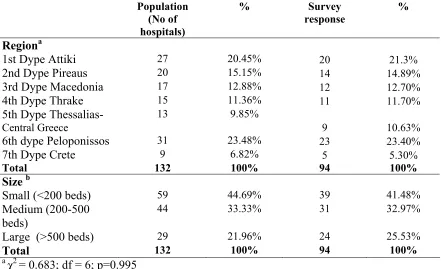
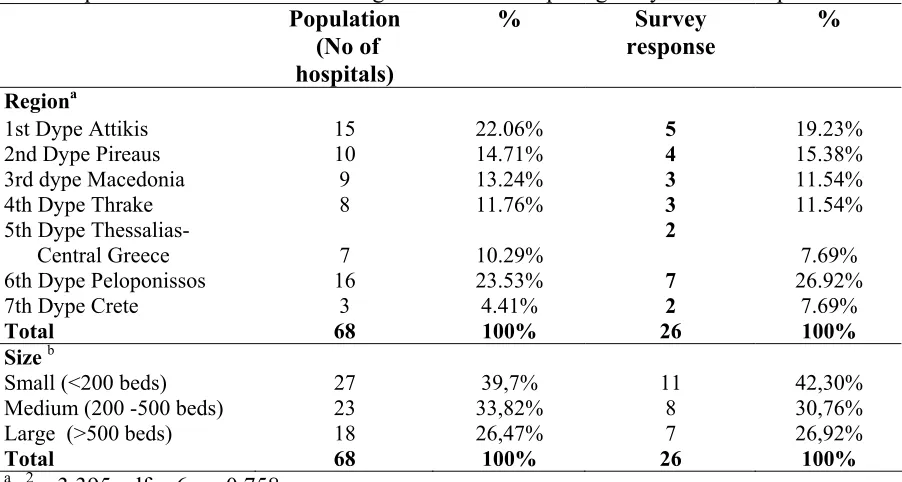
[image:14.595.88.529.327.596.2]In order to minimize the chance that the reported results differ between respondents and non-respondents a nonparametric, one-sample Chi-square test was performed to test respectively (a) whether the distribution of the 132 hospitals in the response (n=94) or non-response (n=38) was independent of two demographic characteristics: administrative region and size, and (b) whether early and late respondents provided significantly different responses (Naranjo-Gil and Hartmann, 2007). The statistical tests indicated no significant differences in the demographic characteristics (administrative region and size) and in the means of responses for non-respondents and early versus late respondents respectively. The results of no evidence of non-response-bias are presented in Tables 2 and 3.
Table 2.
Chi-square test based on administrative region and size of the population and survey respondents
Population (No of hospitals)
% Survey response
%
Regiona
1st Dype Attiki 27 20.45% 20 21.3%
2nd Dype Pireaus 20 15.15% 14 14.89%
3rd Dype Macedonia 17 12.88% 12 12.70%
4th Dype Thrake 15 11.36% 11 11.70%
5th Dype Thessalias-
Central Greece
13 9.85%
9 10.63%
6th dype Peloponissos 31 23.48% 23 23.40%
7th Dype Crete 9 6.82% 5 5.30%
Total 132 100% 94 100%
Size b
Small (<200 beds) 59 44.69% 39 41.48%
Medium (200-500 beds)
44 33.33% 31 32.97%
Large (>500 beds) 29 21.96% 24 25.53%
Total 132 100% 94 100%
a χ2
= 0.683; df = 6; p=0.995
bχ2
Table 3.
Chi-square test for administrative region and size comparing early and late respondents
Population (No of
hospitals)
% Survey response
%
Regiona
1st Dype Attikis 15 22.06% 5 19.23% 2nd Dype Pireaus 10 14.71% 4 15.38% 3rd dype Macedonia 9 13.24% 3 11.54% 4th Dype Thrake 8 11.76% 3 11.54% 5th Dype Thessalias-
Central Greece 7 10.29%
2
7.69% 6th Dype Peloponissos 16 23.53% 7 26.92% 7th Dype Crete 3 4.41% 2 7.69%
Total 68 100% 26 100%
Sizeb
Small (<200 beds) 27 39,7% 11 42,30% Medium (200 -500 beds) 23 33,82% 8 30,76% Large (>500 beds) 18 26,47% 7 26,92%
Total 68 100% 26 100%
a χ2
= 3.395; df = 6; p=0.758
bχ2
= 0.379; df = 2; p=0.827
In terms of size the sample counted 41.4% small facilities with less then 200 beds, 32.9% medium-sized hospitals with 200–499 beds and 25.5% large hospitals with over 500 beds.
5.2 Measurement of the variables
Dependent variable
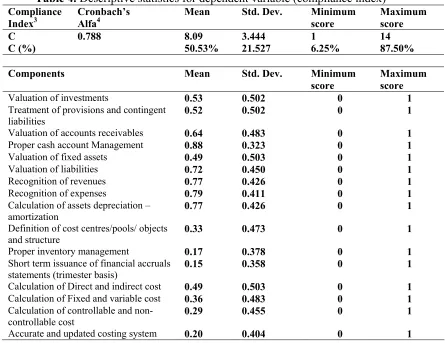
Table 4. Descriptive statistics for dependent variable (compliance index)
Compliance Index3
Cronbach’s Alfa4
Mean Std. Dev. Minimum
score
Maximum score
C 0.788 8.09 3.444 1 14
C (%) 50.53% 21.527 6.25% 87.50%
Components Mean Std. Dev. Minimum
score
Maximum score
Valuation of investments 0.53 0.502 0 1
Treatment of provisions and contingent liabilities
0.52 0.502 0 1
Valuation of accounts receivables 0.64 0.483 0 1
Proper cash account Management 0.88 0.323 0 1
Valuation of fixed assets 0.49 0.503 0 1
Valuation of liabilities 0.72 0.450 0 1
Recognition of revenues 0.77 0.426 0 1
Recognition of expenses 0.79 0.411 0 1
Calculation of assets depreciation – amortization
0.77 0.426 0 1
Definition of cost centres/pools/ objects and structure
0.33 0.473 0 1
Proper inventory management 0.17 0.378 0 1
Short term issuance of financial accruals statements (trimester basis)
0.15 0.358 0 1
Calculation of Direct and indirect cost 0.49 0.503 0 1 Calculation of Fixed and variable cost 0.36 0.483 0 1 Calculation of controllable and
non-controllable cost
0.29 0.455 0 1
Accurate and updated costing system 0.20 0.404 0 1
Independent variable measurement
Objective data was used for the “CEOEDUC”, “EDUC”, “SIZE”, and “EXPER” variables. Learning Experience effect (EXPER) is measured using the number of years passed of hospital first accrual based financial statements issuance year. The CEO educational background (CEOEDUC) is measured using the years of business-oriented education to the total number of education years5. The size variable was measured using the natural logarithm number of beds. Regarding the general level of accounting staff education (EDUC), a compound average level of finished studies (master, bachelor and secondary level) was used6.
3
It is the overall compliance index that is calculated as the sum of the 16 dichotomous variables that refer to the hospitals’ compliance with reformed accounting legislation requirements.
4
According to Hair (1998) If the variables being tested are all dichotomous, Cronbach's alpha is the same as Kuder-Richardson coefficient.
5
In particular, this indicator is measured by the following formula: Business-oriented educational background = (UD + PD + T) / (total number of education years ) in which UD for years of undergraduate degree on business oriented education, PD stands for years of postgraduate degree on business oriented education , and T for years of training seminars and special courses on business oriented education.
6
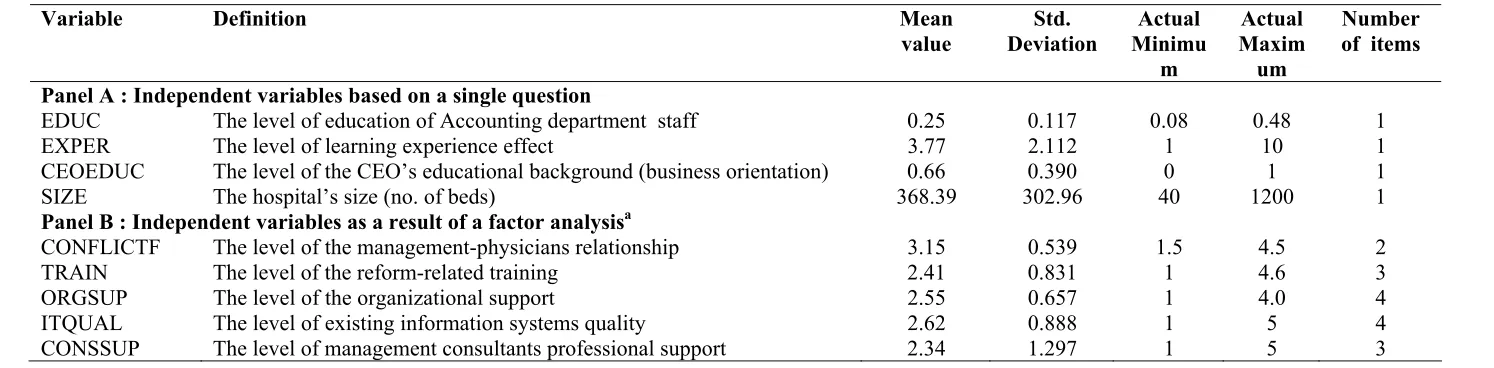
The other five independent variables, “CONFLICTF”, “CONSUL”, “ITQUAL”, “TRAIN”, and “ORGSUP” required the use of perceptive measures and thus multi-question Likert-type five point scales (where 1 = strongly disagree and 5 = strongly agree) were used to derive composite scores for each factor. All of the measures were based on previously validated instruments. Multiple items were preferred because they captured more of a construct’s multi-dimensionality than single items (Foster and Swenson, 1997; Cardinaels et al., 2004; Al-Omiri and Drury, 2007; Krumwiede, 1998). The descriptive statistics of the independent variables in the study are presented in Table 5.
Table 5.
Descriptive statistics of the independent variables in the study
Variable Definition Mean
value
Std. Deviation
Actual Minimu
m
Actual Maxim
um
Number of items
Panel A : Independent variables based on a single question
EDUC The level of education of Accounting department staff 0.25 0.117 0.08 0.48 1 EXPER The level of learning experience effect 3.77 2.112 1 10 1 CEOEDUC The level of the CEO’s educational background (business orientation) 0.66 0.390 0 1 1 SIZE The hospital’s size (no. of beds) 368.39 302.96 40 1200 1
Panel B : Independent variables as a result of a factor analysisa
CONFLICTF The level of the management-physicians relationship 3.15 0.539 1.5 4.5 2 TRAIN The level of the reform-related training 2.41 0.831 1 4.6 3 ORGSUP The level of the organizational support 2.55 0.657 1 4.0 4 ITQUAL The level of existing information systems quality 2.62 0.888 1 5 4 CONSSUP The level of management consultants professional support 2.34 1.297 1 5 3
a
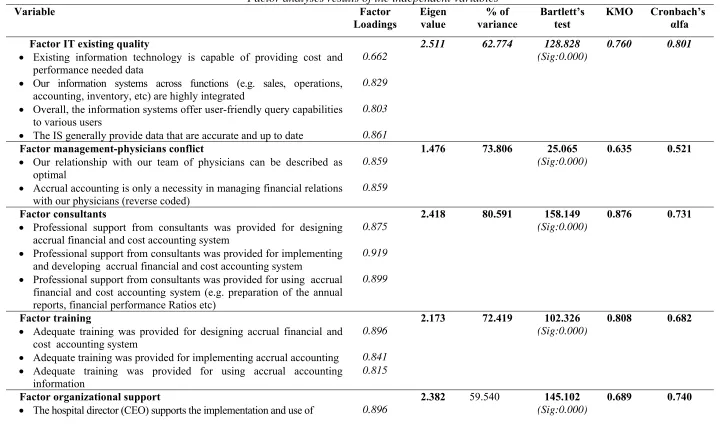
The resulting composite factor scores are computed using mean standardized responses, having a mean of zero and a standard deviation of one, to the survey questions loading greater than 0.407 on the respective factors with eigenvalues in excess of one. The construct validity and reliability for the multi-item variables were assessed by using a principal component analysis and Cronbach coefficient alphas8 respectively. Based on this analysis, the factors appear to be reliable and reasonably valid. The results of the factor analysis for the four composite variables are presented in Table 6.
7
This is in line with Hair et al. (1998) who considered items that display factor loadings of .40 and above as important
8
Table 6.
Factor analyses results of the independent variables
Variable Factor
Loadings
Eigen value
% of variance
Bartlett’s test
KMO Cronbach’s
αlfa
Factor IT existing quality 2.511 62.774 128.828 0.760 0.801
• Existing information technology is capable of providing cost and performance needed data
0.662 (Sig:0.000)
• Our information systems across functions (e.g. sales, operations, accounting, inventory, etc) are highly integrated
0.829
• Overall, the information systems offer user-friendly query capabilities to various users
0.803
• The IS generally provide data that are accurate and up to date 0.861
Factor management-physicians conflict 1.476 73.806 25.065 0.635 0.521
• Our relationship with our team of physicians can be described as optimal
0.859 (Sig:0.000)
• Accrual accounting is only a necessity in managing financial relations with our physicians (reverse coded)
0.859
Factor consultants 2.418 80.591 158.149 0.876 0.731
• Professional support from consultants was provided for designing accrual financial and cost accounting system
0.875 (Sig:0.000)
• Professional support from consultants was provided for implementing and developing accrual financial and cost accounting system
0.919
• Professional support from consultants was provided for using accrual financial and cost accounting system (e.g. preparation of the annual reports, financial performance Ratios etc)
0.899
Factor training 2.173 72.419 102.326 0.808 0.682
• Adequate training was provided for designing accrual financial and cost accounting system
0.896 (Sig:0.000)
• Adequate training was provided for implementing accrual accounting 0.841
• Adequate training was provided for using accrual accounting information
0.815
Factor organizational support 2.382 59.540 145.102 0.689 0.740
accrual and cost accounting system
• The medical board supports implementation and use of accrual financial and cost accounting
0.518
• The physicians support the implementation of accrual and cost accounting
0.894
• The Heads of various nursing departments support the implementation of accrual financial and cost accounting
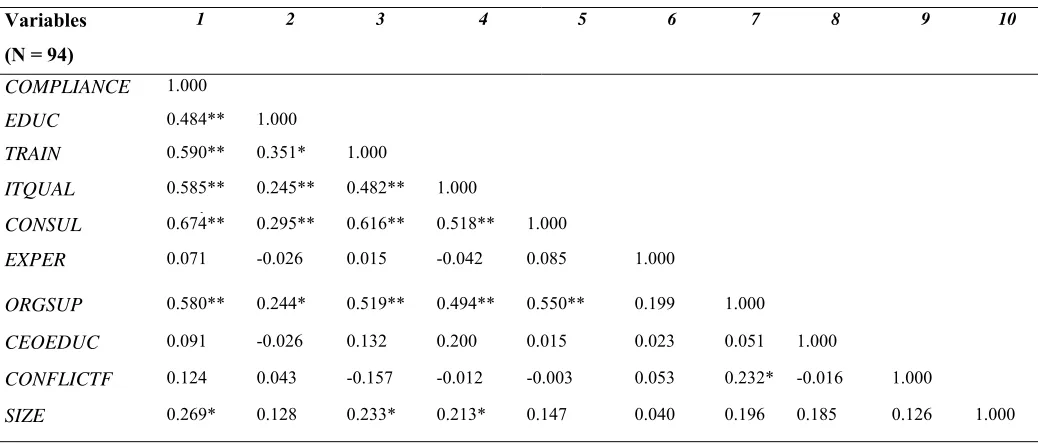
Finally, Table 7 presents a Pearson Correlation matrix for the independent variables. None of the Pearson Rank correlation coefficients are high thus suggesting that multi-collinearity is not an issue. Lewis-Beck (1990) (cited in Pavlatos and Paggios, 2009) reported that intercorrelations need to be 0.8 or above before they are of any concern.
Table 7. Pearson correlation matrix for all the variables.
Variables
(N = 94)
1 2 3 4 5 6 7 8 9 10
COMPLIANCE 1.000
EDUC 0.484** 1.000
TRAIN 0.590** 0.351* 1.000
ITQUAL 0.585**
λ
0.245** 0.482** 1.000
CONSUL 0.674** 0.295** 0.616** 0.518** 1.000
EXPER 0.071 -0.026 0.015 -0.042 0.085 1.000
ORGSUP 0.580** 0.244* 0.519** 0.494** 0.550** 0.199 1.000
CEOEDUC 0.091 -0.026 0.132 0.200 0.015 0.023 0.051 1.000
CONFLICTF 0.124 0.043 -0.157 -0.012 -0.003 0.053 0.232* -0.016 1.000
SIZE 0.269* 0.128 0.233* 0.213* 0.147 0.040 0.196 0.185 0.126 1.000
Note: *, **, correlation is significant at respectively 5, 1% levels (2-tailed).
6. DATA ANALYSIS
6.1 Main Results of the compliance Index
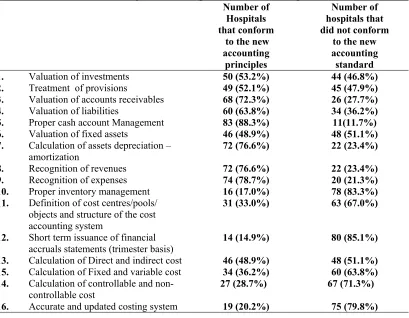
The elements related to the accounting compliance index are shown in Table 8. The total extent of compliance scores range from a high of 87.5 per cent of the maximum possible score to a low of 6.25 per cent. On average, each organization reported a 50.53 per cent of compliance with the prescribed accounting reform demands (Table 4). However, taking a closer look, a variation in compliance score of the different aspects (i.e., accrual financial accounting and cost accounting aspect) of the index can be observed. In particular, the data suggest that the financial accounting elements of the index show relatively higher compliance scores (i.e. Valuation of accounts receivables, Proper cash account Management, Valuation of liabilities etc) than those of the cost accounting elements of the index (i.e. Definition of cost centres, Calculation of Fixed and variable cost, Calculation of controllable and non-controllable cost).
At first, these findings are consistent with Comerford and Abernethy (1999) and Hill (2000) that supported the low adoption level of cost accounting systems in hospitals. They reported that hospitals traditionally had little incentive or demand for cost accounting systems to be used as a management control tool. Hospitals primarily reported to external funding authorities, such as the government, and therefore only served as external reporting factors.
Table 8.
Areas of accounting reform compliance vs. non-compliance
Number of
Hospitals that conform
to the new accounting
principles
Number of hospitals that did not conform
to the new accounting standard 1. Valuation of investments 50 (53.2%) 44 (46.8%) 2. Treatment of provisions 49 (52.1%) 45 (47.9%) 3. Valuation of accounts receivables 68 (72.3%) 26 (27.7%) 4. Valuation of liabilities 60 (63.8%) 34 (36.2%) 5. Proper cash account Management 83 (88.3%) 11(11.7%) 6. Valuation of fixed assets 46 (48.9%) 48 (51.1%) 7. Calculation of assets depreciation –
amortization
72 (76.6%) 22 (23.4%)
8. Recognition of revenues 72 (76.6%) 22 (23.4%) 9. Recognition of expenses 74 (78.7%) 20 (21.3%)
10. Proper inventory management 16 (17.0%) 78 (83.3%)
11. Definition of cost centres/pools/ objects and structure of the cost accounting system
31 (33.0%) 63 (67.0%)
12. Short term issuance of financial accruals statements (trimester basis)
14 (14.9%) 80 (85.1%)
13. Calculation of Direct and indirect cost 46 (48.9%) 48 (51.1%) 15. Calculation of Fixed and variable cost 34 (36.2%) 60 (63.8%) 14. Calculation of controllable and
non-controllable cost
27 (28.7%) 67 (71.3%)
16. Accurate and updated costing system 19 (20.2%) 75 (79.8%)
6.2 Factors affecting the compliance level
In order to test the level of accounting reform in public the following linear regression model was applied:
Y = a + b1 EDUC + b2 TRAIN + b3 ITQUAL +b4 CONSUL +b5 EXPER + b6 ORGSUP +
b7 CEOEDUC +b8 CONFLICT + b9 SIZE + e
Where Y : is a variable measuring the level of regulatory compliance with the accrual financial and cost accounting. Moreover, the above model contains nine (9) independent variables. In order to examine the associations proposed in hypotheses H1 through H9 in Section 3 a multivariate regression analysis was used because the univariate tests provide valuable information regarding a large number of variables over a sample and their results are informative but there is the question of whether the association is a direct association or whether there is a joint correlation with a third or fourth variable.
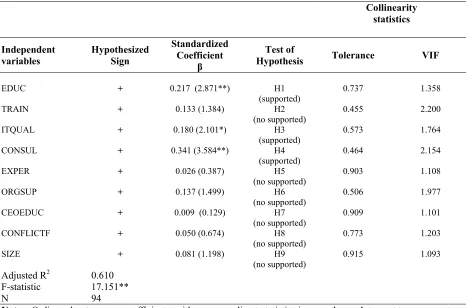
Table . 9
Ordinary Least Squares Linear Regression Results of reform accounting compliance Regression Results for the determinants of reform accounting compliance
Collinearity statistics Independent variables Hypothesized Sign Standardized Coefficient β Test of
Hypothesis Tolerance VIF
EDUC + 0.217 (2.871**) H1
(supported)
0.737 1.358
TRAIN + 0.133 (1.384) H2
(no supported)
0.455 2.200
ITQUAL + 0.180 (2.101*) H3
(supported)
0.573 1.764
CONSUL + 0.341 (3.584**) H4
(supported)
0.464 2.154
EXPER + 0.026 (0.387) H5
(no supported)
0.903 1.108
ORGSUP + 0.137 (1.499) H6
(no supported)
0.506 1.977
CEOEDUC + 0.009 (0.129) H7
(no supported)
0.909 1.101
CONFLICTF + 0.050 (0.674) H8
(no supported)
0.773 1.203
SIZE + 0.081 (1.198) H9
(no supported)
0.915 1.093
Adjusted R2 0.610
F-statistic 17.151**
N 94
Note: Ordinary least squares coefficients, with corresponding t-statistics in parentheses. Intercept terms are not reported.
**, * indicate statistical significance at the 1, and 5% levels, respectively.
The observed F-statistic of the regression is 17.151 and significant at alpha = 0.000 which points at an acceptable goodness-of-fit. The validity threat of multicollinearity is examined with a Pearson correlation test and by calculating the tolerance and variance inflation factors (VIF) for all the independent variables (see the two final columns of the table). No indication of multicollinearity is found between the different variables9.The adjusted R2 explains 61.0 percent of the variation for compliance level.
As regards the factors that affect hospitals’ compliance with new accounting principles, the results presented in Table 9 indicate that among the nine variables which were tested for associations on the level of the accounting reform, four are found to be positively associated with level of compliance: the IT existing quality (p < 0.05),education level of accounting department staff (p < 0.1), and professional support from consultants (p < 0.01), were the most significant in statistical terms. On the other hand, the hospital size, the years of accrual accounting experience, the CEO educational background, the relationships between administrators-physicians, the level of organizational support and the level of reform related training do not exhibit a significant influence on compliance with new accounting principles. Thus, we summarize that statistical analysis showed that only H1, H3, and H4 hypotheses are supported, while H5, H6, H7, H2 and H9 are not supported by the data
9
7. DISCUSSION AND CONCLUSION 7.1 Research findings
As mentioned above, this paper is not set up to explain the reasons of the accounting reform in public hospitals, nor is it an analysis or an appraisal of the impulses or incentives behind the reform. It aims at exploring, describing and comparing in an objective way the actual adoption and implementation of accrual financial and cost accounting practices in public hospitals. This can only be done by analyzing features of organizations that succeed in complying with the reform requirements and determining the impact on the level of accounting reform adoption of certain contingent factors cited in previous studies within a broad institutional framework.
Under this research approach, the present research results indicate that the level of accounting reform adoption in public hospitals is realized only to a limited extent, especially on cost accounting aspects of the reform. The relatively higher compliance index scores of financial accounting system aspects compared with the lower compliance score of the cost accounting system aspects indicate that hospitals’ management focused more to some specific reform aspects than others maybe due to different institutional pressures.
As expressed by the interviewees of our study, the financial accounting related aspects of the reform were under a stricter supervisory pressure and attention from both the central government (i.e. MoF and MHSC) and the regional health authorities within the hospital reporting process than cost accounting related aspects and that is why these aspects have received more attention from hospitals’ management. Most of them stated that the main driver for adopting accruals was the legislative requirements (coercive pressure) by conforming to at least the minimum accounting standards, and not economic incentives for more efficient and effective organizational results as well as the need to portray themselves as “modern” by adopting accrual accounting practises used by earlier implementers in the same field because they perceive to be more legitimate or successful.
In other words, hospitals are concerned more to demonstrate that they have the capability to use the accrual accounting information rather than actual use it, in an attempt to portray themselves as “modern organizations” and gain external legitimacy for their activities rather than to actually improve their decision-making and control mechanisms. According to Meyer and Rowan (1977), this tactical response to institutional processes in which the organizations adopt new technologies and management techniques in order to appear to be in use but may not be acted upon, is an example of “sagacious conformity” (cited in Arnaboldi and Lapsley, 2003) or compromise.
Nonetheless, and contrary to the isomorphic influences observed in the case of accrual basis financial accounting adoption, institutional inertia or limited isomorphism seem(s) to prevail as a tactical response to institutional pressures by the public hospitals in the case of cost accounting adoption. In particular, and based on the interviews conducted with six (6) Financial and Accounting executives of public hospitals, the following explanatory factors regarding the slow moving implementation progress of the accrual and especially cost accounting system are presented:
and that hospitals do not have to comply with the accounting reform requirements in order to meet governmental prerequisites for funding support. In particular, the current reimbursement system applied in the GNHS could be classified as a retrospective per-diem reimbursement10. This payment method, in which the hospital’s own costs are reimbursed ex post without any link to unit costs and performance measures, eventually provides no incentives to public hospitals to stimulate efficiency and to economize; hospitals are reimbursed for extra production and not for cost-efficiency initiatives. Under per-diem reimbursement hospitals prefer to keep the patients in the hospital as long as they can, in order to allow additional revenues to be generated. Thus, as many academics and practitioners have noted (see for example, Hill, 2000; Jegers et al., 2002), a change in the reimbursement mechanism from a retrospective to a Prospective Payment System (PPS) and case-mix funding should be considered as essential in many hospitals settings for the development of a cost accounting system.
Another reason for which public hospitals are not very concerned with the possibility of non-compliance with the coercively enforced change is the fact that they are evaluated and controlled on the basis of reports related to cash basis accounting (i.e. yearly budget and actual yearly amounts) and not to accrual basis accounting as the control mechanism is more appropriate to the cash accounting practice. Most interviewees pointed out that hospitals focus on regularity and legality of the cash operations and that no legal provision exists for control in terms of financial audit or in terms of conformity with the new accounting system imposed by the P.D. 146/03. In order to comply with the legal provision in force, the hospitals’ officials pay more attention to the budget and the budget execution reporting. In other words hospitals are lead to pay more attention to the cash accounting practice to the detriment of accrual financial and cost accounting as there is no link with performance measures.
Moreover, and according to the semi-guided interviews conducted with the financial officers within the hospitals, the lack of political implication and interest at the level of central government consists of a major obstacle to successful implementation of accrual accounting in the public hospitals. Since the government accounting reform elaboration and until today, 2003 to 2009, not much political debate has taken place and no serious political interests were manifested in the sense of modernising public management accounting. All the interviewees indicated that political will is a critical factor to the successful implementation of cost accounting system and of NPM ideas.
A further obstacle to successful implementation of accounting reform is the lack of an effective enforcement mechanism to actually mobilize the implementation process with budgetary cutbacks or explicit financial restrictions and penalties in case of no compliance. Hence, although fines and penalties have been established by the legislator in the P.D. 146/03 in case of non-compliance with the adoption timetables, the interviewees of no-compliant hospitals pointed out that no such action has been taken yet. This finding is consistent with the argument of Berry and Jacobs (1981), (cited in Cohen et al., 2007), that the lack of an effective enforcement system is a leading reason of non-compliance.
Another reason for restricted levels of accrual accounting implementation could be the lack of the cost accounting framework (i.e., cost centers structure and chart of accounts) customization to the public sector’s needs without taking into consideration the considerable differences and unique characteristics of the public sector in general, and the public hospitals in particular. This could be due to the following reasons: First, the development team having experience mainly from the private sector and without acknowledging the public sector specificity has based its work mainly on the private sector
10
accounting principles. Second, the accrual accounting framework in question, centrally developed, has been imposed following a top-down procedure of policy formulation without the contribution and co-operation of the directly interested parties in the implementation process (i.e. hospital representatives) . In particular, only a few meetings with public hospitals (i.e., five public hospitals) were held in order for the consulting development team members to understand their characteristics. Most of the Interviewees mentioned that they became aware of the accounting reform features after its official enactment without having any kind of familiarization with it (i.e., official presentations, related training programs etc). The result of this lack of dialogue, between hospital employees and the development team, has been the development of an accounting system which may not be easily understood by those that are in charge to implement and operate it within public hospitals. This is also consistent with the perception of Otley (1999) and Lapsley (2000) (cited in Venieris and Cohen, 2004) that implementation of private sector practices to the public sector may be problematic if the level of understanding of the organizational context is low.
Last but not least, nearly all of the interviewees responded that the implementation of the accrual basis financial and especially of the cost accounting system within their organizations was considered to be a difficult and time consuming task, and that they did not have the necessary organizational capacity for action in managing the shift.
From the institutional perspective, public organisations are expected to comply with legislation to obtain legitimacy and stability. However, if a non-compliance with the legislative requirements does not deliver the organization a legitimacy or survival problem then institutional inertia or limited isomorphism is likely to prevail (Windels and Christiaens, 2005). This is also consistent with the statement of Oliver (1991) in his work, about the strategic responses to institutional pressures, that:
“Dismissing, or ignoring institutional rules and values, is a strategic option that organizations are more likely to exercise when the potential for external enforcement of institutional rules is perceived to be low or when internal objectives diverge or conflict very dramatically with institutional values or requirements”.
The current case seems to deliver a good example of this suggested course of action, as indicated by the abovementioned explanatory factors regarding the particular low level of cost accounting adoption progress compared to accrual basis financial accounting adoption progress.
Finally, the empirical investigation of the cross-sectional differences among hospitals in terms of accounting reform adoption reveals that there are certainly some significant constraints (or enablers) in the process of organizational change and that public hospitals experience implementation difficulties because of resources and operational capacity considerations in complying with the regulatory accrual accounting requirements.
7.2 Limitations and suggestions for future research
The study findings are subject to a number of limitations. First, cross-sectional studies can establish associations, but not causality. Another factor that may affect these results is the “noisiness” of the measures. A mail survey prevents an assessment of the survey respondent’s actual knowledge of the accrual accounting, although the surveys were mailed to Chief Financial Officers. In particular, although tests were performed to look for evidence of non-response bias, there is no way to directly test whether the non-respondents (n=38) are systematically different to the respondents (n=94). Also, the data is based on the respondents' opinions (perceptual measures) in the absence of official statistics which could offer a clearer picture with regards to the impact of the explanatory and implementation factors discussed throughout this paper.
Additionally, although this study takes into consideration relevant work of previous researchers in the health care area in various countries and organizational settings, it also acknowledges that empirical research on the subject in the Greek environment is limited. A limited number of hospitals that have already implemented the cost accounting system together with the fact that the data would still derive from early stages of system infiltration, form the two basic limitations the researchers face today when asked to collect system-oriented data from the Greek experience of adopting the accrual accounting. Therefore, this study should be viewed as an initial step towards providing such material. As more data becomes available, future research should consider and investigate the benefits deriving from the implementation and use of the accrual-based financial and cost accounting system in Greek hospitals, as well as examine associations between accrual and cost systems functionality, usage of accounting data (e.g., decision making, budgeting and budgetary control, cost management, performance evaluation) and hospital performance.
Finally, another important limitation on the generality of findings in this study is that the impact of the factors referred to above upon the adoption of the accounting reform has only been examined from the sole perspective of accounting function and financial staff, and may thus exhibit a bias, as it may offer valid but only partial interpretations of events and situations. It does not attempt to survey the views and opinions of other interest parties and stakeholders inside the hospitals’ organizational environment such as the hospital’s clinical managers, physicians and nurses. Moreover, interview’s data were collected from individuals (i.e. six CFOs) that choose to participate in the study, resulting in a possible self-selection bias. As a result, it is suggested that future researchers should incorporate these concerns into their research endeavours in order to enrich our understanding of how modernization and accounting change process take effect into public health sector organizations.