ISSN Online: 2162-5824 ISSN Print: 2162-5816
Compound Heterozygous C282Y/H63D Mutation
in Hemochromatosis: A Case Report
Zazour Abdelkrim
*, Wafaa Khannoussi, Amine El Mekkaoui, Ghizlane Kharrasse, Zahi Ismaili
Hepato-Gastro-Enterology Unit, Mohammed VI University Hospital Oujda, Oujda, Morocco
Abstract
Hereditary hemochromatosis is a condition characterized by iron overload, which is both treatable and preventable. It’s mainly related to hepcidin deficiency related to mutations in genes involved in hepcidin regulation. Iron overload increases the risk of disease such as liver cirrhosis, heart disease and diabetes. Two HFE genotypes have been commonly described in cases of iron overload, C282Y homozygosity and C282Y/H63D compound heterozygoty. The diagnosis of this rare disease now can be explored by biological and imaging tools. We report a case of compound hetero- zygous C282Y/H63D discovered by family screening for elevated serum ferritin.
Keywords
Iron Overload, Compound Heterozygoty, Phlebotomy
1. Introduction
HFE hemochromatosis is a genetic disease related to mutation in HFE gene [1]. Its prevalence in Morocco is unknown and is believed to be rare. In HFE related iron overload, 2 major genotypes have been described: C282Y homozygosity and C282Y/ H63D compound heterozygosity. The prevalence of homozygous C282Y in Caucasians is very high, about 3% - 5% [2], and the prevalence of C282Y/H63D compound hetero-zygosity is 4 times higher [3]. In clinical iron overload and iron overload related dis-ease, the dominant genotype is C282Y, and a small proportion of cases are compound heterozygotes [3]. Though the clinical penetrance of C282Y homozygosity is about 28% in males and 1% in females [4], the penetrance of compound heterozygosity is about 13.5% [5].
It has been recently confirmed that heterozygosity is rarely clinically overt and serum ferritin is higher in this population compared with mutation free controls [6]. The pa-How to cite this paper: Abdelkrim, Z.,
Khannoussi, W., El Mekkaoui, A., Kharrasse, G. and Ismaili, Z. (2016) Compound Hete-rozygous C282Y/H63D Mutation in He-mochromatosis: A Case Report. Open Jour- nal of Clinical Diagnostics, 6, 30-35. http://dx.doi.org/10.4236/ojcd.2016.63006
Received: July 25, 2016 Accepted: September 18, 2016 Published: September 21, 2016
Copyright © 2016 by authors and Scientific Research Publishing Inc. This work is licensed under the Creative Commons Attribution International License (CC BY 4.0).
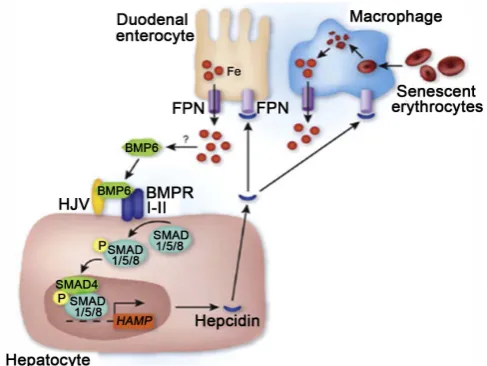
thophysiology is better known, and hepcidin deficiency is the main mechanism leading to iron overload [5]. The liver synthesis of hepcidin is decreased and inappropriate to iron burden in case of HFE mutation. The role of hepcidin is to insure the iron ho-meostasis by regulating ferroportin related intestinal absorption and excretion by the reticuloendothelial macrophages. Plasma iron overload consequent to unregulated in-testinal absorption and erythrophagocytosis iron release, lead to high transferrin-iron saturation [TS] and generate a non transferrin bound iron taken by organs, mostly liv-er, pancreas and heart. Iron deposition in these organs leads in the ultimate stage to organ dysfunction and failure (Figure 1) [7] [8]). In heterozygotes, it is not yet clear if serum ferritin (SF) level > 1000 ng/ml is isolated risk factor for disease development or associated comorbid factors are necessary [9].
HFE-related hemochromatosis is the classical and first described form of genetic iron overload [10]. The HFE gene located on chromosome 6 codes for the membrane protein HFE, a MCH-like protein whose definite role at the membrane remains unclear [8] [11].
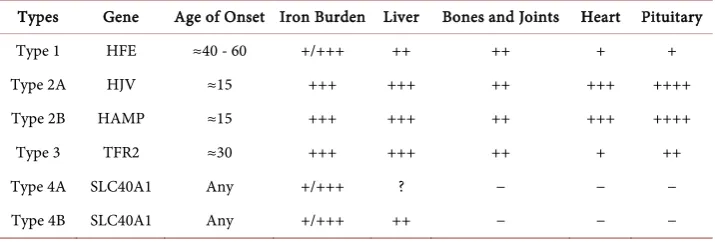
[image:2.595.252.496.476.659.2]The most frequent and classical mutation of this gene is the p.Cys282Tyr (C282Y) mutation. Prevalence of this mutation is high in Caucasian population (10% of the sub-jects are heterozygous, and 3 to 5 subsub-jects per thousand are homozygous), but almost absent in nonwhite populations [11]. Other genotypes commonly included in HFE than C282Y homozygosity cannot explain overt iron overload and do not result in clinically significant iron overload in the absence of cofactors accounting for disturbed iron me-tabolism (alcoholism or metabolic syndrome): compound heterozygosity C282Y/H63D. However, some subjects with compound heterozygosity, even without known cofactors, increased transferrin-iron saturation and serum ferritin. Other rare HFE mutations have been described associated with those frequent genotypes, thus explaining unusual cases of iron overload: type 2 HJV and HAMP, type 3 TFR2, type 4 ferroportin [11] (Table 1).
Figure 1. Molecules involved in Iron Metabolism Iron homeostasis as regulated by hepcidin.
Table 1. Different types of hereditary hemochromatosis according to the genes involved and their classical phenotypes.
Types Gene Age of Onset Iron Burden Liver Bones and Joints Heart Pituitary
Type 1 HFE ≈40 - 60 +/+++ ++ ++ + +
Type 2A HJV ≈15 +++ +++ ++ +++ ++++
Type 2B HAMP ≈15 +++ +++ ++ +++ ++++
Type 3 TFR2 ≈30 +++ +++ ++ + ++
Type 4A SLC40A1 Any +/+++ ? − − −
Type 4B SLC40A1 Any +/+++ ++ − − −
We report a rare case in our settings of compound heterozygosity C282Y/H63D re-vealed by family screening treated by phlebotomy.
2. The Natural History of Disease and Clinical Expression
-A lag phase (stage 0)
-A biological expression phase, which rarely starts before the age of 20. At this point, the early stigma of excess iron in the body appear and translates into an increase of the coefficient of transferrin-iron saturation (plasma iron overload; stage 1), then the con-centration of serum ferritin (Tissue iron overload; stage 2): A phase of clinical expres-sion, manifesting itself by symptoms non-specific occurring usually around the age of 40 years for men and 50 years for women. The disease will first associate signs altering the quality of life of patients (stage 3): asthenia, osteo-articular pain, hepatomegaly, skin hyperpigmentation, heart faillure.
At a more advanced stage (stage 4), it will evolve into abuses that might compromise the prognosis (diabetes, cirrhosis, hepatocarcinoma ...). Hemochromatosis type I is one of the only genetic diseases to benefit from a simple, inexpensive and effective treat-ment once it is impletreat-mented early. The treattreat-ment is based on iterative bleedings (phle-botomy) and consists of two phases: a phase of attack (to decrease ferritin in the body) and a maintenance phase (to avoid the re-accumulation of iron). Early support helps prevent the development of irreversible complications and provides patients with a life expectancy similar to that of the general population [4] [6].
3. Observation
ration at 65%, the blood count was normal as it was for diabetes tests, cholesterol, he-mostasis, liver enzymes and renal function. Genetic testing for HFE hemochromatosis concluded to compound heterosigosity C282Y/H63D (Figure 2). Hepatic MRI eva-luated iron overload to 230 micromol/g +/−50 (normal <36). Cardiac evaluation found no abnormality, the left ventricular ejection fraction was 62%. The patient has regular phlebotomies (he received 15 sessions of phlebotomy treatment during the attack phase every 3 weeks until a serum ferritin at 43.25 ng/ml). Currently, he is on remission with a maintenance phlebotomie every 2 - 4 months), and the follow up is uneventful.
4. Discussion
Due to variability in the clinical penetrance of hemochromatosis, visceral iron overload was observed in less than 10% of patients who are homozygous for the C282Y muta-tion, with a clinical expression in 24% to 43% among males and 1% to 14% among women (low percentage of men due to monthly menstruation resulting from a loss of iron and having a protective effect) [11]. While the compound heterozygosity (C282Y/ H63D) patients represent only 5% of the cases of hemochromatosis [11] [12].
Knowing that heterozygosity H63D is very common in the general population about 15% explaining important penetrance of double heterozygote C282Y/H63D [4] [12].
Few studies have focused the pathological value of C282Y/H63D. In the series of the “Health Iron Study Investigators”, having brought 242 patients double heterozygote, the importance of body iron overload was assessed biologically (ferritin, transferrin- iron saturation coefficient). The values were low and stable with age so it is an increase for women after menopause, and the most important values related to the male sex. There was little clinical manifestation of hemochromatosis, which concludes with a low morbidity of the double heterozygosity [8] [13]. However, the authors recognized do not have liver biopsy or MRI for assessment of iron overload order correlate biological markers to the actual overload. In a study conducted in France on 40 patients diag-nosed double heterozygote had objectified mean values of the ferritin at 480 ng/ml and the TSat 50%, iron overload was assessed by MRI in patients with an average of 119 µmol/g allowed to the indication of the depleting bleeding in two thirds of cases [2] [4] [12]-[14].
In our case, the importance of iron overload in the body was evaluated biologically and radiologically with very high values (ferritin > 1000 ng/ml, TS 65% and major liver overload was estimated by MRI at 230 μmol/g +/− 50 (normal < 36 µmol/g) which leads us to indicate the phlebotomy treatment (the signed iterative).
5. Conclusions
In the literature, the weight of the C282Y/H63D genotype in the occurrence in iron overload is very relative and patients with this genotype are less frequent than expected. They are diagnosed at an advanced age and more commonly associated with predis-posing factors.
The therapeutic management of patients’ compound heterozygosity (C282Y/H63D) is essentially based on the evaluation of iron overload in the body including liver MRI that is a review of reference to detect it.
References
[1] Feder, J.N., Gnirke, A., et al. (1996) A Novel MHC Class 1-Like Gene Is Mutated in Patient with Hereditary Hemochromatosis. Nature Genetics, 13, 399-408.
http://dx.doi.org/10.1038/ng0896-399
[3] Gurrin, L.C., et al. (2009) HFE C282Y/H63D Compound Heterozygotes Are at Low Risk of Hemochromatosis-Related Morbidity. Hepatology, 50, 94-101.
[4] Deugnier, Y., Barbou-Jecquet, E., et al. (2011) Diagnostic d’une surcharge hépatique en fer. EMC hépatologie. http://dx.doi.org/10.1016/S1155-1976(11)40364-8
[5] D’Alessio, F., Hentze, M.W., et al. (2012) The Hemochromatosis Proteins HFE, TfR2, and HJV from a Membrane-Associated Protein Complex for Hepcidin Regulation. Journal of Hepatology, 57, 1052-1060. http://dx.doi.org/10.1016/j.jhep.2012.06.015
[6] Bacon, B.R., et al. (2011) Diagnosis and Management of Hemochromatosis: Practice Guide- line by the American Association for the Study of Liver Diseases.
[7] Salgia, R.J. and Brown, K. (2015) Diagnosis and Management of Hereditary Hemochroma-tosis. Clinics in Liver Disease, 19, 187-198.
http://dx.doi.org/10.1016/j.cld.2014.09.011
[8] Pietrangelo, A. (2015) Genetics, Genetic Testing, and Management of Hemochromatosis: 15 Years since Hepcidin. Gastroenterology, 149, 1240-1251.
http://dx.doi.org/10.1053/j.gastro.2015.06.045
[9] Walsh, A., Dixon, J.L., et al. (2006) The Clinical Relevance of Compound Heterozygosity for the C282Y and H63D Substitution in Hemochromatosis. Clinical Gastroenterology and Hepatology, 4, 1403-1410. http://dx.doi.org/10.1016/j.cgh.2006.07.009
[10] Pietrangelo, A. (2007) Hemochromatosis: An Endocrine Liver Disease. Hepatology, 46, 1291-1301. http://dx.doi.org/10.1002/hep.21886
[11] Bardou-Jacquet, E. and Brissot, P. (2014) Diagnostic Evaluation of Hereditary Hemo- chromatosis (HFE and Non-HFE). Hematology/Oncology Clinics of North America, 28, 625-635. http://dx.doi.org/10.1016/j.hoc.2014.04.006
[12] Bardou-Jacquet, E., et al. (2013) Non-HFE Hemochromtosis: Pathophysiological and Diag- nostic Aspects. Clinics and Research in Hepatology and Gastroenterology, 38, 143-154. [13] Zaloumis, S.G., et al. (2015) The Natural History of HFE Simple Heterozygosity for C282Y
and H63D: A Prospective Twelve Year Study.Journal of Gastroenterology and Hepatology, 30, 719-725.http://dx.doi.org/10.1111/jgh.12804
[14] Bouizergarène, P., et al. (2006) Les hémochromatoses héréditaires lièe au HFE.
Submit or recommend next manuscript to SCIRP and we will provide best service for you:
Accepting pre-submission inquiries through Email, Facebook, LinkedIn, Twitter, etc. A wide selection of journals (inclusive of 9 subjects, more than 200 journals)
Providing 24-hour high-quality service User-friendly online submission system Fair and swift peer-review system
Efficient typesetting and proofreading procedure
Display of the result of downloads and visits, as well as the number of cited articles Maximum dissemination of your research work