http://www.scirp.org/journal/jilsa ISSN Online: 2150-8410
ISSN Print: 2150-8402
Improved Term Weighting Technique for
Automatic Web Page Classification
Kathirvalavakumar Thangairulappan1, Aruna Devi Kanagavel2
1Department of Computer Science, V. H. N. S. N. College, Virudhunagar, India
2Department of Computer Science (PG), Kristu Jayanti College, Bengaluru, India
Abstract
Automatic web page classification has become inevitable for web directories due to the multitude of web pages in the World Wide Web. In this paper an improved Term Weighting technique is proposed for automatic and effective classification of web pages. The web documents are represented as set of features. The proposed method selects and extracts the most prominent features reducing the high dimensionality problem of classifier. The proper selection of features among the large set improves the performance of the classifier. The proposed algorithm is implemented and tested on a benchmarked dataset. The results show the better performance than most of the existing term weighting techniques.
Keywords
Web Page Classification, Term-Weighting Scheme, Feature Selection, Feature Extraction, Artificial Neural Network, Back Propagation
1. Introduction
The rapid development of technology leads human beings and the devices to connect to internet and share the data. Thus the information is accumulating in WWW at a very high rate. In this scenario it is necessary to categorize the web contents in an organized way. Automatic classification of web pages into relevant categories helps the search en-gines to give quicker and better results. Web page classification [1] is the task of decid-ing whether a page belongs to a set of predefined category of document which is rele-vant to the topic. The web pages can be structured or unstructured or semi-structured and also they have heterogeneous contents which include text, images, audios, videos, links etc. The standard way of representing a web document for classification is Vector How to cite this paper: Thangairulappan,
K. and Kanagavel, A.D. (2016) Improved Term Weighting Technique for Automatic Web Page Classification. Journal of Intelli-gent Learning Systems and Applications, 8, 63-76.
http://dx.doi.org/10.4236/jilsa.2016.84006
Received: July 7, 2016 Accepted: September 24, 2016 Published: September 27, 2016
Copyright © 2016 by authors and Scientific Research Publishing Inc. This work is licensed under the Creative Commons Attribution International License (CC BY 4.0).
http://creativecommons.org/licenses/by/4.0/
space model that include documents and index terms as its components. Since a web page has no restrictions on the occurrences of a word it may have any number of words. The words in the web pages can have different length and different spelling also. The high dimensionality of web pages has its impact on performance of the classifier. Inten-sive researches are going on to reduce the dimension of web pages and to improve the classifier performance.
The goal of web page categorization is to classify the information on WWW into certain number of predefined categories. Categorization is an active research area in IR and machine learning. Several text categorization methods such as Naive Bayes [2], Rocchio [3], and Nearest Neighbor [4] and Back Propagation [5] have been proposed. The whole process can be done in three successive stages. In the first stage, the infor-mation is retrieved from the web and the features are to be extracted by analyzing the source of the web pages. In the second stage fix the input values of the neural network. Finally the third stage should determine the class of a certain web page out of prede-fined classes.
Ali Selamat and Sigeru Omatu [6] have proposed automatic categorization method that deals with the scaling problem of the World Wide Web. A news web page classifi-cation method (WPCM) uses a neural network with inputs obtained by both the prin-cipal components and class profile-based features. Each news web page is represented feature vectors and weighted using TF-IDF scheme. The principal component analysis (PCA) has been used to select the most relevant features out of many features for the classification. The final output of the PCA is combined with the feature vectors from the class-profile which contains the most regular words in each class. These feature vectors are then used as the input to the neural networks for classification.
Thabit Sabbah et al. [7] proposed Hybridized term weighting method for web con-tents classification using SVM. The hybridized method combines feature sets generated by the term weighting schemes TF, DF, TF-IDF, Glasgow and Entropy into one feature set for effective classification. Improved Web Page Identification Method using Neural Networks proposed by Ali Selamat et al. [8] is based on the improvement of feature se-lection of the web pages using Class Based Feature Vectors. The approach has been examined using the modified term weighting scheme. Gowri Shanthi and Antony Sel-vadoss Thangamani [9] have proposed an Enhanced Approach on Web Page Classifica-tion Using Machine Learning Technique that clean the dataset and transform it in to the pattern for classification. Then the feature extraction is performed to extract only minimum number of representative features or terms extracted from it without using the entire Web page. Then FP-Growth algorithm is used to classify the dataset into one of the seven classes. Alamelu Mangai, Santhosh Kumar and Appavu Balamurugan [10]
have proposed a new classification model for web page classification called a probabil-istic web page classifier (PWPC) which is based on a probabilprobabil-istic framework and Attribute-Value Similarity measure (AVS).
clustering technique and the navigational behavior of the user through Markov model. The clustering algorithms considered are K-means and K-mediods, where K is deter-mined by HITS algorithm. Finally, the predicted web pages are stored in form of cellu-lar automata to make the system more memory efficient. Qiming Luo, Enhong Che-nand HuiXiong [12] proposed a term weighting scheme by exploiting the semantics of categories and indexing terms. The semantics of categories are represented by senses of terms appearing in the category labels. The weight of a term is correlated to its semantic similarity with a category. Man Lan et al. [13] investigated several widely-used unsu-pervised and suunsu-pervised term weighting methods on benchmark data collections in combination with SVM and kappa NN algorithms. They have proposed a new simple supervised term weighting method, i.e. tf.rf, to improve the terms’ discriminating pow-er for text categorization task.
Chris Buckley [14] concluded in his research article that Good weighting methods are more important than the feature selection process and it is suggested that the two need to go hand-in-hand in order to be effective. Kusum Kumari Bharti and Pramod Kumar Singh [15] used the feature selection methods term variance (TV) and docu-ment frequency (DF) for features’ relevance score computation. Principal component analysis (PCA) is applied to further reduce dimensions in the feature space without losing much information. Behzad et al. [16] investigated two different kinds of feature selection metrics (one-sided and two-sided) as a global component of term weighting schemes (called as tffs) in scenarios where different complexities and imbalance ratios are available. They concluded that supervised term weighting methods based on one-sided term selection metrics are the best choice for SVM in the imbalanced datasets and k-NN algorithm usually perform well with tfidf. The construction of a text classifi-er [17] usually involves (i) a phase of term selection, in which the most relevant terms for the classification task are identified, (ii) a phase of term weighting, in which docu-ment weights for the selected terms are computed, and (iii) a phase of classifier learning, in which a classifier is generated from the weighted representations of the training documents. This process involves an activity of supervised learning.
In this paper feature vectors of the web pages are classified using a new term weight-ing scheme. As the weight of a term drives the classifier for efficient and accurate cate-gorization, the weighted features are ranked and the top ranked features are selected for classification. Neural network classifier is used to classify the 20 Newsgroups dataset
[18], a benchmarked dataset. The paper is organized as follows. The traditional term weighting schemes and the new term weighting scheme are introduced in Section 2. Classifier and its training method are discussed in Section 3. The Web page classifica-tion method is presented in Secclassifica-tion 4. The results of the proposed method are com-pared with the standard weighting schemes TF, DF, TF-IDF, Glasgow and Entropy in Section 5.
2. Traditional and Proposed Term Weighting Scheme
the class the web page belongs to. Hence it is necessary to select only the most relevant terms from a document. The weight [19] of the term represents how much the term contributes to the semantics of the document. The widespread term weighting methods are TF, DF, TF-IDF, Glasgow and Entropy. The Vector Space Model (VSM) is a very common and effective way to represent the collection of documents. In VSM model each document d is represented as vector in the term spaces, d =
(
t t1, ,2 ,tn)
, where n is the size of vocabulary and the corresponding weight vector is w=(
w w1, 2,,wn)
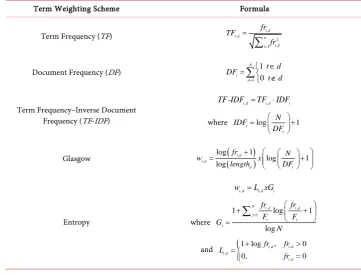
. The weights w w1, 2,,wn are the weights of the respective terms t t1, ,2 ,tn com-puted using any term weighting scheme. The VSM model is a two dimensional matrix where rows represent the documents and columns represent the terms. The computed weight can be in the range of 0 to 1. The various weighting schemes are discussed and their formulae are tabulated in Table 1.a) Term Frequency (TF): TF is based on the normalized frequency of a certain term. If a term has more occurrences then it has more implication.
b) Document Frequency (DF): Document frequency states the number of documents in the collection has the term t.
[image:4.595.190.552.431.706.2]c) Term Frequency—Inverse Document Frequency (TF-IDF): In IDF the more oc-curred term in the collection is considered as least significant term. It is a global term weighting scheme in which the weight is computed with respect to its occur-rence in the entire collection. TF-IDF is an eventual ranking measure in which the less frequent term in the collection but at the same time it is most occurred in a document is considered significant and vice versa.
Table 1. Various term weighting schemes and their mathematical formulae.
Term Weighting Scheme Formula
Term Frequency (TF) , ,
2 , 1
t d
t d n
t d t fr TF fr = =
∑
Document Frequency (DF)
1 1 0 N t d t d DF t d = ∈ = ∉
∑
Term Frequency–Inverse Document Frequency (TF-IDF)
, ,
- t d t d t
TF IDF =TF ⋅IDF
where t log 1
t N IDF DF = +
Glasgow (
(
,)
), log 1 log 1 log t d t d d t fr N w x length DF + = + Entropy , ,
t d t d t
w =L xG
where
, ,
1
1 log 1
log
N t d t d
j t t t fr fr F F G N = + + =
∑
and , ,
,
,
1 log , 0
0, 0
d) Glasgow term weighting: This weighting scheme is introduced to avoid favoring the longer documents with lot of irrelevant words than the small documents.
e) Entropy term weighting: It is based on a probabilistic analysis of the text. The more frequent the term is contained in most documents is considered as more significant. It computes the term weight from two aspects, which are local term-weighting and global term-weighting. This means that, once every term receives a weight, it will be composed of local and global weights. It is calculated at the range of 0 - 1, hence values are normalized.
f) Proposed Term Weighting Scheme
The new term—weighting scheme is originally improved from traditional TF-IDF. The improved term-weighting considers three main factors—term frequency factor, collection frequency factor, and document length factor. The proposed term weighting formula is expressed as,
(
,)
,
log 1
log 1
t d t d
t TF w
DF N
+ =
+
(1)
where TFt,d represents the Term Frequency and DFt represents the Document
Fre-quency of the term.
The new term weighting technique is focused on the word occurrence in a single document and also its occurrence in the entire collection. The term value increases proportionally to the number of times a word appears in the document, but is offset by the frequency of the word in the collection, which helps to adjust for the fact that some words appear more frequently in general.
3. Classifier and Its Training Method
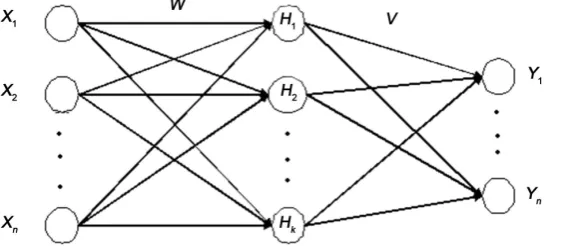
Artificial neural network is used as the classifier to classify the web documents. ANN is composed of collection of neurons and layers. It usually consists of three layers which are input layer, hidden layer and output layer. A Single hidden layer feed-forward neural network in Figure 1 is used. Let X = (xi) be the input vector, Y = (yi) be the
out-put vector, H = (hi) be the hidden neuron vector, W = (wij) be the weight matrix
[image:5.595.237.518.564.687.2]be-tween input layer and hidden layer, and V = (vij) be the weight matrix between hidden
layer and output layer. In the input layer a bias node is included which with the con-stant value of 1.0. Bias node is added to increase the flexibility of the model to fit the data. It allows the network to fit the data when all input features are equal to 0.The weighted sum for neurons in hidden layer and output layer can be calculated by,
1
1
n h
j ij i
i
net w x
=
=
∑
⋅ (2)2
1
n o
j ij i
i
net v h
=
=
∑
⋅ (3)where n1 represents number of input neurons, n2 represents the number of hidden neurons, neto represents net value for output layer neurons and
neth represents net value for hidden layer neurons.
The training patterns are given as input to the network and the respective outputs of the output layer and hidden layer are computed. The Sigmoidal function is used as the activation function for hidden and output layer. It is given as follows,
( )
11 e il
l i net f net − =
+ (4) where l represents the layer.
The network is learned by minimizing the Mean Square Error (MSE). MSE is defined as
(
)
21 1 1 MSE p n j j p j d o
p = =
=
∑∑
− (5)where “p” represents patterns, “j” represents jth neuron of the output layer, “d”
represents desired value and “o” represents obtained value. Standard Backpropagation
The basic idea of the Standard backpropagation algorithm is the repeated application of the chain rule to compute the influence of each weight in the network with respect to an arbitrary error function. This algorithm is used on hidden layer to find optimal set of hidden layer weights and thresholds that minimizes error. The sum of squared error of the network is
( )
21 1 1 2 nl p j j E e =
=
∑
(6)where the nonlinear error signal e1 is, e1j =dj−yj, dj and yj represent desired and ob-tained outputs for jth unit in the output layer.
( )
2 1
1
n
o
i j j ij
j
e e f net v
=
′
=
∑
(7)Now the weight update rule for hidden layer is as follows,
( )
2h P h
ij ij i i
ij E
w x f net e
w
µ∂ µ ′
∆ = − =
where μ is the learning rate, h represents hidden layer.
Then the hidden layer weight will be updated by the following equation.
ij ij ij
w =w + ∆w .
4. Web Page Classification Method
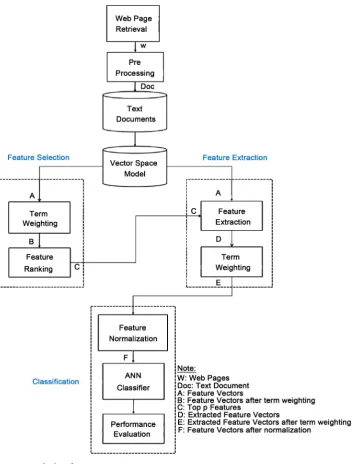
The news web pages can be of different length, different structure and different voca-bulary. The high dimensionality of the web pages diminishes the performance of the classifier. There are many categories of news in the web news pages such as sports, weather, politics, economy, computer etc. In each category there can be many different classes. The objective of this paper is to classify the web pages according to their cate-gory. The principal function of the web page classification is represented in Figure 2.
The news web pages which are retrieved from www have text information, multimedia contents, html tags etc. The preprocessing phase removes the stop words like and, for, is etc. and applies stemming to reduce derived words to their root word like playing, played to play. After the stemming and stopping processes of the terms in each docu-ment, the web documents have only unique words and they are represented as the document-term frequency matrix as shown in Table 2. Each row in the table indicates the documents and columns represent terms. Docj refers to each web page document
that exists in the collection where j=1, 2,,m and ti refers to the unique terms in the
collection where i=1, 2,,n. Here m is the total number of documents and n is the total number of terms in the collection. The values in the table give the number of times the term ti occurred in Docj.
Since the numbers of terms are more in number it is necessary to recognize and ex-tract the significant terms. To identify the significant terms, their term weights are computed using the proposed Formula (1). The term weights are sorted in ascending order and the top ranked p numbers of features are selected. The top ranked p feature profiles are stored in the Feature profiles. Feature selection is significant in supervised learning tasks such as binary or multiclass classification in order to improve the clas-sifier efficiency and training time of the supervised clasclas-sifier. In feature extraction phase the selected feature profiles are retrieved from the collection. The selected fea-tures are weighted using the new term weighting scheme. The selected feafea-tures undergo normalization so that the data sets are scaled within the range of [1, −1]. To perform the normalization task, E is represented as
{
e e1, 2,,em}
as a m × p matrix, where p is the number of term features and m is the number of documents. ej denotes the p × 1vector containing p term features for each ej. The normalized feature vector is given to
ANN for classification. The feed forward back propagation artificial neural network ca-tegorizes the given vector and in the final stage the classifier performance is measured.
Classification Algorithm
Figure 2. Web classification process
Table 2. The document-term frequency data matrix.
Doc/Term t1 t2 t3 … tn
Doc1 4 1 2 … 2
Doc2 2 3 3 … 1
Doc3 0 2 1 … 4
: : : : : :
Step 1: Start the training.
Step 2: Fix the desired number of features p to be given to classifier.
Step 3: Read the VSM of the web documents in matrix A of dimension m x n, where n is the no. of terms in the collection; m is the no. of documents in the collection.
Step 4: Compute term weight matrix B by the new term weighting scheme for each element in matrix A.
Step 5: Rank the terms by sorting the value in B from highest to lowest according to sum of term weight values.
Step 6: Select p number of highest value from B and store it in feature profile matrix C.
Step 7: Extract the term values from the collection corresponding to feature profile matrix C and VSM model and store significant features in matrix D of dimension m x p.
Step 8: Compute the term weight of matrix D using proposed formula and store the result in E.
Step 9: Normalize the term matrix E and results can be stored in matrix F.
Step 10: The normalized output matrix F of dimension m x p is given as input to the neural network classifier.
Step 11: Initialize the parameters for neural network training.
Step 12: For each input pattern compute output of the network applying standard back propagation approach
Step 13: Update the weights for the network.
Step 14: Calculate network error for the network with updated weights. Step 15: Repeat the training, until the MSE reaches 0.001.
Step 16: Test the trained network with the testing documents.
Step 17: Measure the classifier performance using Accuracy, Precision, Recall and F1.
5. Experiments and Results
5.1. Data Sets
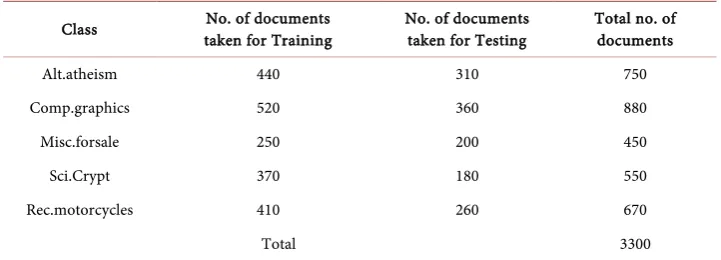
Experiments were done on benchmark dataset called 20 News groups [18]. This dataset is a collection of approximately 20,000 newsgroup documents with 60,000 terms, parti-tioned across 20 different newsgroups. For the analysis of the proposed work 3300 documents (m = 3300) of 5 different newsgroups are considered. Table 3 depicts the details of various web page collections taken for the experiments. The number of fea-tures taken are 1200 (n = 1200).
5.2. Feature Extraction and Feature Selection
Table 3. 20 Newsgroup dataset.
Class taken for Training No. of documents No. of documents taken for Testing Total no. of documents
Alt.atheism 440 310 750
Comp.graphics 520 360 880
Misc.forsale 250 200 450
Sci.Crypt 370 180 550
Rec.motorcycles 410 260 670
[image:10.595.309.548.539.652.2]Total 3300
Table 4. Hardware and software specifications.
Hardware Software
Processor: Intel Core Duo 2.1 GHz Platform: MS Windows 8 Memory: 3GB RAM; 32 bit OS Software: Matlab R2014a
5.3. Neural Network Classifier
The extracted p number features are then given as input to the neural network classifi-er. The feed-forward neural network with an input layer, a hidden layer and an output layer is used. The Back-propagation method is used for training the network. The net-work parameters are given in Table 5.
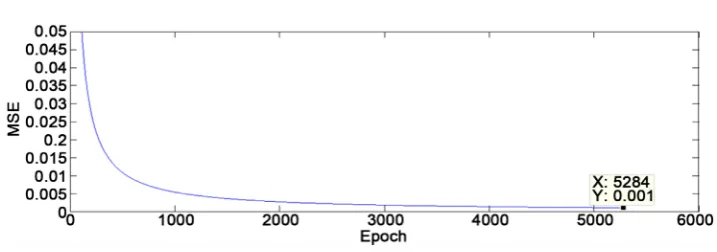
The learning rate is chosen based on trial basis for minimum cost. The weights are initialized randomly. The weight adjustments are drastic initially and then get stabi-lized. Thus the network learning is found to be smooth and is shown in Figure 3.
5.4. Evaluation
After the neural network is trained the test input patterns are given and the results of classifier are evaluated using standard information retrieval measurement tools. We evaluated using precision (P), recall (R), Accuracy (Acc) and F1. They can be expressed as follows:
a P
a b
=
+ (8)
a R
a c
=
+ (9)
2
1 PR
F
P R
=
+ (10)
Total Correct
100% Total No.of Documents
Acc= ×
(11)
Figure 3. Epoch Vs MSE learning curve.
Table 5. Parameters for back-propagation neural network used.
Parameter Value
Learning Rate 0.005
Mean Squared Error 0.001
Input Neurons n (No. of terms)
Hidden Neurons 10
[image:11.595.194.554.370.437.2]Output Neurons 5
Table 6. Definition of parameters a, b, c and d.
Category Set Expert Judgment
Yes No
System Judgement Yes a b
No c d
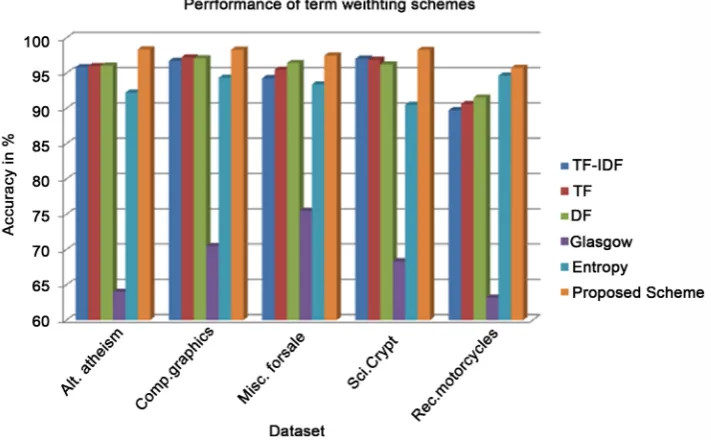
The classification accuracy of the term weighting methods TF, TF-IDF, DF, Glasgow, Entropy and the proposed method is tabulated in Table 7. On comparing the classifier accuracy of all the methods (Figure 4) the proposed scheme is found to be better. The overall classifier performance is tabulated in Table 8. With the new term weighting technique 97.69 percent web pages are classified accurately. The presented results show that the proposed solutions are reasonably accurate and fast. Through the proposed term weighting technique, we have succeeded in identifying the significant terms that are essentially needed for the classification. The classifier accuracy varies with respect to the class of the page also. In Rec. motorcycles class and Misc. for sale class the accuracy is comparatively low. The reason may be the page consists of more graphical contents than the text information.
6. Conclusion
Figure 4. Comparison of classification accuracy.
Table 7. Classification accuracy of various term weighting methods.
Category TF-IDF TF DF Glasgow Entropy Proposed Scheme Alt.atheism 95.86 96.01 96.08 64.01 92.25 98.3871 Comp.graphics 96.74 97.25 97.10 70.5 94.35 98.3333
Misc.forsale 94.29 95.5 96.45 75.5 93.4 97.5
Sci.Crypt 97.06 96.9 96.24 68.35 90.5 98.3146
[image:12.595.196.555.499.599.2]Rec.motorcycles 89.75 90.62 91.55 63.18 94.65 95.7692 Average 94.74 95.256 95.484 68.308 93.03 97.68524
Table 8. Overview of performance of the proposed method.
Category Accuracy Precision Recall F1
Alt.atheism 98.35 100 95.81 97.86
Comp.graphics 98.1450 99.4 97.13 98.25
Misc.forsale 97.9126 100 96.93 98.44
Sci.Crypt 98.2121 99.5 96.33 97.89
Rec.motorcycles 95.8065 96.7 95.65 96.17
good for text based web documents, but when the page has more graphical contents than text contents the system performance goes low.
References
[1] Qi, X.G. and Davison, B.D. (2009) Web Page Classification: Features and Algorithms. ACM Computing Surveys, 41, 12:1-12:31.
[2] McCallum, A. and Nigam, K. (1998) A Comparison of Event Models for Naive Bayes Text Classification. Proceedings in Workshop on Learning for Text Categorization, AAAI’98, 41-48.
[3] Lewis, D.D., Schapire, R.E., Callan, J.P. and Papka, R. (1996) Training Algorithms for Li-near Text Classifiers. Proceedings of 19th International Conference on Research and de-velopment in Information Retrieval, ACM, New York, 289-297.
http://dx.doi.org/10.1145/243199.243277
[4] Yang, Y., Slattery, S. and Ghani, R. (2002) A Study of Approaches to Hypertext Categoriza-tion. Journal of Information Systems, 18, 2-3.
[5] Kamruzzaman, S.M. (2006) Web Page Categorization Using Artificial Neural Networks.
Proceedings of the 4th Intl Conf. on Electrical Engg. & 2nd Annual Paper Meet, Bangla-desh, January 2006, 26-28.
[6] Selamat, A. and Omatu, S. (2004) Web Page Feature Selection and Classification Using Neural Networks. Information Sciences, 158, 69-88.
http://dx.doi.org/10.1016/j.ins.2003.03.003
[7] Selamat, A., Lee, Z.S., Maarof, M.A. and Shamsuddin, S.M. (2011) Improved Web Page Identification Method using Neural Networks. International Journal of Computational In-telligence and Applications, 10, 87-114. http://dx.doi.org/10.1142/S1469026811003008 [8] Sabbah, T., Selamat, A., Selamat, M.H., Ibrahim, R. and Fujita, H. (2016) Hybridized Term
Weighting Method for Web Contents Classification using SVM. Neuro Computing, 173, 1908-1926. http://dx.doi.org/10.1016/j.neucom.2015.09.063
[9] Shanthi, S.G. and Thanamani, A.S. (2012)Enhanced Approach on Web Page Classification Using Machine Learning Technique. International Journal of Advanced Research in Com-puter Engineering & Technology, 1, 278-282.
[10] Alamelu Mangai, J., Santhosh Kumar, V. and Appavu Balamurugan, S. (2013) A Novel Ap-proach for Effective Web Page Classification. International Journal of Data Mining Model-ling and Management, 5, 233-245. http://dx.doi.org/10.1504/IJDMMM.2013.055860 [11] Dutta, R., Kundu, A. and Mukhopadhyay, D. (2011) Clustering-Based Web Page
Predic-tion. International Journal of Knowledge and Web Intelligence,2, 257-271. http://dx.doi.org/10.1504/IJKWI.2011.045163
[12] Luo, Q.M., Chen, E.H. and Xiong, H. (2011) A Semantic Term Weighting Scheme for Text Categorization. Expert Systems with Applications,38, 12708-12716.
http://dx.doi.org/10.1016/j.eswa.2011.04.058
[13] Lan, M., Tan, C.L., Su, J. and Lu, Y. (2009) Supervised and Traditional Term Weighting Methods for Automatic Text Categorization. IEEE Transactions on Pattern Analysis and Machine Intelligence, 31, 721-35. http://dx.doi.org/10.1109/TPAMI.2008.110
[14] Buckley, C. (1993) The Importance of Proper Weighting Methods. Proceedings of the workshop on Human Language Technology—HLT’93, Association for Computational Linguistics, Stroudsburg, 349-352. http://dx.doi.org/10.3115/1075671.1075753
Selection with Feature Extraction Method for Text Clustering. Expert Systems with Appli-cations, 42, 3105-3114. http://dx.doi.org/10.1016/j.eswa.2014.11.038
[16] Naderalvojoud, B., Bozkir, A.S. and Sezer, E.A. (2014) Investigation of Term Weighting Schemes in Classification of Imbalanced Texts. Proceedings of European Conference on Data Mining (ECDM),Lisbon, 15-17 July 2014, 39-46.
[17] Debole, F. and Sebastiani, F. (2003) Supervised Term Weighting for Automated Text Cate-gorization. Proceedings of the 18th ACM Symposium on Applied Computing (SAC 2003), Melbourne, 9-12 March 2003, 784-788. http://dx.doi.org/10.1145/952532.952688
[18] 20 Newsgroup Dataset. http://www.cad.zju.edu.cn/home/dengcai/Data/TextData.html [19] Ko, Y. (2012) A Study of Term Weighting Schemes Using Class Information for Text
Clas-sification. Proceedings of SIGIR’12, Portland, Oregon, 12-16 August 2012, 1029-1030.
Submit or recommend next manuscript to SCIRP and we will provide best service for you:
Accepting pre-submission inquiries through Email, Facebook, LinkedIn, Twitter, etc. A wide selection of journals (inclusive of 9 subjects, more than 200 journals)
Providing 24-hour high-quality service User-friendly online submission system Fair and swift peer-review system
Efficient typesetting and proofreading procedure
Display of the result of downloads and visits, as well as the number of cited articles Maximum dissemination of your research work
Submit your manuscript at: http://papersubmission.scirp.org/