Diminution in Error Approximation by Identity
Authentication with IPAS for FTLSP to
Enhance Network Security
Kuljeet Kaur, Geetha Ganesan
School of Computer Applications, Lovely Professional University, Phagwara, India Email: [email protected]
Received July 6,2013; revised August 7, 2013; accepted August 15, 2013
Copyright © 2013 Kuljeet Kaur, Geetha Ganesan. This is an open access article distributed under the Creative Commons Attribution License, which permits unrestricted use, distribution, and reproduction in any medium, provided the original work is properly cited.
ABSTRACT
In this paper, we have proved the diminution in error approximation when identity authentication is done with Ideal Password Authentication Scheme (IPAS) for Network Security. Effectiveness of identity authentication parameters for various attacks and security requirements is verified in the paper. Result of analysis proves that IPAS would enhance the transport layer security. Proof of efficiency of result is generated with drastic diminution in error approximation. IPAS would have advanced security parameters with implemented RNA-FINNT which would result in fortification of the transport layer security protocol for enhancement of Network Security.
Keywords: Fingerprint; Error Approximation; Network Security; Fortification; Transport Layer
1. Introduction
Identity Authentication could be done with Password, Smart Cards and Fingerprints. As the Smart card loss is very common attack on the network so this identity au- thentication parameter is not completely reliable. Pass- word faces the dictionary attacks, stolen verifier attack, and man in the middle attack etc in common. So it states that there should be an Ideal Password Authentication Scheme which should have an assimilation of most ef- fective identity authentication parameters. Survey on user’s choice was done and it concluded that fingerprint would be the most acceptable identity authentication pa- rameter in future along with password [1]. So assimila- tion of password and fingerprint would generate an ideal password authentication scheme [2].
Fingerprint could be extracted on the basis of template, texture and minutiae points. Amongst the three minutiae points, it is the most effective as no one has the same number of points on the same place. Minutiae points give uniqueness to the fingerprint. There are various algo- rithms for extracting minutiae points like grid hash, angle hash and minimum distance hash. But we derived a new algorithm RNA-FINNT for extracting the minutiae point’s values of the fingerprint [3]. This paper has vali- dation of diminution in error approximation in terms of percentage. IPAS which is generated with assimilation of
password and fingerprint is used to validate the results. RNA-FINNT is used to extract values of minutiae points [3]. Calculations with respect to various fingerprint ex- traction algorithms are done by assimilating them with Password. Comparative analysis of all these calculations validates that the percentage of error would reduce when password is assimilated with fingerprint in which extrac- tion of minutiae points is performed by RNA-FINNT.
Remainder sections of the paper prove this validation. Section 2 proposes methodology for proving the diminu- tion in error approximation, Section 3 states the effec- tiveness of Identity Authentication Parameters for vari- ous Attacks and Security Requirements, Section 4 gener- ates a proof of Diminution in Error Approximation and Section 5 suggests the advanced security parameters of ideal password authentication scheme which results in fortification of transport layer security protocol for en- hancement of network security.
2. Proposed Methodology for Proving the
Diminution in Error Approximation
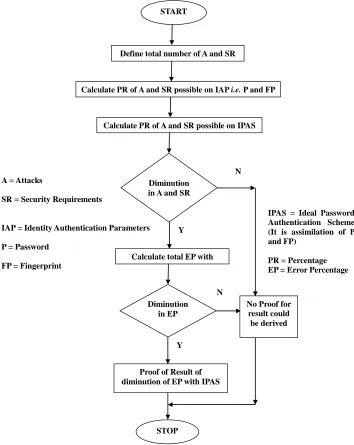
authentication scheme. Multi server environment is re- quired for implementation of IPAS [4]. Methodology proves that IPAS results in diminution in error approxi- mation. Flowchart defines the proposed methodology (Figure 1).
2.1. Mentioned below Is the Stepwise Process for Proving Diminution in Error Approximation
Step 1: Calculate the total number of Attacks and Secu- rity Requirements possible on each Identity Authentica- tion Parameter. This implies for password, fingerprint (extraction with Grid Hash Algorithm) [5], fingerprint (extraction with Angle Hash Algorithm) [5], fingerprint (extraction with Minimum Distance Hash Algorithm) [5]
and fingerprint (extraction with RNA-FINNT Hash Al- gorithm) [3].
Step 2: Calculate the total number of Attacks and Se- curity Requirements possible if password is assimilated with on each Identity Authentication Parameter. This implies for password assimilation with fingerprint (ex- traction with Grid Hash Algorithm), fingerprint (extrac- tion with Angle Hash Algorithm), fingerprint (extraction with Minimum Distance Hash Algorithm) and fingerprint (extraction with RNA-FINNT Hash Algorithm) respec- tively.
Step 3: Proof would be derived from the result of Step 2 that less number of attacks are possible if password is assimilated with fingerprint (extraction with RNA-FIN-
START
Define total number of A and SR
Calculate PR of A and SR possible on IAP i.e. P and FP
Calculate PR of A and SR possible on IPAS
Diminution in A and SR
Y
N
Calculate total EP with
Diminution in EP
Y
N
Proof of Result of diminution of EP with IPAS
STOP
No Proof for result could be derived A = Attacks
SR = Security Requirements
IAP = Identity Authentication Parameters
P = Password
FP = Fingerprint
IPAS = Ideal Password Authentication Scheme (It is assimilation of P and FP)
[image:2.595.120.474.273.718.2]PR = Percentage EP = Error Percentage
NT Hash Algorithm) which is an Ideal Password Au- thentication Scheme.
Step 4: Calculate the total error percentage if pass- word is assimilated with on each Identity Authentication Parameter. This implies for password assimilation with fingerprint (extraction with Grid Hash Algorithm), fin- gerprint (extraction with Angle Hash Algorithm), finger- print (extraction with Minimum Distance Hash Algo- rithm) and fingerprint (extraction with RNA-FINNT Hash Algorithm) respectively.
Step 5: Proof would be derived from the result of Step 4 that less number of error would be there if password is assimilated with fingerprint (extraction with RNA-FIN- NT Hash Algorithm) which is an Ideal Password Au- thentication Scheme.
Error Approximation = e Password = p
Total Number of defined Attacks and Security Require- ments = n
Number of Attacks on p = t (p)
Error Approximation in p = p (e)
Fingerprint Extracted Value through Grid Hash Algo-rithm = f (g)
Number of Attacks on f (g)= t (f (g))
Error Approximation in f (g) = f (g)(e)
Fingerprint Extracted Value through Angle Hash Al-gorithm = f (a)
Number of Attacks on f (a) = t (f (a))
Error Approximation in f (a) = f (a) (e)
Fingerprint Extracted Value through Minimum Dis-tance Hash Algorithm = f (m)
Number of Attacks on f (m) = t (f (m))
Error Approximation in f (m) = f (m) (e)
Fingerprint Extracted Value through RNA-FINNT Hash Algorithm = f (r)
Number of Attacks on f (r) = t (f (r))
Error Approximation in f (r) = f (r) (e)
Total Number of Attacks and Security Requirements possible if:
1) p is assimilated with f (g) = p (f (g)) 2) p is assimilated with f (a) = p (f (a)) 3) p is assimilated with f (m) = p (f (m)) 4) p is assimilated with f (r) = p (f (r))
Total Error Percentage when p is assimilated with f (g) = te (pg)
Total Error Percentage when p is assimilated with f (a) = te (pa)
Total Error Percentage when p is assimilated with f (m) = te (pm)
Total Error Percentage when p is assimilated with f (r) = te (pr)
Total Number of defined Attacks and Security Require- ments are n but if:
1) p is assimilated with f (g) = n (p (f (g)))
2) p is assimilated with f (a) = n (p (f (a))) 3) p is assimilated with f (m) = n (p (f (m))) 4) p is assimilated with f (r) = n (p (f (r)))
2.2. Proposed Methodology for Validating Results
Step 1: Calculate the total number of Attacks and Secu- rity requirements possible on each Identity Authentica- tion Parameter.
100
p e t p n
100
f g e t f g n
100
f a e t f a n
100
f m e t f m n
100
f r e t f r n
Step 2: Calculate the total number of Attacks and Se- curity requirements possible if p is assimilated with each Identity Authentication Parameter.
p f g t p t f g t p t f g
p f a t p t f a t p t f a
p f m t p t f m t p t f m
p f r t p t f r t p t f r
Step 3: Proof is derived from Step 2 that less number of attacks are possible if p is assimilated with f (r) i.e. an Ideal Password Authentication Scheme.
Proof:p (f (r)) is best for Identity Authentication.
Step 4: Calculate the Total Error Percentage if p is as-similated with each Identity Authentication Parameter.
te pg p e f g e n p f g
te pa p e f a e n p f a
te pm p e f m e n p f m
te pr p e f r e n p f r
Step 5: Proof is derived from Step 4 that less number of error would be there if assimilation of p with f(r) is implemented i.e. Ideal Password Authentication Scheme.
through RNA-FINNT and is assimilated with the Pass- word. This assimilation is IPAS which is an Ideal Pass- word Authentication Scheme and results in the diminu- tion of error percentage while matching the fingerprint. Section 4 validates the result with exact data for proving the diminution in the error approximation.
3. Effectiveness of Identity Authentication
Parameters for Various Attacks and
Security Requirements
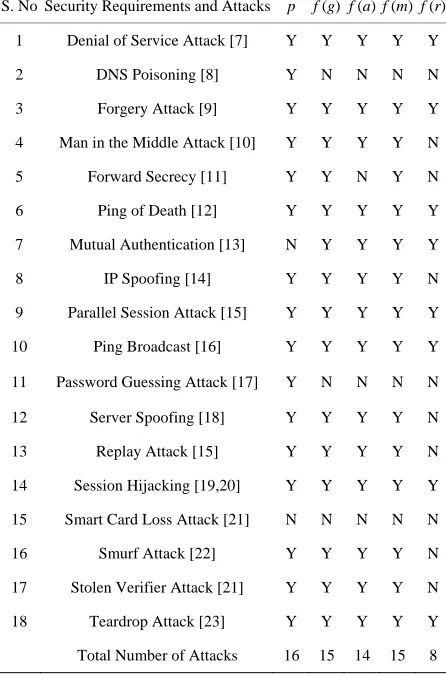
[image:4.595.60.283.400.739.2]As mentioned in Section 2 flowchart (Figure 1 and Ta- ble 1) comparative study of the attacks and security re- quirements in context to the existing and new fingerprint algorithms is to be done for proving diminution in error approximation. Standard attacks and security require- ments are denial of service [7], DNS poisoning [8], for- gery attack [9], man in the middle attack [10], forward secrecy [11], ping of death [12], mutual authentication [13], IP spoofing [14], parallel session [15], ping broad- cast [16], password guessing [17], server spoofing [18], replay [15], session hijacking [19,20], mutual authentica- tion [13], smart card loss [21], smurf [22], stolen verifier
Table 1. Comparative study of attacks and security require- ments on identity authentication parameters.
S. No Security Requirements and Attacks p f (g) f (a)f (m) f (r)
1 Denial of Service Attack [7] Y Y Y Y Y
2 DNS Poisoning [8] Y N N N N
3 Forgery Attack [9] Y Y Y Y Y
4 Man in the Middle Attack [10] Y Y Y Y N
5 Forward Secrecy [11] Y Y N Y N
6 Ping of Death [12] Y Y Y Y Y
7 Mutual Authentication [13] N Y Y Y Y
8 IP Spoofing [14] Y Y Y Y N
9 Parallel Session Attack [15] Y Y Y Y Y
10 Ping Broadcast [16] Y Y Y Y Y
11 Password Guessing Attack [17] Y N N N N
12 Server Spoofing [18] Y Y Y Y N
13 Replay Attack [15] Y Y Y Y N
14 Session Hijacking [19,20] Y Y Y Y Y
15 Smart Card Loss Attack [21] N N N N N
16 Smurf Attack [22] Y Y Y Y N
17 Stolen Verifier Attack [21] Y Y Y Y N
18 Teardrop Attack [23] Y Y Y Y Y
Total Number of Attacks 16 15 14 15 8
[21] and tear drop [23].
Password = p
Fingerprint Extracted Value through Grid Hash Algo-rithm = f (g)
Fingerprint Extracted Value through Angle Hash Al-gorithm = f (a)
Fingerprint Extracted Value through Minimum Dis-tance Hash Algorithm = f (m)
Fingerprint Extracted Value through RNA-FINNT Hash Algorithm = f (r)
Proof of Validation
Total Attacks = 18
p = 16, f (g) = 15, f (a) = 14, f (m) = 15, f (r) = 8
Out of total 18, number of attacks possible on pass- word is 16, fingerprint (extraction with Grid Hash Algo- rithm) is 15, fingerprint (extraction with Angle Hash Al- gorithm) is 14, fingerprint (extraction with Minimum Distance Hash Algorithm) is 15 and fingerprint (extrac- tion with RNA-FINNT (Reduced Number of Angles Fingerprint) Hash Algorithm) is 8. This implies that only 8 attacks or security requirements are possible on IPAS (Ideal Password Authentication Scheme).
4. Proof of Diminution in Error
Approximation
While validating the diminution in error approximation, RNA-FINNT is implemented in IPAS [24]. In RNA- FINNT number of minutiae points extracted is more than 12 so the overall reduction of error while extracting fin- gerprint is 4 [25]. On the basis of result of Section 3 (number of attacks) the steps of Section 2 are followed and below mentioned is the validation of the result. Be- low mentioned steps proved that as only 8 attacks are possible on RNA-FINNT so it result in diminution of error approximation.
Proposed Methodology for Validating Results
Step 1: Calculate the total number of Attacks and Secu- rity requirements possible on each Identity Authentica- tion Parameter
100
16 18 100 88 8 89p e t p n .
100
15 18 100 83 3 83f g e t f g n .
100
14 18 100 77 7 78f a e t f a n .
100
15 18 100 83 3 83f m e t f m n .
100
8 18 100 44 4 44f r e t f r n .
curity requirements possible if p is assimilated with each Identity Authentication Parameter.
16 15 18 13p f g t p t f g t p t f g
16 14 18 12p f a t p t f a t p t f a
16 15 18 13p f m t p t f m t p t f m
16 8 18 6p f r t p t f r t p t f r
Proof:p (f (r)) is best for Identity Authentication.
Step 3: Proof is derived from Step 2 that only 6 num- bers of attacks are possible if p is assimilated with f (r)
i.e. an Ideal Password Authentication Scheme.
Step 4: Calculate the Total Error Percentage if p is as- similated with each Identity Authentication Parameter.
89 83 100 72te pg p e f g e n p f g
89 78 100 67te pa p e f a e n p f a
89 83 100 72te pm p e f m e n p f m
89 44 100 33te pr p e f r e n p f r
Step 5: Proof is derived from Step 4 that only 33% of error would be there if assimilation of p with f(r) is im-plemented i.e. Ideal Password Authentication Scheme.
When password is assimilated with fingerprint (extrac- tion with Grid Hash Algorithm) or fingerprints (extrac- tion with Angle Hash Algorithm) or fingerprints (extrac- tion with Minimum Distance Hash Algorithm) or finger- print (extraction with RNA-FINNT Hash Algorithm) the error approximation is 72, 67, 73 and 33 respectively. Result derived is that in IPAS number of minutiae points extracted are more than12 so the error percentage drasti- cally gets reduced to 4 [25] and IPAS error approxima- tion on the basis of attacks and security requirements over the transport layer is just 33.
5. Advanced Security Parameters of IPAS
Results in FTLSP for Enhancement of
Network Security
When only limited attacks or security requirements could be practiced by intruders over the network then data would remain more secure. These attacks hinder the data communication on the transport layer. RNA-FINNT re- sulted to generate an ideal password authentication sche- me which has password assimilated with fingerprint. Ex- traction process with the help of RNA-FINNT has im- proved and this would enhance the security at the net- work layer. With IPAS intruder cannot impersonate a legal user by stealing the user’s ID and PW from the password table whenever user accesses data from remote server because storage at the server is done with hash code values. Along with this mutual authentication is im- plemented in the multi server environment so that IP or Server Spoofing could be eliminated. The organization
which would be using this IPAS should have Secured Socket Layer implemented in the Virtual Private Net- work because it enhances the security of a message trans- mission on the internet.
6. Conclusion
Conclusion is that implementation of ideal password au-thentication scheme results in the diminution of error approximation, fortifies the transport layer (Secured So- cket Layer implemented in the Virtual Private Network of an organization) and enhances the network security.
REFERENCES
[1] K. Kaur and G. Geetha, “Survey for Generating an Ideal Password Authentication Scheme Which Results in Forti- fication of Transport Layer Security Protocol,” Interna- tional Journal of Computer Science and Information Technologies, Vol. 3, No. 2, 2012, pp. 3608-3614. http://www.ijcsit.com/ijcsit-v3issue2.php
[2] K. Kaur and G. Geetha, “Fortification of Transport Layer Security Protocol by Using Password and Fingerprint as Identity Authentication Parameters,” International Jour- nal of Computer Applications, Vol. 42, No. 6, 2012, pp. 36-42.
[3] K. Kaur and G. Geetha, “Fortification of Transport Layer Security Protocol with Hashed Fingerprint Identity Pa- rameter,” International Journal of Computer Science Is- sues, Vol. 9, No. 2, 2012, pp. 188-193.
[4] K. Kaur and G. Geetha, “Generating Multi Server Envi- ronment for implementation of Ideal Password Authenti- cation Scheme,” International Journal of Advances in Computer Networks and Its Security, Vol. 2, No. 3, 2012, pp. 2250-3757.
from Fingerprint Scans,” 2011.
[6] K. Kaur and G. Geetha, “Framework for Proving Fortifi- cation of TLSP with IPAS,” International Journal of Computer Engineering and Technology, Vol. 3, No. 2, 2012, pp. 499-505.
[7] C. A. Huegen, “Network-Based Denial of Service At- tacks”.
www.pentics.net/ denial-of-service/presentations/.../1998- 0209_dos.pp...
[8] K. Davis,” DNS Cache Poisoning Vulnerability Explana- tion and Remedies,” Viareggio, 2008.
www.iana.org/about/.../davies-viareggio-entropyvuln-081 002.pdf
[9] D. A. McGrew and S. R. Fluhrer, “Multiple Forgery At- tacks against Message Authentication Codes,” Cisco Systems, Inc., San Jose, 2005.
eprint.iacr.org/2005/161.pdf
[10] A. Ornaghi and M. Valleri, “Man in the Middle Attacks Demos,” BlackHat Conference, USA, 2003.
[11] D. G. Park, C. Boyd and S.-J. Moon, “Forward Secrecy and Its Application to Future Mobile Communications Security”.
www.dgpark6.com/ Down/pkc2000_FwdSec.pdf [12] R. Bidou, “Ping of Death”.
www.iv2-technologies.com/ DOSAttacks.pdf [13] “Mutual Authentication”.
en.wikipedia.org/wiki/Mutual_authentication [14] C. Hofer and R. Wampfler, “IP Spoofing”.
rvs.unibe.ch/teaching
/cn%20applets/IP_Spoofing/IP%20Spoofing.pdf
[15] A. Yasinsac and S. Goregaoker, “An Intrusion Detection System for Security Protocol Traffic,” Department of Computer Science, Florida State University, Tallahassee, 1996, p. 12.
[16] “Ping Broadcast”.
en.wikipedia.org/wiki/Broadcast_radiation
[17] V. Goyal, V. Kumar, M. Singh, A. Abraham and S. San- yal, “CompChall: Addressing Password Guessing At- tacks,” 2003. http://eprint.iacr.org /2004/136.pdf
[18] L. Seltzer, “Spoofing Server-Server Communication: How You Can Prevent It,” 2009.
www.verisign.com/ssl/ssl.../ssl.../whitepaper-ev-prevent-s poofing.pdf
[19] S. Kapoor, “Session Hijacking Exploiting TCP, UDP and HTTP Sessions”.
infosecwriters.com/text_resources/.../SKapoor_SessionHijack- ing.pdf
[20] R. Ramasamy and A. P. Muniyandi, “New Remote Mu- tual Authentication Scheme Using Smart Cards,” Trans- actions on Data Privacy, Vol. 2, No. 2, 2009, pp. 141- 152.
[21] H. Jeong, D. H. Won and S. Kim, “Weaknesses and Im- provement of Secure Hash-Based Strong-Password Au- thentication Protocol,” Journal of Information Science and Engineering, Vol. 26, No. 5, 2010, pp. 1845-1858. [22] “Smurf Attack”.
http://en.wikipedia.org/wiki/Smurf_attack [23] “Teardrop Attack Detection”.
https://www.daxnetworks.com/Dax/Products/Switch/DTS _T5C_24G_24GT.htm
[24] K. Kaur and G. Geetha, “Implementing RNA-FINNT in Ideal Password Authentication Scheme Results in Forti- fication of Transport Layer Security Protocol,” Interna- tional Journal of Advances in Computer Science and Its Application, Vol. 2, No. 3, 2012, pp. 201-205.