ISSN Online: 2327-6053 ISSN Print: 2327-6045
The Effect on the Electric Structure and Optical
Properties of Ca2Ge Bulk with Sr-Doping
Yingjian Wei
1,2, Yinye Yang
1,2*, Weifu Cen
1,2, Ruijie Li
2,3, Lin Lv
1,21College of Big Data and Information Engineering, Guizhou Minzu University, Guiyang, China 2College of Big Data and Information Engineering, Guizhou University, Guiyang, China
3Special and Key Laboratory of Guizhou Provincial Higher Education for the Analysis and Processing of Photoelectric Information,
Guizhou Minzu University, Guiyang, China
Abstract
The electronic structure and the optical properties of Ca2Ge have been calculated by
the first-principles pseudo potential method. The results of the electric structure show that Ca2Ge bulk is a direct semiconductor with the band gap of 0.306 eV, the
conduction band is mainly composed of Ca 3d, the valence band is mainly composed of Ge 3p. With Sr-doping, Ca2Ge bulk is a direct semiconductor with the band gap of
0.350 eV, the conduction bands are mainly composed of Ca 3d and Sr 3d, the valence bands are mainly composed of Ge 3p and Sr 3d. The results of the optical properties show that the dielectric constant of Ca2Ge bulk is reduced from 21.52 to 13.94, the
reflectivity is decreased, and the absorption is increased with Sr-doping. The optical properties are improved with Sr-doping, the results offer theoretical guide for the opt-ical properties control of Ca2Ge.
Keywords
Ca2Ge, Electronic Structure, Optical Properties, First Principle, Sr-Doped
1. Introduction
The alkaline-earth metal of Ca2Ge is a new environmental friendly semiconductor
ma-terial, the existence of multiple germander phases in the Ca-Ge system leads to the si-multaneous formation of Ca2Ge, Ca5Ge3, CaGe, Ca3Ge4, CaGe2, Ca7Ge6 and so on
dur-ing growth process. However, Ca2Ge is a direct semiconductor, has a simple
orthor-hombic structure and a cubic structure (The orthororthor-hombic structure, which is a stable phase with an energy band gap of is 0.26 eV) [1] [2] [3] [4] [5]. Ca2Ge has attracted
much attention for its potential to create new classes of environmentally conscious
elec-How to cite this paper: Wei, Y.J., Yang, Y.Y., Cen, W.F., Li, R.J. and Lv, L. (2016) The Effect on the Electric Structure and Op- tical Properties of Ca2Ge Bulk with Sr-Do- ping. Journal of Materials Science and Che- mical Engineering, 4, 20-26.
http://dx.doi.org/10.4236/msce.2016.411003
Received: October 10, 2016 Accepted: November 27, 2016 Published: November 30, 2016
Copyright © 2016 by authors and Scientific Research Publishing Inc. This work is licensed under the Creative Commons Attribution International License (CC BY 4.0).
Jun used the first-principles method base on the density functional theory to study the photon correlation spectroscopy of Ca2Ge, the results showed that the photon frequency
of Ca2Ge was lower than Ca2Si in the low energy region; the results provide reference
for the photoelectric properties of Ca2Ge in the next phase study [6]. The dielectric
function is described the polarization response of the material under the condition of the electric field, it as a bridge establish the connection between microscopic photon ex-citation, electronic transmission associate and macroscopic visible optical properties, revealing the macroscopic dielectric properties of the micro mechanism. While, in or-der to improve the optical properties of Ca2Ge, using the first principles pseudo-poten-
tial method to study the electric structure of Ca2Ge with Sr-doping, discuss the
influ-ence of dielectric function of Ca2Ge with Sr-doping, and study the regulated mechanics
of the optical properties of Ca2Ge.
2. Calculation Method
The simple orthogonal Ca2Ge bulk belongs to the space group of Pnma (No.62), the
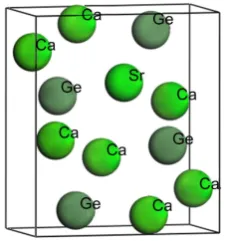
lat-tice constant are a = 7.804 Å, b = 4.896 Å, c = 9.204 Å. Each primitive cell contains 8 Ca atoms and 4 Ge atoms [7]. Figure 1 shows that the position of Ca atom has been the re-place by one Sr atom in the internal coordinate of (0.522, 0.250, 0.676). All the possible structures are optimized by the BFGS algorithm (proposed by Broyden, Fletcher, Gold-farb and Shannon) [8] [9] [10] [11], which provides a fast way of finding the lowest energy structure and supports cell optimization in the CASTEP code [12] [13] [14]. The optimization is performed until the forces on the atoms are less than 0.01 eV/Å, and all the stress components are less than 0.02 GPa, the tolerance in the self-consistent field (SCF) calculation is 1.0 × 10⁻⁶ eV/atom. Ultra-soft pseudo-potentials (USPP) is
ex-panded within a plane wave basis set with 330eV, the iteration convergence accuracy is 1.0 × 10⁻⁶ eV. The energy of Ca
2Ge have been calculated based on the optimization of
structural system, the minimum energy made to be chosen stable structure, the elec-tronic structure and polarization of the dielectric function were calculation. The ionic and electronic interaction was calculated, the Ca 3p 4s, Ge 3p 4s electron made to be chosen valence electron, the k-point sampling are 4 × 5 × 3 according to the Monk-horst-Pack method in the Brillouin Zone (BZ) [15].
3. Calculation Results and Discussion
3.1. The Crystal Structure
Figure 1. The atomic structure of Ca2Ge.
Table 1. Geometric structure of Ca2Ge and doping after optimization.
Sample a/nm b/nm c/nm V/nm3
OrthCa2Ge 7.804 4.896 9.204 351.670 OrthCa2Ge with Sr-doping 7.912 4.931 9.228 360.022
shows that the lattice constants a, b, c and the original cell volume V are slightly changed with Sr-doping. Comparing with the results of Ca2Ge bulk it shows that the lattice
con-stant and volume of Ca2Ge were increased, slightly. The reason is that the atom radius of
Sr is larger than Ge and the bond length of Sr-Ge is longer than the Ca-Ge (the atomic radius of Sr is 2.45 Å, the atomic radius of Ge is 1.52 Å).
3.2. The Electronic Structure
3.2.1. The Energy Band Structure
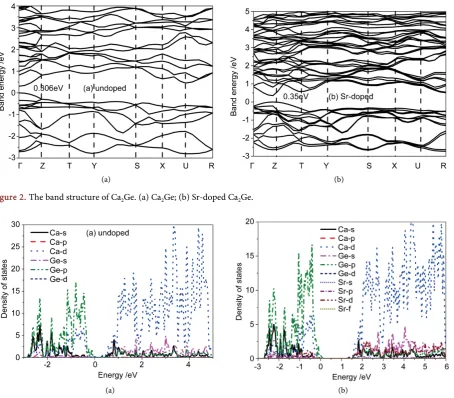
The energy band structure of Ca2Ge bulk for derails see Figure 2. The Figure 2(a)
shows that the Ca2Ge bulk is a direct semiconductor with the band gap of 0.306 eV at
the Γ-point. The Figure 2(b) shows that the top of valence band and the bottom of the conduction are moved to the direction of the high energy with Sr-doped and is formed a direct semiconductor with the band gap of 0.350 eV at the Z-point. The change is that the configurationof extra-nuclear electron of Ca is 3p64s2, the configuration of extra
nuclear electron of Sr is 4p65s2, and the lose electron of Sr is easy than Ca. the results
show that Ca2Ge is a direct band gap semiconductor material with the band gap of 0.35
eV, with Sr-doping.
3.2.2. The Density of States
The density of states of Ca2Ge bulk for derails see Figure 3. The Figure 3(a) shows that
the valence bands are mainly composed of Ge 4p, Ca 3d, the contribution of Ge 3s and Ca 3p are less. The conduction bands are mainly composed of Ca 3d, the contribution of Ge 3p 3s and Ca 3p are less. The Figure 3(b) shows that the valence bands are mainly composed of Ge 4p, Ca 3d, Sr 4d, the contribution of Ge 3s and Ca 3p are less. The conduction bands are mainly composed of Ca 3d, Sr 4d, and the contribution of Ge 3p 3s and Ca 3p are less. The effect of density of states of Ca2Ge bulk with Sr-doped is that
[image:3.595.193.553.241.291.2](a) (b)
Figure 2. The band structure of Ca2Ge. (a) Ca2Ge; (b) Sr-doped Ca2Ge.
[image:4.595.99.548.73.253.2]
(a) (b)
Figure 3. Density of states. (a) Ca2Ge; (b) Sr-doped Ca2Ge.
creased in the conduction bands. The valance bands of Sr-doped Ca2Ge are mainly
composed of Ge 4p, Ca 3d and Sr 4d. The conduction bands are mainly composed of Ca 3d, Sr 4d.
3.3. The Optical Properties
3.3.1. The Complex Dielectric Function
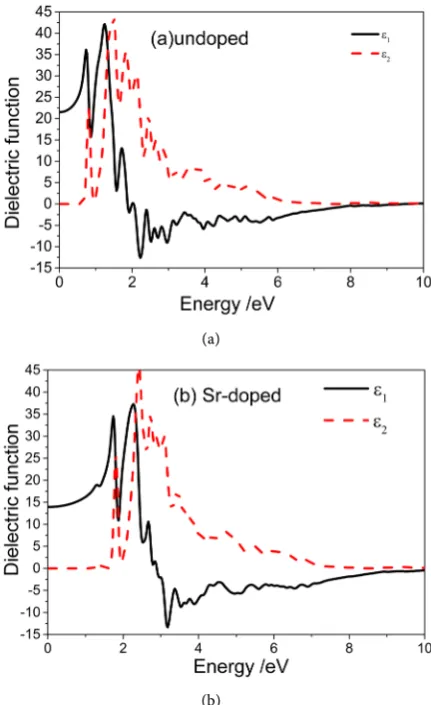
Figure 4 is the dielectric function of Ca2Ge bulk. Figure 4(a) shows that the dielectric
constant of Ca2Ge bulk is 21.5 and the dielectric function department is formed two
di-electric peaks with the photoelectron energy increasing. The maximum didi-electric peak is appeared at 1.3 eV, and the maximum dielectric peak is 42.5. The dielectric function imaginary part is forthcoming when the photoelectron energy is higher than 0.8 eV is formed four dielectric peaks with the photoelectron energy increasing, and it reflect-ed the transition of the electron. Figure 4(b) shows that the dielectric constant Ca2Ge
[image:4.595.103.550.284.466.2](a)
[image:5.595.267.483.71.424.2](b)
Figure 4. The dielectric function. (a) Ca2Ge; (b) Sr-doped Ca2Ge.
dielectric peaks with the photoelectron energy increasing. The maximum dielectric peak is appeared at 2.1 eV, and the maximum dielectric peak is 38.5. The dielectric function imaginary part is forthcoming when the photoelectron energy is higher than 1.8eV is formed two dielectric peaks with the photoelectron energy increasing. The ef-fect of the dielectric function of Ca2Ge bulk with Sr-doped is that the dielectric constant
and the maximum dielectric peak are decreased, and it due to the configuration of ex-tra-nuclear electron of Sr is active than Ca. The results show that the dielectric constant of Ca2Ge bulk is 21.5. The results show that the dielectric constant Ca2Ge bulk with
Sr-doping is 13.9.
3.3.2. The Absorption Spectrum
Figure 5 is the dielectric function of Ca2Ge bulk. Figure 5 shows that the absorption
edge of Ca2Ge bulk is appeared at the photoelectron energy of 0.8 eV, and in the energy
range of 1.8 - 7.3 eV the absorption spectrum more than 10,000. The absorption edge of Ca2Ge bulk with Sr-doping is appeared at the photoelectron energy of 1.8 eV, and in the
Figure 5. The absorption of Ca2Ge.
Figure 6. Reflectivity spectrum of Ca2Ge.
direction with Sr-doping. The results show that the absorption coefficient decreased.
3.3.3. The Reflectivity Spectrum
Figure 6 is the dielectric function of Ca2Ge bulk. Figure 6 shows that the reflectivity of
Ca2Ge bulk is exceed 80% is appeared at the photoelectron energy range of 6.3 - 8.2 eV.
The reflectivity of Ca2Ge bulk with Sr-doping is exceed 80% is appeared at the
photoe-lectron energy range of 7.6 - 8.7 eV. Comparing the reflectivity spectrum found that the reflectivity is moved to the high direction and is decreased the high reflection area with Sr-doping. The results show that the reflection spectrum decreased.
4. Conclusion
The electronic structure and optical properties of orthorhombic Ca2Ge bulk are
calcu-lated by first-principles pseudo potential method based on density functional theory. The results show that the forbidden bandwidth is increased, and the optical properties are enhancedwith Sr-doping.
Acknowledgements
[image:6.595.269.477.233.389.2]References
[1] Manfrinetti, P., Fornasini, M.L. and Palenzona, A. (2000) Phase Diagram of the Ca-Si Sys-tem. Intermetallics, 8, 331-334. http://dx.doi.org/10.1016/s0966-9795(99)00112-0
[2] Palenzona, A., Manfrinetti, P. and Fornasini, M.L. (2002) The Phase Diagram of the Ca-Ge System. Journal of Alloys and Compounds, 345, 144–147.
http://dx.doi.org/10.1016/S0925-8388(02)00326-2
[3] Migas, D.B., Miglio, L., Shaposhnikov, V.L. and Borisenko, V.E. (2003) Comparative Study of Structral, Electronic and Optical Properties of Ca2Si, Ca2Ge, Ca2Sn, and Ca2Pb Structural.
Physical Review B, 67, Article ID: 205203.
[4] Yang, Z.W., Shi, D.M., Wena, B., et al. (2010) First-Principle Studies of Ca-X (X = Si, Ge, Sn, Pb) Intermetallic Compounds. Journal of Solid State Chemistry, 183, 136-143.
http://dx.doi.org/10.1016/j.jssc.2009.11.007
[5] Bouderba, H., Djaballah, Y., Belgacem-Bouzida, A. and Beddiaf, R. (2011) First-Principles Investigations of Intermetallics in the Ca-Ge System. Physica B, 406, 2601-2609.
http://dx.doi.org/10.1016/j.physb.2011.03.075
[6] Tani, J. and Kido, H. (2015) Investigation of Structural, Elastic, and Lattice-Dynamical Pro- perties of Ca2Si, Ca2Ge, and Ca2Sn Based on First-Principles Density Functional Theory.
Computational Materials Science, 97, 36-41.
http://dx.doi.org/10.1016/j.commatsci.2014.10.002
[7] Eckerlin, P. and Wölfel, E. (1955) Die Kristallstruktur von Ca2Si und Ca2Ge. Zeitschrift Für
Anorganische Und Allgemeine Chemie, 280, 321-331.
http://dx.doi.org/10.1002/zaac.19552800509
[8] Broyden, C.G. (1970) The Convergence of a Class of Algorithms the New Algorithm Doub-lerankminimization. Journal of the Institute of Mathematics and Its Applications, 6, 222- 231.
[9] Fletcher, R. (1970) A New Approach to Variable Metric Algorithms. The Computer Jour-nal, 13, 317-322. http://dx.doi.org/10.1093/comjnl/13.3.317
[10] Goldfarb, D. (1970) A Family of Variable Metric Methods Derived by Variational Means. Mathematics of Computation, 24, 23-26.
http://dx.doi.org/10.1090/S0025-5718-1970-0258249-6
[11] Shanno, D.F. (1970) Conditioning of Quasinewton Methods for Function Minimization. Mathematics of Computation, 24, 647-656.
http://dx.doi.org/10.1090/S0025-5718-1970-0274029-X
[12] Segall, M.D., Lindan, P.J.D., Probert, M.J., et al. (2002) First-Principles Simulation: Ideas, Illustrations and the CASTEP Code. Journal of Physics, 14, 2717-2744.
http://dx.doi.org/10.1088/0953-8984/14/11/301
[13] Zhang, F.C., Yan, J.F. and Zhang, Z.Y. (2008) Acta Optica Sinica, 57, 3138-3146.
[14] Feng, J., Xiao, B., Chen, J.C., et al. (2009) Theoretical Study on the Stability and Electronic Property of Ag2SnO3. Solid State Sciences, 11, 259-264.
http://dx.doi.org/10.1016/j.solidstatesciences.2008.04.015
Efficient typesetting and proofreading procedure
Display of the result of downloads and visits, as well as the number of cited articles Maximum dissemination of your research work