Munich Personal RePEc Archive
Outerfactor and the indirect journal
impact
Coralio, Ballester and Alfonso, Rosa-Garcia
Universidad de Alicante, Universidad de Murcia
24 March 2011
Outerfactor and the indirect journal impact
Coralio Ballester
yAlfonso Rosa-García
zMarch 24, 2011
Abstract
In this paper, we use research chains across the citation graph as the basis for journal impact analysis. While some existing measures take into account research chains that end in a given journal, we
calcu-late the proportion of research chains that include a journal, obtaining a new index of journal impact, Outerfactor, that is directly related to Pagerank (Brin and Page, 1998), Eigenfactor (Bergstrom, 2007) and the Invariant Method (Pinsky and Narin, 1976). In this way, the Outerfactor score obtained by each
journal is independent on its own citation pattern and its article share. To our knowledge, this is the …rst measure that satis…fes these invariance properties whilst accounting for both direct and indirect
im-pact. Based on research chains that connect two journals, we also construct new measures for analyzing
cross-impact. This cross-impact analysis results in a two-fold view of Outerfactor in terms of a journal’s in‡uence (impact) on other journals, or a journal’s contribution to all journals’ impact scores. Finally, we
provide an illustration with 60 economics journals, showing how Outerfactor performs compared to other
measures: apart from its cardinal invariance, Outerfactor behaves more robustly to ordinal manipulation than other eigenvector-based measures.
This paper has bene…tted from suggestions provided by participants in the VII REES in Cartagena and seminars at the University of Alicante and at the University of Murcia. Financial support from the Spanish Ministry of Education and Innovation and FEDER, through the project SEJ–2007–62656 (Coralio Ballester) and ECO2010-19830 (Alfonso Rosa-García), is gratefully acknowledged.
yCorresponding author. Departamento de Fundamentos del Anál¬sis Econónomico, Universidad de Alicante, Campus de San
Vicente, 03690 Alicante, Spain. Email: [email protected]
zDpto. de Fundamentos del Análisis Económico. Facultad de Economía y Empresa. Universidad de Murcia, Campus de
1
Introduction
Citation analysis is an area of increasing interest that has become an important tool for research quanti…cation and analysis. Although it is an imperfect measure of research impact, the fact that researchers make references to those papers they have found useful, implies that citation patterns include partial information about the signi…cance of research papers or journals. In this paper, we provide a theoretical framework that is able to accommodate several journal impact measures, we construct a new index of journal impact and we provide an illustration of our results by to a subset of sixty economics journals.
Measures of journal impact assign di¤erent scores to journals depending on their position in a citation graph where journals are represented by nodes and references by links between those journals. The most direct way of quantifying this in‡uence is by counting how many citations a journal receives. Ceteris paribus, a journal receiving more citations is more in‡uential, since each citation can be regarded as a "vote" for that journal. This is the idea behind Impact Factor (Gar…eld, 1955), a measure reported by the Journal Citation Reports since its creation. A journal’s Impact Factor is the average number of citations per article that this journal receives.
However, information in the citation graph can be used in a more extensive way. Direct citation count is only one of many measures that produce information about the importance of nodes in a given citation graph. Other measures weight di¤erently citations received from di¤erent articles or journals, so that the impact of a journal depends on its citations as well as on the impact of its citing journals. Therefore, these measures take into account both direct and indirect impact. Traditional examples are shortest-path centrality, closeness, betweenness (Freeman, 1979), eigenvector centrality (Bonacich, 1987) and the Katz centrality measure (Katz, 1953).
A more recent in‡uential measure of this type is Pagerank (Brin and Page, 1998). In the context of journal citations, Pagerank assigns to each journal the stationary probability of a Markov chain where a random surfer travels across the citation graph, jumping to a random journal with a …xed probability. Pagerank is the founding algorithm used by Google to sort its search results. Several measures that rely on Pagerank have been speci…cally used for journal ranking. For instance, the Invariant Method (Pinsky and Narin, 1976; Palacios-Huerta and Volij, 2004) is closely related to Pagerank, Scopus also assesses journal impact by using Pagerank (González-Pereira et al., 2009). Finally, Eigenfactor (Bergstrom, 2007) uses Pagerank in order to assign di¤erent weights to each journal, and then it counts citations of each journal weighting them by the Pagerank of the source. Eigenfactor is the …rst eigenvector-based measure that has been included in the Journal Citation Reports.
indirect in‡uence. The model relies on the basic concept of a research chain, which is a …nite sequence (or pile) of journals (or papers) connected through references. Intuitively, in this research chain model a researcher starts reading a given article, and then she starts reading another article from the reference list, and so on. At some point, the researcher stops this process, resulting in a chain (pile) of articles. The measure that we propose Outerfactor , is roughly the proportion of research chains in which a given journal is included,i.e., the probability that a paper from this journalappears at least once in the typical
research chain. In this sense, the Outerfactor score of a journal can be regarded as a measure of itsimpact
on other journals. This framework will also allow us to provide cross-journal statistics to measure how a given journal will in‡uence (or contribute to the impact of) any other journal. As we will show, cross-journal analysis will allow for an added interpretation of Outerfactor as a measure ofcontribution to all journals’
Eigenfactor impact.
An interesting feature of Outerfactor is that the score of each journal depends only on other journals’ citation patterns. Therefore, our measure is completely independent of own citation patterns and journali will not be able to increase its score by promoting citations to the journals that often cite journalidirectly or indirectly (or to itself). To our knowledge, no measure taking into account indirect impact has this property. For instance, as we will show, Pagerank, Eigenfactor and the Invariant Method can be interpreted as probabilities of a researcher ending his research chain in a given journal1. Thus, under these measures, a journal is able to increase its score if it generates cycles that return to it, and this is possible even when
the indirect-impact measure ignores (removes) self-citations before calculations are carried out. computation takes place2. However, once a researcher has arrived to a given journal for her …rst time, it is irrelevant to Outerfactor whether she returns to this journal again during the research process. This is the simple reason why the Outerfactor score assigned to a journaliis independent of the structure of citations made by journal i.
Another related property is that a journal’s Outerfactor is invariant to this journal’s article share. In other words, journali’s Outerfactor will be robust to journal i "trying" to increase its score by producing more articles and, hence, increasing the probability that the researcher starts a chain at journal i. This property is also the result of a very intuitive fact: in order to assess a journal’s Outerfactor, no research chain is allowed to start at that journal.
Our contribution possesses four inter-related dimensions. First, we use a simple framework, theresearch
chain model, that relates Pagerank, the Invariant Method, Eigenfactor and Outerfactor in the same setting,
1An equivalent interpretation of these measures is the average number of times that journaliwill appear in a research chain. 2Self-citations are cycles of length one. Meassures of indirect impact typically include longer cycles, for instance of length
allowing us to easily interpret and compare all these measures as well-de…ned probabilities. The research chain model is identical to the Markov model used in Pagerank, it only di¤ers in its interpretation. In Pagerank’s Markov model, a random surfer starts a random walk at a journal (or article) chosen at random from the whole set of journals (or articles). Then the researcher follows citations in the research graph, but with probability 1 2(0;1)she starts a new research chain by jumping to a new randomly selected
journal (or article). This results in a Markov chain, an in…nite walk where every journal will be visited with a stationary probability, its Pagerank score. However, in the research chain model, we focus on the typical (average) research chain which has …nite length almost surely, that is, on any research chain formed between these random jumps. In this framework, it is easy to frame and compare all these eigenvector-based measures. More speci…cally the Pagerank and Eigenfactor scores for a journali are probabilities of ending at journaliin a research chain3. Similarly, journali’s Outerfactor is the probability of using (at least once) any article from journali in the typical research chain. We point out that the research chain model (and the set of measures we propose) is still valid when the researcher is assumed to perform more than one but a…nite number of research chains.4 The model enables us to provide a closed-form formula for our measure
as a function of Pagerank and Eigenfactor.
Second, to our knowledge Outerfactor is the …rst impact score that takes into account both direct and
indirect citations, whilst preserving the invariance to own-citation patterns and to article shares. Impact factor (when self-citations are removed) is invariant to own-citation patterns but it does not take into account indirect citations. Pagerank, Eigenfactor and the Invariant Method take into account indirect citations but they do depend on own-citation patterns (even when self-citations are removed). The increasing importance of impact measures in research evaluation makes these properties specially pertinent. Several scientometric measures are often used by research evaluation committees and institutions as a tool to obtain partial information about a candidate’s research performance. Moreover, journal impact is also used by libraries when deciding which journals they will subscribe. Therefore it is important to evaluate this impact with measures that are as robust to manipulation by journals/authors as possible.
As the vast majority of measures of journal impact, Outerfactor is cardinal in nature. In our model, cardinal comparisons of Pagerank, Eigenfactor or Outerfactor have a straightforward meaning: journal i receives twice the score of journalj ifi is twice as used asj.5
3The Invariant Method will be the same probability when the typical research chain has length that grows to in…nity, that
is, when tends to1.
4To see this, note that ifOFi is the Outerfactor score of journali, and the researcher follows Kdi¤erent research chains,
then its adjusted Outerfactor forKtrials would be1 (1 OFi)K . This is increasing inOFi, so that the ranking of journals will be the same.
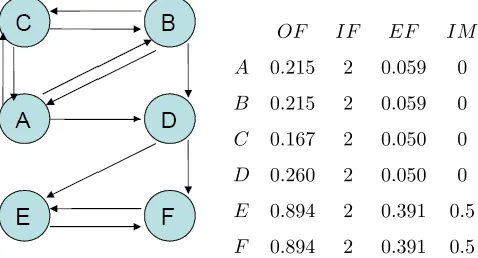
An interesting consequence of the invariance properties of Outerfactor is that if we have two journals that receive exactly the same citations from the same set of journals, Outerfactor assigns a higher score to the journal which cites relatively less this set of reference sources. Why? Because the less citing journal obtains indirect impact from the more citing journal. On the contrary, Eigenfactor, Impact Factor and the Invariant Method will give the same score to both journals. We illustrate this fact in Figure 1:
OF IF EF IM
A 0:215 2 0:059 0
B 0:215 2 0:059 0
C 0:167 2 0:050 0
D 0:260 2 0:050 0
E 0:894 2 0:391 0:5
[image:6.612.186.425.241.370.2]F 0:894 2 0:391 0:5
Figure 1: Outerfactor (IM), Impact Factor (IF), Eigenfactor (EF) and Invariant Measure (IM)
for a set of 6 journals with 10 articles each. Each link represents 10 citations.
Each node represents a journal. All journals have 10 articles. Each link represents citations from journal to journal, and for simplicity we suppose that every link represents 10 citations. Thus, 50% of journal C’s citations go to journal B and 50% to journal A. An instance of a research chain could be (A,B,D,E), or (C,B,C) where the latter chain starts with an article from C, citing an article from B, citing an article from C, and …nally the research chain ends. Therefore, the chain (C,B,C) occurs with probability 1
6
2(1 )in
the research chain model. All journals receive 2 edges (20 citations), therefore they are scored equally by Impact Factor (IF). Outerfactor (OF) and Eigenfactor (EF) take into account both direct and indirect impact by weighting di¤erently citations from di¤erent journals. They assign the highest score to E and F. Nevertheless, they value journals C and D in a di¤erent way. In particular,EF assigns the same score to C and D because they receive the same citations from the same set journals. However, OF ranks D over C, because it does not take into account own citation patterns so that the value received by D through A and B is increased by indirect impact of C, while there is no indirect impact from D to C through A and B.
Third, the research chain framework allows for the measurement of cross-e¤ects between any two journals.
Cross-e¤ects are an extension of cross-citations to include both direct and indirect impact. We divide these
e¤ects into two classes of measures: in‡uences and contributions. On the one hand, cross-in‡uence of journal i on journal j refers to how often articles from journal i are used in research chains that started at journalj, that is, how journalj cites directly or indirectly journali. In simple words, cross-in‡uence is accounting for the impact of one journal on another. In this paper, we introduce two measures of cross-in‡uence: Eigen-in‡uence and Outer-in‡uence. On the other hand, cross-contribution of journali to journalj’s impact refers to how much ofj’s impact score (measured by Eigenfactor) is due to journali, i.e., how often citations made to journaljmake direct or indirect use of journali. In other words, our coe¢cients of cross-contribution measure how much journal iis responsible for journalj’s impact score. We introduce closed-form expressions for all cross-e¤ects as functions of the Pagerank (or Eigenfactor) of journalsiandj. More importantly, measuring these cross-e¤ects will allow us to provide an important two-fold interpre-tation of Outerfactor: a journal’s Outerfactor can be seen as its average impact (in‡uence) on other journals, or as itscontribution to the all journals’ impact scores (measured by their Eigenfactor).
Finally, we illustrate all measures for a subsample of 60 economics journals. We compute Outerfactor and compare it with Impact Factor, Eigenfactor Pagerank and the Invariant Method. Results show that the rankings provided by Outerfactor are very similar to those by Eigenfactor, but both scores have cardinal di¤erences that become evident when we normalize them by the number of articles in each journal.6 Moreover, we show that our measure displays a higher resistance to ordinal manipulation in several aspects, like the strategic deletion/addition of references or articles. Additionally, we show that the ranking obtained by Outerfactor is very robust to the existence of self-citations, meaning that Outerfactor is already controlling for the possible undesirable e¤ects of self-citations and that they need not be arti…cially excluded from the data. We …nally compute all of cross-e¤ects for this subset of journals.7
2
The model
2.1
Research chains
Our model relies on the notion ofresearch chain, which we use as the basic tool for measuring journal impact.
A research chain is a …nite sequence of journals8 (for instance, a pile of articles) that a researcher uses during
6When we divide Eigenfactor by the share of articles we obtain Article In‡uence, which is the main eigenvector-based measure
provided by JCR that can be compared to Impact Factor.
7Di¤erences in the Impact Factor that we report with respect to JCR are mainly due to the fact that we present a simple
illustration with a subset of 60 economics journals, while JCR uses all citation data from social sciences.
8We perform our analysis on journals, as in the Journal Citation Reports, Palacios-Huerta and Volij (2004), Vergstrom
her research process.
LetJ be a …niteset of journalsandsi>0the number of articles published by journali. Letathe vector of article shares, that is, ai = si=Pj2Jsj > 0. Citation patterns are summarized through the jJj jJj
citation matrix C, where each entry cij denotes the number of citations from journal j to journal i in a speci…c period of time. Letci=Pjcjibe the number of citations made by journali.
We remove self-citations by making the entries in the diagonal equal to zero. Hence, it is assumed that
cii = 0for alli2J.9
In order to describe the research chain process, let us de…ne the matrix H, where
hij= 8
<
:
cij=cj if cj>0
0 if cj= 0
Each entryhijrepresents the proportion of citations made byjthat are pointing toi. We say that a journal
iis adangling node if it makes no citations to other journals, that is,ci= 0. We assume that there are no dangling nodes, that is, every journal cites at least once some other journal. This assumption is reasonable for the vast majority of scienti…c journals. ThusP
ihij= 1for every journalj, i.e.,His column stochastic.10 We de…neHi as thei throw vector ofH.
A research chain is generated as follows. The researcher starts the chain in a randomly selected article,
i.e., journalk will be selected with probabilityak. At each moment in time when she is at journalj, with probability0 <1she will follow the reference list to read a new journal cited byj; and with probability
1 the research chain will terminate. In case of continuation, the researcher will step from j to i with probability given byhij. The matrixH de…nes the transition probabilities between journals in this process. More formally a research chain in H is a …nite sequence of journals = (j0; j1; : : : ; jm) such that hjl+1jl>0for0 l < m. In this random process, journaljo is initially chosen with probabilityaj0. At any
moment in time, when the research process is at journalj, it will continue to journaliwith probability hij,
9This is inessential to our theoretical contribution. We perform this step in our data in order to fairly compare Pagerank
(Brin and Page, 1998), Eigenfactor (Bergstrom, 2007) and Outerfactor in the same citation setting, since the computation of Eigenfactor removes self-citations from the matrix C. However, the invariance properties of our measure (Outerfactor), and speci…cally the independence of the score with respect to own cittation pattern, also hold when self-citations are not deleted from the citation graph. Moreover, as we show in our examples with 60 economics journals, Outerfactor is very robust to the consideration of self-citations as part of the citation patterns.
10A typical scienti…c journal includes citations to other journals. However, dangling nodes can be incorporated into the model
and it will terminate with probability1 . Thelengthof a particular research chain like(j0; j1; : : : ; jm)is m. The length of the typical research chain, that is, the expected amount of journals visited by the researcher in this random process, is given byl( ) = =(1 ). We adopt a value of = 0:85, which corresponds to a process where our random researcher follows chains of an average length ofl( ) = 6journals,i.e.,the size
of the typical research pile is 6 articles.11
As an example, consider the following case with three journals J =fA; B; Cg, whereA has 10 articles, B has 6 andC has 4. Their mutual citations are
Example 1
Then, the corresponding matrices are
s = 8 > > > < > > > : 10 6 4 9 > > > = > > > ;
;a=
8 > > > < > > > :
0:5 0:3 0:2
9 > > > = > > > ; C = 8 > > > < > > > :
5 10 0 3 5 4 2 5 1
9 > > > = > > > ;
;H=
8 > > > < > > > :
0 0:67 0 0:6 0 1 0:4 0:33 0
9 > > > = > > > ;
2.2
Impact Factor, Invariant Method, Pagerank and Eigenfactor
We now describe some of the existing measures in the literature and we also settle them in the research chain framework.
De…nition 1 The Impact Factor of journali is
IFi= P
jcij si
11The value = 0:85was proposed by Brin and Page when implementing Pagerank in Google. It is the value usually adopted
Impact Factor is reported for a sample of 8000 journals by the Journal Citation Reports. It assigns to each journal the number of citations that point to it, divided by citable items in the journal.
De…nition 2 The Invariant Method score of journali is
IMi= i si
,
where is the principal eigenvector ofH.12
In their in‡uential article, Palacios-Huerta and Volij (2004) showed that the Invariant Method can be characterized as the unique ranking method that meets four properties.
For0< <1, let
Q= H+ (1 )a e>
whereeis a vector of ones.
The Pagerank vectorq(Brin and Page, 1998) of journals is de…ned as the principal (probability) eigen-vector ofQ, and it is a function of ,H anda. Pagerank is the centrality measure used by Google in order
to assess the signi…cance of webpages. It is the stationary probability of a Markov chain on the matrixQ.
The following straightforward result frames Pagerank in the setting of the typical research chain of …nite length that we de…ned.
Lemma 1 The probability that a typical research chain terminates at journali is given byqi.
12The Invariant Method assumes that the matrixHis irreducible and this results in a well-de…ned unique principal eigenvector
ofH.
According to Palacios-Huerta and Volij (2004), the Invariant Method is the vectorvthat solves
A 1CD 1 C Av=v,
that is,vis the principal eigenvector of
A 1CDC1A.
In our notation,
H=CDC1
Moreover,Ais a positive diagonal matrix such that its entryaiiis the number of articles of journali,siin our notation. The principal eigenvector of His the vector that solves
H = , and therefore
Eigenfactor is a successful measure of journal impact (Bergstrom, 2007; Fersht, 2009), which has been included in the Journal Citation Reports since its 2008 Edition. It is a linear transformation of Pagerank.
De…nition 3 The Eigenfactor score (Bergstrom 2007) of journal iis the probability vector13
EFi=Hi q. (1)
Since Impact Factor counts citations and Eigenfactor (and Pagerank) weights them by impact of the citing journal, they have been interpreted as measures of "popularity" and "prestige", respectively. One of the main advantages of Eigenfactor, the Invariant Method and Pagerank with respect to Impact Factor is that Impact Factor only accounts for direct impact by counting references. However, Eigenfactor, the Invariant Method and Pagerank take into account both direct and indirect impact of journals, by assigning more weight to citations coming from more relevant journals.
In the research chain model, Eigenfactor also has a straightforward interpretation as summarized in the following lemma.
Lemma 2 The probability that a typical research chain of length 1 terminates at journal i is given by
EFi.
Lemmas 1 and 2 deliver a new neat probabilistic relationship between Pagerank and Eigenfactor that is not feasible if we restrict to the Markov chain interpretation. Both Pagerank and Eigenfactor are measuring a journal’s impact by the probability of terminating at that journal in a research chain. The only di¤erence between them is that theEF assumes that at least one citation has been followed by the researcher. This is a reasonable adjustment with respect to Pagerank when analyzing journal impact since journals with a high article share are receiving a high Pagerank score. In particular, it is clear that qi (1 )ai, where this bound corresponds to the Pagerank of an non-cited journal when the research chain has length zero. On the contrary, Eigenfactor’s conditioned probability is bounded below by zero. In fact, if a journal receives no citations its Eigenfactor score will be zero.
The following result relates both Pagerank and Eigenfactor in the opposite direction to (1) through a simple closed-form expression:
13The Eigenfactor measure is in fact de…ned by its creators as:
EFi= Hi q
0 P
j2JHj q0
whereq0is the Pagerank of an adjusted matrixH0that deals with dangling nodes assuming that they cite all journals according
to their article share,i.e,ifjis a dangling node thenh0
ij=aifor alli. Since we are assuming that there are no dangling journals,
thenH0=H. Consequentlyq0=qandPj2JH
0
j q
0=P
j2JHj q= 1because His column-stochastic andPi2Jqi= 1.
Lemma 3 Pagerank and Eigenfactor are related as follows
qi= EFi+ (1 )ai.
The interpretation of lemma 3 is simple. The Pagerank of journal i is an average between its article share ai (the score that i obtains when the research chain has length zero) and its Eigenfactor score EFi (the corresponding score when the research chain has positive length).
Remark 1 Bothqi andEFi are functions of ,Handa. In particular,qi andEFi can vary with citations
(hji)j2J made by journali, and withi’s article shareai. Also, the Invariant Method score assigned to journal i,IMi, is not independent of (hji)j2J orai.
In Appendix I, we illustrate with an example how a journal can change its Eigenfactor, Invariant Method and Pagerank scores by modifying its citation pattern or its article share.
2.3
Outerfactor
LetRbe the matrix
R= (1 ) (I H) 1
Each entryrij ofRis the probability that a research chain starting from journalj will terminate at nodei (see Appendix).14
We introduce a new measure Outerfactor that complements Eigenfactor naturally in the analysis of journal impact. It is the probability that a journal is used (at least once) in a research chain. We now provide a closed-form formula for Outerfactor as a function of Pagerank (or Eigenfactor, by lemma 3).
De…nition 4 The Outerfactor (OF) of journal i is de…ned as
OFi= qi rii ai
(1 ai)
.
As before, the research chain model accommodates Outerfactor easily.
Proposition 1 OFi is the probability that a research chain of length 1 that does not start from journali
uses journali.
14The inverse is well-de…ned becauseHis a non-negative matrix andj j<1. Moreover,Ris a column-stochastic matrix,
Outerfactor divides Pagerank qi of the journal i by its corresponding diagonal entry in R. The entry rii of Ris the probability that a research chain that starts from journal i will also terminate at i: In the Appendix, we compute the score obtained by the journals in Example 1 with di¤erent impact measures.
There are two important di¤erences between Eigenfactor and Outerfactor. The main di¤erence is that
EF measures the chance ofterminating at a journal in a research chain, whileOF accounts for the likelihood of using that journal in a research chain. Thus, once journal i is reached for the …rst time in the chain,
OFi does not account for subsequent uses of journal i in the research chain. This subtle di¤erence in the
de…nition of probabilities has deeper implications in the manipulability of the scores as we will show in the next paragraphs. A second di¤erence is that OFi only considers chains that do not start from journal i, while EFi considers all journals as potential starting points. This adjustment is done as a normalization since the (Outerfactor) probability of using journaliwould be bounded below byai otherwise, which would correspond to the case where a research chain starts at journal i and then this journal would be trivially used.
Measures that take into account indirect impact typically improve information, since they assign higher values to those journals cited by more relevant journals, which are usually assumed to reference to high quality research. This notion is also behind the success of Google Pagerank algorithm when assessing the importance of webpages.
Remark 2 Invariant Method, Pagerank, Eigenfactor and Outerfactor take into account indirect impact,
while Impact factor does not.
The parameter controls the average length of the research chain. Brin and Page (1998) initially proposed
= 0:85for Pagerank, which has become a standard value. In our framework, a lower value of implies to give a higher value to shorter research chains, and a higher value of implies to give more weight to longer chains. When !1, Pagerank and Eigenfactor tend to the in…nite stationary Markov process onH, the
Invariant Method.
When !0,qi is just the probabilityai, while Outerfactor and Eigenfactor are closely related15: both measures report the share of other journals’ citations that point to a given journal. In this case, only research chains of length 1 matter, and then the concepts of a research chainterminating orusing a journal
are equivalent. The only di¤erence comes from the fact that Outerfactor accounts for research chains that do not start from the journal, while this possibility is included in Eigenfactor. To summarize, when !0
Eigenfactor and Outerfactor are related as follows
lim
!0OFi= lim!0
EFi
1 ai
=
P
j2Jajhij
1 ai
which is imply the probability of arriving to journali in exactly one step when the research chain does not start ati.
In our …rst main result, we highlight one important dissimilarity between OF and the other measures: the chance of using journali in a research chain is independent of the citation pattern ofi, as opposed to remark 1.
Theorem 1 OFi is invariant with respect to i’s citation pattern(hji)j2J.
This result is a direct consequence of the probabilistic interpretation of Outerfactor in the research chain model given in Proposition 1. SinceOFi measures the proportion of chains that use journal i, it does not depend on the citations made byi. This is the case because once journal i is reached in a research chain,
OFi will not account for future appearances of journali in that chain. This is in contrast with Eigenfactor
or Pagerank: under these scores, journal i could increase the likelihood that a chain terminates at i by referencing journals that point to idirectly or indirectly. Even when self-references are removed from the citation matrix C, this does not prevent Eigenfactor or Pagerank from being manipulated in this manner.
In Appendix I, we show how a journal can manipulate its own Eigenfactor or Invariant Method by changing its citation pattern, while Theorem 1 shows that this is not the case with Outerfactor.
This has immediate implications when the actual rankings are obtained withEF andOF. With Eigen-factor manipulation can occur if journal i starts citing journals that have cited it, because this generates cycles that can increase journal i’sEF score. As a consequence, journals forming small and closed groups are usually bene…ted from the existence of these cycles in the citation graph. This is not the case with OF which basically considers the mere use of journals: once a journal is visited by a research chain for the …rst time, Outerfactor will not consider subsequent visits to this journal in order to assess its impact.
The most basic form of Impact Factor uses total cites received by a journal, including self-citations. Ma-nipulability of Impact Factor can be easily addressed, by deleting self-references. This measure is known as the Impact factor without self-references. Nevertheless, it only takes into account direct impact. Eigenfac-tor and Pagerank also include indirect impact but this inclusion triggers undesirable manipulability issues. Outerfactor is a …rst step towards reconciling the inclusion of indirect impact with the robustness to manip-ulation, because it does not take into account the e¤ect ofi’s citations on i’s score.
and therefore it could potentially decrease Outerfactor of other journals in order to increase its own relative position. However, in our illustration with 60 economics journals, we will show how Outerfactor performs very well against ordinal manipulation.
An additional property of Outerfactor is that a journal’s score is independent of its article share. Once again, this invariance property is a consequence of Proposition 1: If research chains considered inOFicannot start at journal i then the probability of using journal i does no longer depend on i’s article share, given that article shares only determine where the research chain starts. This property is unique to Outerfactor and it is summarized in the following result.
Proposition 2 OFi is invariant toai.
Finally, we note that Pagerank, Eigenfactor and Outerfactor are measures ofglobal impact, that is, they are not computed in a per-article basis. We think that a measure of global impact should be independent of the article share, and this is what Outerfactor does. In particular, if a journal produces new non-cited articles (without changes in the matrix H) its Outerfactor will not change as a measure of global impact.
Nevertheless, as we mentioned before, this invariance to own article share constitutes a pure normalization of the measure. However, it is always convenient to normalize by the share of articles in order to assess the true average impact of a journal.
Impact Factor measures impact per article by dividing the measure of global impact of the journal (the total amount of citations received in the period) by the number of articles. Invariant Method also reports impact per article. Eigenfactor considers per-article impact by dividing a journal’s impact by its share of articles, which is known as the Article In‡uence (AI) of that journal and is also included in the Journal Citation Reports:
AIi = EFi
ai
Following this line, we analyze impact per article in our framework by dividing Outerfactor by the article share, resulting in a new measure of per-article impact, Article-Outerfactor (AO):
AOi= OFi
ai
The following corollary is a direct consequence of proposition 2, and it states that if a journal increases its number articles while keeping the citations it receives (H constant), then it will decrease its per-article
Outerfactor score.
This property is also satis…ed by Impact Factor, but not by Article In‡uence: a new article by journal
ihas a direct negative e¤ect on AIi by increasing the denominator and an indirect e¤ect by changing EFi
that can be positive or negative.16
2.3.1 Other Impact Measures
There have been proposed di¤erent ways of quantifying journal impact and a number of these approaches take into account both direct and indirect impact. Although self-references are usually deleted in order to alleviate the problem of manipulation, none of these measures circumvents the problem of manipulation when indirect impact is considered, which is precisely the main feature of Outerfactor.
The Liebowitz-Palmer measure (Liebowitz and Palmer, 1984) also considers both direct and indirect impact. However, it can also be manipulated if a journal increases the number of its citations pointing to journals that cite it. Note that this strategy can be used by deleting self-citations. A successful measure of impact is the H-Index (Hirsch, 2004), which is the maximal numberhof articles of journalisuch that each one is cited at leasthtimes.17 This notion can avoid manipulation just by not using self-citations, but as in the case of Impact Factor, it does not take into account indirect impact.
Kóckzy and Strobel (2010) address the problem of manipulability providing a ranking score which is non manipulable through addition of new references. They compare two journals by mutual references, and assign to each journal the amount of times that it gets more citations than its rival. This kind of rankings are known as "tournaments", and the ranking they propose is similar to the one typically used in sports leagues. This measure can be manipulated by decreasing the number of references that a journal makes to other journals, but Kóckzy and Strobel reasonably argue that this behavior would not be accepted in the research publication process.18
2.4
Cross-E¤ects
In this section, we take advantage of the research chain framework in order to address the problem of analyzing cross-e¤ects between pairs of journals. We do so by studying the interactions between any pair of
16Eigenfactor can be adjusted in order to make it invariant to own article shares. The formula
g
EFi= qi airii
(1 ai) =riiOFi
is the probability that a research chain not starting at journaliwill terminate ati, which does not depend onaiby de…nition.
17Although H-Index was initially proposed for ranking scientists, it is also used for journals.
18Kóckzy and Strobel meassure does not take into account indirect impact. However, it can be easily incorporated in their
journals in the same research chain. We propose di¤erent ways of measuring these cross-e¤ects that allow us to understand the interplay of journals in determining journal impact, taking into account both direct and indirect relationships. These measures of cross-e¤ects can be understood as assessments of how a journal is in‡uenced or impacted by others (cross-in‡uence), or how large is the contribution of a journal to the impact score of others (cross-contribution). Propositions 4 and 6 provide adouble interpretation for Outerfactor: it
can be understood as an average in‡uence of a journal on other journals, or as its average contribution to all journal’s impact. Proposition 3 also gives an interpretation of Eigenfactor as the average in‡uence of a journal on all journals.
2.4.1 Cross-In‡uence
Cross-in‡uence of journali onj refers to the relevance of journal ito another journal j, by analyzing the pattern of direct and indirect citations from journalj to journali. In simple words, it refers to the impact that journal i has on j. In the simplest case of direct impact, cross-in‡uence is the proportion of direct citations from journalj to journal i and this proportion shows how in‡uent is journal i on journalj. We extend this intuition in order to incorporate indirect impact in the research chain model. We introduce two new probabilities that incorporate this idea: Eigen-in‡uence of journal i in journal j (EIij), which is the proportion of research chains starting fromj that terminate ati; and Outer-in‡uence of journaliin journal
j (OIij), which is the proportion of research chains starting fromj that include (use) journal i. Therefore,
these two probabilities capture how relevant is journali for the research published in journalj. Note that both probabilities converge to the simple case of direct impact if we account only for research chains of length 1, which occurs when !0.
De…nition 5 The Eigen-in‡uence of journal iin j is.
EIij = rij
,
and fori=j
EIjj=
rjj (1 )
.
In the research chain model, EIij is the probability that a research chain of length 1 that starts at journal j will terminate at node i.19 Consequently, P
iEIij = 1 for all j 2 J. The following result is straightforward by using the Bayes rule
19All cross-e¤ects expressions and their interpretation as probabilities in the research chain model are relagated to the
Proposition 3 The Eigen-in‡uence EIij is the probability that a research chain of length 1 that starts
at journal j will terminate at nodei. Moreover, journali’s Eigenfactor is the weighted average of its
eigen-in‡uence on all journals:
EFi = X
j
ajEIij.
We note that EIij is independent ofa, but not of citations made by journali’s.
De…nition 6 The Outer-in‡uence of journali inj is
OIij = EIij
rii
,
and fori=j
OIii= 1.
OIij is the probability that a research chain of length 1that starts at journal j will use journali.
Proposition 4 The Outer-in‡uenceOIij is the probability that a research chain of length 1that starts at
journal j will use journali. Moreover, the Outerfactor of journalican be expressed as the weighted average
of its outer-in‡uence on other journals:
OFi = X
j6=i aj
1 ai OIij.
Interestingly,OIij is independent of both journali’s citation pattern andai.
2.4.2 Cross-Contribution
The idea of cross-contribution refers to how a journali contributes to the impact of journalj. This notion is di¤erent from cross-in‡uence where we study how often iis cited by j; now we study the chance that i appears in chains that increase j’s impact (wherej is cited). Once again, we propose two usable measures that are equivalent when we restrict to direct citations ( !0).
De…nition 7 The Eigen-contribution of journali to journalj’s impact is, fori6=j,
ECij = airji
EFj
,
and fori=j
ECjj=
aj[rjj (1 )] EFj
In the research chain model, ECij is the probability that a research chain of length 1 that terminates at journal j started at journal i. Clearly, P
iECij = 1. More importantly, from this interpretation we derive thatECij is a measure of the contribution of journali to journalj’s EigenfactorEFj. For instance, ifECij = 0:2, it means that journal icontributes to 20%of journal j’s eigenfactor because journal iis the starting journal in20%of all chains terminating atj. ECij depends on citations made byiand onai, since iis the starting point of all chains accounted for by this measure.
Proposition 5 The Eigen-contribution OCij is the probability that a research chain of length 1 that
terminates at journalj started at journal i. Moreover,
X
j
EFjECij =ai.
De…nition 8 The Outer-contribution of journal ito to journal j’s impact is, fori6=j,
OCij =
1rji rii
qi EFj
.
and fori=j
OCii= 1.
As we show below,OCijis the probability that a research chain of length 1that terminates at journalj uses journali. The Outer-contribution score captures the contribution of a journal to other journals’ impact measured by Eigenfactor, because it restricts precisely to chains of positive length that end at journals, that is, those chains that form the Eigenfactor score. Note that,P
iOCij 1 since using one journal in a chain does not exclude the possibility of using another journal. OCij is capturing the contribution of journal ito journal j’s eigenfactorEFj in a di¤erent way than ECij does: when OCij = 0:2, journal i contributes to
20% of journal j’s eigenfactor because journali is used at least once in20%of all chains terminating at j. Now, we provide an expression of the Outerfactor of a journal as the average contribution to other journals impact measured by Eigenfactor: the Outerfactor of journal i is its average contribution to all journals’ Eigenfactor scores.
Proposition 6 The Outer-contribution OCij is the probability that a research chain of length 1 that
terminates at journal j uses journal i. Moreover, journal i’s Outerfactor can be expressed as the weighted
average of its outer-contribution to other journals’ impact:
OFi= X
j EFj
OCij ai
1 ai
The averaging weights are given by EF. The ratio (OCij ai)=(1 ai)is just the same contribution probability as OCij conditioned on the initial node of the research chain not being journal i. This ratio is an a¢ne transformation on OCij and it is independent ofai and it is essential in relating Outerfactor and Outer-contribution sinceOFi is conditioned on the initial journal not beingi. Finally, we note thatOCij is
not independent ofi’s citation pattern even when it is accounting for chains that usei. This is so because
we analyze research chains that arrive at j after crossing i. Therefore, these research chains go throughi’s references and are sensitive toi’s citation structure. Similarly,OCij is not independent ofi’s article share because a higher proportion of research chains pointing toj start in (and therefore includes) journaliwhen this journal increases its article share.
All these measures of cross-in‡uence can be used for analyzing mutual impact of journals, as well as a basis for building new rankings. Other rankings of journals take as the basic notion of in‡uence the number of direct citations among journals. Our measures of cross-in‡uence are extensions of citations in order to include also indirect impact, and therefore, they contain richer information than direct citations. For instance, Kockzy and Strobel (2010) propose a tournament to rank journals, by comparing their cross-citations two by two, and assigning points to the journal with the highest number of citations in each comparison. The same procedure can be developed using our measures of cross-in‡uence instead of direct citations, with the additional advantage is that our measures incorporate both direct and indirect impact. Another possible application of this approach would be to construct a ranking based in the H-index, where citations can be substituted by direct and indirect research chains with an appropriate normalization.
3
Evaluating impact of economics journals
3.1
A comparison
We computed rankings and scores for a citation graph with 60 economics journals20. We have obtained the citation data from the JCR 2009. Citation data for each journal i are the citations made by journal i in 2009 to articles published between 2004 and 200821. In all relevant cases, we use = 0:85corresponding to an average chain length of6.
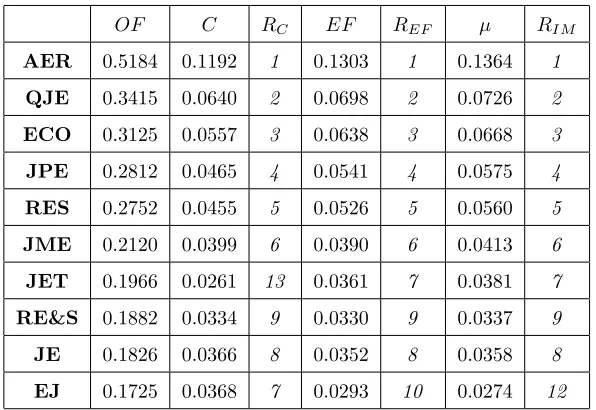
In Table 1 we show the di¤erent non-normalized impact measures (that is, not normalized by article
shares) for the Top 10 journals according to Outerfactor (OF), as well as total share of citations (C),
20We take the 60 economics journals from the JCR with the highest Article In‡uence score (AI). Recall thatAIi=EFi=ai. 21We have considered a ciation window of 5 years, which is the one that uses Eigenfactor in its computation. The JCR reports
Eigenfactor (EF) and the non-normalized Invariant Method (that is, i = aiIMi). We also show the rankings that result from all these measures. For the sake of comparability, we have deleted all self-citations from the citation matrixC before computing these measures.
OF C RC EF REF RIM
AER 0.5184 0.1192 1 0.1303 1 0.1364 1
QJE 0.3415 0.0640 2 0.0698 2 0.0726 2
ECO 0.3125 0.0557 3 0.0638 3 0.0668 3
JPE 0.2812 0.0465 4 0.0541 4 0.0575 4
RES 0.2752 0.0455 5 0.0526 5 0.0560 5
JME 0.2120 0.0399 6 0.0390 6 0.0413 6
JET 0.1966 0.0261 13 0.0361 7 0.0381 7
RE&S 0.1882 0.0334 9 0.0330 9 0.0337 9
JE 0.1826 0.0366 8 0.0352 8 0.0358 8
[image:21.612.90.388.197.402.2]EJ 0.1725 0.0368 7 0.0293 10 0.0274 12
Table 1. non-normalized measures. ColumnsOF; C; EF and report scores of each journal
andRC; REC andRIM are ranking positions. The table for the whole set of 60 journals appears in the Appendic.
American Economic Review is ranked as the journal with highest impact according to all non-normalized measures. Although it receives 11.92% of all citations, the proportion of all direct and indirect citations that point to it is higher, 13.03% in the case of Eigenfactor and 13.64% with the Invariant Method. The top 5 journals increase their shares by considering indirect impact. Outerfactor reveals that any of these top 5 journals is present in more than 27% of all research chains, being the American Economic Review in 51.84% of all research chains. The six highest ranked journals coincide in all rankings; and very similar orderings are obtained for the three normalized measures of indirect impact (Outerfactor, Eigenfactor and the non-normalized Invariant Method). When only direct citations are used (C), the Journal of Economic Theory gets a much lower score that when any type of indirect impact is used. As opposed to other measures, OF ranks the Review of Economics and Statistics over the Journal of Econometrics.
114:00%, 104:23% and 104:19% higher than ECO). However, this is not the case with Outerfactor, where AER gets a probability of use65:89% higher than ECO. These di¤erences in the score are due to the fact that Outerfactor focuses on the event of using (at least once) a journal, whilst all other indirect measures take into accountall visits to a journal during the research process.
Table 2 shows all measures normalized by share of articles: Article Outerfactor (AO), Impact Factor
(IF), Article In‡uence (AI) and the Invariant Method (IM).
AO IF RIF AI RAI IM RIM
JPE 31.37 5.19 1 6.03 1 6.41 1
QJE 27.47 5.15 2 5.62 2 5.84 2
BPEA 24.21 2.86 6 3.75 3 4.00 3
RES 19.04 3.15 5 3.64 4 3.87 4
JEL 18.56 3.16 4 3.00 6 2.98 6
ECO 17.72 3.16 3 3.62 5 3.79 5
RJE 14.64 2.36 7 2.55 7 2.60 7
JLE 13.93 2.15 9 2.24 10 2.31 11
JEP 13.59 2.36 8 2.33 8 2.37 10
[image:22.612.165.431.252.456.2]REDC 13.08 1.66 13 2.15 11 2.40 8
Table 2. Measures normalized by article shares. IF is computed asC=ai.
Appendix B reports the table for the 60 journals.
that a relatively important part of its impact is due to the citations it makes. In our sample, AER is in the 9th position underAI and IM, and in the 10th position under citations, but it falls to the 13th position under Article Outerfactor.
3.2
Including self-citations
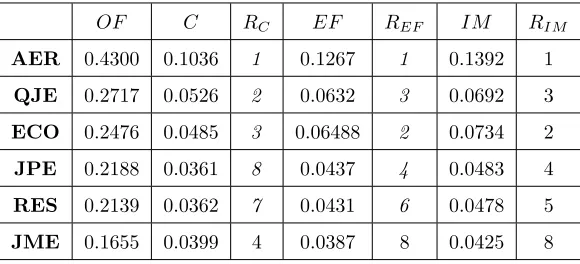
The popularity and wide use of Impact Factor has been argued as the motivation of journals in order to in‡ate their impact through self-citations (Smith, 1997). The JCR reports Impact Factor as well as the Impact Factor without self-references. The Eigenfactor score used in JCR is also computed by discarding self-citations. This methodology is used in order to alleviate the problem derived from the incentives of journals to increase their citations, although it implies to put apart relevant citation information. In order to analyze these di¤erences, we have computed new scores when self-citations are included. Table 3 reports the Top 6 ranking for our impact measures per journal. Remember, as Table 1 shows, that the four ranking methods coincide in their Top 6 ranking after deleting self-citations, while now it is not the case:
OF C RC EF REF IM RIM
AER 0.4300 0.1036 1 0.1267 1 0.1392 1
QJE 0.2717 0.0526 2 0.0632 3 0.0692 3
ECO 0.2476 0.0485 3 0.06488 2 0.0734 2
JPE 0.2188 0.0361 8 0.0437 4 0.0483 4
RES 0.2139 0.0362 7 0.0431 6 0.0478 5
[image:23.612.171.461.383.515.2]JME 0.1655 0.0399 4 0.0387 8 0.0425 8
Table 3. Rankings including self-citations
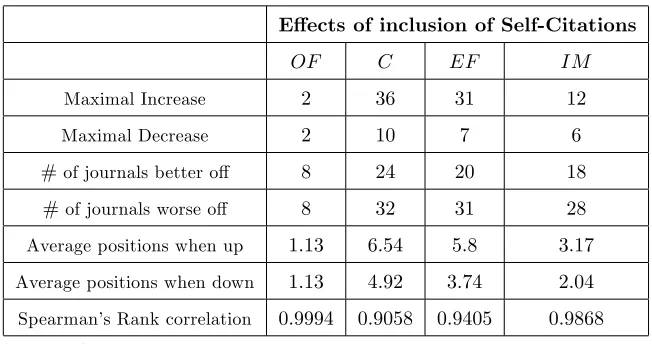
Once we include self-citations, the ranking by Outerfactor is the one that remains with less variations22. Although self-citations do not a¤ect the own Outerfactor score of each journal, they a¤ect Outerfactor of other journals, and therefore, have an e¤ect on rankings. In our sample, the ranking obtained by Outerfactor changes with the inclusion of self-citations for 16 of the 60 journals, with a maximum increase of two positions and a maximum decrease of two positions. Table 4 shows some descriptive statistics about the changes that inclusion of self-ctiations generates in the di¤erent rankings.
22Although we do not show the variations in rankings under the normalized versions of the measures, our robustness results
E¤ects of inclusion of Self-Citations
OF C EF IM
Maximal Increase 2 36 31 12
Maximal Decrease 2 10 7 6
#of journals better o¤ 8 24 20 18 #of journals worse o¤ 8 32 31 28
Average positions when up 1.13 6.54 5.8 3.17
Average positions when down 1.13 4.92 3.74 2.04
[image:24.612.153.479.143.315.2]Spearman’s Rank correlation 0.9994 0.9058 0.9405 0.9868
Table 4. All numbers are ranking positions.
As shown in Table 4, the inclusion of self-citations a¤ects the ranking by any measure, with Outerfactor been the least a¤ected with a rank correlation of0:9994. Thus, Outerfactor generates very similar rankings
even when we use the full information about citation for its calculation. In this regard, Outerfactor is very robust to the consideration of self-citations, and in fact it is not strictly necessary to remove self-citations from the data in order to compute Outerfactor.
3.3
Rank manipulation
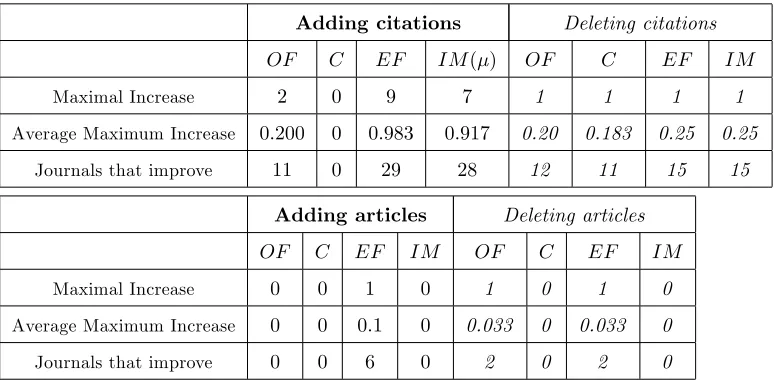
Since measures of indirect impact are not extensively used yet, it is unlikely that they have generated already incentives to manipulate them. However, in this section we simulate how sensitive each measure is to manipulation in our sample of economics journals. We assumed four di¤erent ways in which a journal could manipulate the citation graph: by increasing or decreasing its citations, or by increasing or decreasing its article share.
Simulations have been performed as follows. In the case of increasing citations, we assume that journal
i duplicates its citations, pointing all new citations to one journal so as to maximize the increase in its
Adding citations Deleting citations
OF C EF IM( ) OF C EF IM
Maximal Increase 2 0 9 7 1 1 1 1
Average Maximum Increase 0.200 0 0.983 0.917 0.20 0.183 0.25 0.25
Journals that improve 11 0 29 28 12 11 15 15
Adding articles Deleting articles
OF C EF IM OF C EF IM
Maximal Increase 0 0 1 0 1 0 1 0
Average Maximum Increase 0 0 0.1 0 0.033 0 0.033 0
[image:25.612.123.510.144.334.2]Journals that improve 0 0 6 0 2 0 2 0
Table 5. Maximal Increase is the maximum number of positions that a journal improves
in each di¤erent ranking.
In our simulation, Outerfactor is signi…cantly more robust than Eigenfactor or the Invariant Method to an increase in citations. Finally, by changing its article share, a journal is not able to change itsC ranking or its ranking, since these measures do not depend on the article share. By changing its article share, a journal is not able to change its Outerfactor score, but may change other journals’ Outerfactor. This generates a potential ranking manipulation that is nevertheless negligible in our simulations.
3.4
Cross-E¤ects
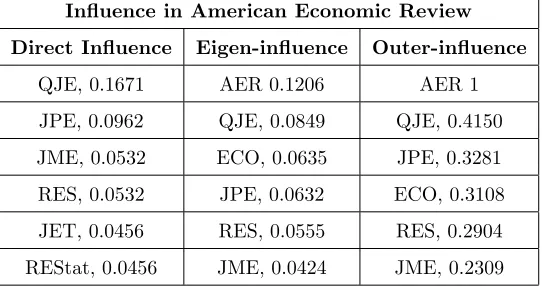
Now we illustrate cross-e¤ect measures for the case of the American Economic Review. We show the journals that are the more related to AER through cross-in‡uence or cross-contribution.
3.4.1 Cross-In‡uence
In‡uence in American Economic Review
Direct In‡uence Eigen-in‡uence Outer-in‡uence
QJE, 0.1671 AER 0.1206 AER 1
JPE, 0.0962 QJE, 0.0849 QJE, 0.4150
JME, 0.0532 ECO, 0.0635 JPE, 0.3281
RES, 0.0532 JPE, 0.0632 ECO, 0.3108
[image:26.612.105.376.150.293.2]JET, 0.0456 RES, 0.0555 RES, 0.2904 REStat, 0.0456 JME, 0.0424 JME, 0.2309
Table 6. The six journals with the highest in‡uence on AER. Note that AER’s direct in‡uence on AER
is zero given that self-citations have been excluded. QJE has a direct in‡uence of 0.1671, that is, 16.71%
of references made by AER point to QJE. ECO has an Eigen-in‡uence of 0.0635, that is, more than 6%
of research chains that start in AER terminate at to ECO.JPE has an Outer-in‡uence of 0.328, meaning
that more than 32.8% of all research chains that start in AER include JPE.
After removing self-citations, the Quarterly Journal of Economics is the journal with highest in‡uence on AER, since 16.71% of AER direct references go to QJE. However, its indirect impact is smaller when we analyze Eigen-in‡uence: in this case 8.5% of the research chains that start in AER point to QJE. As for Outer-in‡uence, 41.5% of the research chains that start in AER include QJE. Note here that the relative values of Eigen-in‡uence and Outer-in‡uence are quite similar (for instance, the Eigen-in‡uence of QJE on AER is 34.5% higher than the in‡uence of JPE; and 26.5% when we compute Outer-in‡uence), while these two measures are di¤erent in relative terms to Direct in‡uence (QJE’s direct in‡uence on AER is 73.7% higher than JPE’s). Although Econometrica is the seventh more cited journal by American Economic Review, it becomes more important when indirect impact is taken into account. On the other hand, JME has a more direct than indirect impact on the American Economic Review. In general, OI shows a smoother in‡uence of journals on AER.
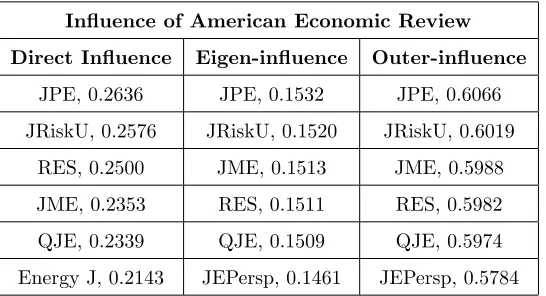
In‡uence of American Economic Review
Direct In‡uence Eigen-in‡uence Outer-in‡uence
JPE, 0.2636 JPE, 0.1532 JPE, 0.6066 JRiskU, 0.2576 JRiskU, 0.1520 JRiskU, 0.6019
RES, 0.2500 JME, 0.1513 JME, 0.5988
JME, 0.2353 RES, 0.1511 RES, 0.5982
QJE, 0.2339 QJE, 0.1509 QJE, 0.5974
[image:27.612.104.377.145.293.2]Energy J, 0.2143 JEPersp, 0.1461 JEPersp, 0.5784
Table 7. The six journals with highest in‡uence by AER: AER has a direct in‡uence of 0.2636 in JPE,
that is, 26.36% of references made by JPE point to AER. JRiskU has an Eigen-in‡uence of AER of
0.1518, meaning that 15.18% of the research chains that start in JRiskU point to AER (but up to 25.7%
of references). JME obtains an Outer-in‡uence by AER of 0.5988: almost 60% of all research chains
that start in JME include AER.
Three of the journals in our sample have more than 25% of its citations pointing to AER, while the highest proportion of indirect research chains is 15% for Eigen-in‡uence and 60% for Outer-in‡uence. The Journal of Political Economy and Journal of Risk and Uncertainty are the two journals most in‡uenced by AER, independently of the measure used.
By Proposition 3, the AER’s Eigenfactor score of 0.1303 is the a weighted average of AER’s Eigen-in‡uences on all journals reported in Table 7. And proposition 4 stated that AER’s Outerfactor (0.5184) is the average of its Outer-In‡uences on other journals.
3.4.2 Cross-Contribution
Table 8 reports the six journals which contribute more to the impact of AER:23
Contribution to American Economic Review’s value
Direct contribution Eigen-contribution Outer-contribution
JME, 0.0741 AER, 0.0524 AER, 1
JET, 0.0509 JEBO, 0.0506 QJE, 0.3464
JPublicE, 0.0498 VH, 0.0438 ECO, 0.2966
QJE, 0.0463 WD, 0.0434 JPE, 0.2891
RES, 0.0451 GEB, 0.0417 RES, 0.2841
[image:28.612.126.452.159.291.2]JEBO & JEL, 0.0428 JET, 0.0363 JME, 0.2329
Table 8. The six journals with the highest contribution to AER’s impact: QJE creates 7.47%
of the references that point to AER. 5.06% of the research chains that terminate at the AER
started in JEBO. And while 28.91% of the research chains that terminate at AER used ECO.
There are signi…cant di¤erences among the three columns. Journals with many articles tend to have a higher Eigen-contribution and Direct contribution because they only account for journals where citations originate (which are usually bigger journals). On the other hand, Outer-contribution extends this to journals usage at any step of the research chain.
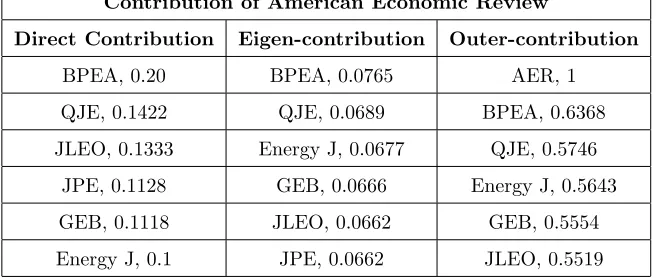
Table 9 reports the highest contributions of AER to other journals’ impact.
Contribution of American Economic Review
Direct Contribution Eigen-contribution Outer-contribution
BPEA, 0.20 BPEA, 0.0765 AER, 1
QJE, 0.1422 QJE, 0.0689 BPEA, 0.6368
JLEO, 0.1333 Energy J, 0.0677 QJE, 0.5746
JPE, 0.1128 GEB, 0.0666 Energy J, 0.5643
GEB, 0.1118 JLEO, 0.0662 GEB, 0.5554
[image:28.612.91.426.489.628.2]Energy J, 0.1 JPE, 0.0662 JLEO, 0.5519
Table 9. The six journals to which AER contributes more: 20% of the references in our sample that point to
Brooking Papers on Economic Activities are in articles of AER. In the Eigen-contribution column, 6.89% of the research chains
References made by AER constitute more than 10% of all references. In particular, 20% of direct references to BPEA and more than 14% of direct references to QJE come from AER. However, AER’s indirect Eigen-contribution is less signi…cant: 7.65% of research chains that point to BPEA start in AER. By applying Proposition 6, we can average the Outer-contribution column of AER to obtain its Outerfactor score (0.5184).
4
Discussion
Measures of journal impact are increasingly being used for many purposes related to research evaluation, a¤ecting incentives to manipulation. We propose a new measure of journal impact –Outerfactor– that addresses this problem while preserving information about both direct and indirect in‡uence. We note, however, that Outerfactor is not completely immune to some strategic considerations. For instance, although a journal can not change its score, it may change score of competitors and modify its position in the ranking. Nevertheless, simulations show that Outerfactor behaves well in this respect compared to other measures. In addition to this, even though the Outerfactor score is invariant to individual strategies, a set of journals may modify their scores by agreeing on their citing strategies.
Computational considerations also deserve a special attention. In the case of Outerfactor, it is required to compute the diagonal of an inverse matrix of size N, or the full inverse in the case of computing all cross-e¤ects. This can be costly in computational terms ifN is large. For cases whereN is in the order of 104, as in the case of scienti…c journals, all our computations can be done in a regular computer in seconds.
References
[1] Bergstrom, C. T. (2007): "Eigenfactor: Measuring the value and prestige of scholarly journals",C&RL
News68(5)
[2] Bonacich, P. (1987): "Power and Centrality: A Family of Measures," American Journal of Sociology,
92, 1170-1182.
[3] Brin, S., and L. Page (1998): "The Anatomy of a Large-Scale Hypertextual Web Search Engine,"
Computer Networks and ISDN Systems, 30(1,2),107-117.
[4] Fersht, A. (2009): "The most in‡uential journals: Impact Factor and Eigenfactor," Proceedings of the
[5] Freeman, L. C. (1979): "Centrality in Social Networks: Conceptual Clari…cation.",Social Networks1:2 15-39.
[6] Gar…eld, E. (1955): "Citation Indexes to Science: A New Dimension in Documentation through Asso-ciation of Ideas,"Science, 122(3159), 108-111.
[7] González-Pereira, B., V.P. Guerrero-Bote and F. Moya-Anegón (2009): "The SJR indicator: A new indicator of journals’ scienti…c prestige",. arXiv:0912.4141v1.
[8] Hirsch, J. E. (2004): "An Index to Quantify an Individual’s Scienti…c Research Output," Proceedings
of the National Academy of Sciences, 102(46), 16569-16572.
[9] Katz, L. (1953): "A New Status Index Derived from Sociometric Analysis." Psychometrika18:39-43
[10] Kóczy, L. A., and M. Strobel. (2010): "The World Cup of Economics Journals: A Ranking by a Tournament Method," Working Paper Series 1011, Óbuda University, Keleti Faculty of Economics
[11] Liebowitz, S. J., and J. C. Palmer (1984): "Assessing the Relative Impacts of Economics Journals,"
Journal of Economic Literature, 22(1), 77-88.
[12] Pinski, G., and F. Narin (1976): "Citation In‡uence for Journal Aggregates of Scienti…c Publications: Theory, with Application to the Literature of Physics,"Information Processing & Management, 12(5),
297-312.
[13] Palacios-Huerta, I., and O. Volij (2004): "The Measurement of Intellectual In‡uence," Econometrica, 72(3), 963-977.
[14] Smith, R. (1997): "Journal accused of manipulating impact factor,",British Medical Journal, 314, 461.
5
Appendix
5.1
Appendix I
H= 0 B B B B B B @
0 0:6 0:1 0:1 0:6 0 0:1 0:1 0:2 0:2 0 0:8 0:2 0:2 0:8 0
1 C C C C C C A
;a=
0 B B B B B B @
0:25 0:25 0:25 0:25
1 C C C C C C A
We use = 0:85. Journals Aand B cite each other and this is also the case between C andD. Pagerank and Eigenfactor ofA andB areqA =qB = 0:23and EFA =EFB = 0:2265. Note thatA can increase its score by increasing its relative citations toB as follows:
H0=
0 B B B B B B @
0 0:6 0:1 0:1 0:8 0 0:1 0:1 0:1 0:2 0 0:8 0:1 0:2 0:8 0
1 C C C C C C A
;a0 =a
Now, Pagerank and Eigenfactor scores for journalA becomeq0
A = 0:2364 andEFA0 = 0:234. This happens because, by increasing its citations to journalB, journalA generates a higher Pagerank and Eigenfactor in
B which will be partially transmitted toA.
This type of manipulation is also feasible by changing articles shares. For instance,
H00=H;a00=
0 B B B B B B @
0:4 0:2 0:2 0:2
1 C C C C C C A
Now we have that Pagerank and Eigenfactor of A are q00
A = 0:2533 and EFA00 = 0:2292. By increasing its articles share, journalAis able to increase its own Pagerank and Eigenfactor.
5.2
Appendix II
with 10, 6 and 4 articles respectively. We use = 0:85forOF andEF. The following table summarizes the results:
OFi IFi EFi i
A 0:7165 5 0:2855 0:2941
B 0:9975 15 0:4486 0:4412
C 0:8223 4 0:2660 0:2647
In order to make the measures comparable, we have computed the unnormalized version of Impact Factor (that is, total number of citations) and Invariant Method ( i=aiIMi), excluding self-citations in all cases. Remarkably,OF ranksC overA, whileIF,EF andIM do not.
5.3
Appendix III
Let us de…ne the following events in the research chain model:
i ! : The research chain starts in journal i
i 6! : The research chain does not start in journal i
! i: The research chain ends in journal i
! i!: The research chain includes journal i
+ : The research chain has positive length
Proof of Lemma 1. This is simply the result of re-interpreting the eigenvector qof Qas the unique
solution to the linear system:
q= (1 )a+ Hq,
from whichq= (1 ) (I H) 1q. Note that this system de…nesqi asP(!i)for alli: with probability
(1 )the research chain has length zero and the probability isai; and with probability the chain continues toi’s neighbors in the matrix H. QED.
Accordingly, the entryrij of the matrixRis the probability of ending in journaliconditional on having started the research chain from journalj:
P(!ijj!) =rij.
This is so becauseRis the unique matrix that solves:
Proof of lemma 2. The probability that a research chain of length longer than 1 ends at iis
P(!i;+) =X
j2J
P(!j) hij= X
j2J
qj hij=Hi q=EFi.
QED.
Lemma 4 The Pagerank score of journal iis
qi=P(!i!)rii.
Proof. First, note that P(!i!) is the probability of reaching journal i for the …rst time in a research chain. Then, the probability of ending at a journaliis the probability of journalibeing reached for the …rst time, times the probability of returning to journali.
Proof of Proposition 1. We show that the probability of using journal iisOFi:
P(!i! ji6!;+) = P(!i!; i6!;+)
P(i6!;+) =
P(!i!; i6!)
P(i6!;+) =
= P(!i!) P(!i!; i!)
P(i6!;+) =
qi
rii P(i!)
P(+) P(i6!)=
=
qi rii ai
(1 ai)
=OFi.
QED.
When !0,
lim
!0qi = lim!0[(1 )ai+ Hiq]
= ai
and therefore
lim
!0
EFi
1 ai
= lim
!0
Hiq 1 ai
=
P
j2Jhijaj
1 ai
=
P
j2J;j6=iajhij
1 ai De…ne nowhHk
ij as theij–entry of the matrixHk. Then
lim
!0OFi = lim!0
qi rii ai
(1 ai)
= lim
!0
P j2Jajrij
rii ai
(1 ai)
= lim
!0
P
j2J;j6=iajrij
rii +
airii rii ai
(1 ai)
=
= lim
!0
P
j2J;j6=iaj(1 ) hij+ 2hH
2
ij +:::
(1 )(1+ hii+ 2hH
2
ii +:::)
(1 ai)
= lim
!0
P
j2J;j6=iaj(1 ) hij
(1 )(1+ hii)
(1 ai)
=
= lim
!0
(1 )P
j2J;j6=iajhij
(1 )(1+ hii)
(1 ai)
= lim
!0
P
j2J;j6=iajhij
(1+ hii)
(1 ai)
=
P
j2J;j6=iajhij
Proof of Proposition 3. Fori6=j:
P(!ijj!;+) = P(!i;+jj!)
P(+jj!) =
P(!ijj!)
P(+) =
rij
=EIij.
And fori=j:
P(!iji!;+) = 1 X
j6=i
P(!jji!;+) = 1 X
j6=i rji
= 1 1 rii =rii (1 ).
Finally,
EFi = P(!ij+) = X
j
P(j! j+)P(!ijj!;+)
= X
j
P(j ! j+)P(!ijj!;+)
= X
j
P(j !)P(!ijj!;+)
X
j
ajEIij.
QED.
Proof of Proposition 4. Fori6=j:
P(!i! jj !;+) = P(!ijj!;+)
P(!iji!) =
EIji rii
Fori=j:
P(!i! ji!;+) = 1.
Finally,
OFi = P(!i! ji9;+)
= 1
P(i9j+)
X
j6=i
P(j! j+)P(!i! jj!;+)
= 1
P(i9)
X
j6=i
P(j!)OIij
= 1 1 ai
X
j6=i
ajOIij.
Proof of Proposition 5. Fori6=j:
P(i! j !j;+) = P(i!;!j;+)
P(!j;+) =
P(!j;+ji!) P(i!)
P(!jj+) P(+) =
= P(!jji!) P(i!)
P(!jj+) P(+) =
rji ai EFj
=ECji
Fori=j:
P(i! j !i;+) = P(!i; i!;+)
P(!i;+) =
P(!i;+ji!) P(i!)
P(!i;+) =
= (rii (1 )) ai
EFi
=ECii.
Also,
X
j
EFjECij = X
j
P(!jj+)P(i! j !j;+)
= X
j
P(i!;!jj+) =P(i! j+)
= P(i!) =ai.
QED.
Proof of Proposition 6. Forj6=i
P(!i! j !j;+) = P(!i!;!jj+)
P(!jj+) =
P(!i!;!j;+)=P(+)
EFj
=
i6=j
= P(!i!;!j)
EFj
=
qi riirji
EFj .
Wheni=j it is clear thatP(!i! j !i;+) = 1.