Munich Personal RePEc Archive
An automatic procedure for the
estimation of the tail index
Gimeno, Ricardo and Gonzalez, Clara I.
2012
An Automatic Procedure for the Estimation of the
Tail Index
Ricardo Gimenoa,1, Clara I. Gonzalezb,∗
a
Banco de España
b
FEDEA
Abstract
Extreme Value Theory is increasingly used in the modelling of financial time
series. The non-normality of stock returns leads to the search for alternative
distributions that allows skewness and leptokurtic behavior. One of the most
used distributions is the Pareto Distribution because it allows non-normal
behaviour, which requires the estimation of a tail index.
This paper provides a new method for estimating the tail index. We
propose an automatic procedure based on the computation of successive
nor-mality tests over the whole of the distribution in order to estimate a Gaussian
Distribution for the central returns and two Pareto distributions for the tails.
We find that the method proposed is an automatic procedure that can be
computed without need of an external agent to take the decision, so it is
clearly objective.
Keywords: Tail Index; Hill estimator; Normality Test
∗Corresponding author. Foundation for Applied Economic Studies (FEDEA). Jorge
Juan 46, 28001 Madrid (Spain). e-mail: [email protected]
1. Introduction
Extreme price movements are a common fact during the normal
function-ing of financial markets and durfunction-ing highly volatile periods correspondfunction-ing to
financial crises, like for example stock market crashes.
In the last decades, researches has been focused in modelling and
esti-mating financial time series. However, most of this studies are concerned
about expected returns, volatility or correlations, and not so much attention
has been paid to extreme movements. Previous works in the use of extreme
value to explain the fluctuations of the financial time series are Rothschild
and Stiglitz (1970), who used the weight of the tails of two random
vari-ables in order to suggest a best definition of the risk increase than the usual
variance, Parkinson (1980) discovered that extreme values offer an useful
in-formation in order to estimate volatility more efficiently, Haan et al. (1989)
showed that the maximum of a distribution will be a Frechet one if the change
in the stock price follows an ARCH process, Jansen and de Vries (1991) used
extreme values in order to research the fat of the distribution tails.
It is a common conclusion in financial literature that the distribution of
stock returns shows heavy tails, it means that there are more realizations in
the tails than is to be expected if it had a normal distribution. In other words,
stock return data shows more extreme realizations than can be accounted for
by the normal distribution. Moreover round the mean value, the very small
movements, there are more likelihood than expected. So the medium values
are going to show a lower likelihood than the normal behavior. Originally
Mandelbrot (1963), and later Fama (1965), pointed out that the distribution
which implies that it is peaked and fat-tailed.
This observation is of vital importance to risk management, and in
par-ticular to Value-at-Risk analysis, because it is the behavior of extremely
low returns that causes large losses. EVT is a useful supplementary risk
measure in risk management as a method for modelling and measuring this
extreme risks. The seminal work of EVT is the one of Gnedenko (1943)
who establishes three types of non-degenerated distributions for the
stan-dardized maximum: Frechet, Weibull and Gumbel. Galambos (1978) gives a
rigorous account of the probability aspects of extreme value theory. Longin
(1996) analysis extreme movements in the U.S. stock market, and obtains
empirically that the extreme returns has a Frechet distribution. Moreover,
applications of extreme value theory in insurance and finance can be found
in Embrechts et al. (1997) and Reiss and Thomas (1997).
The structure of this article is as follows, in section 2 Extreme Value
The-ory is introduced. Then we brought up the Generalized Pareto Distribution
in section 3 and the Pareto Distribution in section 4. Finally, in section 5 is
proposed a new methodology for the estimation of the threshold value of the
tail index.
2. Introduction to Extreme Value Theory
There are two classes of extreme value distributions who are used to find
the correct limit distributions for maxima and minima. The first class was
proposed by Jenkinson (1955), a Generalized Extreme Value (GEV)
distribu-tion that includes the three standard extreme value distribudistribu-tions established
The second class includes the distribution of excess over a given threshold,
what it is interesting in modelling the behavior of the excess loss once a
high threshold (loss) is reached. A more modern group of models are the
Peaks-Over-Threshold (POT) models, that can be used to estimate the excess
distribution with respect to a threshold levela, and to estimate the tail shape
of the original distribution.
Within the POT class of models we can find two sorts of models, one
of them is the semi-parametric model family built around the Hill estimator
and its relatives Beirlant et al. (1996); Danielsson et al. (1998) and other are
the fully parametric models based on de generalized Pareto distribution or
GDP Embrechts et al. (1999).
There has been in the last years several researches about the adaptation
of the stable Pareto distribution in order to model the unconditional
dis-tribution of returns, the first considerations about it are the researches of
Mandelbrot (1963) and Fama (1963, 1965). Not always the stable class of
models are suitable to apply to leptokurtic and skewed returns, despite they
are suitable in a theoretical approach.
Hill estimator (Hill, 1975) and other similar tail estimators, are known
because they are not reliable in-even large-finite samples (cf. Mittnik and
Rachev (1993), McCulloch (1997), Resnick (1997) and Mittnik et al. (1998))
3. Generalized Pareto Distribution
The Generalised Pareto Distribution (GPD) is a two parameter
distribu-tion and its importance in extreme value theory was observed by Pickands
(1975) who showed basically that the GDP offers a good approximation of
the tail of the distribution of returns for some fixed ξ as a shape parameter
and β as an additional parameter that is β > 0. Its distribution function is
the following,
Gξ,β(x) =
1−1 +ξX β
−1
ξ
if ξ 6= 0
1−e−Xβ if ξ = 0
(1)
where x≥0when ξ≥0and 0≤x≤ −β
ξ whenξ < 0. The sign of the shape
parameter ξ determines its tail behavior and thus the tail behavior of the
original distribution.
This distribution is generalized in the sense that it subsumes other
dis-tributions under a common parametric form. If ξ > 0 the tail of the
distri-bution function Gξ,β(x) decays like a power function x−
1
ξ, in this case, the
function Gξ,β belongs to a family of heavy-tailed distributions that includes:
the Pareto, log-gamma, Cauchy and t-distributions and others. Forξ = 0the
tail forGξ,β decreases exponentially, and belongs to a class of medium-tailed
distributions that include the normal, exponential, gamma and lognormal
distributions. Finally if, ξ <0is known as a Pareto Type II distribution, the
underlying distribution Gξ,β is characterized by a finite right endpoint, this
4. The Pareto Distribution
The first of the three previous groups of distributions, when ξ > 0, is
the most relevant case for risk management purposes because implies a GDP
with heavy tails. This is the reason why the Pareto distribution is the most
used in fat-tailed distributions. It is considered as a truncated distribution,
because the right tail of the distribution has values greater than an specific
value a or threshold. It has this probability density distribution
f(x, a, α) = α a
α
xα+1 (2)
with x≥a and α the tail index.
But we are interested in the extreme movements that lead to large losses,
so we have to focus on the left tail where the values are below a certain
thresh-old level. The cumulative distribution function of the Pareto distribution will
be
F(−x)≈ax−α (3)
with α >0.
The issue is how we can obtain the value of a or threshold level and
of α or tail index, if the threshold is known then α can be estimated by
the maximum likelihood method. The maximum likelihood estimator of the
reciprocal of the tail index, γ ≡ 1/α, is obtained from the Hill estimator
(Hill, 1975): (equation 4),
b
γH ≡1/αbM L = n X
i=1
log xi a
We usually not know the threshold valuea from where the empirical
dis-tribution behaves as a Pareto disdis-tribution, the choice off this cut-off point is
the more important of all the estimation results. In order to find it, the usual
method consists in calculating and plotting the Hill estimator for different
values of the threshold a (Drees et al., 2000), to search those value where
the tail index is stable, so that the threshold a is selected from the hill plot
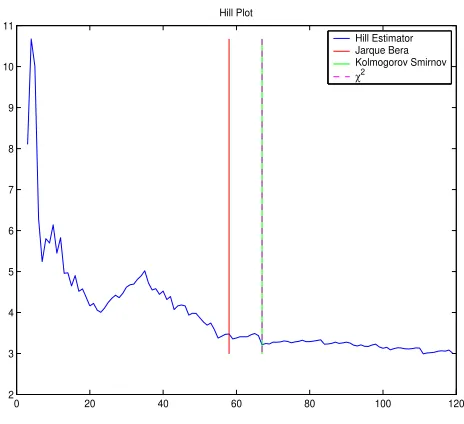
for the stable areas of the tail index (In figure 1 we present the Hill plot for
the FTSE 100 index). However, this choice is not always clear. In fact, this
method applies well for a GPD or close to GPD type distribution. As stated
by Bensalah (2000), the Hill estimator is the maximum likelihood for a GPD
and since the extreme distribution converges to a GPD over a high threshold
u its use is justified.
5. The distribution of financial returns. Identification of outliers
It is a common place now in the literature, since the initial works of
Mandelbrot (1963) and Fama (1965) that the hypothesis of normality must
be rejected. The three features that are commonly alleged as the causes of
this rejection are:
1. Fat tails or extreme values in the distribution. The tails of the
distri-butions concentrate more probability than is supposed on a Gaussian
distribution.
2. Cluster of probability near the mean value of the distribution. Most of
the movements in asset prices are relatively small.
3. The extreme movements are more frequent in the left side of the
news.
The first two features lead to a leptokurtic distribution, and the third
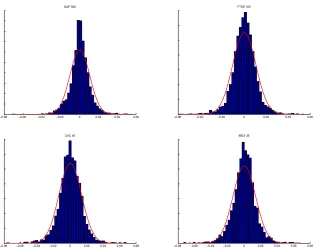
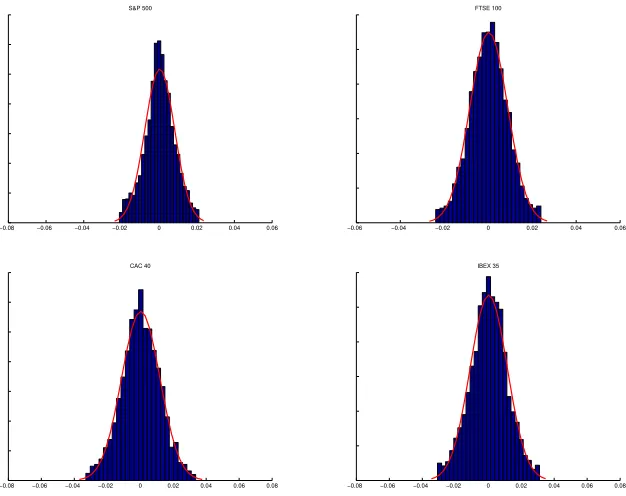
feature to the presence of skewness in the distribution. Figure 2 shows this
features plotting the histogram of the returns in the case of four different
stock indexes: S&P500 (NYSE), FTSE100 (London), CAC40 (Paris) and
IBEX35 (Madrid). Table 1 shows the mean, standard deviation, skewness
(g3 = m
3
s3) and kurtosis (g4 = m
4
s4 −3) coefficient. All of them have left
skewness and an excess of kurtosis.
Extreme Value Theory as it is applied to financial markets assume that
the tails of the distribution are governed by a different function than the rest
of the distribution. The tails are then fitted with a Pareto distribution as
presented in section 4. The Hill estimator (equation 4) is then used to split
the returns in extreme and non-extreme returns. This estimation explains
one of the three features of the asset returns and require a subjective selection
of the threshold in the region where the hill estimator remains stable (Figure
1).
It is our aim to obtain a method for the estimation of the threshold that
not only explains the fat tails, but also the skewness and kurtosis of the
distribution. The distribution of the whole asset returns can be obtained as
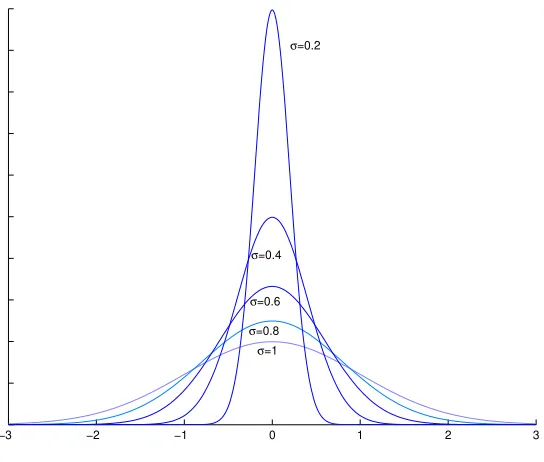
a mixture of a gaussian function for the center of the distribution and two
Pareto laws for both tails as presented in figure 3.
If the tails are explained by two Pareto laws, the rest of the distribution
will have a lower standard deviation. After diminishing the value of the
variance, the gaussian function will be concentrated around the mean value
laws would explain not only the fat tails but the cluster on the mean value
and even the skewness if we consider a different Pareto law for each tail.
We propose to fit the lower price movements to a normal distribution
instead of trying to fit the tails of the distribution. Our proposal is to identify
the asset returns that cannot be considered gaussian, and will be treated as
outliers that we will be modelled by a Pareto distribution.
Given a time series of asset returns,xi, the process of identification of the
values from both distribution will be as follows:
1. We define the absolute returns, yi=|xi| ∀i= 1, . . . , T. A higher value
will imply a strong movement of the asset price, doesn’t matter if it is
positive or negative.
2. We order the values of yj, such as y1 ≥ y2 ≥ y3 ≥ . . . ≥ yT, and save
the ordination index.
3. We test the normality hypothesis for the subset {xj}∀j =r, . . . , T.
4. We select the value of r that produce a better result in the normality
test.
As we eliminate the extremal values we reduce the excess of kurtosis.
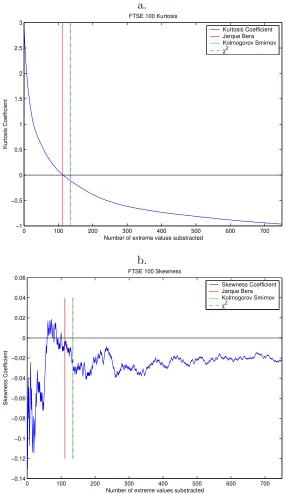
The kurtosis coefficient for the returns of the FTSE 100 index is plotted in
figure 5a. After eliminating a sufficient number of extreme value we pass
from a leptokurtic to a platykurtic distribution. But also the skewness of the
distribution (figure 5b) is reduced in the process. In Figure 6 can be seen
the resulting distributions for the four indexes.
In order to test the normality of the distribution we have chosen three
1. χ2
goodness of fit. Also known as test χ2
, this test present as null
hypothesis that the sample has been obtained from a variable with
probability distribution equal to P, i.e. the normal distribution.
We will have a sample called X with observations that could be
classi-fied inrclasses (i.e. the intervals of an histogram). We could represent
this categories by A1, A2, . . . , Ar. In the sample X there are n1
ele-ments that belongs to category A1, n2 elements that belongs to A2
and so on. Under the null hypothesis, we know the probability of each
class, P(Ai) = pi, where p1 +p2 +. . .+pr = 1. The probability of
obtaining n1, n2, . . . , nr elements of each class will have a multinomial
distribution with probabilities,
P(n1, n2, . . . , nr) =
n! n1!· · ·nr
pn1
1 · · ·p
nr
r (5)
where each ni has a marginal binomial distribution B(n, pi) with an
expected value, E(ni) = npi = Ei. This expected value called Ei
represents the number of observations belonging to class Ai, that we
expect if the null hypothesis is true. So we construct an statistic,
r X
i=1
(ni −Ei)
Ei
χ2
r−k−1 (6)
under the null hypothesis, where k is the number of parameters
esti-mated on the null hypothesis distribution (i.e. µ and σ in the case of
a normal distribution)
For a continuous distribution we obtain the classes and the ni
val-ues from an histogram, and the correspondent pi from the expression
order to obtain not-empty intervals we select the extremesxi that have
equal values of ni.
2. Kolmogorov Smirnov test. It compares the values of the theorized
normal distribution function and the empirical sample distribution.
The test compute the maximum difference between both distributions
(equation 7).
D= sup
x
|Ft(x)−Fr(x)| (7)
3. Jarque Bera test (Jarque and Bera, 1980). It is based on the kurtosis
and skewness coefficients, comparing the results of both coefficients in
the sample with the values of a gaussian distribution (equation 8).
JB = T −k 6 m3 s3 2 + m4 s4 −3 2 1 4 !
∼χ2
2 (8)
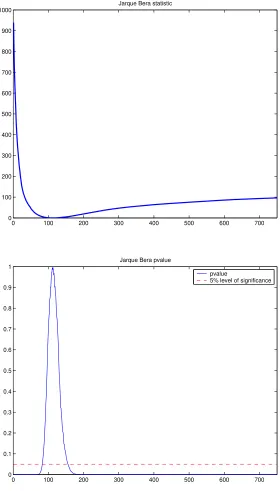
In figure 7 it is possible to see how as we eliminate the extreme values of
the sample, the Jarque-Bera test gives increasing values, reaching a threshold
in which the test accept the null hypothesis of normality. Figure 7 implies
that for the FTSE 100 index it is possible to reach a pvalue of 0.999 in the
Jarque-Bera test. If we continue eliminating values we pass from a problem
from the leptokurtic shape of the distribution to the opposite problem of
platykurtic distribution. This is clear if we observe figure 5 where the kurtosis
and skewness of the distribution is presented against the number of extremal
returns subtracted. In the same figure 5 it is possible to see the value of the
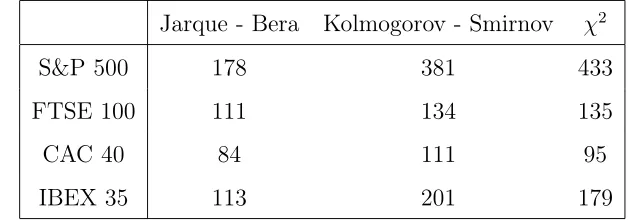
threshold a for the three normality tests used. Jarque-Bera select a value
that gives skewness and kurtosis coefficients closer to the ones expected in a
6. Conclusions
Fama (1963) and Mandelbrot (1965) proved empirically that stock returns
do not have a Gaussian Distribution so it is necessary to select an alternative
distribution that allows skewness and leptokurtic behaviour. The Extreme
Value Theory is increasingly used in the modelling of financial time series
and the Pareto Distribution is one of the most widely used because it allows
non-normal behaviour.
The estimation of the tail index is usually obtained by plotting the Hill
Estimator for different values of the threshold, choosing that value where
this estimator becomes stable. However, this procedure requires a subjective
choice on the part of the researcher and in addition it is not automatic.
This paper provides a new method for estimating the tail index of the
distribution of stock returns.In this paper, successive normality tests are
realized over the whole of the distribution in order to estimate a Gaussian
Distribution for the central returns and two Pareto distributions for the tails.
It is possible to see that the threshold estimations obtained by the
nor-mality tests lies in the plateau of the Hill plot (figure 1). These threshold
estimators are consistent with the results obtained with the Hill plot, but
with the great advantage of been an automatic procedure that can be
References
Beirlant, J., Teugels, J., Vynckier, P., 1996. Practical analysis of extreme
values. Tech. rep., Leuven University Press, Leuven.
Bensalah, Y., 2000. Steps in applying extreme value theory to finance: A
review. Working Paper 20, Bank of Canada.
Danielsson, J., Hartmann, P., de Vries, C. G., January 1998. The cost of
conservatism: Extreme returns, value-at-risk, and the basle multiplication
factor. Risk.
Drees, H., de Haan, L., Resnick, S., 2000. How to make a hill plot. The
Annals of Statistics 28, 254–274.
Embrechts, P., Klüppelberg, C., Mikosch, T., 1997. Modelling Extremal
Events. Springer Verlag, Berlin.
Embrechts, P., Resnick, S., Samorodnitsky, G., 1999. Extreme value theory
as a risk management tool. North American Actuarial Journal 3, 30–41.
Fama, E. F., 1963. Mandelbrot and the stable paretian hypothesis. Journal
of Business 36 (4), 420–429.
Fama, E. F., 1965. The behavior of stock market prices. Journal of Business
38, 34–105.
Galambos, J., 1978. The Asymptotic Theory of Extreme Order Statistics.
Gnedenko, B., 1943. Sur la distribution limite du terme maximum d’une serie
aleatoire. Annals of Mathematics 44, 423–453.
Haan, L. D., Resnick, I. S., Rootzen, H., de Vries, C., 1989. Extremal
be-havior of solutions to a stochastic difference equation with applications to
arch process. Stochastic Processes and Their Applications 32, 213–224.
Hill, B., 1975. A simple general approach to inference about the tail of a
distribution. Annals of Statistics 3, 1163–1174.
Jansen, D., de Vries, C., 1991. On the frequency of large stock returns:
putting booms and busts into perspective. Review of Economics and
Statis-tics 73, 18–24.
Jarque, C. M., Bera, A. K., 1980. Efficient tests for normality,
homoscedastic-ity and serial independence of regression residuals. Economics Letters (6),
255–259.
Jenkinson, A., 1955. The frequency distribution of the annual maximum
(or minimum) values of meteorological elements. Quarterly Journal of the
Royal Meteorological Society 87, 145–158.
Longin, F., 1996. The asymptotic distribution of extreme stock market
re-turns. Journal of Business 69, 383–408.
Mandelbrot, B., 1963. The variation of certain speculative prices. Journal of
Business 36, 394–419.
index alpha: A critique. Journal of Business & Economic Statistics 15 (1),
74–81.
Mittnik, S., Paolella, M., Rachev, S., 1998. A tail estimator for the index of
the stable paretian distribution. Communications in Statistics Theory and
Methods 27 (5), 1239–1262.
Mittnik, S., Paolella, M. S., Rachev, S. T., 2000. Diagnosing and treating
the fat tails in financial returns data. Journal of Empirical Finance (7),
389–416.
Mittnik, S., Rachev, S., 1993. Modeling asset returns with alternative stable
models. Econometric Reviews 12, 261–330.
Parkinson, M., 1980. The extreme value method for estimating the variance
of the rate of returns. Journal of Business 53, 61–65.
Pickands, J., 1975. Statistical inference using extreme order statistics. Annals
of Statistics 3, 119–131.
Reiss, R., Thomas, M., 1997. Statistical Analysis of Extreme Values.
Birkhäuser, Basel.
Resnick, S., 1997. Heavy tail modeling and teletraffic data. Annals of
Statis-tics 25 (5), 1805–1869.
Rothschild, M., Stiglitz, J. E., 1970. Increasing risk: I. a definition. Journal
0 20 40 60 80 100 120 2
3 4 5 6 7 8 9 10 11
Hill Plot
Hill Estimator Jarque Bera Kolmogorov Smirnov
[image:17.612.192.424.130.342.2]χ2
Figure 1: Hill plot of the FTSE 100 index and the values of the tail threshold with the
−0.08 −0.06 −0.04 −0.02 0 0.02 0.04 0.06 S&P 500
−0.06 −0.04 −0.02 0 0.02 0.04 0.06 FTSE 100
−0.08 −0.06 −0.04 −0.02 0 0.02 0.04 0.06 0.08 CAC 40
[image:18.612.151.465.125.377.2]−0.08 −0.06 −0.04 −0.02 0 0.02 0.04 0.06 0.08 IBEX 35
Figure 2: Histogram of the returns of the indexes S&P 500, FTSE 100, CAC 40 and IBEX
Gaussian Distribution Rigth Pareto Distribution Left Pareto Distribution
−3 −2 −1 0 1 2 3 σ=1
σ=0.8 σ=0.6 σ=0.4
[image:20.612.175.447.271.502.2]σ=0.2
Table 1: Descriptive statistics from four stock index daily returns(S&P 500, FTSE 100,
CAC 40, IBEX 35)
Mean Std. Deviation Skewness kurtosis
S&P 500 0,000284268 0,010479535 -0,123687694 3,922177894
FTSE 100 0,000164333 0,01055061 -0,130502363 2,8471159
CAC 40 0,000147307 0,013697291 -0,1205063 2,544084239
IBEX 35 0,000214679 0,013742123 -0,145496279 2,757789877
Table 2: Number of observation subtracted in each index according with the gaussian test
used
Jarque - Bera Kolmogorov - Smirnov χ2
S&P 500 178 381 433
FTSE 100 111 134 135
CAC 40 84 111 95
[image:21.612.144.458.502.612.2]a.
0 100 200 300 400 500 600 700
−1 −0.5 0 0.5 1 1.5 2 2.5 3
FTSE 100 Kurtosis
Kurtosis Coefficient
Number of extreme values substracted
Kurtosis Coefficient Jarque Bera Kolmogorov Smirnov χ2
b.
0 100 200 300 400 500 600 700
−0.14 −0.12 −0.1 −0.08 −0.06 −0.04 −0.02 0 0.02 0.04 0.06
FTSE 100 Skewness
Skewness Coefficient
Number of extreme values substracted
[image:22.612.163.448.126.620.2]Skewness Coefficient Jarque Bera Kolmogorov Smirnov χ2
Figure 5: Returns of FTSE 100 (a. Skewness Coefficient and b. kurtosis Coefficient). In
−0.08 −0.06 −0.04 −0.02 0 0.02 0.04 0.06 S&P 500
−0.06 −0.04 −0.02 0 0.02 0.04 0.06 FTSE 100
−0.08 −0.06 −0.04 −0.02 0 0.02 0.04 0.06 0.08 CAC 40
[image:23.612.151.464.249.497.2]−0.08 −0.06 −0.04 −0.02 0 0.02 0.04 0.06 0.08 IBEX 35
Figure 6: Histogram of the returns of the indexes S&P 500, FTSE 100, CAC 40 and IBEX
0 100 200 300 400 500 600 700 0
100 200 300 400 500 600 700 800 900 1000
Jarque Bera statistic
0 100 200 300 400 500 600 700
0 0.1 0.2 0.3 0.4 0.5 0.6 0.7 0.8 0.9 1
Jarque Bera pvalue
pvalue
[image:24.612.166.446.135.626.2]5% level of significance
Figure 7: Jarque Bera test on the returns of FTSE 100 (a. Jarque-Bera test b. P-value).