Munich Personal RePEc Archive
Forecasting Performance of Alternative
Error Correction Models
Iqbal, Javed
Karachi University
19 March 2011
Online at
https://mpra.ub.uni-muenchen.de/29826/
Forecasting Performance of Alternative Error Correction Models
By Javed Iqbal Department of Statistics
Karachi University Karachi Pakistan
Email: [email protected]
Preliminary draft: Not for publication
Abstract
Forecasting Performance of Alternative Error Correction Models
It is well established that regression analysis on non-stationary time series data may yield
spurious results. An earlier response to this problem was to run regression with first
difference of variables. But this transformation destroys any long-run information
embodied in the levels of variables. According to ‘Granger Representation Theorem’
(Engle and Granger, 1987) if variables are co-integrated, there exist an error correction
mechanism which incorporates long run information in modeling changes in variables.
This mechanism employs an additional lag value of the disequilibrium error as an
additional variable in modeling changes in variables. It has been argued that ECM
performs better for long run forecast than a simple first difference or level regression.
This process contributes to the literature in two important ways. Firstly empirical
evidence does not exist on the relative merits of ECM arrived at using alternative
co-integration techniques. The three popular co-co-integration procedures considered are the
Engle-Granger (1987) two step procedure, the Johansen (1988) multivariate system based
technique and the recently developed Autoregressive Distributed Lag based technique of
Pesaran et al. (1996, 2001). Secondly, earlier studies on the forecasting performance of
the ECM employed macroeconomic data on developed economies i.e. the US and the
UK. By employing data form the Asian countries and using absolute version of the
purchasing power parity and money demand function this paper compares forecast
accuracy of the three alternative error correction models in forecasting the nominal
1. Introduction:
The Granger Representation Theorem (Engle and Granger, 1987) enables simultaneous
modeling of first difference and the levels of the variables using an error correction
mechanism which provides the framework for estimation, forecasting and testing of
co-integrated systems. If Xtand Ytare individually I(1) variables are co-integrated with
cointegration vector (1,0,1)the general form of the ECM can be expressed as
t t t
t
t B L X Y X u
Y L
A( ) ( ) ( 10 1 1) (1)
with the lag polynomials
p pL a L a L a L
A( )1 2 ...
2 1 ; q qL b L b L b b L
B( ) 2...
2 1
0
where the lag operator is defined as t t i i
Y Y
L . In this model the coefficients in the A(L)
and B(L) represent the impact of short changes while the long run effects are given by
the co-integration vector (1,0,1) and the controls the speed of adjustment short
run changes towards long run path.
As co-integration and ECM provides a unified framework of molding both long and short
run an interesting question for researcher was whether incorporating the long-run
restriction in an error correction models yields superiors forecast in comparison with pure
first difference models which do not impose co-integration restrictions. On a theoretical
ground co-integration is expected to yield better forecast as pointed by Stock (1995, p-1)
who asserts that “If variables are co-integrated, their values are linked over the long run,
and imposing this information can produce substantial improvements in forecast over
that long horizon forecasts from the co-integrated systems satisfy the co-integration
relationship exactly and that the cointegration combination of variables can be forecast
with finite long-horizon forecast error variance.
A simulation study by Engle and Yoo (1987) shows that the two step EG ECM provide
better forecast compared to unrestricted VAR particularly at longer horizons while the
similar simulation study by Chambers(1993) further corroborated this result using a
non-linear one-step ECM. Using the same experimental set up as Engle and Yoo, Clements
and Hendry (1995) find that over-differencing the system results in inferior forecasting
performance. In a simulation study using a four-dimensional VAR(2) Reinsel and Ahn
(1992) show that forecast gains from co-integrated system depends on proper
specification of the number of unit roots and under specifying the number of unit roots
results in poor performance for ten to twenty five steps ahead forecasts whereas
over-specification results in inferior short-term forecasts
After the pioneering two-step estimator of the ECM parameters proposed by Engle and
Granger (1987) several ECM techniques have been developed. The Engle-Granger
technique can identify only a single equilibrium relationship among the variables under
study. Johansen (1988) proposed a frame work of estimation and testing of vector error
correction model (VECM) based on vector auto regression (VAR) equations. The VECM
can be expressed as:
p
j
t j t j t
t Y Y u
Y
1
The is an mm matrix containing the long-run parameters. If there are r
co-integration vectors then can be expressed as a product of tow matrices as'wher
both and are mrmatrices. The matrix contains the coefficients of long-run
relationship and the contains the speed of adjustment parameters which is also
interpreted as the weight with which each co-integration vectors appears in a given
equation.
This approach can accommodate multiple equilibrium relationships in the VECM. Both
of these estimation techniques assume that the variables to be modeled are I(1). Recently
Pesaran, Shin and Smith (1996) and Pesarn (2001) proposed a techniques based on
Autoregressive Distributed Lag (ARDL) model which allows both I(0) and I(1) variables
thus potentially avoids pre-test bias. In the literature some studies have compared forecast
ability of the ECM resulting from the Engle-Granger and the Johansen VECM technique.
However the literature does not provide empirical evidence regarding the forecast
accuracy of the ARDL based ECM and its comparison with EG and Johansen techniques.
In addition, most of the empirical evidence employing real data in forecast comparison
comes from the developed economies. This study provides empirical evidence of
forecasting performance of the ECM resulting from the three techniques from Asian
countries.
2. The Literature
Hoffman and Rasche (1996) compared the forecast performance of a cointegrated system
relative to the forecast performance of a comparable VAR that fails to recognize that the
system is characterized by cointegration. They considered cointegrated system
premium captured by an interest rate differential. The data were from the US economy.
They found that the advantage in imposing co-ingratiation appears only at loner forecast
horizon and this is also sensitive to the appropriate data transformation. They considered
8 years out-sample forecast horizon.
Jansen and Wang (2006) investigated the forecasting performance of the Error Correction
model arising from the co-integrating relationship between the equity yield on the S&P
500 and the bond yield relative to that of univariate models. They found that the Fed
Model improves on the univariate model for longer-horizon forecasts, and the nonlinear
vector error correction model performs even better than its linear version. The forecast
horizon they considered was 10 years.
Wang and Bessler (2004) employed five US agriculture time series. They used annual
data from 1867 to 1966 for model specification and data for 1966 to 2000 were used for
out-of sample forecast evaluation. Their results favored ECM for three to four steps
ahead forecasts. However the differences in forecast obtained from different models were
not statistically significant.
Lin and Tsay (1996) considered both simulated and financial and macroeconomic real
data from the UK, Canada, Germany, France and Japan and interest rate data from the
US and Taiwan. Their results are contradictory as the simulated data yield better forecast
fro the ECM whereas for real data the performance of ECM is mixed. They attribute this
contradiction to deficiency in forecast error measure which does not recognize that
forecast are tied together in the long-run.
This brief literature review indicates that at best the results on relative merit of imposing
longer horizon. An important observation from this review is that very few studies
employ data from the less developed economies such as East and South Asian economies.
Also no study has yet considered forecasting performance of the newly developed ARDL
based co-integration. It has been argued that ARDL has important advantages over the
Engle-Granger and Johansen approaches. Firstly it can be applied irrespective of whether
underlying repressors are I(0) or I(1). Secondly in simulation studies it performs better
than EG and Johansen co-integration test in small samples. Thirdly appropriate
modification of the orders of the ARDL model is sufficient to simultaneously correct for
residual serial correlation and the problem of endogenous variables.
3.The data and the models
The economic models we considered are the Purchasing Power Parity and the money
demand function. The absolute PPP states that exchange rate between two currencies
adjust to remove any arbitrage opportunities (buy in a low price market and sell with a
profit in a high price market). If PPP holds then in the long run exchange rate equals ratio
of prices in the two economies. i.e. the intercept equals zero and slope equals 1 in the
equation:log(e)t 01log(CPIRatio)t ut (3)
Secondly we considered demand of real money balances depends positively on
transaction volume (output level) and negatively on cost of holding cash i.e. interest rate
i.e.
t t t
t Y R u
CPI
M / ) 0 1log( ) 2
Thus the task is to forecast exchange rate (local currency per dollar) and money stock
(M2) from the alternative ECM resulting from the three co-integration techniques. The
quarterly data (1978Q1-2009Q4) of ten Asian countries are employed namely
1. Korea 2. Singapore 3. Malaysia 4. Indonesia 5. Thailand 6. Philippines 7. Sri Lanka 8.
India 9. Pakistan 10. Bangladesh.
Interest rate is measured by discount rate, lending rate or money market rate (whichever
is available for full sample period) Output is measured by manufacturing production
index which indicate significant seasonality so quarterly dummies are added in
estimation. The data comes mostly from IFS. Thai manufacturing production index is
obtained from Bank of Thailand. The output data for Sri Lanka are not available so
money demand results are not presented for Sri Lanka.
In the empirical analysis possess certain challenges e.g. EG and Johansen require the
pre-testing for unit root in the variables and strictly speaking are valid if variables are I(1).
However ARDL does not need such pre-testing. Unit root tests on all the series were
conducted using ADF, Phillips-Perron and KPSS methods. In some cases EG, Johansen
and ARDL co-integration tests could not uncover any co-integration however in most
cases the co-integration evidence comes from significance of Error Correction term. The
analysis is conducted for all countries despite these limitations.
We considered quarterly data from 1978Q1 to 2009Q4. For model specification and
estimation we employ data from 1978Q1 to 1994Q4 and the forecast evaluation is
conducted from the period 2005Q1 and 2009Q4. We employ Mean Absolute Percentage
scaling of variables so that forecast error from countries is comparable MAPE is given
by:
H t t t t Y Y Y H MAPE 1 | ˆ | 1 100
Where Ytand Yˆt represent actual and forecast respectively.
5. Results and Discussion
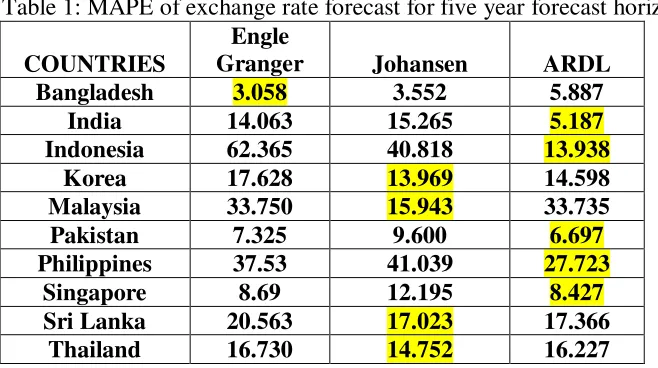
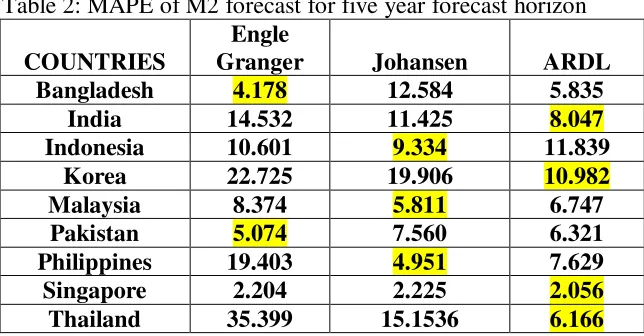
The following tables (Table 1 and Table 2) present the comparison of forecast accuracy
based on MAPE. The best ECM model in each case is highlighted. Generally the ARDL
appears to yield lower forecast errors followed by Johansen technique. This is the case
for money stock forecast (Table 2) where potentially more than one co-integration
vectors are possible. For Bangladesh the EG ECM yields the best forecast for the two
variables. For Malaysia Johansen technique appears to be superior. For India and
Singapore the ARDL technique results in the lowest forecast error. The results for other
[image:10.612.89.418.436.620.2]countries are mixed for the two variables.
Table 1: MAPE of exchange rate forecast for five year forecast horizon
COUNTRIES
Engle
Granger Johansen ARDL
Bangladesh 3.058 3.552 5.887
India 14.063 15.265 5.187
Indonesia 62.365 40.818 13.938
Korea 17.628 13.969 14.598
Malaysia 33.750 15.943 33.735
Pakistan 7.325 9.600 6.697
Philippines 37.53 41.039 27.723
Singapore 8.69 12.195 8.427
Sri Lanka 20.563 17.023 17.366
Thailand 16.730 14.752 16.227
Notes: Schwarz criteria selects lag 1 as optimal for Engle-Granger method for all ten countries. Regression of ECM model with this optimal lags indicate that error correction term is insignificant only in Sri Lanka.
was insignificant only in Indonesia. In other cases loading coefficient was significant with negative sign in at least one VECM equation.
[image:11.612.89.411.150.318.2]Optimal lags using Schwarz criteria for ARDL is 1 for all countries. With optimal lags ECT term is insignificant only in Indonesia.
Table 2: MAPE of M2 forecast for five year forecast horizon
COUNTRIES
Engle
Granger Johansen ARDL
Bangladesh 4.178 12.584 5.835
India 14.532 11.425 8.047
Indonesia 10.601 9.334 11.839
Korea 22.725 19.906 10.982
Malaysia 8.374 5.811 6.747
Pakistan 5.074 7.560 6.321
Philippines 19.403 4.951 7.629
Singapore 2.204 2.225 2.056
Thailand 35.399 15.1536 6.166
Notes: Optimal lags for Engle-Granger test are 1 for all counties. In some countries Engle-Granger ADF test did not uncover co-integration but subsequent in ECM model error correction term is insignificant only in Korea, Malaysia and Pakistan.
Optimal lags for Johansen vary over different countries using same lags for each variable. Trace and Max statistics do not indicate co-integration but in VECM models the loading coefficients was insignificant only in Indonesia.
Optimal lags using Schwarz criteria using ARDL method are four for Korea, Philippines, Pakistan and Bangladesh; three for Singapore and one for India, Malaysia, Thailand. With optimal lags error correction term is insignificant only in Malaysia and Pakistan
Manufacturing production for Sri Lanka is not available so money demand estimation is not possible.
6. Conclusion
It is well known that regression analysis on non-stationary time series data may be
spurious (non-sense) if the underlying variables are not co-integrated. Error correction
models provide a convenient solution for estimation, testing and forecasting. However
there are now different co-integration estimation and testing techniques have been
developed. In this paper we have compared the forecast accuracy of three popular error
correction models that are derived from the Engle-Granger, Johansen and the ARDL
techniques. The results indicate that in general the ECM based on both the ARDL and
in the best performance in about 48% of the cases whereas the Johansen’s ECM yields
the best performance in about 36% cases. The ARDL technique appears to be superior
even in cases where more than one co-integration relationships are possible i.e. money
demand model which involve three variables in the system. The average MAPE for
exchange rate forecast across ten countries is 15%, 18.4% and 22.5% for the ARDL,
Johansen and the EG techniques respectively. The average MAPE for M2 forecasts are
7.3%, 9.9% and 13.6% for the ARDL, Johansen and the EG techniques respectively.
Thus our analysis provides evidence in favor of the ARDL based ECM. Also it will be
interesting to compare forecast of ECM from alternative techniques which do not impose
References
Chambers , M.J. (1993). A note on forecasting in co-integrated systems. Computers
Method Application s, 25, 93-99.
Clements, M. P. and D. F. Hendry (1995), Forecasting in co-integrated systems. Journal
of Applied Econometrics10, 127-146.
Engle, R.F. and Granger, C.W.J. (1987).Co-integration and error correction:
Representation, estimation and testing, Econometrica 55,251-276
Engle, R.F. and Yoo, B.S. (1987). Forecasting and testing in co-integrated systems, the
Journal of Econometrics, 35,143-159.
Haigh, M.S. (2000). Co-integration, unbiased expectations and forecasting in the
BIFFEX freight futures market. Journal of Futures Market, 20, 545-571
Hoffman, D.L and Rasche, R. H. (1996). Assessing Forecast Performance in a
Cointegrated System. Journal of Applied Econometrics, Vol. 11,495-517.
Jansen, D.W and Wang, Z. (2006). Evaluating the ‘Fed Model’ of Stock Price Valuation:
an Out-of-Sample Forecasting Perspective. Econometric Analysis of Financial
and Economic Time Series/Part B Advances in Econometrics, Volume 20, 179–
204.
Johansens S. (1998). Statistical analysis of cointegrating vectors. Journal of Economics of
Lin, J.L. and Tsay, R.S. (1996). Co-integration constraint and Forecasting: An empirical
examination. Journal of Applied Econometrics, Vol. 11,519-538
Pesaran, M. H., Shin, Y., and Smith, R. J. (1996) “Bounds Testing Approaches to the
Analysis of Level Relationships” DEA working paper 9622, Department of
Applied Economics, University of Cambridge.
Pesaran, M. H., Shin, Y. and Smith, R. J. (2001) “Bounds Testing Approaches to the
Analysis of Level Relationships” Journal of Applied Econometrics 16, 289-326.
Stock, J.H.(1995). Point forecasts and prediction intervals for long-horizon forecast.
Manuscript, J.F.K. School of Government, Harvard University.
Wang, Z and Bessler, D.A. (2004). Forecasting performance of multivariate time series
models with full and reduced rank: An empirical examination. International