Tail Dependence Study of SSE Composite Index and SZSE
Component Index Based on the Copula
*
Guohua Sun, Hongliu Su, Guoqiang Tang College of Science, Guilin University of Technology, Guilin, China
Email: [email protected]
Received April 17, 2013; revised May 17, 2013; accepted May 24, 2013
Copyright © 2013 Guohua Sun et al. This is an open access article distributed under the Creative Commons Attribution License, which permits unrestricted use, distribution, and reproduction in any medium, provided the original work is properly cited.
ABSTRACT
With the rapid development of financial industry, copula methods are more and more widely used for the study of fi- nancial fields. By selecting the appropriate copulas, the tail dependence of financial variables can be measured easily. Using the nonparametric estimation method to select A12 copula from Archimedean copulas, and do tail dependence study of SSE composite index and SESE component index. The results show that the SSE composite index and SESE component index simultaneously have the upper tail dependence and lower tail dependence, and the upper tail depend- ence coefficient is less than the lower tail dependence coefficient, which is consistent with the real financial market rule.
Keywords: Rank; Copula; Nonparametric Estimation; Tail Dependence
1. Introduction
With the continuous development of the financial mar- kets, the relationship of interior financial markets is more and more complex, it will promote the study of depend- ence between financial market structure. In the quantita- tive analysis of related financial market structure, de- pendence study is very important, a series of financial problems involve the dependence studies, such as risk management, portfolio selection, asset pricing and so on. Using multivariate distribution function to depict the de- pendence between each component is the most common method in mathematics; However traditional multivariate distribution function exists some problems in practical application, when the analysis formulas of multivariate distribution function contain many variables, it will be difficult to handle, and it requires the type of marginal distribution function to fit the type of multivariate distri- bution function. In financial analysis, marginal distribu- tion often do not have the same type of distribution, this makes the traditional multivariate distribution functions can not be widely used in the dependence analysis of financial markets. By Sklar theorem [1], using the copula function to structure flexible multivariate distribution
function, so as to grasp the real dependence between fi- nancial markets. Therefore, in this paper we use copula functions to study the tail dependence between SSE com- posite index and SZSE component index.
At present, using copula function to study the depend- ence of the financial market already had many achieve- ments, but also in many domestic and foreign literatures, most of them used parameter estimation method to esti- mate parameters of copula functions. The innovation of this paper is to use a parameter estimation method for parameter estimation, to determine copula functions, and then to do the test of tail dependence.
2. Tail Dependence Based on Copula
Tail dependence can be used to represent extreme events of the interaction between the variables, for example, when the random variable X increased or decreased sig- nificantly, the probability of the random variable Y in- creased or decreased significantly [2]. We use the tail dependence coefficient of copula to research the relation- ship between SSE composite index and SZSE component index. Let X and Y be continuous random variables with distribution functions F and G respectively, and whose copula is C, and then, based on the copula function we define the upper tail dependence coefficient U and the lower tail dependence coefficient L as follows [3]:
*
1
1 lim
1 2 ,
lim 1
U t
t
P Y G t X F t
t C t t
t
(1)
0
0 lim
, lim
L t
t
P Y G t X F t
C t t
t
(2)
where , when , we think the
upper (lower) tail of X and Y be asymptotic dependence; when , we think the upper (lower) tail of X and Y be asymptotic independence; where
, 0,
U L
0U L
1 U
L 0
F t and
G t
are the t quantile functions of distribution func- tions F and G
respectively [4].3. Selecting Copulas and Estimating
Parameters
There are many kinds of copula functions, Elliptic copu- las and Archimedean copulas are used commonly, and each group has many specific copula functions. Different copula functions have different properties, in the actual application, choosing the right copula functions need to follow two principles: one is that the established model of copulas should be easy to operate and understand, to avoid the phenomenon of unknown parameters [5]; sec- ond is to choose the appropriate copula functions which are suitable for the sample datas. Elliptical copula func- tions are with a symmetrical tail dependence, this will be conflicted with fat-tailed distribution of financial datas. Archimedean copulas are the most widely used in the financial field, and it is easy to build and calculate them. The bivariate normal copula with symmetry and asymp- totic tail independence is applied widely, but it is unable to capture the asymmetric dependence and tail depend- ence between the variables. Here we select copulas which have obvious tail features. Because the log return corre- lation is accorded with the Archimedean copula distribu- tion, so we choose the Clayton copula with obvious lower tail features, the Gumbel copulas with obvious up- per tail features, and the A12 copula with both upper and lower tail features from Archimedean copulas on the fi- nancial data fitting [6]. Moreover Archimedean copulas have a feature that Kendall’s tau is the analytic function of . By Sklar theorem, when marginal distribution function is continuous, the copulas function will be uni- quely identified.
For the parameter estimation of a specific copula func- tion, parametric approach and nonparametric approach are common methods: 1) strict maximum likelihood ap- proach (EML) and marginal distribution extrapolation approach (IFM) are more frequently used in the parame- ter method. Maximum likelihood approach estimates
marginal distribution and parameters of copula function at the same time; Marginal distribution extrapolation ap- proach divide estimation process into two steps, first to estimate the parameters of the marginal distribution func- tion, and then estimate the parameters of copula function. 2) Genest and Rivest approachs are commonly used in the nonparametric approach [7]. As we know, for a cop- ula function C u v
, , it is related to the Kendall’s tau as following:
0,12
4 C u v, dC u v,
1So for most of the single parameter Archimedean cop- ula functions, because of its generating element
t is a function of the parameter and the relationship be- tween
t and the Kendall’s tau as follows:
1
0 1 4 t dt
t
(3)By solving the formula above, we can get the estimate value of . The deficiency of EML and IFM approaches lie in the parameter estimation of copula function is af- fected by the marginal distribution function, if the as- sumptive model of marginal distribution function were wrong, it will lead to a biased estimate to the copula function. Therefore, in this article we use nonparametric estimation method in view of the features of the Archi- medean copulas, to calculate the estimate value of by the estimate value of the Kendall’s tau, further to esti- mate the parameters of copula functions.
3.1. The Introduction of Three Types of Copulas
1) Gumbel copula
1, exp ln ln , 1
Gu
C u v u v
(4)
Gumbel copula function is very sensitive to the change of variables at the upper tail of the distribution, so it can quickly capture the changes of upper tail dependence, and it can be used to represent the relations between fi- nancial variables which have upper tail dependence. Its parameter represent the degree of correlation, when
1
, the variables are independent; when , the variables are completely related. By formula (1) and (4), we can get the upper tail dependence coefficient of Gumbel copula function, namely 2 21
U
t, by its generating element
t ln and formula (3), the Kendall’s tau is the analytic function of
:
1
Then, 1
1
1 ˆ ˆ 1
(5)
In addition, by the formula
1 2 ,
1
U P Y G X F
C
We can get U
under different levels of . 2) Clayton copula
1, 1
Cl
C u v uv ,0 (6) Clayton Copula function is very sensitive to the change of variables at the lower tail of the distribution, so it can quickly capture the changes of lower tail depend- ence, and it can be used to represent the relations be- tween financial variables which have lower tail depend- ence. Its parameter also represent the degree of cor- relation, when 0, the variables are independent; when , the variables are completely related. By formula (2) and (6), we can get the lower tail dependence coefficient of Clayton copula function, namely 2 1
L
, by its generating element and formula (3), the Kendall’s tau is the analytic function of
t t 1 : 2
Then, 2
1
, accordingly, ˆ 2 ˆ ˆ 1
(7)
In addition, by the formula
,
L
C
P Y G X F
We can get L
under different levels of . 3) A12 copula of Archimedean copulas
1
1
1 1, 1 1 1 ,
C u v u v
1
(8)
Gumbel copula function has only the feature of the upper tail dependence, and Clayton copula function has only the feature of the lower tail dependence, while the A12 copula of Archimedean copulas has both upper tail and lower tail dependence, by formula (1) and (8), the upper tail dependence coefficient can be expressed with
the formula 1
2 2 U
, and by formula (2) and (8), the lower tail dependence coefficient can be expressed with the formula 1
2 L
n by its generating element
, the 1 1 t t the analytic func
and formula (3), the Kendall’s tau is
tion of :
2 1 3 Then,
2
3 1
, accordingly,
2
ˆ ˆ 3 1 (9)
3.2. Estimating
with Nonparametric EstimationIn order to estimate the parameters, firstly we need to know the estimated value of the Kendall’s tau, originally the Kendall’s tau was not defined by the copula function
C , it was defined by the consistent probability of the random variable
X Y,
minus the non-uniform prob- ability of the random variable
X Y,
, that is
X Y,
P
X1 X
Y2
0
2 1
1 2 1 2 0
Y
P X X Y Y
where
X Y1, 1
and
X Y2, 2
are independent identi-cally distributed samples of the random variable
X Y,
.If
X Y1, 1
,,
X Yn, n
are independent identically distributed samples which come from joint distribution function F
of random variable
X Y,
and its cop- ula function is C
, R S1, 1
,,
Rn,Sn
are the ranks of these samples, R ii, 1, 2,,n represent the rank of, 1, 2, , i
X i n; Si,i1, 2,,n represent the rank of , 1, 2, ,n
i
Y i as
; then the Kendall’s tau for the sample is defined
1
2
sgn sgn
1 i j n i j i j
R R S S
n n
(10)So we can work out ˆ
ˆ
on the basis of ˆ, and the copula function can be de rmined solely; then according to the next two formulas to calculate the estimated values of the upper tail dependence coefficient and the lower tail dependence coefficient.
te
ˆ 1 ˆ
U 2 2
(11) ˆ 1 ˆ 2 L (12)
4. Computing Steps and Results
4.1. Calculating the Parameter
ˆWe select day’s closing price
p qi, i
,n1024, of SSE composite index and SZSE component index from Janu- ary 4, 2007 to March 21, 2011. Logarithmic yield
x yi, i
log
pi1 pi
, log
qi1 qi
.
We define R Si, i
rank xi , rank yi
we can get ˆ 0.77338, and by
(5 and formula (9) respectively; 3) Putting the which was calculated in step 2) into formula (13);
i t
), formula (7) we get es-
timated values of parameters o ent copulas in Ta- ble 1.
f differ
From Table 1, the parameters of three kinds of copu- las are
4) KC ~U
0,1 , to do test with a Q-Q figure of the uniform distribution.in their respective domains, this explain that there ex
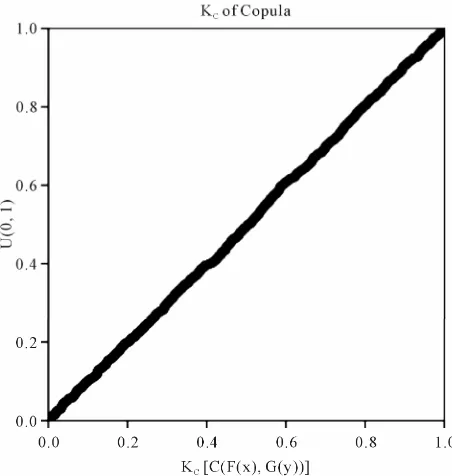
So we use these steps to get the Q-Q test which is shown in Figure 1.
ist both upper tail dependence and lower tail depend- ence between SSE composite index and SZSE compo- nent index. Because the A12 copula of Archimedean copulas has both upper tail and lower tail dependence, we choose A12 copula to study for tail dependence, then we should do the test for the selected copula functions.
4.2. Testing for Copulas
In Figure 1, the KC F X G Y ,
t of A12 copula dis- tribute uniformly on the oblique diagonal line and two sides, so it obey uniform distribution; Table 2 can also explain the KC F X G Y ,
t of A12 copula obeys uni- form distribution. Therefore, we think that the A12 cop- ula function is appropriate for describing the relationship between SSE composite index and SZSE component index, namely, A12 copula function is feasible to study the tail dependence of SSE composite index and SZSE component index.In order to further illustrate A12 copula f scribe the tail dependence be
unction can de- tween SSE composite index and SZSE component index, we do test for the datas. In order to avoid the fault of hypothetical marginal distribu- tion of copula function, we estimate parameters with the Kendall’s tau directly, so we don’t know the marginal distribution function. We use the empirical distribution and KC to structure and test variables which obey uni- form distribution on inspection. Firstly we use geometric meth to test copula distribution, then use K-S statistics to do the test of goodness of fit.
4.3. Studying Tail Dependence
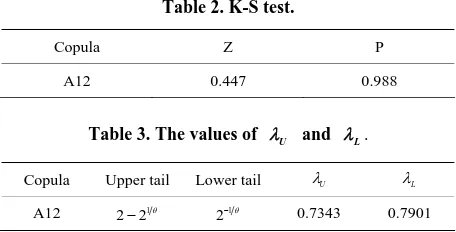
By formula (11) and formula (12), we can work out the upper tail dependence coefficient and the lower tail de- pendence coefficient, the results are shown in Table 3.
od
Univariate distribution function KC
t is defined as
C
K t t t t
where,
t is the generating elem nt of copula func- e tions [8], KC F X G Y ,
t obeys the standard uniform distribution. Setting variables X and Y to obey the em- pirical distri e can wok out the
bution, then w
,
C F X G Y
K t by means of ˆ. For A12 copula function,
,
C F X G Y
1
1 t
K t t
(13)
Follow the steps to calculate,
1) To solve the distribution function F x
i and
yi of logarithm yieldG
1
i i n empirical distribution function);
o solve
,
i
x y (b and G
2) T
oth F are
,G y
i i i
[image:4.595.310.536.352.590.2]t C F x by formula (8); Figure 1. Q-Q figure of KC function of A12 copula.
Table 1. Parameter estimation of copulas.
,
C u v ˆ ˆ ˆ
1, exp ln ln
Gu
C u v u v ˆ1 1 ˆ
Gumbel Copula 4.4127
Clayton Copula
1
, 1
Cl
C u v u v
ˆ2ˆ1ˆ 6.8253
A12 Copula
1 1
1 1
1 u 1 v 1
ˆ2 3 1 ˆ 2.9418
[image:4.595.111.483.636.734.2]st.
[image:5.595.58.286.88.204.2]Copula Z P
Table 2. K-S te
A12 0.447 0.988
able 3. The va
T lues of U and L.
Copula Upper tail Lower tail U L
A12 1
22 1
2 0.7343 0.7901
T able 3 show that the per pen fficient is 0.7343, the lower tail dependence coefficie
he T s up tail de dence co-
e is
nt 0.7901. It indicates that there exists both upper tail de- pendence and lower tail dependence between SSE com- posite index and SZSE component index, what’s more, the upper tail dependence is less than the lower tail de- pendence. The tail dependence between logarithmic yield of SSE composite index and logarithmic yield of SZSE component index demonstrated the consistency of both two extremums; it also demonstrated that whether the price rise or fall, there would be different degrees of de- pendence between two indices.
5. Conclusion
We select Gumbel copula, ula from Archime
Clayton copula and A12 cop-dean copulas, all of which have fea-tures of tail dependence. We use the nonparametric esti- mation approach to estimate parameters of copula func- tions, and find that there exists both upper tail depend- ence and lower tail dependence between SSE composite index and SZSE component index, therefore, we select A12 copula to do the empirical analysis about the tail de- pendence between SSE composite index and SZSE com- ponent index. The results show that the upper tail de- pendence coefficient is less than the lower tail depend- ence coefficient between SSE composite index and SZSE
the downturn of the stock market is higher than the active period, which is consistent with the real financial market rule [9].
com nent index, that is t ay, the dence between SSE posite index and SZSE c ent index during
REFERENCES
[1] R. B. Nelsen, “An Introduction to Copulas,” Springer- Verlag, New Y
po com
o s depen
ompon
ork, 2006, pp. 17-23.
[2] A. Juri and M. V. Wutrich, “Copula Convergence Theo- rems for Tail Events,” Insurance Mathematics and Eco- nomics, Vol. 30, No. 3, 2002, pp. 405-420.
doi:10.1016/S0167-6687(02)00121-X
[3] H. Joe, “Multivariate Models and Dependence Concepts,” Chapman & Hall, London, 1997, pp. 186-198.
doi:10.1201/b13150
[4] A. J. McNeil, R. Frey and P. Embrechts, “Quantitative Risk Management: Concepts, Techniques and Tools,” ceton University Pres
Prin- s, Princeton, 2005, pp. 201-208. [5] J. V. Rosenberg and T. Schuermann, “A General Ap-
proach to Integrated Risk Management with Skewed, Fat- Tailed Risks,” Journal of Financial Economics, Vol. 79, No. 3, 2006, pp. 569-614.
doi:10.1016/j.jfineco.2005.03.001
[6] Y. Li and X. J. Cheng, “Tail Dependence Analysis of SZI & HSI Based on Copula Method,”
Vol. 24, No. 5, 2006, pp. 88-92.
Systems Engineering,
[7] C. Genest and L. P. Rivest, “Statistical Inference Proce- dures for Bivariate Archimedean Copula,” Journal of the American Statistical Association, Vol. 88, No. 423, 1993, pp. 1034-1043. doi:10.1080/01621459.1993.10476372
[8] V. Durrleman, A. Nikeghbali and T. Roncalli, “Which Copula Is the Right One?” Groupe de Recherche Opera- tionelle, Credit Lyonnais, France, 2000, pp. 13-15. [9] X. L. Ren and S. Y. Zhang, “Tail Dependence Analysis of