comm
en
t
re
v
ie
w
s
re
ports
de
p
o
si
te
d r
e
se
a
rch
refer
e
e
d
re
sear
ch
interacti
o
ns
inf
o
rmation
The two tempos of nuclear pore complex evolution: highly adapting
proteins in an ancient frozen structure
Eric Bapteste
¤*
, Robert L Charlebois
*†
, Dave MacLeod
*
and
Céline Brochier
¤‡
Addresses: *Canadian Institute for Advanced Research Program in Evolutionary Biology, Department of Biochemistry and Molecular Biology,
Dalhousie University, College Street, Halifax, Nova Scotia, B3H 1X5 Canada. †Genome Atlantic, Department of Biochemistry and Molecular
Biology, Dalhousie University, 5850 College Street, Halifax, Nova Scotia, B3H 1X5, Canada. ‡EA EGEE (Evolution, Génome, Environnement),
Centre Saint-Charles, Université Aix-Marseille I, place Victor Hugo, 13331 Marseille Cedex 3, France.
¤ These authors contributed equally to this work.
Correspondence: Céline Brochier. E-mail: [email protected]
© 2005 Bapteste et al.; licensee BioMed Central Ltd.
This is an Open Access article distributed under the terms of the Creative Commons Attribution License (http://creativecommons.org/licenses/by/2.0), which permits unrestricted use, distribution, and reproduction in any medium, provided the original work is properly cited.
Nuclear pore evolution
<p>An analysis of the taxonomic distribution, evolutionary rates and phylogenies of 65 proteins related to the nuclear pore complex shows high heterogeneity of evolutionary rates between these proteins.</p>
Abstract
Background: The origin of the nuclear compartment has been extensively debated, leading to several alternative views on the evolution of the eukaryotic nucleus. Until recently, too little phylogenetic information was available to address this issue by using multiple characters for many lineages.
Results: We analyzed 65 proteins integral to or associated with the nuclear pore complex (NPC), including all the identified nucleoporins, the components of their anchoring system and some of their main partners. We used reconstruction of ancestral sequences of these proteins to expand the detection of homologs, and showed that the majority of them, present all over the nuclear pore structure, share homologs in all extant eukaryotic lineages. The anchoring system, by contrast, is analogous between the different eukaryotic lineages and is thus a relatively recent innovation. We also showed the existence of high heterogeneity of evolutionary rates between these proteins, as well as between and within lineages. We show that the ubiquitous genes of the nuclear pore structure are not strongly conserved at the sequence level, and that only their domains are relatively well preserved.
Conclusion: We propose that an NPC very similar to the extant one was already present in at least the last common ancestor of all extant eukaryotes and it would not have undergone major changes since its early origin. Importantly, we observe that sequences and structures obey two very different tempos of evolution. We suggest that, despite strong constraints that froze the structural evolution of the nuclear pore, the NPC is still highly adaptive, modern, and flexible at the sequence level.
Published: 30 September 2005
Genome Biology 2005, 6:R85 (doi:10.1186/gb-2005-6-10-r85)
Received: 23 March 2005 Revised: 15 July 2005 Accepted: 1 September 2005 The electronic version of this article is the complete one and can be
Background
In 1938, Copeland proposed to gather in a large but unnamed natural group all the organisms (both multicellular and uni-cellular) harboring a nucleus [1,2]. He considered that the nucleus was too complex a structure to have appeared inde-pendently several times [1,2]. The possession of a nucleus is still commonly considered as a good synapomorphy for eukaryotes. However, very little broad comparative analyses of eukaryotic nuclei have been conducted in order to test the homology of this structure. Very recently, Mans et al. [3] investigated by BLAST searches the distribution of homolo-gous proteins of the nucleus and of a few associated systems in the three domains of life. Yet, apart from this stimulating work, the nucleus is only well studied in vertebrates [4,5] and in fungi [6-8], whereas little is known in protists or plants. For this reason, the origin and evolution of this structure are difficult to address and largely remain to be described.
The nuclear pore complex (NPC) is one of the most important components of the nucleus. It is a gate between the nucleo-plasm and the cytonucleo-plasm, mediating the nucleocytonucleo-plasmic
transport of small molecules by either diffusion or active transport of large substrates [9-15]. Recent works have sug-gested that some components of the NPC may play a role in the structural and functional organization of perinuclear chromatin [16], in chromatin boundary activities [17] and in interactions with kinetochores [18,19]. A role in numerous pathways has also been observed, such as the control of gene expression, oncogenesis and the progression of the cell cycle [20-23]. The NPC is thus a fully integrated structure and its evolution is likely very constrained.
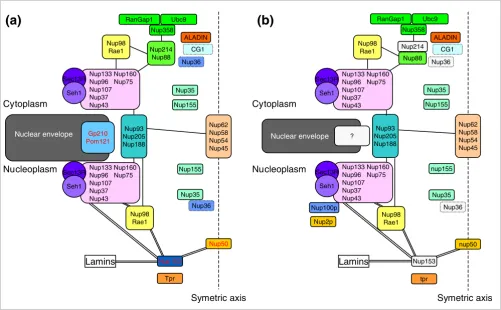
The NPC is also one of the largest macromolecular complexes in the eukaryotic cell (approximately 60 MDa and 125 MDa in yeast [6] and vertebrates [24], respectively), composed of more than 30 different interacting proteins generally referred to as nucleoporins [5,6,15,25]. The nuclear pore exhibits an octagonal symmetry around its cylindrical axis. It consists of a cylindrical core, composed of eight interconnected spokes (each spoke being composed of the Nup93, Nup205, Nup188 nucleoporins; Figure 1a), that surrounds the central channel. Each spoke is connected on the nucleoplasm and cytoplasm
[image:2.612.57.558.347.657.2]The structure of the nuclear pore complex
Figure 1
The structure of the nuclear pore complex. Schematic representation of the position of the major nucleoporin subcomplexes in (a) unikonts and (b) bikonts. The schematic organization of the NPC in unikonts is based on the schematic organizations of NPC in vertebrates published by Powers and Dasso [15], completed accordingly with recent works [5,19]. Boxes delimited by dashed lines indicate proteins having unkown or no precise localization within or around the NPC. Light gray boxes represent nucleoporins present in unikonts but having no homologs in bikonts. Protein names in black in (a) indicate proteins having homologs in fungi, whereas those in red indicate proteins having no homologs but structural analogues in fungi. Lines between subcomplexes indicate putative interactions whereas double lines indicate undisputable interactions.
(a)
Nuclear envelope Gp210 Pom121
Nup93 Nup205 Nup188
Nup155 Nup35 RanGap1 Ubc9
Tpr Nup155 Nup133 Nup160
Nup96 Nup75 Nup107 Nup37 Nup43 Sec13R
Seh1
Nup35
Nup36 CG1
Nup36 ALADIN
Cytoplasm
Nucleoplasm
Nup98 Rae1
Symetric axis Lamins
Nup214 Nup88 Nup98
Rae1
Nup133 Nup160 Nup96 Nup75 Nup107 Nup37 Nup43 Sec13R
Seh1
Nup50
Nup153 Nup358
Nup62 Nup58 Nup54 Nup45
(b)
Nup35
Nup2p Nuclear envelope ?
Nup93 Nup205 Nup188
Nup155 Nup35 RanGap1 Ubc9
nup155 Nup358
Nup133 Nup160 Nup96 Nup75 Nup107 Nup37 Nup43 Sec13R
Seh1
Nup100p
CG1
Nup36 ALADIN
Nup36 Nup214
Cytoplasm
Nucleoplasm
tpr Nup98
Rae1
Nup62 Nup58 Nup54 Nup45
Symetric axis
Nup98 Rae1
Nup133 Nup160 Nup96 Nup75 Nup107 Nup37 Nup43 Sec13R
Seh1
Nup153
nup50
Lamins
comm
en
t
re
v
ie
w
s
re
ports
refer
e
e
d
re
sear
ch
de
p
o
si
te
d r
e
se
a
rch
interacti
o
ns
inf
o
[image:3.612.56.550.122.750.2]rmation
Table 1
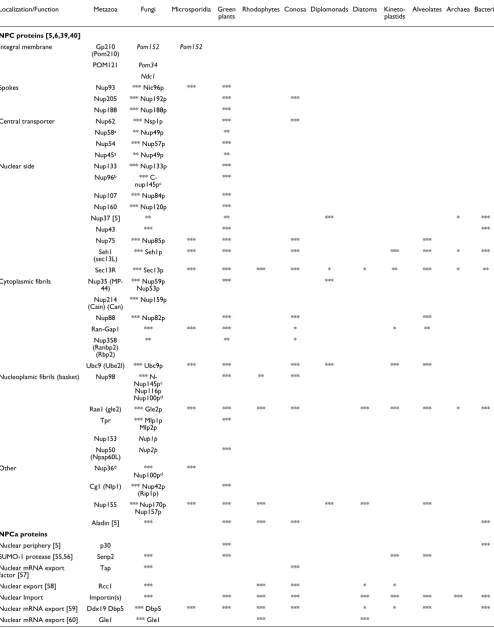
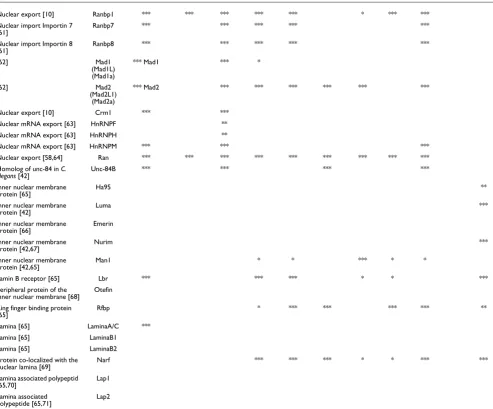
Distribution of homologs of the metazoan NPC and NPCa proteins across different lineages of eukaryotes and prokaryotes
Localization/Function Metazoa Fungi Microsporidia Green plants
Rhodophytes Conosa Diplomonads Diatoms Kineto-plastids
Alveolates Archaea Bacteria
NPC proteins [5,6,39,40]
Integral membrane Gp210 (Pom210)
Pom152 Pom152
POM121 Pom34 Ndc1
Spokes Nup93 *** Nic96p *** ***
Nup205 *** Nup192p *** *** Nup188 *** Nup188p ***
Central transporter Nup62 *** Nsp1p *** *** Nup58a ** Nup49p **
Nup54 *** Nup57p *** Nup45a ** Nup49p **
Nuclear side Nup133 *** Nup133p *** Nup96b ***
C-nup145pc ***
Nup107 *** Nup84p *** Nup160 *** Nup120p ***
Nup37 [5] ** ** *** * ***
Nup43 *** *** ***
Nup75 *** Nup85p *** *** *** ***
Seh1 (sec13L)
*** Seh1p *** *** *** *** *** * ***
Sec13R *** Sec13p *** *** *** *** * * ** *** * ** Cytoplasmic fibrils Nup35
(MP-44)
*** Nup59p Nup53p
*** ***
Nup214 (Cain) (Can)
*** Nup159p
Nup88 *** Nup82p *** *** ***
Ran-Gap1 *** *** *** * * **
Nup358 (Ranbp2) (Rbp2)
** ** *
Ubc9 (Ube2I) *** Ubc9p *** *** *** *** *** *** Nucleoplamic fibrils (basket) Nup98 ***
N-Nup145pc
Nup116p Nup100pd
*** ** ***
Rae1 (gle2) *** Gle2p *** *** *** *** *** *** *** * *** Tpr *** Mlp1p
Mlp2p
***
Nup153 Nup1p
Nup50 (Npap60L)
Nup2p ***
Other Nup36d ***
Nup100pd
***
Cg1 (Nlp1) *** Nup42p
(Rip1p) ***
Nup155 *** Nup170p Nup157p
*** *** *** *** *** ***
Aladin [5] *** *** *** *** ***
NPCa proteins
Nuclear periphery [5] p30 *** ***
SUMO-1 protease [55,56] Senp2 *** *** *** ***
Nuclear mRNA export
factor [57] Tap *** ***
Nuclear export [58] Rcc1 *** *** *** * *
sides to a Nup160 subcomplex (Nup133, Nup96, Nup107, Nup37, Nup43, Nup160, Nup75) that binds to the Sec13R and Seh1 proteins (Figure 1a; Table 1). The Nup160 complexes form a plane pseudo-mirror symmetry running parallel to the nuclear envelope. From the central ring, 50 to 100 nm fibrils extend into the nucleoplasm, where they conjoin distally to form a basket-like structure (Nup153, Nup98/Rae1, Nup50, Tpr; Figure 1a; Table 1), spreading outwards into the cyto-plasm (Nup214, Nup88, Nup358, Ubc9, RanGap1, Nup35; Figure 1a; Table 1). The Nup62 subcomplex, also called the
central transporter, may be involved in transport across the NPC (Figure 1a; Table 1). In vertebrates, the NPC is anchored to the nuclear envelope by the Gp210 and the Pomp121 pro-teins (Figure 1a) and is connected with the nuclear lamina, a meshwork of lamins and lamin-associated proteins that form a 15 nm thick fibrous structure between the inner nuclear membrane and peripheral chromatin (Figure 2).
To further highlight the origin and the evolution of this essen-tial structure in eukaryotes, we investigated the evolutionary
Nuclear export [10] Ranbp1 *** *** *** *** *** * *** *** Nuclear import Importin 7
[61] Ranbp7 *** *** *** *** ***
Nuclear import Importin 8
[61] Ranbp8 *** *** *** *** ***
[62] Mad1
(Mad1L) (Mad1a)
*** Mad1 *** *
[62] Mad2
(Mad2L1) (Mad2a)
*** Mad2 *** *** *** *** *** ***
Nuclear export [10] Crm1 *** *** Nuclear mRNA export [63] HnRNPF ** Nuclear mRNA export [63] HnRNPH **
Nuclear mRNA export [63] HnRNPM *** *** ***
Nuclear export [58,64] Ran *** *** *** *** *** *** *** *** *** Homolog of unc-84 in C.
elegans [42] Unc-84B *** *** *** ***
Inner nuclear membrane protein [65]
Ha95 **
Inner nuclear membrane protein [42]
Luma ***
Inner nuclear membrane
protein [66] Emerin Inner nuclear membrane
protein [42,67]
Nurim ***
Inner nuclear membrane protein [42,65]
Man1 * * *** * *
Lamin B receptor [65] Lbr *** *** *** * * ***
Peripheral protein of the inner nuclear membrane [68]
Otefin
Ring finger binding protein
[65] Rfbp * *** *** *** *** **
Lamina [65] LaminaA/C *** Lamina [65] LaminaB1 Lamina [65] LaminaB2 Protein co-localized with the
nuclear lamina [69]
Narf *** *** *** * * *** ***
Lamina associated polypeptid
[65,70] Lap1
Lamina associated polypeptide [65,71]
Lap2
aNup58 and Nup45 proteins are generated by alternative splicing of the nup58/nup45 gene mRNA. bNup96 and Nup98 are cleaved from a 186 kDa
precursor protein. cN-Nup145p and C-Nup145p are cleaved from the Nup145p precursor protein. dNup36 showed 96.8% identity with the
[image:4.612.61.554.114.523.2]carboxy-terminal region of Nup100p. ***, indicates proteins for which the homology with metazoan proteins seems indisputable and allows good alignments; **, indicates proteins with a likely homology; *, indicates proteins for which a putative homology has been detected by BLAST, but for which no alignment was possible; italic font corresponds to proteins for which no sequence homology was detected but for which structural analyses revealed similar positions within the nuclear pore complex (NPC); underlined font indicates sequences identified using the reconstruction of ancestral sequences.
Table 1 (Continued)
comm
en
t
re
v
ie
w
s
re
ports
refer
e
e
d
re
sear
ch
de
p
o
si
te
d r
e
se
a
rch
interacti
o
ns
inf
o
rmation
history of its components using a classic phylogenetic approach. Beyond detection of homologs by BLAST, we stud-ied the phylogenies, the evolutionary rates, and the domain organization of all the known nucleoporins and of a selection of their main partners involved in nuclear transport or com-posing the nuclear envelope. We subsequently propose some hypotheses on the origin of the nucleus and its evolution.
Results and discussion
Identification of the core of homologous NPC and NPCa proteins present in all extant eukaryotes Our first goal was to test the widely but a priori accepted hypothesis that the NPC is homologous in all extant eukaryo-tes by investigating the distribution of homologs of the meta-zoan NPC and NPCa proteins across eukaryotic lineages. We retrieved the sequences of 65 metazoan NPC and NPCa pro-teins and searched for their homologs in all eukaryotic phyla for which sequences are available in current databases, such as fungi, green plants, Rhodophytes, Conosa, and Diplomon-ads (Table 1; Additional data file 1).
Two different phyletic patterns are expected depending on: whether the NPC was a very recent evolutionary innovation and the outcome of independent evolutionary processes in different eukaryotic lineages; or whether it originated before the last eukaryotic common ancestor (LECA [3]). In the first case, very few metazoan NPC and NPCa proteins would have homologs in all eukaryotic lineages; and in the second case, the vast majority of metazoan NPC and NPCa proteins would have homologs in all eukaryotic lineages [26].
Retrieving homologs for NPC and NPCa proteins was unex-pectedly difficult, despite the apparent structural conserva-tion of the NPC between fungi and metazoa [8]. The ability to identify and successfully retrieve homologs by BLAST and PSI-BLAST approaches is notably dependent on the evolu-tionary rates of sequences. For example, attempts to retrieve a rapidly evolving Arabidopsis thaliana sequence using a slowly evolving Homo sapiens sequence, or vice versa, may be unsuccessful if these homologous sequences have evolved beyond recognition. To overcome this limitation, we multi-plied the seeds for our BLAST searches. Interestingly, we observed that 40 of the 65 NPC and NPCa proteins studied were present in at least the fungal, animal and plant lineages (Table 1). Furthermore, mining of protist EST databases, notably of stramenopiles, expanded this taxonomical distri-bution (Table 1), revealing that 48 of the 65 proteins under study were present in bikonts (the grouping of plants and all protists excepted conosa [27]) and in unikonts (the grouping of opisthokonts: metazoa and fungi, and conosa). Among these 48 proteins, 27 of the 33 components of the NPC (Table 1; Figure 1) and 16 of the 17 proteins involved in nucleocyto-plasmic transport were conserved in unikonts and bikonts against only four of the 14 proteins associated with the nuclear envelope (Lbr, Narf, Rfbp and Man1; Table 1). Thus,
we did not observe any of the outcomes of the two a priori models, but we obtained an intermediate picture, in which most but not all of the metazoan NPC and NPCa proteins have homologs in other eukaryotic lineages. A unique and ancient origin of the NPC and, by extension, of the nuclear compart-ment itself would be favored because similar patterns of dis-tribution would be better explained by an inheritance from the LECA than by multiple convergent recruitments. This claim would be strengthened if phylogenies of these tic ubiquitous proteins are all in agreement with the eukaryo-tic tree [26]. Indeed, phylogeneeukaryo-tic analyses of these proteins led to trees in which the relationships between the eukaryotic lineages were generally well preserved; most of the trees dis-playing apparent phylogenetic oddities could be easily
[image:5.612.311.553.83.487.2]ration-Schematic representation of the putative inner nucleus membrane organization
Figure 2
Schematic representation of the putative inner nucleus membrane organization. All the proteins (Nurim, Emerin, Lap-1, Lap-2, A-type lamins and B-type lamins) except Lbr are found only in metazoa (for more details, see [65]). Distant homologs of rfbp and Man1 have been found in some bikont protists (Table 1).
NPC
Cytoplasm Nucleoplasm
Nurim
Type-A lamins
RFBP
Emerin
Man1
Lap-2(β γ δ ε, , , )
Lap-1
LBR
Outer nuclear membrane
Inner nuclear membrane
Chromatin
Type-B lamins
Otefin
Ha95
Lap-2α
RUSH
Ha95
alized by reconstruction artifacts due to heterogeneity of evolutionary rates (not shown).
Interestingly, the ubiquitous homologs are broadly located on the NPC structure (Figure 1), suggesting that a large fraction of the genes for NPC components originated once, prior to the LECA (27 of the 33 nucleoporins have homologs in unikonts and bikonts), and that the LECA likely had a complex nucleo-plasmic transport system (16 of the 17 proteins have homologs in unikonts and bikonts) and possibly a large and modern-type nucleus.
We reckon that one has to be cautious when making conclu-sions about the lack of homologs in some lineages, such as conosa, for which no complete genome was available when we conducted this study (Table 1; Figure 1). This reduced our ability to shed light on several steps of NPC evolution. In organisms with complete genome sequences available, such as metazoa, fungi, and green plants, an absence may be inter-preted as either a true loss, but also as the outcome of evolu-tion beyond recognievolu-tion. For example, the absence of a metazoan and fungal Nup214/Nup159p homolog in green plants (despite the presence of the homolog of its partner Nup88/Nup82p) may well reflect a true loss of this gene in the green plant lineage or an innovation in the opisthokont lineage (metazoa and fungi). If this absence is proven to be true, it could suggest some limited structural reorganization of the NPC. However, this apparent absence could also simply reflect a fast evolutionary rate for this protein in green plants or in opisthokonts, or both.
Interestingly, eight proteins (Pom121, Gp210, and the lam-ina-associated proteins Emerin, Otefin, Lamina A/C, Lamina B1 and B2, Lap1 and Lap2) were found only in metazoa, whereas five proteins (Pom152, Pom34, Ndc1, Nup1p and Nup2p) appeared as fungi specific (Table 1). Could this reflect lineage-specific innovations? In metazoa, Pom121 and Gp210 are involved in the anchoring of the NPC to the nuclear mem-brane [5]. The lack of apparent homologs of these genes in fungi indicates that they likely have an analogous anchoring system. Indeed, structural analyses have shown that three analogous proteins (Pom152, Pom34, and Ndc1) that do not display any sequence similarity with Pom121 and Gp210 per-form this function in fungi [6]. These observations favor the hypothesis of a lineage-specific innovation with non-homolo-gous replacement, followed by loss of the ancestral anchoring system in one of the two lineages. Additional information about the NPC anchoring structure in other opisthokonts, and in conosa (for which no homologs of those genes have been detected) may help to determine in which lineage (fun-gal or metazoan) this replacement occurred. A similar hypothesis could be formulated for the metazoan-specific nucleoporins Nup153 and Nup50. Structural analyses revealed that fungi possess analogues of Nup153 and Nup50 called Nup1p and Nup2p, respectively [5]. As plants harbor a candidate homolog of Nup50, a replacement of these proteins
may have occurred specifically in fungi. An alternative expla-nation would be that they have evolved beyond recognition. Further investigations of structural data, especially from pro-tists and plants, will be required to further test these hypotheses.
Heterogeneity of evolutionary rates and domain evolution of NPC and NPCa proteins
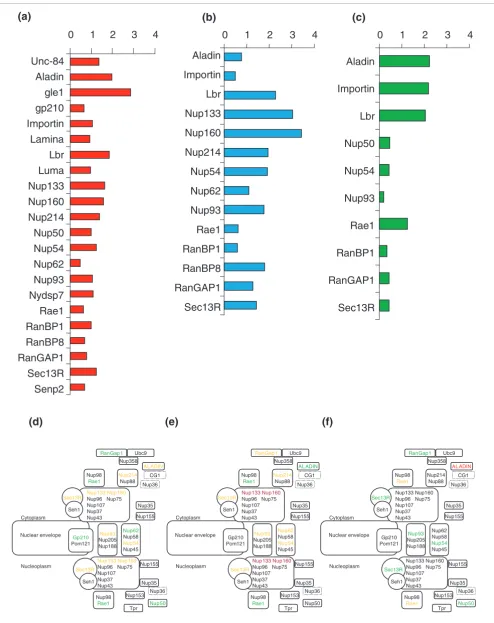
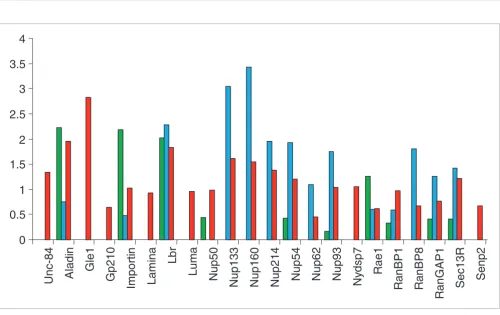
To understand the evolution of NPC protein sequences, we compared evolutionary rates: between markers for all the species (Figure 3); between markers for three given lineages independently (Figures 4 and 5); and within lineages (Figure 6). We produced a very conservative estimate because we considered only the 22 datasets composed of unambiguously aligned sequences having multiple representatives in green plants, fungi, and/or metazoan groups (the datasets used are available in Additional data file 2). Other markers presented too little sequence conservation and/or too limited taxonomic samples in the three lineages analyzed. We show that these 22 ubiquitous proteins present important differences in their rates of evolution (Figure 3a). For instance, some proteins (Nup160 or RanGAP1) displayed on average six times more substitutions than others (Lap2) (Figure 3a). The position within the NPC structure did not explain these differences in evolutionary rates as proteins evolving at either rapid or aver-age rates are uniformly distributed across the NPC and found in almost all of the NPC subcomplexes (Figure 3b). However, such a global average rate of evolution, because it is estimated for all species altogether, is not the most accurate way to describe the evolution of protein sequences, which might be lineage-dependent. Thus, we estimated the evolutionary rates in fungi, metazoa, and plants separately (Figures 4 and 5). This analysis revealed that the markers were not homogene-ously slowly or rapidly evolving. In fact, they evolved at differ-ent rates in the differdiffer-ent lineages, without any general rule and without any obvious correlation with their structural location (Figures 4 and 5). For instance, Nup93 and Nup54 evolved at average rates in metazoa and in fungi, but slowly in plants (Figures 4 and 5). Some markers such as RanGAP1 are slowly evolving in the green plants and in metazoa but ing at an average rate in fungi, while Importin is slowly evolv-ing in fungi but rapidly evolvevolv-ing in plants and at an average rate in metazoa (Figures 4 and 5). Rae1 protein displays slowly evolving evolutionary rates within fungi and metazoa and average evolving evolutionary rates in plants; Nup133 and Nup160 evolve at average rates within metazoa but very rapidly in fungi, and so on. Evolutionary rates were also sometimes heterogeneous within a given lineage. For instance, Rae1 evolves faster than average in Drosophila melanogaster but slower than average in Mus musculus and H. sapiens (Figure 6).
comm
en
t
re
v
ie
w
s
re
ports
refer
e
e
d
re
sear
ch
de
p
o
si
te
d r
e
se
a
rch
interacti
o
ns
inf
o
rmation
very diverse functions, the contrast between their ubiquitous distribution, their lack of sequence conservation, and their heterogeneity of evolutionary rates probably reflects a higher plasticity of sequences than for NPC structure, which could thus have become frozen very early in eukaryotic evolution.
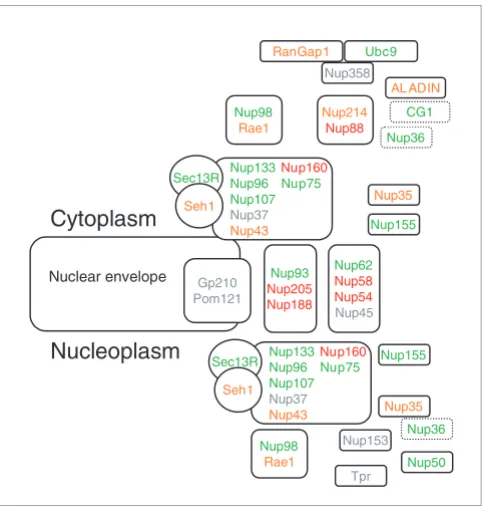
Yet, if the evolutionary rate of NPC protein sequences is very heterogeneous, the domains detected in 43 proteins by query-ing the SMART database [28] were generally conserved (Additional data file 10 and Figure 7); 7 out of 43 of the
pro-teins tested presented no domain organization. We found no loss or gain of domains for 23 of the remaining proteins over NPC evolution in four organism representatives of three majors phyla, metazoa, fungi and green plants. Only 12 pro-teins displayed less than 90% of identical domains between plants, fungi and metazoa, and only half (Narf, Nup214, Luma, Ranbp7, Ranbp8, p30 and Nup35) showed a signifi-cant change. For example, Narf has either lost an iron-only hydrogenase domain in H. sapiens and Schizosaccharomyces pombe or gained it in D. melanogaster and A. thaliana.
[image:7.612.57.553.86.549.2]NPC and NPCa protein evloutionary rates
Figure 3
NPC and NPCa protein evloutionary rates. (a) Comparison of the evolutionary rates for several NPC and NPCa proteins. The evolutionary rate for a marker corresponds to the average distance estimated between species. (b) The evolutionary rates mapped onto the NPC structure with a color code: green, slowly evolving marker (average distance < 1); yellow, marker evolving at an average rate (1 < average distance < 2); red, rapidly evolving marker (2 < average distance < 3); dark red, very rapidly evolving marker (average distance > 3).
Nuclear envelope Gp210
Pom121
Nup93
Nup205 Nup188
Nup62
Nup58
Nup54
Nup45 Nup155
Nup35
RanGap1 Ubc9
Tpr Nup153
Nup50
Nup155
Nup98
Rae1
Nup133Nup160
Nup96 Nup75 Nup107 Nup37 Nup43 Nup98
Rae1
Nup214
Nup88 Nup358
Sec13R
Seh1
Nup133Nup160
Nup96 Nup75 Nup107 Nup37 Nup43
Sec13R
Seh1
Nup35
Nup36 CG1
Nup36
AL ADIN
Cytoplasm
Nucleoplasm
0 0.5 1 1.5 2 2.5 3 3.5
Unc-84
Aladin
Gle1
Gp210
Importin
Lamina
Lap2
Lbr
Luma
Nup133
Nup160
Nup214
Nup50
Nup54
Nup62
Nup93
Nydsp7
Rae1
RanBP1
RanBP8
RanGAP1
Sec13R
Senp2
Figure 4 (see legend on next page)
0
1
2
3
4
Aladin
Importin
Lbr
Nup50
Nup54
Nup93
Rae1
RanBP1
RanGAP1
Sec13R
Aladin
0
1
2
3
4
Importin
Lbr
Nup133
Nup160
Nup214
Nup54
Nup62
Nup93
Rae1
RanBP1
RanBP8
RanGAP1
Sec13R
0
1
2
3
4
Unc-84
Aladin
gle1
gp210
Importin
Lamina
Lbr
Luma
Nup133
Nup160
Nup214
Nup50
Nup54
Nup62
Nup93
Nydsp7
Rae1
RanBP1
RanBP8
RanGAP1
Sec13R
Senp2
Nuclear envelope Gp210 Pom121
Nup93
Nup205 Nup188
Nup62 Nup58
Nup54
Nup45 Nup155
Nup35 RanGap1 Ubc9
Tpr Nup153
Nup50 Nup155
Nup98 Rae1
Nup133 Nup160
Nup96 Nup75 Nup107 Nup37 Nup43 Nup98 Rae1
Nup214
Nup88 Nup358
Sec13R
Seh1
Nup133 Nup160
Nup96 Nup75 Nup107 Nup37 Nup43
Sec13R
Seh1 Nup35 Nup36 CG1 Nup36
ALADIN
Cytoplasm
Nucleoplasm
Nuclear envelope Gp210 Pom121
Nup93
Nup205 Nup188
Nup62
Nup58
Nup54
Nup45 Nup155
Nup35
RanGap1 Ubc9
Tpr Nup153
Nup50 Nup155
Nup98 Rae1
Nup133 Nup160
Nup96 Nup75 Nup107 Nup37 Nup43 Nup98 Rae1
Nup214
Nup88 Nup358
Sec13R
Seh1
Nup133 Nup160
Nup96 Nup75 Nup107 Nup37 Nup43
Sec13R
Seh1 Nup35 Nup36 CG1 Nup36
ALADIN
Cytoplasm
Nucleoplasm
Nuclear envelope Gp210 Pom121
Nup93 Nup205 Nup188
Nup62 Nup58 Nup54 Nup45
Nup155 Nup35 RanGap1 Ubc9
Tpr Nup153
Nup50 Nup155
Nup98
Rae1
Nup133 Nup160 Nup96 Nup75 Nup107 Nup37 Nup43 Nup98
Rae1
Nup214 Nup88 Nup358
Sec13R Seh1
Nup133 Nup160 Nup96 Nup75 Nup107 Nup37 Nup43 Sec13R
Seh1 Nup35 Nup36 CG1 Nup36
ALADIN
Cytoplasm
Nucleoplasm
(a)
(b)
(c)
(f)
(e)
comm
en
t
re
v
ie
w
s
re
ports
refer
e
e
d
re
sear
ch
de
p
o
si
te
d r
e
se
a
rch
interacti
o
ns
inf
o
rmation
Conversely, other proteins (Aladin, Nup43, Rae1, RanGAP1 and Seh1) show variation only in the number of repeated domains. For example, if we take H. sapiens as a reference, Aladin seems to have gained two WD domains in S. pombe, and one in D. melanogaster, and to have lost two such domains in A. thaliana.
This strong domain conservation for NPC proteins all over the NPC structure and despite the multiple changes in the rest of the sequence illustrates the strength of the structural con-straints acting on NPC and NPCa proteins, probably since LECA.
Thus, while the presence of NPC and NPCa proteins seems to be necessary, most of their sequences can be highly adapted and plastic. These differential evolutionary constraints between sequences and NPC structure are an example of
tink-ering in eukaryotic evolution, a trick to overcome the frozen structural evolution (that is, the structure and complexes in interaction are preserved, but the sequences of their compo-nents vary). Thus, while the global structure of the NPC seems mostly preserved and rigid, it is also strikingly flexible outside the preserved domains, enough to accommodate multiple dif-ferent functions and to interact with an indefinite number of partners.
Looking for origins: a possible prokaryotic connection The age of the NPC structure - as ancient as LECA - raises the question of its origin. The possibility of a pre-LECA NPC deserves consideration. Indeed, a structure comparable to a nucleus (membranes surrounding and isolating the DNA from the rest of the cytoplasm) has been observed in some members of the Planctomycetales, possibly one of the most ancient bacterial phyla [29,30]. However, available data
[image:9.612.55.555.169.484.2]NPC and NPCa protein evloutionary rates within lineages
Figure 4 (see previous page)
NPC and NPCa protein evloutionary rates within lineages. Comparison of the evolutionary rates of three lineages for several NPC and NPCa proteins, calculated for a marker as the average distance between species of a particular lineage: (a) metazoa in red; (b) fungi in blue; and (c) green plants in green. The evolutionary rate for a marker corresponds to the average distance estimated between species of a given lineage. The evolutionary rates were mapped onto the (d) metazoan, (e) fungi and (f) green plant NPC structures with a color code: green, slowly evolving marker (average distance < 1); yellow, marker evolving at an average rate (1 < average distance < 2); red, rapidly evolving marker (2 < average distance < 3); dark red, very rapidly evolving marker (average distance > 3).
Alternative representation of the evolutionary rates presented in Figure 4a,b,c, allowing a better comparison of the evolutionary rates of several NPC and NPCa proteins between the three lineages (metazoa in red, fungi in blue and green plants in green)
Figure 5
Alternative representation of the evolutionary rates presented in Figure 4a,b,c, allowing a better comparison of the evolutionary rates of several NPC and NPCa proteins between the three lineages (metazoa in red, fungi in blue and green plants in green).
0
0.5
1
1.5
2
2.5
3
3.5
4
Un
c-84
Al
a
d
in
Gle
1
G
p
210
Imp
or
ti
n
La
m
ina
Lb
r
Lu
ma
Nup5
0
Nup1
33
Nup1
60
Nup2
14
Nup5
4
Nup6
2
Nup9
3
Ny
d
s
p7
Rae1
Ran
B
P
1
Ran
B
P
8
Ran
G
A
P1
Sec
1
3
R
S
concerning the nature, the composition, the structure, and the function(s) of these nuclear-like structures in
Planctomy-cetales have not yet established whether they were homolo-gous to the eukaryotic nucleus. Importantly, some
Relative evolutionary rates of several NPC and NPCa proteins for several species (H. sapiens, M. musculus, D. melanogaster, S. pombe and A. thaliana), corresponding to the average distance to a given species minus the average distance to any species
Figure 6
Relative evolutionary rates of several NPC and NPCa proteins for several species (H. sapiens, M. musculus, D. melanogaster, S. pombe and A. thaliana), corresponding to the average distance to a given species minus the average distance to any species.
The species evolve
FASTER
than average
The species evolves
SLOWER
than average
Un
c-84
-1
-0.8
-0.6
-0.4
-0.2
0
0.2
0.4
0.6
0.8
1
Al
ad
in
Nup1
60
Nup1
33
Ran
B
P
8
Ran
B
P1
RA
E1
Nup9
3
Nup6
2
Nup5
4
Sec
13R
Arabidopsis thaliana
Drosophila melanogaster
Homo sapiens
Mus musculus
comm
en
t
re
v
ie
w
s
re
ports
refer
e
e
d
re
sear
ch
de
p
o
si
te
d r
e
se
a
rch
interacti
o
ns
inf
o
rmation
Methanogens (Archaea) also display intriguing inner mem-branes [31,32]. Could these structures in prokaryotes and eukaryotes have a common origin or did they appear inde-pendently in the three domains of life? Moreover, could viruses have played an important role in the origin of the nucleus and of the NPC as sometimes suggested [33]?
To address this, we tested whether some phylogenetic con-nections between the eukaryotic NPC components and some putative prokaryote and viral homologs may be proposed. This may provide some answers, even though the absence of a convincing rooting of the Tree of Life does not allow any obvious temporal polarization [34]. For instance, if homologs of the NPC genes were found in prokaryotes, and in particular in Planctomycetales, this could be an argument in favor of a very ancient origin of the genes constituting the NPC (before the separation of the three domains), consistent with a very ancient origin of the nucleus itself. On the other hand, if no prokaryotic homologs are found, the hypothesis of a strictly eukaryotic construction of the NPC (and nucleus) might be most parsimonious.
Hence, we specifically looked for homologous sequences in prokaryotes and viruses, even if they were at first not retrieved when multiple extant eukaryotic seeds were used. Clearly, the large evolutionary distances between eukaryotes
and prokaryotes and the heterogeneity of evolutionary rates in sequences complicate such analyses [35,36]. Ancestral sequences inferred using Codeml [37], software taking into account the heterogeneity of rates of evolution, for genes with sufficiently long unambiguously aligned regions provided us with additional seeds. Interestingly, BLAST searches seeded with these ancestral sequences systematically recovered pre-viously identified eukaryotic sequences (a positive control on the quality of ancestral sequences) and sometimes retrieved new prokaryotic sequences that were otherwise undetected (Tables 1 and 2).
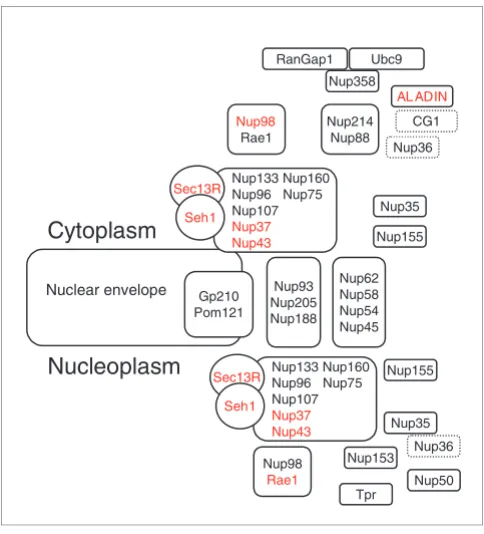
We found seven proteins with such additional prokaryotic homologs, leading to a total of 15 proteins with prokaryotic homologs: 9 are NPCa proteins (p30, Nurim, Importins, Ha95, Luma, Lbr, Rfbp, Ddx19 and Narf), whereas only 6 are NPC proteins (Nup37, Nup43, Seh1, Rae1, Aladin, Sec13R) (Table 2; Figure 8). All the NPC proteins with prokaryotic homologs detected have WD repeated domains, suggesting that this domain, if not convergent, may be very ancient and would have originated before the separation of the tree domains of life. Five of these NPC proteins are involved in the anchoring system (Ha95, Luma, Nurim, Lbr, Narf). Interest-ingly, all NPC proteins are localized on the nuclear side, except Aladin, which locates near Nup358 on the cytoplasmic face of NPCs [38]. In addition, two of the NPCa proteins are involved in nucleocytoplasmic transport (Importins and Ddx19). This result is very suggestive because our phylogenetic approach was very conservative: only 31 pro-teins were used to infer ancestral sequences (see Materials and methods), and the evolutionary distances and the heter-ogeneity of the evolutionary rates are obviously larger between prokaryotes and eukaryotes than inside eukaryotes alone. This search could then be improved when additional eukaryotic sequences are known.
From these results, an exciting hypothesis may be that an ancient universal system of transmembrane transport was recruited during early eukaryotic evolution (before LECA) to form the NPC. However, too little is currently known about the function of these proteins in prokaryotes to test this hypothesis.
It was interesting to find homologs in Methanosarcinales since those Archaea could display inner membranes. Yet, the absence of undisputable homologs in Planctomycetales, even if the complete genome of Pirellula were available, does not support a relationship between their nucleus-like structure and the eukaryotic nucleus. In the detail, the taxonomical dis-tribution of prokaryotic NPC protein homologs is intriguing (Table 2; Additional data files 3, 4, 5, 6, 7). The species har-boring these proteins are mainly members of Cyanobacteria for Bacteria and Methanosarcinales for Archaea. The prokaryotic homologs of NPCa proteins are more patchily dis-tributed than those of the NPC proteins. They are mainly present in various phyla of Bacteria such as Proteobacteria,
[image:11.612.55.296.85.342.2]Domain conservation of the proteins constituting the NPC
Figure 7
Domain conservation of the proteins constituting the NPC. The color code is: proteins exhibiting the same domain organization in the four species are in green; proteins presenting less than 90% similarity in their organization in domains are in orange; proteins presenting no PFAM domain are in red; proteins for which the structural organization was not studied are in gray.
Nuclear envelope Gp210 Pom121
Nup93
Nup205 Nup188
Nup62
Nup58 Nup54
Nup45
Nup155
Nup35 RanGap1 Ubc9
Tpr Nup153
Nup50 Nup155
Nup98
Rae1
Nup133Nup160
Nup96 Nup75 Nup107
Nup37
Nup43
Nup98
Rae1
Nup214
Nup88
Nup358
Sec13R
Seh1
Nup133Nup160
Nup96 Nup75 Nup107
Nup37
Nup43
Sec13R
Seh1
Nup35
Nup36 CG1 Nup36
AL ADIN
Cytoplasm
Cyanobacteria, Green non sulfur bacteria or the Cytophagales-Flavobacteria-Bacteroides group. This patchy taxonomical distribution could be explained by multiple inde-pendent losses, the proteins being kept in some species for different purposes, but also - and more likely - by several independent gene transfers from eukaryotes to prokaryotes. For Ha95, Luma and Nurim, the hypothesis of lateral gene transfers between metazoa and prokaryotes seems the most likely explanation (see for instance the phylogenies of Luma, found only in metazoan and in Mesorhizobium loti and of Nurim, found in some Cyanobacteria plus α-Proteobacteria; Additional data files 5 and 6). These examples of transfers from eukaryotes (and sometimes specifically from metazoa) to prokaryotes suggest that NPC and NPCa proteins can be functional in a prokaryotic cellular context even in the absence of a nuclear compartment. In any case, this illus-trates the plasticity, flexibility, multitasking and recruitment potential for these NPC/NPCa proteins, already suggested by their highly specific rates of evolution.
Conclusion
[image:12.612.57.554.114.364.2]Our study confirms that most of the metazoan proteins con-stituting the NPC and involved in nuclear transport have homologs in all eukaryotic lineages, as recently pointed out by Mans et al. [3]. Only the main partners of the NPC that local-ize to the inner membrane appear specific to metazoa. As most of the ubiquitous proteins observed in green plants, Table 2
Taxonomic affiliation of NPC and NPCa prokaryotic homologous proteins
Protein name Archaea Bacteria Virus
Ddx19 Euryarchaeota/Crenarchaeota Proteobacteria, Gram positives, Green non sulfur bacteria...
Importin Methanosarcina barkeri Anabaena
Lbr Coxiella burnetii (gamma-Proetobacteria), Parachlamydia sp. (Chlamydiales)
Ha95 Nostoc fragment
Luma Mezorhizobium loti
Aladin Methanosarcina acetivorans
Methanosarcina barkeri
Cyanobacteria mainly (some Planctomycetales and Proteobacteria)
Nurim α-Proteobacteria mainly (some Cyanobacteria and Gram positives)
Narf Firmicutes, Proteobacteria, CFB group, Green-non sulfur Bacteria
Nup37 Methanosarcina acetivorans Cyanobacteria
Nup43 Cyanobacteria
P30 Proteobacteria
Cyanobacteria
Rae1 Methanosarcina acetivorans Cyanobacteria
Rfbp Methanosarcina barkeri,
Methanosarcina acetivorans
Short poorly conserved fragments
Sec13R Methanosarcina acetivorans Cyanobacteria
Seh1 Methanosarcina acetivorans Cyanobacteria
Homologs detected by BLASTP are in bold, whereas homologs detected using ancestral sequences as seed for BLASTP searches are indicated with a standard font.
Localization of the six NPC proteins having prokaryotic homologs
Figure 8
Localization of the six NPC proteins having prokaryotic homologs. The names of those six proteins are in red. All except Aladin are part or associated with the Nup160 subcomplex on the nuclear side.
Nuclear envelope Gp210 Pom121
Nup93 Nup205 Nup188
Nup62 Nup58 Nup54 Nup45
Nup155 Nup35
RanGap1 Ubc9
Tpr Nup153
Nup50 Nup155
Nup98
Rae1
Nup133 Nup160 Nup96 Nup75 Nup107
Nup37 Nup43 Nup98
Rae1
Nup214 Nup88 Nup358
Sec13R Seh1
Nup133 Nup160 Nup96 Nup75 Nup107
Nup37 Nup43 Sec13R
Seh1
Nup35
Nup36 CG1
Nup36
AL ADIN
Cytoplasm
[image:12.612.57.299.422.689.2]comm
en
t
re
v
ie
w
s
re
ports
refer
e
e
d
re
sear
ch
de
p
o
si
te
d r
e
se
a
rch
interacti
o
ns
inf
o
rmation
fungi, animals and protists are located in all the structural subcomplexes of the NPC, we conclude that the majority of the NPC is homologous in all extant eukaryotes. A core of interacting proteins seems to have been preserved for at least 1.5 billion years, their association being at least as ancient as LECA. How and when this NPC structure originated, how-ever, remains unclear.
At present, most nuclear proteins seem to have no identified prokaryotic homologs. This does not mean, however, that these genes are strictly eukaryotic. They might well have prokaryotic homologs that are too distantly related to be rec-ognized, especially if the origin of eukaryotes involved some sort of quantum evolution [27], with an acceleration of the rate of evolution in the branch leading to extant eukaryotes. Indeed, we found distant prokaryotic homologs of several NPC and NPCa proteins. Some of them were likely recruited by lateral gene transfer from eukaryotes, and it will be inter-esting to understand the way they adapted their function to a prokaryotic environment. Intriguingly, the presence of prokaryotic homologs of NPC components of the nuclear side may imply the existence of a pre-eukaryotic fragment of the nuclear pore structure.
Finally, our study illustrates that even if NPC and NPCa com-plexes are built from the same proteins, they display two tem-pos of evolution, one at the structural level, which became mostly frozen early in eukaryotic evolution, and another, very dynamic, one at the sequence level. The poor conservation of their sequences, the varied evolutionary rates observed in various genes and lineages, the recent replacement of the anchoring system in either the fungi or the metazoa, and the evidence for successful lateral gene transfer (LGT) of these genes, bespeak for this dual evolution of the NPC and NPCa components: structurally rigid but very adaptable in their sequences, a likely reason for the success of the nuclear structure.
Materials and methods
Construction of the data setsHomologous sequences of all the identified nucleoporins in vertebrates and in fungi [5,6,39,40] (completed by the list of proteins published in the Nuclear Protein Database [41]), of proteins involved in the NPC anchoring system [5,6,42], and of several important protein partners in and around the nuclear envelope (Table 1) were retrieved from the National Center for Biotechnology Information [43] with the programs BLASTP, TBLASTN, and PSI-BLAST [44,45]. To avoid incor-rect assignment for non-homologous sequences containing the phylogenetically weakly discriminant WD domains and FG repeats, we considered as homologous only those sequences with long stretches of sequence homology outside of these regions with repeats. When no homologous sequences were retrieved outside metazoa, additional searches were performed using each new sequence as a seed
to complete the retrieval phase and initiate new searches. Homologous proteins were aligned with ClustalW [46] and the alignment was then manually refined with the ED pro-gram of the MUST package [47]. Regions of unambiguous alignment were manually selected using the program NET from the MUST package [47]. All the alignments are available upon request from CB or EB.
Eukaryotic EST databases were mined for each gene with a satisfactory phylogenetic alignment. The EST databases we used (Additional data file 8), included more species than in Mans et al. [3] because they notably contained stramenopiles. This approach is far from being ideal, however, because the absence of an EST in a given lineage does not mean that these species do not harbor the corresponding homologs in their genome. In addition, many homologs were probably not retrieved because of the limited size of the databases. Indeed, the largest database (diatoms and conosa, a group including Dictyostelium and Entamoebae species) provide the largest number of hits.
Phylogenetic analyses
All protein alignments were used to calculate phylogenetic trees by maximum likelihood (ML), maximum parsimony (MP) and Neighbor Joining (NJ) methods with the programs PHYML version 1.0 [48] (JTT+F+Γ model taking into account among-site rate variations), PMBML (JTT+PMB model) [49] and TREE-PUZZLE version 5.1 [50], PAUP ver-sion 4.0 beta [51] and MUST [47].
We selected a few proteins for further in-depth phylogenetic analyses by maximum likelihood (PROML; nine user defined categories) [52] when they presented a broad taxonomic dis-tribution and enough unambiguously aligned sites. Bootstrap values were calculated with an exact procedure (100 repli-cates were generated using SEQBOOT [52], and trees were inferred by an ML method with Γ distribution using PUZZLE-BOOT) to estimate the robustness of phylogenetic inference.
Estimation of rates of evolution
phyloge-netically consistent. These estimates were calculated by Evospeedometer [53].
Analysis of domain conservation
The presence of domains in the sequences was investigated using the SMART server [28]. This also allows, in addition to the HMMER searches of the SMART database, which is the default option, detection of outlier homologs and homologs of known structures, signal peptides, internal repeats, intrinsic protein disorders, and PFAM domains. All NPC and NPCa proteins present in at least two of the three lineages, metazoa (H. sapiens, D. melanogaster), fungi (S. pombe) and green plants (A. thaliana) were investigated.
Reconstruction of ancestral sequences
Ancestral sequences were reconstructed for 31 proteins. Only regions of proteins with significantly long, contiguous and unambiguously aligned regions (>200 successive positions) were used (Additional data file 9). A maximum likelihood tree for each of these proteins was calculated by PMBML (JTT+PMB model), with user-defined categories. The topol-ogy of this tree was provided as an intree to CODEML [37] (WAG model, pre-estimated alpha parameter by TREE-PUZ-ZLE version 5.1 [50], for eight categories of rates of evolu-tion), which infers the ancestral sequences for each node of the tree. Ancestral sequences were extracted from the outfile of CODEML using ancestRetrieve [54].
Additional data files
The following additional data are available with the online version of this paper. Additional data file 1 is a table contrast-ing our phylogenetic-ancestral reconstruction results with those (BLAST-COG based) published in [3]. Additional data file 2 is a zip file containing the 22 datasets we used to com-pare the evolutionary rates between markers for all the spe-cies, between markers for three given lineages independently and within lineages. Additional data file 3 is a PDF file show-ing the ML tree of the Aladin protein (209 sites). The boot-strap proportions are reported only when they are greater than 75%. Additional data file 4 is a PDF file of the ML tree of the Lbr protein (282 sites). The bootstrap proportions are reported only when they are greater than 80%. Additional data file 5 is a PDF file of the ML tree of the Luma protein (349 sites). The bootstrap proportions are reported only when they are greater than 75%. Additional data file 6 is a PDF file of the ML tree of the Nurim protein (228 sites). The bootstrap pro-portions are reported only when they are greater than 75%. Additional data file 7 is a PDF file of the ML tree of the Ddx19 protein (282 sites). Purple circles indicate bootstrap propor-tions greater than 90%. Additional data file 8 is a PDF file including the website addresses of the EST under study. Addi-tional data file 9 is a zip file containing the datasets we used to compute ancestral sequences. Additional data file 10 is a table listing the domains present in the NPC and NPCa pro-teins in the two metazoa Homo sapiens and Drosophila
mel-anogaster, the fungus Schizosaccharomyces pombe and the green plant Arabidopsis thaliana.
Additional data file 1
A table contrasting our phylogenetic-ancestral reconstruction results with the ones (BLAST-COG based) published in [3] A table contrasting our phylogenetic-ancestral reconstruction results with the ones (BLAST-COG based) published in [3] Click here for file
Additional data file 2
The 22 datasets we used to compare the evolutionary rates between markers for all the species, between markers for three given line-ages independently and within lineline-ages
The 22 datasets we used to compare the evolutionary rates between markers for all the species, between markers for three given line-ages independently and within lineline-ages
Click here for file Additional data file 3
ML tree of the Aladin protein (209 sites)
ML tree of the Aladin protein (209 sites). The bootstrap propor-tions are reported only when they are greater than 75% Click here for file
Additional data file 4
ML tree of the Lbr protein (282 sites)
ML tree of the Lbr protein (282 sites). The bootstrap proportions are reported only when they are greater than 80%
Click here for file Additional data file 5
ML tree of the Luma protein (349 sites)
ML tree of the Luma protein (349 sites). The bootstrap proportions are reported only when they are greater than 75%
Click here for file Additional data file 6
ML tree of the Nurim protein (228 sites)
ML tree of the Nurim protein (228 sites). The bootstrap propor-tions are reported only when they are greater than 75% Click here for file
Additional data file 7
ML tree of the Ddx19 protein (282 sites)
ML tree of the Ddx19 protein (282 sites). Purple circles indicate bootstrap proportions greater than 90%
Click here for file Additional data file 8
Website addresses of the EST under study Website addresses of the EST under study Click here for file
Additional data file 9
The datasets we used to compute ancestral sequences The datasets we used to compute ancestral sequences Click here for file
Additional data file 10
Domains present in the NPC and NPCa proteins in the twometazoa Homo sapiens and Drosophila melanogaster, the fungus Schizosaccharomyces pombe and the green plant Arabidopsis thaliana
Domains present in the NPC and NPCa proteins in the twometazoa Homo sapiens and Drosophila melanogaster, the fungus Schizosaccharomyces pombe and the green plant Arabidopsis thaliana
Click here for file
Acknowledgements
We thank Ford Doolittle, David Walsh, Valerie Doye, Simonetta Gribaldo and two anonymous referees for critical reading of the manuscript, as well as B Mans and Eugene Koonin for sending us their manuscript before pub-lication. E.B. was supported by a CIHR grant MOP-4467.
References
1. Copeland HF: The kingdoms of organisms. Quart Rev Biol 1938, 13:383-420.
2. Copeland HF: Progress report on basic classification. Amer Nat 1947, 81:340-361.
3. Mans BJ, Anantharaman V, Aravind L, Koonin EV: Comparative genomics, evolution and origins of the nuclear envelope and nuclear pore complex. Cell Cycle 2004, 3:1612-1637.
4. Vasu SK, Forbes DJ: Nuclear pores and nuclear assembly. Curr Opin Cell Biol 2001, 13:363-375.
5. Cronshaw JM, Krutchinsky AN, Zhang W, Chait BT, Matunis MJ: Pro-teomic analysis of the mammalian nuclear pore complex. J Cell Biol 2002, 158:915-927.
6. Rout MP, Aitchison JD, Suprapto A, Hjertaas K, Zhao Y, Chait BT: The yeast nuclear pore complex: composition, architecture, and transport mechanism. J Cell Biol 2000, 148:635-651. 7. Damelin M, Silver PA: In situ analysis of spatial relationships
between proteins of the nuclear pore complex. Biophys J 2002, 83:3626-3636.
8. Doye V: Nuclear pores: from yeast to higher eukaryotes. J Soc Biol 2002, 196:349-354.
9. Allen TD, Cronshaw JM, Bagley S, Kiseleva E, Goldberg MW: The nuclear pore complex: mediator of translocation between nucleus and cytoplasm. J Cell Sci 2000, 113:1651-1659. 10. Ossareh-Nazari B, Gwizdek C, Dargemont C: Protein export from
the nucleus. Traffic 2001, 2:684-689.
11. Fried H, Kutay U: Nucleocytoplasmic transport: taking an inventory. Cell Mol Life Sci 2003, 60:1659-1688.
12. Bednenko J, Cingolani G, Gerace L: Nucleocytoplasmic trans-port: navigating the channel. Traffic 2003, 4:127-135.
13. Doye V: Molecular rearrangements within the nuclear pore complexes: a new way to regulate nucleocytoplasmic transport. Dev Cell 2004, 6:1-3.
14. Fahrenkrog B, Koser J, Aebi U: The nuclear pore complex: a jack of all trades? Trends Biochem Sci 2004, 29:175-182.
15. Powers MA, Dasso M: Nuclear transport erupts on the slopes of Mount Etna. Nat Cell Biol 2004, 6:82-86.
16. Galy V, Olivo-Marin JC, Scherthan H, Doye V, Rascalou N, Nehrbass U: Nuclear pore complexes in the organization of silent telo-meric chromatin. Nature 2000, 403:108-112.
17. Ishii K, Arib G, Lin C, Van Houwe G, Laemmli UK: Chromatin boundaries in budding yeast: the nuclear pore connection. Cell 2002, 109:551-562.
18. Belgareh N, Rabut G, Bai SW, van Overbeek M, Beaudouin J, Daigle N, Zatsepina OV, Pasteau F, Labas V, Fromont-Racine M, et al.: An evolutionarily conserved NPC subcomplex, which redistrib-utes in part to kinetochores in mammalian cells. J Cell Biol 2001, 154:1147-1160.
19. Loiodice I, Alves A, Rabut G, Van Overbeek M, Ellenberg J, Sibarita JB, Doye V: The entire Nup107-160 complex, including three new members, is targeted as one entity to kinetochores in mitosis. Mol Biol Cell 2004, 15:3333-3344.
20. Lain S, Midgley C, Sparks A, Lane EB, Lane DP: An inhibitor of nuclear export activates the p53 response and induces the localization of HDM2 and p53 to U1A-positive nuclear bod-ies associated with the PODs. Exp Cell Res 1999, 248:457-472. 21. Jeffries S, Capobianco AJ: Neoplastic transformation by Notch
requires nuclear localization. Mol Cell Biol 2000, 20:3928-3941. 22. Takizawa CG, Morgan DO: Control of mitosis by changes in the
subcellular location of cyclin-B1-Cdk1 and Cdc25C. Curr Opin Cell Biol 2000, 12:658-665.
comm
en
t
re
v
ie
w
s
re
ports
refer
e
e
d
re
sear
ch
de
p
o
si
te
d r
e
se
a
rch
interacti
o
ns
inf
o
rmation
export, nuclear pore distribution, and proper cell division. Mol Cell Biol 2004, 24:6379-6392.
24. Reichelt R, Holzenburg A, Buhle EL Jr, Jarnik M, Engel A, Aebi U: Cor-relation between structure and mass distribution of the nuclear pore complex and of distinct pore complex components. J Cell Biol 1990, 110:883-894.
25. Lyman SK, Gerace L: Nuclear pore complexes: dynamics in unexpected places. J Cell Biol 2001, 154:17-20.
26. Simpson AG, Roger AJ: The real 'kingdoms' of eukaryotes. Curr Biol 2004, 14:R693-R696.
27. Cavalier-Smith T: The phagotrophic origin of eukaryotes and phylogenetic classification of Protozoa. Int J Syst Evol Microbiol 2002, 52:297-354.
28. SMART [http://smart.embl-heidelberg.de]
29. Lindsay MR, Webb RI, Strous M, Jetten MS, Butler MK, Forde RJ, Fuerst JA: Cell compartmentalisation in planctomycetes: novel types of structural organisation for the bacterial cell. Arch Microbiol 2001, 175:413-429.
30. Brochier C, Philippe H: A non-hyperthermophilic ancestor for bacteria. Nature 2002, 417:244.
31. Fuerst JA, Webb RI, Garson MJ, Hardy L, Reiswig HM: Membrane-bounded nucleoids in microbial symbionts of marine sponges. FEMS Microbiology Letters 1998, 166:29-34.
32. Fuerst JA, Webb RI, Garson MJ, Hardy L, Reiswig HM: Membrane-bounded nuclear bodies in a diverse range of microbial sym-bionts of Great Barrier Reef sponges. Memoirs Queensland Museum 1999, 44:193-203.
33. Takemura M: Poxviruses and the origin of the eukaryotic nucleus. J Mol Evol 2001, 52:419-425.
34. Bapteste E, Brochier C: On the conceptual difficulties in rooting the tree of life. Trends Microbiol 2004, 12:9-13.
35. Felsenstein J: Cases in which parsimony or compatibility meth-ods will be positively misleading. Syst Zool 1978, 27:401-410. 36. Hirt RP, Logsdon JM Jr, Healy B, Dorey MW, Doolittle WF, Embley
TM: Microsporidia are related to Fungi: evidence from the largest subunit of RNA polymerase II and other proteins. Proc Natl Acad Sci USA 1999, 96:580-585.
37. Yang Z: PAML: a program package for phylogenetic analysis by maximum likelihood. Comput Appl Biosci 1997, 13:555-556. 38. Cronshaw JM, Matunis MJ: The nuclear pore complex protein
ALADIN is mislocalized in triple A syndrome. Proc Natl Acad Sci USA 2003, 100:5823-5827.
39. Kiseleva E, Goldberg MW, Cronshaw J, Allen TD: The nuclear pore complex: structure, function, and dynamics. Crit Rev Eukaryot Gene Expr 2000, 10:101-112.
40. Stoffler D, Fahrenkrog B, Aebi U: The nuclear pore complex: from molecular architecture to functional dynamics. Curr Opin Cell Biol 1999, 11:391-401.
41. Nuclear Protein Database [http://npd.hgu.mrc.ac.uk/index.html] 42. Dreger M, Bengtsson L, Schoneberg T, Otto H, Hucho F: Nuclear envelope proteomics: novel integral membrane proteins of the inner nuclear membrane. Proc Natl Acad Sci USA 2001, 98:11943-11948.
43. National Center for Biotechnology Information [http:// www.ncbi.nlm.nih.gov/]
44. Altschul SF, Gish W, Miller W, Myers EW, Lipman DJ: Basic local alignment search tool. J Mol Biol 1990, 215:403-410.
45. Altschul SF, Madden TL, Schaffer AA, Zhang J, Zhang Z, Miller W, Lip-man DJ: Gapped BLAST and PSI-BLAST: a new generation of protein database search programs. Nucleic Acids Res 1997, 25:3389-3402.
46. Thompson JD, Higgins DG, Gibson TJ: CLUSTAL W: improving the sensitivity of progressive multiple sequence alignment through sequence weighting, position-specific gap penalties and weight matrix choice. Nucleic Acids Res 1994, 22:4673-4680. 47. Philippe H: MUST, a computer package of Management Utili-ties for Sequences and Trees. Nucleic Acids Res 1993, 21:5264-5272.
48. Guindon S, Gascuel O: A simple, fast, and accurate algorithm to estimate large phylogenies by maximum likelihood. Syst Biol 2003, 52:696-704.
49. Veerassamy S, Smith A, Tillier ER: A transition probability model for amino acid substitutions from blocks. J Comput Biol 2003, 10:997-1010.
50. Schmidt HA, Strimmer K, Vingron M, von Haeseler A: TREE-PUZ-ZLE: maximum likelihood phylogenetic analysis using quar-tets and parallel computing. Bioinformatics 2002, 18:502-504. 51. Swofford DL: PAUP*. Phylogenetic Analysis Using Parsimony
(*and Other Methods) Version 4. Sinauer Associates, Sunderland Massachusetts; 2003.
52. Felsenstein J: Phylogeny Inference Package (Version 3.2). Cla-distics 1989, 5:164-166.
53. Evospeedometer [http://coffee.biochem.dal.ca/ makeEvoSpeed.zip]
54. ancestRetrieve [http://coffee.biochem.dal.ca/AncestRetrieve.zip] 55. Hang J, Dasso M: Association of the human SUMO-1 protease
SENP2 with the nuclear pore. J Biol Chem 2002, 277:19961-19966.
56. Zhang H, Saitoh H, Matunis MJ: Enzymes of the SUMO modifica-tion pathway localize to filaments of the nuclear pore complex. Mol Cell Biol 2002, 22:6498-6508.
57. Kang Y, Cullen BR: The human Tap protein is a nuclear mRNA export factor that contains novel RNA-binding and nucleocy-toplasmic transport sequences. Genes Dev 1999, 13:1126-1139. 58. Zhang C, Goldberg MW, Moore WJ, Allen TD, Clarke PR: Concen-tration of Ran on chromatin induces decondensation, nuclear envelope formation and nuclear pore complex assembly. Eur J Cell Biol 2002, 81:623-633.
59. Schmitt C, von Kobbe C, Bachi A, Pante N, Rodrigues JP, Boscheron C, Rigaut G, Wilm M, Seraphin B, Carmo-Fonseca M, Izaurralde E: Dbp5, a DEAD-box protein required for mRNA export, is recruited to the cytoplasmic fibrils of nuclear pore complex via a conserved interaction with CAN/Nup159p. EMBO J 1999, 18:4332-4347.
60. Rayala HJ, Kendirgi F, Barry DM, Majerus PW, Wente SR: The mRNA export factor human Gle1 interacts with the nuclear pore complex protein Nup155. Mol Cell Proteomics 2004, 3:145-155.
61. Gorlich D, Dabrowski M, Bischoff FR, Kutay U, Bork P, Hartmann E, Prehn S, Izaurralde E: A novel class of RanGTP binding proteins. J Cell Biol 1997, 138:65-80.
62. Campbell MS, Chan GK, Yen TJ: Mitotic checkpoint proteins HsMAD1 and HsMAD2 are associated with nuclear pore complexes in interphase. J Cell Sci 2001, 114:953-963.
63. Lei EP, Silver PA: Protein and RNA export from the nucleus. Dev Cell 2002, 2:261-272.
64. Ren M, Drivas G, D'Eustachio P, Rush MG: Ran/TC4: a small nuclear GTP-binding protein that regulates DNA synthesis. J Cell Biol 1993, 120:313-323.
65. Foisner R: Inner nuclear membrane proteins and the nuclear lamina. J Cell Sci 2001, 114:3791-3792.
66. Yorifuji H, Tadano Y, Tsuchiya Y, Ogawa M, Goto K, Umetani A, Asaka Y, Arahata K: Emerin, deficiency of which causes Emery-Dreifuss muscular dystrophy, is localized at the inner nuclear membrane. Neurogenetics 1997, 1:135-140.
67. Rolls MM, Stein PA, Taylor SS, Ha E, McKeon F, Rapoport TA: A vis-ual screen of a GFP-fusion library identifies a new type of nuclear envelope membrane protein. J Cell Biol 1999, 146:29-44.
68. Goldberg M, Lu H, Stuurman N, Ashery-Padan R, Weiss AM, Yu J, Bhattacharyya D, Fisher PA, Gruenbaum Y, Wolfner MF: Interac-tions among Drosophila nuclear envelope proteins lamin, otefin, and YA. Mol Cell Biol 1998, 18:4315-4323.
69. Barton RM, Worman HJ: Prenylated prelamin A interacts with Narf, a novel nuclear protein. J Biol Chem 1999, 274:30008-30018.
70. Maison C, Pyrpasopoulou A, Theodoropoulos PA, Georgatos SD: The inner nuclear membrane protein LAP1 forms a native complex with B-type lamins and partitions with spindle-asso-ciated mitotic vesicles. EMBO J 1997, 16:4839-4850.
71. Gant TM, Harris CA, Wilson KL: Roles of LAP2 proteins in nuclear assembly and DNA replication: truncated LAP2beta proteins alter lamina assembly, envelope formation, nuclear size, and DNA replication efficiency in Xenopus laevis extracts. J Cell Biol 1999, 144:1083-1096.
![Figure 2organizationsee [65]). Distant homologs of rfbp and Man1 have been found in some Schematic representation of the putative inner nucleus membrane Schematic representation of the putative inner nucleus membrane organization](https://thumb-us.123doks.com/thumbv2/123dok_us/8667402.871832/5.612.311.553.83.487/organizationsee-distant-homologs-schematic-representation-schematic-representation-organization.webp)