reviews
reports
deposited research
interactions
information
refereed research
Chentao Lin* and Takeshi Todo
†
Addresses: *Department of Molecular, Cell and Developmental Biology, University of California, Los Angeles, 621 Charles Young Drive South, Los Angeles, CA 90095-1606, USA. †Radiation Biology Center, Kyoto University, Yoshidakonoe-cho, Sakyoku, Kyoto 606-8501, Japan. Correspondence: Chentao Lin. E-mail: [email protected]
Summary
Cryptochromes are photoreceptors that regulate entrainment by light of the circadian clock in plants and animals. They also act as integral parts of the central circadian oscillator in animal brains and as receptors controlling photomorphogenesis in response to blue or ultraviolet (UV-A) light in plants. Cryptochromes are probably the evolutionary descendents of DNA photolyases, which are light-activated DNA-repair enzymes, and are classified into three groups - plant cryptochromes, animal cryptochromes, and CRY-DASH proteins. Cryptochromes and photolyases have similar three-dimensional structures, characterized by an ␣/ domain and a helical domain. The structure also includes a chromophore, flavin adenine dinucleotide (FAD). The FAD-access cavity of the helical domain is the catalytic site of photolyases, and it is predicted also to be important in the mechanism of cryptochromes. Published: 29 April 2005
GenomeBiology2005, 6:220 (doi:10.1186/gb-2005-6-5-220) The electronic version of this article is the complete one and can be found online at http://genomebiology.com/2005/6/5/220
© 2005 BioMed Central Ltd
Gene organization and evolutionary history
Cryptochromes are receptors for blue and ultraviolet (UV-A) light that share sequence similarity to DNA photolyases, DNA-repair enzymes that use blue light to repair UV-induced DNA damage by removing pyrimidine dimers from DNA [1]; cryptochromes have no photolyase activity, however [1-4]. There are two types of DNA photolyase, which repair different types of damage: CPD photolyases repair cyclobutane pyrimidine dimers (CPDs), and 6-4 pho-tolyases repair 6-4 pyrimidine pyrimidone photoproducts. These photolyases together with the cryptochromes make up the photolyase/cryptochrome superfamily [5]. According to their sequence similarities, cryptochromes from a range of organisms can be clustered, more or less, into three subfami-lies (Figure 1): plant cryptochromes, animal cryptochromes and cryptochrome-DASH proteins (CRY-DASH; see below).
Cryptochromes are widely distributed in bacteria and eukary-otes but are not found in archaea, although archaea do have a CPD photolyase (see Figure 1). The first cryptochrome gene to be identified was Arabidopsis CRY1[6], and cryptochromes
were soon found by homology in other plant species and in animals. Soon after the cloning of the first 6-4 photolyase from Drosophila [7,8], a related sequence was discovered in the human expressed sequence tag (EST) databases that proved to encode human cryptochrome 1 (hCry1) [8,9]. Cryptochromes have now been found in various animal lin-eages, including insects, fish, amphibians, and mammals. Animal cryptochromes act as components of the circadian clock that control daily physiological and behavioral rhythms and as photoreceptors that mediate entrainment of the circadian clock to light [3].
Figure 1
An unrooted phylogenetic tree of the photolyase/cryptochrome superfamily, with subfamilies indicated on the right. Abbreviations: A, archaea; B, bacteria; F, fungi I; insects; P, plants; S, sponges; V, vertebrates.
Animal cryptochromes 6-4 Photolyases
CRY-DASH proteins
Plant cryptochromes
CPD photolyases
0.1 amino-acid substitutions per site
Aphrocallistes vastus (S)
Drosophilia melanogaster (I)
Anopheles gambiae (I)
Antheraea pernyi (I) Arabidopsis thaliana (P)
Danio rerio (V)
Drosophilia melanogaster (I)
Anopheles gambiae (I)
Homo sapiens (V)
Mus musculus (V)
Xenopus laevis (V)
Xenopus laevis (V)
Gallus gallus (V)
Gallus gallus (V)
Danio rerio 1a (V)
Danio rerio 1b (V)
Danio rerio 2a (V)
Danio rerio 2b (V)
Homo sapiens (V)
Mus musculus (V)
Gallus gallus (V)
Xenopus laevis 2b (V)
Danio rerio 3b (V)
Synechocystis sp. PCC6803 (B) Trichodesmium erythraeum (B)
Arabidopsis thaliana (P) Pirellula sp. (B)
Cytophaga hutchinsonii (B)
Vibrio parahaemolyticus (B) Vibrio cholerae (B)
Neurospora crassa (F)
Xenopus laevis (V)
Danio rerio (V)
Chlamydomonas reinhardtii (P) Physcomitrella patens (P)
Adiantum capillus-veneris (P) Arabidopsis thaliana (P) Lycopersicon esculentum (P) Sorghum bicolour (P)
Oryza sativa (P) Oryza sativa (P)
Lycopersicon esculentum (P) Arabidopsis thaliana (P)
Sinapis alba (P)
Steptomyces griseus (B)
Halobacterium salinarum (A)
Thermus thermophilus (B) Synechcoccus sp. PCC 6301 (B)
Synechocytis sp. PCC 6803 (B) Bacillus firmus (B)
Escherichia coli (B)
Salmonella typhimurium (B) Buchnera aphidicola (B)
Neurospora crassa (F) Trichoderma harzianum (F)
humans) [11]. CRY-DASH proteins have been found not only in the photosynthetic cyanobacteria but also in non-photo-synthetic bacteria, fungi, plants and animals, including Ara-bidopsis, Neurospora, zebrafish, and Xenopus (see Figure 1). The biological function of CRY-DASH proteins remains unknown at present.
The phylogenetic tree shown in Figure 1 illustrates the evolu-tionary relationships of photolyases and cryptochromes from different organisms. According to the tree topology, the photolyase/cryptochrome superfamily contains four sub-families: animal cryptochromes/6-4 photolyase, plant cryp-tochromes, CRY-DASH proteins, and CPD photolyases. It is intriguing that animal cryptochromes and 6-4 photolyases are clustered together into the same clade, suggesting a close evolutionarily relationship between them even though they perform very different functions.
Characteristic structural features
Cryptochromes show an overall structural similarity to DNA photolyases (Figure 2a,b), despite the fact that cryptochromes possess no photolyase activity. Most cryptochromes, with the exception of CRY-DASH proteins, are composed of two domains, an amino-terminal photolyase-related (PHR) region and a carboxy-terminal domain of varying size [4] (Figure 2c). The PHR region of cryptochromes appears to bind two chromophores, cofactors that absorb light; one chromophore is flavin adenine dinucleotide (FAD) and the other 5,10-methenyltetrahydrofolate (pterin or MTHF) [9,12,13]. Photolyases also have FAD, and the second chro-mophore can be either pterin or deazaflavin [9,13]. The carboxy-terminal domain of cryptochromes is generally less conserved than the PHR region [2]; it is longer in most plant cryptochromes than animal cryptochromes, and CRY-DASH proteins lack this domain.
Crystal structures have been determined for three members of the photolyase/cryptochrome superfamily in various species: CPD photolyase (Escherichia coli (Figure 2b), Syne-chococcussp. and Thermus thermophilus) [14], CRY-DASH (Synechocystis sp.; Figure 2d) [11], and a plant cryp-tochrome (the PHR region of ArabidopsisCRY1; Figure 2a) [15]. The PHR regions have remarkably similar three-dimen-sional structures: all three fold into two domains, an ␣/ domain and a helical domain, which are connected by a vari-able loop that wraps around the ␣/domain (Figure 2c,d). The ␣/ domain adopts a dinucleotide-binding fold with five-strand parallel  sheets flanked on either side by ␣ helices. Two lobes of the helical domain form a cavity called the FAD-access cavity in all three proteins [11,14,15]. FAD is buried deeply inside the FAD-access cavity, but it may be accessible to the solvent from the bottom of the cavity. FAD binds non-covalently to the protein in a U-shaped conforma-tion, with its adenine and isoalloxazine rings positioned at the bottom of the cavity (Figure 2d).
Despite the overall structure similarity, the Arabidopsis CRY1 PHR region has several structural characteristics that differ from photolyase and CRY-DASH. First, photolyase
comment
reviews
reports
deposited research
interactions
information
[image:3.609.312.555.84.562.2]refereed research
Figure 2
The structure of cryptochromes. A comparison of the structures of the photolyase-related (PHR) regions of (a)ArabidopsisCRY1 and (b)E. coli DNA photolyase. White lines indicate the boundaries of the FAD-access cavity; red and blue represent areas of negative and positive electrostatic potential, respectively. Reproduced with permission from [15]; copyright 2004 National Academy of Sciences USA. (c)A schematic representation of a typical photolyase/cryptochrome superfamily protein. The parts of the PHR region bound by pterin and FAD are indicated with brackets and the domains are shown below the protein. (d)The overall fold of a CRY-DASH protein (Synechosystis sp. PCC6803 cryptochrome).
Pterin
α/β domainInterdomain Helical domain
loop
FAD Carboxy-terminal domain PHR
(a)
(c)
(d)
(b)
Interdomain loop
FAD-access cavity
FAD
N
α/β domain
Helical domain
has a generally positively charged groove running through the FAD-access cavity (Figure 2b), which is where DNA interacts, and CRY-DASH has a similar positive electrosta-tic potential on the surface around the cavity, consistent with the observation that CRY-DASH binds DNA [11]. The CRY1 PHR region does not have this DNA-binding groove (Figure 2a), indicating that it may not bind DNA directly. Second, the surface of CRY1 PHR is predominantly nega-tively charged, except for a small concentration of positive charges near the FAD-access cavity [15]. Another distinc-tion between the PHR regions of photolyase/CRY-DASH and CRY1 is that the FAD-access cavity of the latter is larger and deeper (see white line in Figure 2a). This difference is consistent with the fact that unlike photolyase, cryp-tochrome does not bind a pyrimidine dimer in the cavity. Finally, a single molecule of an ATP analog (AMP-PNP) can bind in the FAD-access cavity of the CRY1 PHR region [15], whereas neither photolyase nor CRY-DASH is reported to bind ATP.
Localization and function
Circadian biological clocks are biochemical oscillators that cycle about every 24 hours and that can be reset (entrained) by exposure to light and other environmental signals. In animals there is a central oscillator in the brain that controls the circadian behavior of the whole organism as well as peripheral oscillators in some tissues. The oscillation arises from a transcriptional feedback loop involving a set of clock transcription factors, including timeless (Tim), period (Per), clock (Clk) and Bmal1 as well as cryptochromes. Cryp-tochromes are ubiquitously expressed in the organs and tissues of all organisms, and they are generally nuclear pro-teins that regulate gene expression. The best-studied animal cryptochromes are Drosophilacryptochrome Cry and mouse cryptochromes Cry1 and Cry2 [16-20], and the two Ara-bidopsis cryptochromes CRY1 and CRY2 have also been extensively studied.
Drosophilacryptochromes
Drosophila Cry is a predominantly nuclear protein that mediates regulation of the circadian clock by light [16,17], although it can also be found in the cytosol [21]. It regulates the circadian clock by interacting directly with the protein Tim to suppress the clock’s negative feedback loop (Figure 3a). Light stimulates the Cry-Tim interaction, which pro-motes ubiquitination and proteosome-dependent degrada-tion of Tim and represses formadegrada-tion of the Per-Tim heterodimer. Inhibition of a heterodimer of the Clock and Cycle proteins by the Per-Tim heterodimer is thus released and the phase of circadian oscillation is reset [21] (Figure 3a). Cryptochrome is apparently not the only photoreceptor that entrains the circadian clock in Drosophila, however. The behavioral rhythmicity of the cryb mutant fly, which lacks Cry function, can nevertheless be entrained in response to light unless the signal transduction by the visual
pigment is also eliminated [17]. In addition to its role as a photoreceptor for the entrainment of the central oscillator of Drosophila, Cry also has a light-independent role in the function of the peripheral circadian oscillator [22].
Mammalian cryptochromes
[image:4.609.314.554.85.364.2]The two functions of Drosophila Cry - as a photoreceptor for the entrainment of the circadian clock together with visual pigments and as an integral component of the circadian oscillator protein complex - are also features of the mam-malian cryptochromes. Mammam-malian cryptochromes are pre-dominantly nuclear proteins [18,20], but they can also be found in the cytosol [23]. Like Drosophila Cry, mammalian cryptochromes perform both dependent and light-independent functions in the regulation of the circadian Figure 3
Regulation of the circadian clock by animal cryptochromes.(a)In Drosophila, Cry suppresses the negative feedback loop of the circadian clock by binding to Tim in a light-dependent manner; this results in the proteosome-dependent ubiquitin-mediated degradation of Tim (Ubq, ubiquitination) and thus inhibition of the action of the Per-Tim heterodimer. Without Cry, the Per-Tim heterodimer would enter the nucleus and inhibit the binding of clock-cycle proteins (Per, Clk and Bmal1) to the E-box in the promoters of clock genes, preventing their expression. (b)In mammals, cryptochromes are integral parts of the negative feedback loop. The Cry protein interacts with Per to repress the activity of the transcription factors Clk and Bmal1 and thus to repress transcription. Cryptochromes may also be involved in the photo-entrainment of the mammalian circadian clock; clock genes are known to be regulated in response to neural signals from the retina in response to light, but it is not yet clear whether this involves cryptochromes.
Nuclear translocation Repression of transcription
Nuclear translocation Repression of transcription
Clk Cycle Per
Tim
Per Cry
Per
Per Cry
Tim Cry
Degradation
Transcripts of clock genes
Retina
Transcripts of clock genes
E-box Clock genes (Per, Tim, Cry)
Cytoplasm Nucleus
Nucleus
Light
Tim Ubq
Clk Bmal1
Cry(?)
Cytoplasm Cytoplasm
Light
E-box
Clock genes (Per, Cry)
(a)
clock. Several observations demonstrate the light-dependent role of mammalian Cry proteins. Knockout mice lacking one or both Cry genes have a reduced or abolished ability to induce expression of genes such as per and the protoonco-gene c-fos in response to light [18,24]. Moreover, the pupils of mutant mice lacking both Cry1 and Cry2 have reduced reflex responses to light [25].
On the other hand, the cry1 cry2 double mutant mouse shows an apparently normal rhythmicity in light-dark cycling conditions, but it loses rhythmicity instanta-neously and completely in free-running (always dark) con-ditions [19]. These observations indicate that the Cry proteins play an essential and light-independent function in the mammalian central circadian oscillator, and that cryptochromes are not the only photoreceptors mediating light control of the clock. The fact that cryptochromes are integral parts of the mouse central oscillator makes it almost impossible to test directly their role in the light entrainment of the clock. Nevertheless, it has been found that, somewhat analogous to the situation for Drosophila, the mouse cry mutant retains its ability to mediate light input unless the function of visual pigments is also dis-rupted at the same time. Triple-mutant mice carrying mutations of both cryptochromes together with a retinal-degenerative mutation are nearly arrhythmic under light-dark cycling conditions [24]. These results demonstrate that mammalian Cry proteins are indeed involved in regu-lation of the circadian clock by light, but their role in the light entrainment of the circadian clock is carried out redundantly by other photoreceptors. It seems clear now that the additional photoreceptors acting together with cryptochromes for the entrainment of the mammalian cir-cadian oscillator are visual rod-cone opsins and the related protein melanopsin [26,27].
Like DrosophilaCry, mammalian cryptochromes interact physically with clock proteins, including the promoter-binding transcription regulators Per, Clk and Bmal1 (Figure 3b). In contrast to Drosophila Cry, mammalian Cry proteins are components of the negative-feedback loop of the circadian clock (Figure 3b). The physical inter-action of cryptochrome with other clock components affects their activity, interaction, degradation, or nuclear trafficking, and consequently alters the transcriptional regulation of the clock genes [28,29]. But the interaction between cryptochromes and other clock proteins such as Per, Clk and Bmal1 appears not to be affected by light, suggesting that such interactions may not be the mecha-nism of photo-entrainment of the circadian clock, as they are in Drosophila. In addition to the direct regulation of transcription via physical interaction with promoter-binding transcription regulators, cryptochromes may also affect the circadian clock by participating in the regulation of histone modifications [30,31], but how this works remains to be elucidated.
Arabidopsis cryptochromes
ArabidopsisCRY1 and CRY2 are predominantly nuclear pro-teins that mediate regulation of gene expression and entrainment of the circadian clock in response to light [32-35]. CRY1 and CRY2 play major roles in plant photo-morphogenesis, such as inhibition of stem elongation by blue light, stimulation of leaf expansion by blue light, and regulation of floral initiation by day length [6,36-38]. It appears that cryptochromes control developmental changes in plants via changes of gene expression in response to light. CRY1 and CRY2 together are responsible for blue-light-dependent changes in gene expression of up to 10-20% of the Arabidopsisgenome [39].
There are at least two mechanisms by which cryptochromes may affect nuclear gene-expression changes in response to light. First, a cryptochrome molecule may interact with pro-teins associated with transcriptional machinery to affect tran-scription directly. ArabidopsisCRY2 binds to chromatin in a DNA sequence-independent manner ([40] and M. Maymon and C.L., unpublished observations), but it is unclear how a sequence-independent chromatin-interacting protein may regulate gene expression. Unlike the animal cryptochromes that have been shown to regulate transcription via physical interactions with promoter-binding transcription regulators, no such interaction has been reported for plant cryp-tochromes. An alternative model is that plant cryptochromes may interact with proteins exerting other cellular functions to regulate the stability, modification, cellular trafficking of the transcriptional regulators. For example, plant cryptochromes have been found to interact with an E3 ubiquitin ligase, COP1, suggesting that plant cryptochromes may act in the way not yet discovered for the animal cryptochromes [32,41,42]. Consistent with this view, it has also been found recently that Arabidopsis cryptochromes mediate suppres-sion by blue light of the proteasome-dependent degradation of an important floral regulator, CONSTANS [43]. Exactly how cryptochromes do this needs to be investigated further.
Mechanism
The catalytic mechanism of cryptochromes has not been fully elucidated, but some clues can be found in the mecha-nism of CPD photolyases, where FAD plays the main cat-alytic role [14]. In a DNA-repair reaction, CPD photolyase binds to the pyrimidine dimer of DNA and ‘flips’ it out from within the DNA duplex into the FAD-access cavity of the enzyme, to form a stable complex. The other chromophore (pterin or deazaflavin), which is also called the ‘antenna’ chromophore, absorbs photons of blue or UV-A light, and it transfers the excitation energy to the flavin of FAD. Flavin in the excited state donates an electron to the pyrimidine dimer to split the cyclobutane ring. The electron is transferred back to flavin in this process, resulting in regeneration of ground-state flavin. The repaired dinucleotide no longer fits into the FAD-access cavity, so it disassociates from the photolyase. The exact role of FAD and the FAD-access cavity in the
comment
reviews
reports
deposited research
interactions
information
function of cryptochromes remains unclear, but it is conceiv-able that it may also be involved in electron-transfer reactions.
Although the PHR region that contains the chromophore(s) is the most conserved part of the proteins, the carboxy-terminal domain has been shown to have a role in the function or regu-lation of both animal and plant cryptochromes. Expression of the carboxy-terminal domains of Arabidopsiscryptochromes fused to the marker enzyme b-glucuronidase confers a
[image:6.609.56.555.83.524.2]constitutive growth response to light even in darkness in the absence of the PHR region [32,41]. In contrast, the PHR regions of the Drosophilaand Xenopus cryptochromes are physiologically active in the absence of the carboxy-terminal domain [44,45]. The carboxy-terminal domain of Drosophila Cry is important for protein stability, interaction with Tim, and sensitivity of the photoreceptor to circadian light signals [44], whereas the carboxy-terminal domain of XenopusCry is required for its nuclear localization [45].
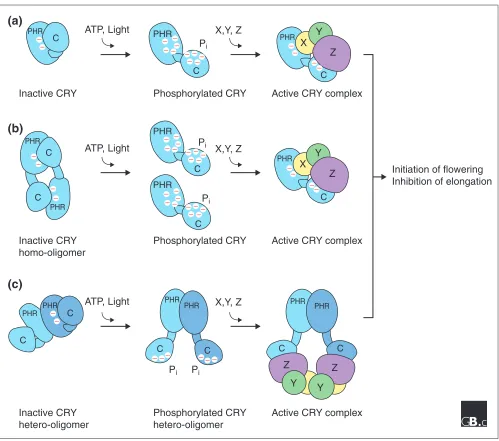
Figure 4
Possible models of the phosphorylation-dependent structural changes of plant cryptochromes in response to blue light. The PHR region is predominantly negatively charged (-), and the carboxy-terminal domain (C) can be made negatively charged by phosphorylation (which requires ATP and releases inorganic phosphate, Pi). In all models, phosphorylation leads to binding of unknown signaling partners (X, Y, Z) and to regulation of plant development. (a)One model is that phosphorylation of the carboxy-terminal domain in response to light is performed by ATP bound to the PHR region; this leads to dissociation of the two domains. (b)A second possibility is that phosphotransfer in response to light involves the interaction of two cryptochromes encoded by the same gene. (c)Alternatively, intermolecular phosphotransfer could involve the interaction of different cryptochromes. All three scenarios may exist in plant cells, and the activity of a cryptochrome may be determined by the kinetics of the different reactions.
ATP, Light
X,Y, Z
Inactive CRY
Phosphorylated CRY
Active CRY complex
Phosphorylated CRY
Phosphorylated CRY
hetero-oligomer
Initiation of flowering
Inhibition of elongation
Inactive CRY
homo-oligomer
Inactive CRY
hetero-oligomer
Active CRY complex
Active CRY complex
X,Y, Z
ATP, Light
P
iP
iP
iP
iP
iX,Y, Z
ATP, Light
PHR C
C
C
C
C
C
C C C C
C
C C
C PHR
PHR
PHR
PHR
PHR
PHR PHR PHR
PHR PHR
PHR
PHR
PHR
X
Y
Z
X
Y
Y
Y
Z
Z
Z
− − −
− −
− −
−
− −−−−−
− −− −−
− −
−− − − −
−
− − − − −
− −− − −
− − − − −
− −− − − −
− − − −
(a)
(b)
Cryptochromes are regulated by phosphorylation. It has been shown that Arabidopsiscryptochromes are phosphorylated in response to blue light and that this is associated with the func-tion and regulafunc-tion of the photoreceptors [46,47]. Moreover, when ArabidopsisCRY1 was expressed in insect cells, it was found to undergo ATP-dependent and blue-light-dependent autophosphorylation [15,47,48]. It is not known whether animal cryptochromes also bind to ATP, although it has been shown that mouse cryptochromes are phosphorylated [49].
The interaction between the ArabidopsisCRY1 PHR region and ATP has a few interesting features reminiscent of the interaction between pyrimidine dimer and photolyase [14]: the phosphate groups of ATP are exposed to solvent; the adenine and ribose moieties are buried deep within the FAD-access cavity; and ATP can have a water-mediated contact with FAD [15]. The interaction of the Arabidopsis CRY1 PHR region with ATP also lacks several features com-monly found in ATP interactions, such as protein-to-phosphate interaction, protein-to-Mg2+ contact, and a
nearby serine residue for phosphotransfer [15]. An exami-nation of the topology of the CRY1 PHR region structure shows, however, that all these features could potentially be provided by the carboxy-terminal domain of the cryp-tochrome (Figure 4). The observation that the serine-rich carboxy-terminal domains of Arabidopsis cryptochromes fused to -glucuronidase are constitutively phosphorylated in vivo[32,46] suggests that a phosphotransfer may occur from ATP bound to the FAD-access cavity to the nearby carboxy-terminal domain (Figure 4a). It is also conceivable that photon-excited FAD may trigger electron transfer to the nucleotide and phosphotransfer from ATP to serine residues on the carboxy-terminal domain. Because the surface of the PHR region is predominantly negatively charged, especially in the place where the carboxy-terminal domain is likely to interact with it, the phosphorylated carboxy-terminal domain would then be repelled from the PHR region surface, resulting in a change of cryptochrome conformation. This conformational change would allow it to interact with other signaling proteins and to propagate the light signal (Figure 4a). Alternatively, another molecule of cryptochrome binding to the FAD-access cavity may also provide the missing features needed for a productive ATP-cryptochrome interaction. Indeed, both CRY2-CRY2 inter-action and CRY1-CRY2 interinter-actions can be detected in Arabidopsis (D. Shalitin, X. Yu, and C.L., unpublished observations). Formation of either a homo-oligomer or a hetero-oligomer of cryptochromes would provide a mecha-nism for intermolecular phosphotransfer, which may change the structure of the cryptochromes (Figure 4b,c).
Frontiers
Despite recent progress in the study of cryptochromes, there are still many intriguing questions about their structure and mechanism. For example, what is the role of the FAD-access
cavity in cryptochrome? Can a photon-excited FAD trigger a phosphotransfer from ATP to the carboxy-terminal domain? Elucidation of the structure of holocryptochromes including the carboxy-terminal domain may help us to answer these questions. For mammalian cryptochromes, it is unclear whether the interaction of Cry with other clock proteins is affected by light in vivo, and also how may cryptochromes mediate regulation of the circadian clock by light. The physi-ological function of CRY-DASH proteins is also not clear, although they may regulate gene expression directly. Eluci-dation of the function and mechanism of CRY-DASH would provide additional clues about the evolutionary history of the cryptochromes.
Acknowledgements
We thank the previous and current members of our laboratories for dis-cussions and preparation of Figures. Figures 1 and 2d were prepared with the help of H. Daiyasu (Kyoto University) and K. Hitomi (The Scripps Research Institute), respectively; Figure 4 was prepared with the help of John Klejnot. We also thank Johann Deisenhofer and The National Academy of Sciences USA for the use of their published material in Figure 2a,b, and Johann Deisenhofer and A. Sancar for helpful discussions. Research in the authors’ laboratories is partially supported by NIH (GM56265 to C.L.), NSF (MCB-0091391 to C.L.), and by Grant-in-Aid for Scientific Research from the Japanese Ministry of Education, Cultures, Sports, Science and Technology of Japan (to T.T.).
References
1. Sancar A: Structure and function of DNA photolyase and cryptochrome blue-light photoreceptors. Chem Rev 2003, 103:2203-2237.
A comprehensive review of the biochemical characteristics of photolyases and cryptochromes.
2. Lin C, Shalitin D: Cryptochrome structure and signal trans-duction.Annu Rev Plant Biol 2003, 54:469-496.
A review of the structure and function of plant cryptochromes.
3. Cashmore AR: Cryptochromes: enabling plants and animals to determine circadian time.Cell 2003, 114:537-543.
A review of the role of cryptochromes in the regulation of the circa-dian clock.
4. Todo T: Functional diversity of the DNA photolyase/blue light receptor family.Mutat Res 1999, 434:89-97.
This review discusses the evolutionary relationship between DNA photolyase and cryptochromes.
5. Kanai S, Kikuno R, Toh H, Ryo H, Todo T: Molecular evolution of the photolyase-blue-light photoreceptor family.J Mol Evol 1997, 45:535-548.
An analysis of the evolutionary history of DNA photolyases and cryp-tochromes.
6. Ahmad M, Cashmore AR: HY4 gene of A. thalianaencodes a protein with characteristics of a blue-light photoreceptor. Nature 1993, 366:162-166.
The isolation of the first cryptochrome gene.
7. Todo T, Takemori H, Ryo H, Ihara M, Matsunaga T, Nikaido O, Sato K, Nomura T: A new photoreactivating enzyme that specifically repairs ultraviolet light-induced (6-4) phopto-products.Nature 1993, 361:371-374.
The first isolation and purification of 6-4 photolyase from Drosophila.
8. Todo T, Ryo H, Yamamoto K, Toh H, Inui T, Ayaki H, Nomura T, Ikenaga M: Similarity among the Drosophila(6-4)photolyase, a human photolyase homolog, and the DNA photolyase-blue-light photoreceptor family.Science 1996, 272:109-112.
The isolation of the first cryptochrome gene from an animal.
9. Hsu DS, Zhao X, Zhao S, Kazantsev A, Wang RP, Todo T, Wei YF, Sancar A: Putative human blue-light photoreceptors hCRY1 and hCRY2 are flavoproteins.Biochemistry 1996, 35:13871-13877.
The first description of the human cryptochromes, hCry1 and hCry2.
comment
reviews
reports
deposited research
interactions
information
10. Hitomi K, Okamoto K, Daiyasu H, Miyashita H, Iwai S, Toh H, Ishiura M, Todo T: Bacterial cryptochrome and photolyase: characterization of two photolyase-like genes of Synechocys-tissp. PCC6803.Nucleic Acids Res 2000, 28:2353-2362.
The first report of the bacterial cryptochrome CRY-DASH.
11. Brudler R, Hitomi K, Daiyasu H, Toh H, Kucho K, Ishiura M, Kane-hisa M, Roberts VA, Todo T, Tainer JA,et al.: Identification of a new cryptochrome class. Structure, function, and evolution. Mol Cell 2003, 11:59-67.
The crystal structure of bacterial CRY-DASH.
12. Lin C, Robertson DE, Ahmad M, Raibekas AA, Jorns MS, Dutton PL, Cashmore AR: Association of flavin adenine dinucleotide with the Arabidopsis blue light receptor CRY1. Science 1995, 269:968-970.
The first report of noncovalent binding of FAD to ArabidopsisCRY1.
13. Malhotra K, Kim ST, Batschauer A, Dawut L, Sancar A: Putative blue-light photoreceptors from Arabidopsis thaliana and Sinapis alba with a high degree of sequence homology to DNA photolyase contain the two photolyase cofactors but lack DNA repair activity.Biochemistry 1995, 34:6892-6899.
The first report of a second chromophore for cryptochromes.
14. Park HW, Kim ST, Sancar A, Deisenhofer J: Crystal structure of DNA photolyase from Escherichia coli. Science 1995, 268:1866-1872.
The first crystal structure of a DNA photolyase.
15. Brautigam CA, Smith BS, Ma Z, Palnitkar M, Tomchick DR, Machius M, Deisenhofer J: Structure of the photolyase-like domain of cryptochrome 1 from Arabidopsisthaliana.Proc Natl Acad Sci USA 2004, 101:12142-12147.
The crystal structure of the PHR region of an Arabidopsiscryptochrome,
which was the first plant cryptochrome structure to be solved.
16. Emery P, So WV, Kaneko M, Hall JC, Rosbash M: CRY, a Drosophila clock and light-regulated cryptochrome, is a major contributor to circadian rhythm resetting and photo-sensitivity.Cell1998, 95:669-679.
The circadian photosensitivity of a Drosophilastrain overexpressing Cry
is shown to be increased.
17. Stanewsky R, Kaneko M, Emery P, Beretta B, Wager-Smith K, Kay SA, Rosbash M, Hall JC: The cryb mutation identifies cryp-tochrome as a circadian photoreceptor in Drosophila. Cell 1998, 95:681-692.
The authors show that a Drosophila crymutant, cryb, exhibits poor
syn-chronization to light-dark cycles and shows no response to brief light pulses.
18. Thresher RJ, Vitaterna MH, Miyamoto Y, Kazantsev A, Hsu DS, Petit C, Selby CP, Dawut L, Smithies O, Takahashi JS, et al.: Role of mouse cryptochrome blue-light photoreceptor in circadian photoresponses.Science 1998, 282:1490-1494.
The first report of a phenotype for the cry2knockout mouse. The
mutant has a intrinsic circadian period that is only an hour long.
19. van der Horst GT, Muijtjens M, Kobayashi K, Takano R, Kanno S, Takao M, de Wit J, Verkerk A, Eker AP, van Leenen D,et al.: Mam-malian Cry1 and Cry2 are essential for maintenance of cir-cadian rhythms.Nature 1999, 398:627-630.
The first report of phenotype of cry1and cry1/cry2double knockout
mutants in mouse. The mice lacking cry1 protein display accelerated free-running periodicity of locomotor activity, but mice lacking both cry proteins show complete loss of free-running periodicity.
20. Kume K, Zylka MJ, Sriram S, Shearman LP, Weaver DR, Jin X, Maywood ES, Hastings MH, Reppert SM: mCRY1 and mCRY2 are essential components of the negative limb of the circadian clock feedback loop.Cell 1999, 98:193-205.
The authors show that Cry1 and Cry2 inhibit transcription mediated by the CLOCK and BMAL1 proteins in mammalian cultured cell line.
21. Ceriani MF, Darlington TK, Staknis D, Mas P, Petti AA, Weitz CJ, Kay SA: Light-dependent sequestration of Timeless by Cryp-tochrome. Science 1999, 285:553-556.
DrosophilaCry blocks the function of Per:Tim heterodimer complex in a light-dependent fashion.
22. Krishnan B, Levine JD, Lynch MK, Dowse HB, Funes P, Hall JC, Hardin PE, Dryer SE: A new role for cryptochrome in a Drosophilacircadian oscillator.Nature 2001, 411:313-317.
A Drosophila cry mutant renders the peripheral circadian oscillator largely arrhythmic but leaves the central circadian oscillator intact in pacemaker neurons.
23. Thompson CL, Rickman CB, Shaw SJ, Ebright JN, Kelly U, Sancar A, Rickman DW: Expression of the blue-light receptor cryp-tochrome in the human retina. Invest Ophthalmol Vis Sci 2003, 44:4515-4521.
The authors show that Cry2 is localized throughout the cytoplasm as well as the nucleus in the ganglion-cell layer of human retina.
24. Selby CP, Thompson C, Schmitz TM, Van Gelder RN, Sancar A: Functional redundancy of cryptochromes and classical pho-toreceptors for nonvisual ocular photoreception in mice. Proc Natl Acad Sci USA 2000, 97:14697-14702.
In a triple mutant mouse lacking Cry1, Cry2 and rhodopsin, the light induction of c-fos transcription in the suprachiasmatic nuclei is markedly reduced, suggesting redundant function of cryptochromes and visual pigments in the photo-entrainment of the circadian clock in the mouse.
25. Van Gelder RN, Wee R, Lee JA, Tu DC: Reduced pupillary light responses in mice lacking cryptochromes. Science 2003, 299:222.
This report showed a defect of the crymutant in the pupillary light
response, suggesting a role for cryptochromes as photoreceptors in the mouse.
26. Hattar S, Lucas RJ, Mrosovsky N, Thompson S, Douglas RH, Hankins MW, Lem J, Biel M, Hofmann F, Foster RG,et al.: Melanopsin and rod-cone photoreceptive systems account for all major accessory visual functions in mice.Nature 2003, 424:76-81.
Mice lacking melanopsin coupled with disabled rod and cone photo-transduction mechanisms fail to show any circadian phase-shifting and other nonvisual photoreception, demonstrating the role of melanopsin as a photoreceptor for the circadian clock.
27. Panda S, Sato TK, Castrucci AM, Rollag MD, DeGrip WJ, Hogenesch JB, Provencio I, Kay SA: Melanopsin (Opn4) requirement for normal light-induced circadian phase shifting. Science 2002, 298:2213-2216.
The authors show that mice with both degeneration of the outer retina and a deficiency in melanopsin exhibit complete loss of photoentrain-ment of the circadian oscillator and of other nonvisual photoreception.
28. Griffin EA Jr, Staknis D, Weitz CJ: Light-independent role of CRY1 and CRY2 in the mammalian circadian clock.Science 1999, 286:768-771.
The authors show that mammalian cryptochromes act as light-indepen-dent inhibitors of the CLOCK:BMAL1 heterodimer.
29. Lee C, Etchegaray JP, Cagampang FR, Loudon AS, Reppert SM: Post-translational mechanisms regulate the mammalian circa-dian clock.Cell 2001, 107:855-867.
This report shows that mammalian Cry proteins are necessary for stabi-lizing phosphorylated Per2 and for the nuclear accumulation of Per1,
Per2 and CKI⑀.
30. Etchegaray JP, Lee C, Wade PA, Reppert SM: Rhythmic histone acetylation underlies transcription in the mammalian circa-dian clock.Nature 2003, 421:177-182.
Acetylation of histone H3 is a potential target of the inhibitory action of Cry.
31. Naruse Y, Oh-hashi K, Iijima N, Naruse M, Yoshioka H, Tanaka M: Circadian and light-induced transcription of clock gene Per1 depends on histone acetylation and deacetylation. Mol Cell Biol 2004, 24:6278-6287.
The authors show that mammalian Cry1 represses transcription through histone deacetylases and the protein mSin3B that is associated with them, indicating a role for histone modification in the circadian clock regulation.
32. Yang H-Q, Wu Y-J, Tang R-H, Liu D, Liu Y, Cashmore AR: The C termini of Arabidopsis cryptochromes mediate a constitu-tive light response. Cell 2000, 103:815-827.
The authors show that the carboxy-terminal domain of Arabidopsis CRY1 and CRY2 is responsible for the signaling function of the proteins in response to light.
33. Guo H, Duong H, Ma N, Lin C: The Arabidopsisblue light recep-tor cryptochrome 2 is a nuclear protein regulated by a blue light-dependent post-transcriptional mechanism.Plant J 1999, 19:279-287.
This paper and [34] show that the carboxy-terminal domain of Ara-bidopsisCRY2 has a functional nuclear-localization signal.
34. Kleiner O, Kircher S, Harter K, Batschauer A: Nuclear localiza-tion of the Arabidopsisblue light receptor cryptochrome 2. Plant J 1999, 19:289-296.
See [33].
35. Somers DE, Devlin PF, Kay SA: Phytochromes and cryp-tochromes in the entrainment of the Arabidopsis circadian clock.Science 1998, 282:1488-1490.
This report shows that ArabidopsisCRY1, but not CRY2, is the blue
light photoreceptor for circadian period length control.
36. Guo H, Yang H, Mockler TC, Lin C: Regulation of flowering time by Arabidopsisphotoreceptors.Science 1998, 279:1360-1363.
This report shows the function of ArabidopsisCRY2 in the control of
37. Mockler T, Yang H, Yu X, Parikh D, Cheng YC, Dolan S, Lin C: Reg-ulation of photoperiodic flowering by Arabidopsis photore-ceptors.Proc Natl Acad Sci USA 2003, 100:2140-2145.
This report shows the redundant as well as the antagonistic function of cryptochromes and phytochromes in the control of photoperiodic flowering.
38. El-Assal SE-D, Alonso-Blanco C, Peeters AJ, Raz V, Koornneef M: A QTL for flowering time in Arabidopsisreveals a novel allele of CRY2.Nat Genet 2001, 29:435-440.
A QTL identified from natural populations is CRY2; a missense defect in theCRY2 gene causes photoperiod-insensitive flowering in an
Arabidop-sisaccession found near the equator.
39. Ma L, Li J, Qu L, Hager J, Chen Z, Zhao H, Deng XW: Light control of Arabidopsisdevelopment entails coordinated reg-ulation of genome expression and cellular pathways.Plant Cell 2001, 13:2589-2607.
This study investigates genome-wide mRNA expression in Arabidopsis in response to light quality, showing that cryptochromes are the major photoreceptors mediating regulation of gene expression by blue light.
40. Cutler SR, Ehrhardt DW, Griffitts JS, Somerville CR: Random GFP::cDNA fusions enable visualization of subcellular struc-tures in cells of Arabidopsisat a high frequency.Proc Natl Acad Sci USA 2000, 97:3718-3723.
A report that the ArabidopsisCRY2 carboxy-terminal domain can be
associated with chromosomes.
41. Wang H, Ma LG, Li JM, Zhao HY, Deng XW: Direct interaction of Arabidopsis cryptochromes with COP1 in light control development.Science 2001, 294:154-158.
This report shows that Arabidopsiscryptochromes interact with the E3
ubiquitin ligase COP1.
42. Sullivan JA, Deng XW: From seed to seed: the role of photore-ceptors in Arabidopsis development. Dev Biol 2003, 260:289-297.
A review of the regulation of plant development by light and the role of COP proteins in this process.
43. Valverde F, Mouradov A, Soppe W, Ravenscroft D, Samach A, Coup-land G: Photoreceptor regulation of CONSTANS protein in photoperiodic flowering.Science 2004, 303:1003-1006.
This paper reports the ubiquitination of CRY2 and degradation of a zinc-finger protein by the proteasome in blue light.
44. Busza A, Emery-Le M, Rosbash M, Emery P: Roles of the two Drosophila cryptochrome structural domains in circadian photoreception.Science 2004, 304:1503-1506.
The PHR region of DrosophilaCry is active alone in vivo.
45. Zhu H, Conte F, Green CB: Nuclear localization and transcrip-tional repression are confined to separable domains in the circadian protein cryptochrome.Curr Biol 2003, 13:1653-1658.
This paper reports that the carboxy-terminal domain of animal cryp-tochromes directs nuclear localization.
46. Shalitin D, Yang H, Mockler TC, Maymon M, Guo H, Whitelam GC, Lin C: Regulation of Arabidopsis cryptochrome 2 by blue-light-dependent phosphorylation.Nature 2002, 417:763-767.
A report of the blue-light-specific phosphorylation of ArabidopsisCRY2.
47. Shalitin D, Yu X, Maymon M, Mockler T, Lin C: Blue light-depen-dent in vivoand in vitrophosphorylation of Arabidopsis cryp-tochrome 1. Plant Cell 2003, 15:2421-2429.
A report of a blue-light-dependent phosphorylation of Arabidopsis CRY1 and its autophosphorylation activity in vitro.
48. Bouly JP, Giovani B, Djamei A, Mueller M, Zeugner A, Dudkin EA, Batschauer A, Ahmad M: Novel ATP-binding and autophospho-rylation activity associated with Arabidopsis and human cryptochrome-1. Eur J Biochem 2003, 270:2921-2928.
Characterization of the autophosphorylation activity of Arabidopsis
CRY1 in vitro.
49. Eide EJ, Vielhaber EL, Hinz WA, Virshup DM: The circadian regu-latory proteins BMAL1 and cryptochromes are substrates of casein kinase Iepsilon.J Biol Chem 2002, 277:17248-17254.
The authors show that mammalian Cry1 is phosphorylated by CKI⑀.
comment
reviews
reports
deposited research
interactions
information