Role assigning and taking in cloud
computing
Khan, S, Nicho, M, TakruriRizk, H, Maamar, Z and Kamoun, F
http://dx.doi.org/10.3233/HSM180336
Title Role assigning and taking in cloud computing
Authors Khan, S, Nicho, M, TakruriRizk, H, Maamar, Z and Kamoun, F
Type Article
URL This version is available at: http://usir.salford.ac.uk/id/eprint/48046/
Published Date 2019
USIR is a digital collection of the research output of the University of Salford. Where copyright permits, full text material held in the repository is made freely available online and can be read, downloaded and copied for noncommercial private study or research purposes. Please check the manuscript for any further copyright restrictions.
1
Role assigning and taking in cloud computing
Shafaq Naheed Khan, University of Dubai, UAE, +971 4 5566 941, [email protected] Mathew Nicho, Zayed University, UAE, +971 4 402 1861, [email protected] Haifa Takruri, University of Salford, UK, +44 (0) 161 295 3139, [email protected]
Zakaria Maamar, Zayed University, UAE, +971 4 402 1461, [email protected] Faouzi Kamoun, ESPRIT. ESPRIT University, Tunisia, +216 99 423 944, [email protected]
Abstract
The widespread use of cloud computing (CC) has brought to the forefront information technology (IT) governance issues, rendering the lack of expertise in handling CC-based IT controls a major challenge for business enterprises and other societal organizations. In the cloud-computing context, this study identifies and ranks the determinants of role assigning and taking by IT people. The study’s integrative research links CC and IT governance to
humane arrangements, as it validates and ranks role assigning and taking components through in-depth interviews with twelve IT decision-makers and forty-four Information Systems Audit and Control Association (ISACA) members, engaged as panelists in a Delphi technique implementation. The empirical results recognize skills and competencies as prioritized determinants of IT controls, while IT security, risk and compliance emerge as capabilities crucial to evaluate and manage CC service providers. Despite the study’s generalizability limitations, its findings highlight future research paths and provide practical guidelines toward the high technology of open-market IT self-governance. The latter entails the humane flows of collegial control and responsibility, as opposed to the inhumane flows of authority and power, under the sequestered technique of the bureaucratically-hierarchized IT hetero-governance.
Key words: cloud computing IT controls, role assignment, role taking components, cloud
2
Shafaq Khan is an Assistant Professor at the College of Engineering and Information Technology, University of Dubai. She holds a PhD degree in Computer Science from Salford University and MSc in Computing and Information Systems from University of Hull. She is a certified ethical hacker (CEH), SAP certified business associate, certified project management professional (PMP) and cloud infrastructure and services (CIS) associate. Her research interests are in IS management, cloud computing, IT governance, IS security and green computing.
Mathew Nicho is an Assistant Professor at the College of Technological Innovation at Zayed University, Dubai, United Arab Emirates, teaching and researching in the cyber security domain. Prior to this he was a lecturer in cybersecurity and IT governance at the School of Computing and Digital Media at Robert Gordon University, Scotland. He obtained his PhD from the Auckland University of Technology, Auckland, New Zealand. His teaching and research are in the socio technical aspects of cyber-attacks, advanced persistent threats, as well as IT governance. His research outputs have appeared in journals and conferences namely Communications of the Association of Information Systems, Information and Computer Security, International Journal of Information Security and Privacy, and conferences namely Hawaii International Conference on System Sciences, International Conference on Mathematical Methods, Models and Architectures for Computer Network Security (to name a few).
3
Zakaria Maamar is Professor in the College of Technological Innovation at Zayed University, Dubai campus. His research interests include mobile computing, business process management, and social computing. Dr. Maamar has published several articles in peer-reviewed journals and conference proceedings. He has a PhD in computer science from Laval University, Canada.
4
1. Introduction
Cloud computing (CC) has emerged as one of the hottest topics in the field of information and communication technologies (ICT) [68]. Some industry experts predicted that by 2018, more than 60% of enterprises will have at least half of their infrastructure in the CC
environment [11], and that by the same year at least half of the information technology (IT) spending will be devoted to CC projects [10]. The rapid adoption of CC by large as well as small scale organizations [63] poses new challenges for CEOs as it requires organizations to transfer (some) IT controls of computing resources to cloud service providers (CSPs) [47]. IT control is a process that provides assurance for information and information services, and helps mitigate risks associated with use of technology [26].
CC users and CSPs have different perspectives concerning the control over the IT resources. In a classical (non-cc) datacenter, organizations govern IT systems by assigning their staff to the internal IT controls. Contrarily, when an organization places selected organizational assets in the custody of a CSP, it cedes control over these assets to the CSP, yet retains accountability for security and regulatory compliances [41]. In this regard, one major issue organizations are facing is the data owner's loss of control in the case of CC migration [37].
CC is creating transformation in the nature of employment [89] that influences human-development resource skill sets and tasks [87]. Technical and managerial capabilities within an organization determine how well CC services achieve the
organization’s goals and potential competitive strategy. Like many other highly-advanced
5
in a CC environment must have the capabilities to change strategic direction by redefining work system and work contents and by creating new opportunities for individual
development and career path transitions. Therefore, governance in CC requires a new mindset that would challenge existing IT policies, roles and responsibilities and power hierarchies[4]. In this respect, role assigning and taking in the CC user organization become very important.
The re-identification of the required new tasks, roles and responsibilities in a CC environment is an information technology governance (ITG) exercise, since it involves participative decision-making [60], control, and direction mechanisms [81]. In fact, most popular ITG frameworks, such as control objectives for information and related
technologies (COBIT) and information technology infrastructure library (ITIL), advocate for responsibility, accountability, consulted, and informed (RACI) charts for guiding people towards taking on new roles and responsibilities. However, none of them provides
guidelines to facilitate this process of self-adaptation for internal as well as for IT controls that have been delegated to the CSP [44].
6
is now a major challenge [83]. In this regard, there is a trend of identifying, analyzing and suggesting skill requirements for changing IT roles [61]. To address this gap, this
contribution plans toidentify the elements that would facilitate role taking in a CC context by recognizing the required competencies, tasks and responsibilities. This can eventually set the stage for a participatory or a team decision-making process whereby people can actively contribute towards defining their training and professional development needs as well as taking on responsibility for their career transitions and planning. Eagerness to obtain a clearer picture [66] led us also to determine the ranking of the role assignment and taking elements.
Based on a case study, this research identified the elements associated with the new roles and responsibilities for IT controls in the context of a public CC deployment. These elements are validated using in-depth interviews and then ranked using Delphi technique. Our contributions include:
Guidelines for contemporary organizations to guide people towards take on roles and
responsibilities associated with public CC-based IT controls.
Guidelines for IT decision makers to help assess their existing workforces’ capabilities
and making informed decisions on training and professional development needs as well as on acquisition of new resources and capabilities needed for the success of CC
projects. In particular, this research advocates the need for organizations to transition from the traditional bureaucratic “command and control” model of role assignment
towards a supportive human system model for role taking.
Guidelines that can be used by ITG authorities as extension to their existing guidelines
to organizations on RACI chart assignments to cover CC-based IT controls.
New insights for researchers on the significant organizational skills for IT controls,
7
topic across different countries and different company sizes, and (2) assessing the risks of inadequate technical skills on CC migration projects.
While this study is important, it is limited to only public deployment model and cannot be generalized to encompass countries of diverse cultures. The remaining of this article is organized as follow: Section 2 examines existing literature to build a set of elements for role assignments, section 3 outlines the research methodology, section 4 discusses the empirical validation and ranking of elements while section 5 concludes the article and provides some directions for future work.
2. Role assigning and taking components
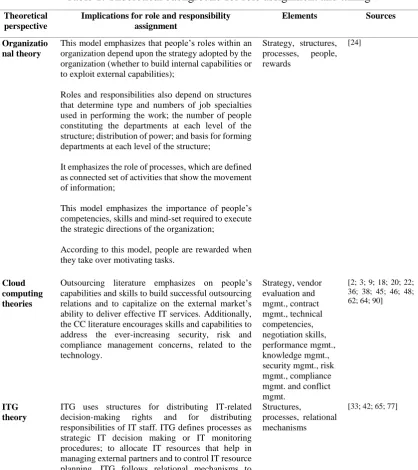
This article reports on authors’ experience in defining and ranking the elements that impact the redefinition of roles and responsibilities for the control of CC-based IT resources. Since true technology is a societal human system [28] and since the topic lies in the nexus of knowledge related to humans and technology/machines, we investigated existing theories related to socio-technical systems. The socio-technical theory [7], technology acceptance model (TAM) [13], human-development resource framework [54] and the task-technology fit model [30] were examined. It was observed that even though these theories were related to the current topic, they could not be used to model roles and responsibilities. Journal articles related to the theories associated with three IS domains, namely organizational theories, CC and IT governance were chosen for their explicit theoretical relevance to identifying roles and responsibilities in the chosen domain of CC deployment (Table 1).
Organizational design (OD): This domain was chosen because it influences the
decision-making process [73] including decisions related to the assignment of people’s roles and responsibilities [8]. Autonomy is considered to be one of the logical requirements for ensuring effective organization, especially in a rapidly changing environment [21].
8
to be broken down to ensure cross functionality [25], leading to a participative role-taking decision-making process. OD helps in channeling organizational roles to meet the business strategy. Migration to CC is an organizational strategy [39]. As a result, we considered the strategic alignment model of Henderson and Venkatraman [35]. However, this model was found to focus more on the role of IT in organizational transformation rather than on role taking. Therefore, widely accepted organizational ‘Star model’ [23; 24] used for channeling resources [58], was useful in providing assignment elements for our research too. This model has been used by practitioners for identifying the right people to manage innovation initiatives [14], for shaping human-development resource processes [79] and for
redesigning activities in organizations [57]. OD was useful in proposing five relevant elements of role assignment and taking namely ‘strategy’, ‘structure’, ‘rewards’, ‘processes’, and ‘people’ (see Table 1).
Cloud computing: It is a paradigm shift which involves the “outsourcing” of computing resources to remote data centers [15; 52], away from a “hierarchical” mode towards a “market” mode of governance [56]. From technology perspective, our analysis of the
academic and practitioner literature on IT outsourcing and public CC resulted in the induction of eleven elements which have an impact on the assignment of people to roles and responsibilities. These eleven elements are: ‘strategy’, ‘vendor evaluation & management’, ‘contract management’, ‘technical competencies’, ‘negotiation skills’, ‘performance management’, ‘knowledge management’, ‘security management’, ‘risk management’, ‘compliance management’ and ‘conflict management’ (Table 1).
IT governance (ITG): This domain has been explored to identify role elements since the
9
processes correlate with those of Galbraith’s Star model, ITG literature helped in identifying a new element, namely ‘relational mechanisms’ (Table 1).
Each of the above theories offers a different lens for understanding how
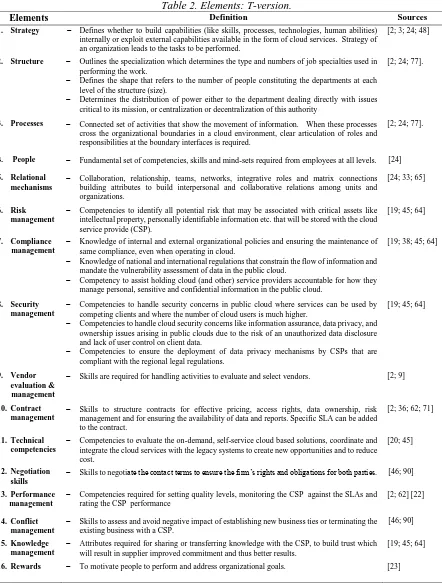
organizations may facilitate role taking in a CC context. However, as shown on Fig. 1, some of the elements derived from these three IS domains overlap with each other. Therefore, these IS domains produced 19 elements, where three of them overlap. Aggregating (with redundancies removed) all the elements resulted in a model (Table 2) with a set of 16 elements for the roles and responsibilities of IT controls in a public CC environment. These are hereinafter referred to as T-version elements.
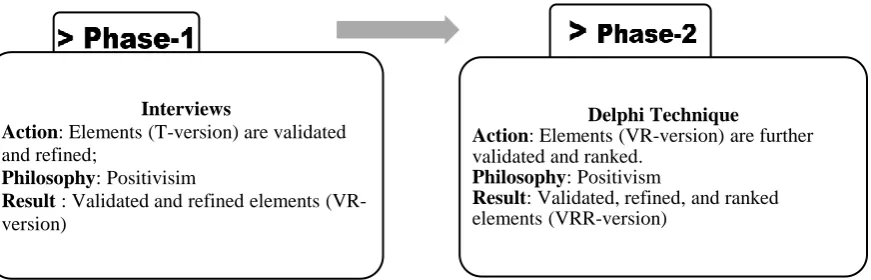
3. Research methodology
To test our model, we have followed a two-phased approach involving validation through interviews followed by ranking using Delphi technique (Fig. 2). Since research in the domain of CC is still in its early stages [40], exploratory research was deemed appropriate. It builds on secondary research and employs formal approaches through in-depth
interviews, focus groups, projective methods, case studies or pilot studies [33]. In this respect, we conducted in-depth interviews of IT decision makers in CC and in the ITG domain in the United Arab Emirates (UAE) in order to and rank the T-version elements listed in Table 2. While a case research can be used with any philosophical perspective, we opted for the positivist philosophy as it can explicitly test as well as build theory [16]. In our study, the positivist philosophy is used to get the elements of the model validated and ranked by IT practitioners.
10
involves a new CC technology trend [1; 59] and Delphi technique provides human
judgmental input [86], which is suitable for making joint decisions related to people’s roles and responsibilities. Even though two to three rounds is not only the norm [72] but also preferred [67], this study planned to conduct rounds until consensus among participants was achieved.
4. Data collection and analysis
Being theoretical, the T-version elements that emerged through the process of researching the related fields using various sources call for validation via empirical research. The exploratory research leading to a qualitative philosophy directed us towards a two-phased case study approach using in-depth interviews for validation and refinement of elements, and further validation and ranking of elements through a Delphi technique.
4.1. Phase 1: validation of role assigning and taking components:
This phase involves expert interviews in a case study setting to validate the T-version assignment elements. This study interviewed 12 IT decision makers from 11 UAE-based large private and/or government organizations that have adopted public CC (refer to Appendix A for the profile of the respondents and their respective affiliations). The T-version elements were shown to the experts for feedback based on the ‘IT control
migration’ context of the organization that they represent. The interview questionnaire is
provided in Appendix B.
Due to the nature of expertise required, respondents at IT decision levels, having related professional certifications and/or have experience on working on CC projects were interviewed. Face-to-face interviews with respondents were conducted over a period of seven months during the year 2015, with each interview lasting an average of 55 minutes. All interviews were audio recorded except for one respondent (R12) who cited
11
taken during the interview. For analysis purposes, the audio files were verbatim-transcribed using ‘O-Transcribe’ and loaded into the qualitative data analysis software NVIVO 10.
4.1.1. Phase 1: analysis
To analyze and interpret the qualitative data, we followed the five-step guideline given by LeCompte [50] namely “tidying up,” “findings items,” “creating stable sets of items,” “creating patterns,” and “assembling structures”. The collected data were subjected to
constant comparison analysis [29] to deductively code data into pre-determined (16)
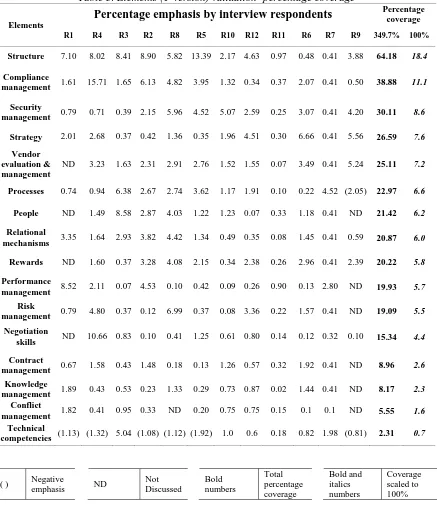
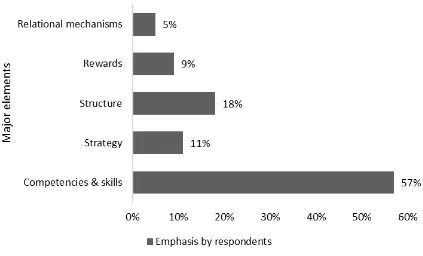
themes. The constant comparison analysis feature of NVIVO was used to generate the word count in terms of ‘percentage coverage’ (Table 3) which shows the number of characters as a percentage of the total source This word count depicts the positive emphasis by
respondents [51] to the identified element. Negative values display the disagreement of the respondent on inclusion of a particular element (displayed in terms of percentages, using NVIVO). Since the content of elements overlap with each other, the combined ‘percentage’ of words for the particular theme (shown in the second last column) aggregates to
349.7.5%. This figure has been normalized to 100% and re-calculated to reveal the ‘true percentage’ in the last column aggregating to 100%.
It is evident from Table 3, that ‘structure’ and ‘compliance management’ received higher (>10%) emphasis while ‘technical competencies’ received the lowest emphasis. Only
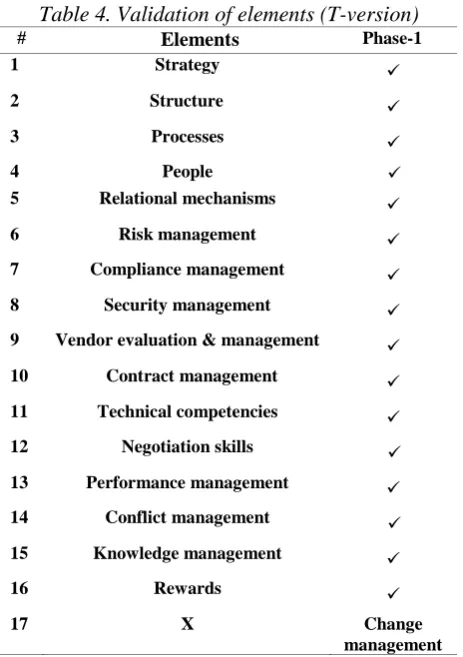
one respondent cited technical competency as a theme by stating that it is only relevant while the organization is still on the journey of migrating to CC. Apart from validating 16 themes of the T-version elements (Table 2), a new theme ‘change management’ also
emerged from the interviews, resulting in a total of 17 elements as illustrated in Table 4.
12
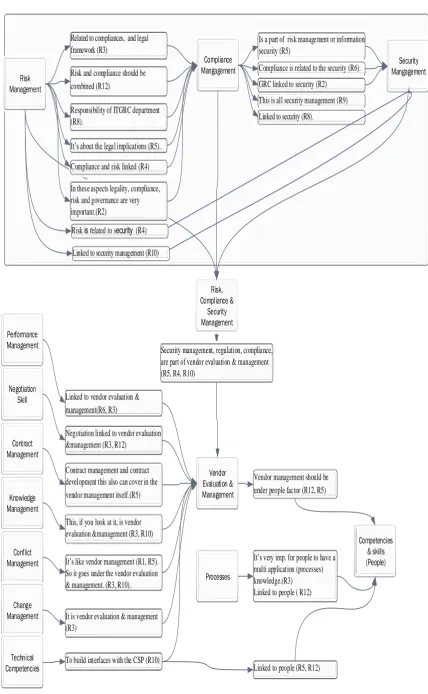
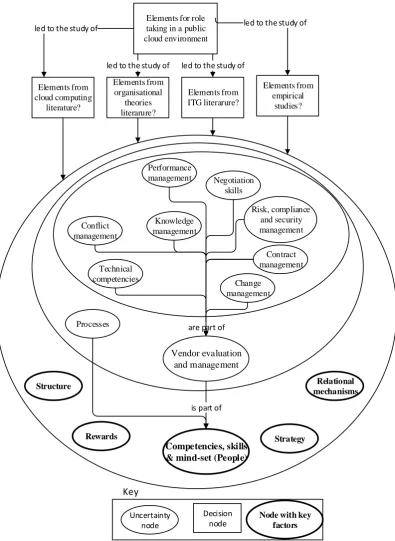
semantic relations to find attributes of the domain (or element). Based on the respondents’ opinion and domain analysis, we identified the relation between the elements, thereby resulting in the creation of patterns (Fig. 3).
As shown on Fig. 3, relations were identified between ‘vendor evaluation & management’ and other elements. Reading through the transcripts in detail revealed that ‘performance management’, ‘negotiation skills’, ‘contract management’, ‘knowledge management’, ‘conflict management’, ‘change management’ and ‘technical competencies’ are all linked to ‘vendor evaluation & management’, which in turn were defined as people’s skills and competencies and therefore were placed under the ‘people’ element. Similarly, when the respondents discussed ‘risk management’, they considered it to be a component of ‘compliance management’. In the same manner, ‘compliance management’ was linked to ‘security management’. Based on their responses, these three elements were aggregated into ‘risk, compliance, and security management’. Further analysis of the transcripts led to their aggregation under ‘vendor evaluation & management’. The respondents associated
‘processes’ with domain competencies therefore aggregating it into the ‘competencies and skills (people)’ element. The respondents deemed ‘structure’, ‘strategy’, ‘rewards’, and ‘relational mechanisms’ exclusive of ‘competencies and skills (people)’ as separate
elements. Meaningful aggregation of elements under respective themes helped in the assembling of structures into five major-elements.
4.1.2. Phase 1: discussion
13
highest competency and skill required is being able to manage risks, compliance, and security.
To recapitulate, the exploration of the relevant literature provided an initial list of elements for role taking in the context of a public CC deployment model. In-depth
interviews helped in validating as well as in refining the elements. Next, we adopted Delphi technique to further validate and rank these elements.
4.2. Phase 2: ranking of role assigning and taking components
To rank the elements, Delphi technique was used involving forty-four ISACA members as panelists. ISACA is a nonprofit, independent association that advocates for professionals involved in information security, assurance, risk management and governance
(https://www.isaca.org). The panelists reflected varying profiles (one CIO, ten IT auditors,
four IT consultants, twenty-five IT management, and four undeclared) with eleven members working in government and twenty in private UAE organizations (the balance did not declare their organization). The panelists were informed about the purpose of the sessions in advance through the ISACA website and emails. To mitigate the risk of ambiguity in the definition of the elements [12], the definition of each element was provided through the questionnaires and further clarified through the presentations. Two Delphi technique rounds were conducted among the panelists.
4.2.1. Phase 2 analysis: round 1
The focus of the round 1 was to re-validate the elements (VR-version, defined in phase-1). Following other researchers’ work [43][17], this Delphi technique research provided
14
agreed with all the validated and refined elements and considered them to be sufficient. However, six panelists suggested revisiting the title of the sub-element ‘change
management’. They also suggested by stating: “change management is not restricted to vendor management alone… Change management should be at organizational level”. The panelists’ suggestions correlated to the response from six interview respondents (R3, R4,
R5, R6, R7, R8) who viewed the abilities of people to accept and adapt to the changed work environment as an important organizational element. These comments are also in
accordance with Galbraith’s [24] views which emphasize the importance of people skills and mind-set to execute the strategic directions of the organization. Therefore, considering the input from the Delphi technique panelists and the interview respondents, we renamed ‘change management’ as ‘mind-set’ and we moved it out from ‘vendor evaluation & management’ to the higher level of main constructs. Subsequently, the ‘competencies and skills’ element was renamed to ‘competencies, skills and mind-set’. The collected data were analyzed, elements modified and a new set of questionnaires–2 (Appendix C) was printed for the round 2.
4.2.2. Phase 2 analysis: round 2
The focus of the round 2 was to rank the modified elements, presented to the panelists, thereby enabling them to see the anonymous collected opinion of the group. Questionnaire 2 was distributed among the panelists who were asked to rank the elements in term of
importance, using a Likert scale. The panelists were, also, requested to assign weights to each element and sub-element. The purpose of using the Likert scale ranking was to measure the degree of consensus between the panelists and therefore leverage Kendall’s
15
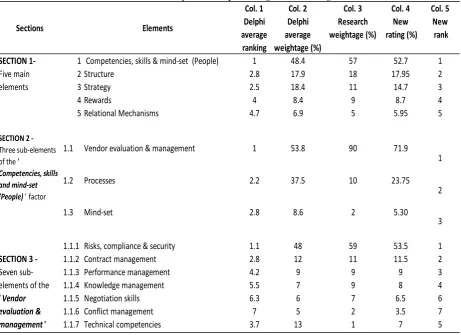
Using the assigned weights and applying statistical aggregation, new ratings and rankings were calculated for each element as shown in Table 5. In the table, column 1 shows the average ranking given to each element by the panelists, and column 2 shows the average percentage weights given by the panelists. Column 3 shows the average weights given by interview respondents, and column 4 shows the average ratings of columns 2 and 3. Consequently, based on column 4 ratings, new ranks were calculated as shown in column 5. As an example, for the ‘competencies, skills & mind-sets’ element, the average
percentage assigned by the panelists was 48.4%, while the average percentage assigned by the interview respondents was 57%. The average of these two resulted in an overall-average of 52.7%. Based on this result, ‘competencies, skills & mind-sets’ retained its first rank (in
terms of importance) in the elements (VR-version).
Round 2 results were shared with the panelist through the subsequent presentation and printed forms. This was done to provide panelists with feedback regarding the ranked elements, thereby complying with Goodman’s [31] guidelines to keep the panelists informed about the current status of their collective opinion. Using Schmidt’s [75]
interpretation of Kendall’s W coefficient, the level of consensus of 0.79 in the first section
and 0.84 in the second section and 0.89 in the third section indicated a strong agreement among the panelists on the element’s rankings. According to Bell [5] data are unreliable if the results of questionnaires show varying answers. Kendall’s W coefficient results
provided a good degree of consensus among panelists, giving confidence in the reliability of the results and providing reason not to go for a third round.
4.2.3. Phase 2: discussion
Kendall’s coefficient concordance [75] was used to measure the degree of consensus among
16
A significant finding in this phase of the empirical study is the higher emphasis on the ‘technical competency’ requirements which differed from that of the interview
respondents. This finding was also reflected in comments of the panelists, as one of them stated that “reasonable in-house technical knowledge is a must” and another one believes that “people's competencies and skills have more impact (on roles and responsibilities
assignment)”. Another panelist commented that the degree of reliance on technical competencies depends on the size of the organization. According to him, as smaller organizations tend to have less technical skills, they rely heavily on CC vendors’ advice. This aspect was re-iterated by another panelist who stated that “technical skills being inadequate with small companies, therefore too much reliance is placed by them on
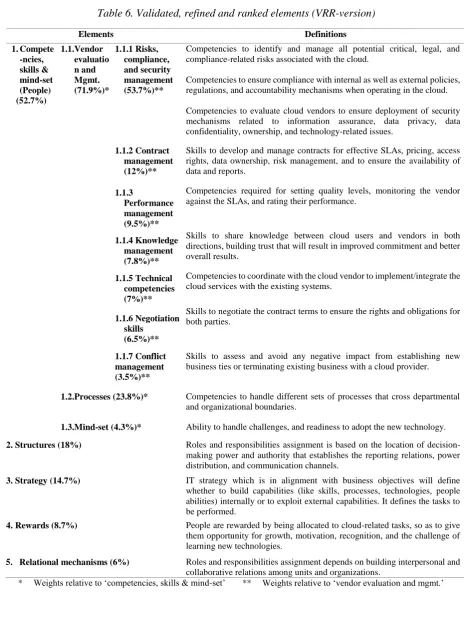
vendors. …whereas in large organizations in house technical skills are strong and mature”. Therefore, in a CC environment, where IT controls are migrated and managed by the CC provider, technical competencies are still required. However, this requirement seems to be less important for smaller organizations which mostly rely on the CSP expertise. Ergo, the final validated, refined and ranked elements termed as elements (VRR-version) are
recompiled as shown in Table 6.
The resulting validated elements will aid in managerial decisions to identify the required skills and competencies for IT controls in a CC environment. While the researchers have described people’s ‘competencies, skills & mind-set’ as critical for achieving the
strategic direction of an organization [24], the empirical study re-established them as the decisive elements in role taking, with the maximum coverage (52.7%). Interpretation of the interview respondent’s statements revealed that the highest (71.9%) desired competency
and skills for IT controls are the ability to evaluate and manage CC vendors, particularly in terms of risk, compliance, and security. Contrary to the literature, which states that people need profound ‘technical competencies’ for integrating CC resources with internal systems
17
replacing people’s technical competency requirements with business skill requirements.
Those who supported the inclusion of technical competencies attributed a much-diminished weight (7%) for this element, stating that technical competencies are needed while the organization is still in the process of migrating towards a CC deployment model.
The structures (18%) within an organization determine the location and distribution of power [24; 65], the type and the number of job specialties used in performing the work. Researchers [24] as well as interview respondents correlated the task assignment to the number of people in the department at each level of the structure. According to five respondents, CC will not only reduce the necessary number of IT professionals in the organization, but also acts as a catalyst to facilitate the relocation of people to different departments or to expose them to new career paths.
The strategy of an organization (14.7%) impacts role taking by redefining the new organizational needs in terms of new CC-driven resources and capabilities in alignment with the business strategy. Rewards have 8.7% impact on role taking as people are rewarded by being trained, and by taking on new and challenging CC related roles, thereby giving them recognition, motivation and growth opportunity.
Networks can be either bureaucratically hierarchized or ecologically self-organized
and self-governed. Networks are much in vogue these days, yet not all networks entail the
humane flows of collegial control and responsibility. Relational mechanisms (with an
emphasis of 6%) are used to build interpersonal relations through collaboration, job rotation, and team decision-making thereby facilitating the humane flows of collegial control and responsibility.
18
become catalysts of change whose role is to facilitate the transition towards a high technology of open market self-governance based on the dispersed hierarchy. Under this model, organizations play the role of a supportive and a developer of its human assets, while people can engage in participative or collegial team decision-making to find the best match between the new skill sets and associated roles required by CC and their individual self-fulfillment needs and career path aspirations. In fact, CC is introducing new skill and competency requirements, new career paths and new roles and responsibilities that people should have a say on as opposed to letting the organization decide for them. In this regards, Hall and Mirvis [34] described the Protean career as a new career model whereby the person, not the organization, takes on the responsibility for one’s own career path. The term
Protean is taken from the Greek sea-god Proteus (Πρωτεύς) who is capable of changing his
shape at will.
5. Conclusion and suggestions for future research
Organizations are pursuing technological scalability by embarking ICT, such as CC. One critical pre-requisite for a plan of technological scalability is the emergence of new governance models [76]. While numerous ITG frameworks, standards, and best practices exist, to date ITG authorities have not come up with guidelines for identifying roles and responsibilities in a CC environment. Theoretical and empirical studies revealed that people’s assignment to IT controls in a CC environment (as well as in a non-CC
19
This research has highlighted ‘people’s competencies, skills and mind-set’ at
evaluating and managing CC vendors as the dominant element. The ability to ‘evaluate and manage CC vendors’, particularly in terms of ‘risk, compliance and security management’ emerged as the highest desired competency. In addition, this study revealed that smaller organizations do not depend much on their internal technical competencies as they have tendency to tap into the CSP expertise. Another significant finding is that staff in the CC user organizations needs to possess significant business competencies to manage CC-based IT controls.
This set of ranked elements is an innovative initiative that can be applied to ITG frameworks while ensuring consistency, uniform control, and compliance. Our empirical study contributes to both ITG research and practice by reducing the gap between these two fields in order to guide managerial actions towards establishing IT-centric governance arrangements to match the CC-based enterprise architecture. The findings contribute to the practice of managing IT controls in public CC by providing guidelines to empower IT decision makers and employees to make informed decisions about training and professional development needs and role taking. It also provides guidelines to ITG authorities and policymakers to comprehend good practices related to people’s skills and competencies in the context of a CC deployment model.
20
bureaucratically-hierarchized IT hetero-governance) towards a role-taking model (based on a supportive societal human system of open market IT self-governance).
Based on a case study in the UAE, our approach lacks some generalization and therefore some caution is required in interpreting the results. For instance, because national culture has been found to have a substantial effect in IS studies [53], generalizing these results to other cultures is encouraged. This study therefore advances academic research in the area of ITG by paving way for further qualitative and quantitative research to conduct a global study, including hybrid CC deployment models and encompassing several countries.
References:
[1] H.A. Akkermans, P. Bogerd, E. Yücesan, and L.N. Van Wassenhove, The impact of ERP on
supply chain management: Exploratory findings from a European Delphi study, European Journal of
Operational Research 146 (2003), 284-301.
[2] S. Alborz, P. Seddon, and R. Scheepers, A model for studying IT outsourcing relationships, in: 7th Pacific Asia Conference on Information Systems (PACIS), Adelaide, Australia, 2003, p. 90. [3] B.A. Aubert, S. Rivard, and M. Patry, A transaction cost model of IT outsourcing,
Information & management 41 (2004), 921-932.
[4] J. Becker and E. Bailey, A comparison of IT governance & control frameworks in cloud computing, in: Twentieth Americas Conference on Information Systems (AMCIS), aisel.aisnet.org, ed., Savannah, GA, 2014.
[5] J. Bell, Doing Your Research Project McGrawHill Education, England, 2010.
[6] T. Bittman, Problems encountered by 95% of private clouds, in: Gartner, ed., Gartner, 2015.
[7] R.P. Bostrom and J.S. Heinen, MIS problems and failures: A socio-technical perspective, Part II: The application of socio-technical theory, MIS quarterly (1977), 11-28.
[8] K.M. Carley, M.J. Prietula, and Z. Lin, Design versus cognition: The interaction of agent cognition and organizational design on organizational performance, Journal of Artificial Societies
and Social Simulation 1 (1998), 1-19.
[9] A. Chaudhury, K. Nam, and H.R. Rao, Management of information systems outsourcing: A
bidding perspective, Journal of Management Information Systems (1995), 131-159.
[10] N.K. Cherrayil, Middle East’s information and communications technology spending to
cross $103b this year, in: Gulf News, Gulf News, UAE, 2016.
[11] L. Columbus, Roundup of cloud computing forecasts and market estimates, 2015, in:
Forbes Magazine, Forbes Media, United States, 2015.
[12] T.D. Cook, D.T. Campbell, and A. Day, Quasi-experimentation: Design & analysis issues for
field settings, Houghton Mifflin Boston, 1979.
[13] F.D. Davis, Perceived usefulness, perceived ease of use, and user acceptance of information technology, MIS quarterly (1989), 319-340.
[14] J.-P. Deschamps, Different leadership skills for different innovation strategies, Strategy &
Leadership 33 (2005), 31-38.
[15] S. Dhar, From outsourcing to cloud computing: Evolution of IT services, Management
Research Review 35 (2012), 664-675.
21
[17] C. Duffield, The Delphi technique: a comparison of results obtained using two expert panels, International journal of nursing studies 30 (1993), 227-237.
[18] EMC, Cloud Infrastructure and Services training material, in, EMC Corporation, United States of America, 2011.
[19] EMC, Cloud infrastructure and services Version 2, EMC Corporation, Hopkinton, MA, 2014.
[20] Endeavor Management, Aligning the organization for effective outsourcing, in: Endeavor
Management, 2011.
[21] A. Espinosa, R. Harnden, and J. Walker, A Complexity Approach to Sustainability–Stafford Beer Revisited, European Journal of Operational Research 187 (2008), 636-651.
[22] G. Fitzgerald and L. Willcocks, Contracting and relationships in IT outsourcing, in: The
Practice of Outsourcing, Springer, 2009, pp. 59-78.
[23] J.R. Galbraith, Designing organizations: An executive briefing on strategy, structure, and
process, Jossey-Bass, San Francisco, CA, 1995.
[24] J.R. Galbraith, The star model, in, Galbraith Management Consultants, Colorado, USA, 2011.
[25] Gartner, Global IT spending to grow in 2013 in: Computer News Middle East, 2013.
[26] J.A. Gatto, ITG General Controls / IT Risk Assessment – Taking it to the Next Level, in: ISACA
Charlotte Chapter, ISACA, Port Charlotte, FL, 2016.
[27] N.C. Georgantzas, Humanizing HSM to benefit human systems, Human Systems
Management 37 (2018), 1-5.
[28] N.C. Georgantzas and V. Zarifopoulou, Politeia in Person: A Civic Eros Cookbook for Human
Beings' Economic Prosperity, LAP LAMBERT Academic Publishing, 2017.
[29] B.G. Glaser and A.L. Strauss, The discovery of grounded theory: Strategies for qualitative
research, Aldine Transaction., New Brunswick, NJ, 2009.
[30] D.L. Goodhue and R.L. Thompson, Task-technology fit and individual performance, MIS
quarterly (1995), 213-236.
[31] C.M. Goodman, The Delphi technique: a critique, Journal of advanced nursing 12 (1987), 729-734.
[32] W.V. Grembergen, S.D. Haes, and E. Guldentops, Structures, processes and relational mechanisms for IT governance, Strategies for information technology governance 2 (2004), 1-36.
[33] S.D. Haes and W.V. Grembergen, An exploratory study into the design of an IT governance
minimum baseline through Delphi research, The Communications of the Association for
Information Systems 22 (2008), 443-458.
[34] D.T. Hall and P.H. Mirvis, The new protean career: Pschological success and the path with a heart, in: The career is dead-long live the career, D.T. Hall, ed., Jossey-Bass, San Fransisco, 1965, pp. 15-45.
[35] J.C. Henderson and N. Venkatraman, Strategic alignment: Leveraging information
technology for transforming organizations, IBM systems journal 32 (1993), 4-16.
[36] V.T. Ho, S. Ang, and D. Straub, When subordinates become IT contractors: Persistent managerial expectations in IT outsourcing, Information Systems Research 14 (2003), 66-86.
[37] J. Hughes, Data breaches in the cloud: Who's responsible?, in, Government Technology,
Folsom, California, 2014.
[38] ISACA, IT control objectives for cloud computing: controls and assurance in the cloud, Author, Rolling Meadows, IL, 2011.
[39] B. Iyer and J.C. Henderson, Preparing for the future: Understanding the seven capabilities of cloud computing, MIS Quarterly Executive 9 (2010), 117-131.
[40] D.S. Jat, M.S. Haodom, and A. Peters, Relevance of Cloud Computing in Namibia: A Case Study, in: Proceedings of the Second International Conference on Information and Communication
Technology for Competitive Strategies, ACM, 2016, p. 89.
[41] K. Julisch and M. Hall, Security and control in the cloud, Information Security Journal: A
Global Perspective 19 (2010), 299-309.
[42] J. Karimi, T.M. Somers, and Y.P. Gupta, Impact of informationt technology management
22
[43] M. Keil, A. Tiwana, and A. Bush, Reconciling user and project manager perceptions of IT project risk: a Delphi study1, Information systems journal 12 (2002), 103-119.
[44] S. Khan, M. Nicho, and H. Takruri, IT controls in the public cloud: Success factors for allocation of roles and responsibilities, Journal of Information Technology Case and Application
Research (2016), 155-180.
[45] S.N. Khan, Impact of cloud computing on the IT portfolio management: UAE case study, in:
9th IBIMA Conference, Barcelona, Spain 2012.
[46] H. Kim, Impact of cultural dimensions on the choice of outsourcing destination in
Information Technology area, Thesis, Erasmus University Rotterdam.
[47] R.K. Ko, P. Jagadpramana, M. Mowbray, S. Pearson, M. Kirchberg, Q. Liang, and B.S. Lee, TrustCloud: A framework for accountability and trust in cloud computing, in: Services (SERVICES),
2011 IEEE World Congress on, IEEE, 2011, pp. 584-588.
[48] J. Laabs, Why HR is turning to outsourcing, Personnel Journal 72 (1993), 92-101. [49] M.C. Lacity and P. Reynolds, Cloud services practices for small and medium-sized enterprises, MIS Quarterly Executive 13 (2014), p31-44.
[50] M.D. LeCompte, Analyzing qualitative data, Theory into practice 39 (2000), 146-154. [51] N.L. Leech and A.J. Onwuegbuzie, Beyond constant comparison qualitative data analysis: Using NVivo, School Psychology Quarterly 26 (2011), 70.
[52] X. Lei, X. Liao, T. Huang, and F. Heriniaina, Achieving security, robust cheating resistance, and high-efficiency for outsourcing large matrix multiplication computation to a malicious cloud,
Information Sciences 280 (2014), 205-217.
[53] D.E. Leidner and T. Kayworth, Review: a review of culture in information systems research: toward a theory of information technology culture conflict, MIS quarterly 30 (2006), 357-399. [54] D.P. Lepak and S.A. Snell, The human resource architecture: Toward a theory of human capital allocation and development, Academy of management review 24 (1999), 31-48.
[55] D.S. Linthicum, The top 5 ways cloud computing projects failed in 2012, and how to aviod them in 2013., in: Cloud Connect, 2013.
[56] L. Loh and N. Venkatraman, Determinants of information technology outsourcing: a
cross-sectional analysis, Journal of Management Information Systems (1992), 7-24.
[57] S.A. Mohrman, Designing organizations for growth: The human resource contribution,
People and Strategy 30 (2007), 34.
[58] D. Nadler and M. Tushman, Competing by design: The power of organizational architecture,
Oxford University Press, New York, 1997.
[59] C. Okoli and S.D. Pawlowski, The Delphi method as a research tool: an example, design considerations and applications, Information & management 42 (2004), 15-29.
[60] J. Orozco, A. Tarhini, and T. Tarhini, A framework of IS/business alignment management practices to improve the design of IT Governance architectures, International Journal of Business
and Management 10 (2015), 1.
[61] S. Palvia and V. Vemuri, Forecasts of jobless growth: Facts and myths, Journal of
Information Technology Case and Application Research (2016), 1-7.
[62] H. Parkes, IT Governance and outsourcing, Information Systems Control Journal 5 (2004), 17-22.
[63] Z.H. Pathan, Z. Jianqiu, U. Akram, M.K. Khan, Z. Latif, and M.Z. Tunio, Innovation-diffusion determinants of cloud-computing adoption by Pakistani SMEs, Human Systems Management 36 (2017), 197-209.
[64] S. Pearson, V. Tountopoulos, D. Catteddu, M. Südholt, R. Molva, C. Reich, S. Fischer-Hübner, C. Millard, V. Lotz, and M.G. Jaatun, Accountability for cloud and other future Internet services, in: CloudCom, IEEE, Taipei,Taiwan, 2012, pp. 629-632.
[65] R.R. Peterson, Integration strategies and tactics for information technology governance, in:
Strategies for information technology governance, Idea Group Inc., USA, 2004, pp. 37-80.
23
[67] S. Proctor, Linking philosophy and method in the research process: the case for realism,
Nurse Researcher 5 (1998), 73 - 90.
[68] D. Puthal, B.P.S. Sahoo, S. Mishra, and S. Swain, Cloud computing features, issues, and challenges: A big picture, in: International Conference on Computational Intelligence and Networks
(CINE), IEEE, Odisha, India, 2015, pp. 116-123.
[69] D. Ramel, New research shows 'staggering' failure rates for cloud projects, in, Enterprise Systems USA, 2014.
[70] M.S. Rashmi and G. Sahoo, A five-phased approach for the cloud migration, International
Journal of Emerging Technology and Advanced Engineering 2 (2012), 286-291.
[71] S. Rivard and B.A. Aubert, Information technology outsourcing, Routledge, New York, USA, 2015.
[72] G. Rowe and G. Wright, The Delphi technique as a forecasting tool: issues and analysis,
International Journal of Forecasting 15 (1999), 353-375.
[73] P. Rowland and K. Parry, Consensual commitment: A grounded theory of the meso-level
influence of organizational design on leadership and decision-making, The leadership quarterly 20 (2009), 535-553.
[74] V. Sambamurthy and R.W. Zmud, Arrangements for information technology governance: A
theory of multiple contingencies, MIS quarterly 23 (1999), 261-290.
[75] R.C. Schmidt, Managing Delphi surveys using nonparametric statistical techniques*,
decision Sciences 28 (1997), 763-774.
[76] H.E. Schmuck, Daily Republican, Springfield (MA), West Springfield, 1940.
[77] H.A. Smith and J.D. McKeen, Developments in practice XXXIII: A holistic approach to managing IT-based Rrsk, Communications of the Association for Information Systems 25 (2009), 519–530.
[78] J.P. Spradley, The ethnographic interview, Waveland Press, 2016.
[79] D. Ulrich, A new mandate for human resources, Harvard business review 76 (1998),
124-135.
[80] A. Venkatraman, Why some cloud projects fail?, in: Ahead in the Clouds
ComputerWeekly, 2014.
[81] P. Webb, C. Pollard, and G. Ridley, Attempting to define IT governance: Wisdom or folly?, in: 39th Hawaii International Conference on Systems Sciences, IEEE, Hawaii, 2006, pp. 194-203. [82] P. Weill and J.W. Ross, IT governance: How top performers manage IT decision rights for
superior results, Harvard Business Press, USA, 2004.
[83] K. Weins, Cloud computing trends: 2016 state of the cloud survey, in: Cloud Management
Blog, R. Scale, ed., 2016.
[84] T.J. Winkler and C.V. Brown, Horizontal allocation of decision rights for on-premise
applications and software-as-a-service, Journal of Management Information Systems 30 (2013), 13-48.
[85] N. World, Most private clouds don't meet their expectations, here's why, in: Network
World, 2015.
[86] G. Wright, M.J. Lawrence, and F. Collopy, The role and validity of judgment in forecasting,
International Journal of Forecasting 12 (1996), 1-8.
[87] C.-W. Yeh, Cloud computing and human resources in the knowledge era, Human Systems
Management 31 (2012), 165-175.
[88] M. Zeleny, High technology management, in: Readings and cases in the management of
new technology: an operations perspective, H. Noori and R.W. Radford, eds., Prentice Hall,
Englewood Cliffs, 1990, pp. 17-20.
[89] M. Zeleny, Crisis and transformation: On the corso and ricorso of human systems, Human
Systems Management 31 (2012), 49-63.
[90] W. Zhao and C. Watanabe, A comparison of institutional systems affecting software advancement in China and India: The role of outsourcing from Japan and the United States,
24
25
[image:26.595.97.516.96.567.2]Tables
Table 1. Theoretical background for role assignment and taking
Theoretical perspective
Implications for role and responsibility assignment
Elements Sources
Organizatio nal theory
This model emphasizes that people’s roles within an organization depend upon the strategy adopted by the organization (whether to build internal capabilities or to exploit external capabilities);
Roles and responsibilities also depend on structures that determine type and numbers of job specialties used in performing the work; the number of people constituting the departments at each level of the structure; distribution of power; and basis for forming departments at each level of the structure;
It emphasizes the role of processes, which are defined as connected set of activities that show the movement of information;
This model emphasizes the importance of people’s competencies, skills and mind-set required to execute the strategic directions of the organization;
According to this model, people are rewarded when they take over motivating tasks.
Strategy, structures, processes, people, rewards
[24]
Cloud computing theories
Outsourcing literature emphasizes on people’s capabilities and skills to build successful outsourcing relations and to capitalize on the external market’s ability to deliver effective IT services. Additionally, the CC literature encourages skills and capabilities to address the ever-increasing security, risk and compliance management concerns, related to the technology. Strategy, vendor evaluation and mgmt., contract mgmt., technical competencies, negotiation skills, performance mgmt., knowledge mgmt., security mgmt., risk mgmt., compliance mgmt. and conflict mgmt.
[2; 3; 9; 18; 20; 22; 36; 38; 45; 46; 48; 62; 64; 90]
ITG theory
ITG uses structures for distributing IT-related decision-making rights and for distributing responsibilities of IT staff. ITG defines processes as strategic IT decision making or IT monitoring procedures; to allocate IT resources that help in managing external partners and to control IT resource planning. ITG follows relational mechanisms to allocate roles and responsibilities in a way that helps in forming a link between business and IT.
Structures,
processes, relational mechanisms
26
Table 2. Elements: T-version.
Elements Definition Sources
1. Strategy Defines whether to build capabilities (like skills, processes, technologies, human abilities) internally or exploit external capabilities available in the form of cloud services. Strategy of an organization leads to the tasks to be performed.
[2; 3; 24; 48]
2. Structure Outlines the specialization which determines the type and numbers of job specialties used in performing the work.
Defines the shape that refers to the number of people constituting the departments at each level of the structure (size).
Determines the distribution of power either to the department dealing directly with issues critical to its mission, or centralization or decentralization of this authority
[2; 24; 77].
3. Processes Connected set of activities that show the movement of information. When these processes cross the organizational boundaries in a cloud environment, clear articulation of roles and responsibilities at the boundary interfaces is required.
[2; 24; 77].
4. People Fundamental set of competencies, skills and mind-sets required from employees at all levels. [24]
5. Relational mechanisms
Collaboration, relationship, teams, networks, integrative roles and matrix connections building attributes to build interpersonal and collaborative relations among units and organizations.
[24; 33; 65]
6. Risk management
Competencies to identify all potential risk that may be associated with critical assets like intellectual property, personally identifiable information etc. that will be stored with the cloud service provide (CSP).
[19; 45; 64]
7. Compliance management
Knowledge of internal and external organizational policies and ensuring the maintenance of same compliance, even when operating in cloud.
Knowledge of national and international regulations that constrain the flow of information and mandate the vulnerability assessment of data in the public cloud.
Competency to assist holding cloud (and other) service providers accountable for how they manage personal, sensitive and confidential information in the public cloud.
[19; 38; 45; 64]
8. Security management
Competencies to handle security concerns in public cloud where services can be used by competing clients and where the number of cloud users is much higher.
Competencies to handle cloud security concerns like information assurance, data privacy, and ownership issues arising in public clouds due to the risk of an unauthorized data disclosure and lack of user control on client data.
Competencies to ensure the deployment of data privacy mechanisms by CSPs that are compliant with the regional legal regulations.
[19; 45; 64]
9. Vendor evaluation & management
Skills are required for handling activities to evaluate and select vendors. [2; 9]
10.Contract management
Skills to structure contracts for effective pricing, access rights, data ownership, risk management and for ensuring the availability of data and reports. Specific SLA can be added to the contract.
[2; 36; 62; 71]
11.Technical competencies
Competencies to evaluate the on-demand, self-service cloud based solutions, coordinate and integrate the cloud services with the legacy systems to create new opportunities and to reduce cost.
[20; 45]
12.Negotiation skills
Skills to negotiate the contact terms to ensure the firm’s rights and obligations for both parties. [46; 90]
13.Performance management
Competencies required for setting quality levels, monitoring the CSP against the SLAs and rating the CSP performance
[2; 62] [22]
14.Conflict management
Skills to assess and avoid negative impact of establishing new business ties or terminating the existing business with a CSP.
[46; 90]
15.Knowledge management
Attributes required for sharing or transferring knowledge with the CSP, to build trust which will result in supplier improved commitment and thus better results.
[19; 45; 64]
27
Table 3. Elements (T-version) validation- percentage coverage
Elements
Percentage emphasis by interview respondents Percentage coverage
R1 R4 R3 R2 R8 R5 R10 R12 R11 R6 R7 R9 349.7% 100%
Structure 7.10 8.02 8.41 8.90 5.82 13.39 2.17 4.63 0.97 0.48 0.41 3.88 64.18 18.4 Compliance
management 1.61 15.71 1.65 6.13 4.82 3.95 1.32 0.34 0.37 2.07 0.41 0.50 38.88 11.1 Security
management 0.79 0.71 0.39 2.15 5.96 4.52 5.07 2.59 0.25 3.07 0.41 4.20 30.11 8.6 Strategy 2.01 2.68 0.37 0.42 1.36 0.35 1.96 4.51 0.30 6.66 0.41 5.56 26.59 7.6
Vendor evaluation & management
ND 3.23 1.63 2.31 2.91 2.76 1.52 1.55 0.07 3.49 0.41 5.24 25.11 7.2
Processes 0.74 0.94 6.38 2.67 2.74 3.62 1.17 1.91 0.10 0.22 4.52 (2.05) 22.97 6.6 People ND 1.49 8.58 2.87 4.03 1.22 1.23 0.07 0.33 1.18 0.41 ND 21.42 6.2 Relational
mechanisms 3.35 1.64 2.93 3.82 4.42 1.34 0.49 0.35 0.08 1.45 0.41 0.59 20.87 6.0 Rewards ND 1.60 0.37 3.28 4.08 2.15 0.34 2.38 0.26 2.96 0.41 2.39 20.22 5.8 Performance
management 8.52 2.11 0.07 4.53 0.10 0.42 0.09 0.26 0.90 0.13 2.80 ND 19.93 5.7 Risk
management 0.79 4.80 0.37 0.12 6.99 0.37 0.08 3.36 0.22 1.57 0.41 ND 19.09 5.5 Negotiation
skills ND 10.66 0.83 0.10 0.41 1.25 0.61 0.80 0.14 0.12 0.32 0.10 15.34 4.4 Contract
management 0.67 1.58 0.43 1.48 0.18 0.13 1.26 0.57 0.32 1.92 0.41 ND 8.96 2.6 Knowledge
management 1.89 0.43 0.53 0.23 1.33 0.29 0.73 0.87 0.02 1.44 0.41 ND 8.17 2.3 Conflict
management 1.82 0.41 0.95 0.33 ND 0.20 0.75 0.75 0.15 0.1 0.1 ND 5.55 1.6 Technical
competencies (1.13) (1.32) 5.04 (1.08) (1.12) (1.92) 1.0 0.6 0.18 0.82 1.98 (0.81) 2.31 0.7
( ) Negative
emphasis ND
Not Discussed
Bold numbers
Total percentage coverage
Bold and italics numbers
28
Table 4. Validation of elements (T-version)
# Elements Phase-1
1 Strategy
2 Structure
3 Processes
4 People
5 Relational mechanisms
6 Risk management
7 Compliance management
8 Security management
9 Vendor evaluation & management
10 Contract management
11 Technical competencies
12 Negotiation skills
13 Performance management
14 Conflict management
15 Knowledge management
16 Rewards
17 X Change
29
Table 5. Delphi technique ratings and rankings
Sections Elements Col. 1 Delphi average ranking Col. 2 Delphi average weightage (%) Col. 3 Research weightage (%) Col. 4 New rating (%)
1 Competencies, skills & mind-set (People) 1 48.4 57 52.7
2 Structure 2.8 17.9 18 17.95
3 Strategy 2.5 18.4 11 14.7
4 Rewards 4 8.4 9 8.7
5 Relational Mechanisms 4.7 6.9 5 5.95
1.1 Vendor evaluation & management 1 53.8 90 71.9
1.2 Processes 2.2 37.5 10 23.75
1.3 Mind-set 2.8 8.6 2 5.30
1.1.1 Risks, compliance & security 1.1 48 59 53.5 1.1.2 Contract management 2.8 12 11 11.5 1.1.3 Performance management 4.2 9 9 9
1.1.4 Knowledge management 5.5 7 9 8
1.1.5 Negotiation skills 6.3 6 7 6.5
1.1.6 Conflict management 7 5 2 3.5
1.1.7 Technical competencies 3.7 13 1 7
SECTION
1-Five main elements
SECTION 2 -Three sub-elements of the '
Competencies, skills and mind-set (People) ' factor
SECTION 3 -
Seven sub-elements of the
30
Table 6. Validated, refined and ranked elements (VRR-version)
* Weights relative to ‘competencies, skills & mind-set’ ** Weights relative to ‘vendor evaluation and mgmt.’
Elements Definitions
1.Compete -ncies, skills & mind-set (People) (52.7%) 1.1.Vendor evaluatio n and Mgmt. (71.9%)* 1.1.1 Risks, compliance, and security management (53.7%)**
Competencies to identify and manage all potential critical, legal, and compliance-related risks associated with the cloud.
Competencies to ensure compliance with internal as well as external policies, regulations, and accountability mechanisms when operating in the cloud.
Competencies to evaluate cloud vendors to ensure deployment of security mechanisms related to information assurance, data privacy, data confidentiality, ownership, and technology-related issues.
1.1.2 Contract management (12%)**
Skills to develop and manage contracts for effective SLAs, pricing, access rights, data ownership, risk management, and to ensure the availability of data and reports.
1.1.3
Performance management (9.5%)**
Competencies required for setting quality levels, monitoring the vendor against the SLAs, and rating their performance.
1.1.4 Knowledge management (7.8%)**
Skills to share knowledge between cloud users and vendors in both directions, building trust that will result in improved commitment and better overall results.
1.1.5 Technical competencies (7%)**
Competencies to coordinate with the cloud vendor to implement/integrate the cloud services with the existing systems.
1.1.6 Negotiation skills
(6.5%)**
Skills to negotiate the contract terms to ensure the rights and obligations for both parties.
1.1.7 Conflict management (3.5%)**
Skills to assess and avoid any negative impact from establishing new business ties or terminating existing business with a cloud provider.
1.2.Processes (23.8%)* Competencies to handle different sets of processes that cross departmental and organizational boundaries.
1.3.Mind-set (4.3%)* Ability to handle challenges, and readiness to adopt the new technology.
2.Structures (18%) Roles and responsibilities assignment is based on the location of decision-making power and authority that establishes the reporting relations, power distribution, and communication channels.
3.Strategy (14.7%) IT strategy which is in alignment with business objectives will define whether to build capabilities (like skills, processes, technologies, people abilities) internally or to exploit external capabilities. It defines the tasks to be performed.
4.Rewards (8.7%) People are rewarded by being allocated to cloud-related tasks, so as to give them opportunity for growth, motivation, recognition, and the challenge of learning new technologies.
31
Figure Captions
Figure 1. Overlapped elements
Figure 2. Two phased empirical research
Figure 3. Creating patterns of elements.
Figure 4. Discussion and results related to validated and refined elements (VR-version)
Figure 5. Coverage of the validated and refined elements (VR-version).
32
Cloud computing theories
Vendor evaluation & management Contract management Performance management
Knowledge management Security management
Risk management Compliance management
Technical competencies Negotiation skills Conflict management
Organization theory
People Rewards
Figures
Figure 1. Overlapped elements Elements for role taking in a public cloud
environment
Structures Processes
ITG theory
Relational Mechanisms
33
Figure 2. Two phased empirical research
Interviews
Action: Elements (T-version) are validated and refined;
Philosophy: Positivisim
Result : Validated and refined elements (VR-version)
Delphi Technique
Action: Elements (VR-version) are further validated and ranked.
Philosophy: Positivism
34
Vendor management should be under people factor (R12, R5)
Competencies & skills (People) Vendor Evaluation & Management Contract management and contract
development this also can cover in the vendor management itself.(R5) Contract
Management
Negotiation linked to vendor evaluation &management (R3, R12)
Negotiation
Skill Linked to vendor evaluation & management(R6, R3) Performance
Management Security management, regulation, compliance,
are part of vendor evaluation & management (R5, R4, R10)
Compliance Mangagement Risk
Management
Related to compliances, and legal framework (R3)
Risk and compliance should be combined (R12)
It’s about the legal implications (R5). Responsibility of ITGRC department (R8).
Security Mangagement Is a part of risk management or information
security (R5)
Compliance is related to the security (R6).
This is all security management (R9) GRC linked to security (R2)
Compliance and risk linked (R4)
In these aspects legality, compliance, risk and governance are very important.(R2)
Risk is related to security (R4)
Linked to security management (R10)
Linked to security (R8).
Risk, Compliance &
Security Management
This, if you look at it, is vendor evaluation &management (R3, R10) Knowledge
Management
It’s like vendor management (R1, R5). So it goes under the vendor evaluation & management. (R3, R10). Conflict
Management
It is vendor evaluation & management (R3)
Change Management
To build interfaces with the CSP (R10) Technical
Competencies
It’s very imp. for people to have a multi application (processes) knowledge.(R3) Linked to people ( R12) Processes
[image:35.595.94.523.47.742.2]Linked to people (R5, R12)
35
Elements for role taking in a public cloud environment
Elements from cloud computing
literature?
Elements from ITG literarure? Elements from
organisational theories literarure?
led to the study of led to the study of
Elements from empirical
studies?
led to the study of
Strategy
Structure Relational
mechanisms
Rewards
Processes
Change management
Vendor evaluation and management
Conflict management
Contract management Technical
competencies
Negotiation skills Performance
management
Knowledge management
Risk, compliance and security management
Competencies, skills & mind-set (People)
is part of are part of
Uncertainty node
Decision node
Key
[image:36.595.99.495.56.598.2]Node with key factors led to the study of
36
37
Figure 6. The Delphi technique rounds and resulting changes
Round-1
- Elements explained through presentation - Elements re-validation using questionnaire-1
1.1.7 'Change management' updated to 1.3 'mind-set'
'competencies & skills' updated to 'competencies,skills & mind-set'
Round-2
- Updated Elements shown to the panelists.
- Elements ranked using questionnaire -2 - Final rankings shown to the panelists