International Journal of Emerging Technology and Advanced Engineering
Website: www.ijetae.com (ISSN 2250-2459,ISO 9001:2008 Certified Journal, Volume 4, Issue 5, May 2014)
435
Face Recognition Using Sparse Representation
Jyotsna Gupta
1, Anoop Singhal
2M.tech student, Jagannath University Assistent Professor, Jagannath University
Abstract— Many classic and contemporary face recognition
algorithms work well on public data sets, but degrade sharply when they are used in a real recognition system. This is mostly due to the difficulty of simultaneously handling variations in illumination, image misalignment, and occlusion in the test image. We consider a scenario where the training images are well controlled and test images are only loosely controlled. We propose a conceptually simple face recognition system that achieves a high degree of robustness and stability to illumination variation, image misalignment, and partial occlusion. The system uses tools from sparse representation to align a test face image to a set of frontal training images. The region of attraction of our alignment algorithm is computed empirically for public face data sets such as Multi-PIE. We demonstrate how to capture a set of training images with enough illumination variation that they span test images taken under uncontrolled illumination. and comparing the accuracy of different database like YALE ,MIT OCL ,CUSTOM database . In order to evaluate how our algorithms work under practical testing conditions we have implemented a complete face recognition system, including a projector-based training acquisition system. Our system can efficiently and effectively recognize faces under a variety of realistic conditions, using only frontal images under the proposed illuminations as training.
Keyword - Face recognition, feature-extraction, occlusion
and corruption, sparse representation , l1 minimization.
I. INTRODUCTION
The ability of humans to quickly and accurately recognize each other by sight is one of the foundations of offline social interaction. As digital devices (both mobile and embedded in our infrastructure) increase in importance for our daily lives, so does the incentive to share with them our capacity for automatic visual recognition. As one of the most successful applications of image analysis and understanding, face recognition has recently received significant attention, especially during the past several years. At least two reasons account for this trend: the first is the wide range of commercial and law enforcement applications, and the second is the availability of feasible technologies after 30 years of research. Even though current machine recognition systems have reached a certain level of maturity, their success is limited by the conditions imposed by many real applications.
For example, recognition of face images acquired in an outdoor environment with changes in illumination and/or pose remains a largely unsolved problem. In other words, current systems are still far away from the capability of the human perception system.
International Journal of Emerging Technology and Advanced Engineering
Website: www.ijetae.com (ISSN 2250-2459,ISO 9001:2008 Certified Journal, Volume 4, Issue 5, May 2014)
436 Face recognition systems
Face recognition is task that humans perform routinely and effortlessly in their daily lives. A facial recognition system is a computer application for automatically identifying or verifying a person from a digital image or a video frame from a video source. One of the ways to do this is by comparing selected facial features from the image and a facial database [3] .
Face recognition is not so much about face recognition at all - it is much more about face detection! It is my (and many others') strong belief, that the prior step to face recognition, the accurate recognition of human faces in arbitrary scenes, is the most important process involved. When faces could be located exactly in any scene, the recognition step afterwards would not be so complicated. Face recognition is the step stone to all facial analysis algorithms. [4,6] Only when computers can understand face well will they begin to truly understand people’s thoughts and intentions..Face recognition has several advantages over other biometric technologies: it is natural, non-intrusive, and easy to use. A face recognition system is expected to identify faces present in images and videos atomically. It can operate in either one or both two modes:
(i) Face verification (or authentication), and (ii) Face identification (or recognition).
Face recognition involves a one-to-one match that compares a query face image against a template face image whose identity is being claimed. Face identification involve a one-to-many matches that compares a query face image against all the template images in database to determine the identity of the query face. Another face recognition scenario involves a watch-list check, where a query face is matched to a list of suspects (one-to-few matches). The performance of face recognition system improved significantly since the first face recognition system was developed by Kanade . Furthermore, face detection, face extraction, and Face recognition is task that humans perform routinely and effortlessly in their daily lives. A facial recognition system is a computer application for automatically identifying or verifying a person from a digital image or a video frame from a video source. One of the ways to do this is by comparing selected facial features from the image and a facial database [3] .
Face recognition is not so much about face recognition at all - it is much more about face detection! It is my (and many others') strong belief, that the prior step to face recognition, the accurate recognition of human faces in arbitrary scenes, is the most important process involved. When faces could be located exactly in any scene, the recognition step afterwards would not be so complicated.
Face recognition is the step stone to all facial analysis algorithms. [4,6] Only when computers can understand face well will they begin to truly understand people’s thoughts and intentions..Face recognition has several advantages over other biometric technologies: it is natural, non-intrusive, and easy to use. A face recognition system is expected to identify faces present in images and videos atomically. It can operate in either one or both two modes:
(i) Face verification (or authentication), and (ii) Face identification (or recognition).
Face recognition involves a one-to-one match that compares a query face image against a template face image whose identity is being claimed. Face identification involve a one-to-many matches that compares a query face image against all the template images in database to determine the identity of the query face. Another face recognition scenario involves a watch-list check, where a query face is matched to a list of suspects (one-to-few matches). The performance of face recognition system improved significantly since the first face recognition system was developed by Kanade . Furthermore, face detection, face extraction, and recognition can now be performed in “real-time” for image captured under favorable (i.e. constrained) situations. Although progress in face recognition has been encouraging .
II. MODES OF OPERATION
International Journal of Emerging Technology and Advanced Engineering
Website: www.ijetae.com (ISSN 2250-2459,ISO 9001:2008 Certified Journal, Volume 4, Issue 5, May 2014)
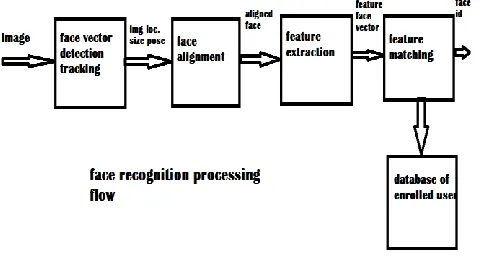
[image:3.612.51.290.177.309.2]437 The face is usually further normalized with respect to photometrical properties such illumination and gray scale.
Fig 1 Face Recognition Processing Flow
Provide effective information that is useful for distinguishing between faces of different persons and stable with respect the geometrical and photometrical variations. For face matching, the extracted feature vector of the input face is matched against those of enrolled faces in the database; it outputs the identity of the face when a match is found with sufficient confidence or indicate an unknown face otherwise .Face recognition results depend highly on features that are extracted to represent the face pattern and classification methods used to distinguish between faces whereas face localization and normalization are the basis for extracting effective features.
A. Identification v/s Verification
The Face recognition system solves a 1:N problem in this mode, where N is the number of subjects enrolled in the face database. This mode has applications in the area of surveillance and the system performance is measured by the fraction of unknown images correctly identified. In identification the goal is to identify an individual based on comparison of features collected against a database of previously collected samples. In other words, systems which are designed for the purpose of identification will answer the question: “Who the subject is?” In the verification applications, on the other hand, we desire to verify whether the subject is the person that they claim to be. This is done by validating the collected features against a previously collected feature sample for the individual in our library. Biometric methods designed for verification purposes answer the question: “Is the subject who he says he is?”[5]
In the authentication or verification mode, the Face recognition system verifies the identity claim of the unknown person. The Face recognition system compares the unknown face (input) to the claimed identity in the database and makes a decision to accept or reject the claim. In this mode, the Face recognition system solves a 1:1 problem. This mode has applications in access control. The system performance is measured by the correct accept rate versus the false accept/reject rate, depending on the sensitivity of the application .The performance of identification systems is measured by the Correct Recognition Rate (CRR). Correct recognition rate at rank k refers to the ratio of the number of correct searches in the top k candidates to the total number of probe images taken as a percentage. When k=1, this becomes the fraction of probe images correctly identified. The performance of the system in the verification mode is measured by the false acceptance rate (FAR), false rejection rate (FRR) and the total error rate (which is the sum of the two) . The FAR and FRR are computed as,
The Equal Error Rate (EER) is rate corresponding to which FAR equals FRR. A smaller EER indicates a better FR system. A trade off is involved in achieving a low FAR and FRR as it is hard to achieve them simultaneously. In face verification systems with sensitive applications, the focus is to maximize the total recognition rate for a minimum FAR
Face Recognition Applications
Today’s technologies have made face recognition a possible reliable solution in applications like driver’s license, passport or national ID verification or security access to ATM , machines, database or medical records . Some of the applications of automatic face recognition Entertainment - Video game, virtual reality , Training Programs
Smart Cards - Driver Licence, Entitlement Programs, Immigration, national ID,Passport, voter Id Registration
International Journal of Emerging Technology and Advanced Engineering
Website: www.ijetae.com (ISSN 2250-2459,ISO 9001:2008 Certified Journal, Volume 4, Issue 5, May 2014)
438 B. Face recognition databases
There are many databases in use currently, the choice of an appropriate database to be used should be made based on the task given (aging, expressions, lighting etc). Another way is to choose the data set specific to the property to be tested If, on the other hand, an algorithm needs to be trained with more images per class (like LDA), Yale face database is probably more appropriate than FERET.MIT OCL is more better than Yale .
The yale face database
It Contains 165 grayscale images in GIF format of 15 individuals. There are 11 images per subject, one per different facial expression or configuration: center-light, w/glasses, happy, left-light, w/no glasses, normal, right-light, sad, sleepy, surprised, and wink.
The yale face database b
The Yale B Face database contains 5760 images from 10 individuals. Each subject has been pictured under 576 viewing conditions which are nine poses and 64 illuminations per pose. Single light sources have been used in different angles for the illumination variations.
Extended yale b database
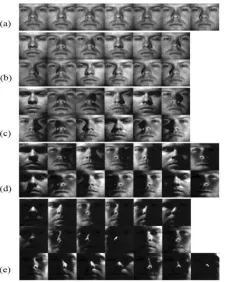
[image:4.612.117.230.494.635.2]The Extended Yale B database is an expanded version of the Yale B Database with 28 more subjects and contains 21888 single light source images of 38 subjects each seen under 576 viewing conditions similar to the Yale B database. For every subject in a particular pose, an image with background illumination was also captured.
Fig 2 One of the subjects in the Extended Yale B database with its 5 subsets
C. Introduction to l1-minimization And sparse representation based classification
l1-minimization has received much attention in recent years due to important applications in compressive sensing and sparse representation . In general, l1-minimization can refer to any minimization problem involving the l1-norm
(sum of absolute values, noted as
.
) of a vector of expressions involving the optimization variables. However, One common spars representation formulation finds the minimum l1-norm solution to an underdetermined linearsystem b = Ax:min
x
subj. to b = AxIt is now well established that, under certain conditions, the minimum l1-norm solution is also the sparsest solution to the system. In addition to numerous other applications, l1-minimization has been recently used to reformulate image-based face recognition as a sparse representation problem. If we stack the m pixels of the training images of K subject classes into the columns of matrices
(
K n m K n
m
R
A
R
A
1,...
1 ) combine the matrices
into a larger matrix
A = [A1; _ _ _ ;AK ] n m
R
, and arrange the pixelsof a new query image into a vector b
Rm, sparsity-based classification (SRC) solves the following minimization problem:Min
x
e
subj to b = Ax + eIf the sparsest solutions for x and e are recovered, e provides a means to compensate for pixels that are corrupted due to occlusion of some part of the query image, and the dominant nonzero coefficients of x reveal the membership of b based on the training image labels associated with A[12]. If A contains images of each subject taken under different illuminations, Aixi acts as a linear
International Journal of Emerging Technology and Advanced Engineering
Website: www.ijetae.com (ISSN 2250-2459,ISO 9001:2008 Certified Journal, Volume 4, Issue 5, May 2014)
439 D. Sparse representation
Given multiple training samples of each of k subjects, the problem is to classify a new test image as one of the k
subjects. For simplicity, we shall consider the frontal face case, We assume that face images of the same person under varying illumination lie on a low-dimensional linear subspace. The individual subspaces can be represented by matricesA1, A2,...,Ak , where each column in Ai is a training sample from class i. Under this assumption, a test sample y from class j can be expressed as a linear combination of the columns of Aj . Therefore, if we let A = [ A1 A2 ... Ak ], then for some vector x that has non-zero components corresponding to the columns of Aj , we have y
= Ax. Notice that the unknown x is a sparse vector, i.e., the number of non-zero components in x is much smaller than its dimension. the original recognition, we now have a linear regression problem to solve. Typically, the columns of A are overcomplete [13](i.e., more columns than rows) and the solution to x is not unique. Conventionally, one seeks the least 2-norm solution for x, which is typically not the desired sparse solution. Recent results state that if the desired x is sparse enough, it can be recovered by minimizing the L1 norm. The theory behind this can be explained using the geometry of high-dimensional polytopes .
Fig 3 Geometry of high-dimensional polytopes for sparse
In the above figure, x0 is the desired sparse
solution, C1 is the standard L1-ball or the cross-polytope
in Rn. The matrix A essentially projects the cross-polytope into Rd, where d < n. The cross-polytope is expanded until a facet of the projected polytope touches the test sample y. Most matrices A preserve the low-dimensional faces of C1,
mapping them to faces of the projected polytope. The sparse solutions x associated with these faces are correctly recovered by L1 minimization. The theory of sparse reprersentation gives us a computationally tractable method to compute the sparse solution x.
To classify y, we consider the contribution of coefficients ofx associated with each subject towards the reconstruction of y, and classify y as the subject whose training samples best approximate the test sample. More precisely, the proposed face recognition algorithm can be summarised by the following pseudo-code:
Input: n training samples partitioned into k classes, A1, A2,...,Ak and a test sample y.
Set A = [ A1A2 ... Ak ].
Use linear programming to solve the L1 minimization problem : min || x ||1 subject
to y = Ax.
Compute the residuals: ri = || y - Axi ||2, where xi is
obtained by setting the coefficients in x, corresponding to training samples not in class i, to zero.
Output: the class with the smallest residual. For more information on the algorithm, and for methods to customize it to deal with occlusion or feature selection, please see the references section. For more information on applying this technique to face recognition.
III. METHODOLOGY
To achieve the above-said objectives, the proposed methodology would proceed in the following steps:-
As first step, the input data that is, database of face images, has to be arranged.
A matrix of training samples would be inputted, A = [A1, A2,………,Ak] 𝜀 IRm×n for k classes, a test sample
y 𝜀IRm.
Normalize the columns of A to have unit l2-norm. Solve the l1-minimization problem,
1 1
arg
min
ˆ
x
x
x Subject to Ax = y.Or alternatively, solve
x
ˆ
1
arg
min
xx
1subject to
y
2Ax
Compute residuals, ri(y), for i = 1 to k
Output: Identity(y) = argmniri(y).
International Journal of Emerging Technology and Advanced Engineering
Website: www.ijetae.com (ISSN 2250-2459,ISO 9001:2008 Certified Journal, Volume 4, Issue 5, May 2014)
440 For every subject in a particular pose, an image with ambient (background) illumination was also captured. Hence, the total number of images is in fact 5760+90=5850.
Fig 4 Flow chart for Methodology
IV. RESULTS
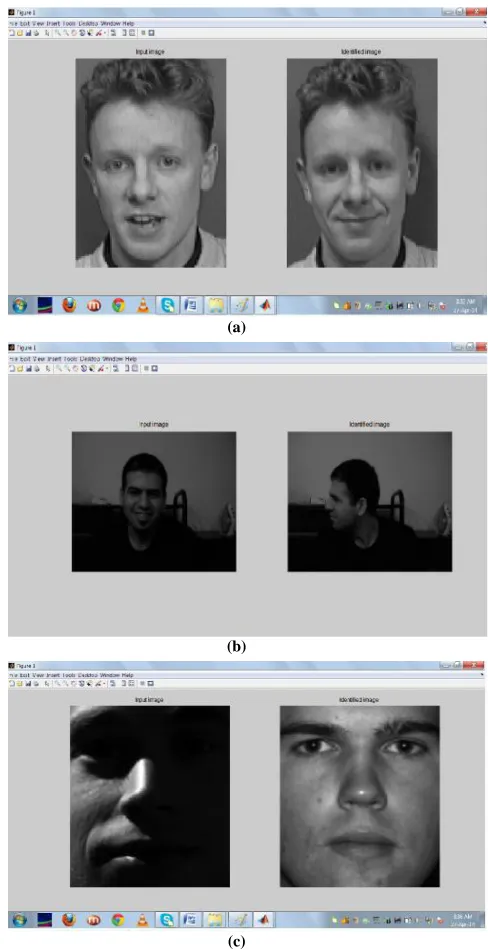
In order to validate the theory, a program in MATLAB has been developed. In addition, a public image database has also been required. The Yale database has been taken for the purpose. The program is run with the help if Image Processing Toolbox of MATLAB. The image has been identified with appreciable similarity.
The snapshot of the input image and the identified image has been shown in Fig. 6. When this program is being applied on the entire database individually, the success rate was found to be 56%. This technique, basically, paved the way for extremely stable performance under a wide range of variations in illumination misalignment, and even under small amounts of pose and occlusion.
(a)
(b)
[image:6.612.331.575.218.693.2](c)
International Journal of Emerging Technology and Advanced Engineering
Website: www.ijetae.com (ISSN 2250-2459,ISO 9001:2008 Certified Journal, Volume 4, Issue 5, May 2014)
441
V. CONCLUSION
Using a well-though-out combination of existing ideas, we have proposed a system for recognizing human faces from images taken under practical conditions that is conceptually simple, well motivated, and competitive with state-of-the-art recognition systems for access control scenarios. The system achieves extremely stable performance under a wide range of variations in illumination, misalignment, and even under small amounts of pose and occlusion. face model Our system could potentially be extended to better handle large pose and expression, either by incorporating training images with different poses or expressions or by explicitly modeling and compensating the associated deformations in the alignment stage.
REFERENCES
[1] http://www.face-rec.org/general-info/, accessed on Nov. 2012.
[2] http://www.facedetection.com/facedetection/publications.htm,access
ed on Nov. 2012.
[3] http://en.wikipedia.org/wiki/Facial_recognition_system,accessed on
Nov. 2012.
[4] Cha Zhang and Zhengyou Zhang, “A Survey of Recent Advances in
Face Detection,” Microsoft Research. A great examination of Viola/Jones and consequential research, Technical Report,
MSR-TR-2010-66, June.2010, also available on
http://www.research.microsoft.com.
[5] E. Hjelmas and B. K. Low,“ Face detection: A survey. Computer
Vision and Image Understanding,”Vol.83, pp.236–274, March 2001.
[6] M.H. Yang, D. J. Kriegman, and N. Ahuja, “Detecting faces in
images: A survey,” IEEE Trans. on Pattern Analysis and Machine Intelligence, Vol.24, No.1, pp.34–58, Sep.2002.
[7] W Zhao, R Chellappa, PJ Phillips, and A. Rosenfeld, “Face
recognition: A literature survey,” ACM Computing Surveys, Vol. 35, No. 4, pp.399-458, Dec. 2003.
[8] T. Kanade, “Pictures processing by computer complex and
recognition of human faces,” Ph.D. thesis, Kyoto University, 1973.
[9] S.Z. Li, and A.K. Jain, “Handbook of Face Recognition,” Springer
Link, 2nd Edition, ISBN: 978-0-85729-931-4, New York, 2011.
[10] Amirhosein Nabatchian, “Human Face Recognition,” Ph.D. thesis,
University of Windsor, Canada, 2011.
[11] Tejaswini Ganapathi, “Color Image Based Face Recognition,”
University of Toronto, Canada, 2008.
[12] Yanjun Yan, “Appearance based face recognition system with
mobility,” Ph.D. Thesis, Syracuse University, Syracuse, 2009.