E n h a n ci n g n e w u s e r c ol d-s t a r t
b a s e d o n d e ci sio n t r e e s a c tiv e
l e a r n i n g b y u si n g p a s t w a r
m-u s e r s p r e d i c tio n s
Poz o, M , C hi ky,, R, M e zi a n e , F a n d M e t a i s, E
h t t p :// dx. d oi.o r g / 1 0 . 1 0 0 7 / 9 7 8-3-3 1 9-6 7 0 7 4-4_ 1 4
T i t l e
E n h a n ci n g n e w u s e r c ol d-s t a r t b a s e d o n d e ci sio n t r e e s
a c tiv e le a r n i n g b y u si n g p a s t w a r m-u s e r s p r e d i c tio n s
A u t h o r s
Po zo, M , C hi ky,, R, M e zi a n e , F a n d M e t ai s , E
Typ e
C o nf e r e n c e o r Wo r k s h o p I t e m
U RL
T hi s v e r si o n is a v ail a bl e a t :
h t t p :// u sir. s alfo r d . a c . u k /i d/ e p ri n t/ 4 3 7 5 0 /
P u b l i s h e d D a t e
2 0 1 7
U S IR is a d i gi t al c oll e c ti o n of t h e r e s e a r c h o u t p u t of t h e U n iv e r si ty of S alfo r d .
W h e r e c o p y ri g h t p e r m i t s , f ull t e x t m a t e r i al h el d i n t h e r e p o si t o r y is m a d e
f r e ely a v ail a bl e o nli n e a n d c a n b e r e a d , d o w nl o a d e d a n d c o pi e d fo r n o
n-c o m m e r n-ci al p r iv a t e s t u d y o r r e s e a r n-c h p u r p o s e s . Pl e a s e n-c h e n-c k t h e m a n u s n-c ri p t
fo r a n y f u r t h e r c o p y ri g h t r e s t r i c ti o n s .
Enhancing New User Cold-Start based on
Decision Trees Active Learning by Using Past
Warm-Users Predictions
Manuel Pozo?, Raja Chiky, Farid Meziane, Elisabeth M´etais
Institut Sup´erieur d’El´ectronique de Paris, LISITE Lab 28, rue Notre-Dame-des-Champs. 75006 Paris, France
[email protected]; [email protected]; [email protected]; [email protected]
Abstract. The cold-start is the situation in which the recommender system has no or not enough information about the (new) users/items, i.e. their ratings/feedback; hence, the recommendations are not accurate. Active learning techniques for recommender systems propose to interact with new users by asking them to rate sequentially a few items while the system tries to detect her preferences. This bootstraps recommender systems and alleviate the new user cold-start. Compared to current state of the art, the presented approach takes into account the users’ ratings predictions in addition to the available users’ ratings. The experimen-tation shows that our approach achieves better performance in terms of precision and limits the number of questions asked to the users.
Keywords: Active learning for recommender systems; Cold-start prob-lem; New users probprob-lem; Decision trees
1
Introduction
The new user cold start is the situation where a recommender system cannot generate personalized recommendations for a new user because it has not learnt yet his preferences. This issue is commonly encountered in collaborative filter-ing recommendations as they rely mainly on the users’ feedback to predict fu-ture users’ interests [1]. In addition, new users start evaluating the system from their first usage [2]. This is a challenge for both academia and industry because the recommendations’ accuracy is directly related to the users’ satisfaction and fidelity [3].
The techniques used to alleviate the new user cold start can be categorized into passive learning and active learning. Passive collaborative filtering tech-niques [1] learn from sporadic users’ ratings; hence learning new users prefer-ences is slow [4]. Active techniques interact with the new user in order to retrieve a bunch of ratings that allow them to learn the user’s preferences. We focus on active learning techniques for collaborative filtering because they quickly and accurately bootstrap the generation of recommendations for users. In addtion,
?
collaborative filtering only requires users preferences; analyzing users’ ratings from (new) users can achieve better recommendation in cold-start than exploit-ing other users’ attributes (e.g. age, genre) [5].
A naive active learning approach is to question users about their interests and get their answers [6]. Such questions may include: ’Do you like this movie?’ with possible answers such as: ’Yes, I do’; ’No, I do not’; ’I have not seen it’. In this context the questions are items and the answers are the users’ preferences to these items. However, users are not willing to answer many questions [3, 7]. As a consequence, the main goal is to present short (a maximum of 5-7 questions [2]), but very informative questionnaires. Active learning creates personalized ques-tionnaires which leads to a progressive understanding of the user’s preferences. In fact, the personalization of the questionnaires is close to a recommender sys-tem concept, although the latter seeks the isys-tems the user likes and the former seeks the items the user recognizes.
Our contribution relies on an active learning technique based on decision trees that exploits both available users’ ratings and warm users’ ratings predic-tions in order to improve the questionnaire. The experimentation shows that our approach enhances previously suggested ones in terms of accuracy and in a smaller number of questions.
This paper is organized as follows: Section 2 presents the state of the art for active learning using decision trees techniques. Section 3 presents our contri-bution to enhance active learning based on past warm users’ rating predictions. Section 4 shows the experimentations performed and the results of our approach. Finally we conclude and present our future works in Section 5.
2
Related Work
In this research, we focus on active learning techniques in the domain of collabo-rative filtering recommendations, particularly those using decision trees because: (1) the sequential question paradigm allows a personalization of the question-naire, and (2) they aim to well profile a new user by posing as less questions as possible. Other techniques, such as Entropy0, Logarithmic Popularity En-tropy (LPE) and Harmonic EnEn-tropy Logarithmic Frequency (HELF), are not discussed [6]. Specifically, we do not mention passive learning techniques [8– 10], content-based techniques [11] or other hybrid techniques [12–14]. For more information about these approaches, the readers can refer to [3, 7, 4].
Enhancing New User Cold-Start 3
The users’ answers lead to a different child node of the trees. This creates a per-sonalized tree path that depends on the past users’ answers. On the other hand, this technique uses a collaborative filtering approach to choose questions. Using available users’ ratings, they seek the best discriminative item in order to split the population of users into three nodes (users who liked, those who hated and those who do not know this item). The best item is the one which minimizes a statistical error within the users’ ratings of the node.
In [16] authors suggest to apply matrix factorization while building every node of a decision tree, yet this is computationally expensive. In [17] the authors proposed to ”learn” the active learning technique. They assumed that warm users can be thought of as new users from whom some ratings are known. Thus, this is seen as a supervised decision trees which internally reduces the accuracy of the technique by picking the best discriminative items. Moreover, they split the tree nodes into six, a 1-5 natural scale rating and an unknown node.
The approach in this paper uses decision trees as in [2, 17], and it picks better discriminative items and hence better bootstraps the new users’ preferences.
3
Contribution
Supervised and non supervised active learning decision trees aim to find out the best discriminative items for every node of the tree in order to better capture the new users preferences.
Formally, let R be the available ratings. The rating of a user u in an item
i is defined by ru,i ∈ R. In addition, let t be a node in the decision trees. We
defineUt,It, andRtas the set of users, items and ratings currently in the node
t. Furthermore,Rt(u) andRt(i) are ratings of the useruand itemiin the node
t. Given the current node t, these techniques iterate over all candidate items
i∈Itby analyzing users’ ratings oni. The users populations are then grouped
into users’ who rated item i and users who did not. Typically, the latter is more populated due to the sparse nature of the available dataset. Furthermore, the users who rated itemican be grouped into further categorizations, e.g. users who liked/hated, or who rated ’1, 2, 3, 4, 5’. Then, the population of users in these nodes, and their ratings, are used to evaluate the performance of choosing
ias one discriminative item of Rt.
Our contribution exploits the predictions over the existingR. Thus, we define
P as the predicted set ofR, so that for eachru,i∈Rthere is a predictionpu,i∈
P. The setP is computed by using collaborative filtering techniques, e.g matrix factorization. Highlight that the number of users, items, and entries inR andP
are the same. Finally, Pt is the set of predictions currently in the node t, and
Pt(u) andPt(i) are the set of users and items predictions in the nodet.
Note that this technique is fast and accurate in large datasets, which allows a quicker generation of predictions from the available ratings inRt. On the other
hand, using more accurate prediction techniques is possible but (1) it can be very expensive and time consuming to do it for every node of the tree, and (2) the predictions needed in decision trees are item-oriented regardless of the user (the same prediction value to any user).
We propose to change this paradigm by using more accurate predictions over the available ratingsR. The main idea is to introduce the predictionP as a new source. Hence, R and P are available from the root node of the tree. Then, when the node is split into child nodes, Rtis split into Rt−child. As long as we
want to preserve that for every ratingru,i∈Rtthere is an associated prediction
pu,i ∈ Pt, for every node t, we split Pt into Pt−child as well. In addition, we
propose to use the available ratings inRonly to split the users population, and
P to find out the best discriminative items to enhance the prediction label of candidate items.
This makes sense since finding discriminative items and label predictions are associated with computing an error. As long asP is built by using more accurate methods than the ”item rating average”, this error is minimized efficiently. We propose using efficient algorithms, such as matrix factorization [18]. The main drawback of using matrix factorization is that it computes different item pre-dictions for different users. The decision trees require a unique item prediction value to be applied to any user. In [2, 17] the authors use the ”item rating av-erage” within Rt. We suggest using a similar method, with a major difference
that is computing the ”item prediction average”, which is indeed the average of the predictions withinPt.
In fact, collaborative filtering methods are very accurate for recommending items to users by replicating the users’ rating behavior. As a consequence, they are good as well in guessing the average prediction of users, items, and in general the average rating value of the dataset. Figure 3 supports this statement. In addition, this is true as well for the ”item prediction average”. Figure 2 develops this by considering different group of users split by quantity of ratings. We observe that ”item prediction average” based on matrix factorization predictions (MF-Avg) are close to the item rating average predictions (Item-Avg), while as normal the matrix factorization (MF) outperforms these predictions.
3.1 Apply Warm Predictions to decision trees algorithms
Enhancing New User Cold-Start 5
[image:6.595.312.467.123.278.2]Statistic Movielens MF 1st Quartile 3.00 3.13 Median 4.00 3.58 Mean 3.51 3.51 3rd Quartile 4.00 3.96
[image:6.595.167.279.182.245.2]Fig. 1. Statistics for available ratings and matrix factorization (MF) predictions of Movielens 10M [19].
Fig. 2.Prediction techniques and average comparisons regarding the RMSE for Movielens 10M [19].
Non Supervised Approach In [2], the authors define a set of statistics and an internal error using these statistics to find out the best discriminative item. In this approach, the best item is the one which reduces this error. In addition, as long as the tree nodes contain many ratings, they use the item rating average method to compute item label predictions for items.
In our approach we use the same statistics to compute the same error, with two major differences. First, the available ratings are only used to split the pop-ulation of users. As a consequence, the statistics and the items predictions are computed by using the proposed set of predictions P. Second, once a discrimi-native item is chosen in a parent node it does not pass to the child nodes. This is done for two reasons: (1) to avoid to choose the same item, and hence, to avoid to pose twice the same question to the same user, and (2) to delete the in-fluence of the items’ ratings in the child nodes. In fact, one can avoid choosing an item without deleting their ratings as done in [2]. This approach is described in Algorithm 1.
Supervised Approach In [17], the authors suggested using warm-users as cold-users from whom some interests are known. This assumption allows to create a supervised decision trees where some labels are known for validation purposes. We suggest again to use the predictionsP over the available ratings inRin order to enhance this technique. We make use ofRto split the users’ population, meanwhileP is used to (1) validate the approach, and (2) obtain items label for the chosen discriminative items. The validation requires the items predictions, which in [17] is given by the item rating average within the child node. As long asP contains the predicted valuespu,i, this validation is more accurate. In
Algorithm 1Non-supervised decision tree algorithm
1: functionBuildDecisionTree(Rt,Pt,currentTreeLevel)
2: forratingru,i inRt do
3: accumulate statistics foriin nodetusingpu,i
4: end for
5: forcandidate itemjinIt do
6: forru,j inRt(j)do
7: obtainPt(u) and splitUt 3 child nodes based onj
8: find the child node whereuhas moved into 9: forratingpu,iinPt(u)do
10: accumulate statistics foriin nodet−childusingpu,i
11: end for
12: end for
13: derive statistics forjin nodetU from thetLandtD statistics 14: candidate error:et(j) =etL(j) +etD(j) +etU(j)
15: end for
16: candidate itemi∗=argmini
17: compute pi∗ by using item prediction average
18: if currentTreeLevel ¡ maxTreeLevelthen
19: create 3 child nodesUt−childbased oni∗ratings
20: forchild in child nodesdo
21: excludei∗fromRt−child
22: BuildDecisionTree(Rt−child,Pt−child,currentTreeLevel +1 )
23: end for
24: end if
25: returni∗
26: end function
and we split the nodes into 3 child nodes (’like’, ’dislike’, ’unknown’) rather than 6. Algorithm 2 shows this approach.
3.2 Complexity of the algorithm
The complexity of our approaches for non-supervised decision trees and su-pervised decision trees is very similar to [2, 17]. In fact, these algorithms fol-low a similar procedure. The complexity of splitting the users in node t is
O(P
u∈Ut|Rt(u)|
2), and thus, for all the nodes in the same level we useO(P
u∈U|R(u)|
2).
As a consequence, the complexity to build a tree ofNquestions isO(NP
u∈U|R(u)|2).
In fact, adding the prediction setP does not affect the complexity of the algo-rithms, although, the memory footprint of the approaches may vary according to their implementations. Considering that rating and prediction datasets are coded equally, our approach consumes double of the memory size to store the setP.
4
Experimentation
Enhancing New User Cold-Start 7
Algorithm 2Supervised decision tree algorithm
1: functionBuildDecisionTree(Ut,Rt−train,Rt−validation,Pt,currentTreeLevel)
2: foruseru∈Ut do
3: computeRM SEu1 onRt−validation(u) andPt(u)
4: end for
5: forcandidate itemjfromRt−traindo
6: splitUt 3 child nodes based onj
7: foruseru∈Ut do
8: find the child node whereuhas moved into 9: computeRM SE2uonRt−validation(u) andPt(u)
10: Mu,i=RM SE1u−RM SE2u
11: end for
12: end for
13: δ= aggregate allMu,i; and pick candidate itemi∗=argmaxiδi
14: compute pi∗ by using item prediction average
15: if currentTreeLevel ¡ maxTreeLevel andMi∗≥0then
16: create 3 child nodesUt−childbased on based oni∗ratings
17: forchild in child nodesdo
18: excludei∗fromRt−child
19: BuildDecisionTree( Ut−child, Rt−child−train, Rt−child−validation,
Pt−child,currentTreeLevel +1 )
20: end for
21: end if
22: returni∗
23: end function
presented approach. Recent techniques have presented their results using Netflix dataset. However, this dataset is no longer available for research. Hence, we use the Movielens 10M dataset [19], which contains 71567 users, 10681 items and 10 million ratings. Since our approach considers external techniques prediction as a new source, in order to build our decision trees we use matrix factorization [18] due to its accuracy. We compare our approach in non supervised decision trees, as in [2], and in supervised decision trees, as in [17].
In order to compare the approaches we use the RMSE metric oriented to users, which measures the squared difference between the real ratings and the pre-dicted ratings:
RM SEu=
r 1
N
X
(ru,i−pi)2 (1)
Where N is the number of ratings of the user u, pi is the predicted label
value of the candidate item in the question node and ru,i is the real rating of
the user ufor the item i. Hence, the evaluation of the error in one question is the average of the users error in this question number. As a consequence, for this metric the lower is the better.
since the same user may appear in both training and test set. We suggest a real cold-start situation. We split the set of users in the datasets into 90% training set, Utrain and 10% test set,Utest. Hence, the users in the training set help to
build the decision trees and the users in the test set are considered as new user to evaluate the performance of the approach.
The process we have followed to run this experimentation is as follows. First we split the dataset into Utrain and Utest. Second, we compute the
collabora-tive filtering algorithms over ratingsR in Utrain and we extract the associated
predictionsP. Third, we train the approach of Golbandi by using Utrain. Our
approach is trained by using both ratings in training set R and the prediction of the training setP. Finally, the performance of the decision trees is evaluated by using the test set Utest. The users in this set are used to answer the
ques-tions. If the item is known, we compute the RMSE associated to this answer and this question. Then, the user answer a new question. At the end, we compute the average of the accumulated nodes RMSE.
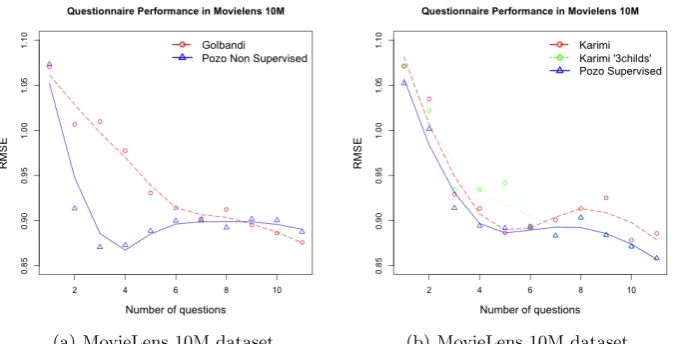
Knowing that the experimentation may depend on the split of the dataset, we run it 50 times and then used the mean value of the RMSE. We use this process to evaluate the performance for the MovieLens 1M and MovieLens 10M. Figure 3(a) shows the results (the mean values and tendency curves) of this experimentation for both MovieLens datasets, where ’Golbandi’ is the approach used in [2]. On the one hand, our approach achieves a much lower error in less number of questions. This matches with the needs of active learning; short but very informative questionnaires. This is possible due to the higher accuracy of the matrix factorization. On the the other hand, all the approaches tend to converge into a pseudo-asymptotic behavior. This is due to the fact that nodes in the bottom of the tree (nodes in 8th question) are less populated by users and thus predictions and profiles are less accurate. This particularity is not shown in [2, 17] due to their very large dataset.
We perform a similar experiementation to compare our approach to [17]. This time the authors use a 4-fold set to evaluate their dataset: Dtrain set which is
split intoUtrain andUvalidationsets, andDtest set which is split intoUtest and
Uanswersets.Utrain andUvalidationare to train and validate the evolution of the
algorithm.UtestandUanswerare used to evaluate the performance of the tree at
the questionqand to answer to that questions. As long as the validation phase aims to optimize the RMSE, the accuracy prediction of the matrix factorization enhances this metric. This yields to better questions and hence the accuracy of the decision tree is enhanced as well. Figures 3(b) shows better results than [17] as well. Further analysis are not described in this paper due to a lack of space.
5
Conclusions and Future Work
ex-Enhancing New User Cold-Start 9
[image:10.595.136.473.122.294.2](a) MovieLens 10M dataset. (b) MovieLens 10M dataset.
Fig. 3.Questionnaire performance in RMSE.
ploit the ”prediction” inside the decision trees since they use very simple ap-proaches (e.g. item rating average) to make it tractable.
The main idea of our contribution is to train an accurate collaborative fil-tering techniques with a ratings dataset to generate a prediction dataset. Then, both ratings and predictions dataset are used inside the decision trees. The former properly split the users’ population while building the tree. The latter enhances the seek of the best discriminative items (questions) and better predict the associated labels. We have tested this approach in non supervised decision trees and supervised decision trees. The experimentation shows that our ap-proach find better questions to present to users in order to better understand his preferences.
Our future work focuses on (1) detecting the new users preferences directly on the fly, and (2) using new techniques to exploit the information coming from questionnaires. We especially believe that the time (new) users spent to answer a question is very significant for the answer itself. Thus, we focus on ”time-aware” recommendation techniques and decision trees to retrieve and exploit not only the users’ answers but also the users’ behavior.
Acknowledgments
This work has been supported by FIORA project, and funded by ”DGCIS” and ”Conseil Regional de l’ˆIle de France”.
References
2. Golbandi, N., Koren, Y., Lempel, R.: Adaptive bootstrapping of recommender systems using decision trees. In: Proceedings of the fourth ACM international conference on Web search and data mining, ACM (2011) 595–604
3. Rubens, N., Kaplan, D., Sugiyama, M.: Active learning in recommender systems. In: Recommender Systems Handbook. Springer (2011) 735–767
4. Karimi, R., Freudenthaler, C., Nanopoulos, A., Schmidt-Thieme, L.: Comparing prediction models for active learning in recommender systems. In: Proceedings of the LWA 2015 Workshops: KDML, FGWM, IR, and FGDB. October 2015, http://ceur-ws.org (2015)
5. Pil´aszy, I., Tikk, D.: Recommending new movies: even a few ratings are more valu-able than metadata. In: Proceedings of the third ACM conference on Recommender systems, ACM (2009) 93–100
6. Rashid, A.M., Albert, I., Cosley, D., Lam, S.K., McNee, S.M., Konstan, J.A., Riedl, J.: Getting to know you: learning new user preferences in recommender systems. In: Proceedings of the 7th international conference on Intelligent user interfaces, ACM (2002) 127–134
7. Elahi, M., Ricci, F., Rubens, N.: Active learning in collaborative filtering recom-mender systems. In: E-Commerce and Web Technologies. Springer (2014) 113–124 8. Hofmann, T.: Collaborative filtering via gaussian probabilistic latent semantic analysis. In: Proceedings of the 26th annual international ACM SIGIR conference on Research and development in informaion retrieval, ACM (2003) 259–266 9. Lemire, D., Maclachlan, A.: Slope one predictors for online rating-based
collabo-rative filtering. In: SDM. Volume 5., SIAM (2005) 1–5
10. Koren, Y., Bell, R., Volinsky, C.: Matrix factorization techniques for recommender systems. Computer42(8) (2009) 30–37
11. Peis, E., del Castillo, J.M., Delgado-L´opez, J.: Semantic recommender systems. analysis of the state of the topic. Hipertext. net6(2008) 1–5
12. Ziegler, C.N., Lausen, G., Schmidt-Thieme, L.: Taxonomy-driven computation of product recommendations. In: Proceedings of the thirteenth ACM international conference on Information and knowledge management, ACM (2004) 406–415 13. Vozalis, M.G., Margaritis, K.G.: Using svd and demographic data for the
enhance-ment of generalized collaborative filtering. Information Sciences 177(15) (2007) 3017–3037
14. Barjasteh, I., Forsati, R., Masrour, F., Esfahanian, A.H., Radha, H.: Cold-start item and user recommendation with decoupled completion and transduction. In: Proceedings of the 9th ACM Conference on Recommender Systems, ACM (2015) 91–98
15. Rashid, A.M., Karypis, G., Riedl, J.: Learning preferences of new users in recom-mender systems: an information theoretic approach. ACM SIGKDD Explorations Newsletter10(2) (2008) 90–100
16. Zhou, K., Yang, S.H., Zha, H.: Functional matrix factorizations for cold-start recommendation. In: Proceedings of the 34th international ACM SIGIR conference on Research and development in Information Retrieval, ACM (2011) 315–324 17. Karimi, R., Nanopoulos, A., Schmidt-Thieme, L.: A supervised active learning
framework for recommender systems based on decision trees. User Modeling and User-Adapted Interaction25(1) (2015) 39–64
18. Zhou, Y., Wilkinson, D., Schreiber, R., Pan, R.: Large-scale parallel collaborative filtering for the netflix prize. In: Algorithmic Aspects in Information and Manage-ment. Springer (2008) 337–348
![Fig. 1. Statistics for available ratings andmatrix factorization (MF) predictions ofMovielens 10M [19].](https://thumb-us.123doks.com/thumbv2/123dok_us/8689428.876784/6.595.312.467.123.278/fig-statistics-available-ratings-andmatrix-factorization-predictions-ofmovielens.webp)