2017 2nd International Conference on Computer, Mechatronics and Electronic Engineering (CMEE 2017) ISBN: 978-1-60595-532-2
Correlation Detection and Judgment of Abnormal Individual Behavior
Based on Unsupervised Learning
Feng LI, Ting-ting LU and Ze-nan WANG
*1
Room 125, Building No. 1, North Renming Road, Songjiang District, Shanghai, China *Corresponding author
Keywords: Fuzzy clustering, Correlation detection, Anomaly judgment.
Abstract. In order to enable the Body Sensor Network (BSN) to detect the abnormal body state without the medical professional supervision, the method is proposed to find fuzzy association rules between daily exercise and physiological health data based on unsupervised learning. Firstly, the fuzzy clustering method is used to transform the numerical attributes to fuzzy categorical attributes. And then the frequent item set is calculated based on the support and confidence. The rules which reflect the behavior habit and laws are obtained from the final strong association rule through the minimum confidence screening. In order to avoid the useless rules and reduce the computational complexity, according to the characteristics of the exercise data, the frequent item set is divided into condition and conclusion groups. The abnormal state is detected by comparing the daily exercise data with the rules. The experiment with mass data had proven the validity of project.
Introduction
With the development of wearable equipment and related technology, many intelligent applications for motion recognition are introduced into the wearable device. C Mandery [1] proposed a dimensionality reduction of the feature space of the whole body motion recognition based on the Hidden Markov Model. In the eigenvector, considering higher dimension features such as joint angle, the algorithm proposed in [2] analyzed the time domain and frequency domain characteristics of the acceleration sensor data, and further improves the adaptability of the exercise state recognition algorithm by direction independence and step processing. And now there are many wearable devices are designed to collect the ECG and blood pressure signal too. Many methods on the processing of ECG signal in the human Body Sensor Network (BSN) are proposed in [3-5], such as the algorithm of heart attack based on Hidden Markov Model (HMM) and the method to remove the baseline drift of the ECG signal.
Based on the body physiological signal collected by the BSN, the individual daily exercise law, as well as the association relationship of these exercise with individual physiological signals, may be found. It can be very helpful to those who focus on daily exercise. The function, such as monitoring daily activities state, diagnosing of the abnormal state implemented on wearable devices, can highlight the value of the body sensor network (BSN). The key technique to complete the function is to find a kind of efficient and unsupervised learning algorithm. The BSN detected the changes of the individual body state, understand the relationship between the characteristics of the human body, and then complete the state monitoring and abnormal status diagnosis without the professional medical supervision. The exercise state and physiological data of a person are normal in most of the time, sudden changes often mean abnormal. Flowing the idea, the association rule mining algorithm is proposed to find the rules of individual daily exercise and physiological data based on the characteristics of individual exercise behavior in the paper. And then the method is discussed to discover the individual behavior or data anomaly based on the rules.
[6] in 1994, that is, to find hidden data patterns or knowledge from a large amount of accumulated data. At present the main researches on the algorithm are as follows: [7]
1) The multi-cycle mining algorithm. Its’ core idea is the "hierarchical algorithm"[8, 9]. Although the algorithm is simple and easy to understand, it may produce a great deal of candidate sets because of layer-by-layer iterative search, and require a large I/O load to scan transaction database multiply.
2) Dynamic counting algorithm. The advantage of the algorithms is the optimized performance with parallel I/O [10], but there are some problems in the application, such as sensitive to the data distribution and the choice of interval size. There is also error accumulation effect in the dynamic counting process.
3) Multi-valued attribute association rule mining algorithm [11], known as Boolean Association Rules. In the algorithm, the multi-valued attribute is divided into multiple intervals, each interval represents a property. However, the property does not represent the data distribution well, especially if the attribute value distribution is not uniform.
With the development of association rules, some scholars have found that Boolean Association Rules have some limitations in dealing with continuous variables. So the fuzzy mathematics is introduced into the association rules [12, 13]. Chan Man Kuok introduced the fuzzy rule into association rules to solve the problem of "hard borders"[13]. This is of great and practical significance to the development of association rules. K.Abhirami proposed a genetic algorithm [14] to find the rules that occur at the boundary of the fuzzy set, but it is more difficult to deal with problems with higher dimensions. Hangbin Li proposed a new tag-based model to solve the "rare project" problem [15]. Each item has a different label; the users can use the label combination to dig their own "rare items", which also lead to the high computational-complexity.
In the frequent item sets algorithm, in order to generate association rules, it is necessary to check all the subsets and then form a lot of useless rules too.
In this paper, in order to improve the efficiency of algorithm, according to the characteristics of mobile health data, a fuzzy clustering algorithm is proposed so that the attributes can be self-adjusted according to the change of data, and the number of rules, generated from the frequent item sets, is reduced by setting the limitation of condition and conclusions of association rules. This scheme is designed to further improve design quality and efficiency, not only gets the required rules, but also reduces the computational complexity.
Our research group have completed the wearable ECG equipment [16, 17], ECG automatic diagnosis [5] system and exercise state recognition [2] system. The study is carried out in the preceding work of our project group.
Numerical Classification Based on Fuzzy Clustering
The individual exercise data such as exercise status, exercise time, movement distance, number of exercise steps, and health data such as heart rate, respiratory rate and pulse rate are numeric data. Because the Apriori algorithm mainly deals with the discrete element aggregation, the numeric data should be converted to discrete element. Although the classification of the data according to its value is a simple solution, the traditional classification scheme of fixed category centers and distances is obviously unreasonable because the deviation is too large among individual’s data. The equal width division method is not ideal for the data with nonuniform distribution density, because the category attributes cannot reflect the semantics of the interval data without considering the relative distance between the data points or the interval. Moreover, it cannot meet the requirements of classifying in unsupervised learning.
to the algorithm. In [20], a dynamic optimization FCM algorithm is proposed. In the algorithm the optimal classification number is automatically determined by the pseudo-F statistic (PFS) on the intra-class information and inter-class information. The dynamic clustering is achieved based on the sample density, and then is adopted in this paper.
The density parameter of the sample xj is defined as the follows:
1
( , ) ( ( , ))
N
j j j i j
i
x R u R d x x
ρ
=
=
∑
− (1)1 1
( ( , )
( 1) N
j i j
i
R d x x
c N =
=
−
∑
(2)Where Rj is the radius of the neighborhood of the samplexj, u is a function that calculate the
degree of the sample xj within the radius of the sample xj neighborhood. d x x( ,i j) is the distance
between xi and xj.
FCM calculate the degree of the sample belong to a set, which determine the relation of the sample and an attribute. In this paper, a sample is a vector, the n vectors (x ii =1, 2,, )n is divided into c fuzzy sets. We should calculate the clustering center of each set so that the objective function reaches the optimal solution. The objective function is:
2
1 1
( , ) ( )( )
c n m
m ij ij
i j
J U V u d
= =
=
∑∑
(3)Where the Uij refers to the membership value, the degree of membership of th
j element belongs to
th
i class, dij2 refers to the distance between the jth element and the center point, the J U Vm( , )
represents the sum of the weighted distance of each point to the each class. The m is a parameter of the fuzzy degree. This algorithm has a constraint that the sum of degree of a sample membership value for all categories is equal to one.
A fitness function is designed based on the principle of minimum-in-cluster-distance and maximum-between- cluster-distance. The optimal solution is to make the objective function Jm take
the minimum value.
Let D={ ,I I1 2,, }In be the characteristic attribute set which includes the user's exercise behavior feature. While the FCM algorithm is used to cluster each attribute, D is transformed into a feature attribute classifier Df :
1 2
{ , , , }
f m
D = F F F (4)
1 2
{ , , , }
i i i in
F = f f f (5)
Where fij is a fuzzy set.
For example, the state vector set:
D = (state of exercise, duration of exercise, number of heartbeats per minute, distance of exercise, number of movement steps)
After fuzzy clustering, the following categories are formed: Movement state F1 = {run, walk, still}
Movement time F2 = {long, normal, short} Heartbeat F3 = {fast, normal}
Individual Exercise Behavior Correlation Detection and Abnormal State Detection Commonly there are two specified criteria for association rules: support and confidence.
Support and Confidence Calculation
(1)Support. The joint possibility of two events, for fuzzy sets the support, the attribute set fik support
forfjl , is defined:
1
( ) ( ( ) * ( )) /
N
ik jl ik s jl s
s
Sup f f f d f d N
=
→ =
∑
(6)Where ds is the raw data in setD , ds∈D , N is the number of data inD . fik(ds) is the
membership function of the data ds in the fuzzy set fik . For example, there are three samples in the
set D as shown in Table I, so the short-time→running's support is: 3
11 23 11 23
1
( ) ( ( ) * ( )) / 3
(0.8* 0.2 0.7 * 0.7 0.2 * 0.1) / 3 0.22
s s s
Sup f f f d f d
=
→ =
= + + =
∑
(7)Table 1. Data in data set D.
Membership Run(f11) Walk(f12) Long(f21) Normal(f22) Short(f23)
d1 0.8 0.2 0.1 0.7 0.2 d2 0.7 0.3 0.2 0.1 0.7 d3 0.2 0.8 0.7 0.2 0.1
(2) Confidence. The possibility of event fjl appears while event fik appears in transactionD. In
the fuzzy set, the confidence level is defined as follows:
( ) ( ) ( ) ik jl ik jl ik Sup f f Con f f
Sup f
→
→ = (8)
1
( ) ( ) /
N
ik ik s
s
Sup f f d N
=
=
∑
(9)The data in Table I, short-time-running confidence is:
11 23
0.8 * 0.2 0.7 * 0.7 0.2 * 0.1
( ) 0.40
0.8 0.7 0.2
conf f − f = + + =
+ + (10)
Fuzzy Association Rules Mining
To expose Fuzzy association rules is to find relationship between the fuzzy concepts attributes. It is also to find the fuzzy frequent item sets in the attribute class library Df by the criteria: support and
confidence. At present, Apriori algorithm [5, 6] or improved Apriori algorithm is the common algorithms of fuzzy frequent item sets. The main process is:
1) Convert the original database D into the attribute category library Df by the FCM algorithm;
2) Get the fuzzy frequent sets from the data by the join and prune operation. 3) Get strong association rules from the fuzzy frequent sets
In the first round the fuzzy candidate sets are the items in the attribute class library Df , while in
In the FCM, the associations’ rules are calculated from fuzzy frequent set through all the subsets. The time and space complexity of the process are very high. In order to reduce the time complexity, we divide the attributes in the fuzzy frequent set into two groups according to its actual meaning. One group only appears in the condition portion of the association rules, and the other group appears in the conclusion portion of the association rules. Such as the ‘number of heartbeats’ should only appear in the conclusion portion, and the 'exercise time' will only appear in the condition portion. The proposed method can reduce the computational complexity and the size of the association rules. Next we will pick out strong association rules based on confidence.
The fuzzy association rule mining algorithm is described as follows:
Finally, the minimum confidence is used to screening the rules having potential value. The rules may be sorted by the confidence. And then we get the association rules of individual exercise behavior and physical data.
We designed the BSN system to collect the real-time in-exercise data, and then check if the data is consistent with current rules. If it is not consistent, that means abnormal state.
Begin
If(Sup f( ik)≥min sup )
The item set fik is inserted into
the 1th frequent item set L1 For (k=2;Lk-1≠∅;k++) Begin
Joint and generate the kth candidate item set Ck For each Ckm Ck
Begin Sup(Ckm)=
1 1
k n
ij j= i= f
∑
∏
If (Sup(Ckm<minsup) ) delete Ckm
End
The kth frequent term is Lk=Ck End
For each SubSet(Lk) Begin
For X ⊆l AndY ⊆l And X ⊆Fpre And Y ⊂Fcon And (X ∩Y =φ) Begin
If Conf (X⇒Y)> = minconf
Return X And Conf(X ) End
End End
Algorithm1: Parameters:
F1…Fn: the item sets in the database. ( )
ik s
f d : the membership function of the data ds in the fuzzy set fik .
Lk-1: the (k-1)t h frequent item sets.
Ck: k th
candidate item set. Ckm: the mth member of Ck.
pre i j
F =FF : the set of the condition of the rule.
con k m
F =F F : the set of the conclusion of the rule.
SubSet(Lk-1): (k-1)th frequent subset of item sets.
Input: feature attribute fuzzy database Df, minimum support: minsup, minimum confidence: minconf.
Experimental Analysis
[image:6.612.106.501.327.565.2]In order to verify the rationality and validity of the algorithm mentioned above, in this chapter some experiments have been made to appraise the performance of algorithms. The parameters, the minimum support and the minimum confidence, were determined by experiments. The parameters of the experiment are shown in Table II
Table 2. Experimental parameters.
Parameters Defaults
number of attribute itemsets 5
Minsup 0.25
Minconf 0.96
items of the condition portion Exercise State (p)、Exercise Time(t)、Motion Steps (s)、Distance (d)
items of the Conclusion portion Heartbeats (r)
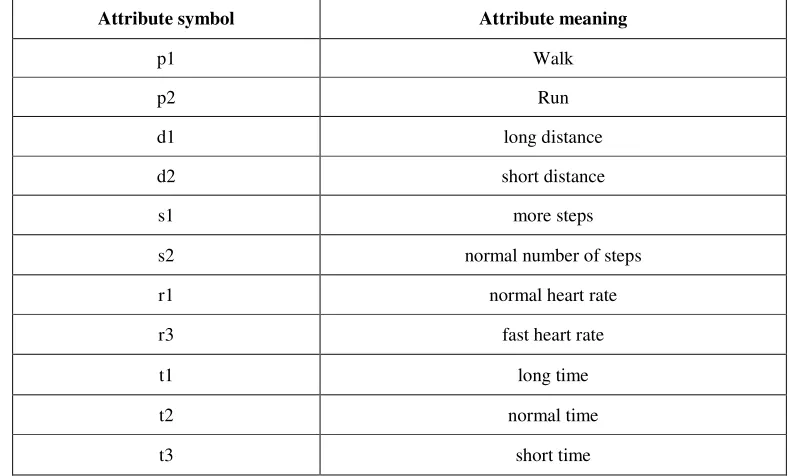
The meaning of each attribute set in the experiment is shown in Table III:
Table 3. The meaning of each attribute in experiment.
Attribute symbol Attribute meaning
p1 Walk
p2 Run
d1 long distance
d2 short distance
s1 more steps
s2 normal number of steps
r1 normal heart rate
r3 fast heart rate
t1 long time
t2 normal time
t3 short time
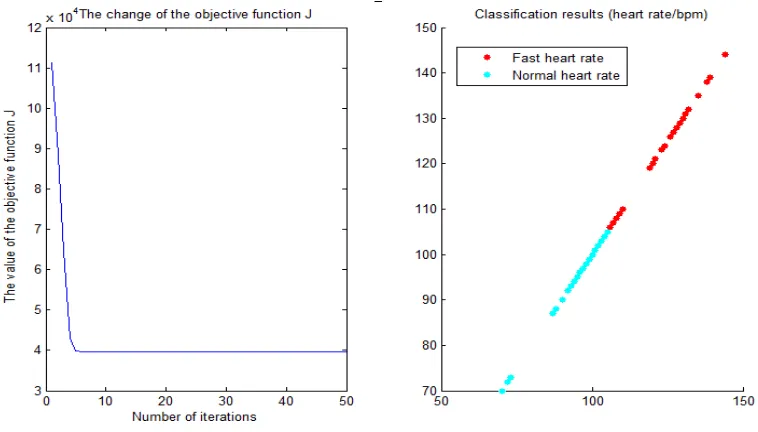
First of all, the database D is transformed to fuzzy database Df by FCM clustered algorithm.
Figure 1. Fuzzy clustering results.
[image:7.612.184.428.318.507.2]Some membership functions of some heart rate data are shown in Figure 2.
Figure 2. Heart rate data membership.
After obtaining the fuzzy database and detecting fuzzy correlation, the first round of the candidate set are shown in Figure 3:
[image:7.612.169.442.549.721.2]In the first round, the candidate set contains the attributes{ 1, 2, 1, 2, 1, 3, 1, 2, 1, 2, 3}d d p p r r s s t t t . By the joint and pruning operation the candidate items set is calculated in the second round (shown in Figure 4):
Figure 4. Candidate 2 itemsets.
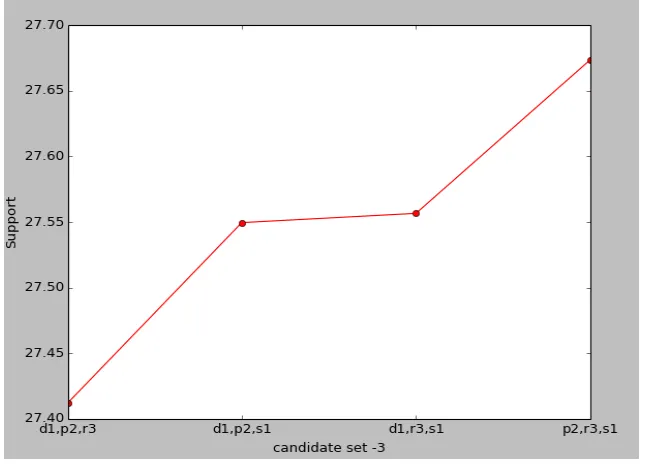
[image:8.612.143.466.110.312.2]In the second round the candidate set contains the attributes :{d1p1, d1p2, d1r1, d1r3, d1s1, d1s2, d2p1, d2p2, d2r1, d2r3, d2s1, d2s2, p1r1, p1r3, p1s1, p1s2, p2r1, p2r3, p2s1, p2s2, r1s1, r1s2, r3s1, r3s2}. The candidate items in 3rd round contains {d1p2r3, d1p2s1, d1r3s1, p2r3s1}, shown in Figure 5.
Figure 5. Candidate-3 itemsets.
We get the 3rd frequent item sets from the 3rd Candidate item sets. Next, the empty Candidate item set is got after self-join and pruning operation, so the algorithm terminates. The final fuzzy frequent set is S: ['d1p2s1', 'd1r3s1', 'p2r3s1'].
If the association rules are generated according to this fuzzy frequent set S directly, there are 1 2
3 3
3 (X C +C ) rules, most of which are meaningless. To avoid this problem, and reduce the
[image:8.612.145.469.382.616.2]Table 4. Comparison of generated exercise association rules.
The previously generated association rules
Improved association rules generated after improvement
d1->p2^s1 p2->s1^d1 s1->p2^d1 d1^p2->s1 d1^s1->p2 p2^s1->d1 d1->s1^r3 s1->d1^r3 d1^r3->s1 d1^s1->r3 r3^s1->d1 p2->s1^r3 r3->p2^s1 s1->p2^r3 p2^r3->s1 p2^s1->r3 r3^s1->p2
d1^s1->r3 p2^s1->r3
[image:9.612.201.417.329.391.2]The confidence level of the improved exercise rules are shown in Table V:
Table 5. Confidence in the rules of exercise.
Rules Confidence
d1^s1->r3 0.773370042885
p2^s1->r3 0.994355245943
The rule which confidence is less than the minimum threshold is deleted, and the finally strong association rule.
2 ^ 1 3
p s →r (11) After the above steps, we can get some rules that reflect the law of a person's movement, such as continuous running in about 10 minutes, heartbeat is 80pbm. When the BSN find that today the people runs just 8 minutes, but the heartbeat is 100bpm, it will remind the user.
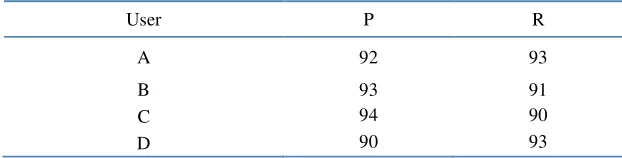
In order to verify the validity of the algorithm, about 60000 samples, covering 4 users ( , , , )A B C D within 3 months, are collected. We've been testing the data, comparing the result, which the BSN system auto-check by the method above, with the data label. The measuring and analyzing results are shown in Table VI.
Precision P and recall R are defined as follow:
/ ( )
P=TP TP+FP (12)
/ ( )
[image:9.612.149.460.669.748.2]R=TP TP+FN (13) TP: the number of the samples which is judged abnormal while they are abnormal actually. FP: the number of the samples which is judged abnormal while they are normal actually. FN: the number of the samples which is judged normal while they are abnormal actually.
Table 6. Precision P and recall R.
User P R
A 92 93
B 93 91
C 94 90
Conclusions
In order to enable the BSN to detect the abnormal body state of the user without the medical professional supervision, the method is proposed to find and analyze the relationship between exercise behavior and body state based on unsupervised learning. Firstly, the fuzzy clustering method is used to transform the numerical attributes to fuzzy categorical attributes. In order to reduce the computational complexity, according to the characteristics of the exercise data, before getting the association rules from the frequent set, the set is divided into condition and conclusion groups, and then obtain the final strong association rule through the minimum confidence screening.
The algorithm discussed in this paper focus on the individual state. In the future we are going to dig into the method to detect the abnormal state based on group data, not only the individual data. The study will focus on how to find the correlation between motion state and body data and then give suggestion on daily exercise.
Acknowledgement
Supported by National Natural Science Foundation of Shanghai: 16ZR1401100.
Reference
[1] C. Mandery, M. Plappert, J. Borràs,.Dimensionality reduction for whole-body human motion recognition . TAsfourInternational Conference on Information Fusion, 2016: 355-362.
[2] Li Feng and Pan Jingkui. Human Motion Recognition Based on Triaxial Accelerometer [j]. Journal of Com- puter Research and Development, 2016, 53(3): 621-631
[3] M.I. Ckidean, ÓscarBarquero-Pérez, Q Zhang, RH Jacobsen. High diagnostic quality ECG compression and CS signal reconstruction in body sensor networks IEEE International Conference on Acoustics, 2016:6255-6259
[4] H Zhang, J Liu, Fault Diagnosing ECG in Body Sensor Networks Based on Hidden Markov Model. International Conference on Mobile Ad-hoc & Sensor Networks 2014:123-129
[5] LI Feng, Chen Meili. An ECG waveform recognition algorithm based on geometric characteristics [J]. Beijing Biomedical Engineering, 2015(3): 261-266.
[6] Agrawal, R. and Srikant, R. (1994). Fast algorithms for mining association rules. In: Bocca, J. B., Jarke, M. and Zaniolo, C. (eds). The Proceeding of the 20th International Conference on Very Large Databases. San Francisco, CA: Morgan Kaufmann, 1994. pp. 487-499.
[7] Xiao-FengGu, Xiao-Juan Hou, Chen-Xi Ma, Ao-Guang Wang, Hui-Ben Zhang, Xiao-HuaWu, Xiao-Ming Wang. Comparison and improvement of association rule mining algorithm. 2015 12th International Computer Conference on Wavelet Active Media Technology and Information Processing (ICCWAMTIP).p.383-386.
[8] P. Karthik, M.Saurabh, U. Chandrasekhar. Classification of text documents using association rule mining with critical relative support based pruning.2016 International Conference on Advances in Computing, Communications and Informatics (ICACCI), Jaipur, India. IEEE Conference Publications.p.1219-1223.
[10] ManojSethi, RajniJindal. Distributed data association rule mining: Tools and techniques.2016 3rd International Conference on Computing for Sustainable Global Development (INDIACom). IEEE.p.481-485
[11] T.Bharathi, P. Krishnakumari. A comparative analysis on efficiency of contemporary association rule mining algorithm. 2016 3rd International Conference on Advanced Computing and Communication Systems (ICACCS -2016), Coimbatore, India.IEEE.p.1-9.
[12] Maocai Cheng, KaiyongXu, XuerongGong. Research on audit log association rule mining based on improved Apriori algorithm. 2016 IEEE International Conference on Big Data Analysis (ICBDA).p.1-7.
[13] Kuok C M, Fu A, Wong M H. Mining fuzzy association rules in databases[J]. Acm Sigmod Record, 1998, 27(1):41-46..
[14] K. Abhirami. Web usage mining using fuzzy association rule. International Conference on Emerging Trends in Engineering, Technology and Science (ICETETS) 2016:1-4
[15] Hangbin Li; Shuhua Chen; Jianchen Li; Shuo Wang; YihangFu. An improved multi-support Apriori algorithm under the fuzzy item association condition[C]. 2011 International Conference on Electronics, Communications and Control (ICECC).2011:3539-3542.
[16] Li Feng, Xu Han. Design and Implementation of a Portable ECG Monitor [J]. Electronic world, 2012, 19(12):52-54.
[17] Li Feng, Chen Kun. Design and implementation of wearable body sensor network [J]. Electronic world, 2014(10): 39-42.
[18] Jiamin Li; Harold W. Lewis. Fuzzy Clustering Algorithms — Review of the Applications.2016 IEEE International Conference on Smart Cloud (SmartCloud). p. 282-288.
[19] Hima Suresh; Gladston Raj S. An unsupervised fuzzy clustering method for twitter sentiment analysis.2016 International Conference on Computation System and Information Technology for Sustainable Solutions (CSITSS).p.80-85.
[20] Yan Z.Z. Improved F.C..M Algorithm Based on K-Means and Granular Computing: Journal of Intelligent Systems [J]. Journal of Intelligent Systems, 2015, 24(2): 215-222.
[21] Hu, Jingyao. The analysis on apriori algorithm based on interest measure. Proceedings - 2012 International Conference on Control Engineering and Communication Technology, ICCECT 2012:1010-1012.