2018 International Conference on Modeling, Simulation and Analysis (ICMSA 2018) ISBN: 978-1-60595-544-5
A Single Airport Time Slot Allocation Method Considering Scheduling
Delay and Operational Delay
Yu-meng REN, Wei-li ZENG
*, Juan LI, Zi-yu ZHAO and Yu-shi SUN
College of Civil Aviation, Nanjing University of Aeronautics and Astronautics, Nanjing 211106, China
*Corresponding author
Keywords: Flight schedule, Hungarian algorithm, Scheduling delay, Operational delay.
Abstract. At present, when flight seasonal routing management departments make the flight plans, there is a lack of quantitative assessment of the actual execution of the delay together with the technology for finding the potential key link of flight delays. In order to enhance the scientificity and rationality of flight seasonal scheduling, this paper proposes a flight schedule optimization model based on historical data, for the purpose of reducing airline’s request deviation, i.e., the time difference between allocated time slots and airline requets and operational delays. This model construct an object function which make the total operating and planned delay minimum and firstly introduce corridor capacity as constraint. In the experimental part based on the historical data of Hangzhou Xiaoshan Airport, we use Hungarian algorithm to give solutions of this model and prove the feasibility and effectiveness.
Introduction
In recent years, Chinese civil aviation transportation industry has been developing rapidly. And conflicts have become increasingly prominent. There is a shortage of the flight schedule resource, and the schedule rate of flights is not guaranteed. In order to fundamentally solve the problem of flight delay, firstly, the supply and demand contradiction of the flight time resources should be resolved and the flight schedule should be arranged reasonably. In particular, how to allocate the flight schedule reasonably in a certain capacity will have an important impact on reducing flight delays.
In order to make the flight seasonal schedule scientifically, this paper proposes a flight seasonal schedule optimization method based on data driven model, in order to provide quantitative decision support method for flight scheduling management. On the airlines and the managers’ side, based on historical season operation data, constructing data driven flight schedule optimization model, achieving the goal of minimizing airline request time deviation and flight delays. After that, use the Hungarian algorithm to solve flight seasonal schedule optimization problem, in order to improve the solution accuracy and computational efficiency.
A Data-Driven Slot Allocation Model
In the pre-tactical and tactical stage, it already has some good flight scheduling software to assist managers to complete daily flight schedule slot operation, but at the aspect of making the flight seasonal schedule there is no software system which assist plan making departments developing strategic level. In order to carry out scientific and reasonable flight seasonal schedule, this paper will establish a data driven optimization model, which based on the history data, making quantitative decision tools for flight scheduling management.
Notation
T Collection of all time slots
m
t The request time of flight m
,
m n
t The actual time slot of flight m in n times execution
max
t Maximum acceptable deviated time for airlines
,
a d
S Collection of minimum over station time for different types of aircraft
M Collection of arrival and departure flights
S
Number of aircraft types
s
t The minimum over station time fors{1 2,... }, S
s
M Collection of arrival and departure flights of s{1 2,... }, S
p
s s s
M M M Collection of over station flight(m ma, d)Msp, among them, ma and md
indicate the arrival and departure of the same flight
m
N The actual flight executes times of flight m in a historical operation
K
Number of corridors
k
M
Collection of flights in the k corridor
k
Q Capacity constraints of the k corridor
t
Length of time interval
t
C Capacity withint
Decision Variable
The purpose of flight time optimization is to assign a time slot to each flight and assign only one, so that the decision variable is defined as
1, 0,
t m
If the flight m is exe
X cute
o
d at s
t ther
(1)
Objective Function
Minimize ,
1 1
m m
N N
t t
m m m n m m M t T n m M t T n
t t X t t X
(2)where 1 m N t m m m M t T n
t t X
represents the total planned offset cost in operation (the differencebetween scheduled departure time and airline request time), ,
1 m
N
t m n m m M t T n
t t X
represents the total actual delay cost in historical operations (the difference between planned take-off time and actual departure time).Constraints
Time slot allocation constraints: one slot allocation only for each flight at the same airport in the same day
1,
t m t T
X m M
(3) The slot searching range constraint: there’s a maximum acceptable value between the assigned slots which airlines could accept and request slots, so limiting the search for the optimal flight time slot within a range, can not only meet the requirements of airline companies, but also can improve the efficiency of the model.max,
m
t t t mM (4) The airport capacity constraints: capacity is the biggest flight number an airport could ensure. The capacity published in our country is airport hourly capacity. When allocating the flight slot, flight schedule’s optimization needs to meet the capacity requirements. But only limiting the airport hourly capacity will result in too much dense of some time slot. In order to keep the flight plan accord with the actual operation, developing a more sophisticated flight plan, this paper will limit the capacity of a continuous time interval whose length are 5 minutes, 15 minutes and 60 minutes respectively and the airport capacity constraints are put forward as follows
, , {5,15, 60}
s
t
m t s m M t T
X C T s t s t t
(5) The corridor capacity constraints: when the researchers at home and abroad study the flight schedule optimization, most of them constrain the airport capacity, the sector capacity only, no one putting forward constraints on the corridor. The second chapter analyzes the current situation of Hangzhou airport operation, the results show that in 2016 there are a total of 30 time slots out of the capacity limit of corridor in summer and autumn flight plans, and the more time slot capacity which do not fit the corridor limits, the more flight delays through this corridor. Therefore, this paper proposes the following corridor capacity constraints., , {1,...., }
k
t m k m M
X Q t T k K
(6) The station passing time constraints: for different types of aircraft, there is a minimumturnaround time requirements, which is one of the most basic constraints.
0, ,
1, ( , ) , [ , ), {1,...., }
d a
s
t t p
m m a d s s
t k t k t n
X X m m M k t n s S
Solving Slot Allocation Model
The company requests’ cost and delay cost is different due to the distribution of different time to different flights, so this problem could be understood as the optimal assignment problem. In the flight schedule allocation problem, time slices available is more than on-demand flights. So it is a nonstandard assignment problem and be solved by using the virtual flight. The virtual flight’s cost and cost coefficient is 0, does not affect the allocation results. Affected by the constraints, not every flight can be assigned by any time, if a flight assignment and time slice does not meet the requirements, the required price and the cost coefficient are set to a large value.
The specific algorithm steps are as follows:
Step 1: if the number of consecutive time slices for optimization is T, each time slice capacity is n. Invented each time slice into n virtual time slices, so the time slice number can be used for distribution is n*T. If the number of flights which need distribution in the time slice is M, it will need to increase (n*T-M) a virtual flight.
Step 2: According to the flight time optimization model, calculating the request deviation and delay cost of each flight assigned to each time slice. Establish the coefficient matrix using time series as the line and the flight number as the column.
Step 2.1: For the station to station flight, the earliest departure time is made by adding the distributed flight entering time with minimum station passing time. And set the cost factor of time slice which before the earliest departure time this flight distributed to a large value.
Step 2.2: For virtual flights, the cost factor allocated to any time slice is 0 so that the results of the distribution do not affect the final target
Step 2.3: In order to improve the efficiency of the model, the search for the optimal flight time slot is in a limited range. Adjustment is made on each flight within P time slice before and after the original flight time. If the M flight originally allocated the time t, the adjustment could only be made within [t-p, t+p] time range, and set its cost parameter distributing to other time a large value.
Step 3: Use Hungarian algorithm to calculate the optimization result.
Step 4: Analysis the optimized flight schedule, judging whether every corridor flow and capacity constraints are matched. If the flow of one time slice exceeds the capacity limit of corridor it will be postponed to the next time slice, until the capacity and flow matched. Mark this continuous time slice sequence as T and the flight sequence which distributed in T time slice in this corridor as F.
Step 5: Take T as the line, and F as the column to establish the coefficient matrix. Use the Hungarian algorithm to assign again locally
Step 6: Output optimization results.
Experimental Results
This paper analysis the feasibility and effectiveness of the time slot allocation method for the single airport. It is divided into three parts, the first part is the source of the experimental data, the second part is using optimization of the model and calculating the result, the third part compare the optimized flight schedule with the previous to reduce delay.
Table 1. Parameters of corridor.
corridor last time statement sorties maximum capacity of actual operation
average capacity of actual operation
Tonglu 5 2 3 1
Andong 5 1 2 1
Lishui 5 1 2 1
Table 2. Capacity parameters.
number last time statement sorties maximum capacity of actual operation
average capacity of actual operation
total capacity
5 5 7 5
15 13 16 11
60 42 47 39
departure
5 3 4 2
15 9 10 7
60 30 28 25
arrive
5 2 8 3
15 12 17 8
60 29 29 15
This experiment is mainly divided into two stages, the first stage is the overall optimization, allocating an available time slot to each flight to ensure different length slot’s flow demand does not exceed the capacity limit and meet the minimum flight station passing time constraints, at the same time ensure the distribution of the flight time is less than the airlines could accept, so that the actual operation delay could be reduced. In the second stage, check the preliminary optimization result, optimize again for corridor does not satisfy the capacity constraints to avoid the single direction departure which further lead to congestion.
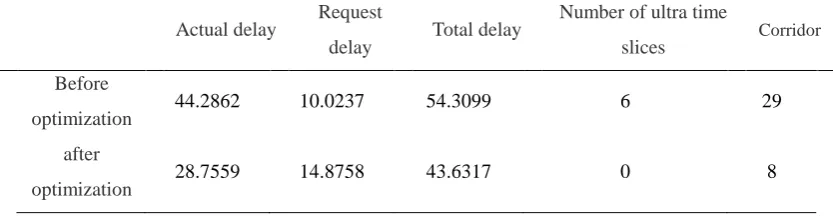
[image:5.595.72.523.85.323.2]Based on the historical operating data of Hangzhou Xiaoshan Airport from April to October and make the overall optimization and local optimization of the original flight schedule, using data of November to test and verify the optimization results. After testing, the flight request delay increases slightly, the actual average running delay is smaller and the overall delay is decreased. And the original flight schedule has 6 time slices beyond the capacity constraints; after optimization all time slice satisfy the capacity constraints. There are 29 time slices do not meet the corridor capacity constraints in the original flight schedule; after optimization the number reduced to 8. It is further proved that there is a causal relationship between the flow and capacity control and reducing the flight operation delay. When the flow is bigger than the capacity constraints, it is more likely coming traffic congestion and causing delays.
Table 3. Data comparison before and after optimization.
Actual delay Request
delay Total delay
Number of ultra time
slices Corridor Before
optimization 44.2862 10.0237 54.3099 6 29 after
optimization 28.7559 14.8758 43.6317 0 8
Conclusions
[image:5.595.89.506.597.705.2]passing station time as constraints, establish the flight schedule optimization model based on data driven, and solve the model by the Hungarian algorithm.
Acknowledgement
This research was financially supported National Natural Science Foundation of China (61403081), and the Natural Science Foundation of Jiangsu Province (BK20140638).
References
[1] Odoni A R, The flow management problem in air traffic control, Springer Verlag, Berlin, 1987.
[2] Andreatta G, Romanin-Jacur G, Aircraft flow management under congestion, J. Transportation Science. 21(1987) 249-253.
[3] Kolitz S E, Terrab M, Real-time adaptive aircraft scheduling, J. NASA Technical Reports. (1990)43-51.
[4] Vranas P B M, Bertsimas D, Odoni A R. Dynamic, ground-holding policies for a network of airports, J. Transportation Science. 28(1994) 275-291.
[5] Bertsimas D, Patterson S S, The air traffic flow management problem with en route capacities, J. Operations research. 46(1998)406-422.
[6] Ball M O, Hoffman R, Odoni A R, et al., A stochastic integer program with dual network structure and its application to the ground-holding problem, J. Operations Research. 51(2003) 167-171.
[7] Bertsimas D, Gupta S, A proposal for network air traffic flow management incorporating fairness and airline collaboration, J. Operations Research. (2011)32~45.
[8] Castelli L, Pesenti R, Ranieri A. The design of a market mechanism to allocate air traffic flow management slots, J. Transportation research part C: Emerging technologies. 19(2011)931-943.
[9] Barnhart C, Bertsimas D, Caramanis C, et al., Equitable and efficient coordination in traffic flow management, J. Transportation Science. 46(2012):262-280.
[10] Clarke J P B, Brooks J, McClain E, et al., Investigation, Modeling, and Analysis of Integrated Metroplex Arrival and Departure Coordination Concepts, J. NASA Technical Reports(2012)56-71.
[11] Samà M, D’Ariano A, D’Ariano P, et al., Optimal aircraft scheduling and routing at a terminal control area during disturbances, J. Transportation Research Part C: Emerging Technologies. 47(2014) 61-85.