Open Access
Research article
Mental health first aid for Indigenous Australians: using Delphi
consensus studies to develop guidelines for culturally appropriate
responses to mental health problems
Laura M Hart*
1, Anthony F Jorm
1, Leonard G Kanowski
1, Claire M Kelly
1and
Robyn L Langlands
2Address: 1Orygen Youth Health Research Centre, Centre for Youth Mental Health, University of Melbourne, Parkville, Victoria, Australia and 2School of Psychology, Victoria University of Wellington, Wellington, New Zealand
Email: Laura M Hart* - [email protected]; Anthony F Jorm - [email protected]; Leonard G Kanowski - [email protected]; Claire M Kelly - [email protected]; Robyn L Langlands - [email protected]
* Corresponding author
Abstract
Background: Ethnic minority groups are under-represented in mental health care services because of barriers such as poor mental health literacy. In 2007, the Mental Health First Aid (MHFA) program implemented a cultural adaptation of its first aid course to improve the capacity of Indigenous Australians to recognise and respond to mental health issues within their own communities. It became apparent that the content of this training would be improved by the development of best practice guidelines. This research aimed to develop culturally appropriate guidelines for providing first aid to an Australian Aboriginal or Torres Strait Islander person who is experiencing a mental health crisis or developing a mental illness.
Methods: A panel of Australian Aboriginal people who are experts in Aboriginal mental health, participated in six independent Delphi studies investigating depression, psychosis, suicidal thoughts and behaviours, deliberate self-injury, trauma and loss, and cultural considerations. The panel varied in size across the studies, from 20-24 participants. Panellists were presented with statements about possible first aid actions via online questionnaires and were encouraged to suggest additional actions not covered by the survey content. Statements were accepted for inclusion in a guideline if they were endorsed by ≥ 90% of panellists as essential or important. Each study developed one guideline from the outcomes of three Delphi questionnaire rounds. At the end of the six Delphi studies, participants were asked to give feedback on the value of the project and their participation experience.
Results: From a total of 1,016 statements shown to the panel of experts, 536 statements were endorsed (94 for depression, 151 for psychosis, 52 for suicidal thoughts and behaviours, 53 for deliberate self-injury, 155 for trauma and loss, and 31 for cultural considerations). The methodology and the guidelines themselves were found to be useful and appropriate by the panellists.
Conclusion: Aboriginal mental health experts were able to reach consensus about culturally appropriate first aid for mental illness. The Delphi consensus method could be useful more generally for consulting Indigenous peoples about culturally appropriate best practice in mental health services.
Published: 3 August 2009
BMC Psychiatry 2009, 9:47 doi:10.1186/1471-244X-9-47
Received: 31 March 2009 Accepted: 3 August 2009
This article is available from: http://www.biomedcentral.com/1471-244X/9/47 © 2009 Hart et al; licensee BioMed Central Ltd.
Background
Australia's first National Mental Health and Wellbeing Survey, carried out in 1997, found that mental illnesses were common, associated with a high level of disability, but often not treated [1]. There are many possible reasons for the low rate of health service use. These include practi-cal barriers such as financial cost, waiting lists and regional isolation. There are also other barriers such as an inability to recognise mental illness, or harbouring atti-tudes that are unfavourable to mental health care or to mental health professionals. In fact, lack of recognition and negative attitudes to treatment pose a significant bar-rier to service use, as research has shown that only one in three Australians are able to correctly label symptoms of a mental illness, and a majority do not consider interven-tions endorsed by health professionals, to be 'helpful' [2].
In 2001 the Mental Health First Aid program (MHFA) was established in response to the need for public education about mental illness and its treatment. MHFA offers a 12-hour course that applies a first aid action-plan model to mental illness [3]. Mental health first aid is defined as the help provided to a person developing a mental health problem or in a mental health crisis. First aid is given until appropriate professional treatment is received or the crisis resolves [4]. Through public education about helpful interventions for mental illness, this course aims to increase the public's mental health literacy and encourage the uptake of evidence-based treatment. Evaluations of the program have found that it is effective in increasing mental health literacy, changing beliefs about treatment to be more like those of health professionals, decreasing social distance from people with mental illness, increas-ing confidence in providincreas-ing help to someone with a men-tal illness, increasing the amount of help provided to others and improving the mental health of participants [5]. The MHFA program has now been independently adapted by organisations in Aotearoa/New Zealand, Can-ada, England, Finland, Hong Kong, Japan, Northern Ire-land, ScotIre-land, Singapore, ThaiIre-land, USA and Wales [4,6].
In order to improve the quality of the mental health first aid techniques being taught to the public, research has been carried out to develop guidelines on what constitutes best practice first aid. This involved using the Delphi method to develop expert consensus. Expert consensus studies have been used as a practical alternative to ran-domised or controlled trials, which are not considered feasible or ethical for evaluating specific first aid tech-niques [7]. To date, guidelines have been developed for providing first aid in a range of mental health related cri-ses, such as suicidal thoughts and behaviours [8], deliber-ate non-suicidal self-injury [9], and following traumatic events (Kelly, Jorm & Kitchener, in submission); as well as for a range of developing mental illnesses, such as
psycho-sis [10], depression [11], eating disorders [12] and prob-lem drinking (Kingston, Jorm, Lubman, Hart, Hides, Kelly, Kitchener & Morgan, in submission)
The importance of culture
Research investigating the impact of culture on mental health has found that it is profound, multidimensional and complex [13]. Investigations of mental health care use have shown that ethnic minority groups are under-represented in psychiatric services, both within Australia and across other nations with developed health systems [14,15]. This trend occurs despite the prevalence of men-tal disorders in minority groups being either equal to, or greater than, those of the majority group. Research has also shown that the under-representation of minority groups in mental health care is not simply explained by inequalities in socioeconomic status across groups [15]. In fact, for cultural minorities other barriers, such as poor mental health literacy and culturally insensitive health services, play a much greater role in impeding use of serv-ices [16,17]. In recent years, many countries including the USA, Australia and Aotearoa/New Zealand have recog-nised the important role that culture plays in the identifi-cation, treatment and prevention of mental illness, and in response, have implemented standards of cultural compe-tency in service delivery and specialised cultural adapta-tions of health education programs [18,19].
Indigenous Australians
In Australia, the diverse groups of Aboriginal and Torres Strait Islander peoples, who constitute 2.3% of the popu-lation [20] exemplify the trend of poor mental health service use in the context of mental illness prevalence that is either equal to, or greater than, that of non-Indigenous Australians. Although prevalence estimates for mental ill-nesses in the Indigenous population are not well researched or documented (the two National Health and Wellbeing Surveys both elected not to collect specific information on the prevalence of mental disorders within the Australian Indigenous population [1,21]) there are some indirect measures which suggest that the mental health of Indigenous Australians is poor, recognition of mental illness within Aboriginal communities is low, and the prevalence of common mental illnesses such as depression and anxiety is high [22-30]. A recent health survey of Indigenous Australians reported that Aboriginal and Torres Strait Islander peoples are twice as likely as non-Indigenous Australians to report high or very high levels of psychological distress [31]. Furthermore, rates of suicide for the Indigenous population in Australia are esti-mated to be up to six times higher than rates for the non-Indigenous population [32].
implemented in Aboriginal communities (e.g. Advanced Suicide Intervention Skills Training [33]), none have used an integrated approach to mental illnesses and associated crisis situations in a way that encourages early interven-tion and increased mental health literacy. The success of the MHFA course in increasing help-seeking behaviours, and the desperate need to provide Indigenous Australians with culturally appropriate training and education for improving mental health [34], led the Office of Aboriginal and Torres Strait Islander Health, a branch of the Austral-ian Federal Government's Department of Health and Age-ing, to fund the development of a cultural adaptation of the MHFA training program, specifically for Aboriginal and Torres Strait Islander Australians [35]. In 2007, an Aboriginal and Torres Strait Islander Mental Health First Aid training program (AMHFA) began teaching Australian Indigenous people a culturally adapted 14-hour course within Indigenous communities. The AMHFA course dif-fers from the general MHFA course in recognising the his-torical, cultural and political forces that have affected Aboriginal mental health [35]. For instance, the course discusses how Australian Aboriginal people have endured centuries of racism, dispossession, violence, trauma and loss. The forced removal of communities from their land, the systematic denial of culture and language, the suppres-sion of political and human rights, and the forced removal of children, have all contributed to an environ-ment of poor environ-mental health compounded by ongoing social and economic disadvantage [34]. In addition, the program acknowledges that Aboriginal people under-stand mental health within a unique cultural framework that is not necessarily complementary to the biopsychoso-cial model of western medicine [28,34]. Furthermore, it recognises that this cultural divergence can at times com-plicate the use of mental health services because Aborigi-nal people are either unable to find services that provide culturally sensitive treatment approaches, or fear access-ing mental health services because historically these serv-ices have failed to provide care which incorporates and respects an individual's cultural world-view [28].
The need for culturally specific mental health first aid guidelines
Although the existing Aboriginal Mental Health First Aid training program was developed through extensive con-sultation with Aboriginal people, it became apparent that the content of training would be improved by the devel-opment of best practice guidelines. In parallel to those developed for English-speaking [8-11] and Asian [6] countries, this research aimed to develop culturally appro-priate guidelines for providing first aid to an Australian Aboriginal or Torres Strait Islander person who is experi-encing a mental health crisis or developing a mental ill-ness. By engaging Indigenous experts who work in the
field of mental health, the research focused on the impor-tance of culture and Indigenous experiences of mental ill-ness.
Methods
The Delphi Method
Originally developed for technological forecasting, the Delphi technique has been used extensively within the last decade in health and social research, to enhance deci-sion-making processes [7]. The Delphi method provides expert consensus on what constitutes best practice in sce-narios that cannot be feasibly or ethically subject to a ran-domised controlled trial. The process involves questionnaires being sent out to a group of experts, who do not have to attend group meetings and can respond anonymously. Traditionally, the Delphi method has involved a number of iterations before consensus is achieved. Feedback is given at each stage in order to help experts assess their opinions against those of the group.
Development of these guidelines using the Delphi method involved four steps: (1) formation of the expert panel, (2) questionnaire development, (3) data collection and analysis, and (4) guidelines development. Five inde-pendent Delphi studies were conducted in order to pro-duce mental health first aid guidelines on the following mental illnesses and crises:
▪ Depression
▪ Psychosis
▪ Suicidal Thoughts and Behaviours
▪ Deliberate Self-injury
▪ Trauma and Loss
A sixth guideline about the importance of understanding and respecting Aboriginal culture while providing mental health first aid, entitled Cultural Considerations and Communication Techniques (hereafter referred to as Cul-tural Considerations) was also developed to accompany the series.
1. Panel formation
for their mental health problems. Potential candidates were considered to have sufficient expertise if they had authored materials on Aboriginal mental health (for instance teaching notes, journal articles, books or infor-mation leaflets), had attended and presented at meetings, conferences or training in Aboriginal mental health, or were known as respected professionals through networks with MHFA staff. Potential candidates were invited to par-ticipate via a face-to-face meeting, telephone call or email, and were sent a Participant Information Sheet prior to participation. Informed consent was implied by respond-ing to online questionnaires. This research was granted human research ethics committee approval by the Univer-sity of Melbourne. Participants were paid A$75 for each survey round completed.
2. Questionnaire development
A systematic search was carried out on websites, online forums, information brochures, leaflets or hand-outs from service providers or information centres, medical journals and online databases for any written information about how to assist an Aboriginal person developing a mental disorder or experiencing a mental health crisis. There were three major sources of information. The first was a web-based search, which involved entering a priori
key terms into an online search engine http:// www.google.com.au and following the links to the first 50 sites listed. Additional File 1 displays a full list of search terms. Any links appearing on these websites, which the authors thought may contain useful information, were followed. The second was an academic journal database search (including Medline and PsycInfo), which pre-sented relevant clinical research and literature reviews per-taining to the topic of interest (e.g [36,37]). The third was the National Libraries Australia database, which was used to identify key print texts located within Australian librar-ies (e.g. [38]). Recommendations from relevant mental health web sites (such as Australian Indigenous HealthIn-foNet) were also searched.
Development of the first round questionnaires involved dividing the recommendations gleaned from the system-atic search into sections based on common themes and developing statements that described first aid actions. For example, in the fact sheet called "Aboriginal Suicide Pre-vention Information", it states that "Expressing thoughts about death through drawings, stories or songs" may be a warning sign that the person is thinking about suicide. This sentence was included in the Round 1 Delphi survey on Suicide as the first aider action statement: The first aider should be aware that expressions of thoughts about death through drawings, stories or songs, can be a warning sign that the person is thinking about suicide.
In addition to these new items, statements that were sented to non-Aboriginal mental health experts in the pre-viously conducted international Delphi studies were also incorporated into the questionnaires. The development of these non-Indigenous studies is described in detail else-where [8-11], so will not be elaborated on here, except to say that the recommendations for the general population were presented to the Aboriginal expert panel for consid-eration to ensure that any gaps in the Aboriginal-specific literature where still considered by the panel. This process was not followed for the Cultural Considerations guide-lines as there was no precedent questionnaire.
The process of drafting statements and incorporating pre-vious questionnaires involved a working group consisting of the authors, experts in the Delphi method and experts in Aboriginal mental health. When drafting first aid action statements from the literature, the working group attempted to remain as faithful as possible to the original wording of the information. Statements were only modi-fied to ensure consistency of format, or where there was concern about the comprehensibility or cultural insensi-tivity of the information. Several draft questionnaires were produced before the group agreed on the statements which formed the final questionnaire for the first round. In total, three rounds of questionnaires were developed for each of six different topics (a total of 18 question-naires).
3. Data collection and analysis
Once panel members had been recruited, they were sent an electronic link to an online questionnaire, hosted by http://SurveyMonkey.com. Participants who were unable to complete the survey online were sent paper copies via mail. Allowing participants to choose between the two methods of delivery ensured that experts who had limited access to the internet were still able to participate in this research. Participants responded by rating how important the first aid action statements were to the development of a set of guidelines on providing culturally appropriate mental health first aid to an Aboriginal person. The ques-tionnaire involved a five point scale including the follow-ing options:Essential, Important, Don't know/depends, Unimportant and Should not be included. In Round 1, panel members were also invited to make comments on any ambiguity or wording of the statements presented, and to suggest any new ones that had not yet been considered.
Once all participants had lodged their ratings, statements were placed into one of three categories.
• If between 80-89% of panel members rated a state-ment as either Essential or Important, then the state-ment was entered into a second questionnaire to be re-rated.
• If neither of the above conditions were met, then the statement was excluded from the guidelines.
The protocol of using the Essential and Important ratings for categorisation was designed to allow selection of only those statements that were clear and broadly applicable for inclusion in the guidelines. Statements that were either unimportant to the provision of first aid, or dependent upon a situation or individual circumstance, were excluded because they did not constitute general princi-ples that could instruct members of the public in how to provide first aid to an Aboriginal person.
Comments that were submitted by panel members were also analysed for any content that had not yet been addressed. To ensure comprehensibility and consistency, any additional ideas gleaned from these comments were written into first aid action statements and presented to the working group. Any statement that was judged by the group to be an original idea was included as a new state-ment in the second round questionnaire.
Once categorisation was complete, panel members were sent a report, which outlined the results of the question-naire. The report consisted of a list of statements that had been endorsed, a list of statements that had been rejected, and a list of statements that were to be re-rated in the next questionnaire round. The statements to be re-rated were displayed with the group percentages for each possible rating, and also with the panel member's individual rat-ing, so that panel members could compare their response to that of the group. Presentation of the report in this way allowed the panel members to decide whether to main-tain or modify their ratings in the second round question-naire.
The same criteria for endorsing, excluding and re-rating statements were applied to the data collected in Round 2, with one exception. If a statement was re-rated in the sec-ond round and again failed to achieve a consensus of between 90 and 100 percent across the panel, it was then excluded. Only those statements that had been entered as new statements in Round 2, and afterward fell into the Re-rate category, were entered into a third round question-naire. Figure 1 outlines how the Delphi method pro-ceeded through three rounds of consultation with expert panel members in order to achieve consensus.
4. Guidelines development
All statements endorsed as either Essential or Important by
≥ 90% of panel members were written into a guideline
document. One author (LMH) drafted the guidelines by writing the list of endorsed statements into sections of prose based on common themes. Where possible, state-ments were combined and repetition deleted to reduce length. The draft was then presented to the working group, who edited the document to create a set of guide-lines that were written in plain English and were easy to follow. A number of drafting iterations were completed before the group agreed upon a final document, a copy of which was sent to each panel member for review. Upon final endorsement by the expert panel, each guideline was printed in hard-copy A4 format for free distribution to interested panel members, Aboriginal Mental Health First Aid instructors, members of the public and attendees at health forums and conferences. The guidelines are also available for free download from the MHFA website: http://www.mhfa.com.au/Guidelines.shtml
Feedback from panel members
To the authors' knowledge, this research is only the sec-ond time the Delphi method has been used to develop expert consensus among Aboriginal people in Australia [39]. To assess the panel members' satisfaction with the research method, participants were invited to complete an online feedback survey at the end of the six Delphi stud-ies. Respondents were encouraged to comment on the appropriateness of the contact methods, research meth-ods, language and concepts used throughout the studies. They were also asked how culturally appropriate and use-ful they thought the developed guidelines would be to Aboriginal people in the future.
The feedback survey contained 48 statements that described the research experience (e.g. I thought the use of email and internet was a good medium for data collection). Participants were asked to respond by selecting where their opinion fell on a 5-point scale of agreement; Strongly Agree, Agree, Neither Agree nor Disagree, Disagree, and
Strongly Disagree.
Results
Expert panel members
31 panel members were recruited and a total of 28 partic-ipants (15 female, 13 male, age range = 31 to 61 years) completed at least three questionnaires. Table 1 outlines how many panel members responded to each round of each topic. There was a high retention rate both across rounds of questionnaires and across topics. The majority of panel members responded to more than 9 rounds; 18 participants (64.3%) completed 10-18 questionnaires.
without representation on the panel. Having a geographi-cal spread of panel members was thought to be important for the representation of different experiences and atti-tudes of Aboriginal communities across Australia. It is therefore important to note that no participants identified as Torres Strait Islander. According to the 2006 Australian Census, 90% of the Australians who identified as Indige-nous were of Aboriginal origin only, 6% were of Torres Strait Islander origin only and 4% were of both Aboriginal and Torres Strait Islander origin [20]. Given that Torres Strait Islander people constitute such a small percentage of the Indigenous population, it is not surprising we found it difficult to recruit a representative from this com-munity.
Participants were employed in a range of different services across the mental health field, including: private psychol-ogy clinics, Aboriginal medical services, government health services, universities, cultural resource and coun-seling services, prisons, social services, and drug and alco-hol services.
The panel was very experienced, with more than half hav-ing between 6-10 years experience in the mental health field (5 years or less = 12.5%, 6-10 years = 62.5%, 11-15 years = 12.5%, 16-20 years = 12.5%). In addition, approx-imately one quarter of panel members had obtained a post-graduate degree (Certificate level = 11.6%, Diploma = 11.76%, Bachelor Degree = 47.06%, Bachelor degree with honours = 5.88% Graduate Diploma = 5.88%, Mas-ters degree 17.65%, PhD = 0.00%).
Endorsed statements
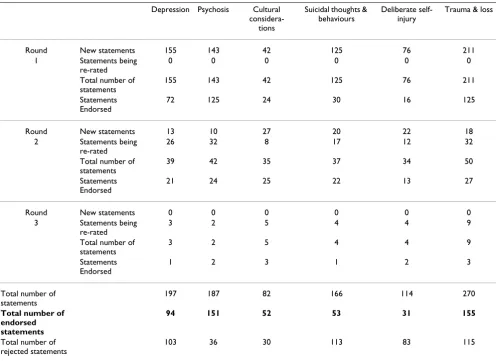
Of the 1,016 statements that were presented to panel members across the 6 Delphi studies, 536 were endorsed as either Essential or Important to the development of guidelines on providing mental health first aid to an Abo-riginal person. A list of all endorsed statements can be found in Additional File 2, Tables S1-S6. The number of statements presented in each first round questionnaire differed markedly across topics and was largely deter-mined by the amount of accessible literature on the area. There is, for instance, a large and culturally relevant liter-ature on the issue of suicidal thoughts and behaviours, however, there is a notable dearth of culturally relevant information on issues such as depression and deliberate self-injury. The largest questionnaires were those on trauma and loss, and psychosis. Table 2 lists the number of statements presented in each Delphi study.
Rejected statements
Some statements were strongly rejected by the panel, with a majority of participants rating a statement as either
Unimportant or Should not be included (see Additional File 2, Table S7, for a list of strongly rejected statements). Across the 6 Delphi studies 36 items were rejected with strong consensus (50% or more of panel members rated an item as either Unimportant or Should not be included). The majority of strongly rejected items came from the sui-cide and deliberate self-injury surveys, while the psycho-sis, cultural considerations and trauma and loss surveys received no strong rejections.
Other statements were rejected because there was disa-greement within the panel. For instance, some statements failed to be endorsed because, even after a second rating, the statement just failed to achieve 90% consensus.
Panel member feedback
Eighteen of a possible 24 participants responded to the feedback survey. The percentage of panel members
The Delphi Method
Figure 1
The Delphi Method. Figure 1 outlines how the Delphi method proceeded through three rounds of consultation with expert panel members in order to achieve consensus. If between 90-100% of panel members rated a statement as either Essential or Important, the statement was endorsed as a guideline. If between 80-89% of panel members rated a state-ment as either Essential or Important, the statement was then entered into a second round questionnaire to be rated again. To perform this next round of re-rating, participants were given a report outlining the results of the previous round, which showed their own individual ratings as well as the pooled ratings of the group. If the statement failed to meet the 90% endorsement level in the second re-rating round, it was then rejected. If a statement received a rating of 79% or less, it was rejected outright. Participants provided feedback in Round 1 which contributed to the edition of new items in Round 2. Only those items that fell into the re-rate category at the end of Round 2 were entered into a third a final round.
(QGRUVHG LWHPV
,WHPVWREH UHUDWHG
&RPPHQWV ([FOXGHG LWHPV
,WHPVWREH UHUDWHG (QGRUVHG
LWHPV
([FOXGHG LWHPV (QGRUVHG
LWHPV
([FOXGHG LWHPV 5RXQG4XHVWLRQQDLUH 5RXQG4XHVWLRQQDLUH 5RXQG4XHVWLRQQDLUH 5RXQG4XHVWLRQQDLUH
5RXQG4XHVWLRQQDLUH 5RXQG4XHVWLRQQDLUH 5RXQG4XHVWLRQQDLUH 5RXQG4XHVWLRQQDLUH
5RXQG4XHVWLRQQDLUH 5RXQG4XHVWLRQQDLUH 5RXQG4XHVWLRQQDLUH 5RXQG4XHVWLRQQDLUH
*XLGHOLQH *XLGHOLQH*XLGHOLQH
responding in each category are shown in Table 3. Of par-ticular interest were the responses to statements that were designed to assess the cultural appropriateness, the utility and perceived quality of the guidelines produced. For instance, in response to the statement I would recommend the guidelines to other people, all participants responded with either Strongly Agree or Agree. In addition, 88.9% of the panel responded with either Strongly Agree or Agree in response to both statements I thought the guidelines were culturally appropriate and I believe the guidelines will benefit Aboriginal people. While these results are promising, they are not unexpected, given that the panel members were involved in the development of the guidelines. The results would be well supported by further evaluation of the util-ity of the guidelines in Indigenous communities.
Statements regarding the appropriateness of the Delphi research method also received a high level of agreement, with 83.3% of participants responding with either Strongly Agree or Agree to the statements I believe the Delphi process can be of benefit to Aboriginal people and I would recommend the Delphi method for other research projects for Aboriginal people.
Discussion
By engaging Aboriginal people who are experts in the field of mental health, this research aimed to develop culturally appropriate guidelines for providing mental health first aid to an Australian Aboriginal or Torres Strait Islander person. Despite diverse backgrounds, the expert panel was able to reach consensus on a range of first aid techniques, from offering a cup of tea or coffee to a person who has experienced trauma, through to talking about the sensi-tive issue of suicide.
Across the different Delphi topics, statements were rejected and endorsed at different rates. For instance, the psychosis study proposed a total of 187 first aider action statements, of which 81% were endorsed and 19% were rejected. In contrast, the deliberate self-injury study pro-posed a total of 114 statements, of which 27% were endorsed and 73% were rejected. While it might be expected that the Delphi studies containing the most cul-tural information may have had the highest rates of endorsement (e.g. trauma and loss or cultural considera-tions), in fact the pattern of endorsement mirrored that of
other international Delphi studies, which have found dif-ferences in the strength of established expert consensus [8-11]. That is, because of wide-ranging and effective research into first episode psychosis, there is a strong con-sensus on how emerging psychosis should be managed. Conversely, due to a dearth in controlled trials and treat-ment studies, there is little expert consensus on how delib-erate self-injury should be treated in a clinical context, let alone managed in the community.
Although each Delphi study addressed a different mental health issue, there were two themes that appeared in each survey and subsequent guidelines. The first theme was about how the person providing first aid needed to under-stand and assess symptoms of mental illness within the cultural context of the person they were helping. The sec-ond was the essential role that family and community play in promoting and protecting the health and wellbe-ing of individuals with mental health problems.
Understanding symptoms of mental illness within a cultural context
A particular concern of culturally appropriate mental health first aid is to check, or to understand, the cultural norms of the community, before assuming that an Indig-enous person is displaying symptoms of mental illness. All of the Delphi study surveys included statements about symptom recognition in the context of culture. For instance, the depression study included the statement The first aider should take into consideration the spiritual and/or cultural context of the person's behaviours. The psychosis study included the statement The first aider should be aware of what constitutes culturally appropriate behaviours so that they don't misinterpret such behaviours as symptoms of psycho-sis (e.g. in some communities, limited eye contact is expected behaviour). The suicidal thoughts and behaviours study included the statement The first aider should learn about the behaviours that are considered warning signs for suicide in the person's community. And the deliberate self-injury study included the statement The first aider should be aware that pathological self-injury, such as cutting and burning, is funda-mentally different to ritualistic, culturally accepted Aboriginal ceremonial or grieving practice.
[image:7.612.57.557.101.171.2]Each of these statements were endorsed by panel mem-bers and incorporated into the guideline documents. That Table 1: Number of respondents for each round of each questionnaire topic
Depression Psychosis Cultural considerations
Suicidal thoughts & behaviours Deliberate self-injury Trauma & loss
Round 1 20 20 24 24 24 24
Round 2 18 18 20 20 20 21
Table 2: Number of statements presented, endorsed and rejected in each Delphi study
Depression Psychosis Cultural considera-tions
Suicidal thoughts & behaviours
Deliberate self-injury
Trauma & loss
Round New statements 155 143 42 125 76 211
1 Statements being re-rated
0 0 0 0 0 0
Total number of statements
155 143 42 125 76 211
Statements Endorsed
72 125 24 30 16 125
Round New statements 13 10 27 20 22 18
2 Statements being re-rated
26 32 8 17 12 32
Total number of statements
39 42 35 37 34 50
Statements Endorsed
21 24 25 22 13 27
Round New statements 0 0 0 0 0 0
3 Statements being re-rated
3 2 5 4 4 9
Total number of statements
3 2 5 4 4 9
Statements Endorsed
1 2 3 1 2 3
Total number of statements
197 187 82 166 114 270
Total number of endorsed statements
94 151 52 53 31 155
Total number of rejected statements
103 36 30 113 83 115
Table 3: Selected statements from the panel member feedback survey
Feedback statement Strongly Agree Agree Neither Agree nor Disagree Disagree Strongly Disagree
I thought the Guidelines were easy to follow. 44.4 44.4 5.6 0.0 0.0 I thought the Guidelines were too long. 0.0 5.6 22.2 61.1 11.1 I thought the guidelines used appropriate language. 22.2 55.6 22.2 0.0 0.0 I thought the language used in the guidelines was too
clinical.
0.0 5.6 27.8 55.6 11.1
I thought the guidelines covered the appropriate issues. 33.3 61.1 5.6 0.0 0.0 I thought the guidelines were culturally appropriate. 27.8 61.1 11.1 0.0 0.0 I believe the guidelines will benefit Aboriginal people. 55.6 33.3 5.6 0.0 0.0 I would recommend the guidelines to other people. 55.6 44.4 0.0 0.0 0.0 I thought the time commitment was appropriate. 16.7 66.7 0.0 16.7 0.0 I thought the remuneration was appropriate. 27.8 61.1 11.1 0.0 0.0 I thought participating in this research was worthwhile. 83.3 16.7 0.0 0.0 0.0 I enjoyed participating in the Delphi research. 61.1 33.3 5.6 0.0 0.0 I believe the Delphi process can be of benefit to Aboriginal
people.
44.4 38.9 11.1 5.6 0.0
I would recommend the Delphi method for other research projects for Aboriginal people.
[image:8.612.65.556.503.705.2]each of the developed guidelines contain information about the need for the person providing first aid to be mindful of cultural norms, before assuming that someone is experiencing a mental health problem, suggests that this is a cornerstone of culturally appropriate first aid. Impor-tantly, from the feedback provided by panel members during the Delphi studies, this principle was not only seen as important for non-Indigenous people providing first aid to Indigenous people, it was also seen as crucial for any Indigenous person who was assisting outside their own community.
While panel members endorsed this idea of culturally appropriate first aid, they did so with a caveat. Panel members comments suggested that individuals providing first aid need not get so immersed in the need for cultural awareness that they lose sight of the physical and emo-tional needs of the person they are assisting; as one panel member's comments suggest: "Whilst having attested to the importance of these cultural awareness items, they sum to a maxim that it's crucial to take time to become familiar with local beliefs and norms, [yet] it is actually counter-productive to think one has to be an anthropologist across the minutiae of all Australian Indigenous cultures...". This idea was also especially apparent in the study on trauma and loss. In the Round 1 and 2 surveys, panel members were presented statements about seeking culturally appropriate profes-sional help. Allowing an Aboriginal person to seek out a professional who is trained or experienced in treating Aboriginal people and their experiences of trauma, was seen as particularly important in facilitating recovery. As the Delphi progressed, however, it became apparent that any rigid statements about the need for culturally appro-priate professional help were not going to be endorsed, because they alone precluded the right of the person receiving care to seek help that is close to their home and community, and which suits their individual needs. The Trauma and Loss guidelines therefore not only include the statement Suggest that the person see a professional who is trained or has experience in working with Aboriginal people and their experiences of trauma and loss, it also contains the additional caveats: It is important to note that counselling suitable for Aboriginal people may be quite difficult to find or gain access to, as there is a shortage of appropriately trained Aboriginal psychologists and counsellors. If this is the case, you can engage other options; and Most importantly, encourage the person to find someone who will help them tell their story and who the person can trust and feel comfortable talking to. So while this research supports the importance of providing culturally appropriate first aid, it also asserts that when assisting an Indigenous person with a mental health prob-lem, it is equally important to meet their individual needs, regardless of their cultural identity.
The role of family and community
The statements endorsed by the panel and the feedback comments submitted in the first round of each study revealed that, to provide culturally appropriate first aid, the person assisting should facilitate additional support for the person in their care, by encouraging positive rela-tionships with family and community members, while upholding the person's right to confidentiality. For exam-ple, the Psychosis guideline contains the statement
Encourage the person to take a support person, such as a family member, to their appointment. If you wish to help the person contact their family, be aware that you must ask the person if its okay for you to talk to family. The Cultural Considerations guideline contains the statement Try to get the person's fam-ily involved in supporting them until they get better, but in doing so, you must uphold the person's right to confidentiality. The Trauma and Loss guideline contains the statement
Whether or not the person seeks professional help, you should encourage them to identify sources of support. These may include community members, support groups and men's or women's groups.
While facilitating support for a person experiencing a mental health problem is recommended as a first aid action in the guidelines produced by previous Delphi studies for English-speaking countries (for instance see
Depression: First Aid Guidelines) [31], the focus of previous guidelines has been on developing a supportive relation-ship between the person providing the first aid and the person receiving care. The Delphi studies conducted in this research, reveal that it is important to establish an additional support person, who can act as a mentor or carer.
This additional first aid strategy appears to have arisen for a number of important reasons. For example, many Abo-riginal people live in regional or remote communities with limited access to mental health care. Establishing a positive and trusting relationship with another person is a way to establish additional psychological support that may otherwise be unavailable. This is demonstrated by the Cultural Considerations guidelines, which state: Estab-lishing a network of support for an Aboriginal person is a very important step in helping them resolve their mental health cri-sis, especially if access to professional support or mental health services is limited. Another reason for including the facilita-tion of addifacilita-tional support is to protect against further psy-chological distress by enhancing the person's social and emotional wellbeing. This is exemplified in the statement:
Acceptance of research outcomes and plans for dissemination
The feedback from panel members demonstrated that support for the Delphi method and the guidelines it pro-duced was very strong (see Additional File 2 Table S4). However, for the developed guidelines to be successful, they need to have a direct impact on the Indigenous com-munities within Australia. The culturally specific 14-hour course developed by the Aboriginal Mental Health First Aid program is one avenue to achieve this impact.
Since its inception in 2007, the AMHFA course has been presented to over 1,936 Australians. When the teaching materials are revised to reflect the consensus on first aid techniques developed by these Delphi studies, the infor-mation in these guidelines will reach a significant number of Indigenous Australians. Furthermore, the detailed material presented in the guidelines will be organised under the MHFA ALGEE action plan [40] and will have associated teaching activities such as role plays and DVD clips. A pictorial flip-chart is also planned. The dissemina-tion of the guideline informadissemina-tion in this way reduces the need for English literacy and thus makes the first aid infor-mation more accessible to Indigenous people who may only use English as a second (third or fourth) language.
In addition to the AMHFA course, the beyondblue: the national depression initiative has developed a national dis-semination program whereby copies of the guidelines will be sent free of charge to health, education and community resource centres across Australia, who engage Indigenous clients. Furthermore, the guidelines will be made availa-ble to order free from beyondblue. Given that a number of important stake-holders in Aboriginal mental health were involved in the guideline research as expert panel mem-bers, and that the feedback survey demonstrated these stake-holders approve of the research outcome and are willing to recommend the guidelines to others, the authors believe the national dissemination project will be successful in presenting the guidelines to a large number of people who care for Indigenous Australians with men-tal health problems.
One limitation of the current research is the lack of perti-nent information for members of the community who wish to provide mental health first aid to young Indige-nous Australians. Given that, in 2001, 39% of IndigeIndige-nous people were under 15 years of age, compared with 20% of non-Indigenous people, providing first aid resources for young Aboriginal and Torres Strait Islander Australians is an important task for AMHFA. It was however, a consid-ered decision of the research team to develop guidelines focused on adults. Now that the validity and acceptability of the research method and outcomes have been estab-lished, it is hoped that future Delphi studies will be able
to develop best practice guidelines for providing assist-ance to young Indigenous people developing a mental ill-ness or experiencing a mental health crisis.
Despite provisional support from the experts involved in the guideline production, and a highly structured dissem-ination plan, only further evaluation of first aid outcome will elucidate whether or not the information developed by this research is effective in decreasing the barriers to mental health care faced by many ethnic minority groups in Australia, such as poor mental health literacy, and ulti-mately increasing the use of health services by Indigenous people.
Conclusion
Aboriginal mental health experts were able to reach con-sensus about what are appropriate first aid actions for a range of mental illnesses and mental health crisis situa-tions. The Delphi research method was able to develop a resource, which describes for the first time, what consti-tutes culturally appropriate best practice first aid for Abo-riginal and Torres Strait islander people with mental health problems. Through a range of dissemination pro-grams, the information in the guidelines will be made available to Indigenous and non-Indigenous people throughout Australia.
According to the outcomes of this research, to provide cul-turally appropriate first aid to an Australian Aboriginal or Torres Strait Islander person, individuals must be aware of relevant cultural factors in mental illness, such as cultural behaviours that may mimic symptoms of mental illness, the important role of family and community, and the need to facilitate supporting relationships. These findings are consistent with the broader literature on culturally appropriate care [17,18].
This research also demonstrates that the Delphi consensus method is a framework that can be used to guide the improvement of mental health services for Indigenous people, as it allows participants to engage in a culturally appropriate way, and produces resources that can of ben-efit to their community.
Competing interests
Authors' contributions
LMH carried out the systematic literature search, was involved in panel member recruitment, drafted the sur-veys, carried out the data collection and analysis, chaired the working group which discussed and modified the sur-vey and guideline drafts, drafted the guidelines, and drafted the manuscript. AFJ participated in the conception and design of the Delphi research protocol, was co-ordi-nator of the research, participated in the working group and helped with the drafting of the manuscript. LGK was involved in design and co-ordination of the study, partic-ipated in panel member recruitment and particpartic-ipated in the working group. CMK was involved in design and co-ordination of the study, participated in panel member recruitment and participated in the working group. RLL participated in the systematic literature search, panel member recruitment, drafting the surveys, and data collec-tion and analysis. All authors read and approved the final manuscript.
Additional material
Acknowledgements
The authors would like to thank the following people who contributed to this research Amy Morgan, Anna Kingston, Betty Kitchener, Joanna Parker, Carol (Kara) Eddington, Kathryn Junor and Tom Brideson. The authors would also like the panel members whose dedication to this research has been outstanding. We hope this research has done justice to your passion and commitment to the Aboriginal and Torres Strait Islander people of Australia.
The research was funded by the beyondblue Victorian Centre of Excellence in Depression and Related Disorders (bbVCoE). This funding body was not involved in the study design, data collection, analysis or interpretation. bbV-CoE also funded the publication of the guideline documents.
References
1. Henderson S, Andrews G, Hall W: Australia's mental health: an overview of the general population survey. Australian and New Zealand Journal of Psychiatry 2000, 34(2):197-205.
2. Jorm AF, Korten AE, Jacomb PA, Rodgers B, Pollitt P: Beliefs about the helpfulness of interventions for mental disorders: a com-parison of general practitioners, psychiatrists and clinical
psychologists. Australian and New Zealand Journal of Psychiatry 1997,
31(6):844-851.
3. Jorm AF, Korten AE, Jacomb PA, Christensen H, Rodgers B, Pollitt P:
"Mental health literacy": A survey of the public's ability to recognise mental disorders and their beliefs about the effec-tiveness of treatment. Medical Journal of Australia 1997,
166(4):182-186.
4. Kitchener BA, Jorm AF: Mental Health First Aid: an interna-tional programme for early intervention. Early Intervention in Psychiatry 2008, 2(1):55-61.
5. Kitchener BA, Jorm AF: Mental health first aid training: review of evaluation studies. Australian and New Zealand Journal of Psychi-atry 2006, 40(1):6-8.
6. Jorm AF, Minas HI, Langlands RL, Kelly CM: First aid guidelines for psychosis in Asian countries: A Delphi consensus study. Inter-national Journal of Mental Health Systems 2008, 2(1):2.
7. Hasson F, Keeney S, McKenna H: Research guidelines for the Delphi survey technique. Journal of Advanced Nursing 2000,
32(4):1008-1015.
8. Kelly CM, Jorm AF, Kitchener BA, Langlands RL: Development of mental health first aid guidelines for suicidal ideation and behaviour: A Delphi study. BMC Psychiatry 2008, 8(1):1-10. 9. Kelly CM, Jorm AF, Kitchener BA, Langlands RL: Development of
mental health first aid guidelines for deliberate non-suicidal self-injury: A Delphi study. BMC Psychiatry 2008, 8(1):1-10. 10. Langlands RL, Jorm AF, Kelly CM, Kitchener BA: First aid
recom-mendations for psychosis: Using the delphi method to gain consensus between mental health consumers, carers, and clinicians. Schizophrenia Bulletin 2008, 34(3):435-443.
11. Langlands RL, Jorm AF, Kelly CM, Kitchener BA: First aid for depression: A Delphi consensus study with consumers, car-ers and clinicians. Journal of Affective Disorders 2008,
105(13):157-165.
12. Hart LM, Jorm AF, Paxton SJ, Kelly CM, Kitchener BA: First aid for eating disorders: development of best-practice mental health first aid guidelines using the Delphi consensus method. Eating Disorders: the journal of treatment and prevention 2009 in press.
13. Bowers L: The social nature of mental illness London; New York: Routledge; 1998.
14. Klimidis S, McKenzie DP, Lewis J, Minas IH: Continuity of contact with psychiatric services: immigrant and Australian-born patients. Social Psychiatry and Psychiatric Epidemiology 2000,
35(12):554-563.
15. Dobalian A, Rivers PA: Racial and ethnic disparities in the use of mental health services. Journal of Behavioral Health Services & Research 2008, 35(2):128-141.
16. Andrulis DP, Brach C: Integrating literacy, culture, and lan-guage to improve health care quality for diverse populations. American Journal of Health Behavior 2007, 31:S122-S133.
17. Ayonrinde O: Importance of cultural sensitivity in therapeutic transactions Considerations for healthcare providers. Dis-ease Management & Health Outcomes 2003, 11(4):233-248. 18. Johnstone M-J, Kanitsaki O: An Exploration of the Notion and
Nature of the Construct of Cultural Safety and Its Applica-bility to the Australian Health Care Context. J Transcult Nurs
2007, 18(3):247-256.
19. Whaley AL, Longoria RA: Assessing cultural competence readi-ness in community mental health centers: A multidimen-sional scaling analysis. Psychological Services 2008, 5(2):169-183. 20. Australian Bureau of Statistics, Australian Institute of Health and
Wel-fare: 4713.0: Population Characteristics, Aboriginal and Torres Strait Islander Australians. Edited by: Trewin D. Can-berra: ABS/AIHW; 2006.
21. Australian Bureau of Statistics: 4326.0 National Survey of Mental Health and Wellbeing: Summary of Results, 2007. Canberra; ABS; 2008.
22. Australian Bureau of Statistics, Australian Institute of Health and Wel-fare: 4704.0: The Health and Welfare of Australia's Aborigi-nal and Torres Strait Islander Peoples. Edited by: Trewin D. Canberra: ABS/AIHW; 2005:318.
23. Australian Bureau of Statistics: 4714.0: National Aboriginal and Torres Strait Islander Social Survey, 2002. Edited by: Linacre S. Canberra: ABS/AIHW; 2002:92.
24. Brown R: Australian Indigenous mental health. Australian and New Zealand Journal of Mental Health Nursing 2001, 10(1):33-41.
Additional file 1
Search terms. A list of the key search terms used in the systematic litera-ture search for all six Delphi studies.
Click here for file
[http://www.biomedcentral.com/content/supplementary/1471-244X-9-47-S1.pdf]
Additional file 2
Statement lists. A list of endorsed statements, and a list of strongly rejected statements, from all six Delphi studies shown in a series of tables.
Click here for file
Publish with BioMed Central and every scientist can read your work free of charge "BioMed Central will be the most significant development for disseminating the results of biomedical researc h in our lifetime."
Sir Paul Nurse, Cancer Research UK
Your research papers will be:
available free of charge to the entire biomedical community
peer reviewed and published immediately upon acceptance
cited in PubMed and archived on PubMed Central
yours — you keep the copyright
Submit your manuscript here:
http://www.biomedcentral.com/info/publishing_adv.asp
BioMedcentral
25. OATSIH, Office of Aboriginal and Torres Strait Islander Health: A National Strategic Framework for Aboriginal and Torres Strait Islander Peoples' Mental Health and Social and Emo-tional Well Being 20042009. Canberra; Commonwealth Govern-ment of Australia, DepartGovern-ment of Health and Ageing; 2004:79. 26. HREOC, Human Rights and Equal Opportunity Commission:
Bring-ing them home: Report of the National Inquiry into the Sep-aration of Aboriginal and Torres Strait Islander Children from Their Families. Canberra: Australian Human Rights Com-mission; 1997:524.
27. Dodson PL: Regional report into the underlying issues in Western Australia of the Royal Commission into Aboriginal deaths in custody. Volume 1. Canberra: Royal Commission into Aboriginal deaths in custody; 1991.
28. Vicary D, Westerman T: 'That's just the way he is': Some impli-cations of Aboriginal mental health beliefs. Australian e-Journal for the advancement of mental health 2004, 3(3):1-10.
29. Ypinazar VA, Margolis SA, Haswell-Elkins M, Tsey K: Indigenous Australians' understandings regarding mental health and disorders. Australian and New Zealand Journal of Psychiatry 2007,
41(6):467-478.
30. HREOC, Human Rights and Equal Opportunity Commission:
Human rights and mental illness: Report of the national inquiry into the human rights of people with mental illness. Volume Chapter 23. Edited by: Burdekin B. Canberra: Australian Human Rights Commission; Aboriginal and Torres Strait Islander people; 1993.
31. AIHW, Australian Institute of Health and Welfare: Measuring the social and emotional wellbeing of Aboriginal and Torres Strait Islander Peoples. In Cat no IHW 24 Edited by: Allbon, Penny DA. Canberra: AIHW; 2009:115.
32. Australian Bureau of Statistics: 3303.0 Causes of Death, Aus-tralia, 2007. Edited by: Harper P. Canberra: ABS; 2008:92. 33. Government NT: Northern Territory Strategic Framework
for Suicide Prevention: A framework for the prevention of suicide and self-harm in the Northern Territory 2003. Edited by: Aagaard. The Hon. Jane., Minister for Health and Community Services. Darwin; 2003.
34. Swan P, Raphael B: Ways Forward: National Aboriginal and Torres Strait Islander Mental Health Policy National Consul-tancy Report. Canberra: Commonwealth Government of Aus-tralia; 1995.
35. Kanowski LG, Jorm AF, Hart LM: A mental health first aid train-ing program for Australian Aboriginal and Torres Strait Islander peoples: description and initial evaluation. Interna-tional Journal of Mental Health Systems 2009, 3(10):1-9.
36. Ypinazar VA, Margolis SA, Haswell-Elkins M, Tsey K: Indigenous Australians' understandings regarding mental health and disorders. Australian & New Zealand Journal of Psychiatry 2007,
41(6):467-478.
37. Hunter E, Milroy H: Aboriginal and Torres Strait Islander Sui-cide in Context. Archives of Suicide Research 2006, 10(2):141-157. 38. Atkinson J: Trauma trails, recreating song lines: the transgenerational
effects of trauma in Indigenous Australia/Judy Atkinson North Melbourne:: Spinifex Press; 2002.
39. Watson J, Hodson K, Johnson R: Developing strategies to gather information about the maternity experiences of indigenous women in an acute care setting. Australian Journal of Rural Health
2002, 10(3):147-153.
40. Kitchener B, Jorm A: Mental health first aid training for the public: evaluation of effects on knowledge, attitudes and helping behavior. BMC Psychiatry 2002, 2(1):10.
Pre-publication history
The pre-publication history for this paper can be accessed here: