2017 2nd International Conference on Wireless Communication and Network Engineering (WCNE 2017) ISBN: 978-1-60595-531-5
The Multicast Function Design Based on Cortina System CS8022
Guang-jun CHEN
School of Computer Engineering, Weifang University, Weifang, China, 261061
Keywords: CS8022 chip, IGMP Proxy processing unit, IGMP packets.
Abstract. In this paper, the Ethernet multicast management protocol agent (IGMP Proxy) processing unit is designed, which is composed of ARMCPU and CS8022 chips. The packets through the up-link or the down-link are firstly received by CS8022 network node interfaces or service node interfaces, then through the CS8022 port analysis, the IGMP message would be sent to the IGMP Proxy Program of ARMCPU to handle. The IGMP Proxy program is composed of the main module, the host module and the routing module. After the processing of the main module, the host module and the routing module, the amount of the IGMP message between the multicast router and the user computer can be greatly reduced, and speed up the response speed of the multicast router query message; When the multicast stream reaches the multicast router, the time for receiving the multicast stream from the user computer is shortened and the network bandwidth is saved.
Introduction
In recent years, with the rapid development of the Internet, a lot of high bandwidth video applications gradually step into people's lives. Such as network television, video conferencing, video on demand, the stock market quotations, distance education, telemedicine and so on. These applications cause problems such as rapid bandwidth consumption and network congestion. It has a large amount of data, high latency requirements, long duration, high quality requirements. Therefore, we need to solve these problems of the demands of large transmission bandwidth and the strong instantaneity of the applications.
The unicast and broadcast used universally now cannot meet the requirements of it. Unicast is the establishment of point-to-point communication between the sending source and the receiving end, this kind of communication mode only involves one transmitting and one receiving end. It means that, when the sender sends a request to the receiver, it sends a packet to the receiver. The sender and receiver establish a one-to-one relationship. A physical logical link is established between each receiver and the sender. From a sender to get the same data, the sender must be sent to each host multiple copies of the same data alone, which is currently used in computer networks, the most common means of communication. Broadcast refers to the source and the receiver to establish a one-to-many communication between the source to send data packets to all the other hosts in the network, regardless of whether the user needs data, the source of each broadcast to send data to send data to All receivers, which not only waste network bandwidth, but also consume all the resources of the host.
We need to use retransmission technology and guarantee mechanism different from the traditional point to point unicast and broadcast mechanism to realize point to multipoint data transmission. Multicast technology is an ideal solution to solve this problem. It can effectively use the network bandwidth and improve the utilization of network resources. One important goal of the next generation of the Internet is to provide effective support for multimedia and other applications. So, multicast technology has become an indispensable key technology for the next generation of the Internet.
The Function of the Multicast Service of IP Multicast Technology Needs to Achieve
reports to the router which multicast group it belongs to. The router periodically performs general queries. When a router is interested in a specific group, it sends a specific group query. The destination address of a specific group query is a specific group address. Only the user computer that belongs to the group responds to the packet. When the router receives the user's computer.
(2) The computer responds to the query message from the router and reports which multicast group it belongs to. In this process, only one computer in the group reports to the router. When any user’s computer asks for a group, it can send joining messages to a multicast group at any time. When a computer wants to leave a group, it can send the leaving message to a multicast group at any time too.
EPON takes the point to multipoint architecture, it is the best access scheme for broadband access network. It can provide a higher bandwidth for each user, meet the demands of video service delivery in any video compression format, and provide a high QoS guarantee in the transmission process. But when the multicast service occurs, there will be a huge number of IGMP packets spread between the user’s computer and the multicast router. The multicast video stream is broadcast on the local area network, and the network bandwidth is occupied.
This paper addressed in EPON on a LAN, how to respond quickly to the multicast router query messages, reducing multicast router and IGMP packets between computers. When the multicast stream reaches the multicast router, it reduces the time that the user computer receives the multicast stream.
The Function Design of Device Multicast Agent (Proxy IGMP) of EPON System-OLT
EPON system is composed of the OLT (optical line terminal) of the Bureau, the ONU (optical network unit) and the ODN (optical distribution network). To achieve multicast in the EPON system, this paper mainly studies the implementation of IGMP proxy function. The IGMP Proxy’s function is to intercept the IGMP message of the user's computer, and establish the corresponding multicast table.
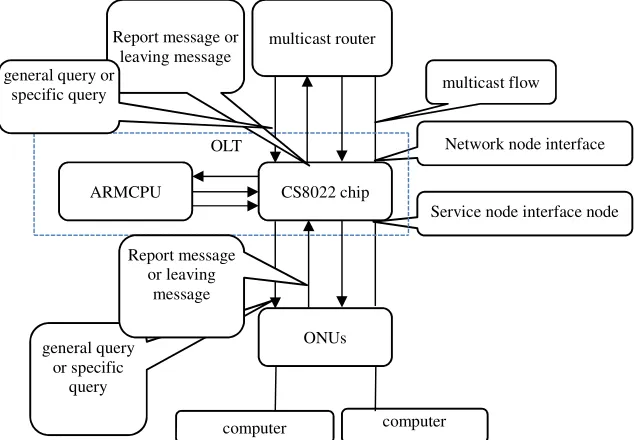
[image:2.612.147.464.510.730.2]The IGMP proxy takes on the role of the user's computer through the network node interface of the OLT, and responses to the queries from the upper router. The multicast agent sends IGMP joining or leaving message to the router when a user’s computer joining in a new multicast group or the last user's computer leaving a multicast group. The IGMP proxy performs the role of an upper-layer router through the service node interface of the OLT. It periodically sends a general query message and sends a specific query message to the user's computer when it receives an IGMP leave message. The message that the multicast proxy needs to process is shown in Figure 1.
Figure 1. Message the multicast agent needs to handle. multicast router
ARMCPU CS8022 chip
ONUs
Network node interface
Service node interface node
interfaceService node
OLT
multicast flow Report message or
leaving message general query or
specific query
general query or specific
query
Report message or leaving
message
The processing unit of multicast agent (IGMP Proxy) is composed of ARMCPU and CS8022 chip.
The Function of CS8022
CS8022 is a highly integrated chip, it provides four interfaces at the service node interface (SNI), at the same time it provides users with 4000 trillion options at the network contact interface (NNI). According to the IEEE802.3ah protocol, the transmission speed at the ports is 1.25GBps, and it provides 128 LLID. It takes optical fiber transmission, 1310nm’s light wavelength in uplink channel, and 1490nm’s light wavelength in the downlink. Its functions are mainly 2-layer forwarding, VLAN management, network layer authentication, special packets such as IGMP, DHCP, and BPDU’s authentication, packets distribution, user packages management and so on. Every function could realize through equipped with the API interface. Many CS8022 chips can form a system with more PON ports and NNI interfaces through cascade connection.
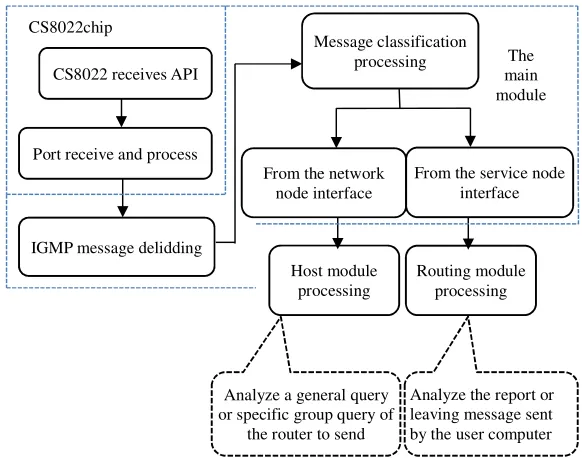
The IGMP proxy program runs on the ARM CPU. The data packets are received by the CS8022 chip API and processed by the CS8022 receiving port. The IGMP proxy is processed by the IGMP proxy program that is delivered to the ARM CPU.
[image:3.612.158.449.340.569.2]IGMP Proxy program is composed of the main module, the host module and the routing module. The basic information table of multicast is formed by the routing module. It will be sent to CS8022 after retrieving. CS8022 establishes the multicast forwarding table, and forward the multicast traffic to member ports according to the multicast forwarding table. The IGMP message reception process is shown in the figure 2.
Figure 2. IGMP message reception process.
IGMP message transmission process is shown in figure 2.
The Main Module
The main module is the control center of the multicast proxy, and needs to be initialized first. During the initialization process it needs to configure the IP address and MAC address of OLT multicast agent, port configuration (network node interface and service node interface), enable the CS8022 multicast function, import user configuration information, Where in global variable initialization completed by the function int IgmpInit Parameters (void). Port enable IGMP, start the member timer, send a general query message, start the initial query timer.
After the initialization, the IGMP packets are received and classified. The packets of different types are sent to the host module or the routing module for processing. Then, the packets are sent to
CS8022 receives API
Port receive and process
IGMP message delidding
Message classification processing
From the network node interface
From the service node interface
Host module processing
Routing module processing
Analyze the report or leaving message sent by the user computer Analyze a general query
or specific group query of the router to send CS8022chip
the CS8022 as required. Thus the establishment and maintenance of the multicast forwarding table is realized.
Message Classification Process
The main module of ARMCPU receives the IGMP message, the message processing function will classify the received packet. Data packets received from the network node interface would be sent to the host module to handle. Then the leaving or joining messages which needed to send to the multicast router will be formed, and packaged by the main module. Calling the send function, and sent it to the multicast router from the network node interface of CS8022. The data packet received from the service node interface to the routing module. The specific query or general query message formed after handling by the routing module, then packaged by the main module. The main module calls the send function, and the message will be sent from the service node interface of CS8022 to the user computer.
The universal query message packaged by the main module, transmitted to the service node interface and the main module starts the port timer.
The Host Module
(1) The function of this module is to handle the IGMP message from the network node interface, take the role of the IGMP user computer, and respond to the router's general query and specific group query.
(2) Retrieving the basic information table generated by the multicast routing module, forming the multicast MAC address, the MAC address of the user computer, the number of users of the multicast group, and so on. When this multicast group is a newly applied multicast group, the number of the user computers of the multicast group is equal to 1, and sends an active report message to the router. If the multicast group has another user computer to join, the router sends an active report packet. If other computer users apply to the multicast group, there is no need to take the initiative to send report message to the router. Only when the last user computer exits the multicast group, the number of users of the multicast group is equal to 0, it needs to send the leaving message to the router, and at the other time there is no need to send the leaving message to the router. It can greatly reduce the number of IGMP packets between the multicast router and the user computer. Host module supports the IGMPV1 version and GMPV2 version.
The Routing Module
(1) The function of this module is to receive the IGMP message from the service node interface, handle the reporting and leaving message. The multicast table of basic information formed in the process of analysis of the reporting and leaving message. The basic information table including multicast MAC address, PON port number, ONU LLID number, the user computer's MAC address, multicast IP address, the number of computer users of the multicast group. Then retrieve the multicast MAC address, PON port number and so on to form the multicast forwarding information to send to the CS8022. The CS8022 start controlling group and adding port, controlling group and deleting port, so as to form a multicast forwarding table in CS8022.
(2) Sending the general query and specific query to the service node interface. Because the multicast agent must send the query message to port. When the module is first started, the initial query timer is started and the initial query is sent. The initial query interval is 1/4 of the general query. The purpose is to discover the member relationship as soon as possible and set up the multicast forwarding table.
The Design of Structure
1) The structure design of IP message 2) The structure design of IGMP message 3) The structure design of multicast
6) The sending function of IGMP packet 7) Message handling function
Simulation and Test
Due to the use of IGMP Proxy multicast agent function in the OLT, the host module is used in the multicast agent program only send the joining message to multicast routers when apply for a new multicast group. When the last user computer leaves the multicast group, the host module sends the joining message to multicast routers. The number of IGMP packet between OLT and the multicast router greatly reduced, multicast router query function using Proxy IGMP multicast agent’s routing module implementation, making the number of IGMP packet between the multicast router and the user’s computer greatly reduced. Multicast service flows forward according to multicast forwarding table, which saves a lot of bandwidth. Using Smart Bits 6000 to test, in the case of the multicast stream is delivered to the OLT equipment. The time from the OLT starts received the first IGMP request message of specific multicast group from a particular PON port to the time to send the multicast data message to the first user of multicast group of the PON port is no more than 20ms.
Summary
OLT Proxy speeds up the response speed of the query message of the multicast router, greatly reducing the network bandwidth cost of the IGMP message in the EPON system and the core, shorten the user computer receives the multicast flow’s time when the multicast flow reaches the multicast router, and saves the network bandwidth.
References
[1] Jianqun Cui, Ailing Chen. High stability Low Delay Spanning Tree Algorithm for Application Layer Multicast[J], Computer Science, 2016, 43 (6):77-80.
[2] Jian Xu, Hong Ni. Advanced aggregated multicast algorithm[J], Application Research of Computers, 2013, 30(10):3048-3050.
[3] Sheng Zuo , Liao Xiao-fei, A Model on Application Layer Balanced Binary Multicast Tree with Low Delay[J], Journal of Chinese Computer Systems, 2015, 36 (8):1743-1746.
[4] Ma Dong-chao, Chen Xue, Wang Li-qian. Implementation Scheme of IGMP Snooping on EPON[J], Computer Engineering, 2010, 36(8):107-109.