2016 International Congress on Computation Algorithms in Engineering (ICCAE 2016) ISBN: 978-1-60595-386-1
1 INTRODUCTION
Cloth simulation has been a hot topic and a difficulty in the research for many years. As a flexible object, cloth with the surface shape varying at any moment is different from the common rigid body, whose surface deformation can almost be negligible. Then there will bring more problems to be solved in the simulation of 3D garment consisting of cloth and garment pieces. In addition to the real-time performance, authenticity and interactivity are also required in the complex cloth-body collision detection. Actually, no matter it’s on an international scale or in China, researches on the flexible cloth, 3D garment modeling and simulation have aroused wide attention, promising a broad appli-cation prospect specifically described as follows in different fields in addition to the theoretical and tech-nical challenges:
(1) Garment-aided design and production. It’s ca-pable to realize the design visualization, the virtual 3D cutting and the automatic formation of garment pieces
and garment pattern making.
(2) 3D animation and games. It’s capable to achieve real-time simulation of the role’s dressing effect to give the players a more authentic experience.
(3) Marketing requirement of E-commerce. With the development of “Internet+” and Garment O2O, it’s inevitable that virtual trying on of garment products will become a link since the static model show has been far from meeting the increasing requirements of the consumers.
(4) Individualized garment customization. Individu-alized customization has become an important trend for the development of garment design and making. As the same with the requirement of E-commerce, on-line experience is also necessary to the consumers, whose consuming intention will be affected directly by the virtual dressing effect.
Garment simulation starts from the simulation of a single piece. On account of the elastic property of woven cloth, Provot [1] has considered the cloth object as a grid structure constituted by virtual mass and spring to calculate the stress and movement condition of each mass by solving the Euler equations through the iterative solution method. Baraff et al. [2] has
pro-Strong Constraint Dynamic Simulation Method
for 3D Garment Models
Zhengdong Liu1*, Shuyuan Shang1 & Jianxia Du1 & James Pazun2
1 Computer Information Centre, Beijing Institute of Fashion Technology, Beijing, China 2 Pfeiffer University, Misenheimer NC, USA
ABSTRACT: With the continuous improvement on quality of 3D games and virtual fitting, the trend of gar-ment simulation has changed from the cloth simulation to the dynamic simulation. Gargar-ment simulation is of sig-nificantly theoretical and practical value, because it is authentic, real-time, universal and interactive. To solve the problems commonly existing in present algorisms on timeliness, universality and over-stretching, a real-time simulation method for all 3D garment models was proposed. In this method, the triangle faces were mapped to the mass-spring model, which overcame the restriction effect of the traditional solver on cloth regular grid. The Verlet integrator is easy to improve the computation efficiency. And the authors put compensation on confronta-tion of deformaconfronta-tion constraint, which prevented the over-stretching and improved the stability of the system. The efficiency and reliability of the proposed algorithm was verified by experiments. The experiment results show that this algorithm is simple and easy to operate, and it can be easily integrated in the form of plug-in components and modules with other software.
Keywords: garment simulation; mass-spring model; triangle faces; Verlet
posed an equation of motion for cloth simulation with the application of implicit large-step integration algo-rithm to strengthen the constraints on particles in real time. In this way, the computing speed will be im-proved significantly. Although not all of the cloth motion equations have been expressed in the same way by the researchers, most of them are developed in the physical model based on Newtonian motion [3-7]. Taking into account the over-stretching in cloth de-formation, Vassilev et al. [4, 5, 14] have set an elongation threshold in addition to the introduction of balancing forces. When the stretch of a spring is detected ex-ceeding the elongation threshold, the spring force should be increased to restore the spring to a proper position. However, it might lead to spring vibration, which would affect the system stability. In view of the bottlenecks such as real-time performance and com-plexity in the “cloth-body” collision detection, Mao Tianlu et al. [8] have proposed a solution to reduce the complexity in collision detection time without the need to update massive intermediate data. In order to obtain the mapping relation between the fabric me-chanical properties and the parameters of the simula-tion model, Jiang Yan et al. [9] have made an attempt to make the simulated fabric deformation be compliant with the physical property of the real fabrics. In order to achieve the perception by two fingers and for the purpose to display the fabric deformation effect, Huang Xin et al. [10] have tried an interactive mul-ti-contact prototype system for virtual fabrics. For the research on the garment simulation in the field of garment-oriented aided design, it generally focuses more on how to simulate the real dressing effect [11] with the designed garment pieces according to the virtual reality technology. Generally, a mapping mod-el from 2D garment pieces to 3D garment will be es-tablished to provide the composition of the internal force and the external force that are imposed on the mass by calculating the realistic garment simulation equation in addition to the display of the garment draping effect [12-14]. Or in reverse, generate a 3D ment surface at first and then unfold it into 2D gar-ment pieces for industrial production through the in-teractive design. Furthermore, due to the availability of the interactive somatosensory devices in recent years, some commercial 2D or 3D dressing systems have also come along, where somatosensory infor-mation from the sensor has been used to process the position and posture of the human body and garment, respectively. However, it’s not a true dynamic gar-ment try-on since the dynamic and physical properties of the garment have been eschewed in such a system. Although various improvement methods have con-tinuously pushed forward the enhancement of the flexible cloth simulation level, most of them still focus on improving the efficiency of the local algorithms without taking the application scope and the efficiency of the algorithms into account from an overall per-spective. Currently, the garment simulation
technolo-gy is yet to be improved in the following aspects: (1) Timeliness. It’s quite time-consuming to make the motion trail of a substantial amount of mass points contained in the cloth conform to the characteristics of real fabrics. In the iterative process, it’s necessary to repeatedly calculate the equation of particle dynamics since the collision detection and response has also constituted one of the major factors that influence the computing efficiency. Hence through the commercial cloth solver, lots of time will be spent on the rendering instead of the real-time simulation.
(2) Universality. Through the early methods, only rectangular plane will be utilized to simulate cloth. Also in current researches, most of them still adopt customized garment models such as T-shirt and skirt and so on, and those have been created through the regular gridding method. Even in some of the models, 3D garment is generated by joining the 2D garment pieces. However, nowadays, lots of ordinary garment models have been created with the 3D modeling soft-ware, containing numerous irregular triangle faces to make the existing methods not so practical and flexi-ble. Sometimes, artificial process is necessary in such models.
(3) Efficient “cloth-body” collision detection. Due to the complexity of human body surface and the flexible characteristics of fabric surface, lots of time will be spent on the collision detection and response. Meanwhile, the error-matrix-based simplified algo-rithm for grid faces in itself is relatively time-consuming [15]. Also, it’s yet to be improved regarding the triangle intersection calculation and the inner point recognition.
Aiming at the problem of timeliness and universal-ity, this paper proposes a simulation method for 3D garment model with an aim to make such a method applicable to any garment model which has been cre-ated based on the universal modeling software to break through the limitation on the regular grid model, which might be a collection of irregular triangle faces then. In this case, map the triangle vertexes into a link list according to the adjacency relation to construct a mass-spring structure for a random 3D model. Then use the efficient Verlet integrator to make a rapid pre-diction about the coordinates for mass motion with the application of strong constraint on the rigid spring to correct the predicted position so as to prevent the oc-currence of over-stretching. For the cloth-body colli-sion detection problem, it will be discussed separately in another paper.
2 VERLET-BASED MASS MOTION MODEL
Typical mass-spring model is actually a grid that con-sists of virtual mass points which are con-nected with a mass-less spring whose natural length is non-zero. Springs can be classified into three different types according to the mechanical force in the cloth:
the structural spring, the shearing spring and the flex-ural spring, which respectively correspond to the cal-culation of the structural force, the shearing force and the bending force in the cloth. The mass-spring struc-ture is shown in Figure 1:
(a) Mass-spring model (b) Structural spring
[image:3.516.53.237.116.250.2]
(c) Shearing spring (d) Flexural spring
Figure 1. Mass-spring model and the three types of springs.
In Figure 1, the spring that connects the closely linked horizontal and longitudinal mass points is the structural spring, which is used to secure the fabric structure. The spring that connects the adjacent mass points on a diagonal line is the shearing spring, which is used to prevent the cloth from artificial transitional deformation on the surface, bringing shear rigidity to the cloth. The spring that connects the horizontal and longitudinal mass points which are separated by a mass point is the flexural spring, and it is used to sim-ulate the flexural loading on the cloth.
The core of simulation is the mass motion system. Although multiple algorithms are available to obtain the numerical solution, there’s a common starting point which is to expand the particle position and the other mechanics parameters (such as speed and accel-eration etc.) into a Taylor series. Actually, the most common numerical solution method is the Verlet al-gorithm [15, 16]. It utilizes the particle position at
moment and the acceleration and the particle position at the moment of to calculate the particle position at the moment of .
(1)
In (1), no explicit calculation is made on the particle
velocity. Since , it’s applicable to
make a direct prediction about the particle position at the moment of according to its positions at moment and at the moment of . At the end of every time step, the previous position and the cur-rent position of every mass point will be reserved. Then in the processing of a high-precision garment model, the simple exchange of array pointers will facilitate the enhancement of the computation
effi-ciency.
Regarding the forces imposed on the various mass points in the cloth, use Newton’s laws of motion
to calculate the current acceleration with , referring to the resultant force imposed on the mass. Taking the typical simulation of cloth falling as an instance, Figure 2 shows the simulation effect through the Verlet algorithm.
[image:3.516.264.463.151.223.2]
Figure 2. Simulation of cloth falling under the effect of gravity.
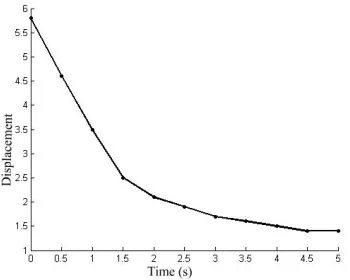
In the whole simulation process, only three position coordinates which include the coordinates of the pre-vious position, the current position and the predicted position for every vertex are calculated. , the difference between the current position and the previous position represents the con-vergence of each iterative process. Taking one of the vertexes as an instance, Figure 3 shows its iterative convergence curve:
Figure 3. Iterative convergence of a single mass point.
3 MAPPING OF ANY GARMENT IN A SPRING
MODEL
The traditional mass-spring model has been created purposely for regular grids. There’s certain regularity in the creation of points and edges in a grid model. The advantage is that it will facilitate the computation, perfectly conforming to the definition of the structural, shearing and flexural springs. The basically regular grid model has been applied in all of the early re-searches on garment simulation. Even it has been )
(t p
t
a(t)t t
t
t
2 2
2
) )( ( ) ( ) ( 2 )
( pt t
dt d t t p t p t t
p
) ( ) ( 2 2
t a t p dt
d
t t
t
t tma
f f
) ( )
(t pt t
[image:3.516.276.451.372.512.2]adopted in the study on the simulation of joining gar-ment parts since the regular grid model is able to pro-vide certain convenience in choosing the joints. How-ever, the shortcoming is also very apparent as the regular grid-based algorithm is not applicable to the models established based on the ordinary modeling software. Then this algorithm has certain deficiency in the universality.
The left image in Figure 4 is a 3D garment model constructed based on 3DS Max and, the right image is a partial enlarged detail. Generally, all of the ordinary 3D models are constituted by numerous vertexes and the triangle faces which consist of vertexes. However, for modeling purpose, the position of the vertex is not regular. Therefore, in order to cater for the mass-spring model, it’s necessary to have a mapping treatment on the vertexes and triangle faces of the model.
(a) Irregular points in the model
[image:4.516.96.209.250.412.2](b) Composition of local triangle faces
Figure 4. Definition on the mass-spring types of triangle faces in a 3D mode.
[image:4.516.307.413.406.495.2]The shear structure of the spring will cause the me-chanical interaction on the latitude and longitude lines. However, it won’t make the thread itself becomes longer. Actually, in an ordinary model consisting of triangle faces, the effect of the shearing spring and structural spring has tended to become obscure. Hence in order to improve the simulation performance of the model, it’s feasible to simplify the mass-spring model so that only structural spring and flexural spring will be taken into account without the consideration of the shearing spring in garment simulation to guarantee a favorable simulation effect and simultaneously reduce the calculation work for higher efficiency.
Figure 5. Adjacency relations of points and faces.
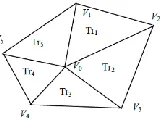
First, construct an adjacency relation according to the inputted information about the vertexes and the faces in the garment model. There’re two types of adjacency relations, including:
(1) The adjacency relation of vertexes. The vertexes that are connected through an edge are the adjacent vertexes. As indicated in Figure 5,
v
0 is the adjacentvertex of
v
1,v
2,v
3,v
4 andv
5.(2) The adjacency relation of triangle faces. The triangle faces that share the same edge are the adjacent surfaces. As shown in Figure 5, Tr1 is the adjacent
surface of Tr5 and Tr2.
It can be proved that the triangulation of any closed surface is able to meet the following condition: Since every edge is exactly the common edge between two triangles, there’re three and only three adjacent trian-gles [17] for every triangle. Actually, it’s based on a flexural spring that can be defined. Also, according to the above analysis, the spring structure of any garment model based on the triangle faces can be constructed according to the following rules:
(1) All of the edges that have been constituted by the adjacent vertexes can be considered as the struc-tural springs.
(2) Search the other three adjacent surfaces for every triangle face. Then choose three vertexes, whose in-degree is 2 from all of the vertexes that have been contained as the mass points of the flexural spring. As shown in Figure 6,
v
1,v
2 andv
3 have respec-tively constituted the mass points of the three flexural springs.Figure 6. Structure of the flexural spring.
4 STRONG CONSTRAINT FOR OVER-STRETCHING
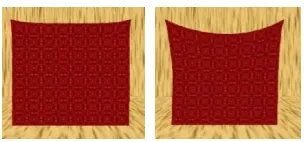
[image:4.516.114.194.583.642.2]corner with different levels of stretch under the action of gravity. The left image shows the state of cloth when the over-stretching is within 5%. And the right image shows the state of cloth when the over-stretching is up to 20%. Both of the images re-veal that the simulation effect is quite similar to the real state when the over-stretching is controlled within 5%. In fact, required by the real-time 3D game and the dressing system, there shouldn’t be apparent cloth stretch under the effect of gravity. However, for the performance enhancement purpose, nowadays, lots of algorithms have deliberately ignored such a fact.
Figure 7. “Over-stretching” of the cloth.
In order to achieve an authentic simulation effect in garment simulation and to avoid the occurrence of over-stretching (super stretch), it’s necessary to make a timely correction on the positions of various mass points in the iterative process. Through the traditional practices [1, 5, 18], calculate the positions of various mass points in an ideal spring model at first, and then calculate the stretch rate of different springs to impose a constraint on the mass points at both sides of the spring when and only when the spring elongation exceeds the preset elongation threshold. That’s to say, this method allows spring over-stretching with an attempt made on the adjustment of the spring length when the spring is stretched. However, since the springs are connected through the mass points, the change of a spring position might lead to the over-stretching of the spring which is adjacent to it, bringing about the fluctuation in the position to affect the convergence of the algorithm. Due to this, new coordinate can be called as predicted coordinate since it might be an error position where over-stretching might occur. Under such a circumstance, it’s not ap-plicable to determine the coordinate before the impo-sition of constraint conditions. The specific approach is provided: Check if the state of every spring is com-pliant with the constraint condition after each iteration process. If not, make a compensatory correction on the predicted coordinate so that the corrected coordinate can be used as the iteration result.
Assume that the mass points at both ends of a spring within the mass-spring model are respectively
i
V
andV
j , then its initial spring can be expressed withij
L , which can also be used as the bilateral con-straints:
j i
ij
p
p
[image:5.516.77.229.185.256.2]L
(2)Figure 8. Constraint on over-stretching.
Although in the initial state, the particle positions are correct, the distance between the points might still become null after several time steps of iteration. Hence in order to obtain the correct distance between the mass points once again, it’s necessary to make an adjustment through the displacement compensation according to the constraint condition by directly pushing away or pulling back the mass points along the direction of the spring. However, whether to push away or pull back the mass points is subject to the error distance, which might be too small or too large as indicated in Figure 8.
In the case that L'ij pi' pj' is defined as the new vector of the predicted spring, the compensation vector for the coordinate of the mass point can be expressed with (3):
' ' '
2 ) (
ij ij ij ij i
L L L L
p
' ' '
2 ) (
ij ij ij ij j
L L L L
p
(3)
In conclusion, the following major links are neces-sary in the simulation of any garment model consist-ing of triangle faces, includconsist-ing the mappconsist-ing of the mass-spring structure, the prediction on the coordi-nates of the mass points and the constraint compensa-tion and so on. A stable coordinate will be gradually obtained after the iterative process with the iteration flow described as follows:
Input: 3D garment model
Step 1: Read the data about the vertexes and the triangle faces of the model, and then calculate the structural spring and the flexural spring between the sets of particles according to the mapping relation to initialize
p
(t
t
)=p
(t
)=p(t -t) .Step 2: Impose such external forces as gravity, wind power and artificial force and others on the mass points. Turn to Step 4 if the resultant force is zero. If not, set p(tt) as the new coordinates of the pre-dicted mass.
coor-dinates to Step 4 and turn to Step 2 for further itera-tion.
Step 4: Render the garment model according to the updated vertex coordinates.
5 EXPERIMENTAL SIMULATION RESULT
This algorithm utilizes Visual C# and Unity3D to complete the simulation and calculation in Windows 8.1 with the operating environment provided as fol-lows: Choose Intel Xeon E5-2620 v2 @2.10GHz as the CPU and NVIDIA Quadro K4000 as the VGA card with 2G of the video memory and 32G of the RAM. With simple computation, this algorithm is able to guarantee a smooth simulation result, showing its advantage in the efficiency and proving that this algo-rithm is able to realize real-time processing on the influence of the external forces on the cloth. In this experiment, the external forces include gravity and wind power. Figure 9 shows the screenshot of the simulation effect. The left image shows the initial state of the model under the effect of the gravity. The mid-dle image shows the state of the model when the value of the wind power is 1.0 and, the right image shows the state when the value of the wind power is 10.0.
[image:6.516.82.223.435.515.2]In this instance, the model shown in Figure 4 is adopted, consisting of numerous irregular triangle faces. The experiment result proves that mapping through spring is able to realize a favorable simulation of cloth deformation under the effect of external forc-es. Meanwhile, the application of the strong con-straints which are used to prevent over-stretching is able to perfectly restrain the occurrence of super stretch. The calculation shows that the fluctuation in any spring deformation is not greater than 1%.
Figure 9. Simulation results of the T-shirt consisting of triangle faces.
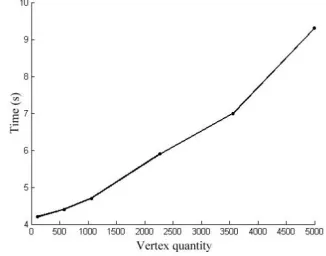
In order to verify the performance efficiency of the algorithm, models with different precisions are adopt-ed in this experiment with the specific approach pro-vided as below: Perform reduction process on the same garment model based on different precisions to obtain Model 10600, Model 5280 and Model 1028 respectively. Figure 10 is a comparison diagram showing the working time of these three models, among which the particle system model is the model
which is most approximate to the nature of cloth. The more precisely the particle grid is divided, the closer the grid is to the size of the internal discontinuous elements in the cloth, giving a more authentic simula-tion effect. However, undoubtedly, this method will bring about the increase in the computation amount. Actually, with the refinement of the grid division, the computation time has been increased geometrically. Therefore, it would be a direction of efforts in the future to find such a computing method which is quicker with higher precision.
6 CONCLUSIONS
With the continuous development of the industrial requirements on garment simulation, it becomes ur-gent to find such a rapid and universal method which is able to satisfy the requirement of garment simula-tion in every respect. The problems that must be solved through the algorithm include: 1) Satisfaction of the requirements on universality: Since ordinary 3D model is not of regular grid structure, the vertexes of the triangle face will be mapped into a structural or a flexural spring according to the angular distribution. 2) The prediction mechanism with the introduction of vertex position: It guarantees the robustness without the explicit calculation made on the movement speed of the vertex. It also provides an opportunity for the constraint computation and position correction. 3) The application of rigid spring without any stretch ability to solve effectively the problem of “over-stretching”: The algorithm has the advantage in the execution speed since only vertex position will be calculated in a triangle face, laying a foundation for the real-time garment simulation. Moreover, from the perspective of application, this algorithm is also featured with the characteristics of simplicity and modularization, which are of great importance in the transformation of the practical and maintainable applications and prac-tices.
[image:6.516.280.443.489.617.2]ACKNOWLEDGEMENT
This paper is sponsored by Beijing Education Com-mission Scientific Research Support Program (KYJH 02150201) and the Beijing Philosophy and Social Science Research Base Foundation (13JDWYA005).
REFERENCES
[1] Provot X. 1995. Deformation constraints in a mass-spring model to describe rigid cloth behavior. in Proceedings Graphics Interface 95. Quebec: Elsevier: 147-154.
[2] Baraff D & Witkin A. 1998. Large Steps in Cloth Simu-lation. Computer Graphics, 32(2): 106-117.
[3] Chen Liang, Zhao Shuguang & Zhang Lijuan et al. 2011. History and research hot spot of three-dimensional virtu-al garment display. Journal of Textile Research, 32(10): 153-160.
[4] Ji Feng & Li Ruqin. 2004. Fabric simulation model based-on particle-spring system. Journal of Textile Re-search, 25(1): 42-44.
[5] Wang Xiaobin, Hou Junyi & Shen Xukun. 2014. Appli-cation of Interaction Technique in Cloth Animation Based on Physically Modeling. Journal of System Simu-lation, 26(9): 2050-2055.
[6] Liang Xiuxia, Han Huijian & Zhang Caiming. 2014. Survey of cloth animation based on physical simulation.
Journal of Computer Research and Development, 51(1): 31-40.
[7] Zhang Dong, Jia Shiyu & Wang Liang. 2008. Particle model with accurate mechanical formulation in cloth simulation. System Simulation Technology, 4(2): 138-142.
[8] Mao Tianlu, Wang Zhaoqi & Xia Shihong. 2006. An al-gorithm for collision detection and response between
human body model and cloth in 3D garment simulation.
Journal of Computer Research and Development, 43(2): 356-361.
[9] Jiang Yan, Liu Zhengdong & Chen Chunli. 2012. 3D textile simulation based on fabric mechanical properties.
Journal of Computer-Aided Design & Computer Graphics, 24(3): 323-329.
[10] Huang Xin, Yang Wenzhen & Wu Xinli et al. 2014. Virtual fabric haptic rendering with double haptic inter-active points. Journal of System Simulation, 26(9): 1997-2002.
[11] Liu Hui, Chen Chun & Shi Baile. 2003. Simulation of 3D garment based on improved spring-Mass model.
Journal of Software, 14(3): 619-627.
[12] Chen Qingqing. 2013. Three-Dimensional garment sim-ulation technology based on interactive suture setting.
Computer System & Application, 22(4): 88-91. [13] Zhu Guangzhou & Li Xiaojiu. 2014. Study on virtual
simulation of 2-D patterns. Journal of Textile Research, 35(10): 141-145.
[14] Vassilev T & Spanlang B. 2000. Efficient cloth model for dressing animated virtual people. Proc of Learning to Behave Workshop. Enschede the Netherlands:[sn]: 89-100.
[15] Sun Shouqian, Xu Aiguo & Huang Qi et al. 2007. Re-al-time garment simulation based on geometrically ap-proximation character with colliding objects. Journal of Software, 18(11): 2921-2931.
[16] Chen Yan, Xue Yuan & Yang Ruoyu. 2014. Real-time simulation for 3D-dressing of random clothes and human body. Journal of Computer Applications, 34(1): 124-128.
[17] Zhang Yisheng, Cui Shubiao & Liang Shuyun. 2001. Rebuild adjacency topology relation between faces of STL model. Computer Application & Software, 18(3): 47-50.