2017 2nd International Conference on Advances in Management Engineering and Information Technology (AMEIT 2017) ISBN: 978-1-60595-457-8
An Adaptive Dwell Scheduling Algorithm for Digital Array Radar
Based on Pulse Interleaving
Di MENG
1,*, Yong WU
2, Qun ZHANG
1, Ying LUO
1and Yi-jun CHEN
11
Institute of Information and Navigation, Air Force Engineering University, Xi’an, China
2
Shaanxi Institute of Metrology, Xi’an, China
*Corresponding author
Keywords: Digital Array Radar (DAR), Resource scheduling, Pulse interleaving, Sparse aperture imaging.
Abstract. According to the characteristics of signal processing in Digital Array Radar (DAR), a dwell scheduling algorithm is proposed. Based on the pulse interleaving technique, the dwell scheduling algorithm can achieve the sparse-aperture cognitive ISAR imaging of precision tracking targets simultaneously during implementing searching and tracking tasks, which gets the full exploitation of transmitting, waiting and receiving durations of radar dwells. Simulation results demonstrate that, compared with the conventional dwell scheduling algorithms, the proposed algorithm can improve the scheduling performance of DAR.
Introduction
With the improvement of radar digitization, digital array radar (DAR) has been widely researched in the radar industry [1]. In order to further improve the resource utilization ratio of the radar system, pulse interleaving technology is proposed. Orman analyzed this method in [2] and proposed the heuristic algorithm to solve the problem of adaptive beam-dwell scheduling for phased array radar. Aiming at the problem of beam-dwell scheduling for DAR, an algorithm based on analyzing scheduling interval is proposed in [3]. However, in almost all existing adaptive resource scheduling methods for DAR, the imaging mission is not taken into account. Joint scheduling imaging tasks with search, tracking and other tasks can not only improve the recognition ability of the radar to the target, but also feedback the target characteristic information obtained by the image to the transmitter radar system, so as to realize the dynamic adjustment of imaging tasks and improve resource utilization radio [4]. Traditional imaging algorithm require continuous observation of targets for a long time to obtain high-resolution images, but the alternation of different tasks inevitably leads to discontinuous synthetic aperture sampling of the imaging target azimuth.
Based on the above issues, in this paper, we propose an adaptive dwell scheduling algorithm for DAR based on pulse interleaving, which takes the imaging task requirements into account in the radar resource scheduling model by using the compressed sensing (CS) ISAR imaging method.
Task Model and Constraints Based on Pulse Interleaving
Sparse Aperture Imaging Based on Compressed Sensing
calculate the demand of radar resources for target imaging based on the cognitive results. Suppose that the target is non-maneuvering, the full aperture imaging of the radar needs to
transmitNi =PRF T⋅ ˆci pulses (PRF is the pulse repetition frequency), and the measurement
dimensionM Mi( i
<
Ni)after dimension reduction is expressed as:ˆ ln( )
i i i
M ≥cK N
(1)
Where cis a constant associated with the recovery accuracy, usually taken as 0.5~2(letc=1in
this paper).
Radar Dwell Model
The DAR dwell model is defined as:
{
, , , , , ,x w r , , ,t}
T = et st t t t
ω
M pri P P(2)
Where et denotes the expected scheduling time; st denotes the actual scheduling time;
, ,
x w r
t t t denote the transmitting duration, waiting duration and receiving duration respectively;
ωdenotes the time window of the task; M denotes the number of pulse repetitions in the search
and tracking tasks, and it denotes the azimuth-oriented observation dimension in the imaging task;
pridenotes the pulse repetition reputation interval; Pt denotes the pulse transmitting power;
andPdenotes the task priority [5].
Scheduling Constraints
Although the overlap of multiple dwell tasks can improve the resource utilization of DAR, the energy consumption of the system is bounded to increase as the radar is in the transmitting state for a long time. In order to avoid the damage of the transmitter due to the long working time, the restriction of energy constraint must be considered in the scheduling algorithm [6]. The transient
energy of the system att moment can be expressed as:
( )/ 0
( ) t ( ) x t
E t =
∫
P x e − τdx(3)
Where P x( ) is the power parameter, τ is the look-back period. The energy constraint of the
system can be defined as that E t( )cannot exceed the maximum threshold Emaxof instantaneous
energy at any time, i.e.
max
( )
E t
≤
E(4)
Dwell Scheduling Algorithm for DAR
In order to measure the performance of the radar resource scheduling, the scheduling success ratio (SSR), the hit value ratio (HVR), the time utilization ratio (TUR) and the energy utilization radio (EUR) are taken as the criterion [7]. They can be expressed as:
'
SSR=N
' ' 1 1 HVR= N i i N i i P P = =
∑
∑
(6) ' 1 total ( ) TUR= Nxi ri i i i
t t M pri
T = + ⋅ ⋅
∑
(7) ' 1 total ( ) EUR= Nt xi i i i
av
P t M pri
P T = ⋅ ⋅ ⋅ ⋅
∑
(8)WhereNis the total number of tasks for requested scheduling, N'is the number of scheduled
tasks,
T
totalis total simulation time,P
tis the peak power of each transmitted pulse andP
av is theaverage power delivered by the radar.
In terms of the above performance index, assume that there are Ndwell tasks in the scheduling
interval[ , ]t t0 e , an effective model of DAR based on pulse interleaving can be defined as:
' ' '
'
1 1 1
1 2 3 4
total total 1 ' 0 ' 1 1 ( ) ( ) ' max{ }
max( , ) min( , ), 1, 2,
[ ( 1) , ( 1) ]
. .
i i
i
N N N
k xi ri i i t xi i i
i i i
N
av k
i
i i i i e
M N
i i i xi i
i j
P t t M pri P t M pri N
q q q q
N T P T
P
t et st et t i N
st j pri st t j pri
s t ω = = = = = = + ⋅ ⋅ ⋅ ⋅ ⋅ + + + ⋅ ≤ ≤ + = + − ⋅ + + − ⋅ =
∑
∑
∑
∑
∩ ∪
1 1 1 1[ ( 1) , ( 1) ]
[ ( 1) , ( 1) ]
[ ( 1) , ( 1) ] , , 1, 2,
se i
i
k
N M
i xi i i xi wi i
i j
M
i i i i xi
j
M
k k xk wk k k xk wk rk
j
st t j pri st t t j pri
st j pri st j pri t
st j pri t t st j pri t t t i k N
= = = = ∅ + + − ⋅ + + + − ⋅ = ∅ + − ⋅ + − ⋅ + + − ⋅ + + + − ⋅ + + + = ∅ =
∩ ∪
∪
∪
' max 0( ) , [ , ]e
E t E t t t ≤ ∈
∩
(9)Where Nse is the number of search tasks and q q q q1, 2, 3, 4 is adjustment factors. The first
constraint gives the scope of the actual execution time of each task; the second constraint indicates that there is no conflict between the transmitted pulses; the third constraint indicates that the search tasks cannot perform pulse interleaving; the fourth constraint indicates that the task dwell received pulse can be overlapped in the same time without colliding with the transmitted pulse; the fifth constraint represents the energy constraint for task scheduling.
The effective algorithm of DAR based on pulse interleaving is summarized as follows:
Step 1: TakeNtasks for requested scheduling in the scheduling interval[ , ]t t0 e , addKtasks with
priority from high to low (tasks with the same priority are arranged according to the expected
execution time), and let i=1.
Step 3: Determine whether the i-th task can be scheduled at timetp.
If the task meets the time and energy constraints in (9), it will be sent to the execution list and
removed from the application list. Initialize the time slot vectorUand time pointer tp.Update the
energy state vector E =E+ ∆E(∆Eis the system energy consumption change), leti= +i 1, and
return to step 3.
If the scheduling fails, adjust the actual execution time of the task in the time window, and let
= +
p p p
t t ∆t ( p t
∆ is the minimum step size of the pointer slide).
Step 4: If tp <sti+
ω
i, return to step 3, otherwise the task cannot be scheduled. Add it to thedelete list, leti= +i 1.
Step 5: If i≤N−K, return to step 3, otherwise go to step 6.
Step 6: The scheduling analysis of the scheduling interval ends.
Simulation and Analysis
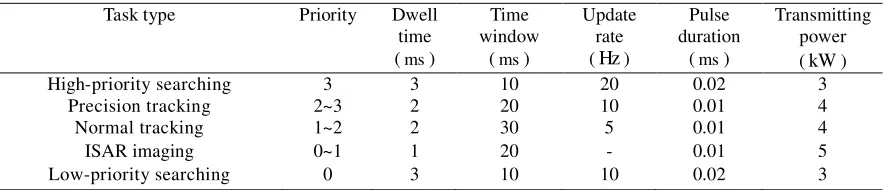
[image:4.612.86.528.355.450.2]In the simulation, we choose three kinds of radar working mode: search, tracking and imaging. Typical parameters for various tasks are summarized in Table 1. The total simulation time is 6s, the scheduling interval length is 50ms, and the radar can provide an average power of 400W.
Table 1. Parameters of radar tasks.
Task type Priority Dwell
time (ms)
Time window
(ms)
Update rate (Hz )
Pulse duration
(ms)
Transmitting power (kW )
High-priority searching 3 3 10 20 0.02 3
Precision tracking 2~3 2 20 10 0.01 4
Normal tracking 1~2 2 30 5 0.01 4
ISAR imaging 0~1 1 20 - 0.01 5
Low-priority searching 0 3 10 10 0.02 3
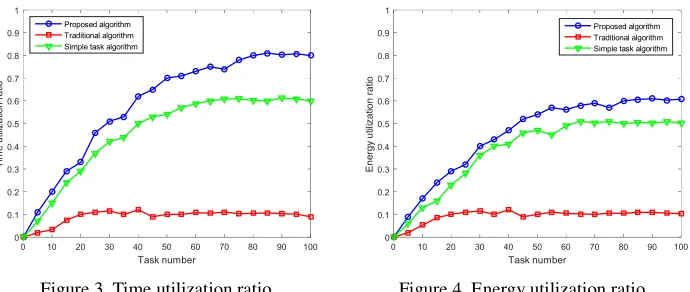
Traditional phased array radar algorithm (traditional algorithm) [8], the pulse interleaving scheduling algorithm(simple task algorithm) which does not consider the imaging tasks [9] and the adaptive dwell scheduling algorithm proposed in this paper (proposed algorithm) are compared in the simulation. Comparison curves of three different algorithms are shown in Fig. 1-4.
0 10 20 30 40 50 60 70 80 90 100 Task number
0 0.1 0.2 0.3 0.4 0.5 0.6 0.7 0.8 0.9 1
H
it
va
lu
e
r
a
tio
Proposed algorithm Traditional algorithm Simple task algorithm
0 10 20 30 40 50 60 70 80 90 100 Task number
0 0.1 0.2 0.3 0.4 0.5 0.6 0.7 0.8 0.9 1
S
c
h
e
d
u
lin
g
s
u
c
c
e
s
s
r
a
tio
[image:4.612.123.475.512.650.2]Proposed algorithm Traditional algorithm Simple task algorithm
0 10 20 30 40 50 60 70 80 90 100 Task number
0 0.1 0.2 0.3 0.4 0.5 0.6 0.7 0.8 0.9 1
T
im
e
u
til
iz
a
tio
n
r
a
tio
Proposed algorithm Traditional algorithm Simple task algorithm
0 10 20 30 40 50 60 70 80 90 100 Task number
0 0.1 0.2 0.3 0.4 0.5 0.6 0.7 0.8 0.9 1
E
n
e
rg
y
u
til
iz
a
tio
n
r
a
tio
[image:5.612.133.478.72.218.2]Proposed algorithm Traditional algorithm Simple task algorithm
Figure 3. Time utilization ratio. Figure 4. Energy utilization ratio.
From Fig. 1, we can see that when the number of tasks is less than 20, the system resources are relatively abundant; the competition for resources among tasks is not obvious. All the three scheduling algorithms can successfully schedule all tasks. With the further increase of the tasks, the scheduling success radio of the traditional algorithm begin to decline significantly, while the other two algorithms based on the pulse interleaving can still successfully schedule all tasks. When the number of tasks increased to 65, the simple task algorithm cannot schedule more tasks, but the proposed algorithm can successfully schedule all tasks until the number of tasks reaches 80. This is due to the saturation of radar resources in the simple task algorithm. But in the proposed algorithm, the imaging tasks have the lowest priority, so that the remaining resources of the system can be fully utilized by the dynamic adjustment of the imaging accumulation time and the flexible sparse aperture allocation without affecting the scheduling of the search and tracking tasks. Consequently, the task number of successful scheduling is improved.
From Fig. 2, we can see that when the radar resources are saturated, the hit value radio of the traditional algorithm and the simple task algorithm starts to decrease when the number of tasks reaches 20 and 65 respectively. In this case, the number of successfully scheduled tasks remains unchanged, and only the higher priority tasks are selected for priority scheduling in the added tasks. The precision tracking task can be imaged with the idle time of searching and tracking in proposed algorithm, so that it can maintain a high hit value radio when the number of tasks reaches 80.
From Fig. 3 and Fig. 4, we can see that when the number of tasks reaches 20, the time utilization ratio and the energy utilization ratio maintain at 0.1 because of the resource bottleneck in traditional algorithm. Through the use of the pulse interleaving technology, the simple task algorithm can further utilize the radar system resources, the time utilization ratio can reach about 0.6 and energy utilization can reach about 0.5. On the basis of pulse interleaving, the idle time of search and tracking task is fully exploited in proposed algorithm, so the time utilization ratio and energy utilization ratio can reach about 0.8 and 0.6 respectively.
Conclusion
In this paper, an effective dwell scheduling algorithm has been proposed based on pulse interleaving for DAR. The time and energy constraints are set respectively, and the optimal resource scheduling algorithm is established. The simulation results show that the proposed algorithm can accomplish tracking and search task effectively. It not only makes use of the multi-task cooperative advantage of DAR, but also improves the resource utilization ratio of radar system.
References
[1] F. Wang, Y.G. Fu, Performance comparison of digital phased array and conventional phased array radar, J. Journal of CAEIT. 7 (2012) 148-151.
[2] A.J. Orman, C.N. Potts, A.K. Shahani, Scheduling for a Multifunction Phased Array Radar System, J. European Journal of Operational Research. 90 (1996) 13-25.
[3] T. Cheng, Z.S. He, T. Tang, Novel radar dwell scheduling algorithm based on pulse interleaving, J. Journal of Systems Engineering and Electronics. 20 (2009) 247-253.
[4] Y.J. Chen, Q. Zhang, Y. Luo, et al, Adaptive scheduling algorithm for radar based on sparse aperture ISAR imaging, J. Journal of Projectiles, Rockets, Missiles and Guidance. 33(2013) 171-176.
[5] Y.J. Chen, Q. Zhang, Y. Luo, et al, Measurement matrix optimization for ISAR sparse imaging based on genetic algorithm, submitted to IEEE Geoscience and Remote Sensing Letters. 13 (2016) accepted.
[6] Chen J, Wang L, Zhang W, et al. Multifunction Phased Radar Resource Management via Maximal Pulse Interleaving Technique[J]. Arabian Journal for Science and Engineering, 2013, 38(11): 3081-3091.
[7] Zhang J, Xia Z T. An adaptive scheduling searching method based on information entropy[J]. Modern Radar, 2015, 37(8): 33-36.
[8] Q.K. Hou, Y. Liu, L.J. Fan, et al, Compressed sensing digital receiver and orthogonal reconstructing algorithm for wideband ISAR radar, J. Science China Information Sciences. 58 (2015) 1-10.