2016 International Conference on Manufacturing Science and Information Engineering (ICMSIE 2016) ISBN: 978-1-60595-325-0
Recommendation with Implicit Trust
Relationship Based on Users’ Similarity
JIATONG WANG, JIEHUA HU, SHUYU QIAO, WEI SUN,
XUEFENG ZANG and BANGZUO ZHANG
ABSTRACT
Recommendation algorithms based on trust relationship have been shown with a great influence. Many existing algorithms only consider the trust relationship. But in the real world, most users have few trustworthy person can be added to the trust list, they do not know or unacquainted each other. So, the implicit trust relationship is valuable by inferring more trust relationships. This paper proposes a new method to mine the implicit trust relationship based on the users’ similarity. The proposed methods combine the trust-based recommendation algorithms and show the effectiveness in the FilmTrust data set.1
1 INTRODUCTION
Recommender system has been considered a critical technique to solve information overload question. The collaborative filtering technology has been the most used recommendation method. With the emergence of social media, there has so much new information, such as friendship information, interactions, trust, and so on. But the traditional recommendation technology often focuses on the user-item ratings, and ignores the relationship in the user's social media.
The most important social media relationship is the trust relationship, which is different from others, because it is asymmetric. And other social relations are symmetric, such as the friendship, the two people need to confirm each other. The
1
Jiatong Wang, Shuyu Qiao, Wei Sun, Xuefeng Zang, Bangzuo Zhang: College of Computer Science and Information Technology, Northeast Normal University, Changchun, China, 130117
current research papers show that the social relationship which symmetric is not obvious effect result for recommending [1], but the trust relationship is more effective. The reason is that the trust relationship can represent the user's interests. Recently, there have a lot of recommendation algorithms based on trust [2], but most of them are based on the known explicit trust relationship that has given by the system. Quite a lot of implicit trust relationship information is not being mined. Since the observation of the user is limited, and the user is not able to find all of other users that have the same interests among them. So it is important to discover the potential trust relationship by some way.
This paper proposes a novel method, based on the regularized Pearson similarity, to discover the potential trust relationship among users. The experiments in real world data sets, FilmTrust, show that the introduction of implicit trust has great importance in Trust-Aware recommender system, and outperform other state-of-the-art recommendation algorithms.
The rest of the paper is organized as follows. We describe some related work in Section 2. We propose one method on mining implicit trust in Section 3. Section 4 provides experimental results and an empirical analysis. Finally, we conclude the paper in Section 5.
2. RELATED WORKS
Generally, collaborative filtering recommender system includes two main approaches: memory-based [3] and model-based [4]. Memory-based approach calculate the similarity among the users/items by the similarity algorithm, the mostly used is Pearson Correlation Coefficient (PCC) [3]. Then, they find the similar neighborhoods of each user/items by the similarity scores.
For the model-based methods, predefined model are trained by the training dataset, and mainly depends on the latent factor model [4]. The matrix factorization method is used to extract a set of potential factors from the rating matrix, which describe users and items through the factor description. For example, in the field of movie, these factors will be automatically identified, and may be some of the general labels of film, such as style or genre.
considered the average of her trusted neighbors with using regularization to form a new matrix factorization model (SoReg [7]).
3 THE PROPOSED METHOD
3.1 Using Users’ Interest to Discover Potential Trust Relationship
In a social media, we usually want to add the users who are interested in. However, each user's observation is limited, that is, there are so many users who are interested in can’t be found by the active user. So it is of great significance to find more and more accurate trust relationship. We measure the similarity among users using Pearson similarity (PCC). Generally, the similarity values is belongs to [0, 1], but the value of PCC is between -1 and 1. So we adjusted it with equation (1).
v u
v u PCC
n NewSim
v u v
u
2 / 1 )
/ 1 1 (
1
,
, ( ) (1)
Where n denotes the rating number of two users u and v, then we find the potential trust users through the similarity NewSim. By this way, we can get the similarity between each user, and adding a trust list which is based on the degree of interest among users. We set a threshold , and get some new implicit trust by similarity that is higher than the threshold , as equation (2).
v
NewSim
v
U
TrustSim
|
u,v
,
, (2)User u will be trusted by the user v since they have the same interest. In this way, we can help each user mining implicit trust relationship.
3.2 Appling to Trust-based Approaches
We combine our mining implicit trust relationship into trust-ware recommendation methods. The related works are all deal with explicit trust relationships, which is given by the dataset.
Nu v N
v v u u T v v u u T M i i T i V N u u T u U N u n i i T u i u R i u u U newT U U newT U V V U U V U g R I V U newT R L 1 , , 1 1 1 1 2 , , ) ( ) ( 2 2 2 )) ( ( 2 1 ) , , , ( (3) (2) Combines to SoRec with new trust relationship as equation (4).
F newZ F V F U k T i m i n j ik newC ik newC m i n j j T i ij R ij newZ V U newZ U g newC I V U g r I newZ V U newC R L 2 2 2 2 1 1 * 1 1 2 2 2 2 )) ( ( 2 )) ( ( 2 1 ) , , , , (
(4)
Combines to SoReg with new trust relationship as equation (5).
2 2 2 1 1 2 ) ( 1 1 2 2 2 || ) ( 1 || 2 )) ( ( 2 1 ) , , ( F F m i F i n ewF f f i m i n j j T i ij ij V U U i newF U V U g R I V U R L
(5)4 EXPERIMENTS AND ANALYSIS
We will validity our proposed methods in a standard dataset, FilmTrust, and compare with the methods without mining implicit trust relationship.
[image:4.612.131.473.509.616.2]FilmTrust is a social network website which can rate and comment for movies.
selected 80% as the training set, and 20% as the test set. We use two general metric to measure the prediction results, that is, RMSE and MAE. For the matrix decomposition technique, we set the latent features dimensions is 10, the number of iteration is 100, and the learning rate is 0.001.
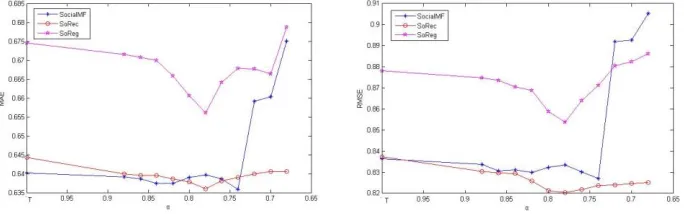
We apply our proposed methods and compare with the original methods, the results are shown in Figure 1. We can find that our proposed methods that further considering the implicit trust relationship in the trust-ware recommendation system are very efficient. For the threshold, smaller threshold is, less the trust relationship is, poorer the effect is. So, it is very meaningful to mining implicit trust relationship for the recommendation result.
5 CONCLUSIONS
This paper focuses on discussing the influence of implicit trust relationships among users for recommender system. We mine the implicit trust relationship through a new method, and apply it to the trust-based recommendation. We perform our experiments on a well-known data set, FilmTrust, and experiments demonstrate that our approach is very efficient. Therefore, mining the implicit trust relationships is very indispensable for the recommendation in social media.
ACKNOWLEDGEMENTS
This work is supported by the National Natural Science Foundation of China (No. 71473035), MOE (Ministry of Education in China) Project of Humanities and Social Sciences (No. 14YJA870010), Jilin Provincial Science and Technology Key Project (No. 20150204040GX), Project of Jilin Provincial Industrial Technology Research and Development (No.2015Y055), National Training Programs of Innovation and Entrepreneurship for Undergraduates (201410200042), Natural Science Fund of Northeast Normal University (2014015KJ004).
REFERENCES
1. H. Ma: On Measuring Social Friend Interest Similarities in Recommender Systems. In Proc. SIGIR’14, 2014, Australia.
2. P. Bedi, H. Kaur, and S. Marwaha. Trust based recommender system for semantic web. In Proc. of IJCAI’07, pages 2677–2682, 2007.
Matrix Factorization. In Proc. of CIKM’08, 2008, USA.
6. M. Jamali and M Ester: A Matrix Factorization Technique with Trust Propagation for Recommendation in Social Networks. In Proc. of RecSys2010, 2010, Barcelona, Spain. 7. H. Ma, D. Zhou, C. Liu, M. R. Lyu and I. King. Recommender Systems with Social